


TL; DR
Wallet share is rising, but payment yield is falling: Adyen processed 24% more volume while constant-currency revenue grew 21%, with take rate falling to 16.2 bps as larger merchants moved into lower pricing tiers.
The thesis has shifted from transactions to relationships: the real opportunity is to deepen merchant economics through Unified Commerce, Platforms, loyalty, billing, issuing and money movement not simply process more volume.
The missing proof is monetization: Adyen increasingly demonstrates that its platform creates merchant value but still does not clearly disclose how much incremental revenue it captures outside core processing.
“We are no longer just a payments company. We are the complete financial operating system for modern commerce.”
There is one number in Adyen’s first-half results that complicates that statement: 16.2 basis points.
Adyen processed €803.8 billion in H1, 24% more than a year ago, while net revenue increased 21% in constant currency. Digital revenue grew 15% against 17% volume growth, while even Platforms grew 40% against 42% volume. Adyen is winning more business, but the revenue attached to each euro of payment volume is declining as large merchants move into lower pricing tiers.
Six months ago we concluded that the old “architecture dividend” thesis needed an upgrade. Adyen’s single platform was still differentiated, but we had confused evidence that the platform creates value with evidence that Adyen captures that value. As we wrote after Q1, “The single platform cannot merely process more volume. It has to help Adyen earn more around that volume.”
H1 is the first report that makes clear management has reached essentially the same conclusion.
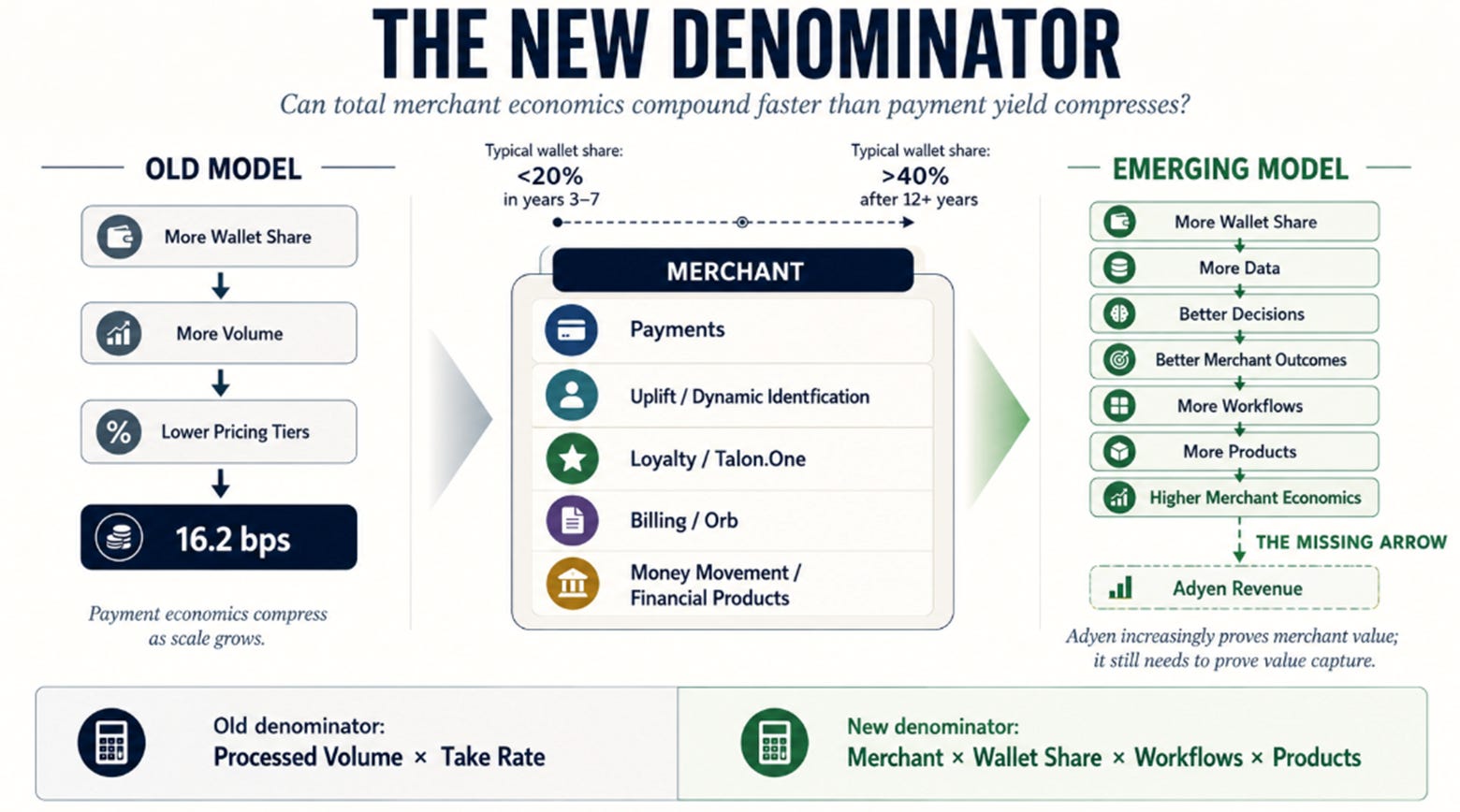
The fundamental question is therefore no longer whether Adyen has superior payment infrastructure. It is whether Adyen can increase the total economics of a merchant relationship faster than scale commoditizes the underlying payment.
That is a harder question. It is also a much more interesting one.
The Merchant, Not the Transaction
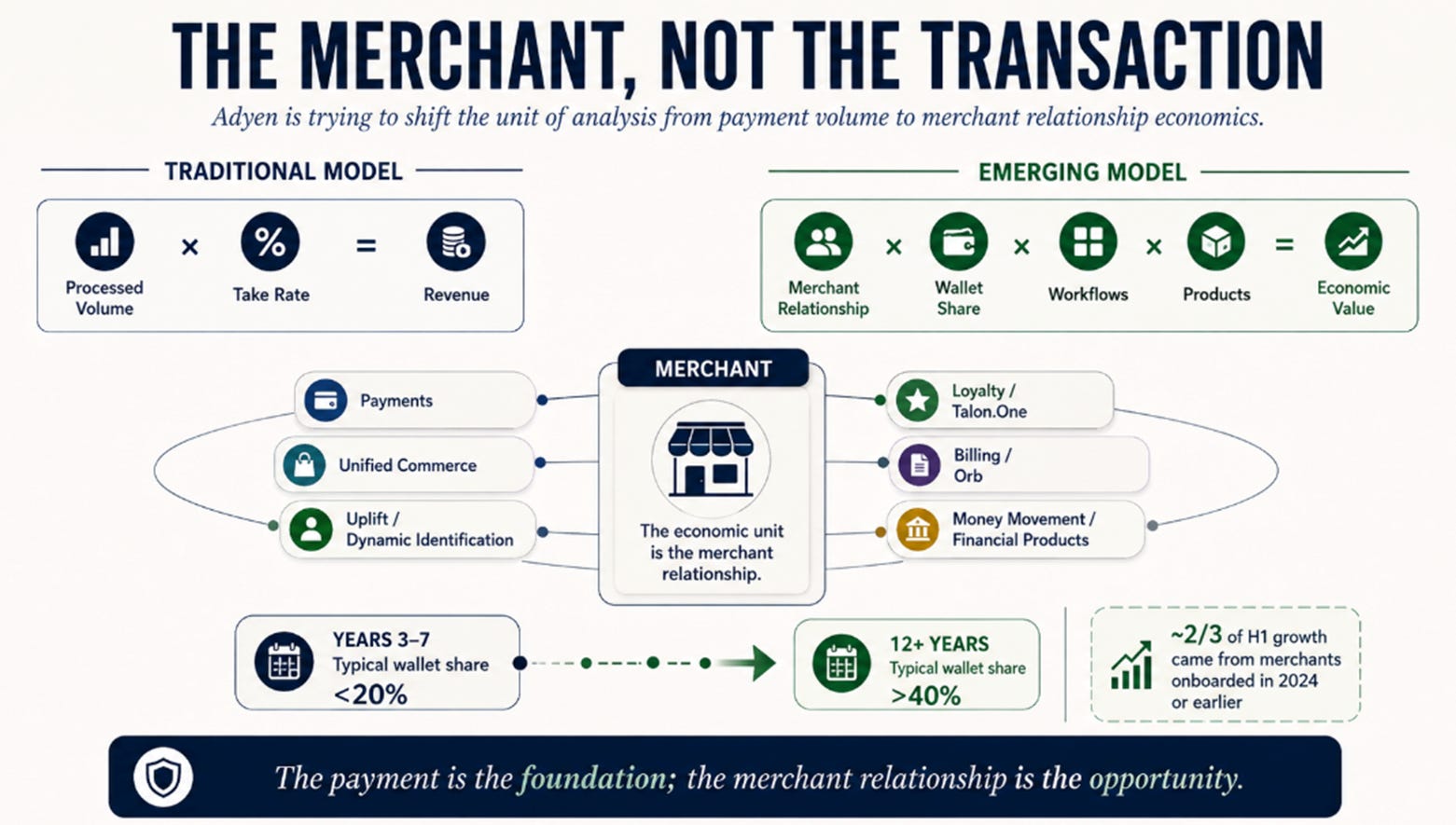
The most important disclosure in H1 was not revenue or EBITDA. It was Adyen’s newly disclosed customer maturity curve.
Roughly two-thirds of H1 growth came from merchants onboarded in 2024 or earlier. Typical wallet share rises from below 20% in years three through seven to above 40% after a decade, while the 300 merchants accounting for roughly 60% of growth represented more than 70% three years ago. That disclosure suggests a different way of measuring Adyen.
The traditional payment equation is straightforward: processed volume × take rate = revenue. The emerging Adyen equation is closer to merchant relationship × wallet share × workflows × products = economic value.
Consider how that might work. A merchant starts with online payments, adds more countries, then physical locations through Unified Commerce. Those transactions make Adyen’s understanding of the merchant and shopper richer; Dynamic Identification and Uplift use that information to improve authorization and fraud outcomes. Talon.One can add loyalty and incentive decisioning before the transaction, Orb can meter and bill usage, while accounts, issuing and Intelligent Money Movement extend Adyen’s role after the transaction.
The payment becomes the foundation rather than the entire product. There is, however, a crucial piece of information management did not provide.
Bryan Bergin asked where Adyen’s existing customer base sits on the newly disclosed maturity curve: how much volume already comes from merchants above 40% wallet share versus customers earlier in their penetration journey. Management talked about diversification and continued expansion but did not give the requested mix.
That matters. Adyen has shown investors the slope of the curve but not where the installed base sits on it. If most volume remains early in the curve, the disclosure is a powerful forward indicator. If much of the business is already mature, it is more descriptive of the past. The non-answer does not prove the latter, but neither should we treat the former as established.
The Paradox of Winning Wallet Share
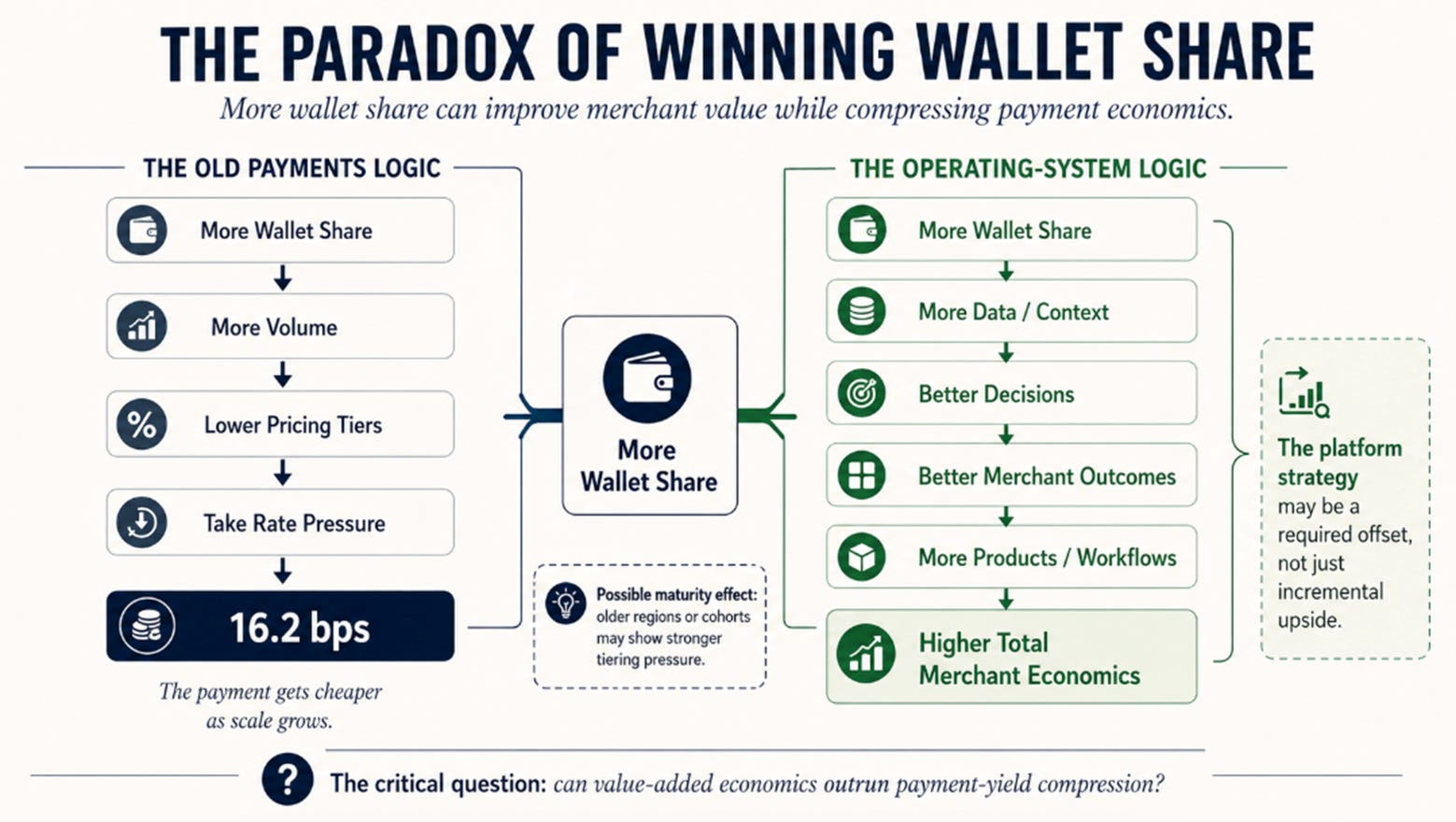
There is another complication embedded in this maturity curve.
More wallet share is good for Adyen, but it also pushes large merchants through volume tiers that reduce payment pricing. Management is categorical that it sees no evidence of competitive pricing pressure in its data; Pieter van der Does said the take-rate movement reflects existing merchants giving Adyen more volume and therefore moving into lower tiers.
This means Adyen’s original flywheel has an opposing force inside it. More wallet share creates more payments, more data and deeper integration, but it can simultaneously reduce the economics of basic processing.
This offers one possible interpretation of EMEA’s slowdown. EMEA revenue grew 15% in H1, versus materially faster growth previously, while North America grew 30% constant currency. Management argues geographic attribution is inherently noisy because global merchants sell across regions and points to the payoff from sustained US investment.
A hypothesis worth testing is that EMEA also contains a relatively more mature set of Adyen relationships, making tiering more visible there. We do not have enough disclosure to establish that. But if it proves correct, the implications are important: Talon.One, Orb, money movement and financial products are not simply exciting incremental growth opportunities layered onto payments. They become a required offset to the natural economics of merchant maturity.
In other words, the question is not how much upside the operating-system strategy adds. It may increasingly be how much operating-system monetization Adyen needs to sustain the growth rate investors already expect.
Purity Was Never the Point
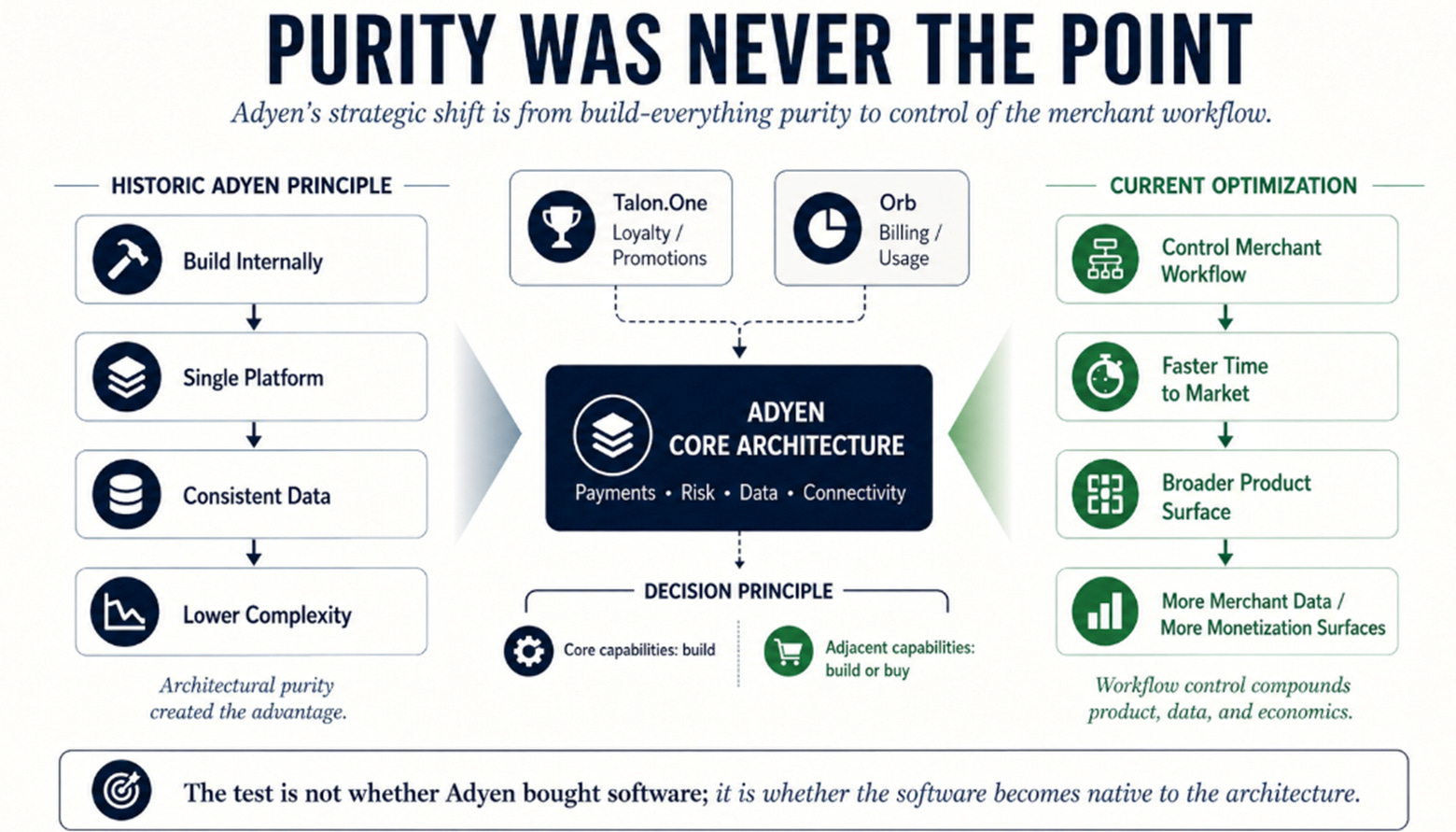
This also explains what otherwise looks like a striking reversal in strategy. The company we originally liked was defined partly by what it refused to do. While payment incumbents accumulated acquisitions and integration debt, Adyen built a single system from scratch. The single platform produced consistent data, lower complexity and faster deployment. Now Adyen has bought Talon.One and Orb.
I no longer think the right interpretation is that Adyen abandoned its architectural philosophy. Rather, management has revealed the deeper principle underneath it. Architectural purity was valuable because it gave Adyen greater control over merchant complexity; purity itself was never the objective.
Pieter made the distinction unusually explicit on the call: for the core, Adyen still prefers to build; for adjacent capabilities, management evaluates both internal development and acquisitions. It simply happened that the answer was “build” for nineteen years and “buy” twice in H1.
The optimization function has changed from build everything ourselves to control the merchant workflow without sacrificing the architecture.
That is sensible. It also creates a new test. Talon.One and Orb cannot merely become software products sold beside Adyen payments; they need to become native participants in the same data loop. Management says merchants already using both Talon.One and Adyen prove the combination works, and the intention is to deepen that integration.
If loyalty, billing, payments and money movement produce one shared intelligence layer, the acquisitions strengthen Adyen’s moat. If they remain separate applications connected through APIs, Adyen has merely broadened the catalogue while introducing the architectural complexity it once avoided.
The Missing Arrow
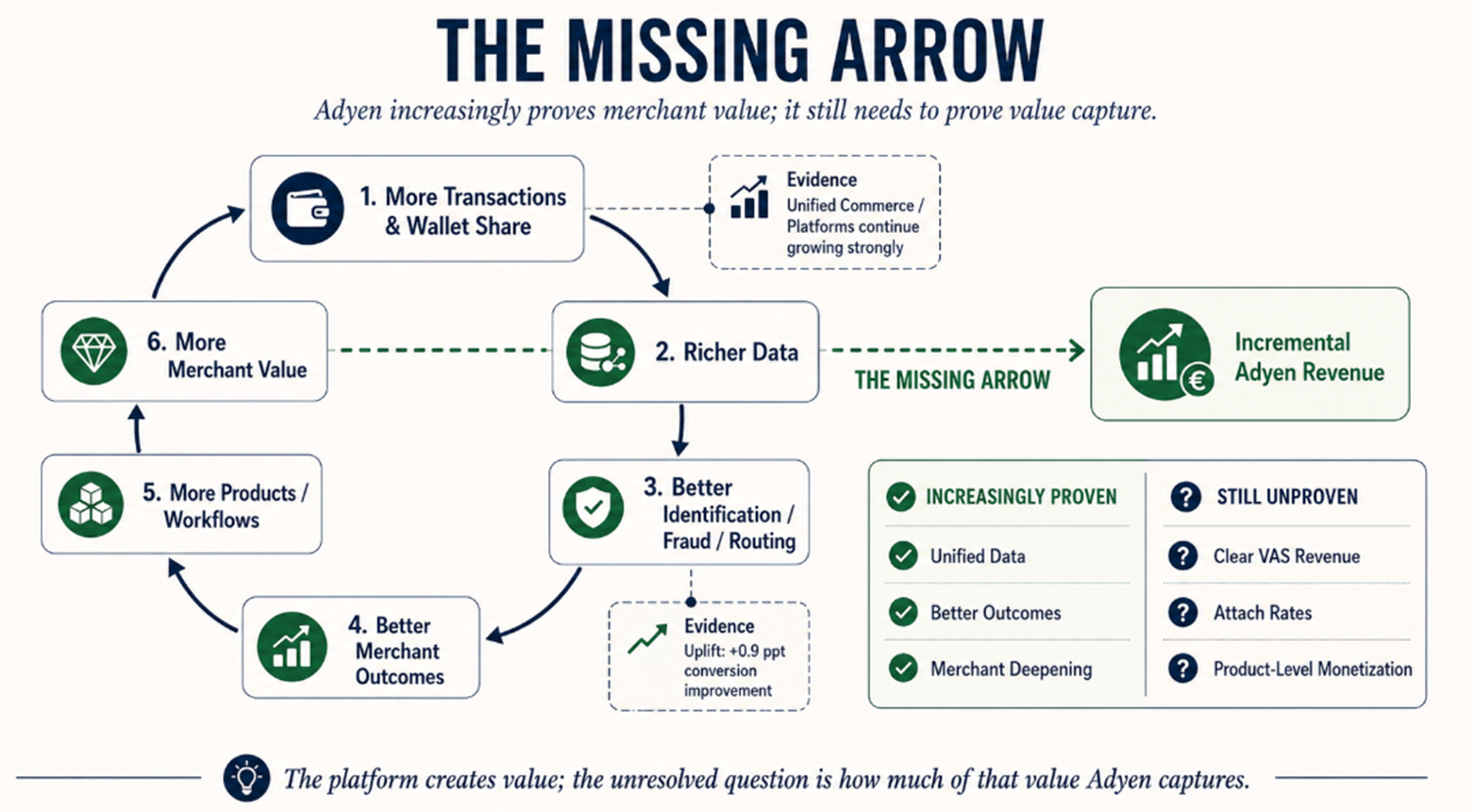
There is now considerable evidence for most of the Adyen flywheel. Unified Commerce grew 27% constant currency; Platforms grew 40%; Adyen has 486 merchants processing across channels at scale and 293,000 active Platform business customers. More importantly, Uplift increased merchant conversion by an average 0.9 percentage points by the end of H1.
That establishes several arrows: more transactions create richer data; richer data creates better decisions; better decisions create measurable merchant value; merchant relationships continue deepening over long periods.
One arrow remains conspicuously missing:
better merchant economics → materially more Adyen revenue outside processing.
In Q1 we said we wanted visible value-added-services revenue, continued >mid-20s Unified Commerce growth, >mid-30s Platforms growth, take-rate stabilization toward 16.5 basis points and a real Talon.One operating proof point. H1 passes the UC and Platforms tests, provides one useful Uplift outcome metric, and demonstrates management’s strategic commitment. It misses the take-rate test and largely defers the monetization test.
Even financial products, which management says should contribute roughly one percentage point of growth this year, remain largely unbroken out.
This is the central analytical tension: Adyen increasingly shows us that its platform creates value, but still does not show us clearly how much of that value Adyen captures.
The Narrative and the Numbers
This distinction also clarifies the valuation argument.
Bloomberg consensus already assumes a significant part of the operational bull case: approximately €3.49 billion of FY27 revenue, €4.19 billion in FY28, and an FY28 EBITDA margin around 55%. At the supplied €1,061.60 reference price, however, Adyen trades at roughly 22.5x FY27 and 18.2x FY28 adjusted earnings.
So consensus may already expect strong execution, but the stock does not obviously carry a full “commerce operating system” multiple. This creates two different bull cases. The first is that estimates are too low. The more interesting one is that estimates may be broadly right, but Adyen proves that their composition and durability deserve a different valuation category.
That gives us three futures:
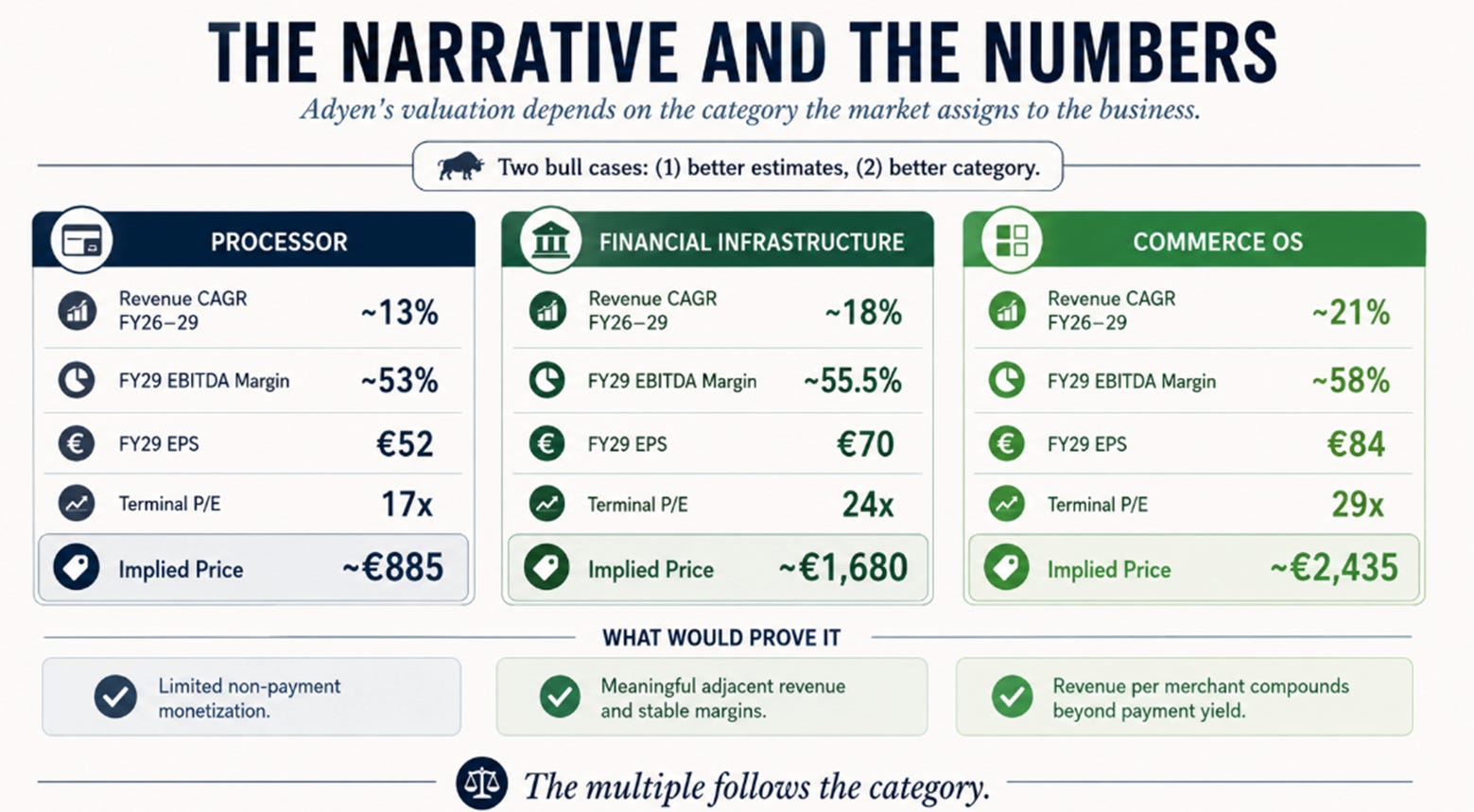
The bear case does not require Adyen to become a bad business; it merely remains an excellent processor whose adjacent products never materially alter merchant economics. The base case assumes those products become meaningful enough to preserve high-teens growth and mid-50s margins. The bull case requires something qualitatively different: revenue per merchant begins compounding independently of payment yield, making processed volume an increasingly poor denominator for the company.
The evidence required from here is therefore quite specific. We need actual monetization or attach-rate disclosure from Talon.One, Orb, IMM or financial products; more information about where customers sit on the maturity curve; evidence that the acquired products become part of Adyen’s unified data architecture; and CapEx returning toward historical levels while the >55% 2028 margin objective survives the expansion.
In May, we asked whether Adyen could sell more than payments. H1 tells us that management has decided it must.
Adyen has shown us the wallet-share slope. It has shown that unified data can produce better merchant outcomes. It has bought capabilities before and after the payment that could expand the economics of the relationship.
What it has not shown is the number connecting those things: how much incremental revenue the expanded platform earns.
That is the missing arrow. If it appears, 16.2 basis points will increasingly look like the wrong denominator. If it does not, it may turn out to have been the most important number all along.
Disclaimer:
The content does not constitute any kind of investment or financial advice. Kindly reach out to your advisor for any investment-related advice. Please refer to the tab “Legal | Disclaimer” to read the complete disclaimer.