


TL; DR
Alibaba’s cloud economics have improved far faster than we expected: cloud margin rose from 9.1% in March to 14.5% in September, external recurring revenue grew 67%, and the gap between cloud profit and AI Labs losses narrowed sharply. The operating case for Alibaba Cloud is materially stronger than it was six months ago.
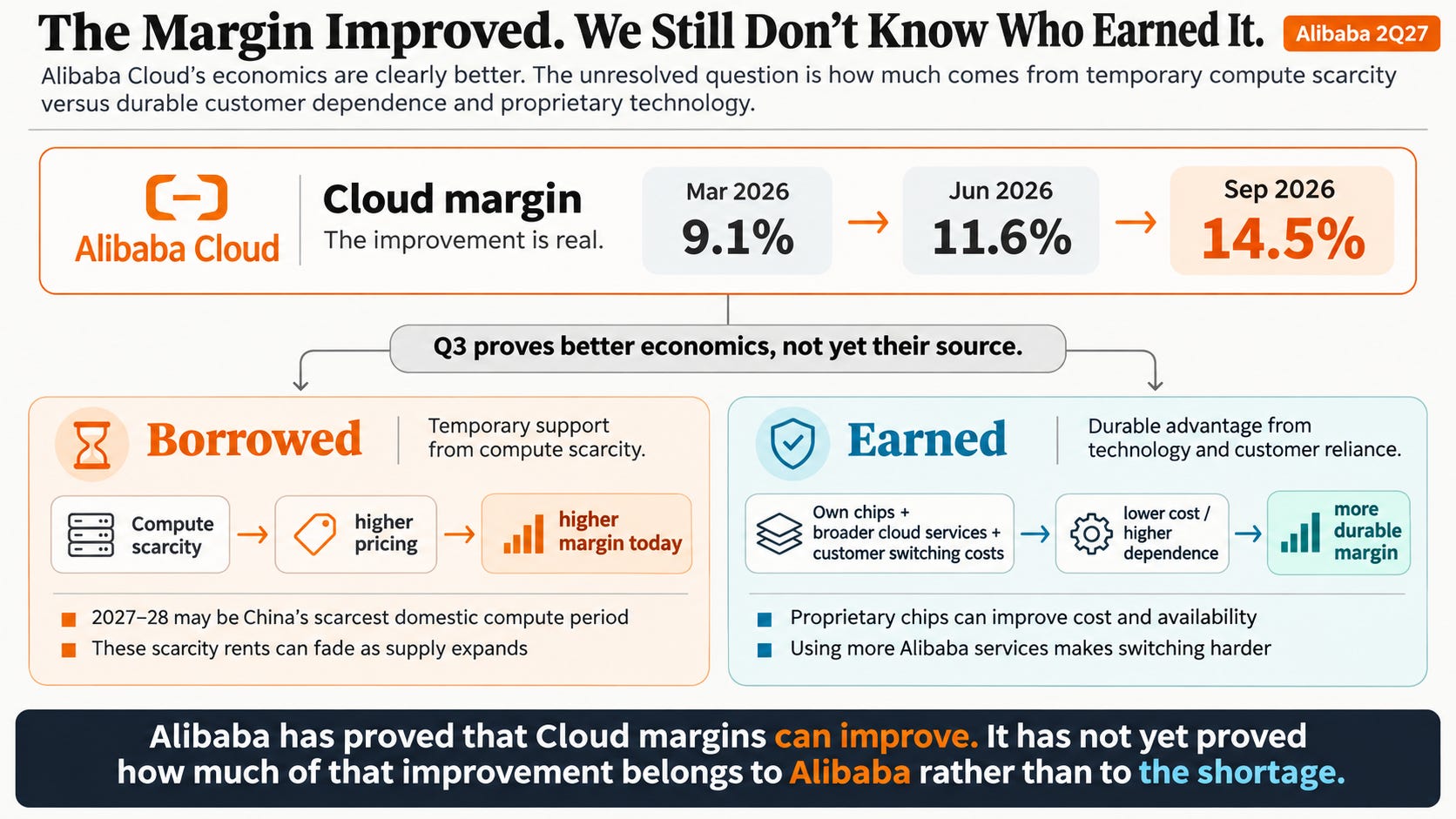
But we still do not know how much of that margin is earned versus borrowed: scarcity allows Alibaba to charge more for scarce compute today, while proprietary chips, broader product usage and higher switching costs could create a durable advantage later. The quarter proves better economics, not yet their source.
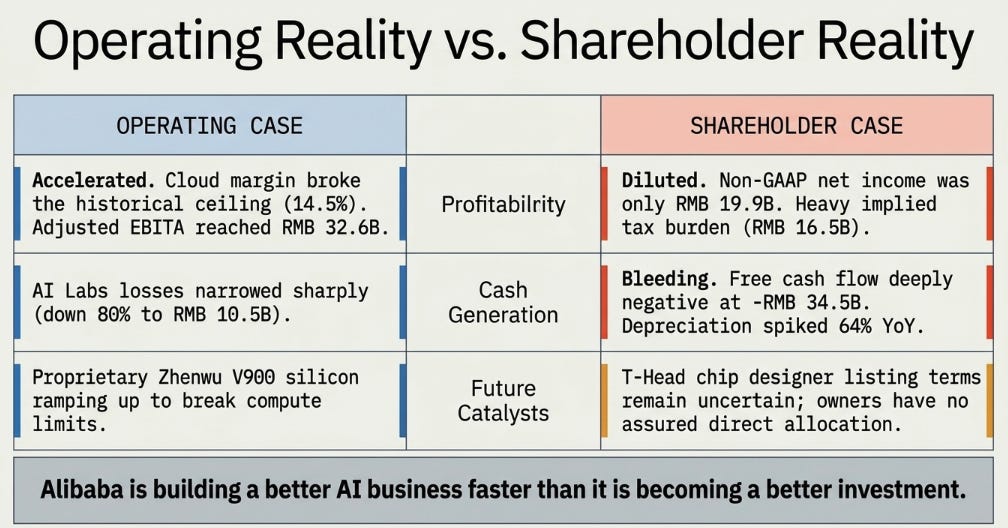
The shareholder case remains weaker than the operating case: free cash flow is still deeply negative, depreciation is rising, commerce is not reaccelerating enough to fund unlimited AI investment, and T-Head’s eventual economics will depend on listing terms and retained ownership. Alibaba may be building a better AI business before it becomes a better investment.
From Bloomberg’s coverage of Alibaba’s September-quarter results:
Alibaba Group Holding Ltd posted a stronger-than-projected 10% rise in revenue, reflecting the company’s pivotal role in providing computing and services to propel China’s artificial intelligence (AI) development boom. Revenue grew to 271.52 billion yuan (US$40.7 billion) in the September quarter, exceeding the average analyst estimate of 270.5 billion yuan. Net income more than tripled, in part because of gains from investments. Alibaba faces growing pressure to show it can deliver on AI despite new limits on its access to data centre chips.
In November 2023, American chip restrictions forced Alibaba to cancel the spin-off of its cloud division, then growing just 2%. Three years later, Washington imposed new restrictions on Chinese companies accessing advanced computing capacity overseas. This time, Alibaba’s cloud business was growing 53%, earning a 14.5% adjusted operating margin, and preparing to list its proprietary chip designer. The same geopolitical pressure that once threatened Alibaba’s cloud ambitions now arrives as those ambitions begin producing meaningful operating profits.
Yet the stock tells another story. Alibaba’s Hong Kong shares closed around HK$81 on Thursday, down approximately 28% since our September 22 article, The Escrow Reversal, and almost half from the HK$159.40 price at which this series began. The company has delivered its strongest cloud economics in years while shareholders have suffered a remarkable destruction of market value.
I think the explanation lies in a question that our earlier articles did not adequately distinguish: has Alibaba earned its new cloud margin through proprietary technology and customer dependence, or borrowed it from China’s shortage of computing capacity? The answer matters because scarcity rents eventually disappear, while genuine competitive advantages can compound. Even if Alibaba has earned the margin, a second question remains: how much survives the cost of maintaining that advantage?
The Engine Caught Up to the Furnace
In May’s The Bills Changed Shape, we were sceptical that Alibaba could escape fifteen years of disappointing cloud economics. We wrote:
Until Cloud margins expand, All Other losses narrow, and free cash flow turns, Alibaba is not China’s AWS. It is a very important company still trying to prove that importance belongs to shareholders. Fifteen years of margin data say the proof will not come. One quarter’s AI ARR disclosure says maybe it will.
Two of those conditions have now moved decisively. Cloud margins expanded from 9.1% in March to 11.6% in June and 14.5% in September. AI Labs and Applications losses narrowed from RMB13.9 billion to RMB10.5 billion sequentially. The historical margin ceiling broke in two quarters, and not for the reason we expected.
Alibaba’s improving AI economics
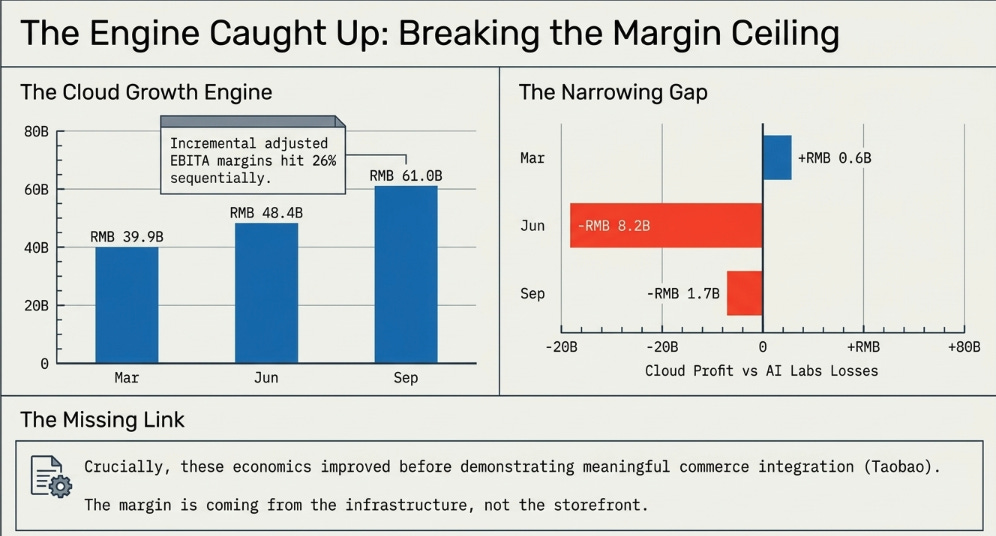
The gap between cloud profit and AI Labs losses narrowed approximately 80% in ninety days. Cloud revenue grew 53%, external revenue 64%, and external recurring revenue 67%. Incremental adjusted EBITA margins were approximately 23% year-on-year and 26% sequentially. These are substantial improvements in the economics of selling computing services.
September’s The Escrow Reversal had already revised our pessimism:
My disagreement with the sceptical reading is not that cash burn is harmless. It is that the 21% incremental cloud margin creates a plausible route to better returns even if growth eventually moderates. A 30-35% growth business with improving cash conversion could be more valuable than a 45% growth business requiring repeated capital injections.
The latest quarter strengthens that argument. It also disproves one of our earlier assumptions. We had considered integration between Qwen and Taobao—the Second Trust thesis—necessary for Alibaba to earn better-than-utility cloud returns. Yet comparable customer-management revenue grew only 1%, with no disclosed evidence of repeat AI shopping, while cloud profitability accelerated. Alibaba improved cloud economics before demonstrating meaningful commerce integration.
Our September checkpoints therefore produce a mixed verdict. Cloud growth and margins have exceeded expectations; AI Labs losses are approaching our sub-RMB10 billion March target. Commerce monetisation remains weak, the RMB30 billion model-services target now refers to the fiscal year ending March rather than calendar year-end, and management’s preliminary cash-flow recovery timetable extends into the second half of calendar 2028. Operating verification is arriving faster than financial verification.
Earned or Borrowed?
The distinction became clearer when Morgan Stanley asked Eddie Wu about the November export restrictions. Wu responded:
Turning to next year’s outlook, the new compute export control rules will affect next year’s products and services, and there is still uncertainty as regards the supply chain. However, our own progress in developing domestic computing power is in fact already ahead of our original expectations. So taking all these different factors into account, our operating plan and targets for next year may be affected to some extent, but we are still in the process of evaluation right now. But taking all these factors into account, we might expect our growth target for cloud revenue to be in the 30%-45% range. As the scale of our domestic compute products expands in calendar year 2028, we expect cloud revenue growth to rebound to 50% or higher in calendar year 2028.
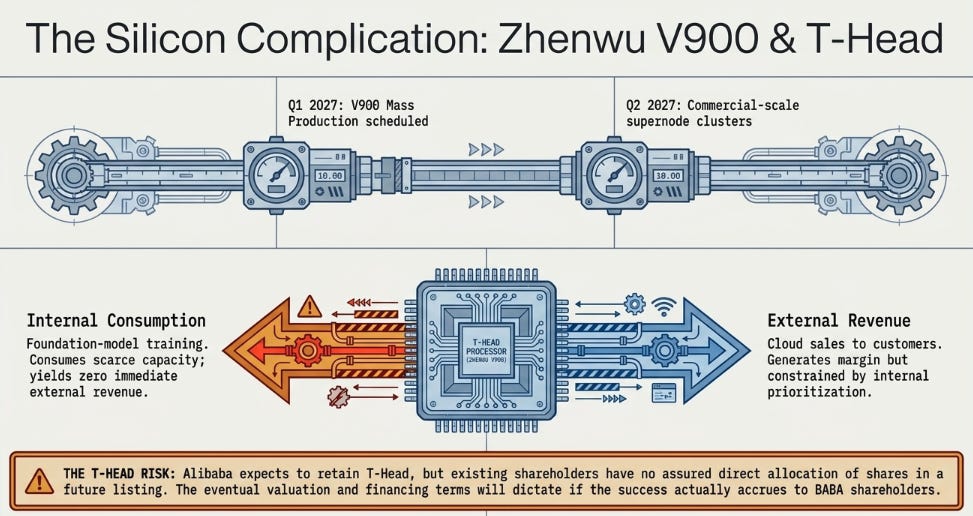
This is a revealing forecast. Alibaba expects domestic computing capacity to constrain growth before its proprietary silicon ramp restores momentum. The Zhenwu V900 is scheduled for mass production in the first quarter of 2027, with commercial-scale supernode clusters following in the second. The difficulty is that chip design, manufacturing yields, systems integration and dependable customer deployment are different accomplishments. Management has demonstrated progress in the first stages without quantifying the manufacturing capacity required for the last.
Asked about margins, Wu supplied two competing explanations:
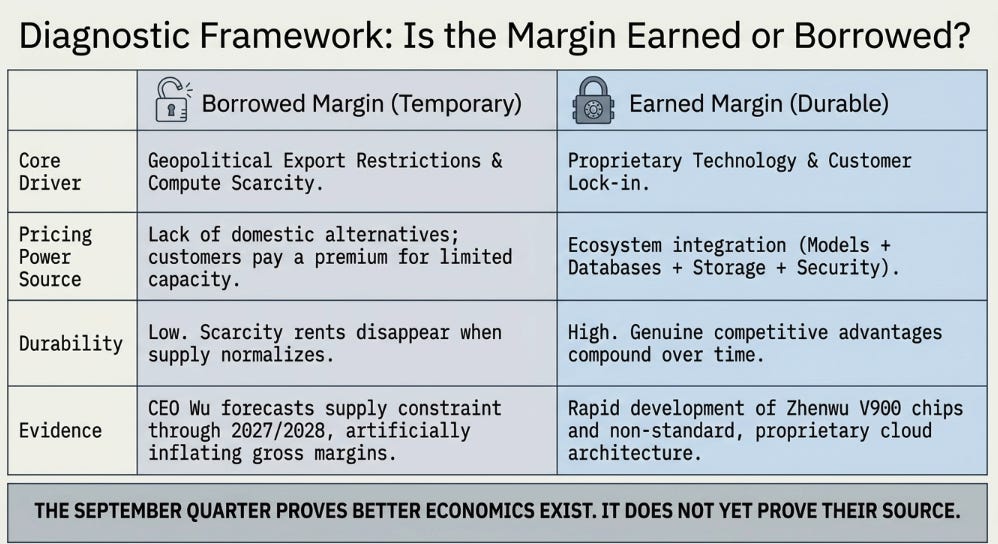
I think that period 2027, 2028 will be the period in which compute supply is at its scarcest in China’s domestic market. I think that is actually very favorable when it comes to overall compute pricing and gross margin for our compute offerings. At the same time, because we are using our own proprietary domestic chips and ramping up very significantly production capacity, there will be cost advantages there and across the supply chain in general.
The first mechanism is borrowed: customers pay more because capacity is scarce. The second could be earned: proprietary silicon reduces costs, improves availability and permits differentiated services. The quarter establishes that margins improved, but not how much improvement belongs to either mechanism.
I think the most compelling explanation of what might endure came in Wu’s response to Citigroup:
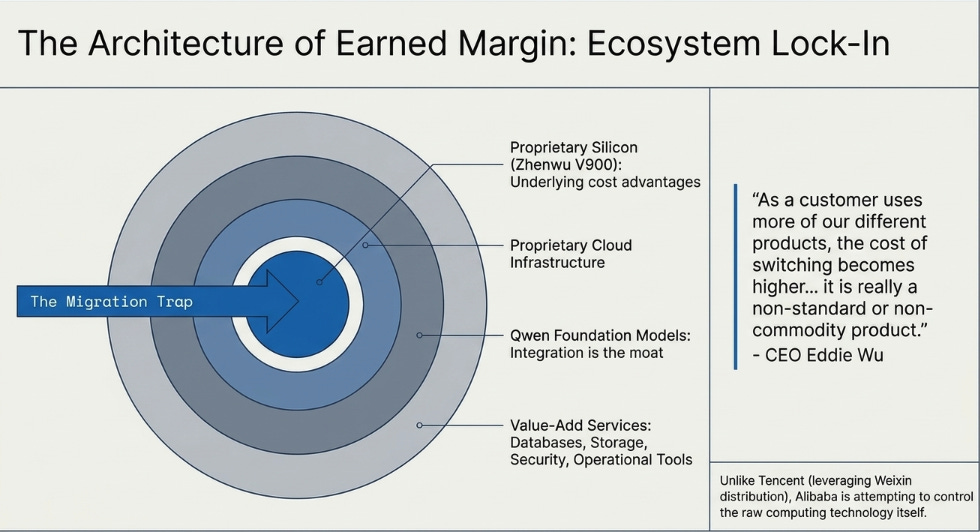
I think an additional factor is that as we continue to build out our data center footprint, we achieve greater economies of scale, not just in terms of our own resources, but also in terms of the number of different products for which customers rely on us. As a customer uses more of our different products, the cost of switching becomes higher for that customer. Again, these factors together are structurally positive for our Cloud and AI margin. I think looking ahead to the even longer term, as we continue to develop AI-related technology and upgrade our AI plus cloud business, building on our own proprietary chips, again, is structurally advantageous for our gross margin. In particular, with our AI offerings running on our proprietary cloud, on our own proprietary chips, it is really a non-standard or non-commodity product.
That is the stronger strategic argument. A customer renting computing capacity can compare prices. A customer whose applications depend on Alibaba’s models, databases, storage, security and operational tools faces a much larger migration project. Scarcity may initially bring customers to Alibaba; integrating their workloads could give them reasons to remain after scarcity ends.
This also explains why proprietary chips alone are insufficient. Qwen’s open weights run on competing clouds, including AWS. Alibaba must capture value through the surrounding services, cost advantages and customer relationships rather than assuming model adoption guarantees cloud adoption.
Tencent offers an instructive contrast. It has invested heavily in securing computing capacity while exploiting Weixin’s distribution advantages. Alibaba is attempting to control more of the computing technology itself. Tencent’s WorkBuddy demonstrates the attraction of existing distribution; Alibaba’s planned Qwen integration with Apple Intelligence in China offers another route to users. Neither strategy is inherently superior. The relevant question is which converts scarce computing expenditure into enduring customer economics.
There is also a complication inside Alibaba’s strategy. Wu acknowledged that proprietary chips will serve Alibaba’s own foundation-model training before external customers. Internal demand can improve chip designs and models, but it also consumes capacity that could otherwise earn external revenue. Alibaba cannot count every accelerator as both a profitable customer sale and an unlimited internal research resource. The economics depend on whether internal consumption eventually generates sufficient additional customer value.
Why the Receipt Has Not Cleared
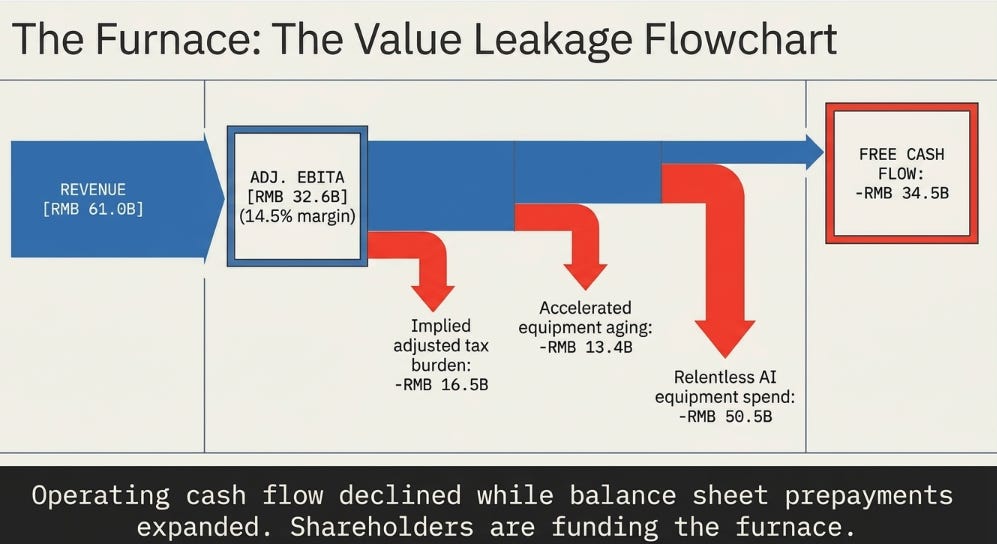
The cloud improvement has not translated proportionately into shareholder earnings. Adjusted EBITA reached approximately RMB32.6 billion, but non-GAAP net income was only RMB19.9 billion. Adjusted earnings per ADS missed the supplied pre-results consensus by roughly 25%, despite substantial operating progress.
One important explanation is the implied adjusted tax burden, approximately RMB16.5 billion against RMB35.5 billion of adjusted pre-tax income. China’s legal-entity taxation may help explain why profitable businesses and loss-making operations do not offset neatly, although segment reporting alone cannot establish the cause. What matters is that cloud profitability must eventually translate into earnings attributable to shareholders.
Cash is the larger problem. Free-cash outflow narrowed from RMB44.7 billion to RMB34.5 billion sequentially, but operating cash flow declined while capital expenditure fell. Management attributed part of the capex reduction to procurement timing. First-half capital expenditure of approximately RMB118 billion already equalled 94% of the previous full year’s spending. Depreciation increased 64% year-on-year to RMB13.4 billion, while prepayments, receivables and other assets expanded substantially. The disclosures do not establish how much of that balance-sheet increase represents computing-equipment commitments.
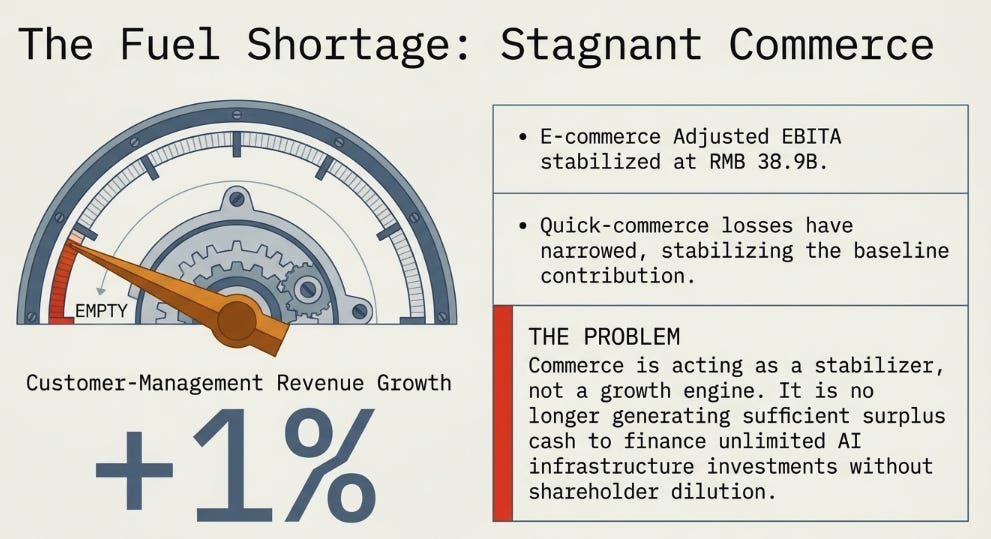
Commerce remains an important source of funding. E-commerce adjusted EBITA reached RMB38.9 billion as quick-commerce losses narrowed, but comparable customer-management revenue grew only 1%. The business is stabilising its contribution rather than demonstrating a new source of growth sufficient to finance unlimited AI investment.
The proposed T-Head listing adds another consideration. Alibaba expects to retain the chip designer as a subsidiary, but existing shareholders have no assured direct allocation of shares in the offering. That does not eliminate their indirect economic interest. It does mean the eventual valuation, retained ownership and financing terms will determine how much of T-Head’s success accrues to Alibaba shareholders.
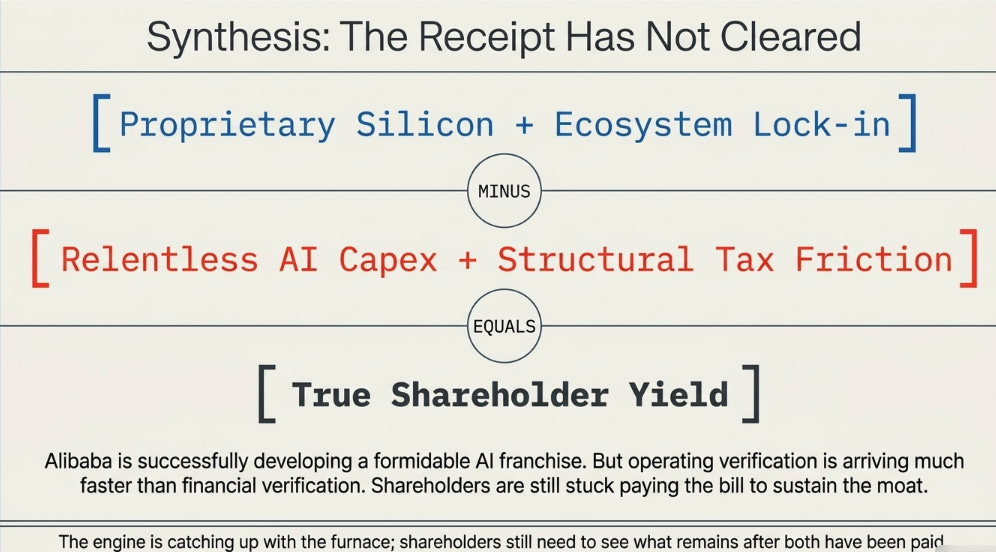
The distinction between a better business and a better investment is therefore becoming sharper. Alibaba may be developing a formidable AI franchise while shareholders continue funding the equipment, models and applications required to sustain it.
Three Futures, Re-Based
September’s Furnace, Grid and Kingdom scenarios valued fiscal 2030 earnings at September 2029, producing HK$74, HK$192 and HK$315 respectively. Those were future values, not present-day downside floors. I retain the RMB1.124 trillion FY27 revenue starting point and RMB0.87 per Hong Kong dollar, while revising margins, share counts and multiples for the earnings-conversion and financing risks now visible.
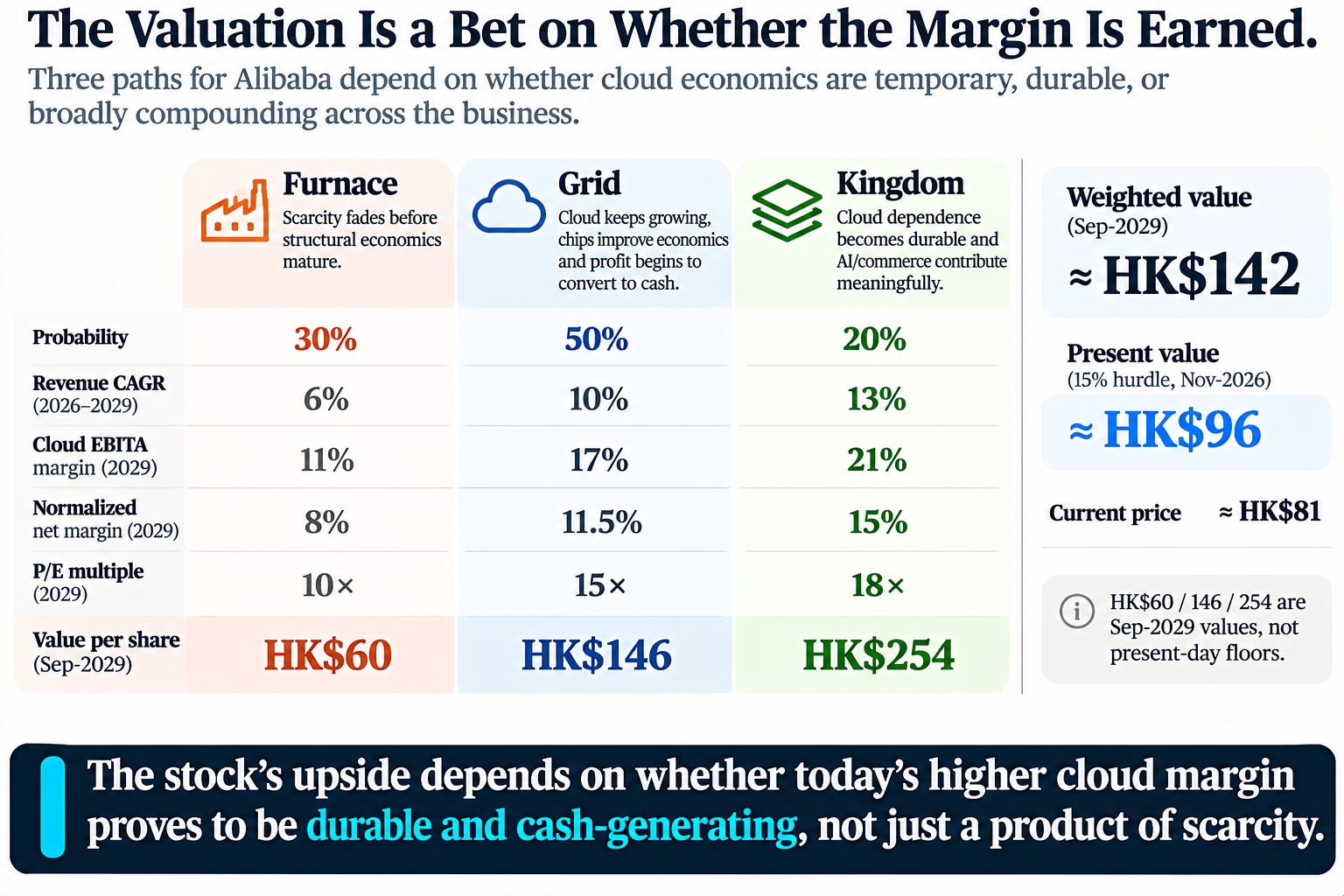
Furnace assumes constrained chip supply, persistent AI investment costs and weak cash conversion. Grid requires sustained cloud growth, improving proprietary-chip economics and credible conversion of operating profit into cash. Kingdom requires those advantages to become durable while commerce and AI applications contribute meaningful additional earnings.
The probability-weighted September 2029 value is approximately HK$142, or HK$96 discounted to November 2026 at a 15% annual hurdle. Against roughly HK$81, that offers a meaningful prospective return, but the HK$60 Furnace outcome remains a serious risk. These probabilities are judgments, not statistical forecasts.
The next two to four quarters must establish whether external recurring cloud growth remains above 50%, margins hold around 13.5–15% despite rising depreciation, V900 clusters ship commercially on schedule, and AI Labs losses continue narrowing. Above all, operating cash must begin catching up with accounting profit without another large shareholder-funded expansion.
In September, Alibaba delivered part of the verification while asking shareholders to enlarge their deposit. November delivered substantially more operating evidence, even as the market reduced the price of waiting. I am more constructive than in September, not because HK$81 is automatically cheap, but because the evidence supporting durable cloud economics has strengthened.
The market appears to be treating much of Alibaba’s improved profitability as borrowed from scarcity. I think some of it is earned, particularly where customers become dependent on services that work together. The unresolved question is how much Alibaba must spend to preserve that advantage. The engine is catching up with the furnace; shareholders still need to see what remains after both have been paid.
Independent analysis based on the supplied earnings materials and prior articles. Management quotations are retained as substantive transcript excerpts. Valuation figures are scenario estimates, not price guarantees.TL; DR
Alibaba’s cloud economics have improved far faster than we expected: cloud margin rose from 9.1% in March to 14.5% in September, external recurring revenue grew 67%, and the gap between cloud profit and AI Labs losses narrowed sharply. The operating case for Alibaba Cloud is materially stronger than it was six months ago.
But we still do not know how much of that margin is earned versus borrowed: scarcity allows Alibaba to charge more for scarce compute today, while proprietary chips, broader product usage and higher switching costs could create a durable advantage later. The quarter proves better economics, not yet their source.
The shareholder case remains weaker than the operating case: free cash flow is still deeply negative, depreciation is rising, commerce is not reaccelerating enough to fund unlimited AI investment, and T-Head’s eventual economics will depend on listing terms and retained ownership. Alibaba may be building a better AI business before it becomes a better investment.
From Bloomberg’s coverage of Alibaba’s September-quarter results:
Alibaba Group Holding Ltd posted a stronger-than-projected 10% rise in revenue, reflecting the company’s pivotal role in providing computing and services to propel China’s artificial intelligence (AI) development boom. Revenue grew to 271.52 billion yuan (US$40.7 billion) in the September quarter, exceeding the average analyst estimate of 270.5 billion yuan. Net income more than tripled, in part because of gains from investments. Alibaba faces growing pressure to show it can deliver on AI despite new limits on its access to data centre chips.
In November 2023, American chip restrictions forced Alibaba to cancel the spin-off of its cloud division, then growing just 2%. Three years later, Washington imposed new restrictions on Chinese companies accessing advanced computing capacity overseas. This time, Alibaba’s cloud business was growing 53%, earning a 14.5% adjusted operating margin, and preparing to list its proprietary chip designer. The same geopolitical pressure that once threatened Alibaba’s cloud ambitions now arrives as those ambitions begin producing meaningful operating profits.
Yet the stock tells another story. Alibaba’s Hong Kong shares closed around HK$81 on Thursday, down approximately 28% since our September 22 article, The Escrow Reversal, and almost half from the HK$159.40 price at which this series began. The company has delivered its strongest cloud economics in years while shareholders have suffered a remarkable destruction of market value.
I think the explanation lies in a question that our earlier articles did not adequately distinguish: has Alibaba earned its new cloud margin through proprietary technology and customer dependence, or borrowed it from China’s shortage of computing capacity? The answer matters because scarcity rents eventually disappear, while genuine competitive advantages can compound. Even if Alibaba has earned the margin, a second question remains: how much survives the cost of maintaining that advantage?
The Engine Caught Up to the Furnace
In May’s The Bills Changed Shape, we were sceptical that Alibaba could escape fifteen years of disappointing cloud economics. We wrote:
Until Cloud margins expand, All Other losses narrow, and free cash flow turns, Alibaba is not China’s AWS. It is a very important company still trying to prove that importance belongs to shareholders. Fifteen years of margin data say the proof will not come. One quarter’s AI ARR disclosure says maybe it will.
Two of those conditions have now moved decisively. Cloud margins expanded from 9.1% in March to 11.6% in June and 14.5% in September. AI Labs and Applications losses narrowed from RMB13.9 billion to RMB10.5 billion sequentially. The historical margin ceiling broke in two quarters, and not for the reason we expected.
Alibaba’s improving AI economics
The gap between cloud profit and AI Labs losses narrowed approximately 80% in ninety days. Cloud revenue grew 53%, external revenue 64%, and external recurring revenue 67%. Incremental adjusted EBITA margins were approximately 23% year-on-year and 26% sequentially. These are substantial improvements in the economics of selling computing services.
September’s The Escrow Reversal had already revised our pessimism:
My disagreement with the sceptical reading is not that cash burn is harmless. It is that the 21% incremental cloud margin creates a plausible route to better returns even if growth eventually moderates. A 30-35% growth business with improving cash conversion could be more valuable than a 45% growth business requiring repeated capital injections.
The latest quarter strengthens that argument. It also disproves one of our earlier assumptions. We had considered integration between Qwen and Taobao—the Second Trust thesis—necessary for Alibaba to earn better-than-utility cloud returns. Yet comparable customer-management revenue grew only 1%, with no disclosed evidence of repeat AI shopping, while cloud profitability accelerated. Alibaba improved cloud economics before demonstrating meaningful commerce integration.
Our September checkpoints therefore produce a mixed verdict. Cloud growth and margins have exceeded expectations; AI Labs losses are approaching our sub-RMB10 billion March target. Commerce monetisation remains weak, the RMB30 billion model-services target now refers to the fiscal year ending March rather than calendar year-end, and management’s preliminary cash-flow recovery timetable extends into the second half of calendar 2028. Operating verification is arriving faster than financial verification.
Earned or Borrowed?
The distinction became clearer when Morgan Stanley asked Eddie Wu about the November export restrictions. Wu responded:
Turning to next year’s outlook, the new compute export control rules will affect next year’s products and services, and there is still uncertainty as regards the supply chain. However, our own progress in developing domestic computing power is in fact already ahead of our original expectations. So taking all these different factors into account, our operating plan and targets for next year may be affected to some extent, but we are still in the process of evaluation right now. But taking all these factors into account, we might expect our growth target for cloud revenue to be in the 30%-45% range. As the scale of our domestic compute products expands in calendar year 2028, we expect cloud revenue growth to rebound to 50% or higher in calendar year 2028.
This is a revealing forecast. Alibaba expects domestic computing capacity to constrain growth before its proprietary silicon ramp restores momentum. The Zhenwu V900 is scheduled for mass production in the first quarter of 2027, with commercial-scale supernode clusters following in the second. The difficulty is that chip design, manufacturing yields, systems integration and dependable customer deployment are different accomplishments. Management has demonstrated progress in the first stages without quantifying the manufacturing capacity required for the last.
Asked about margins, Wu supplied two competing explanations:
I think that period 2027, 2028 will be the period in which compute supply is at its scarcest in China’s domestic market. I think that is actually very favorable when it comes to overall compute pricing and gross margin for our compute offerings. At the same time, because we are using our own proprietary domestic chips and ramping up very significantly production capacity, there will be cost advantages there and across the supply chain in general.
The first mechanism is borrowed: customers pay more because capacity is scarce. The second could be earned: proprietary silicon reduces costs, improves availability and permits differentiated services. The quarter establishes that margins improved, but not how much improvement belongs to either mechanism.
I think the most compelling explanation of what might endure came in Wu’s response to Citigroup:
I think an additional factor is that as we continue to build out our data center footprint, we achieve greater economies of scale, not just in terms of our own resources, but also in terms of the number of different products for which customers rely on us. As a customer uses more of our different products, the cost of switching becomes higher for that customer. Again, these factors together are structurally positive for our Cloud and AI margin. I think looking ahead to the even longer term, as we continue to develop AI-related technology and upgrade our AI plus cloud business, building on our own proprietary chips, again, is structurally advantageous for our gross margin. In particular, with our AI offerings running on our proprietary cloud, on our own proprietary chips, it is really a non-standard or non-commodity product.
That is the stronger strategic argument. A customer renting computing capacity can compare prices. A customer whose applications depend on Alibaba’s models, databases, storage, security and operational tools faces a much larger migration project. Scarcity may initially bring customers to Alibaba; integrating their workloads could give them reasons to remain after scarcity ends.
This also explains why proprietary chips alone are insufficient. Qwen’s open weights run on competing clouds, including AWS. Alibaba must capture value through the surrounding services, cost advantages and customer relationships rather than assuming model adoption guarantees cloud adoption.
Tencent offers an instructive contrast. It has invested heavily in securing computing capacity while exploiting Weixin’s distribution advantages. Alibaba is attempting to control more of the computing technology itself. Tencent’s WorkBuddy demonstrates the attraction of existing distribution; Alibaba’s planned Qwen integration with Apple Intelligence in China offers another route to users. Neither strategy is inherently superior. The relevant question is which converts scarce computing expenditure into enduring customer economics.
There is also a complication inside Alibaba’s strategy. Wu acknowledged that proprietary chips will serve Alibaba’s own foundation-model training before external customers. Internal demand can improve chip designs and models, but it also consumes capacity that could otherwise earn external revenue. Alibaba cannot count every accelerator as both a profitable customer sale and an unlimited internal research resource. The economics depend on whether internal consumption eventually generates sufficient additional customer value.
Why the Receipt Has Not Cleared
The cloud improvement has not translated proportionately into shareholder earnings. Adjusted EBITA reached approximately RMB32.6 billion, but non-GAAP net income was only RMB19.9 billion. Adjusted earnings per ADS missed the supplied pre-results consensus by roughly 25%, despite substantial operating progress.
One important explanation is the implied adjusted tax burden, approximately RMB16.5 billion against RMB35.5 billion of adjusted pre-tax income. China’s legal-entity taxation may help explain why profitable businesses and loss-making operations do not offset neatly, although segment reporting alone cannot establish the cause. What matters is that cloud profitability must eventually translate into earnings attributable to shareholders.
Cash is the larger problem. Free-cash outflow narrowed from RMB44.7 billion to RMB34.5 billion sequentially, but operating cash flow declined while capital expenditure fell. Management attributed part of the capex reduction to procurement timing. First-half capital expenditure of approximately RMB118 billion already equalled 94% of the previous full year’s spending. Depreciation increased 64% year-on-year to RMB13.4 billion, while prepayments, receivables and other assets expanded substantially. The disclosures do not establish how much of that balance-sheet increase represents computing-equipment commitments.
Commerce remains an important source of funding. E-commerce adjusted EBITA reached RMB38.9 billion as quick-commerce losses narrowed, but comparable customer-management revenue grew only 1%. The business is stabilising its contribution rather than demonstrating a new source of growth sufficient to finance unlimited AI investment.
The proposed T-Head listing adds another consideration. Alibaba expects to retain the chip designer as a subsidiary, but existing shareholders have no assured direct allocation of shares in the offering. That does not eliminate their indirect economic interest. It does mean the eventual valuation, retained ownership and financing terms will determine how much of T-Head’s success accrues to Alibaba shareholders.
The distinction between a better business and a better investment is therefore becoming sharper. Alibaba may be developing a formidable AI franchise while shareholders continue funding the equipment, models and applications required to sustain it.
Three Futures, Re-Based
September’s Furnace, Grid and Kingdom scenarios valued fiscal 2030 earnings at September 2029, producing HK$74, HK$192 and HK$315 respectively. Those were future values, not present-day downside floors. I retain the RMB1.124 trillion FY27 revenue starting point and RMB0.87 per Hong Kong dollar, while revising margins, share counts and multiples for the earnings-conversion and financing risks now visible.
Furnace assumes constrained chip supply, persistent AI investment costs and weak cash conversion. Grid requires sustained cloud growth, improving proprietary-chip economics and credible conversion of operating profit into cash. Kingdom requires those advantages to become durable while commerce and AI applications contribute meaningful additional earnings.
The probability-weighted September 2029 value is approximately HK$142, or HK$96 discounted to November 2026 at a 15% annual hurdle. Against roughly HK$81, that offers a meaningful prospective return, but the HK$60 Furnace outcome remains a serious risk. These probabilities are judgments, not statistical forecasts.
The next two to four quarters must establish whether external recurring cloud growth remains above 50%, margins hold around 13.5–15% despite rising depreciation, V900 clusters ship commercially on schedule, and AI Labs losses continue narrowing. Above all, operating cash must begin catching up with accounting profit without another large shareholder-funded expansion.
In September, Alibaba delivered part of the verification while asking shareholders to enlarge their deposit. November delivered substantially more operating evidence, even as the market reduced the price of waiting. I am more constructive than in September, not because HK$81 is automatically cheap, but because the evidence supporting durable cloud economics has strengthened.
The market appears to be treating much of Alibaba’s improved profitability as borrowed from scarcity. I think some of it is earned, particularly where customers become dependent on services that work together. The unresolved question is how much Alibaba must spend to preserve that advantage. The engine is catching up with the furnace; shareholders still need to see what remains after both have been paid.
Independent analysis based on the supplied earnings materials and prior articles. Management quotations are retained as substantive transcript excerpts. Valuation figures are scenario estimates, not price guarantees.
Disclaimer:
The content does not constitute any kind of investment or financial advice. Kindly reach out to your advisor for any investment-related advice. Please refer to the tab “Legal | Disclaimer” to read the complete disclaimer.