


TL; DR
Alibaba finally cleared an important cloud-economics test: AI Cloud and Compute revenue grew 45%, adjusted EBITA grew 133%, and margin reached 11.6%, above the 11% threshold set earlier.
But the cash burden worsened materially: capex reached RMB67.7 billion, free cash flow was negative RMB44.7 billion, and Alibaba subsequently raised HK$80 billion of new equity for AI investment.
The thesis is now narrower: Alibaba must prove not just that cloud demand is real, but that profits eventually grow faster than the capital required to sustain them. Owning Qwen, applications and infrastructure only matters if enough of the economics ultimately accrue to shareholders.
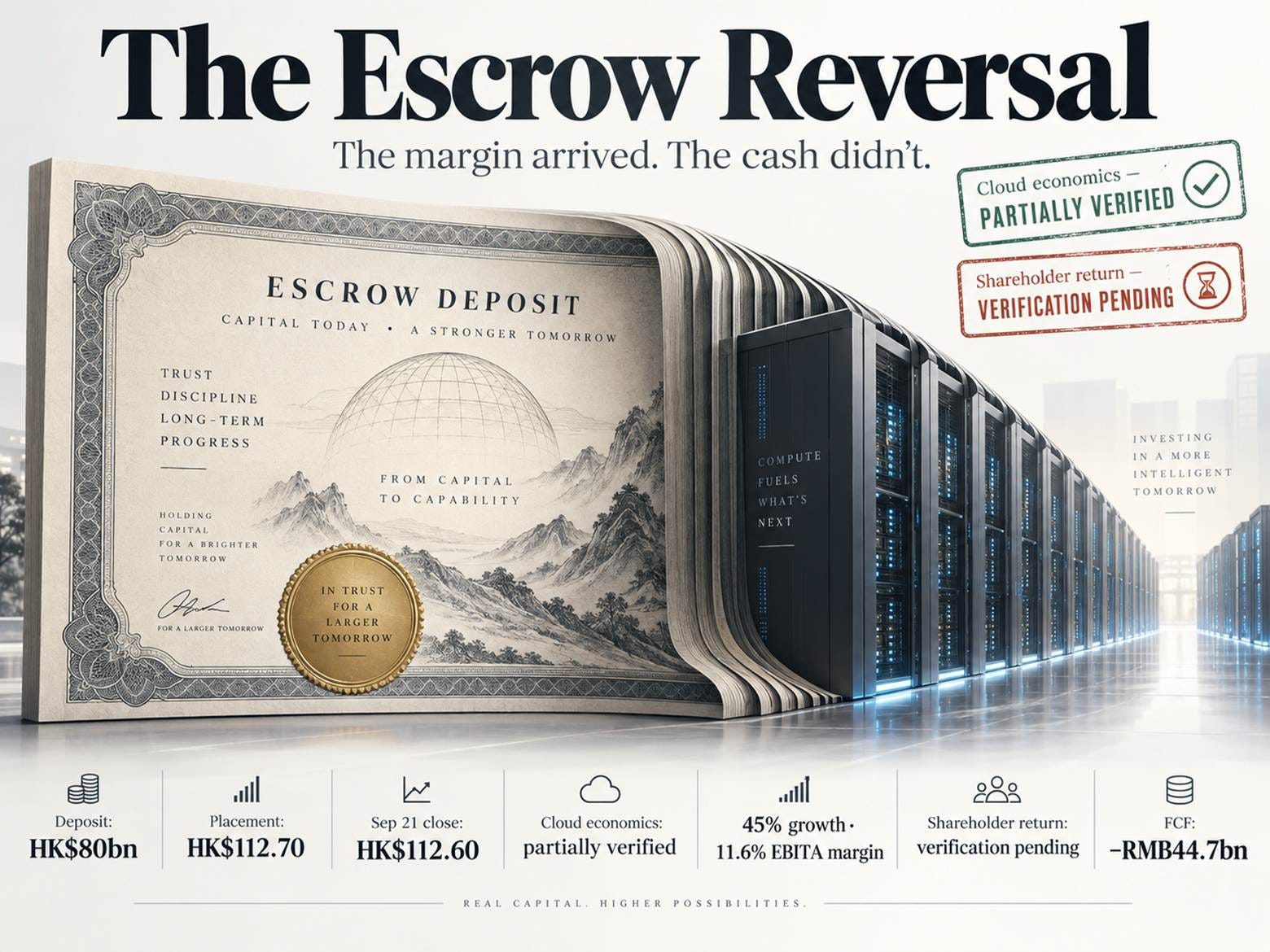
On August 23, Alibaba announced the pricing of HK$80bn of new equity: 710 million shares at HK$112.70, with the proceeds earmarked for AI. By September 21, the Hong Kong shares had closed at HK$112.60, almost exactly the placement price. That coincidence is not a valuation model, but it captures the question confronting shareholders: how much should they pay today for capacity whose eventual returns remain uncertain?
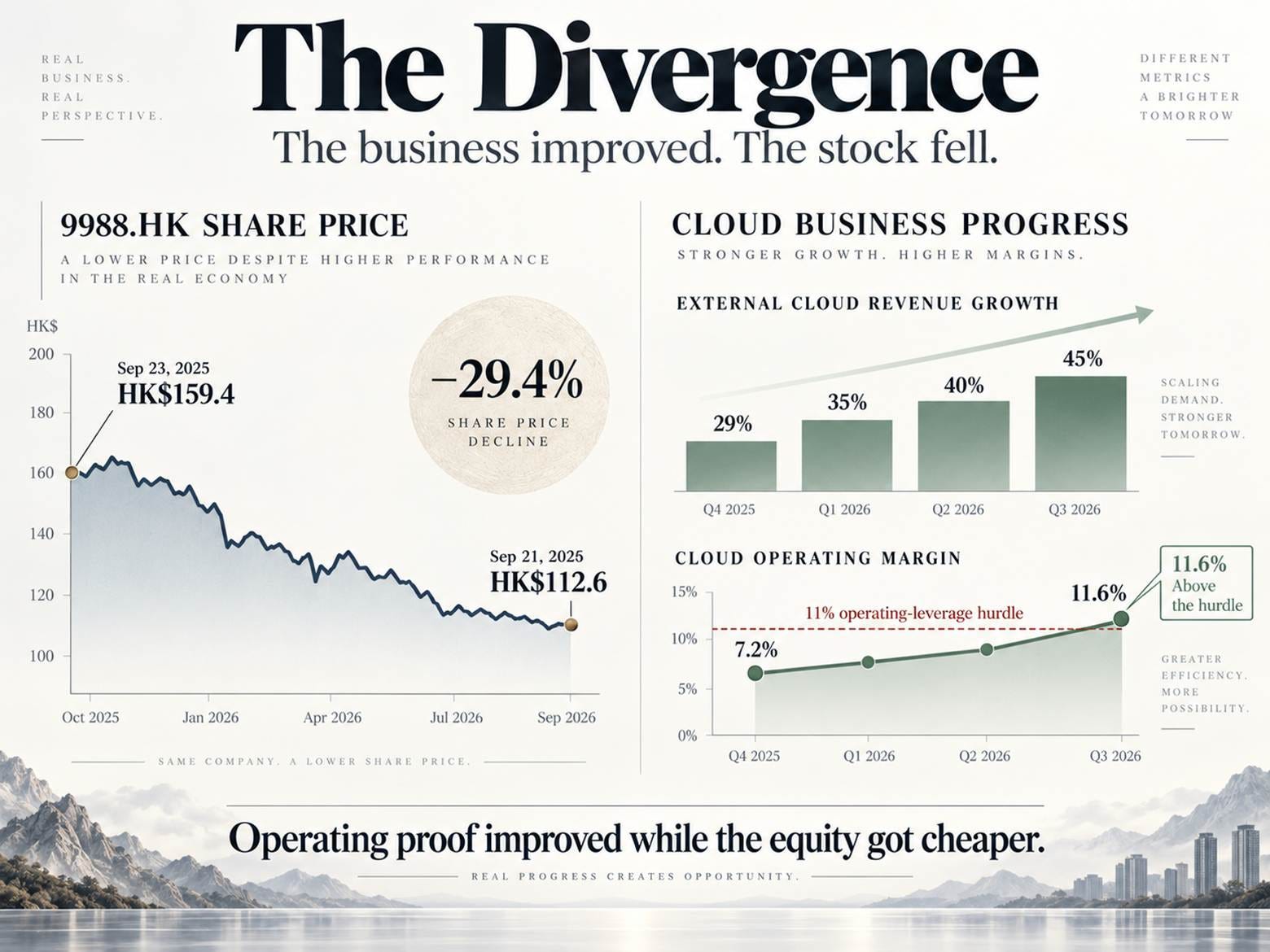
Our first article in this series appeared on September 23, 2025, when 9988.HK closed at HK$159.40. Bloomberg’s price history shows a decline of 29.4%, excluding dividends, through September 21. Our three-year forecasts have not reached their horizon, but the experience so far has been poor. We identified Alibaba’s strategic direction more accurately than we estimated the cost of travelling in it.
Our January article, The Second Trust Problem, concerned customers trusting AI to execute transactions. The question now extends to shareholders. Alipay’s original escrow arrangement withheld payment to the seller until delivery was verified; Alibaba’s AI transformation requires capital before the financial delivery can be verified.
This quarter supplied meaningful verification. It also increased the amount at risk.
The test we cannot move
In March, we wrote:
“Cloud EBITA margin crossing above 11% in any quarter would indicate that operating leverage is beginning to emerge.”
The June quarter crossed that threshold. AI Cloud and Compute generated RMB48.4bn of revenue and RMB5.6bn of adjusted EBITA, an 11.6% margin. Revenue grew 45%; profit grew 133%. The segment now includes T-Head, so our original standalone-cloud test is not perfectly unchanged, but Alibaba has recast the prior-year comparison. The improvement is not simply an artifact of adding a business to one side of the calculation.
That deserves an upgrade to our view of cloud economics. It does not justify declaring the entire transformation successful.
Our earlier expectations about funding have aged considerably worse. November’s Peak Investment argument assumed financial pressure would force spending to normalize. January placed too much faith in a rapid improvement in commerce economics. By May, we had retreated to The Bills Changed Shape: AI demand was real, but neither lower spending nor stronger shareholder cash generation had followed.
Customer-management revenue supplies an uncomfortable audit of another condition. We said a year-over-year decline would change our view; reported CMR fell 7%. The reported trigger has been crossed. Moving subsidies from marketing expense to contra-revenue complicates comparisons, but management’s comparable figure is only 1% growth—still far below the 8% threshold we once regarded as validation.
We should neither ignore the reported breach nor mistake a presentation change for proof of equivalent economic deterioration. Either way, the expectation of a strong, expanding commerce engine comfortably financing AI is no longer our base assumption.
The revised conclusion is narrower: cloud is beginning to earn its growth, while commerce is providing less support than we expected. We were not merely early on the cash recovery; important assumptions behind its timing were wrong.
What compounds
Alibaba’s opportunity is not simply that customers need more accelerators. It is that AI can make computing part of producing work rather than merely supporting the software around it.
An agent completing a task may generate tokens, retrieve records, execute code, maintain state and call other services repeatedly. Management says agent adoption is increasing demand for CPUs, storage, databases and networking alongside GPUs. This creates an opportunity for recurring, usage-linked revenue across several products—provided customers continue finding the work useful.
That broadens Alibaba’s opportunity to capture each customer’s activity. A customer renting an accelerator can compare prices. A customer running a process across databases, execution tools and model services has more reasons to stay, provided those services work well together.
T-Head could strengthen the economics underneath this relationship. Alibaba reports more than 650 external customers using Zhenwu chips through its cloud services. Management argues that proprietary silicon can reduce dependence on merchant accelerators and improve margins through tighter integration. Customer adoption is documented; the size of the fully loaded cost advantage is not.
The potential mechanism is straightforward: more paying workloads support better utilization and system optimization, which improve price-performance and attract more workloads. This is primarily a scale-and-cost mechanism, not an automatic network effect.
The quarter makes it more credible:
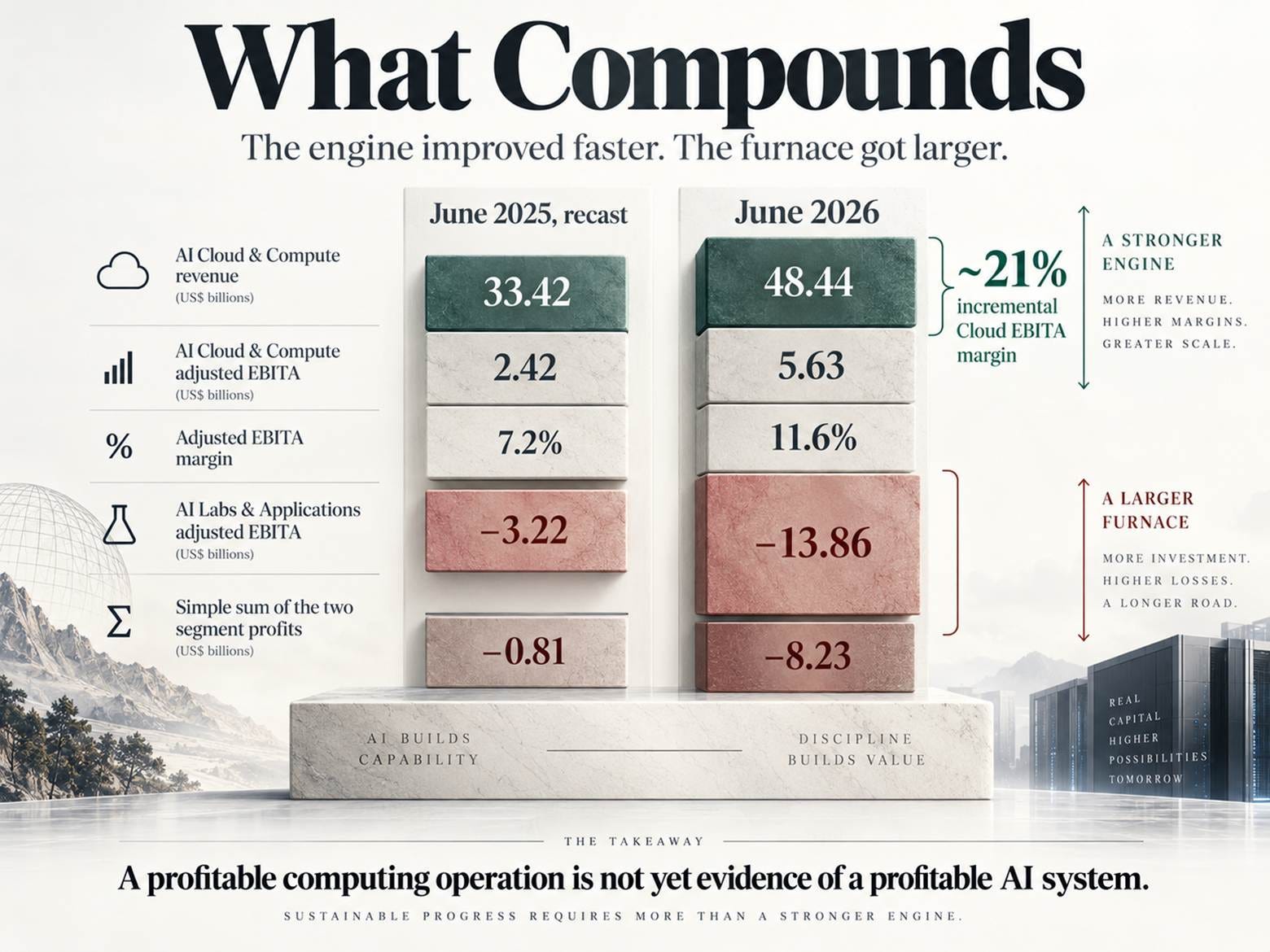
Source: company disclosures; calculations ours. The sum is not a standalone consolidated AI income statement: it excludes unallocated and intersegment effects and benefits elsewhere in commerce.
Cloud earned approximately a 21% incremental EBITA margin on its additional revenue. But its RMB3.2bn profit improvement was outweighed by a RMB10.6bn increase in model-and-application losses. A profitable computing operation is not yet evidence of profitable ownership of the entire AI system.
There is a second test ahead. EBITA already includes depreciation, making the margin improvement meaningful. As additional equipment becomes operational, however, its depreciation enters expenses. We cannot assign the entire capex wave to an invented future start date or assume today’s margin is untouched by it.
The question is whether utilization, pricing, mix and T-Head savings can continue improving economics as the installed asset base grows. That is how an encouraging quarter becomes a durable competitive advantage.
The deposit got larger
Group capex reached RMB67.7bn, against RMB22.9bn of operating cash flow, leaving free cash flow negative RMB44.7bn. The subsequent equity placement made the financing question explicit.
Issuing shares does not automatically destroy value: the cash received can fund investments worth more than their cost. But it changes the bargain. Existing shareholders own a smaller percentage of a better-funded company, and the return on that enlarged capital base—not the popularity of its models—determines whether they benefit.
Repurchases were only US$162m in the quarter, against approximately US$0.8bn a year earlier. Those are company-reported transaction amounts; our stock prices and valuations remain in HKD. Meaningful capital return has given way to construction.
The most revealing post-earnings change is in estimates:
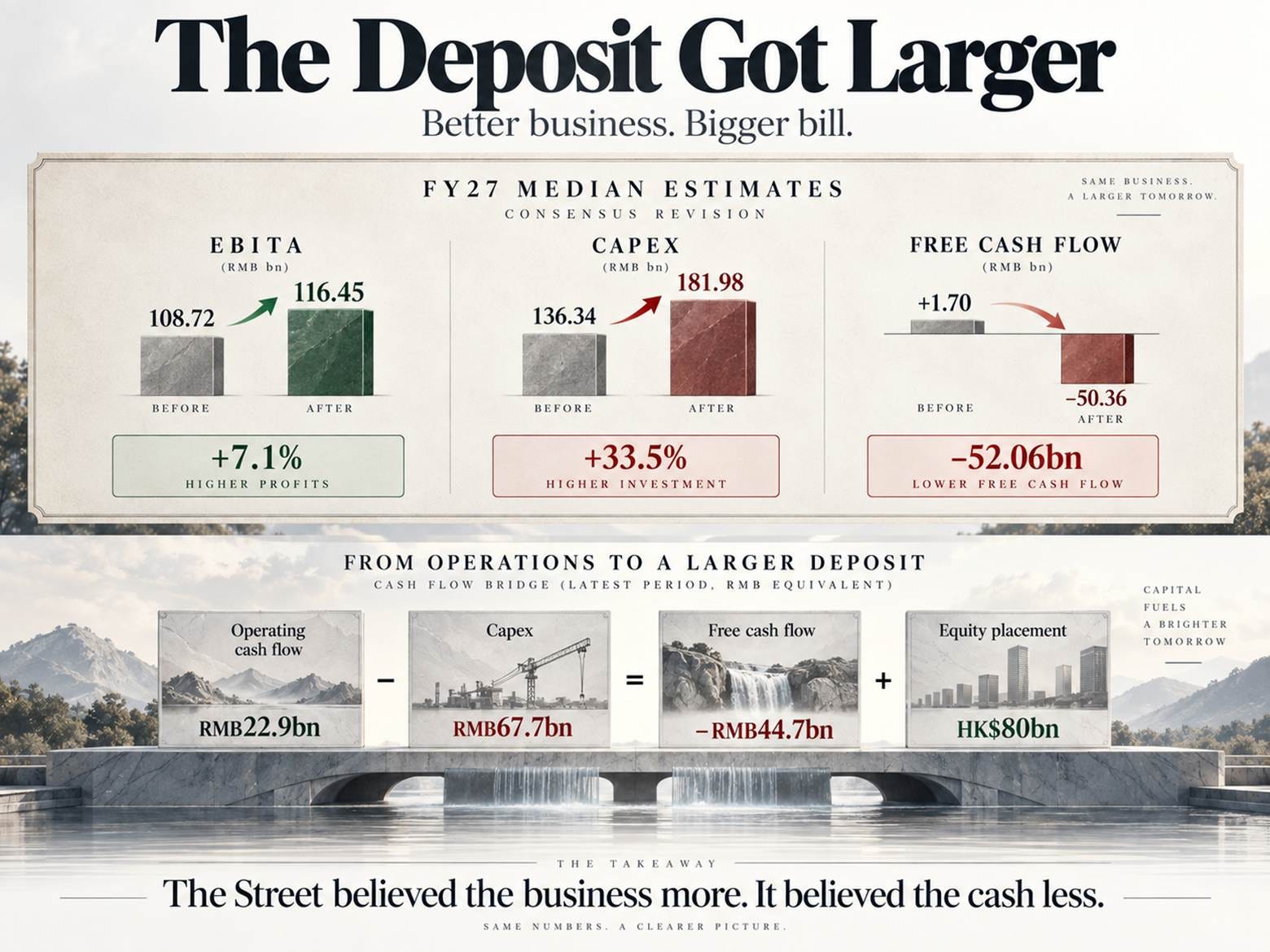
Source: Bloomberg point-in-time estimates for the year ending March 2027, using the same RMB-reporting BABA-US panel. Contributor counts changed: EBITA 27→24, capex 30→26, FCF 14→13. These are consensus-snapshot changes, not matched-analyst revisions.
Analysts came away expecting more operating profit and substantially less cash. That is not confusion; it is recognition that the better business requires a bigger investment.
Management has offered a concrete defence. AI assets are said to pay back in roughly three years, potentially shortening toward 2–2.5 years. On procurement timing, the call was explicit:
“I don’t think we should take the spending for this quarter and multiply it by four.”
That is reasonable. RMB190bn spent against a RMB380bn three-year program does not, by itself, prove the budget has failed. Nor does a shorter hardware payback establish an attractive return after recurring research, replacement equipment, financing and the time value of money.
Our November article began with Alibaba’s failed New Retail investments precisely because coherent architecture is insufficient evidence of good capital allocation. Today’s external revenue and operating margin offer more tangible verification. They do not exempt this investment cycle from the same test.
The relevant question is whether profits eventually grow faster than the capital required to sustain them—not whether Alibaba can keep finding projects on which to spend.
Owning intelligence is not owning the return
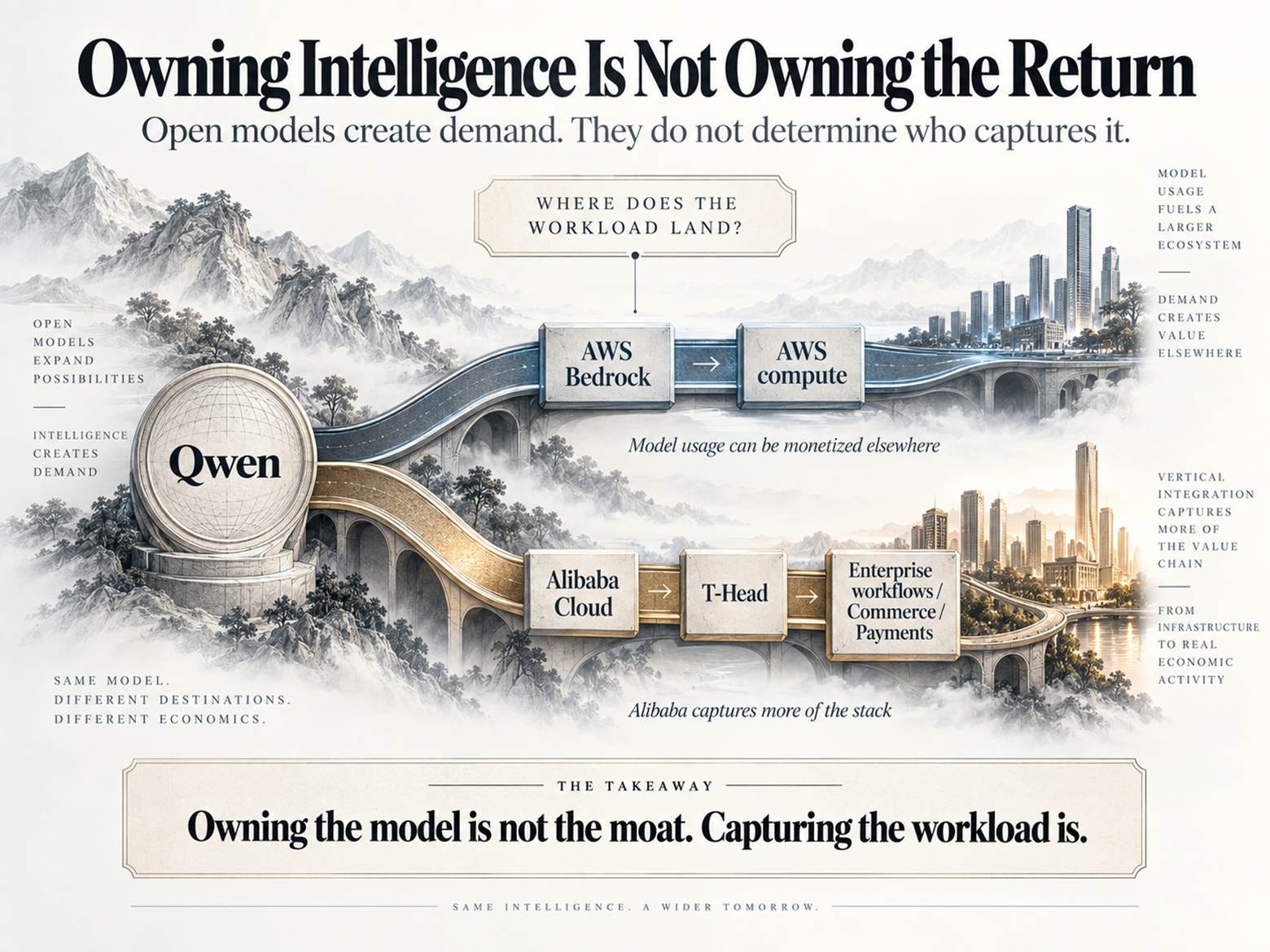
One claim from our earlier work needs correction rather than refinement.
We suggested that developers standardizing on Qwen were implicitly standardizing on Alibaba Cloud. AWS has offered Qwen through Bedrock since September 2025. A customer can use Alibaba’s intelligence while paying Amazon to execute it. The assumption was too strong when we made it.
Management’s answer about model-as-a-service economics narrows the thesis further:
“The level of gross margin from those two kinds of models is actually very comparable.”
That refers to hosting proprietary versus third-party models. It supports Alibaba’s ability to monetize a multi-model market; it does not prove models have no value. Comparable serving margins also leave unanswered whether developing Qwen earns an adequate return on its research expenditure.
Alibaba must win workloads through better execution economics, useful integrations or distribution not merely through the availability of its weights.
This is where Second Trust still matters. Qwen can connect recommendations to merchants, fulfilment and after-sales processes. Those relationships could make an agent more useful and transactions more profitable. But 250 million users having their first AI-shopping experience demonstrates reach, not repeat usage or incremental commerce profit. Our March requests for repeat rates, incremental GMV and order economics remain unanswered.
The investment case has two distinct accomplishments to prove: Alibaba must capture a growing share of useful work, and the combined cost of models, applications and capacity must leave sufficient profit for shareholders.
My disagreement with the sceptical reading is not that cash burn is harmless. It is that the 21% incremental cloud margin creates a plausible route to better returns even if growth eventually moderates. A 30–35% growth business with improving cash conversion could be more valuable than a 45% growth business requiring repeated capital injections.
That would also change who can own the stock. A value investor awaiting distributions and a growth investor underwriting productive capacity can interpret the same quarter differently. A durable re-rating requires evidence that satisfies both: profitable expansion followed by cash generation. We should not infer that shareholder transition merely from a rally.
Three futures, with the arithmetic exposed
We retain Kingdom, Grid and Furnace, with conditional operating-case probabilities of 25%, 45% and 30%. Better cloud economics strengthen the upside; greater funding requirements strengthen the downside.
One further correction is necessary: our previous Furnace price band was too forgiving. A downside case must allow weak cash conversion and further dilution to damage value substantially—not assume support near HK$100.
The valuation date is September 2029, using FY30 earnings. All assumptions below are ours, not company guidance.
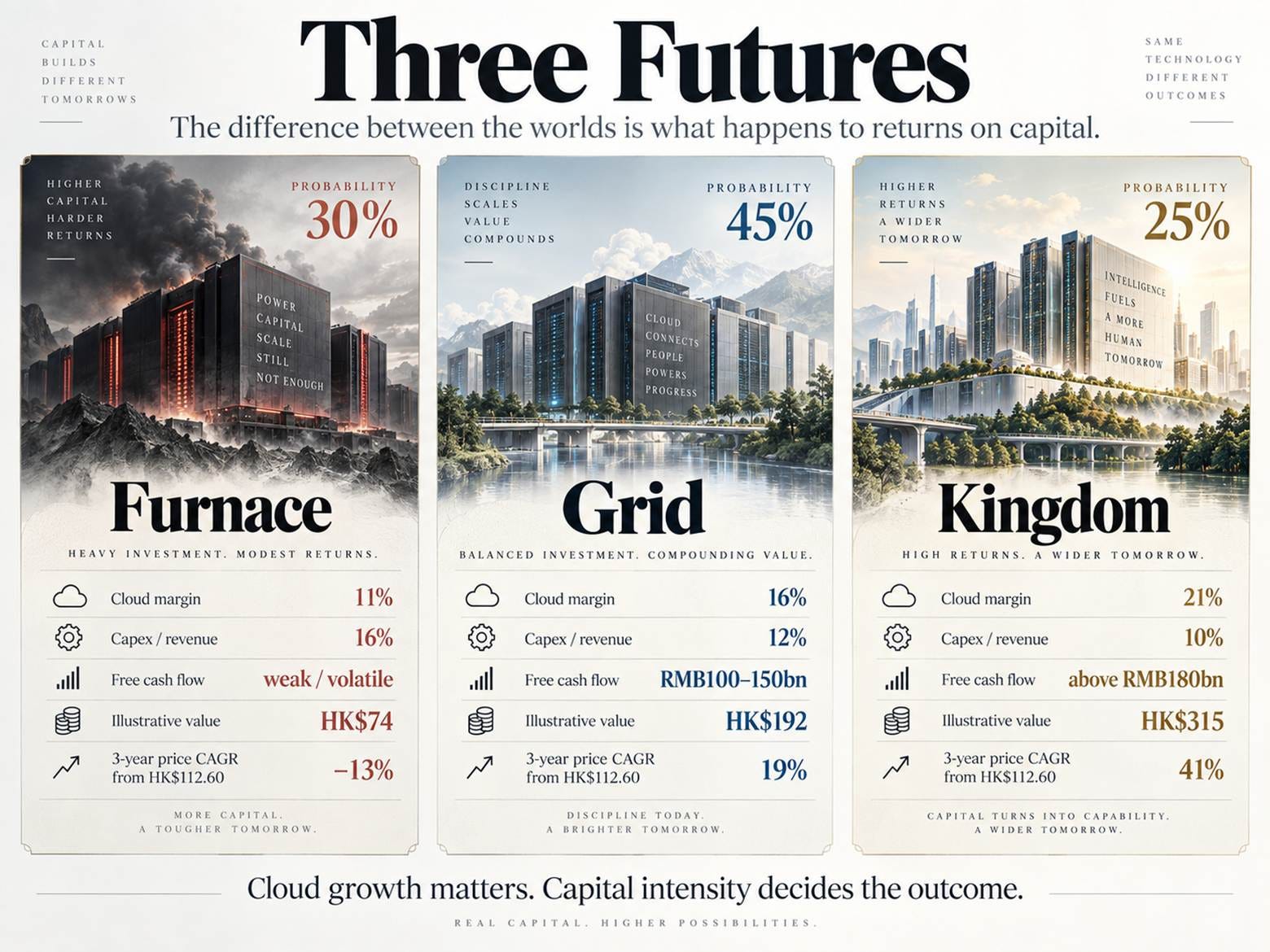
Revenue starts from Bloomberg’s September 22 FY27 median of RMB1.124tn. Price equals revenue × normalized net margin ÷ diluted shares ÷ assumed RMB0.87 per HK$1 × P/E. Net margins include recurring model/application costs and share-based compensation but exclude investment revaluation gains. Share counts incorporate financing and assumed net repurchases; buybacks are not added again to returns. Dividends are excluded.
The Furnace can grow and still disappoint because continued capital consumption deserves a low multiple. The Grid earns 16 times earnings only if cash conversion becomes credible. The Kingdom requires differentiated returns across cloud and commerce, not simply larger chip shipments.
These are business scenarios, not downside limits. Severe geopolitical disruption could produce losses beyond the Furnace case; the probabilities are conditional on its absence.
What the next evidence must show
We will judge the next chapters against five tests rather than another model leaderboard.
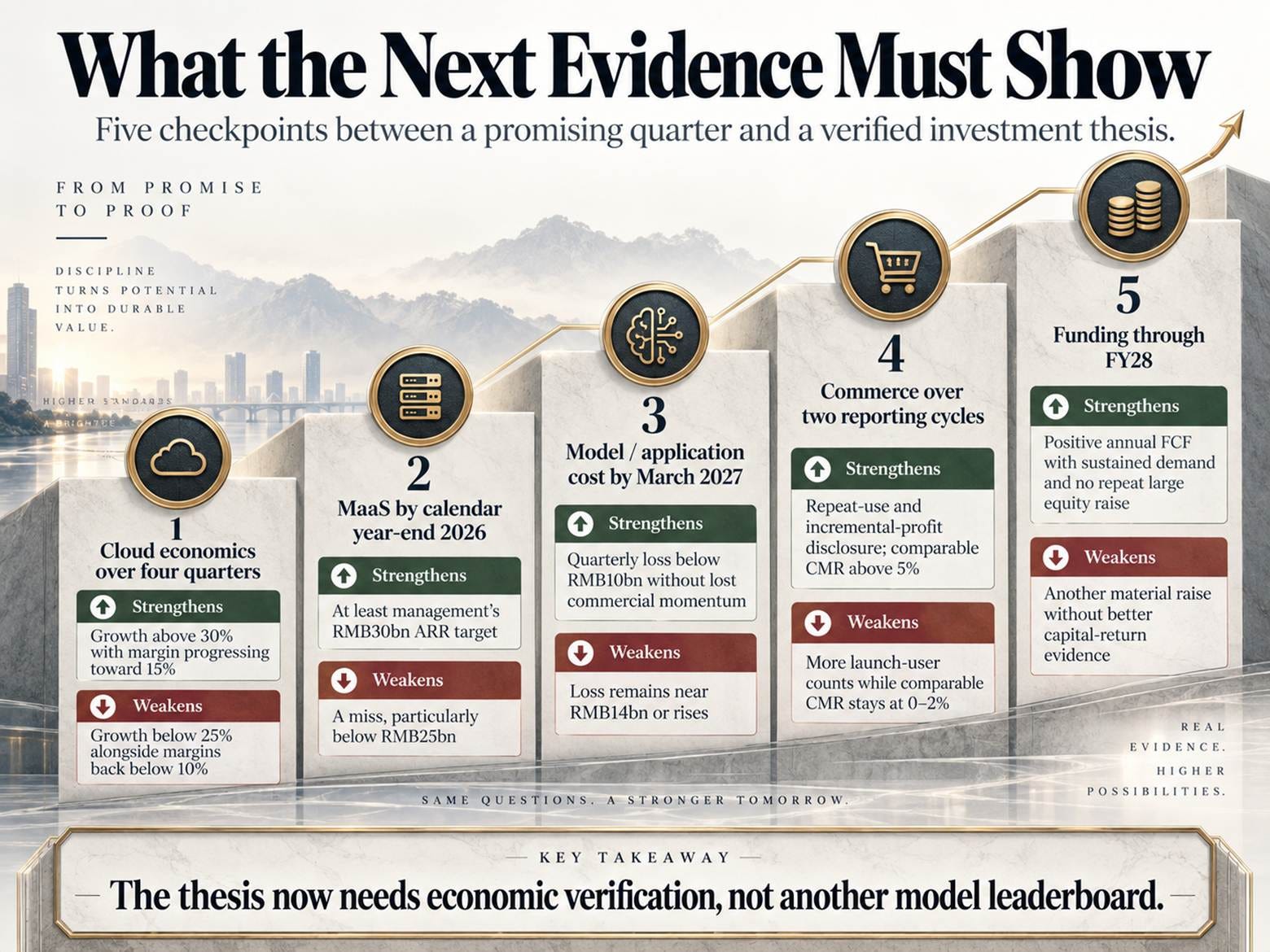
Thresholds are our monitoring judgments, except management’s RMB30bn year-end ARR target. No isolated result establishes or falsifies the whole thesis.
Alipay reduced the distance between a promise and verification by withholding payment until delivery. Equity investment cannot offer that protection: capital must come first. What shareholders can demand is that each round of investment produces more evidence, rather than merely a larger ambition.
Alibaba has finally delivered part of the verification we were waiting for. It has simultaneously asked shareholders to enlarge the deposit. The investment works only when the value of the delivery grows faster than the deposit required to secure it.
Disclaimer:
The content does not constitute any kind of investment or financial advice. Kindly reach out to your advisor for any investment-related advice. Please refer to the tab “Legal | Disclaimer” to read the complete disclaimer.