


TL; DR
Google Cloud delivered the clearest evidence yet for Alphabet’s systems thesis: revenue grew 82%, margins reached 35.6%, and backlog rose to $514 billion, even while Gemini lagged in important areas such as coding.
Search remains resilient, but the cost of building the AI grid is escalating capex guidance rose to $195–205 billion, free cash flow turned negative, and Alphabet raised substantial debt and equity capital.
The investment case now depends on repetition: Alphabet must sustain Cloud growth and margins, keep Search above the mid-teens, and prove that Gemini can remain close enough to the frontier for its infrastructure and distribution advantages to matter.
Philipp Schindler was deep in his advertising commentary when he paused: “Of course, a huge congratulations to Spain for taking home the trophy.” A throwaway line. Also, the best frame anyone offered for Alphabet’s quarter.
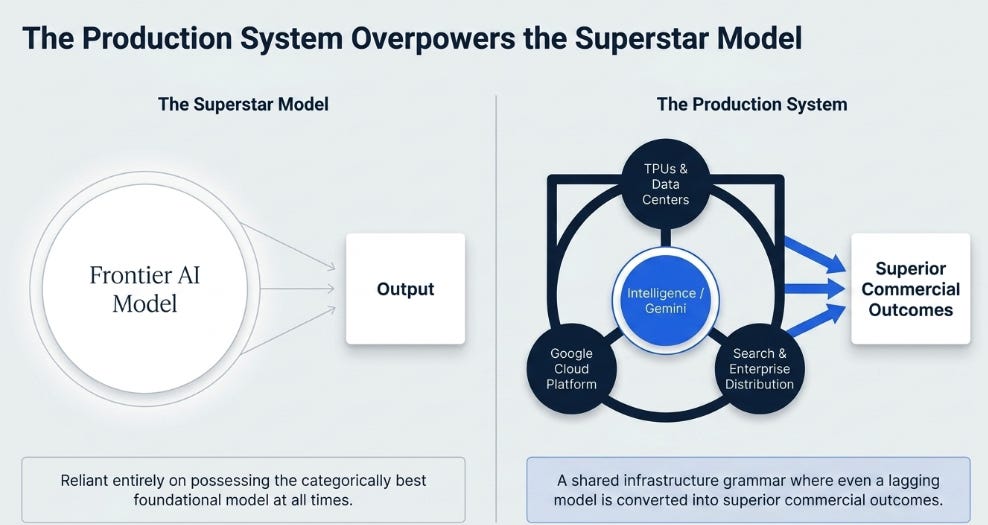
Spain did not arrive with the most celebrated forwards. France had the Paris stars. Portugal carried the mythology. Argentina had Messi and the champions’ calm. Spain laboured through matches they were expected to control, won anyway, and the win was impossible to dismiss because the pattern is too long to be luck: three European Championships, the Nations League, Olympic gold, the women’s World Cup, a coaching diaspora that rewired half of Europe’s elite clubs. Spain does not produce one great team. It runs a production system, a shared grammar into which talent gets inserted and comes out better. And Spain has proved it, repeatedly, across squads and decades.
Alphabet has not. That distinction makes the analogy useful rather than decorative. Spain was the conclusion. Alphabet, this quarter, was the question.
The quarter armed both sides. Cloud grew 82% to $24.8 billion at a 35.6% margin with a $514 billion backlog. Search grew 17%. Model APIs process 22 billion tokens per minute, up from 16 billion last quarter. Nearly 90% of the Fortune 100 use Gemini Enterprise. System numbers. Against them: Gemini 3.5 Pro unshipped, Sundar Pichai fumbling the most predictable question of the call, capex guidance up again, free cash flow negative for the first time.
Has Alphabet built the AI equivalent of Spanish football, a system that turns chips, models, infrastructure and distribution into outcomes better than any component would suggest, or does the structure fail if the model at its centre cannot stay near the frontier?
What I Believed Coming In
My view has moved in stages, and I should be honest about where it overshot. By late 2025 the argument had hardened into the grid: Google wasn’t trying to win a chatbot contest, it was building the system, TPUs, data centres, models, distribution, that delivers intelligence at scale, the way Westinghouse won electricity by building the network, not the lightbulb. In Q1 I pushed further: one grid powering four compounding loops.
I also wrote, in February, that “the AI arms race is effectively over, and Google won.” Q2 taught me to split that sentence. There are two races. Google is winning the infrastructure race by a widening margin. The model race is open, and Google’s position looks worse than six months ago.
One more revision. I described the buildout as offensive, demand-backed and self-funded. The first two hold. The third doesn’t survive this balance sheet: $49.6 billion of equity raised in the quarter, $20.3 billion of new notes, no buybacks, $98 billion of long-term debt. I was too relaxed about what the grid would cost.
The Scoreboard
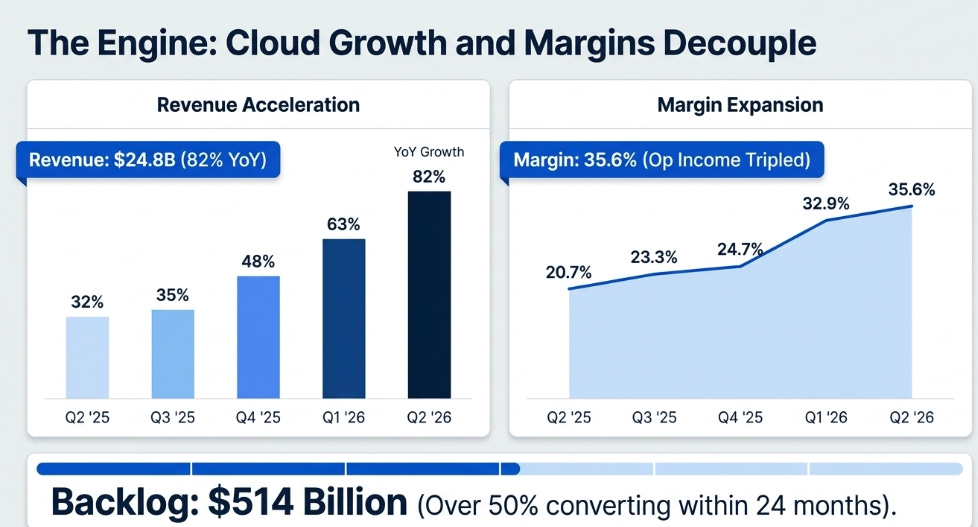
Growth accelerated for a fourth straight quarter while margins rose fifteen points and operating income more than tripled. Businesses at this scale do not normally accelerate and expand margins at once. Anat Ashkenazi closed off the easy sceptical readings herself:
We also began to recognize revenues from TPU system sales, which we delivered to customer data centers for the first time in Q2. Cloud revenue growth accelerated meaningfully even after excluding the impact of TPU system sales.
So: not a hardware quarter dressed up as Cloud. And with backlog up more than $50 billion sequentially to $514 billion, “just over 50%” converting within 24 months, not demand without commitment either.
The deeper point came from Pichai’s description of customer behaviour:
We are winning new customers faster, with new customer acquisition doubling compared to the same period last year. We are deepening our relationships with existing customers who are expanding their usage and exceeding their commitments by more than 50%. Also, an acceleration over last quarter.
Customers exceeding contracted commitments by half, and accelerating, consumption running ahead of what enterprises thought they would need. Cloud is no longer where Alphabet sells spare capacity from an internal buildout. It is becoming the external market for the production system itself.
When Morgan Stanley’s Brian Nowak asked whether the return picture had changed, Pichai reached for a comparison sharper than the usual CEO reflex:
We used to talk about cloud itself, very small percentage of overall workloads and enterprises have shifted to cloud. Think about what percentage of workloads are really AI native and AI enabled. It again feels very early.
The cloud-migration analogy is testable rather than rhetorical. Cloud grew 82% in a quarter when Azure grew about 40% and AWS about 28%. Definitions differ; the direction is not ambiguous, and it is not closing.
The Forward Who Isn’t Scoring
The ugliest part of the call was the part everyone knew was coming. JPMorgan’s Doug Anmuth asked directly about staying at the frontier and closing the coding gap:
The frontier is incredibly dynamic space... We’ve had clearly frontier models. There are many attributes on which we are still at the frontier. There are areas where we’ve acknowledged we need to improve. Coding and agentic coding is an example of that.
He then moved to Flash, to voice quality in customer service, to summarisation for professional services firms, and never came back to the question he was asked. The buy-side reaction was brutal, and fair. He needed three sentences: frontier AI is hard, we missed on 3.5 Pro, Gemini 4 is our answer. Instead, the market got a reason to wonder whether management understands the concern, with reports of senior DeepMind departures still fresh.
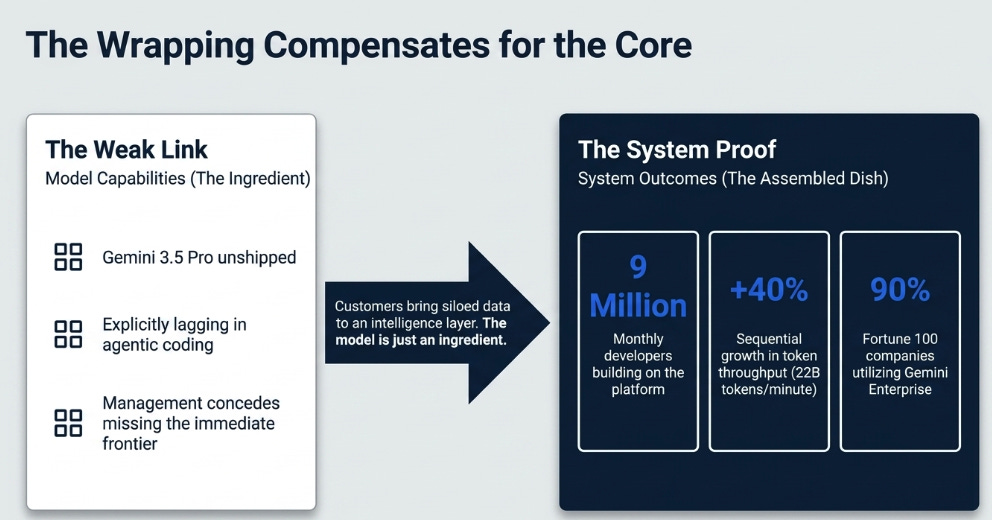
Two questions are being run together. Is Gemini the best model at every moment? No, management conceded it. Is Alphabet’s system commercially competitive? The quarter says emphatically yes, and the evidence is behavioural. Nine million developers building monthly. Token throughput up nearly 40% sequentially. When MoffettNathanson’s Michael Nathanson asked what the moat is if capabilities converge, Pichai gave the most substantive answer of the call:
People are bringing what’s been in the past siloed data sources, putting it all together, and having an intelligence layer on top of it with Gemini Enterprise. The model is just an ingredient in those solutions.
The ingredient matters. The assembled dish is what gets purchased. That has been my thesis since early 2025, products beat models, and Cloud accelerating to 82% while Gemini lagged on benchmarks is the strongest evidence it has had.
But the limit of that thesis is the real risk in the stock. A system compensates for not fielding the best forward. It cannot compensate indefinitely for a structurally weak player in a foundational position. Spain wins without the tournament’s best striker; nobody wins with a goalkeeper who concedes soft goals every match. If the gap stays narrow, the system carries Gemini. If Claude and GPT become categorically better at agentic work, not five percent better, differently capable, the wrapper stops compensating.
Which is Gemini? I don’t know, and I distrust anyone who claims to. Pichai’s bet is explicit: “We will need Gemini 4 as a larger base model to compete at that frontier level.” Note the phrasing, will need. An admission that the current generation cannot. The honest test is behavioural: whether developers leave, whether coding workloads land elsewhere, whether token growth slows. None of that is happening yet.
Search Still Pays the Bill
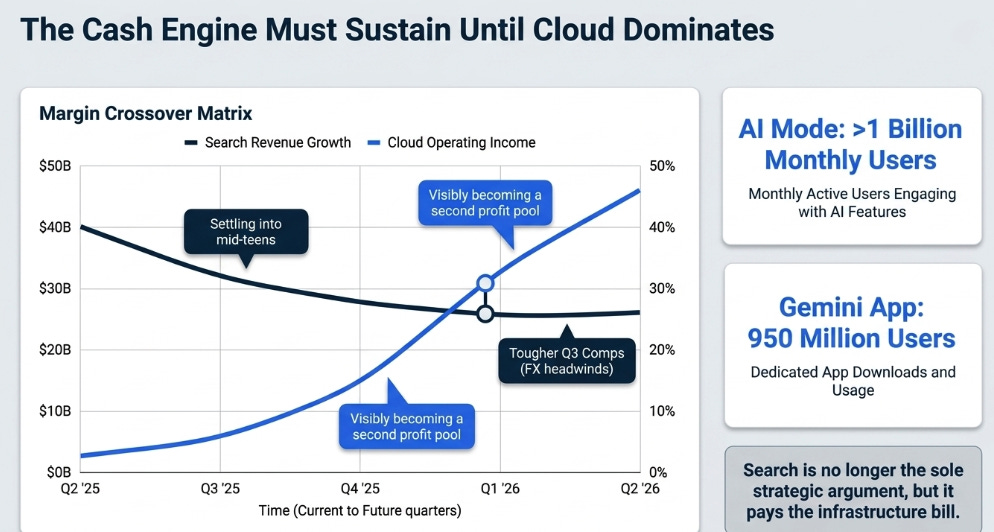
Search grew 17% to $63.3 billion, in line, a deceleration from Q1’s 19%, and the first break in a four-quarter acceleration streak. Then Ashkenazi did something CFOs only do deliberately:
At the current spot rates, we would expect a slight FX headwind to our consolidated revenue in Q3 compared to a 1 percentage point FX tailwind in Q2... At the same time, in Q3, we will begin lapping an acceleration in Search performance that began in the third quarter last year.
You do not volunteer a tougher-comps narrative unless you expect it to bind. Read it as guidance toward mid-teens Search growth in the back half.
A year ago, that would have alarmed me. It doesn’t now, because the debate has changed shape. AI Mode has passed a billion monthly users; the Gemini app has 950 million. Schindler described the monetisation mechanism concretely:
Gemini improves query understanding, allowing us to find relevant ads for longer searches previously difficult to monetize... With shopping ads, for instance, we drove a 20% improvement in showing highly relevant ads.
The existential question does AI destroy the click, the auction, the cash engine, has been answered about as well as a quarterly report can. What remains is a growth-rate question and the multiple that follows: “AI expanded Search” supports a growth multiple; “mature franchise with AI lift” supports a compounder multiple, three or four turns lower.
Search no longer carries the whole strategic argument, but it still carries most of the bill. Alphabet can tolerate Search settling into the low teens if Cloud becomes a second profit pool, which it visibly is becoming. It cannot tolerate Search weakening before the rest of the system is self-supporting.
The Bill
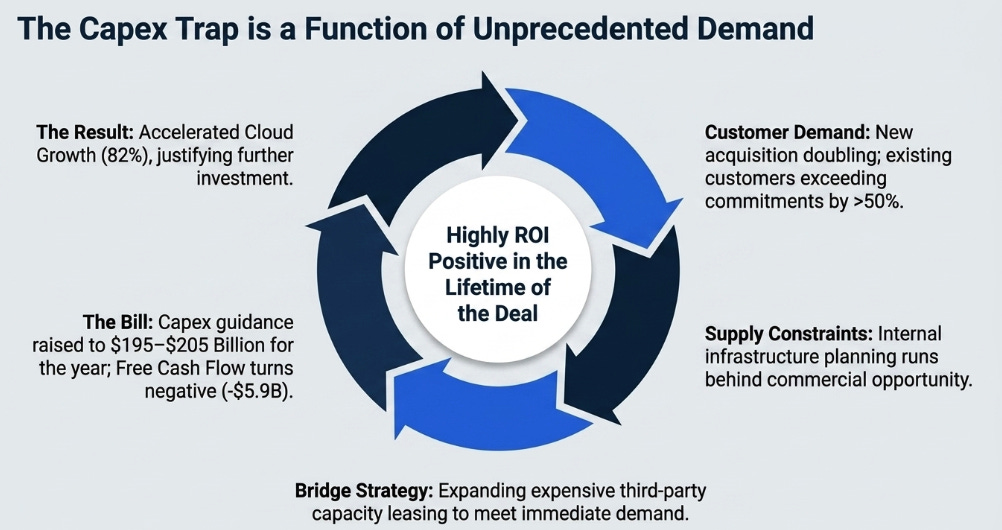
Capex guidance rose to $195–205 billion “primarily due to an acceleration in the delivery of capacity to meet growing demand,” with 2027 higher still. Free cash flow was negative $5.9 billion, $39.1 billion of operating cash flow against $44.9 billion of capex. Alphabet is investing faster than it collects.
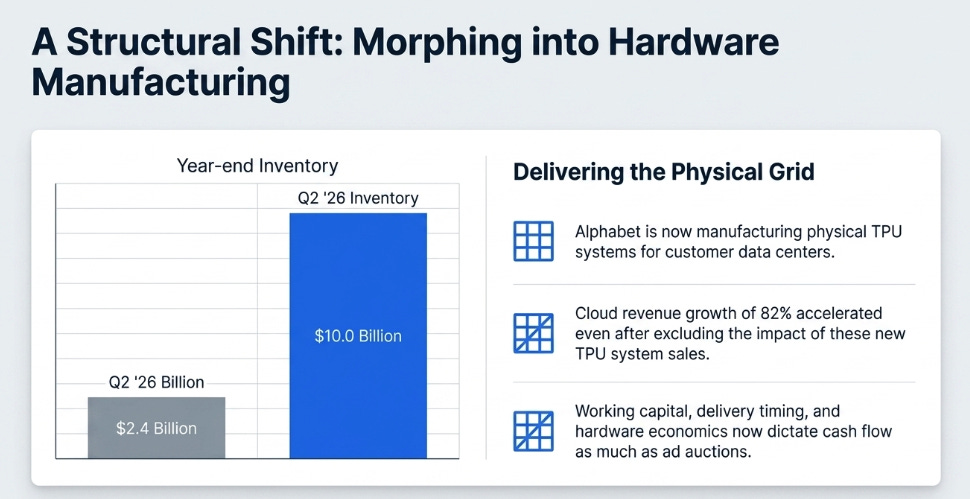
Two details deserve attention. Inventory rose from $2.4 billion at year-end to $10 billion, Alphabet is manufacturing physical TPU systems for customer data centres, so working capital, delivery timing and hardware economics now matter for a company whose model was ads and metered consumption. A change in the character of the business, not just its size. And then this:
Given the supply-constrained environment, we plan to expand the use of third-party capacity in Q3 as a bridging strategy while we build out more internal capacity. This strategy allows us to keep growing our customer base and capture greater overall value. However, it will create modest margin pressure in the near term as we utilize this capacity.
Read that both ways. Proof the demand is real, you do not rent expensive outside capacity for imaginary customers, and proof that supply planning ran behind the commercial opportunity. When Bernstein’s Mark Shmulik pushed, Pichai defended the economics in unusually plain terms:
The incremental opportunities they are bringing to us, while a short-term cost over a few months may be very high, in the lifetime of the deal, as we bring more capacity on, is highly ROI positive.
I accept the logic and its implication: 35.6% is probably a local high-water mark for Cloud margin.
The structural problem is the trap. Every piece of evidence that the spending works, acceleration, backlog, supply constraint, justifies more spending, and more spending is what the stock gets punished for.
Alphabet cannot spend less without the story unravelling and cannot keep raising the guide without each raise reading as a moving goalpost. The trap resolves only when a peak becomes visible, and none is. T
The direction of the return is right, though: a year ago Cloud earned roughly $11 billion annualised against a $91 billion capex year; today, roughly $35 billion against $200 billion. Crude, Cloud’s income sits after depreciation, and the capex funds Search and model training too, but the profit attached to the grid is growing faster than the bill.
Where I Land
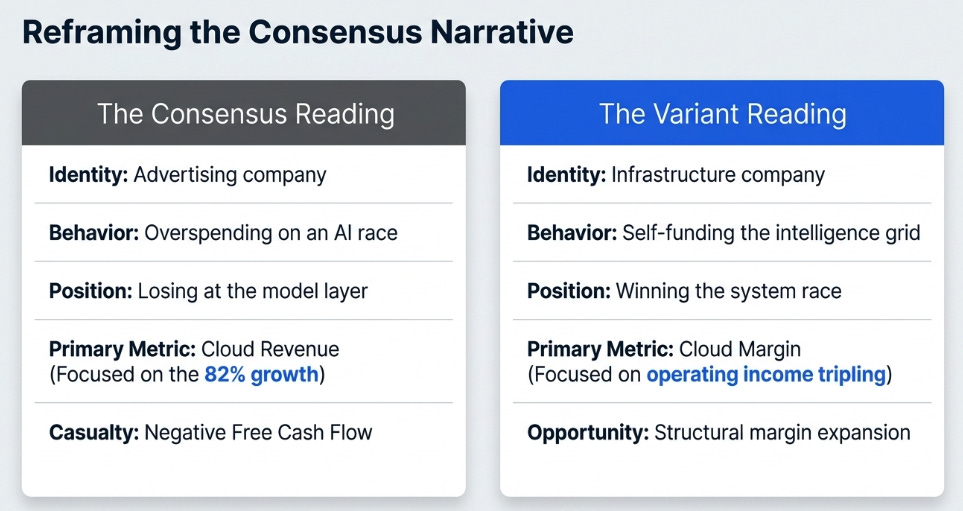
The consensus reading: an advertising company overspending through an AI race it may be losing at the model layer, free cash flow the casualty. My variant reading: the market is watching Cloud revenue when the signal is Cloud margin. Everyone sees 82%. Fewer are sitting with operating income tripling while margins rose fifteen points, which is what makes the infrastructure thesis financially credible rather than narratively appealing. If margins hold near current levels while backlog converts, outer-year estimates are too low.
Built forward from assumptions rather than backward from targets, 19% tax, ~12.3 billion shares held flat, financial assets at current marks:
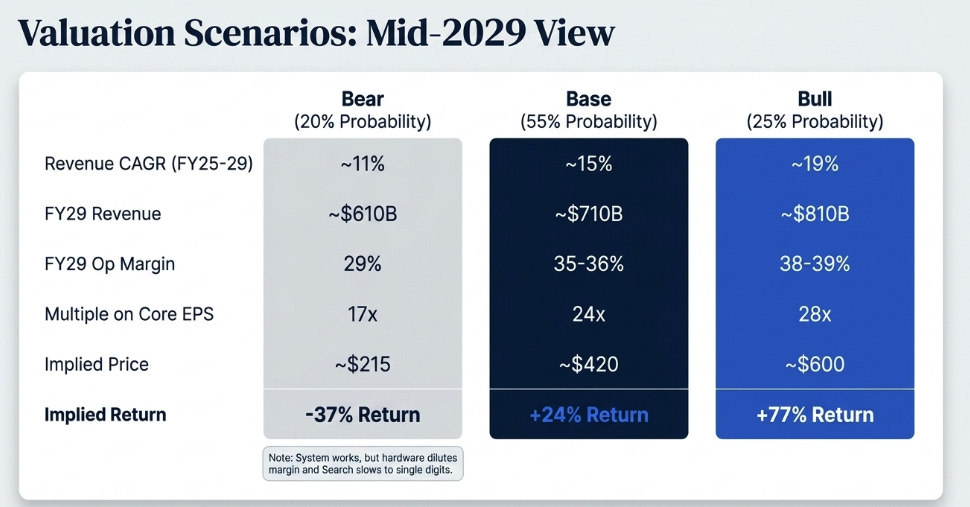
The bear case is not that AI fails; it is that Search slows into single digits, Cloud decelerates below 30% before capex peaks, hardware dilutes margins, and shareholders discover the system works but they don’t own enough of the return. Probability-weighted: roughly $430. My base sits below the Street’s outer years, which embed margins I struggle to bridge across the depreciation wave.
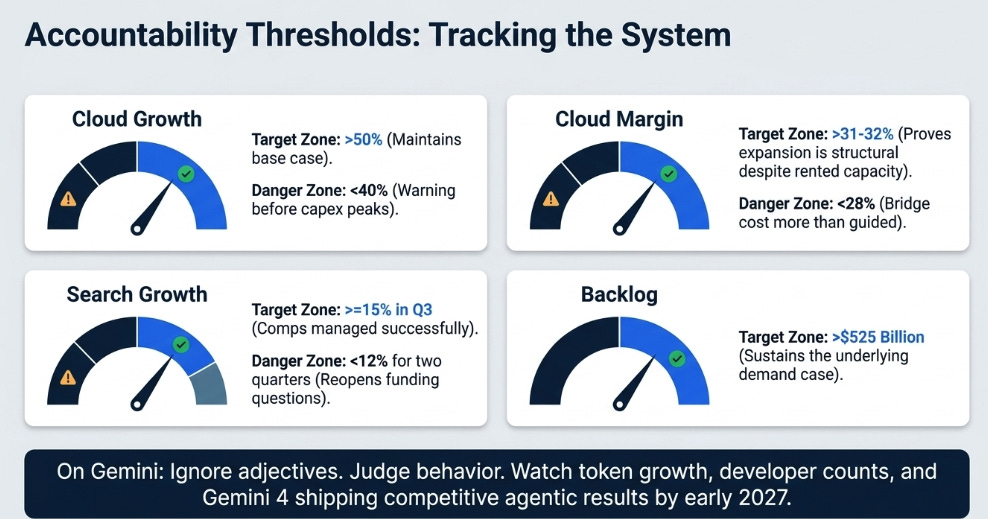
Thresholds I can be held to: Cloud above 50% through mid-2027 keeps the base case, below 40% before capex peaks is a warning. Cloud margin above 31–32% in the back half despite rented capacity means the expansion is structural; below 28% means the bridge cost more than guided. Search at or above 15% in Q3 means the comps were managed; below 12% for two quarters reopens the funding question. Backlog above $525 billion sustains the demand case. On Gemini I judge behaviour, not adjectives, token growth, developer counts, coding-workload wins, Gemini 4 shipping with competitive agentic results by early 2027.
The Readers of This Article
There is an irony in who reads this. The great investment firms are the system argument institutionalised. None was built around one great trader. They were built on infrastructure, risk architecture, data pipelines and a talent production line that makes average PMs good and good PMs excellent. The platform is the alpha; the pass-through economics exist because the system, not the star, is what investors pay for. These firms are Spanish football, with the trophies to match.
And yet the marginal price-setter in Alphabet on Wednesday night was, marking the stock down on a capex raise and one bad answer about one model, while the three-year thesis sat untouched.
The System Has Not Won
Spain earned the right to be called a system: trophies across coaches, generations, men’s and women’s football, club and country. The structure survived every change in personnel and kept producing winners.
Alphabet is nowhere near that standard, and this quarter did not get it there. What Q2 provided is more preliminary and still important: the first convincing financial scorecard that such a system may exist. Cloud’s growth, margin and backlog suggest the whole is producing more than the parts would imply. Gemini’s uncertainty, Search’s tougher second half, and a capital bill rising with no visible crest are the open tests. They decide whether this is a repeatable production system, or an extraordinary run of form.
Spain won by repeating. Now Alphabet must repeat.
Disclaimer:
The content does not constitute any kind of investment or financial advice. Kindly reach out to your advisor for any investment-related advice. Please refer to the tab “Legal | Disclaimer” to read the complete disclaimer.