


TL; DR
Cloud has arrived as a genuine second engine: revenue grew 103% to $30.7 billion, operating profit reached $11.1 billion, margins hit 36.2%, and backlog rose to $561 billion. Google is also extending its TPU architecture beyond its own data centers, potentially allowing customers to finance part of the infrastructure required to use Google technology.
But Cloud’s success does not automatically improve Alphabet’s consolidated economics: shared AI research costs are rising sharply, Search growth slowed to 12%, and Alphabet-level activities absorbed enough expense that Cloud contributed more than 100% of the group’s incremental normalized profit. The laboratory is increasingly eating the gains before shareholders see them.
The most interesting new thesis is capital-light expansion of the TPU platform: selling systems lets Google earn from its architecture even when workloads run in someone else’s facility and potentially when a competitor’s model wins. That could broaden the return on Google’s research while shifting some power, datacenter and financing requirements to customers.
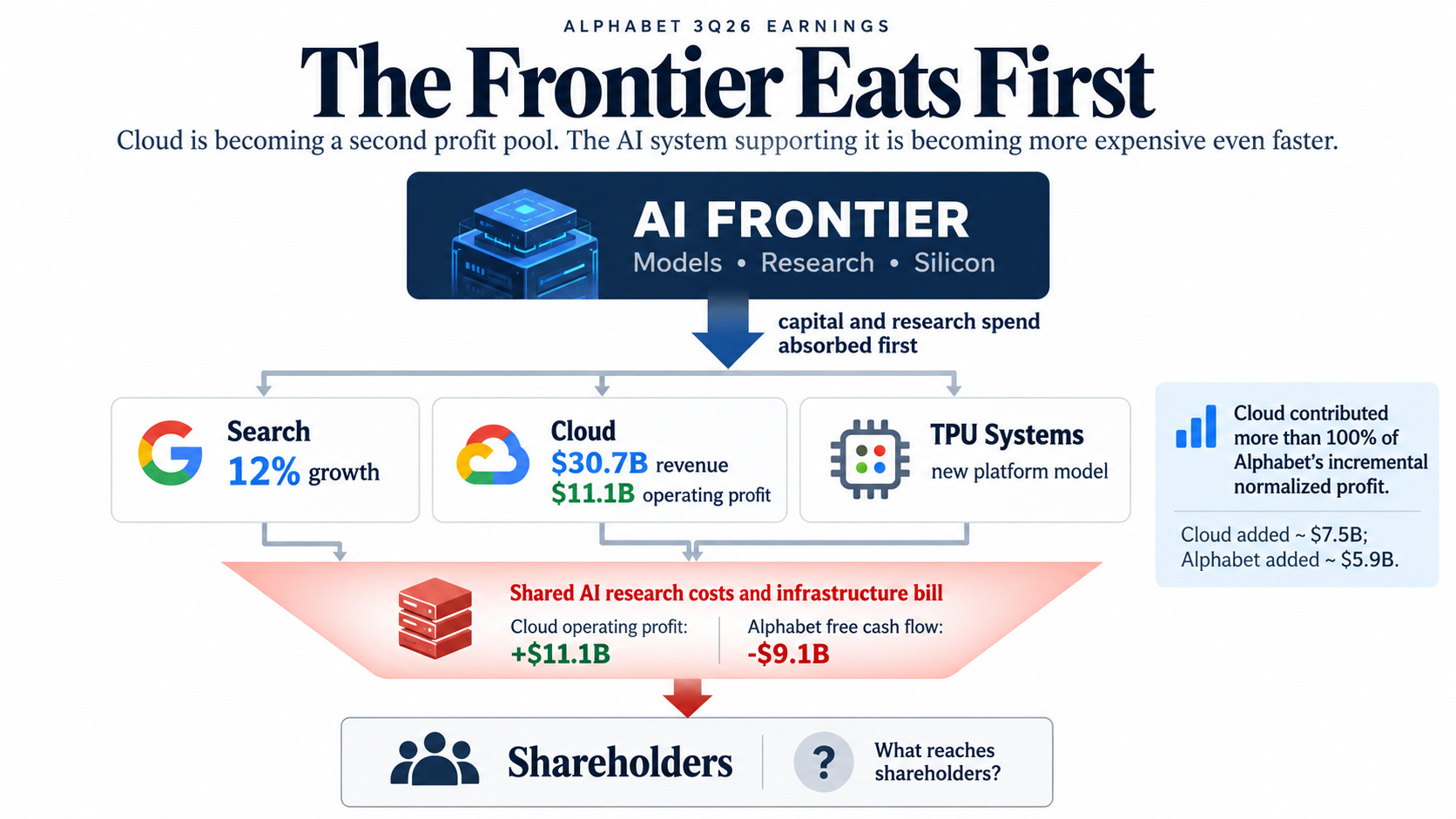
In July’s The System on Trial, I argued that Alphabet’s advantage was the combination of its models, silicon, infrastructure and distribution, rather than any individual product. That system was beginning to work, but I ended with a qualification:
Search no longer carries the whole strategic argument, but it still carries most of the bill. Alphabet can tolerate Search settling into the low teens if Cloud becomes a second profit pool, which it visibly is becoming. It cannot tolerate Search weakening before the rest of the system is self-supporting.
Three months later, Cloud has become that second profit pool more quickly than I expected. Revenue grew 103% to $30.7 billion, operating profit reached $11.1 billion, and the margin increased to 36.2%. Backlog reached $561 billion, while Gemini 4 Argon and Carbon strengthened Google’s position at the technological frontier. These were better outcomes than the tests I set in July, yet the shares fell roughly 10% after hours.
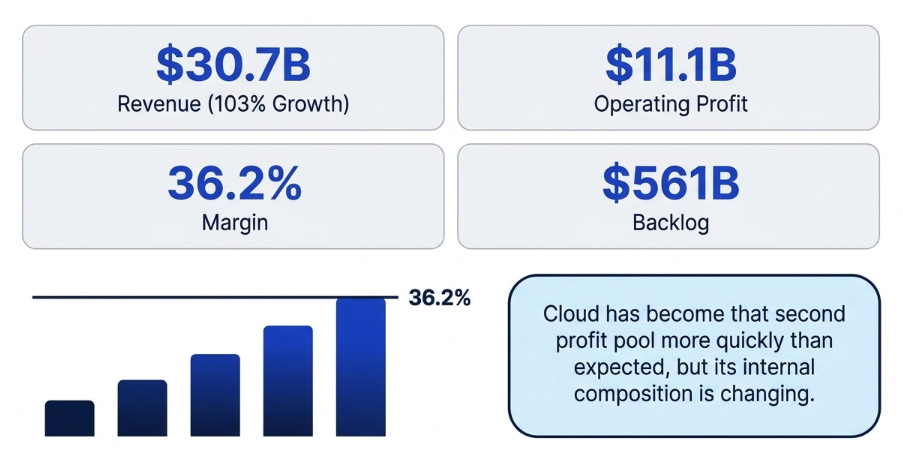
The qualification, it turns out, mattered more than the milestones. Search growth slowed to 12%, shared AI research expenses rose sharply, and free cash flow was negative $9.1 billion. I had expected a Cloud business exceeding $100 billion in annualized revenue to justify a re-rating; at $123 billion, it instead revealed the weakness in that argument. Cloud’s success does not automatically establish the economics of the system supporting it.
Why the Lab Comes First
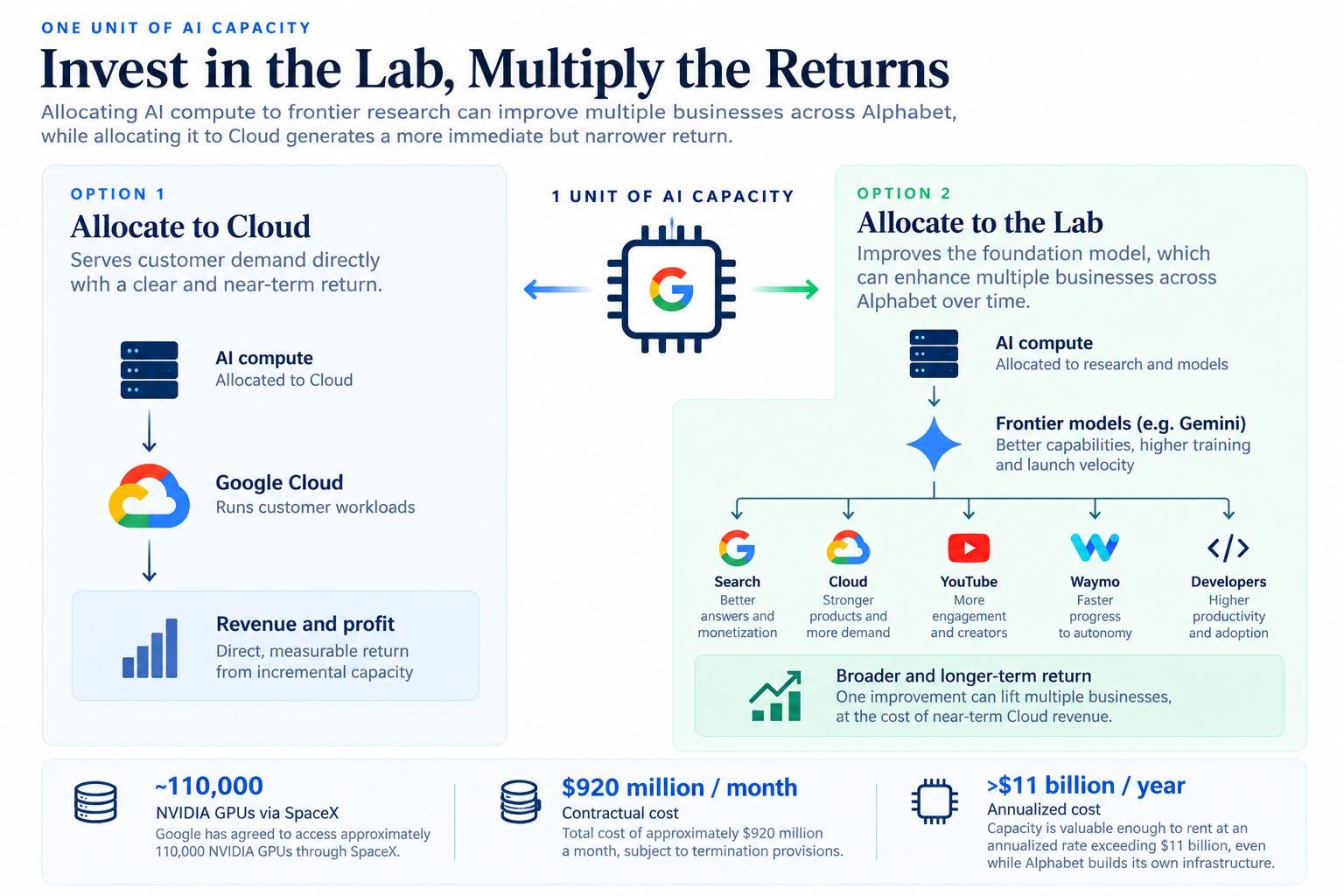
The most revealing exchange concerned how Google allocates computing capacity. Asked by Goldman Sachs about competing demands across the company, Sundar Pichai explained:
Each of our business areas submit long-range plans with a very disciplined ROIC framework. I would broadly think of all of this as a long-range planning process, not a short-term allocation exercise. Obviously, our AI models underlie everything we do, from Search and YouTube to Cloud to Waymo and so on. It is the foundation, and we view it as a highly leveraged approach. The full stack approach drives a lot of efficiency as well as gives us a lot of optionality across a wide variety of opportunities.
This is the rationale for putting the laboratory first: its output improves multiple businesses, whereas allocating another unit of capacity to Cloud produces a more immediate but narrower return. The opportunity cost is real. Thomas Kurian acknowledged that Cloud could serve substantially more demand with additional capacity, while Google’s agreement to access approximately 110,000 NVIDIA GPUs through SpaceX carries a contractual cost of $920 million a month, subject to termination provisions. Capacity is valuable enough to rent at an annualized rate exceeding $11 billion even while Alphabet builds its own infrastructure.
Pichai’s argument becomes more consequential when combined with his comments about recursive self-improvement. AI is now helping Google increase its training and launch velocity, and he expects further acceleration over the next twelve months. The proposed loop is that better models improve research productivity, which produces better models faster; those models then improve Search, enterprise software and the tools used to build the next generation.
There is evidence of progress, although not yet proof of that entire loop. Google reports that teams using Argon shipped 35% more code with 30% fewer errors, while developer usage ramped three-and-a-half times faster than Gemini 3. Both Argon and Carbon arrived after quarter-end, however, so they cannot explain Q3’s financial results. What they explain is management’s willingness to spend ahead of those results: the return might extend across Google, and falling behind could be more expensive than sacrificing near-term Cloud revenue.
A Platform Beyond Google
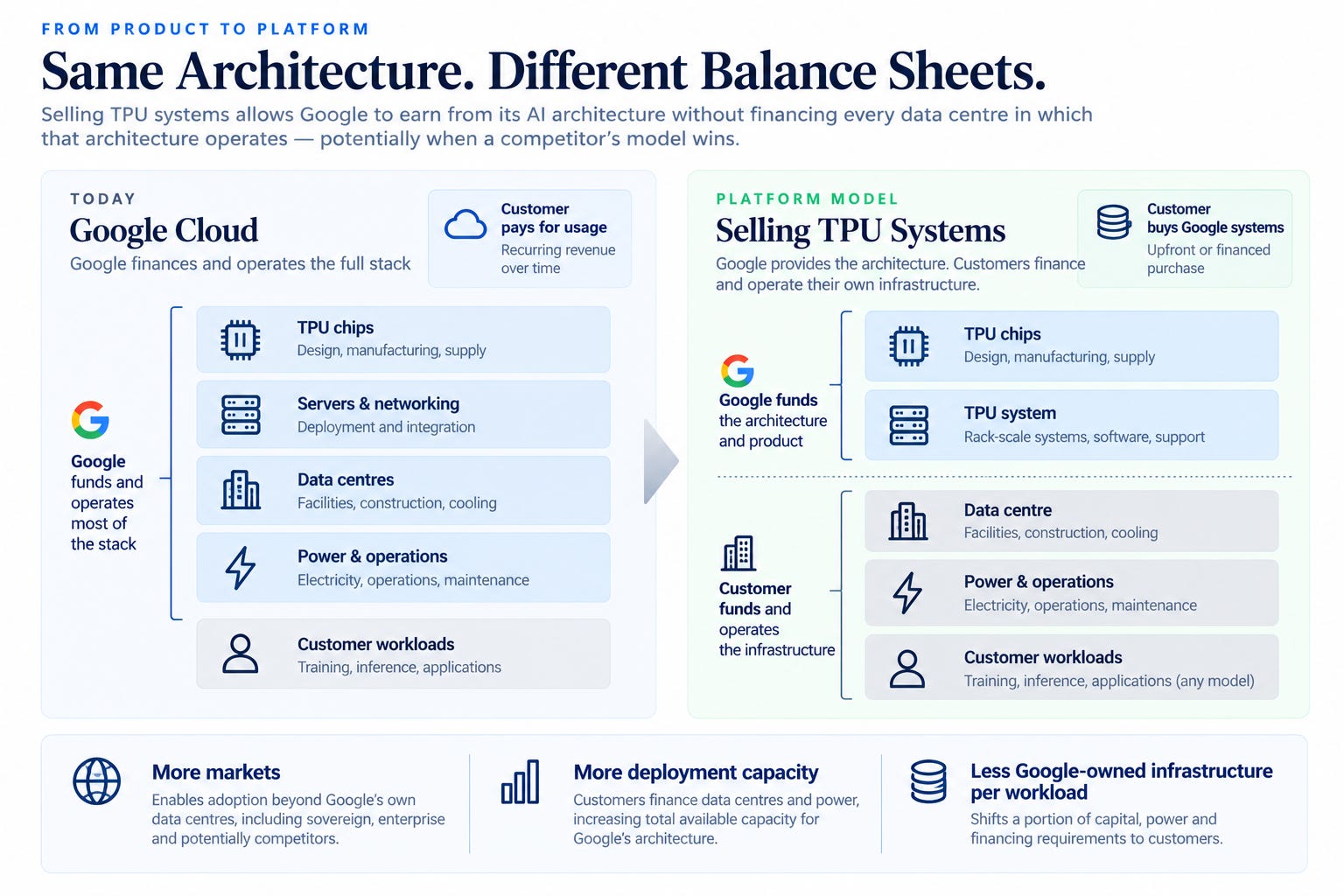
The problem with this strategy is that the laboratory’s ambitions are not bounded by the cash available to finance them. Google’s response is becoming more interesting than simply building additional data centers. When MoffettNathanson’s Michael Nathanson asked why Google would supply companies competing with its own products, Pichai distinguished between products and platforms:
We have long viewed what we build as categories of things which we build as products, and then there are categories of things which we build as platforms. You need to have a clear view on which is which. When you’re building things as platforms, you really work hard to make the platform great and make sure it works for everyone.
Pichai explicitly placed TPU systems in the platform category. Historically, Google’s custom accelerators made its own infrastructure more competitive; the commercial opportunity was largely bounded by workloads Google hosted. Selling complete systems removes that boundary. An AI laboratory can use Google’s architecture without renting all its capacity from Google, while enterprises and other infrastructure providers can deploy it where their own data, power and facilities are available.
This is already broader than a chip-development experiment. Apple and Anthropic use TPUs, Oracle and Crux AI extend distribution, and TorchTPU brings the architecture to developers using PyTorch. More customers increase production volumes and spread development costs; better software compatibility broadens adoption further. Google can potentially benefit from a competitor’s growth even when Gemini does not win that competitor’s customer.
Kurian explained why this matters financially, not just strategically. His answer connected customer commitments, market expansion and infrastructure ownership:
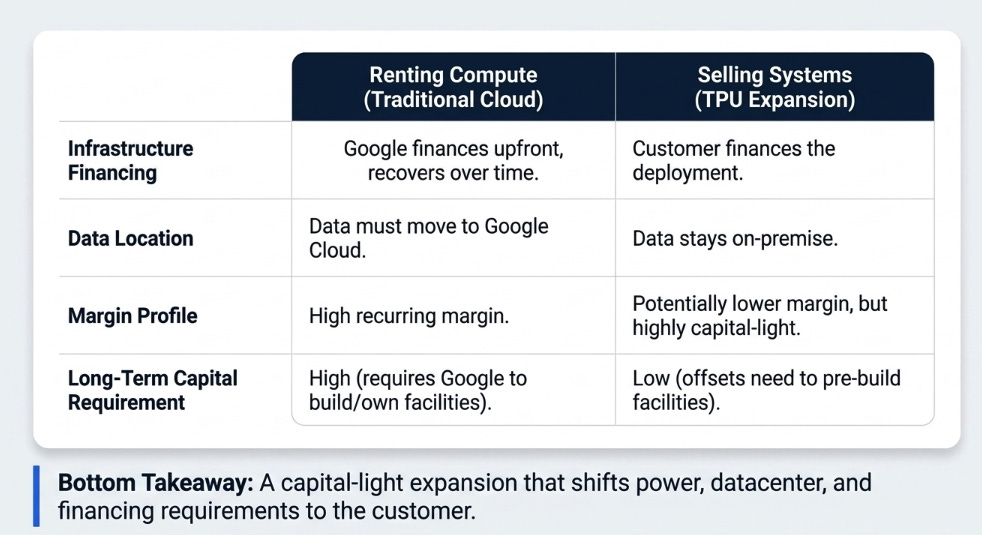
First of all, when Anat mentioned that we procure components to build inventory, we only do that after we have signed contracts. All of the inventory for TPU systems are associated with committed contracts. Additionally, by putting TPU systems in third-party facilities and in customer data centers, it allows us to broaden our addressable markets. For some industries, they have data in their premise that they cannot move to a cloud, and it allows us to bring accelerated compute to where the data sits. Additionally, it also offsets the need for us to have to pre-build facilities to host these TPU systems.
When Google rents compute to a customer, it finances infrastructure and recovers that investment over time. When it sells a system, the customer finances the deployment, while Google finances production and inventory ahead of delivery. Research, software and support still cost money, but Google no longer needs to own every facility in which its technology earns a return. The same strategy expands its market and reduces the long-term infrastructure investment required to serve those additional deployments.
That is the strongest addition to the investment case this quarter. The laboratory can remain expensive while its output becomes available to more buyers, including buyers supplying their own scarce power and capital. The question is no longer simply whether Google can build a better integrated system; it is whether it can sell enough of that system to make the integration more valuable.
What Cloud’s Growth Contains
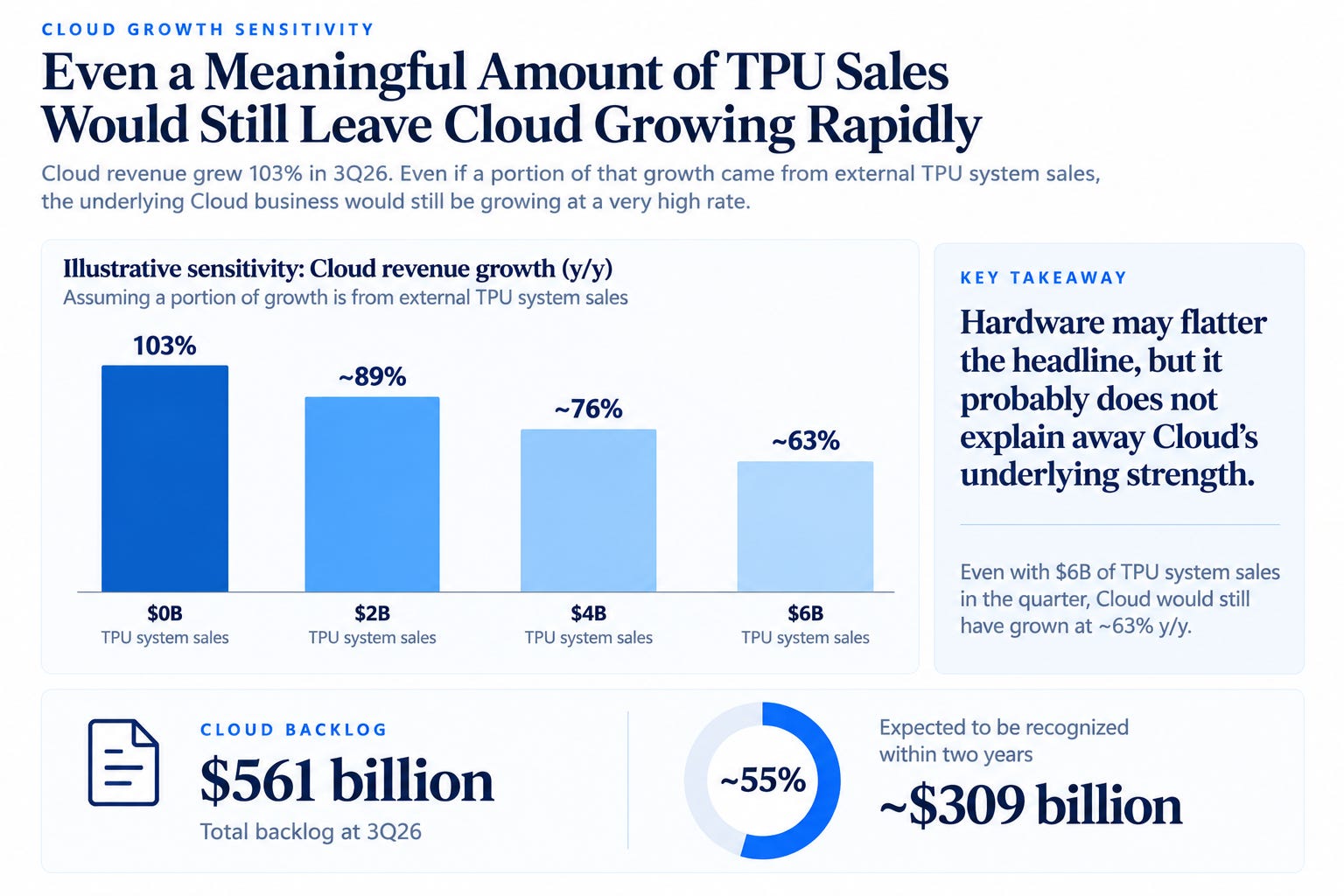
The complication is that Cloud now combines recurring consumption with system deliveries, and Alphabet does not disclose the revenue or profitability of the latter. Illustratively, external TPU sales of $2 billion, $4 billion or $6 billion would leave the remaining Cloud business growing approximately 89%, 76% or 63%, respectively. Those are assumptions, not disclosures, but they show that substantial hardware revenue need not invalidate the underlying growth story.
There is evidence of demand beyond system deliveries. Just over 55% of the $561 billion backlog is expected to become revenue within two years, equivalent to approximately $309 billion. Kurian also described how Gemini adoption generates spending on compute, storage, databases and security: customers adopting the model have reasons to adopt more of the platform. Hardware and recurring services can reinforce each other without having identical economics.
That distinction changes how I interpret margins. A system sale could earn a lower margin than a recurring Cloud service while requiring less long-term capital, making it an attractive addition despite diluting the reported percentage. Conversely, Cloud’s 36.2% margin excludes shared research costs and barely reflects the third-party capacity that arrived at quarter-end. The business is stronger, but treating every dollar of its revenue or profit as economically interchangeable would overstate what the quarter proved.
Search’s Unfinished Transition
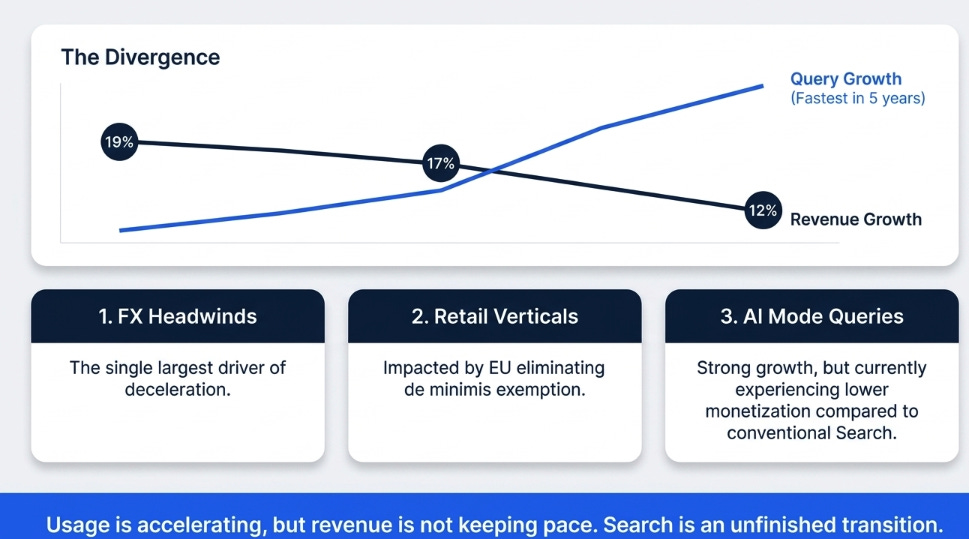
Search presents the reverse problem: usage is accelerating, but revenue is not keeping pace. Query growth was the fastest in five years, yet revenue growth slowed from 19% in Q1 to 17% in Q2 and 12% in Q3. Asked about the disconnect, Philipp Schindler gave an explanation whose order matters:
First, there was FX. It was the single largest driver of Search deceleration relative to Q2. Second, there were vertical-specific dynamics. In retail, some of our APAC advertisers were impacted by the E.U. eliminating its de minimis exemption. In media and entertainment, spend normalized after an unseasonably strong Q2, driven by the FIFA World Cup, which had more matches and therefore more advertising budgets allocated in June than actually in July. Also to the next part of your question, it’s worth noting that the strong growth in AI Mode queries had an impact because of the lower monetization we were seeing in AI Mode.
The final sentence matters, but it does not erase the preceding explanation. Currency was the largest contributor to the slowdown, and AI Mode is not AI Overviews, whose monetization Google previously described as approximately comparable to conventional Search. The evidence establishes a lower-yield product growing within Search; it does not establish that AI has broken the advertising franchise.
The economics depend on whether those conversations replace existing commercial searches or create additional ones. Management says most AI Mode queries are incremental, is expanding advertising internationally, and sees opportunities in agentic commerce. I find that opportunity credible, but query growth alone cannot settle the question. Google is deliberately building the experience before fully monetizing it, just as it invests in research before collecting the resulting revenue. Both choices can be right; making them simultaneously increases the financing burden.
What Reaches Shareholders
The segment reconciliation makes that burden visible. After excluding the previous year’s European Commission fine, Cloud added approximately $7.5 billion of operating profit, while Alphabet added only $5.9 billion. Cloud therefore supplied 128% of the group’s incremental normalized profit: everything outside it, combined, reduced the increase. Alphabet-level activities, primarily shared AI research and development, lost $7.7 billion, up 71% and approximately $1.9 billion worse than consensus.
Those expenses do not belong entirely to Cloud, because the research supports other businesses too. They do belong entirely to Alphabet shareholders, which is why the group’s normalized margin fell from 33.9% to 31.8% while Cloud’s margin expanded. My mistake was assuming that a second profit pool would necessarily improve consolidated economics; the cost of maintaining the technology behind both pools is rising faster than I allowed.
Cash generation tells the same story with an important qualification. Operating cash flow of $42.3 billion fell short of $51.4 billion in capex, but the quarter also included a $5.2 billion fine payment and inventory accumulation for contracted TPU deliveries. Those items make one quarter’s negative free cash flow an imperfect measure of underlying profitability. The structural issue is the $195–205 billion capex programme, a further substantial increase expected in 2027, and a financing mix that now includes common equity, preferred securities and additional debt rather than buybacks.
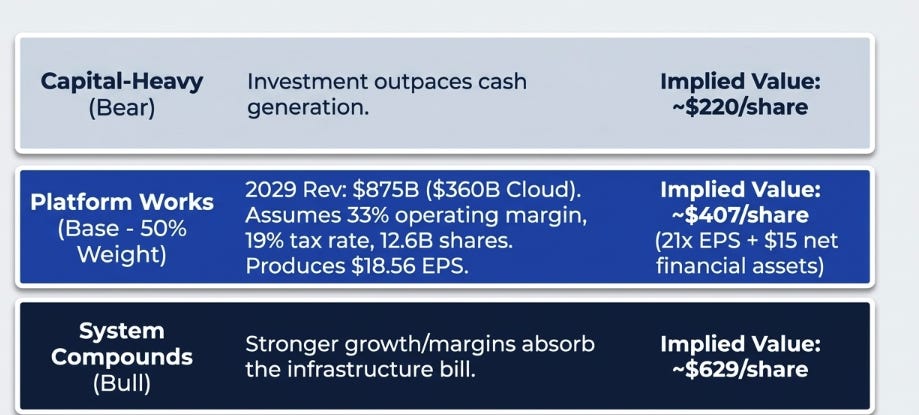
My valuation therefore remains anchored in consolidated earnings and cash conversion. In the “Platform works” scenario, 2029 revenue reaches $875 billion, comprising $515 billion from Services and $360 billion from Cloud. A 33% operating margin, 19% tax rate and 12.6 billion diluted shares produce approximately $18.56 of normalized earnings per share. Applying 21 times earnings and adding $15 per share of net financial assets, after financial claims and reserves, produces a value near $405. The accompanying cash-flow assumption is $95 billion after $350 billion of capex.
The alternatives remain $220 in “Capital-heavy,” where investment outpaces cash generation, and $629 in “System compounds,” where stronger growth and margins absorb the infrastructure bill. Weighting those outcomes at 27% and 23%, against 50% for the central case, produces approximately $407 over a three-year horizon. At a $300 purchase price, the implied annualized appreciation is about 11%, before dividends, with a central value around 35% higher and a downside scenario about 27% lower. Around that price, I would accumulate: the business has acquired more ways to earn a return, even though each share’s claim on those returns faces a larger capital bill.
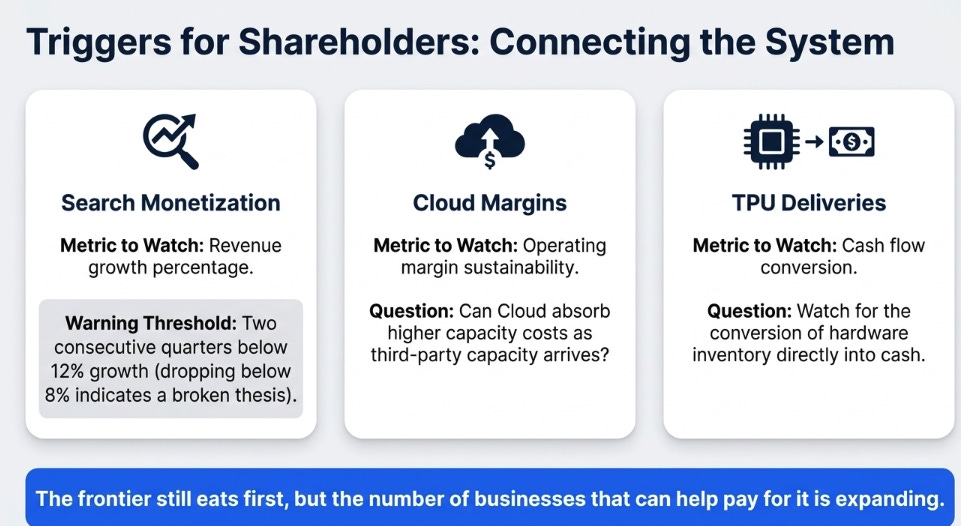
The next evidence must connect those two sides. Search needs to turn additional usage into revenue, Cloud needs to absorb higher capacity costs, and TPU deliveries need to convert inventory into cash. My warning remains two consecutive quarters below 12% Search growth, with growth below 8% indicating a more serious problem; neither threshold substitutes for examining what is happening to monetization.
July’s question was whether Google could repeat its technological success. The stronger question now is whether that success can earn money beyond Google’s own products without requiring Alphabet to finance every deployment. By selling systems that other companies finance and operate, Google is creating a way for competitors’ growth to support its own research advantage. The frontier still eats first, but the number of businesses that can help pay for it is expanding.
Disclaimer:
The content does not constitute any kind of investment or financial advice. Kindly reach out to your advisor for any investment-related advice. Please refer to the tab “Legal | Disclaimer” to read the complete disclaimer.