


TL; DR
The operating opportunity expanded materially: AWS grew 39.3%, margins reached 38.7%, backlog rose to $578 billion, and management now believes AWS can grow above 40% in both 2027 and 2028. That implies a much larger future earnings base than pre-results forecasts assumed. Pasted markdown
The strategic advantage is broader than scarce GPU capacity: Amazon’s case rests on customers running applications, data, inference and tools in the same environment. If that platform relationship persists after capacity shortages ease, AWS can keep earning from the operating system around AI rather than merely renting accelerators. Pasted markdown
But the financing burden is now impossible to treat as secondary: free cash flow is deeply negative, long-term debt has risen sharply, and infrastructure plus strategic investments are consuming enormous capital. The thesis works only if that spending ultimately produces a larger and sufficiently profitable earnings base.
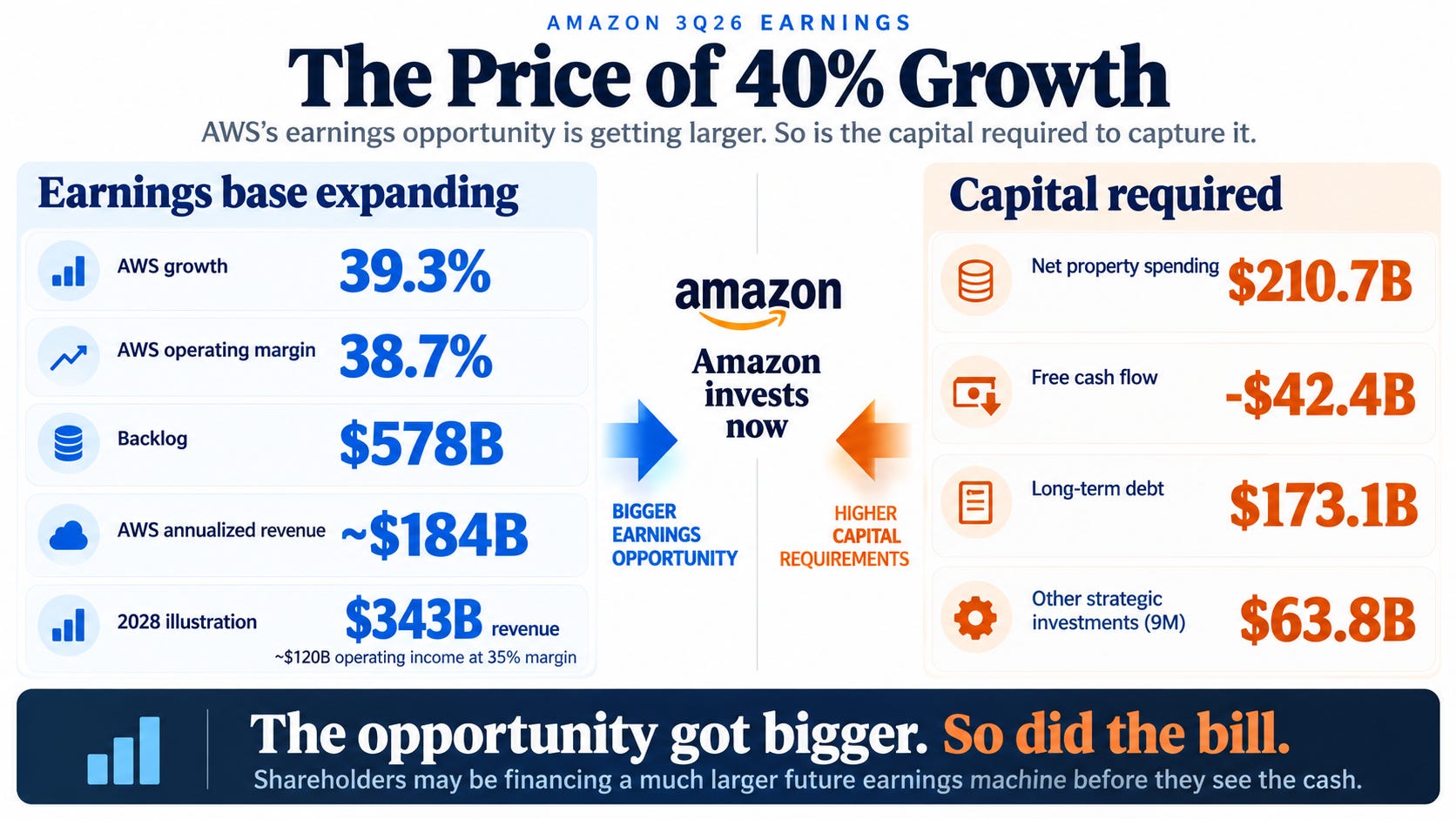
“With our continued pace of innovation, new core and AI functionality, enterprises wanting to run their core and AI workloads in AWS, and the amount of capacity that we’re adding each year, we believe that AWS can grow north of 40% in each of 2027 and in 2028 and be a trillion-dollar revenue business in the next five to 10 years. We’re in the very early days of this inflection. Our strategy is working, and I expect it will for the foreseeable future.”
— Andy Jassy, October 29 earnings call.
My first reaction was that Amazon had materially increased the earnings opportunity investors should be underwriting. AWS is already a $184 billion annualized business. Growing that business more than 40% for two further years is not a routine extension of the current quarter.
Yet Amazon shares fell approximately 7% in extended trading. Revenue of $201.9 billion narrowly missed expectations; advertising disappointed; and the $31 billion midpoint of Q4 operating-income guidance fell below the $33.1 billion in our October 26 consensus snapshot. Those concerns are legitimate. But Q3 operating income of $28.1 billion exceeded that snapshot by 7%, and AWS grew 39.3% while earning a 38.7% operating margin.
In July, we concluded that the Foundry worked but might never finish being built. Q3 confirms that argument while enlarging the opportunity. I think the lower share price offers a better entry into a stronger franchise not because financing no longer matters, but because the potential earnings increase deserves more weight.
A Much Larger Earnings Base
The quarter largely delivered what our last published article anticipated. We expected AWS to add $2.5–4 billion sequentially; it added $3.75 billion. We wanted margins above 35–36%; they reached 38.7%. The new information is management’s expectation that this much larger business can accelerate again in 2027 and sustain that growth in 2028.
The distinction becomes clear against the forecasts retained in our pre-earnings preparation. Using approximately $175 billion of estimated 2026 AWS revenue, exactly 40% growth produces the following:
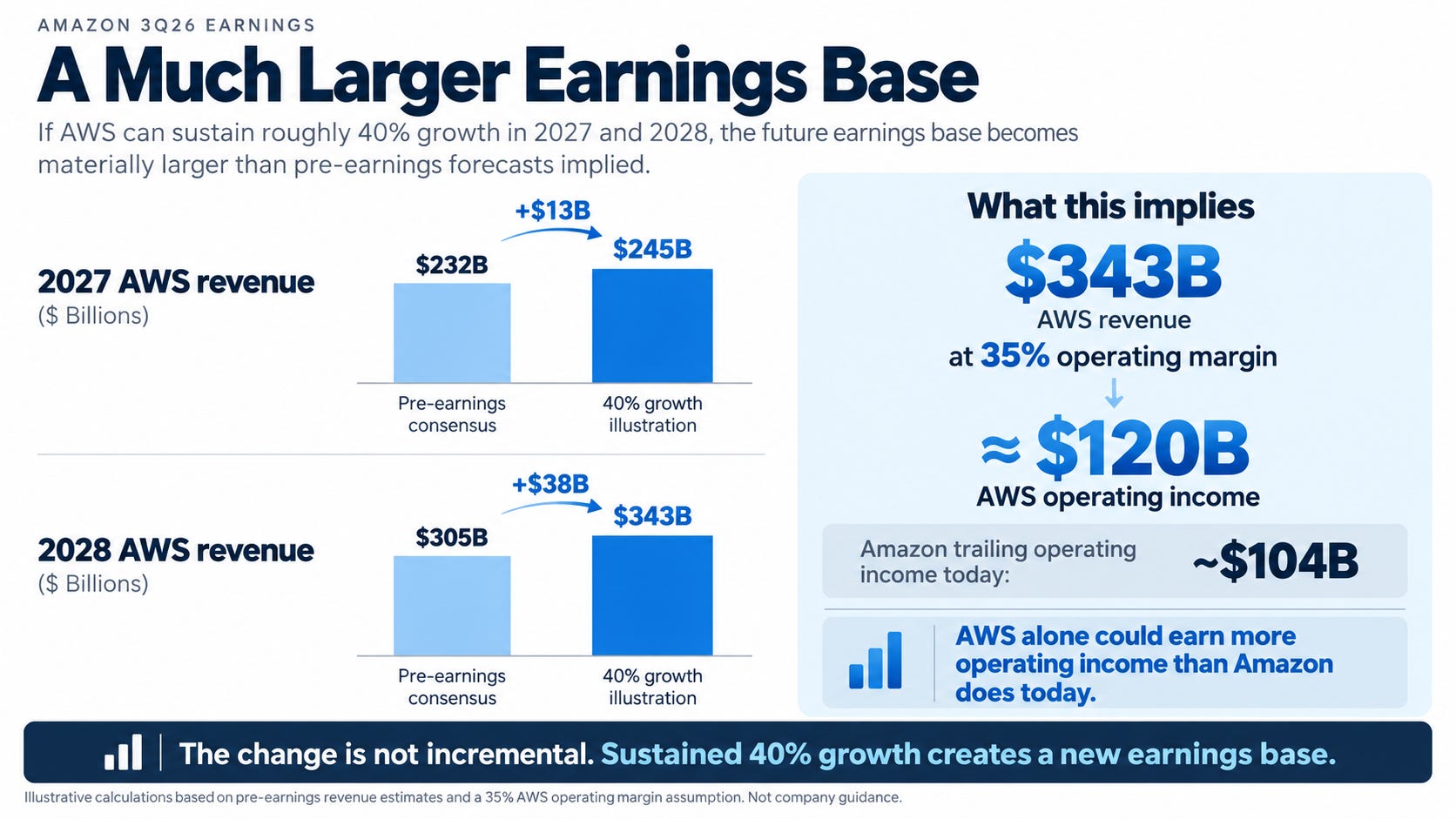
At a 35% operating margin, $343 billion of revenue would produce approximately $120 billion of AWS operating income. That exceeds Amazon’s entire current trailing operating income of $104 billion. Even allowing margin compression, the potential change in earnings scale is substantial.
The revenue difference alone would contribute roughly $13 billion of additional operating income at the same assumed 35% margin. That is a sensitivity, not a claimed beat against segment-profit consensus: it assumes the additional revenue earns that margin and says nothing by itself about the capital needed.
Jassy’s confidence rests partly on customers reserving hundreds of megawatts, sometimes a gigawatt, years ahead. Backlog reached $578 billion, up $82 billion sequentially. Those reservations improve visibility, but backlog is not revenue already earned, cash already collected, or proof of attractive pricing. Customer concentration and financing remain material unknowns.
The quarterly pattern also deserves attention. AWS’s sequential addition slowed from $4.65 billion in Q2 to $3.75 billion in Q3. Management attributed the variation to uneven capacity additions. That is plausible, but it cannot become a permanent explanation for missing the new growth trajectory.
My conclusion is nevertheless constructive: Amazon has supplied a credible reason to raise our expectations for future operating earnings. Whether those earnings deserve a premium valuation depends on why customers keep choosing AWS and what Amazon must spend to serve them.
The Advantage After Scarcity
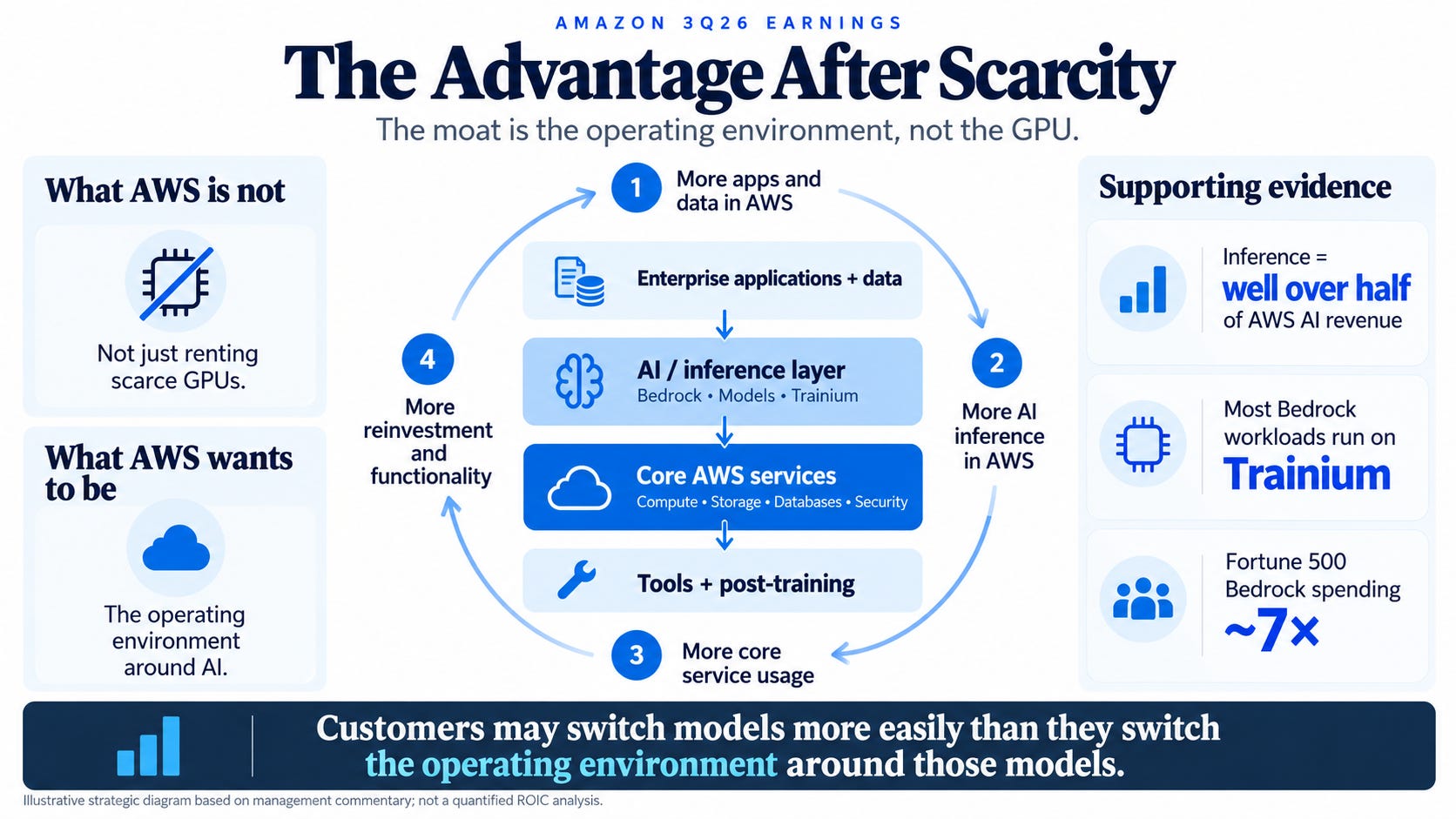
The strongest strategic claim was not the trillion-dollar ambition. It was Jassy’s explanation of why AWS should remain advantaged when computing capacity becomes less scarce:
“In AWS, having the leading functionality, security, and operational performance can’t help but drive customers to run their apps and store their data in AWS, which can’t help but drive AWS AI demand because customers prefer their production inference to be near the rest of their data and apps, which can’t help but drive core AWS demand because AI uses core for work like reinforcement learning, post-training, and tool usage, which can’t help but drive reinvestment back into our broader AWS functionality. This is a different model than primarily hosting GPUs or renting short-term data center capacity. This is a long-term platform strategy that broadly helps customers invent and evolve their customer experiences, operate stably, and build a reliable partnership they can grow for many years. It also yields very attractive long-term economics for us, regardless of supply scarcity.”
This is the mechanism our July article identified, now articulated more explicitly by management. An enterprise agent does not merely generate text. It retrieves information, calls applications, checks permissions and records actions. The model supplies intelligence; the surrounding infrastructure makes that intelligence useful. Amazon can earn revenue from both. Past Articles on Amazon
The important customer relationship is therefore not simply access to an accelerator. It is the operating environment containing the customer’s applications and data. Moving inference between providers may be relatively easy; recreating every integration, permission and operational dependency is harder. That is the potential source of durability after capacity shortages disappear.
Management’s evidence is encouraging. Core compute and storage grew at their fastest rates in several years. Inference represents well over half of AWS AI revenue, and most Bedrock workloads run on Trainium. Fortune 500 spending on Bedrock increased nearly sevenfold. These disclosures support the platform argument, although none isolates its incremental return on capital.
The silicon matters because Amazon can lower the cost beneath a service customers already use. Customers choosing Bedrock need not choose their accelerator separately. If several models become sufficiently capable for most workloads, as Jassy expects, model choice can become a feature of AWS rather than a reason to leave it.
That does not guarantee Amazon retains the savings. Competition can pass them to customers. Olsavsky also acknowledged that AI margins remain below core AWS margins, creating dilution as AI grows. Our valuation therefore should not assume today’s margin simply survives unchanged; the base case below uses 36%, not 38.7%.
External Trainium sales, planned for late 2027, add another way to monetize the capability. Selling equipment recognizes revenue sooner and transfers much of the deployment financing to the customer; operating it inside AWS can yield years of service revenue but requires more capital. Jassy explained the trade-off without quantifying comparable returns. I treat external sales as an option, not a separate profit pool to add on top of cloud earnings from the same chips.
The advantage I am underwriting is consequently broader than cheaper inference. It is Amazon’s ability to combine cost-efficient computing with services customers need to operate enterprise applications. Q3 strengthens that case without proving every part of it.
The Financing Error We Must Own
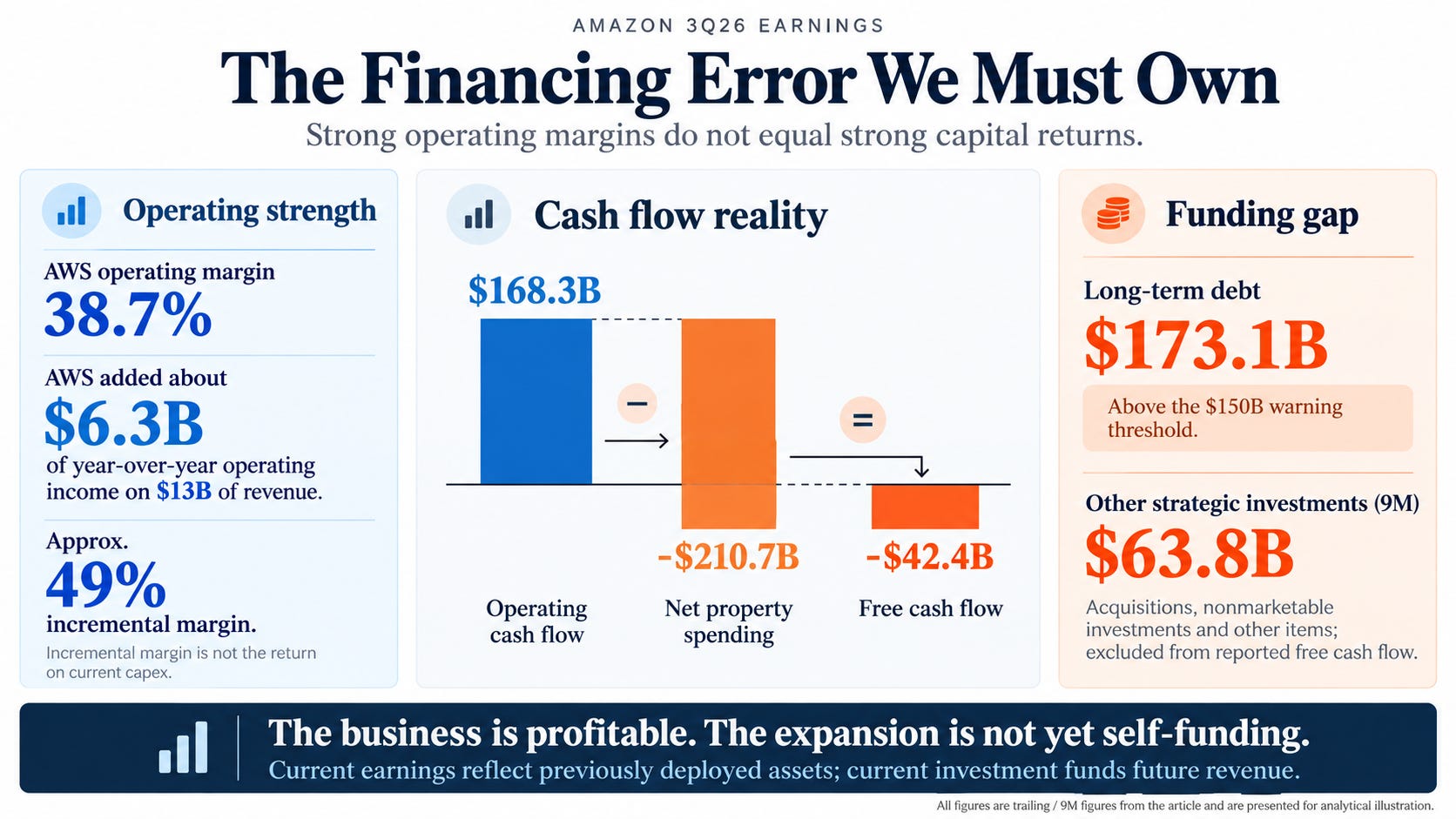
The strongest objection is that attractive operating margins can coexist with disappointing returns on a rapidly expanding capital base. Our July article anticipated the mechanism:
“Every capacity cohort may earn a good return, reveal still more demand, and justify a larger cohort before the cash from the previous one appears in consolidated results. Operating cash flow rose 33% to $161.4 billion. Net property spending rose 64% to $169.0 billion. Free cash flow turned negative. Long-term debt nearly doubled in six months.” Past Articles on Amazon
Q3 made that imbalance larger. Trailing operating cash flow reached $168.3 billion, but net property spending reached $210.7 billion, leaving negative free cash flow of $42.4 billion. Long-term debt reached $173.1 billion, exceeding the $150 billion warning threshold we retained in July.
We should acknowledge that miss without rewriting the original thesis. Debt financing was already part of our April analysis; Q3 changes its magnitude, not its existence. Nor can consolidated operating cash flow be attributed entirely to retail and advertising. AWS itself contributes to the company’s cash generation. Past Articles on Amazon
There is a second financing demand outside the headline capex figure. Amazon spent $63.8 billion during the first nine months in the category covering acquisitions, nonmarketable investments and other items. That is excluded from its reported free-cash-flow measure. Not all borrowing finances data centers, and strategic investments in AI customers must be evaluated separately from infrastructure spending.
The operating evidence still argues against treating this as indiscriminate expansion. AWS added approximately $6.3 billion of year-over-year operating income on $13 billion of revenue. But that roughly 49% incremental margin is not the return on this quarter’s capex: current earnings reflect previously deployed assets, mature services and accounting depreciation, while much current spending supports future revenue.
Retail remains relevant to the funding capacity. Units grew 12% against 11% shipping-cost growth, restoring the favorable spread we flagged in July. Advertising is less reassuring: constant-currency growth slowed to 12%, below our threshold, despite credible explanations involving Prime Day and other comparisons. Management’s promised high-teens Q4 recovery now needs to happen.
The evidence favors productive reinvestment over wasteful expansion, but fully burdened returns remain unproven. My response is to lower assumptions about cash conversion and allow for financing not to ignore the debt, and not to assume negative free cash flow disproves the business.
What the Stronger Business Is Worth
Our variant perception is not that AWS is growing quickly. It is that Amazon can sustain a larger earnings base than the pre-earnings forecasts implied, while preserving enough profitability to compensate shareholders for the capital required.
That is more demanding than accepting Jassy’s revenue outlook. It requires lower-cost silicon, utilization and operating efficiency to offset some AI margin dilution. It also requires the investment programme eventually to generate cash beyond its continuing expansion. The share-price decline offers a better starting valuation; it does not prove that the market is wrong.
I value 2029 operating income after depreciation and stock compensation, rather than capitalize investment gains or add back the cost of running the infrastructure. The starting assumptions are approximately $829 billion of 2026 group revenue, comprising $175 billion of AWS and $654 billion of everything else.
The calculation is terminal operating income multiplied by the enterprise-value multiple, plus the net financial-asset bridge, divided by diluted shares. The bridge is an assumption, not a forecast balance sheet; an additional $100 billion of net liabilities would reduce each value by approximately $9.
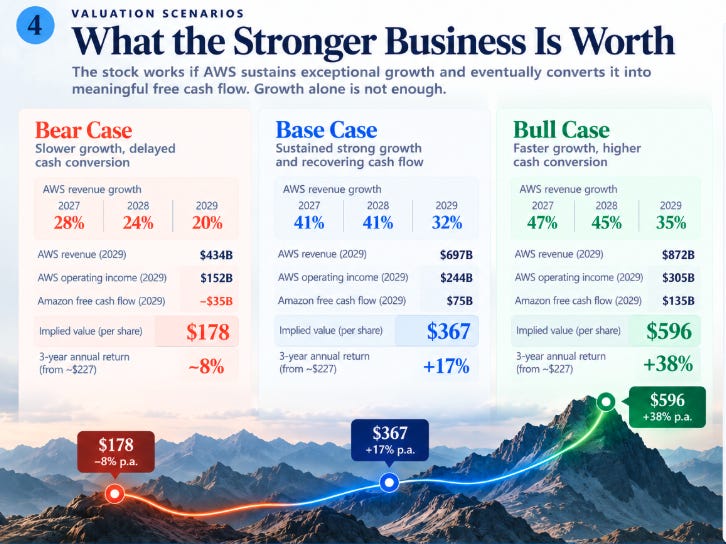
Cash flow is a separate test, not something mechanically inferred from operating profit. The scenarios assume 2029 operating cash flow/cash capex of $285/$320 billion, $360/$285 billion and $440/$305 billion, respectively. These assumptions are demanding, especially the recovery in the base case, and are not independently verified forecasts.
The base case lets AWS’s margin decline and its growth moderate in 2029. Its $367 valuation sits within July’s published $345–425 range, although this model uses operating income rather than the earlier table’s P/E approach. The bull value remains within the earlier $540–690 range. The bear value falls below the previous $200–240 range because financing and cash-conversion risks have increased. Past Articles on Amazon
Assigning subjective probabilities of 25%, 50% and 25% produces a weighted value around $377. I would not confuse that arithmetic with precision: terminal multiples, asset returns and financing outcomes drive the distribution. Nevertheless, approximately 17% annualized upside in the base case makes selective accumulation around $220–230 attractive to me. The bear value is not a guaranteed floor.
The thesis now has concrete tests. AWS should deliver approximately 40%-plus growth in 2027 while maintaining underlying margins around 36–39%; growth repeatedly below 30% despite available capacity, or margins below 35% for several quarters, would challenge the operating case. Advertising should recover to high-teens growth in Q4, while shipping costs should continue growing more slowly than units.
The financial test must not keep moving. July called for operating-cash-flow growth to begin overtaking capital-spending growth during 2027. I retain that as an important signpost, alongside broader paid Trainium adoption beyond strategically financed customers. More backlog without better conversion, or continued rapid debt accumulation without improving capital returns, would push the valuation toward the downside case. Past Articles on Amazon
The next major checkpoint is the Q4 report and a quantified 2027 spending plan. My judgment today is that Amazon’s operating opportunity has improved enough to outweigh the greater financing burden at the reduced price. We underestimated the funding required, but we also underestimated how large AWS could become. The right response is to incorporate both not let the cash-flow disappointment erase the stronger earnings evidence.
Disclaimer:
The content does not constitute any kind of investment or financial advice. Kindly reach out to your advisor for any investment-related advice. Please refer to the tab “Legal | Disclaimer” to read the complete disclaimer.