


TL; DR
AI has moved toward Amazon’s architecture. Agents require CPUs, storage, databases, security, and enterprise data—not just accelerators—turning AI into a multiplier on the rest of AWS.
The Foundry is strengthening the Engine Room. Amazon’s custom silicon and AI services increasingly support retail, advertising, logistics, and internal automation, creating a reciprocal flywheel across the company.
The remaining question is cash. AWS growth, margins, and backlog validate the investment, but each successful capacity expansion appears to justify an even larger one before shareholders see the free cash flow.
“We’ve long believed AWS could become a few hundred billion dollars revenue business and now believe it will be at least double that and very possibly be $1 trillion annual revenue business for us in time.”
— Andy Jassy
I have spent the past three quarters asking whether Amazon’s Engine Room could finance its Foundry.
In Q3, commerce, Prime, sellers, and advertising were generating enough cash to fund AWS, AI capacity, and custom silicon. In Q4, the Foundry stopped being one destination for Amazon’s surplus and became the organizing principle of capital allocation. Q1 proved that customers wanted what Amazon was building, but the balance sheet entered the story, and I ended with a deliberately hard conclusion: evidence was not yet cash.
Q2 makes the evidence overwhelming and the cash question harder.
AWS growth needed to remain above 27%; it reached 36.7%. Advertising needed to hold above 22%; it accelerated to 26%. Paid units needed to grow at least 12%; they rose 17%. Trainium needed customers beyond Amazon’s investment portfolio; OpenAI, Uber, Pinterest, and a growing group of AI companies appeared.
The two cash tests failed. Trailing free cash flow moved from positive $1.2 billion to negative $7.6 billion. Long-term debt reached $128.9 billion, close to the $150 billion level I had marked as a warning. Amazon then raised expected 2026 cash capital spending from $200 billion to $220 billion.
I was right about the demand. I was too conservative about how quickly it would become revenue and profit, and too optimistic about when those profits would become free cash flow.
That is enough reconciliation.
The deeper question is whether the nature of AI has changed in a way that makes Amazon’s old architecture once poorly suited to frontier-model training unusually well suited to inference and agents. If it has, AWS may have entered a cycle in which AI demand pulls the rest of the cloud behind it, cheaper internal silicon widens the profit pool, and better economics justify still more capacity.
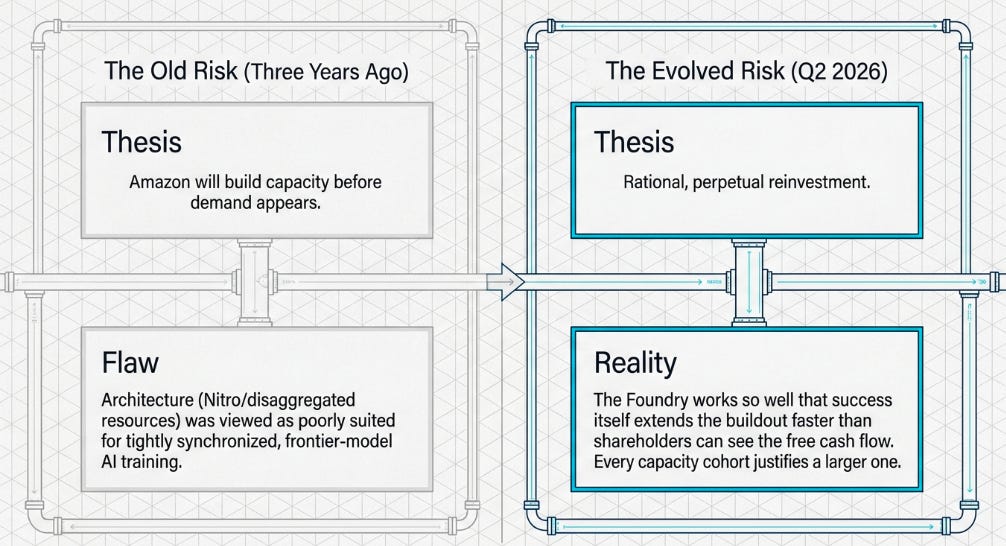
The risk is no longer that the Foundry fails. The risk is that it works so well it never finishes being built.
The Workload Moved Toward Amazon
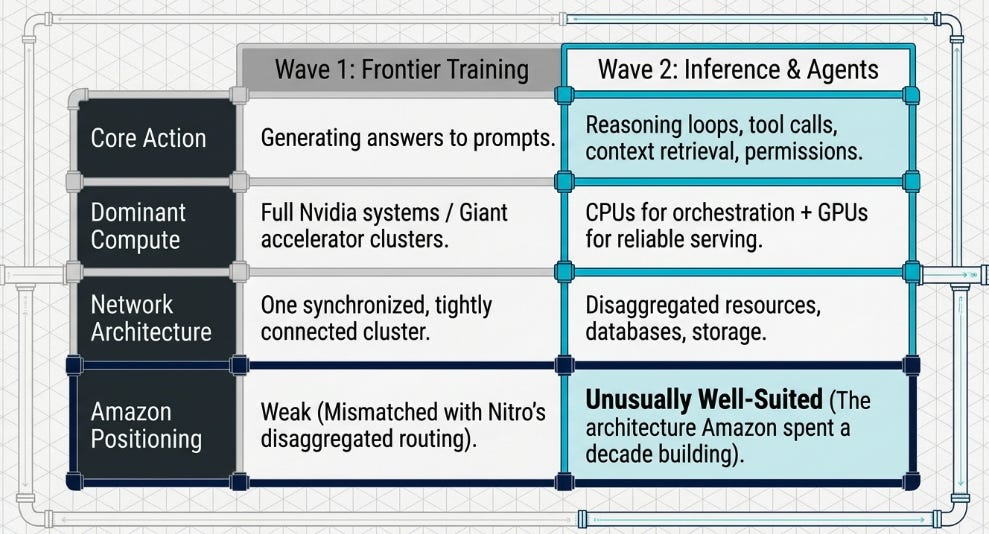
Three years ago, the case against AWS was persuasive.
The first generative-AI wave revolved around training giant models across thousands of tightly connected Nvidia accelerators. That job rewarded the fastest horizontal networking, full Nvidia systems, and clouds willing to reorganize their architecture around one synchronized cluster. AWS had spent years moving in a different direction: Nitro, its own networking, disaggregated resources, managed services, and custom chips built around the cost structure of general cloud computing.
Those choices made AWS weaker for frontier training. The criticism was right. Then AI changed shape.
The first wave generated answers to prompts. Reasoning models began generating many more tokens before producing an answer. Agents now trigger those reasoning loops repeatedly, retrieve context, call software, query databases, check permissions, save memory, and act again without waiting for another human instruction.
Each shift changes what the underlying system must do well.
Training wants one giant accelerator cluster. Production inference needs reliable serving near the model. Agents need CPUs for orchestration and tool calls, storage for memory, databases for context, identity and security for permissions, and access to the applications and proprietary data on which they are supposed to act.
That sounds much more like AWS.
Nitro was designed to separate and route different resources efficiently. Graviton was built to own the CPU cost curve. AWS’s broader advantage was that much of the enterprise data and software an agent needs already lived there.
AWS did not suddenly repair every weakness identified during the training era.
The workload moved toward the architecture Amazon had already spent a decade building.
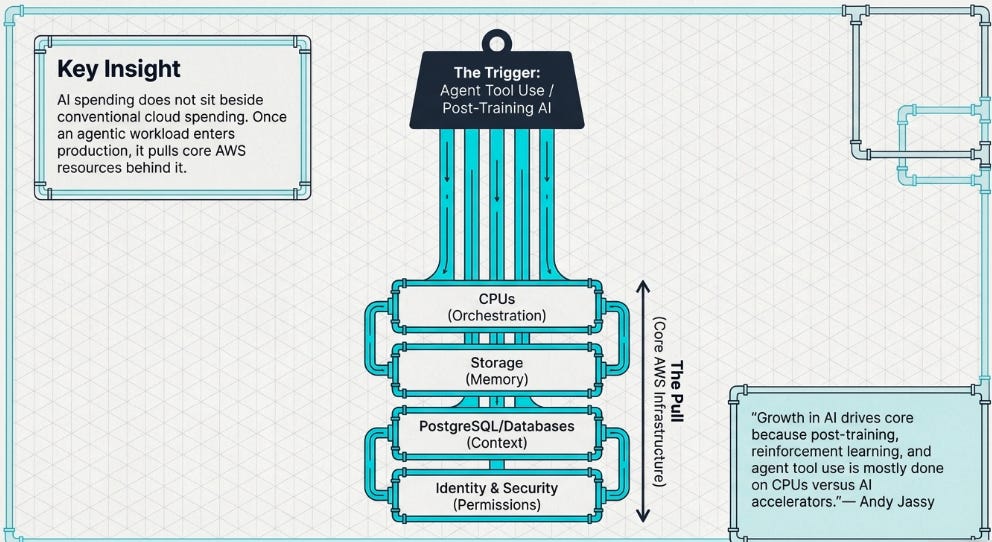
Jassy described the commercial consequence:
“Growth in AI drives core because post-training, reinforcement learning, and agent tool use is mostly done on CPUs versus AI accelerators.”
This is a claim about the structure of demand, not a product boast. AI spending does not sit beside conventional cloud spending. Once a workload enters production, it pulls CPU cycles, storage, databases, networking, security, and observability behind it.
AI becomes a multiplier on the rest of AWS.
Microsoft independently described the same mechanism two days earlier. Satya Nadella said CPUs were “just as important as GPUs” for agents, while Microsoft highlighted rising demand for PostgreSQL, Fabric, Foundry, enterprise context, identity, and security. Amy Hood said additional CPU and GPU capacity was monetized almost immediately once engineering teams made it available.
Two competitors are describing the same system. That makes it harder to dismiss Jassy’s explanation as earnings-call framing.
Amazon may be better placed to collect on it because more applications and data already reside in AWS, and because Graviton gives it a credible, widely adopted CPU cost advantage.
The financial evidence is striking:
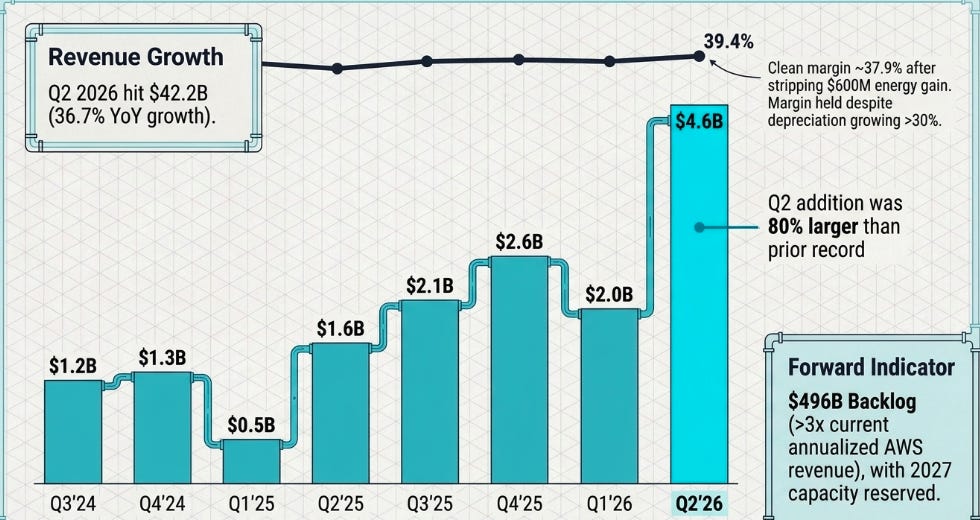
Q2’s $4.6 billion sequential increase was about 80% larger than AWS’s prior record. Growth accelerated for the fifth straight quarter. Backlog reached $496 billion, more than three times current annualized AWS revenue, although Amazon did not disclose the duration, customer concentration, or conversion schedule. Most 2027 capacity is reserved, and Jassy described demand already committed for 2028 as “striking.”
Then there was margin.
Reported AWS operating margin reached 39.4%, including a $600 million energy-contract gain. Strip that out and clean margin was still roughly 37.9%, slightly above Q1, while depreciation grew more than 30%.
Growth accelerated by nine points. Margin held.
At a $169 billion revenue run rate.
Part of that reflects high utilization, mature core services, software improvements, and cost discipline. Trainium cannot explain every basis point. It does, though, explain why margins like these may persist.
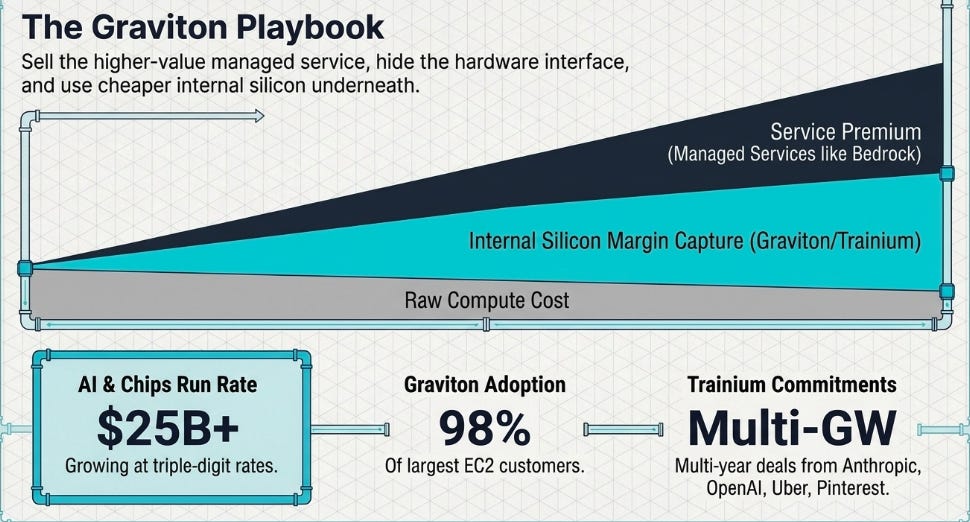
The lower layers of inference are becoming more commodity-like. Customers increasingly consume an outcome through Bedrock or another managed service rather than selecting a chip directly. When models can be swapped and the interface hides the hardware, cost structure matters more. A provider paying full third-party silicon margins sets one cost benchmark; Amazon can run a growing share of its services on Trainium and retain the difference.
That is the old Graviton playbook: sell the higher-value service and use cheaper internal silicon underneath.
Amazon’s AI and chips businesses have each passed $25 billion annual revenue run rates, both growing at triple-digit rates. Graviton is used by 98% of the largest EC2 customers. Trainium has multi-year, multi-gigawatt commitments from Anthropic and OpenAI. Jassy previously said Trainium could save tens of billions of dollars in annual capital spending and add several hundred basis points of margin at scale.
Q2 does not prove the whole claim. It makes it much easier to believe.
The Engine Room Learns from the Foundry
It would be a mistake to write this as an AWS-only quarter.
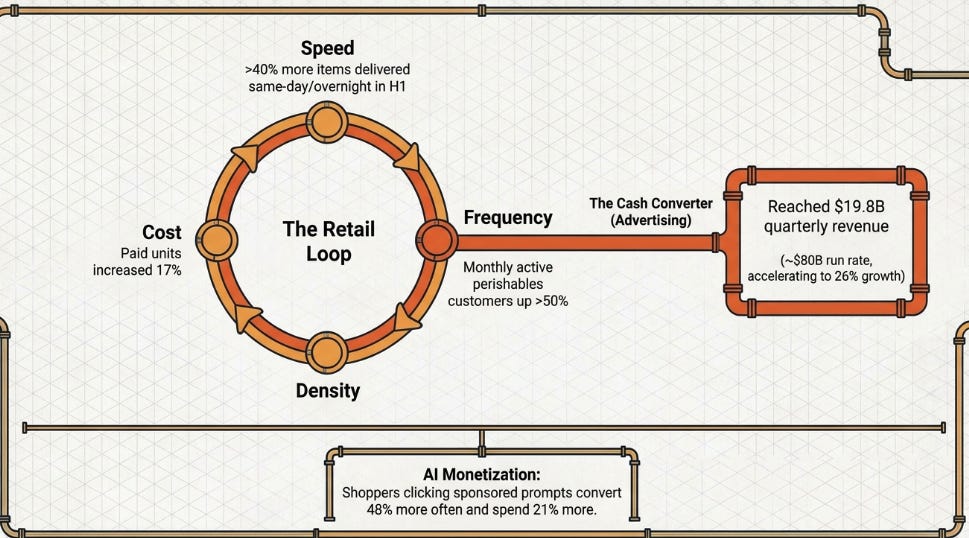
Online stores grew 15%, up from 9% in Q1. Third-party seller services grew 16%, up from 12%. Paid units increased 17%. North America and International revenue grew 16% and 15%, respectively. Advertising stepped from four quarters at 22% growth to 26%.
Retail’s mechanism is speed.
Amazon delivered more than 40% more items on the same day or overnight in the first half. Monthly active perishables customers rose more than 50% since January. Same-day orders containing perishables carried more than three times as many units. Pharmacy doubled new customers, and same-day prescription deliveries increased nearly fivefold.
A two-day service is useful for a planned purchase. Same-day delivery can become the default for milk, medicine, toiletries, and whatever the household forgot this morning.
Speed increases frequency. Frequency improves inventory and route density. Density lowers unit cost and supports wider selection and faster delivery.
Then it repeats.
There was one crack. Shipping costs grew 19%, two points faster than paid units. For three quarters I had treated units growing faster than shipping costs as evidence that the retail network was gaining operating strength. That spread reversed. Olsavsky blamed fuel inflation and higher linehaul rates, with an FBA surcharge offsetting part of the pressure.
I am willing to accept the explanation for one quarter. I will not ignore the metric.
North America’s reported 7.9% margin also included a $600 million tariff refund. Clean margin was closer to 7.3%, below Q1. Retail demand accelerated, but the cost advantage did not widen.
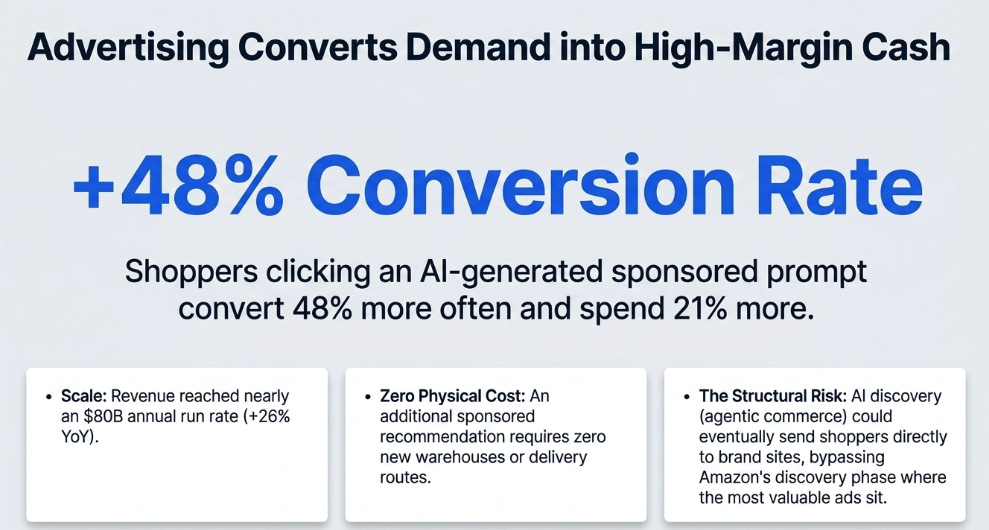
Advertising converts that demand into cash.
The business reached $19.8 billion in quarterly revenue, nearly an $80 billion annual run rate. Amazon does not disclose its profit, but the economics are attractive: the shopping traffic, purchase data, and customer relationship already exist. An additional sponsored recommendation does not require another warehouse or delivery route.
AI is creating more monetization surfaces. Shoppers who click a sponsored prompt convert 48% more often and spend 21% more. Advertisers using Ads Agent see lower costs per impression and acquisition. Prime Video adds attention outside the store; inventory across the NFL, NBA, WNBA, and NASCAR sold out.
There is a real risk. AI discovery may send more shoppers directly to brand sites and Shopify merchants, leaving Amazon with fulfillment while weakening the discovery moment where its most valuable ads sit. For now, agentic commerce looks more like a referral channel than a distributor that owns checkout. That gives Amazon time to build sponsored prompts into Rufus and Alexa without surrendering the customer relationship.
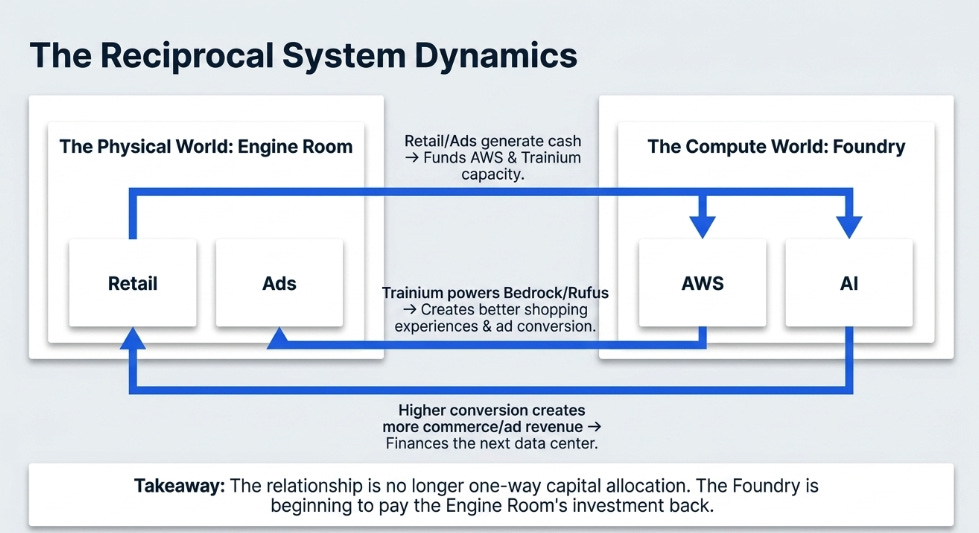
This is the update to the Engine Room and Foundry framework.
The Engine Room still supplies the cash. Retail creates traffic and transaction data. Advertising monetizes it. Prime deepens the relationship.
The Foundry is beginning to pay some of that investment back. Trainium runs Bedrock; Bedrock supports Rufus, Alexa, advertising tools, and internal automation; better shopping experiences drive conversion and purchase frequency; more commerce creates more advertising revenue; that revenue helps finance the next data center.
The relationship is now reciprocal.
Amazon Supply Chain Services shows the same corporate formula in the physical world. Amazon built logistics for itself, reached extraordinary scale as its first customer, then began selling the capability to P&G, 3M, Lands’ End, and American Eagle.
AWS was born this way. Logistics may be next.
The Market Paid for Proof
Amazon raised expected 2026 cash capital spending from $200 billion to $220 billion, largely because memory costs increased, and the shares rose.
The market does not hate capital spending. It hates spending it cannot underwrite.
Alphabet delivered extraordinary Google Cloud growth, margin, and backlog, yet a larger capex shock and negative quarterly free cash flow overwhelmed that evidence. Microsoft paired accelerating Azure with positive free cash flow and a clearer path to containing consolidated margin pressure. Amazon supplied the most explicit asset-level return math of the three.
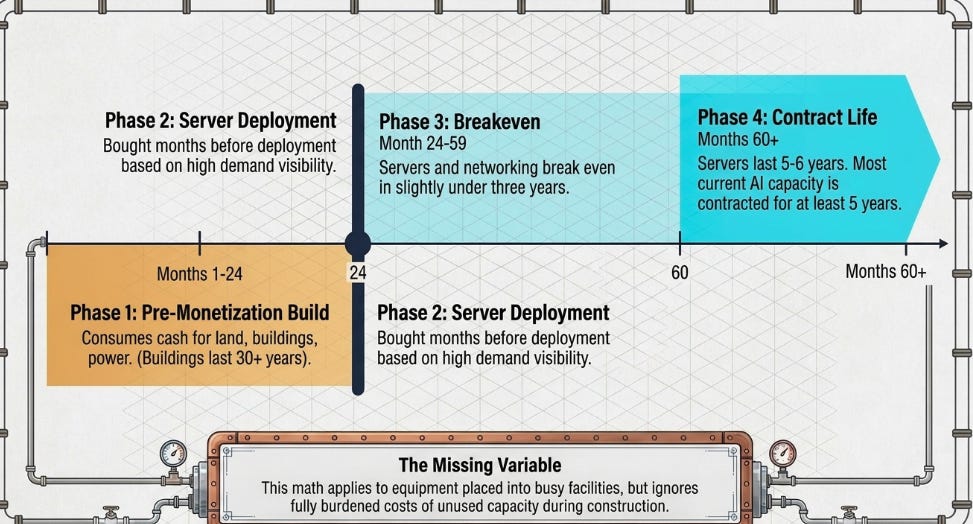
Data centers begin consuming cash roughly two years before monetization, but the buildings last more than 30 years and can host several generations of servers. Servers are bought only months before deployment, when Amazon has much better demand visibility. They break even in slightly under three years, last five to six years, and most current AI capacity is contracted for at least five.
The math is attractive. It is not complete.
The sub-three-year break-even applies to servers and networking, not the fully burdened cost of land, buildings, power, financing, and unused capacity during construction. Amazon proved that equipment placed into a busy facility can earn strong returns. It has not shown when the total capital program generates cash for shareholders.
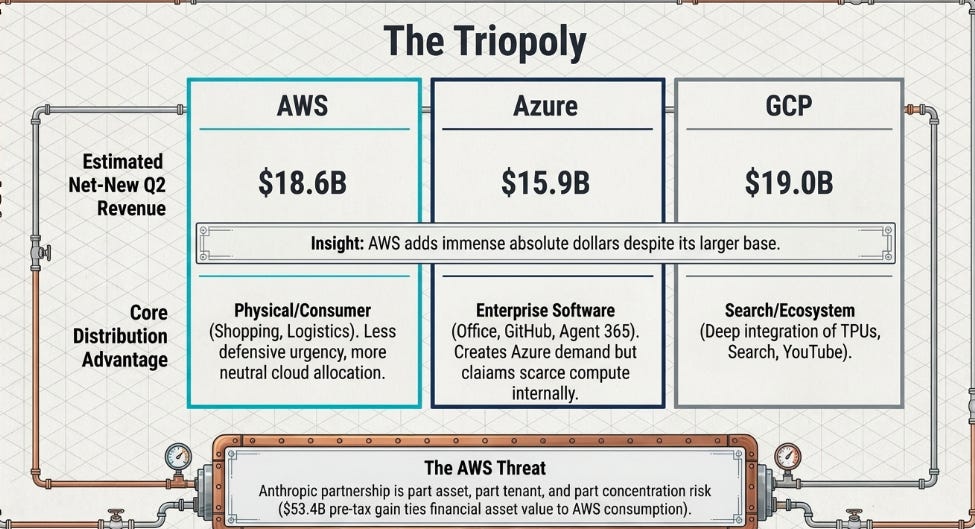
The peer comparison adds another wrinkle. Estimated annualized net-new cloud revenue in the quarter was roughly $19.0 billion for GCP, $18.6 billion for AWS, and $15.9 billion for Azure. The figures are estimates and contract timing differs, so I would not build an entire thesis around them. They do invert the lazy percentage-growth narrative: AWS is adding immense absolute dollars despite its larger base.
Microsoft owns the strongest enterprise distribution through Office, GitHub, identity, security, and Agent 365. Those products create Azure demand, though they also claim scarce compute for Microsoft’s own use. Google has the deepest integration among models, TPUs, Search, YouTube, advertising, and Cloud.
Amazon’s consumer businesses are more physical. AI tends to improve shopping, logistics, and advertising rather than directly replace them. That may give Amazon less defensive urgency when allocating capacity between internal products and external customers.
Less. Not none.
Amazon is building Rufus, Alexa, Quick, Kiro, its own models, and a deep Anthropic partnership. The neutrality advantage remains a hypothesis.
Management’s new disclosures were designed to make the capital easier to accept: $496 billion of backlog, $25 billion-plus AI and chips businesses, capacity reserved through 2028, five-year contracts, and explicit break-even math.
What Amazon left out is where the uncertainty now lives.
It did not disclose how much backlog belongs to Anthropic and OpenAI, how much the AI and chips numbers overlap, when the backlog converts, the split between short- and long-cycle capital, fully burdened returns, or the expected free-cash-flow inflection. Asked about funding, Olsavsky said Amazon had “a lot of options.”
A non-answer.
Anthropic is part asset, part tenant, and part concentration risk. The $53.4 billion pre-tax gain made Q2 net income meaningless for operating analysis. It also confirmed that Amazon owns a valuable financial asset whose value and AWS consumption are tied to the same relationship.
Useful. Complicated.
A Foundry That Never Finishes
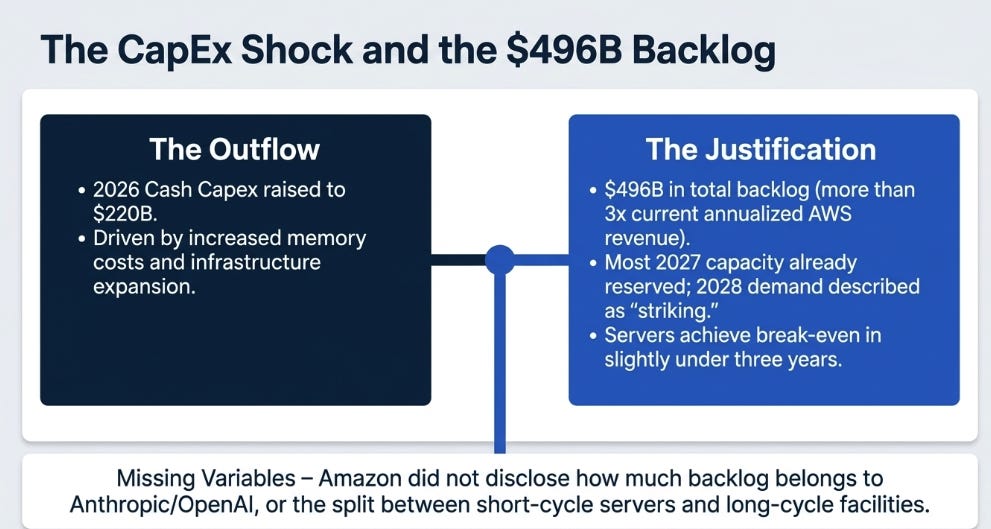
The old bear case was that Amazon would build capacity before demand appeared. Q2 weakened it. The new risk is rational perpetual reinvestment.
Every capacity cohort may earn a good return, reveal still more demand, and justify a larger cohort before the cash from the previous one appears in consolidated results. Operating cash flow rose 33% to $161.4 billion. Net property spending rose 64% to $169.0 billion. Free cash flow turned negative. Long-term debt nearly doubled in six months.
The Q3 headline guide is distorted because Prime Day moved from Q3 last year into Q2 this year, with nearly four points of calendar impact and another 80 basis points of currency pressure. AWS has no Prime Day.
I would underwrite a wide $2.5–4.0 billion sequential AWS addition, implying roughly 35–40% growth. The range is wide because Amazon gave strong demand commentary but no quarterly capacity schedule. Below 30% would reopen the question of whether Q2 was a concentrated capacity release. Clean margin below 35% would suggest that depreciation is arriving faster than the benefits from utilization and custom silicon.
For valuation, consolidated operating income is the cleaner primary anchor. A sum-of-the-parts view is useful because AWS, advertising, commerce, and Anthropic have very different economics, but it can count the same traffic, data, and AI investment twice.
At a post-print price around $258, my three-year ranges are:
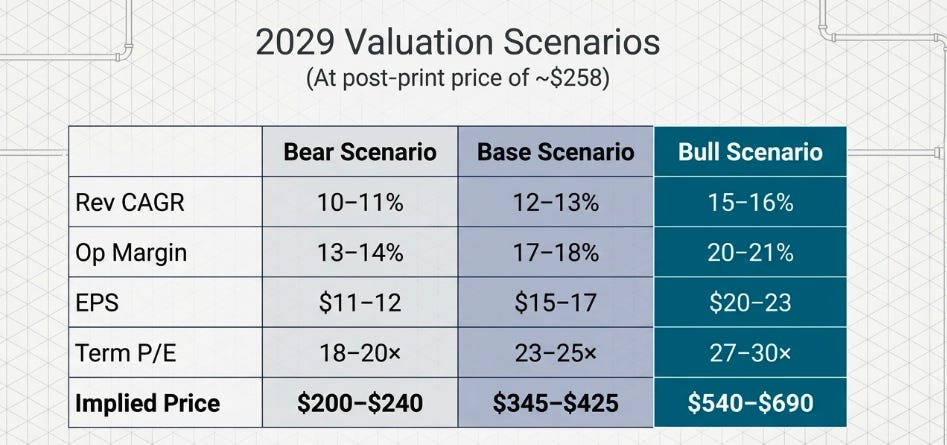
The numbers are not the thesis. They show where the thesis matters.
AWS must keep adding at least $3 billion of quarterly revenue or explain the capacity timing. Clean AWS margin should remain above 35–36%. Advertising needs to hold above 20%. Shipping-cost growth must fall back below unit growth. Debt should remain near or below $150 billion at year-end. Above all, operating-cash-flow growth needs to begin outrunning capital-spending growth during 2027.
Q4 was the declaration. Q1 proved the demand. Q2 proved the operating economics.
The remaining proof is cash.
The Foundry works. The question is whether Amazon’s success keeps extending the buildout faster than shareholders can ever see it.
Disclaimer:
The content does not constitute any kind of investment or financial advice. Kindly reach out to your advisor for any investment-related advice. Please refer to the tab “Legal | Disclaimer” to read the complete disclaimer.