


TL; DR
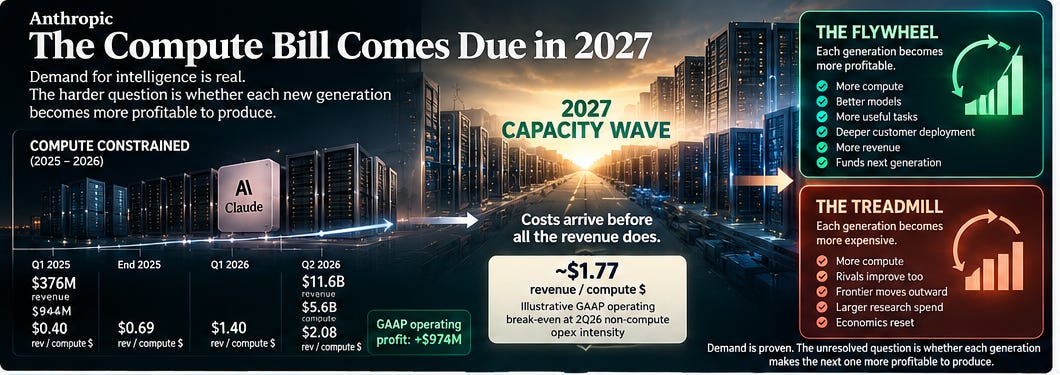
Anthropic has already demonstrated extraordinary commercial demand: quarterly revenue rose from $376 million in Q1 2025 to roughly $11.6 billion in Q2 2026, while revenue per dollar of compute improved from $0.40 to $2.08 and the company reached GAAP operating profitability.
But those economics may partly reflect scarcity: compute is contracted 12–18 months in advance, so revenue recently grew much faster than available capacity. As the next wave of infrastructure arrives, Anthropic must prove that higher utilization and model efficiency not simply constrained supply are driving the operating leverage.
The real 2027 test is flywheel versus treadmill: better models can expand usage and deepen customer relationships, but if OpenAI and Google improve just as quickly, productivity gains may simply fund a larger research race. The key question is whether each generation strengthens Anthropic’s capability, cost or customer advantage enough to make the next one more profitable.
In 2021 and 2022, container shipping enjoyed the most profitable period in its history. Pandemic disruptions had constrained capacity, freight rates multiplied, and shipping companies rushed to order new vessels. Maersk generated $30.9 billion of operating profit in 2022, an extraordinary result for an industry accustomed to considerably thinner margins.
The economics changed before much of that new capacity could arrive. By the second quarter of 2023, Maersk’s EBITDA had fallen 72% from a year earlier. Freight rates had normalized, companies were destocking, and the exceptional conditions of the pandemic had disappeared. The ships ordered during the shortage would arrive in a market that had already changed.
The lesson was not that ships were unnecessary or that global trade had stopped growing. It was that capacity committed during a shortage could arrive after the economics supporting that shortage had changed.
Anthropic’s October 26 S-1 raises a similar question about artificial intelligence, although with an important difference. Unlike container shipping, increasingly capable intelligence can create entirely new sources of demand rather than merely serve an existing market.
The filing reveals a business generating $11.6 billion of quarterly revenue, with extraordinary customer growth and its first quarter of GAAP operating profitability. It also reveals hundreds of billions of dollars in infrastructure commitments, much of which will become operational over the next several years.
On the same day, Broadcom and a consortium of financial institutions announced a $63 billion financing arrangement to acquire AI accelerators and networking equipment for lease to Anthropic. The transaction finances part of an existing compute agreement, not additional orders.
Together, these disclosures capture the central tension in the AI trade. Demand for intelligence is real and expanding rapidly. But the infrastructure required to produce it is being financed on the expectation that demand will become considerably larger.
My reading is that Anthropic has sufficient financial resources to make a near-term liquidity crisis unlikely. But 2027 will test whether its extraordinary operating leverage represents a durable economic advantage or the temporary benefit of revenue growing faster than available compute.
The distinction matters well beyond Anthropic. An intelligence business that compounds its economic advantage could support successive waves of infrastructure investment. An escalating research arms race could also generate enormous hardware demand while leaving the laboratories conducting that research with disappointing shareholder returns.
Efficient Because Compute Was Scarce
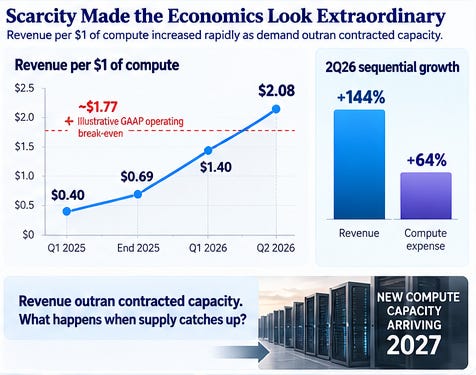
Anthropic’s historical financial results are remarkable.
Quarterly revenue increased from $376 million in the first quarter of 2025 to approximately $11.6 billion in the second quarter of 2026. Over the same period, compute and infrastructure expenditure rose from $944 million to approximately $5.6 billion.
Revenue per dollar of compute consequently increased from $0.40 to $2.08. At the end of 2025, the ratio had been just $0.69. It then increased to $1.40 in the first quarter of 2026 and $2.08 in the second.
The improvement was sufficient to turn a $1.7 billion GAAP operating loss in Q1 into a $974 million operating profit in Q2.
There has clearly been substantial improvement in commercial efficiency. But the mechanism is not simply that Anthropic learned to run its models at a fraction of their previous cost.
Compute is generally contracted 12 to 18 months before it becomes available. Infrastructure expenses are therefore relatively fixed in the near term, while revenue can change rapidly as new models and products attract customers. In the second quarter, revenue grew 144% sequentially while compute expenditure increased 64%.
Customers arrived considerably faster than the capacity needed to serve them.
Anthropic acknowledges having repeatedly underestimated its compute requirements, leaving the company capacity-constrained and affecting both product development and deployment. The shortage helps explain the recent improvement in utilization and operating leverage, alongside genuine advances in model efficiency, pricing and product mix.
It also identifies the risk ahead.
Anthropic is now securing much larger amounts of capacity. Once that capacity becomes available, expenses begin before the company necessarily generates the additional revenue expected from the investment.
The current economics provide a useful benchmark. In Q2 2026, operating expenses other than compute represented approximately 43.5% of revenue. Holding that ratio constant, Anthropic needs roughly $1.77 of revenue per dollar of compute expenditure to break even at the GAAP operating level. Only Q2 2026 clears that threshold among the six quarters disclosed.
That ratio is not a permanent break-even point. Personnel costs, distribution expenses and stock-based compensation will change as the company scales. Nor does revenue per compute dollar isolate technological efficiency from utilization and pricing.
Nevertheless, it demonstrates how quickly exceptional profitability can turn into operating losses when compute represents such a large portion of expenditure.
And it raises a deeper question: why must Anthropic keep buying so much compute even after its existing models become more efficient?
A Flywheel or a Competitive Treadmill?
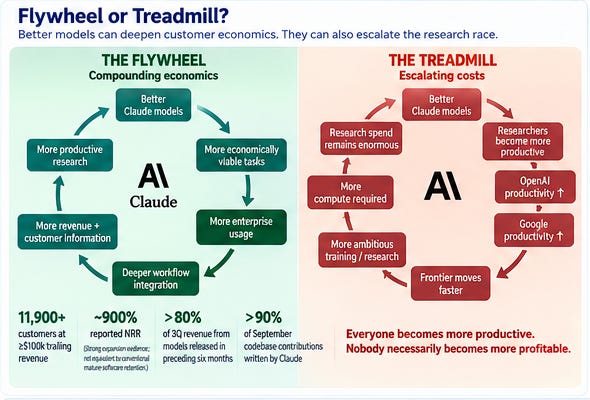
Anthropic’s economics are more complicated than those of a conventional software company because compute is not used exclusively to serve paying customers. It is also used to develop better models.
The supplemental financial statements show $2.38 billion of cost of revenue in the first half of 2026 against $16.29 billion of revenue, implying an 85% functional gross margin.
That is extraordinary. But during the same six months, Anthropic spent $9.74 billion on research and development, while total compute and infrastructure expenditure reached $8.95 billion.
These expense classifications do not reveal precisely how compute is divided among inference, training, research and internal usage. The 85% gross margin should therefore not be interpreted as the economic margin on all customer-serving compute.
What is clear is that Anthropic is investing enormous resources to develop the next generation of intelligence, not simply to deliver the intelligence it has already developed.
The economics of those activities are fundamentally different. Serving an existing model becomes more profitable as utilization increases, inference improves and customers consume more intelligence. Developing the next frontier model is partly a competitive necessity.
If OpenAI or Google produces a substantially more capable model, Anthropic may need to accelerate its research regardless of how profitable its current products have become.
The S-1 reports that models released in the preceding six months generated more than 80% of Anthropic’s third-quarter revenue. That demonstrates rapid migration toward newer Anthropic models, not necessarily switching between competing suppliers. But independent transaction data also shows how competitive the market is. Among businesses tracked by Ramp, OpenAI narrowed Anthropic’s adoption lead during September even as Anthropic continued growing.
Anthropic does not simply own a technological lead and collect rent from it indefinitely. It must repeatedly defend that lead through better models, lower costs and deeper customer relationships.
Yet there is an equally powerful argument for compounding.
Better models make more activities economically viable. Customers consume more intelligence and integrate it into increasingly consequential workflows. That generates revenue to finance further research. Commercial deployment also provides information about reliability, costs and the capabilities customers value most, helping direct subsequent development.
Anthropic’s customer numbers support this possibility. More than 11,900 customers were generating at least $100,000 in trailing annual revenue by September, compared with approximately 1,500 at the end of 2025. The company also reported net revenue retention of approximately 900%.
That latter figure deserves careful interpretation. It means revenue from a qualifying cohort was approximately nine times its level in the corresponding quarter a year earlier. But customers need only have generated $1 in the base quarter to qualify, and consumer Pro and Max subscriptions are excluded. It is powerful evidence of expansion from small initial deployments, not proof of durable retention or switching costs.
The potential flywheel is nevertheless real. If customers embed Claude deeply into critical workflows, each generation of better intelligence could expand usage while making displacement progressively harder.
Anthropic is also using Claude to accelerate its own research and engineering. More than 90% of contributions to its codebase in September were written by Claude, and daily code contributions per engineer increased more than 45 times relative to 2024. Those figures do not establish equivalent gains in useful engineering productivity, but they demonstrate how extensively AI has entered the development process.
Now consider the alternative.
Suppose AI allows Anthropic to conduct twice as much productive research with the same resources. If OpenAI and Google achieve comparable improvements, all three laboratories may simply pursue more ambitious research.
The cost of reaching yesterday’s frontier falls, while expenditure on reaching tomorrow’s frontier continues increasing.
All three become more productive. None necessarily becomes more profitable.
That is the competitive treadmill: technological progress expands the market but competition prevents individual laboratories from retaining much of the value they create.
Both outcomes can coexist. Intelligence may transform software development, scientific research and engineering while competitive research expenditure absorbs much of the resulting surplus.
The question is not whether Claude improves its successors. It is whether those improvements create a widening advantage in capability, cost or customer relationships that competitors cannot readily replicate.
That distinction has enormous implications for semiconductor demand. A research arms race can support extraordinary accelerator and networking expenditure even when laboratory profitability deteriorates. A strong semiconductor cycle therefore does not automatically imply an equally strong profitability cycle for the companies purchasing the chips.
The Bill
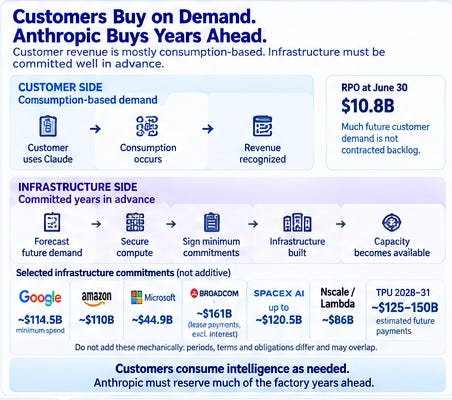
The S-1 shows the scale of the next infrastructure wave.
Anthropic has committed to minimum spending of approximately $114.5 billion with Google, $110 billion with Amazon and $44.9 billion with Microsoft over multiyear periods. These agreements are generally non-cancelable, subject to defined exceptions, and include payment obligations when actual spending falls below agreed minimums.
Separate Broadcom equipment leases involve approximately $161 billion of payments excluding interest. The GPU arrangements include up to $120.5 billion with SpaceXAI and approximately $86 billion with Nscale and Lambda. Additional TPU arrangements for 2028–31 involve estimated future payments of $125 billion to $150 billion.
These amounts should not simply be added into one definitive liability figure. Contractual periods differ, some categories may overlap, delivery conditions matter, and not every commitment represents an unconditional payment obligation.
But the mismatch is unmistakable.
Anthropic’s customers had committed $10.8 billion of remaining performance obligations at June 30, while the company had secured infrastructure involving hundreds of billions in potential future expenditure.
That comparison does not mean customers will spend only $10.8 billion. Anthropic’s revenue is predominantly consumption-based, so much of its future demand is not reflected in contractual backlog.
It means something more important: customers largely buy intelligence as they use it, while Anthropic must secure much of the capacity required to produce that intelligence years beforehand.
Whether that mismatch becomes dangerous depends on how much demand materializes, how quickly the capacity arrives and who ultimately bears the financial obligations.
Who Pays Meanwhile?
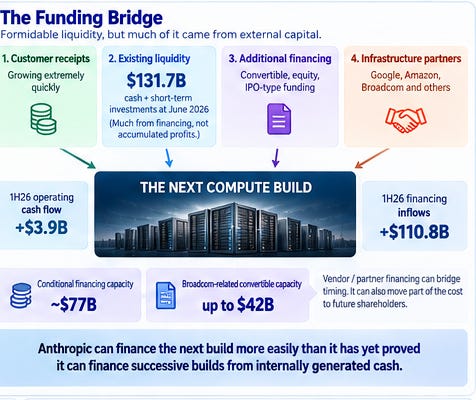
There are four sources of funding: customer receipts, previously raised equity, additional financing and capital supplied by infrastructure partners.
Anthropic held approximately $131.7 billion of cash and short-term investments at June 30, 2026. That is a formidable liquidity position, although the money was not primarily accumulated through operating profits. During the first half, operating cash flow was positive at $3.9 billion while financing activities generated approximately $110.8 billion.
The cash balance was built overwhelmingly through outside capital.
Nor should Anthropic’s $80.7 billion first-half GAAP net loss be confused with operating cash consumed. Approximately $72.4 billion reflected fair-value changes in convertible instruments and related liabilities, principally driven by the company’s rising valuation.
The earlier financing arrangements established much of the underlying economic dilution when they were agreed. Subsequent accounting losses largely reflected the increased value of those conversion rights.
The forward question is how much of the next investment cycle customer revenue can finance.
Consider an illustrative 2027 scenario. If Anthropic generates $113 billion of revenue, incurs $95 billion of compute expense and spends another $34 billion on other operating expenses, the resulting operating shortfall would be approximately $16 billion.
Against its existing liquidity, that appears manageable. But it is not a complete cash-flow forecast. Compute expenses and cash payments do not necessarily coincide, and finance-lease principal, capital expenditure, working capital and other obligations can materially change the outcome.
Nor can we yet establish precisely how much cash will be required each year. The preliminary S-1 leaves important aggregate contractual-obligation schedules incomplete, while potential IPO proceeds remain unspecified.
My base case is therefore not an immediate funding crisis during the 2027–28 expansion. Anthropic has substantial financial resources and a plausible path to supporting a meaningful portion of its expenditure through revenue. That is different from claiming every obligation has already been funded.
The company also has approximately $77 billion of conditional financing capacity under arrangements involving Google, Amazon and Broadcom. Those facilities are not equivalent to cash already received.
The Broadcom arrangement is particularly revealing. Anthropic can potentially issue up to $42 billion of convertible notes to finance equipment-lease obligations associated with Broadcom.
In economic substance, that is a form of vendor financing. It may be a rational way to fund productive infrastructure before the associated revenues arrive. But it can also shift part of the burden to future shareholders.
A rising valuation makes this financing easier. More capital supports better models, which attract customers and potentially justify the valuation. If competition absorbs those improvements, however, repeated financing may become necessary merely to remain competitive.
Anthropic’s ability to finance the next buildout is stronger than its demonstrated ability to finance successive buildouts entirely from internally generated cash.
Where Does the Risk Go?
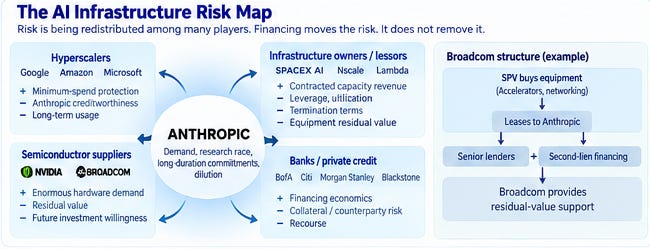
The financing arrangements also reveal that risk is distributed unevenly across the AI infrastructure supply chain.
Google, Amazon and Microsoft benefit from substantial minimum-spend protections. These improve revenue visibility but do not eliminate counterparty credit risk. Their value ultimately depends on Anthropic’s ability to meet its obligations.
SpaceXAI is different. Under agreements covering up to $120.5 billion of Nvidia-based capacity, fees are expected to reach approximately $3.1 billion per month once all capacity is delivered. Following initial non-cancelable periods ending in January and March 2027, either party can terminate the relevant agreements with 90 days’ notice.
That flexibility works in both directions. If Anthropic’s demand disappoints, it may be able to reduce a substantial portion of its compute bill. Conversely, if GPU rental prices increase materially, the provider may have an incentive to terminate rather than continue supplying capacity on less attractive terms.
Nscale and Lambda carry financing, delivery and acceptance conditions, but these should not be confused with unrestricted rights to cancel because customer demand is weak.
The $63 billion Broadcom financing illustrates another distinction. A special-purpose vehicle will acquire Broadcom equipment for lease to Anthropic, with senior financing arranged by Bank of America, Citi and Morgan Stanley and committed second-lien financing from Blackstone.
Broadcom is providing residual-value support equivalent to the first-lien portion. Its equipment revenue may be supported by firm demand, but the company retains contingent exposure to the value of the financed hardware.
The financing redistributes risk. It does not eliminate it.
My working hypothesis is that leveraged infrastructure providers with flexible customer agreements, substantial financial obligations and limited alternative demand for their capacity could experience stress before well-capitalized hyperscalers or Anthropic itself. Whether that happens depends on leverage, recourse, collateral values and actual contract terms.
For semiconductor investors, the broader implication is important. Nvidia, Broadcom and the networking and equipment supply chain can generate substantial revenue while the infrastructure owners have yet to demonstrate attractive returns on the capital deployed.
An escalating research competition can therefore remain excellent for hardware demand and much less attractive for laboratory shareholders. But the divergence cannot persist indefinitely if the laboratories lose access to financing or become unwilling to commit to successive infrastructure cycles.
The AI trade is not one homogeneous investment. The laboratories, hyperscalers, semiconductor suppliers and infrastructure financiers occupy different positions in the same economic chain.
The Conversion Test
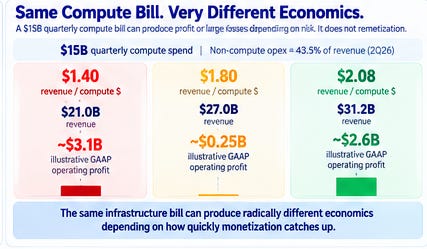
The central question for 2027 is whether Anthropic’s expanding compute base generates enough commercial value to strengthen its business, rather than simply raising the cost of remaining competitive.
Anthropic is reducing the cost of useful intelligence. In September, Opus 5.5 lowered customer cost per task by approximately 40% relative to Opus 5, through a combination of model efficiency and pricing improvements.
That is not the same as a 40% price reduction. A more efficient model can complete a task with less compute even when its price per unit changes much less.
The distinction matters because lower costs can stimulate additional consumption without necessarily compressing provider margins proportionately.
Coding became an early commercial market partly because useful outputs can be verified. Similar principles could increasingly apply to scientific research, engineering and professional workflows. Autonomous agents performing lengthy sequences of reasoning, verification and tool use may consume vastly more intelligence than a conventional chatbot interaction.
The potential market is not restricted to substituting existing software or labor expenditure. Better intelligence could enable discoveries, products and activities that would not otherwise have existed.
That is the strongest argument for the scale of investment now underway.
But growing demand does not automatically establish attractive returns for Anthropic. The commercial value created must exceed both the cost of delivering intelligence and the continuing expenditure required to defend its technological position.
An early financial indicator is revenue per dollar of compute.
Consider a future quarter in which Anthropic incurs $15 billion of compute expenditure. At $1.80 of revenue per compute dollar, it would generate $27 billion of revenue. If non-compute operating expenses remain at Q2 2026’s 43.5% of revenue, GAAP operating profit would be only approximately $250 million.
At $1.40 per compute dollar, the same illustrative cost structure would produce an operating loss of approximately $3.1 billion. At $2.08, operating profit would approach $2.6 billion.
The same infrastructure expenditure can therefore support very different earnings outcomes depending on how quickly monetization catches up.
These calculations are deliberately simplified. They are not forecasts of cash flow after finance-lease principal and other infrastructure payments. They also do not establish an attractive return on invested capital.
My expectation is that revenue per dollar of compute will fall from Q2’s exceptional $2.08 as substantial new capacity becomes operational. I expect at least one GAAP operating-loss quarter during the first half of 2027.
That would not invalidate Anthropic’s commercial progress. It would demonstrate that the infrastructure investment cycle had temporarily moved ahead of monetization.
If Anthropic maintains revenue per dollar of compute around $1.80 or better in the first half of 2027, while quarterly compute expenditure reaches at least $15 billion, my expectation of meaningful operating-margin compression would be too pessimistic.
The more demanding test is whether the resulting profits translate into cash after infrastructure financing, and whether each investment in research and compute makes Anthropic more competitively differentiated.
Operating profitability is necessary evidence. It is not sufficient proof of a compounding economic advantage.
The Call
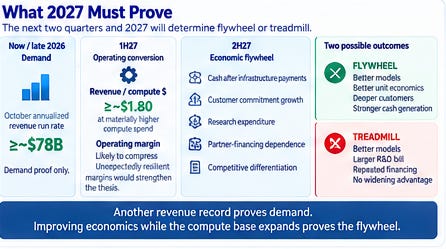
I take three conclusions from Anthropic’s S-1.
First, the commercial market for intelligence is real and expanding extraordinarily quickly. Customer growth, cohort expansion and improving operating efficiency provide substantial evidence that enterprises are finding economic value in Claude. The opportunity could become considerably larger as AI moves beyond coding into scientific discovery, engineering and increasingly autonomous work.
Second, Anthropic’s financial position is stronger than the headline infrastructure commitments alone suggest. Its accumulated liquidity, growing revenue and contractual flexibility in certain agreements provide meaningful protection against near-term disappointment.
My base case is therefore not a liquidity crisis as the next capacity wave arrives.
Third, that wave will begin revealing whether Anthropic is building a compounding economic advantage or an exceptionally well-funded competitive treadmill.
I expect a strong October run-rate revenue disclosure, followed by pressure on operating margins as new capacity enters service in 2027. An October annualized run rate above approximately $78 billion would strengthen the near-term demand outlook, although it would not settle the profitability question.
The first half of 2027 will provide the more important operating test. Sustained revenue per compute dollar around or above $1.80, at substantially higher compute expenditure, would challenge my expectation of margin compression.
By the second half of 2027, I would pay greater attention to cash generation after infrastructure payments, the growth of customer commitments, research expenditure and Anthropic’s dependence on partner-financing facilities. The strongest evidence for a genuine flywheel would be improving economics alongside customer retention and competitive differentiation, not simply another increase in revenue.
For the wider AI trade, the timing matters. Semiconductor suppliers can benefit from several quarters of extraordinary infrastructure demand even while the laboratories purchasing that capacity experience deteriorating margins. Eventually, however, the returns generated by the infrastructure determine how much additional capacity its owners are willing and able to finance.
The shipping analogy reminds us that capacity and demand operate on different timelines. AI introduces an additional possibility: improvements in the underlying technology can expand the market itself, potentially justifying far more infrastructure than current consumption suggests.
That possibility makes Anthropic fundamentally different from a shipping company ordering vessels during a freight shortage.
But it does not eliminate the economic question.
Anthropic has demonstrated that customers are willing to pay extraordinary sums for intelligence. It has also demonstrated that revenue can grow considerably faster than the compute infrastructure required to produce it. What it has not yet demonstrated is that the profits from one generation of intelligence can finance the next while strengthening its competitive position.
The question is not simply whether Anthropic can pay for the next generation of intelligence. It is whether each generation makes the following one more profitable to produce.
That is what 2027 will begin to tell us.
$ANT
Disclaimer:
The content does not constitute any kind of investment or financial advice. Kindly reach out to your advisor for any investment-related advice. Please refer to the tab “Legal | Disclaimer” to read the complete disclaimer.