


TL; DR
The thesis has broadened: Applied is benefiting not only because AI chips require more process complexity, but because customers are increasingly constrained by clean-room space, yield, uptime and time-to-ramp.
Scarcity is showing up in pricing: Semiconductor Systems gross margin reached 55.4%, helped by value-based pricing for tools that save space, improve yield and accelerate production.
The key question is durability: the market already believes this cycle is extraordinary. The next rerating depends on proving that higher content, pricing and service economics survive after today’s scarcity fades.
Applied Materials reported record revenue of $9.12 billion, record adjusted earnings of $3.50 per share and a 50.4% gross margin. It then guided the October quarter to $10.25 billion of revenue and $4.02 of earnings, with Semiconductor Systems alone expected to reach roughly $7.9 billion, up 62% year over year. The stock nevertheless fell after hours.
That contradiction is the right place to begin, because Applied no longer has to persuade investors that artificial intelligence is driving an extraordinary equipment cycle. The market already believes that. The harder question is whether Applied is becoming economically better because semiconductor manufacturing itself is becoming harder.
I have written about this progression three times. In January, I argued that physics was shifting value from drawing smaller features toward constructing increasingly complicated three-dimensional structures. In February, Gate-All-Around, HBM and a 54.5% Semiconductor Systems gross margin made that claim measurable. By May, management had raised its calendar 2026 Semiconductor Systems growth outlook from more than 20% to more than 30%, every test from the prior article had cleared, and the debate had moved from whether the complexity thesis worked to how much of it was already reflected in the price.
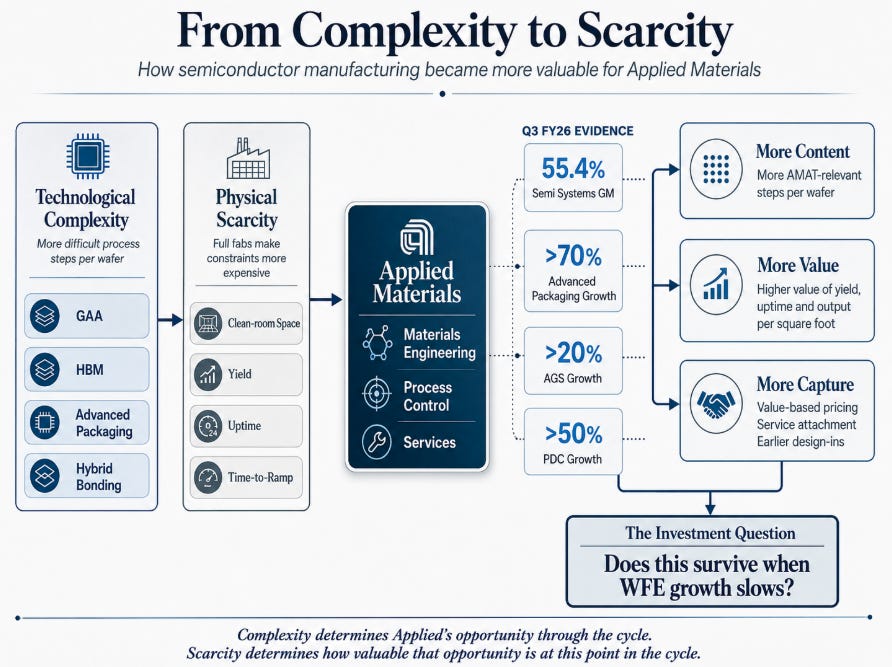
Q3 did not overturn that argument. It exposed the half we had not fully described. I had thought the opportunity was primarily that harder chips require more Applied equipment; this quarter makes clear that those chips are also being produced inside increasingly constrained factories. Complexity creates more content, while scarcity changes the value of that content.
Five of Six
The May article set six signposts for Q3. Five cleared.
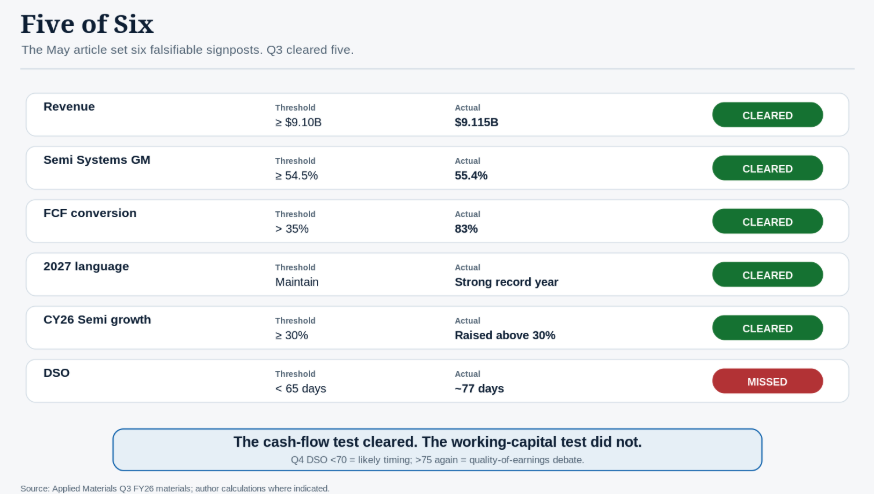
The accountability matters. Revenue, margins, cash conversion, duration and growth all moved in the direction the thesis required, while working capital did not. The May article’s tests are set out in the prior piece; Q3 subsequently delivered $2.33 billion of free cash flow and record profitability across both Semiconductor Systems and AGS.
Accounts receivable rose from $5.19 billion at fiscal year-end to $7.69 billion in Q3, producing a rough DSO calculation of approximately 77 days. That is worse than the threshold we set, not better. The offset is real: operating cash flow rebounded to $3.04 billion, contract liabilities increased, and the quarter included a $1.2 billion sequential revenue step-up that may have been back-end loaded. Still, the proper conclusion is not that the cash-flow question has disappeared. The cash-flow test cleared; the working-capital test did not. A Q4 DSO below 70 would support the timing explanation, while another quarter above 75 would turn the issue into a genuine earnings-quality debate.
The Three Raises
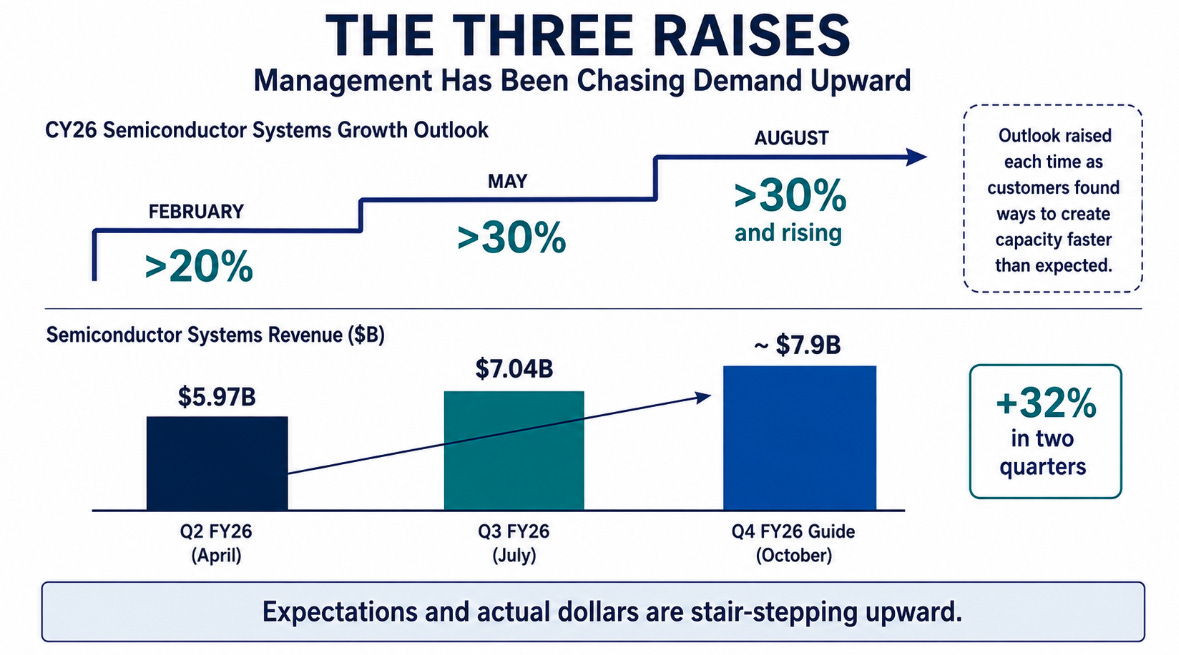
The simplest way to understand the acceleration is to follow management’s own forecast.
In February, Applied expected calendar 2026 Semiconductor Systems revenue to grow more than 20%. In May, that became more than 30%. This quarter, CFO Brice Hill said the previous greater-than-30% expectation was now too low:
“The greater than 30% that we highlighted last quarter, we’re saying now that it’s greater than that at this point.”
Semiconductor Systems generated $5.97 billion in April, $7.04 billion in July and is guided to approximately $7.9 billion in October. Applied is taking its core equipment business from a roughly $6 billion quarterly run rate to almost $8 billion in six months.
The cause matters more than the magnitude. Customers repeatedly found ways to create clean-room capacity, pulled equipment deliveries forward and supplied Applied with detailed eight-quarter forecasts. Demand did not merely exceed Applied’s estimate; it repeatedly exceeded customers’ physical ability to house the equipment.
Two Kinds of Scarcity
Gary Dickerson described AI as creating two races: one for technology leadership and another for manufacturing capacity. The first requires better transistors, memory, wiring and packaging. The second requires customers to extract more yield and output from existing fabs while bringing new capacity online.
Applied sits at the intersection of both. Technological scarcity is the thesis we already know: leading-edge foundry and logic, DRAM and advanced packaging are expected to account for roughly 80% of WFE growth, while advanced-packaging revenue, previously expected to grow more than 50% this year, is now expected to grow more than 70%.
Physical scarcity is the new part. When fabs are full, the scarce resources are not only wafers and tools but clean-room area, yield, uptime and time-to-ramp. Applied is increasingly selling directly against each constraint. A new DRAM epitaxy system improves performance while using 20% less clean-room space. More than 37,000 chambers are connected to AIx software. AGS is expected to grow more than 20% this year, while process diagnostics and control is expected to grow more than 50%.
This distinction matters because complexity and scarcity play different roles. Complexity determines Applied’s opportunity through the cycle; scarcity determines how valuable that opportunity is at this point in the cycle. A tool that saves floor space is worth more when floor space is the bottleneck. A service that reduces downtime is worth more when every chamber is running. A metrology system that improves yield is worth more when additional fab capacity is years away.
Applied is therefore not simply selling more process steps. It is increasingly selling solutions to increasingly expensive bottlenecks.
What 55% Means
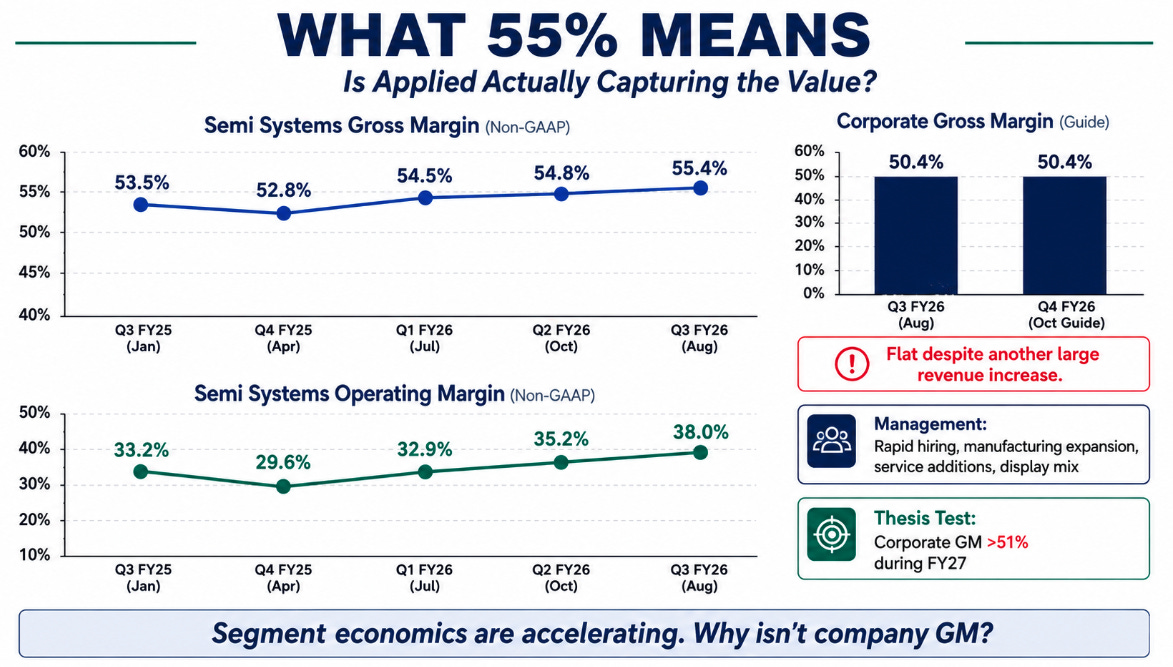
The strategic story matters only if Applied captures the economics.
Semiconductor Systems produced a 55.4% non-GAAP gross margin and a 38.0% operating margin, compared with 53.5% and 33.2% a year ago. AGS reached a 30.1% operating margin.
Management attributes part of the improvement to a value-based pricing system introduced three years ago. Applied now evaluates what a tool contributes to the customer’s economics rather than simply what it costs to build, and says pricing and margins are higher across both new and existing products.
Hill made the mechanism unusually explicit:
“We examine the value of every single tool and put a new price on every single tool.”
The customer is not merely buying a chamber. It is buying earlier time-to-market, more output per square metre, better yield and less downtime. That is why physical scarcity can convert technological differentiation into pricing power.
There is, however, a counter-signal. Q4 corporate gross margin is guided flat at 50.4% despite another large revenue increase. Management points to rapid hiring, manufacturing expansion, service additions and display mix. Those explanations are credible, but they create the next test. If the costs are temporary, corporate gross margin should begin following Semiconductor Systems higher. If company margin remains around 50% while revenue surges, Applied may be creating more value than it captures.
What Management Would Not Say
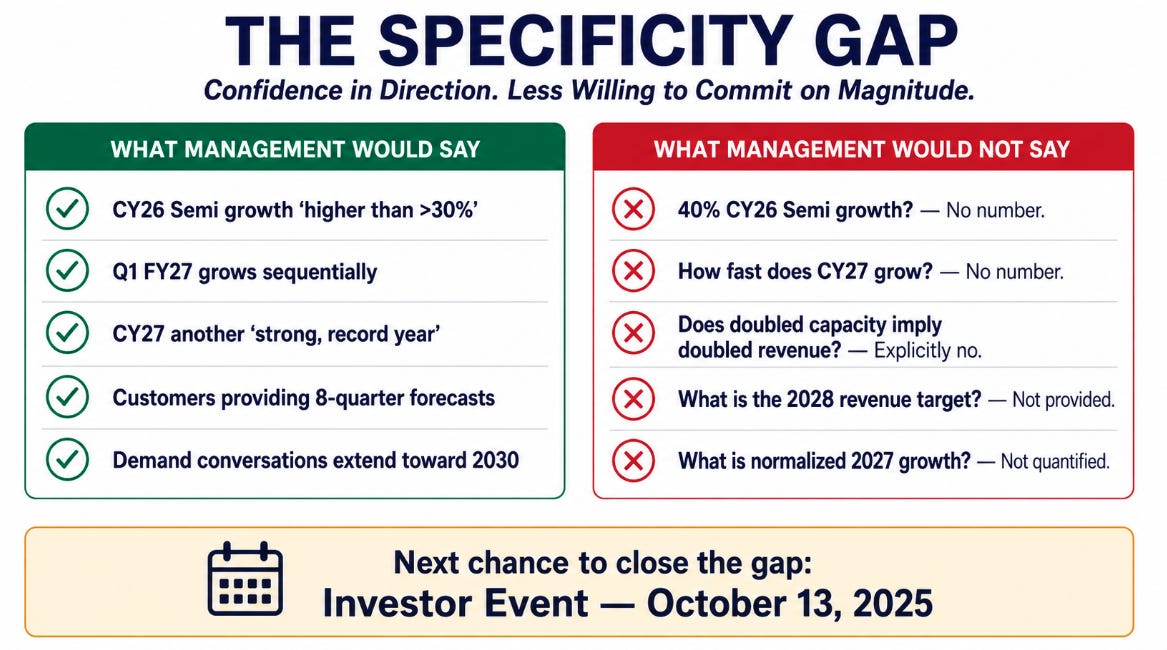
The most revealing part of the call was the gap between management’s confidence and its specificity.
UBS analyst Timothy Arcuri argued that the trajectory effectively required Semiconductor Systems growth near 40% if Applied was to outgrow the market. Hill replied:
“I think you’ve got the dynamics right.… We’re not giving that number because we’re not guiding that out quarter.”
Management did not endorse 40%, but it also did not reject the arithmetic.
The same pattern appeared around 2027. Dickerson called it another strong growth year; Hill called it another strong, record year. Yet neither would quantify it. When analysts tried to turn the plan to double manufacturing capacity by 2028 into a revenue forecast, Hill pushed back:
“It is capacity. So it is not a revenue forecast for 2028.”
The uncertainty has therefore moved. Management appears confident about demand direction but is less willing to commit on magnitude and timing, because physical clean-room availability still determines when customer intent becomes Applied revenue.
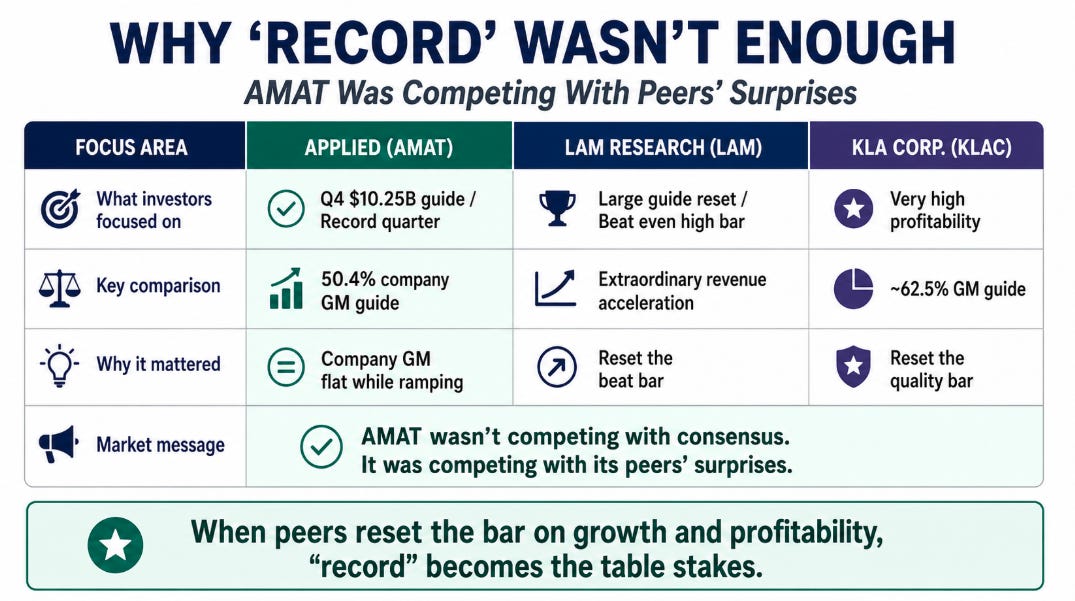
That specificity gap helps explain why an excellent guide did not make the stock work. At roughly thirty times forward earnings, directional confidence is no longer enough. The October investor event now matters because investors need a quantified bridge from today’s shortage to normalized 2027 and 2028 economics.
Three Worlds After Q3
The Q4 midpoint takes fiscal 2026 revenue to approximately $34.3 billion and adjusted EPS to roughly $12.75. The more important question is what remains after the current acceleration fades.
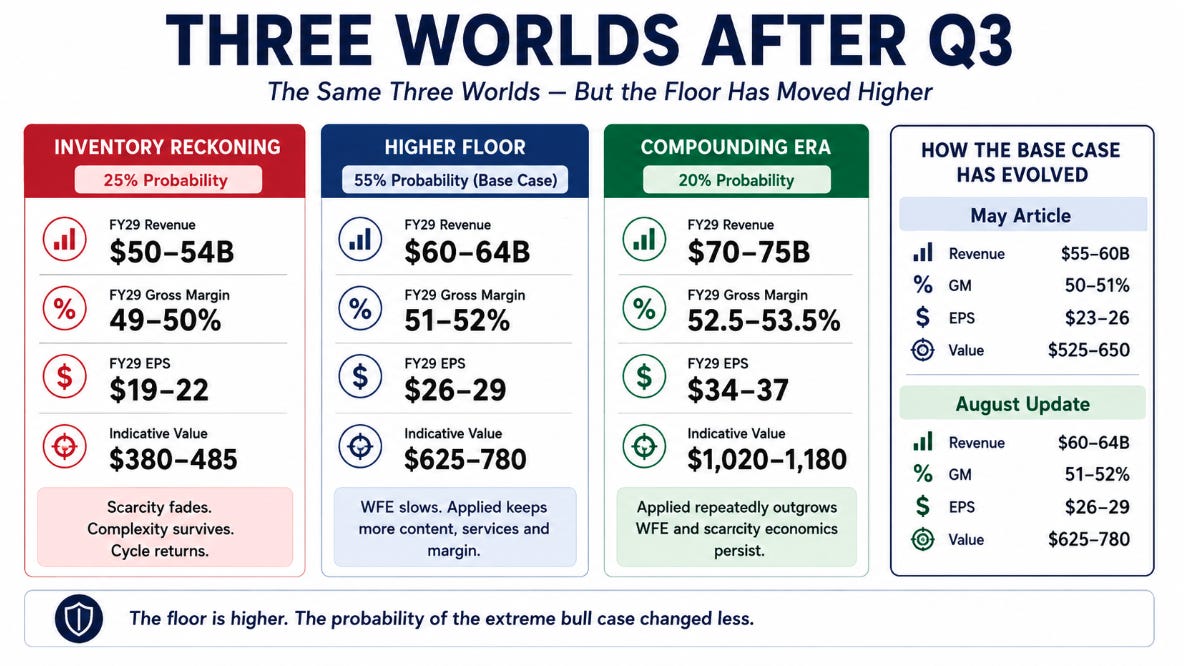
These are scenarios rather than point forecasts.
The Inventory Reckoning assumes that today’s shortage contains meaningful pull-forward. Applied exits the cycle with more content and a higher earnings base than before, but the familiar capital-equipment pattern reasserts itself as utilization falls, urgency fades and customers absorb capacity already ordered.
The Higher Floor is my base case. WFE eventually slows, but packaging, process control and AGS remain larger businesses; Applied captures modestly more content per wafer; and company margins rise after the current ramp costs fade. This thesis does not require the cycle to disappear. It requires the next trough to be materially higher than the last.
The Compounding Era demands more. Applied must consistently outgrow WFE, sustain mid-teens AGS growth, convert EPIC partnerships into earlier design-ins and move corporate margins toward the economics already visible inside Semiconductor Systems. Q3 makes that world possible, but the durability of the scarcity premium remains too untested to make it probable.
What the Stock Now Implies
Before the report, Bloomberg expected FY27 EPS of roughly $17.31. That estimate should rise, but I would not leap immediately to $20 or $21. The January quarter contains 14 weeks, and management deliberately refused to quantify the year. A move toward approximately $18–19-plus is a more disciplined starting point.
The interesting setup is that the earnings denominator is rising while the share-price numerator has fallen.
Below approximately $475, the market would be treating much of the current surge as cyclical despite evidence that the earnings floor has risen. Around $500–550, the stock prices substantial 2027 strength without requiring the full Higher Floor case. Between roughly $650 and $750, that base case becomes increasingly reflected. Above $1,000, investors are effectively accepting that the Compounding Era has arrived.
The first-half story was multiple expansion. From here, earnings revisions must do most of the work.
After the Cycle
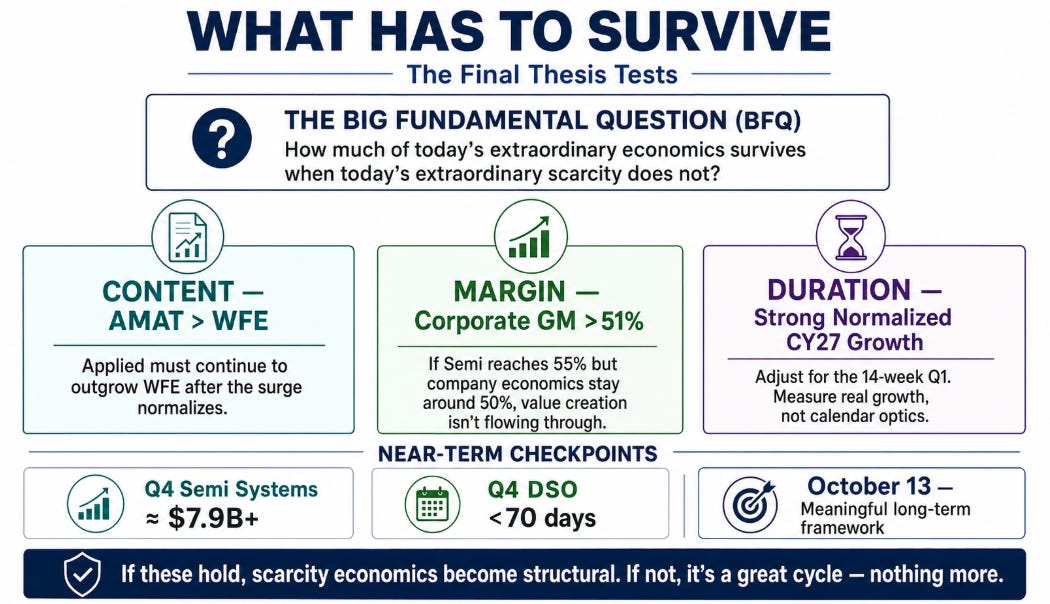
The Big Fundamental Question has evolved:
Can Applied turn the growing physical and technological difficulty of producing AI chips into structurally more content, pricing and service revenue per unit of semiconductor capacity, such that complexity becomes the compounding engine rather than WFE growth being the thesis?
Q3 moved the answer toward yes. Packaging is growing more than 70%, process diagnostics more than 50%, AGS more than 20%, and Semiconductor Systems gross margin exceeds 55%. Customers are giving Applied longer forecasts, and the company is developing tools whose value comes from extracting more output from limited factory resources.
Three structural tests now matter. Corporate gross margin should move through approximately 51% during FY27. The October event should demonstrate that the 2026 exit rate is not mostly demand pulled forward from later years. Applied should continue to outgrow WFE after the present surge begins to normalize.
Three nearer-term observations will tell us whether those tests are progressing: Q4 Semiconductor Systems revenue near or above $7.9 billion, DSO below 70 days, and a Q1 FY27 outlook that remains strong after adjusting for the extra week.
The stock fell because investors already understand that this equipment cycle is extraordinary. Applied’s next task is harder: it must prove that some of today’s extraordinary economics remain after today’s scarcity fades.
The question is no longer how extraordinary this cycle becomes. It is how much of the extraordinary economics Applied keeps after the cycle is gone.
$AMAT
General Disclaimer: The information presented in this communication reflects the views of the author and does not necessarily represent the views of any other individual or organization. It is provided for informational purposes only and should not be construed as investment advice, a recommendation, an offer to sell, or a solicitation to buy any securities or financial products.
While the information is believed to be obtained from reliable sources, its accuracy, completeness, or timeliness cannot be guaranteed. No representation or warranty, express or implied, is made regarding the fairness or reliability of the information presented. Any opinions or estimates are subject to change without notice.
Past performance is not a reliable indicator of future performance. All investments carry risk, including the potential loss of principal. This communication does not consider the specific investment objectives, financial situation, or particular needs of any individual.
The author and any associated parties disclaim any liability for any direct or consequential loss arising from the use of this material and undertake no obligation to update or revise it.