


TL; DR
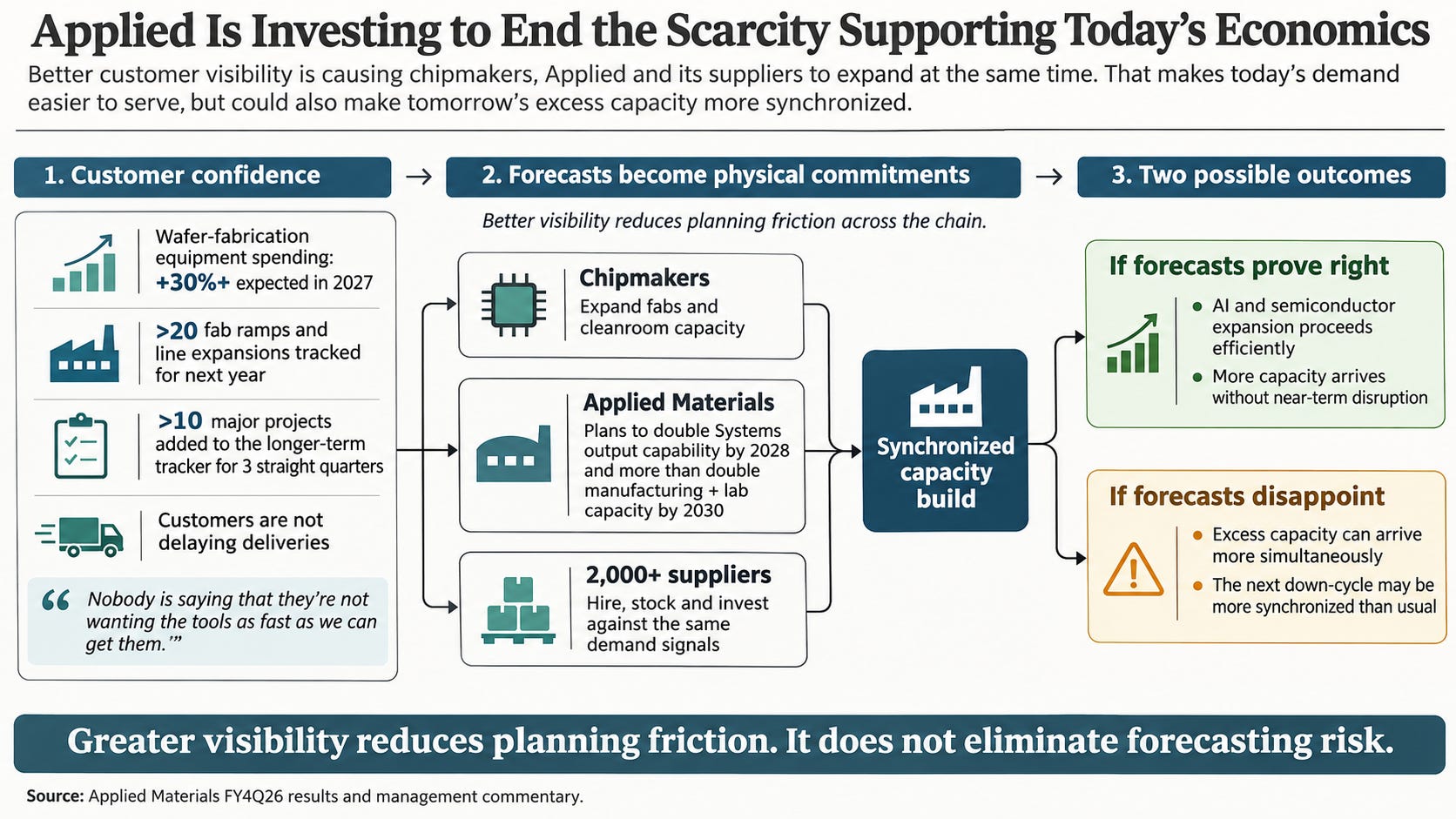
The demand case is now much stronger: Applied expects wafer-fabrication equipment spending to grow more than 30% in 2027, is tracking more than twenty fab ramps and line expansions and is doubling systems output capability by 2028. The near-term shortage is real.
But Applied is financing more of the solution itself: inventory, capex, supplier commitments and receivables have all risen while core equipment margins slipped sequentially and full-year free-cash-flow conversion fell to roughly 60%. The question is not whether customers need the tools, but who captures the economics of resolving the bottleneck.
The durable thesis is complexity, not scarcity: advanced DRAM, packaging, metrology and earlier process involvement through EPIC could support higher content and pricing even after cleanroom capacity catches up. If margins and returns remain elevated once delivery urgency fades, the business has structurally improved; if not, we will have mistaken a stronger cycle for a different company.
In fiscal 2000, Applied Materials generated $9.56 billion of revenue at a 50.8% gross margin. Two years later, revenue had fallen 47%, gross margin was down to 40.6%, and operating margin had collapsed from approximately 29% to 6%. Applied had not forgotten how to manufacture semiconductor equipment. Its customers had finished buying it. What appeared to be extraordinary earning power had belonged partly to the cycle.
Twenty-six years later, Applied is approaching those margins again. Fourth-quarter revenue increased 53% to a record $10.41 billion, non-GAAP EPS rose 92% to $4.16, and adjusted gross margin reached 50.6%. Management guided the January quarter to $11.1 billion and expects wafer fabrication equipment spending to increase more than 30% in calendar 2027. Yet the stock closed November 12 at $380.95, roughly 25% below where it traded when we published our August article. Earnings expectations have improved while the valuation has compressed.
In January, I argued that Applied was collecting a complexity tax as increasingly sophisticated chips required more materials engineering. May introduced the wafer-volume multiplier, while August identified the scarcity premium attached to cleanroom space, yield and time-to-ramp. Our conclusion then was that the question was no longer how extraordinary the cycle could become, but how much of those economics Applied would retain afterward.
Q4 makes that question more urgent. Applied is not merely benefiting from the semiconductor industry’s capacity shortage. It is committing its own factories, suppliers and working capital to ending that shortage. The durability of its investment returns will depend on what remains valuable when those investments succeed.
When Forecasts Become Factories
August’s central uncertainty was the gap between management’s confidence and its willingness to quantify future demand. That gap has largely closed.
Gary Dickerson’s calendar-2026 Semiconductor Systems growth expectation has progressed from more than 20% in February to more than 40% today. He now expects wafer fabrication equipment spending to grow over 30% in 2027, with Applied outperforming the market. The company is tracking more than twenty fab ramps and line expansions next year, while customers have added over ten major projects to its longer-term tracker for three consecutive quarters. Many will not begin production until 2029 or 2030.
When UBS’s Timothy Arcuri asked whether customers were delaying equipment deliveries, Dickerson was unequivocal:
No, very clear, the answer is no. Nobody is saying that they’re not wanting the tools as fast as we can get them.
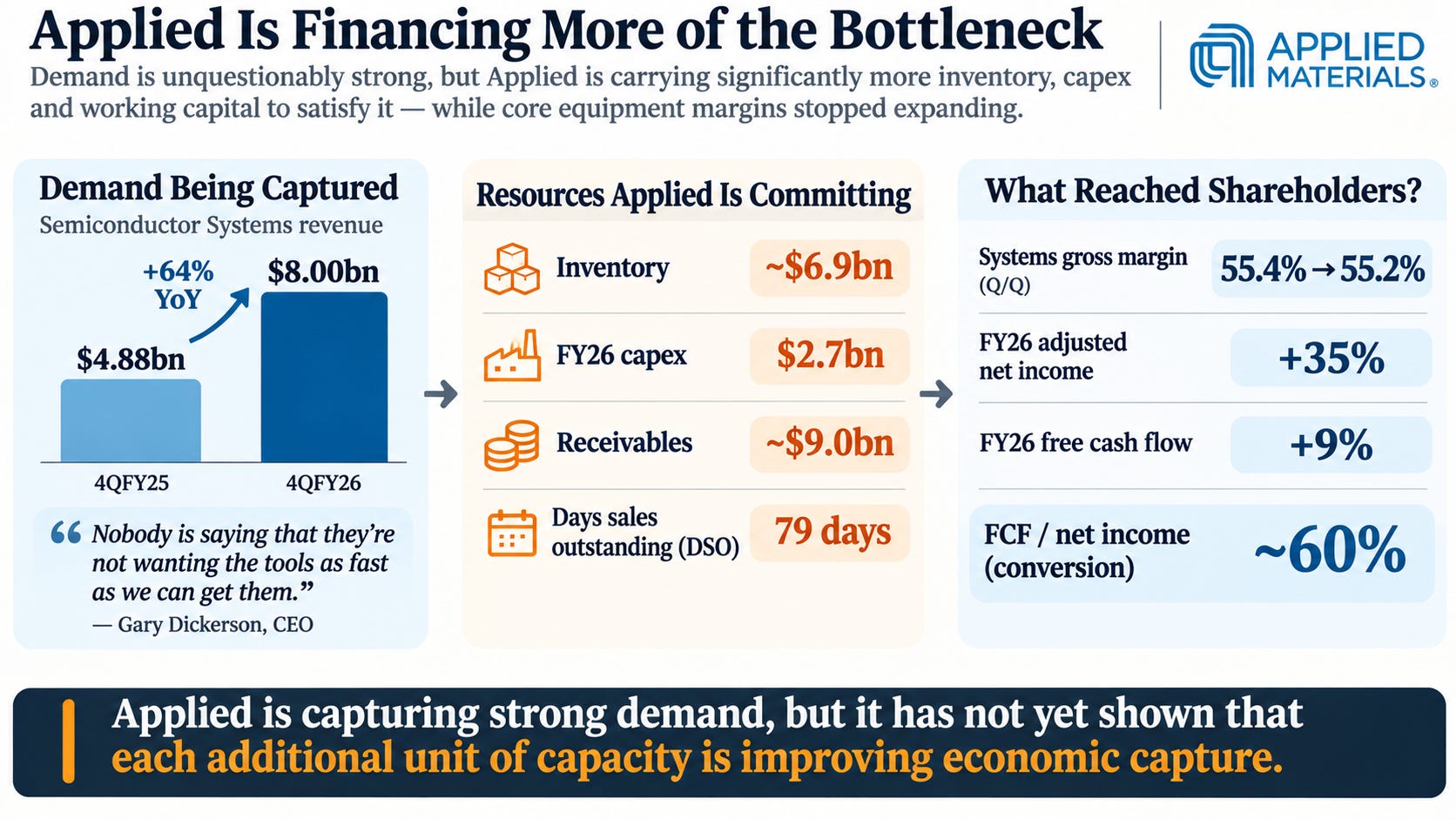
The response is important because Applied is translating those forecasts into physical commitments. Semiconductor Systems revenue has risen from $4.88 billion a year ago to $8 billion this quarter, with approximately $8.7 billion implied for January. Management plans to double systems output capability from current levels by 2028 and more than double manufacturing and laboratory capacity by 2030.
That does not mean customers have committed to purchasing twice as much equipment. Output capability is not revenue, and capacity built for an exceptionally strong market becomes expensive when utilization falls.
The more interesting implication concerns the industry’s confidence in its forecasts. In May, I suggested that rolling eight-quarter customer visibility could reduce semiconductor cyclicality. Better planning would let equipment makers and their suppliers expand more efficiently, avoiding some of the shortages and excess inventory that historically amplified the cycle.
I now think that argument was incomplete. Applied is passing increasingly detailed customer forecasts through a network of more than 2,000 suppliers. Chipmakers are expanding fabs, equipment manufacturers are expanding production lines, and component suppliers are hiring and investing against overlapping projections. Each company is making an individually rational decision using better information.
Collectively, however, the industry may be synchronizing its capacity expansion. If the forecasts prove accurate, that coordination allows an unprecedented investment cycle to proceed efficiently. If they disappoint, the resulting excess capacity could be more synchronized than in previous cycles. Greater visibility reduces planning friction; it does not eliminate forecasting risk.
The immediate danger is not an imminent collapse in 2027 demand. Management’s evidence argues strongly against that. The more consequential risk is that confidence in 2027 encourages too much capacity for 2028 and beyond.
The Scarcity Moved Inside Applied
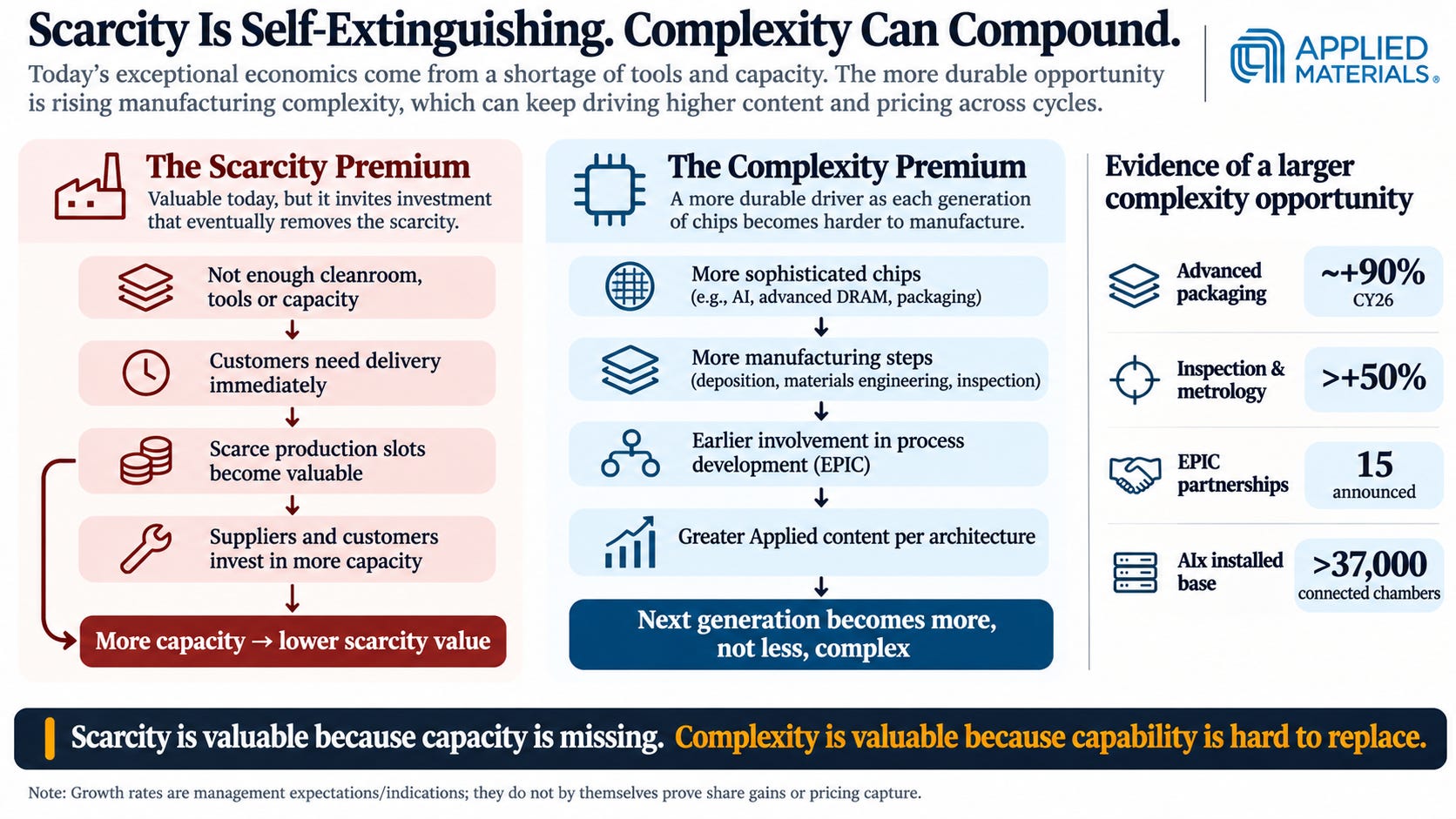
August identified two forms of scarcity. The first was technological: the deposition, etch, materials modification and packaging capabilities required to manufacture increasingly complex chips. The second was physical: cleanroom space, wafer output and the time required to achieve acceptable yields.
Q4 revealed a third constraint Applied’s own manufacturing capacity.
CFO Brice Hill acknowledged that the January revenue outlook would be somewhat higher if components were fully available. Asked why inventory was not growing faster, he explained:
I would like to have even more inventory, so we are working on that with the suppliers... we had three quarters of double-digit increases in output, so we are definitely pushing the system.
Applied is running extraordinarily hard to satisfy customers. Equipment revenue increased 13.6% sequentially, inventories reached approximately $6.9 billion, and the company spent $2.7 billion on capital expenditure during FY2026. Much of the investment is necessary to deliver the growth investors expect.
But scarcity creates different economics depending on who pays to resolve it.
If customers fund capacity reservations and pay higher prices for scarce production slots, the supplier captures more of the scarcity premium. If the supplier finances expansion, increases inventory and absorbs higher costs while customer pricing changes modestly, more of the benefit flows to customers.
Applied’s latest margins suggest the answer remains unsettled.
Both core businesses experienced sequential margin declines despite higher revenue. The consolidated improvement came largely from the residual Other category, including Display. That does not erase Semiconductor Systems’ 240-basis-point year-over-year expansion, which management partly attributed to higher pricing. It does mean the latest quarter did not demonstrate further margin capture in the core equipment business.
The comparison with Lam Research is revealing. In its September quarter, Lam generated $8.22 billion of revenue at a 40.2% non-GAAP operating margin, versus Applied’s 35.3%. Lam’s free cash flow exceeded $3.2 billion, compared with Applied’s $2.62 billion, despite Applied’s larger revenue base. Applied also converted less of its earnings into cash.
Part of the difference may reflect product mix, customer terms or investment timing rather than superior execution. Indeed, Applied’s revenue outside China grew 17.5% sequentially, against roughly 7% at Lam across their respective reporting periods. One possible explanation is that Applied is spending more aggressively to capture available demand while Lam retains more cash. The comparison deserves monitoring, not a definitive judgment from one quarter.
There is a further complication. Applied ended Q4 with approximately $9 billion of receivables, implying 79 days of sales outstanding. August established that another reading above 75 days would require an earnings-quality debate. That threshold has been breached, although historical data show that DSO has previously exceeded 80 days.
Fourth-quarter cash flow provides reassurance: free cash flow reached a record $2.62 billion. But across FY2026, adjusted net income increased 35% while free cash flow rose only 9%, reducing conversion to approximately 60%. Applied is expanding earnings much faster than the cash it retains.
The conclusion is not that customers are failing to pay or that manufacturing investment is misplaced. It is that Applied is currently carrying substantial costs associated with the industry’s urgency. Whether the resulting capacity earns an adequate return remains a different question from whether customers need it today.
The Complexity Premium Is Different
This distinction brings us back to the investment thesis we began developing in January.
Scarcity and complexity can both produce superior profits, but their durability differs.
A shortage makes existing manufacturing capacity valuable because customers urgently need equipment. Complexity makes particular engineering capabilities valuable because the chip cannot be manufactured competitively without them. The shortage eventually invites competing capacity. The engineering requirement can become harder with each successive generation.
Consider advanced DRAM. The transition from conventional cell architectures toward 4F² and eventually 3D DRAM potentially increases the number and sophistication of manufacturing steps that Applied can address. Advanced packaging adds another source of content growth through bonding, deposition, inspection and materials integration. Applied expects its packaging business to grow approximately 90% in calendar 2026, while inspection and metrology are growing more than 50%.
These opportunities do not disappear simply because semiconductor fabs build more cleanroom space.
Applied’s EPIC initiative addresses an additional source of competitive advantage: becoming involved in process development before customers finalize their manufacturing architectures. With fifteen announced partnerships and more than 37,000 installed chambers connected to AIx, Applied can potentially shorten the learning cycle between process development, qualification and high-volume manufacturing.
That is a more durable proposition than charging extra because customers cannot obtain equipment quickly enough. If Applied helps determine how the next semiconductor architecture is manufactured, it may retain pricing power even when tools are plentiful.
However, the distinction between participating in a growing market and capturing more of its value remains essential.
Management aims to gain more than two percentage points of wafer fabrication equipment share by 2030. Some current outperformance reflects Applied’s exposure to DRAM, leading-edge logic and advanced packaging—the fastest-growing equipment categories—rather than demonstrated share gains within every category.
The same distinction applies to services.
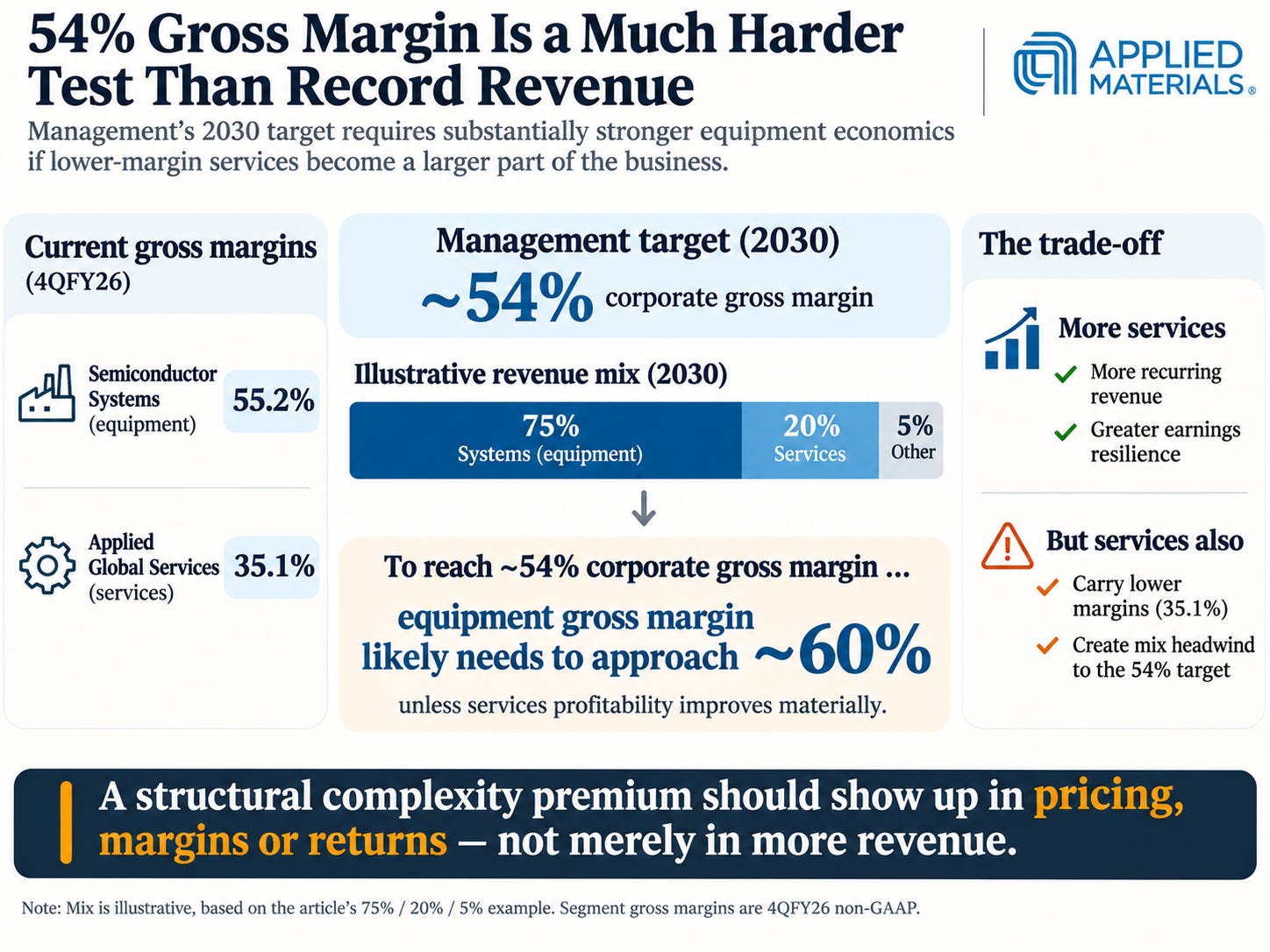
Applied Global Services grew 26% in Q4, with operating margin reaching 30.5%. But Hill expects a more sustainable growth rate around 15%, because customers’ utilization is already close to full. The extraordinary utilization benefit cannot repeat indefinitely.
Services should make Applied’s earnings more resilient across equipment cycles, but its 35.1% gross margin is considerably below Semiconductor Systems’ 55.2%. As services grow, they can improve earnings durability while diluting consolidated gross margin.
Management’s target of roughly 54% corporate gross margin by 2030 therefore demands substantial improvement elsewhere. At an illustrative future mix of 75% equipment, 20% services and 5% other businesses, equipment margins would need to approach 60% unless services profitability also improves materially.
That is a demanding target, and it provides a better test of the complexity premium than another record quarterly revenue number. A company genuinely capturing more value from manufacturing sophistication should demonstrate better pricing, higher margins or stronger returns on capital—not merely greater exposure to an expanding industry.
The Price of a Higher Floor
The valuation has changed considerably since August. At $380.95, Applied trades near 20 times FY2027 consensus EPS of approximately $18.78, compared with roughly 31 times the earnings forecast prevailing before August’s results. The business outlook improved as investors reduced the multiple.
I think that reduction is partly justified. Applied has demonstrated exceptional demand and better manufacturing economics, but not that its historical cyclicality has disappeared. The more appropriate thesis is a higher earnings floor, not the end of the cycle.
For a consistent three-year horizon, I would value forward FY2030 earnings at the end of 2029. The three outcomes reflect different degrees of capacity normalization and re tention of the complexity premium.
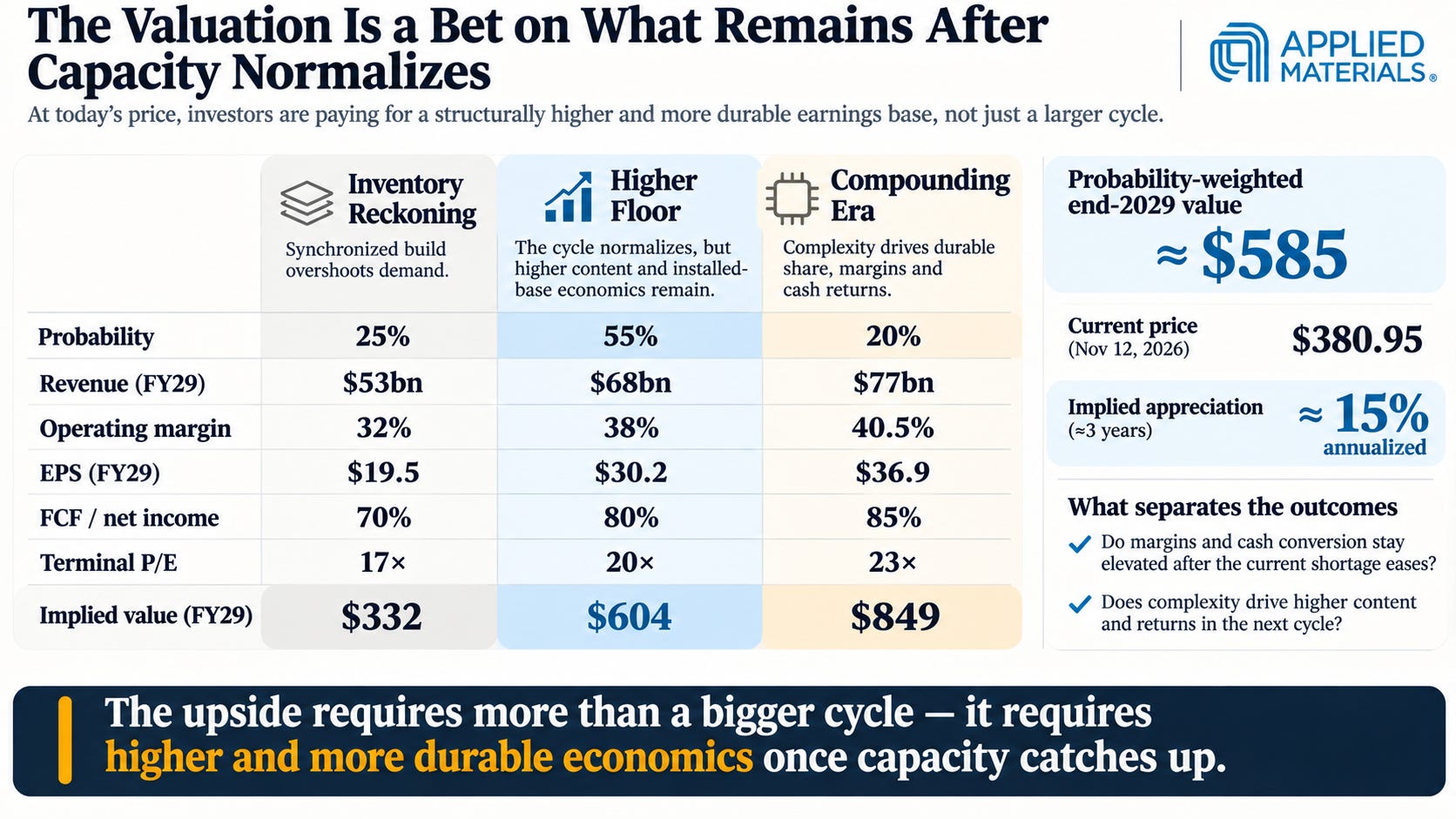
The scenarios assume a 13% normalized tax rate and declining diluted shares. Their probability-weighted value is approximately $585, implying about 15% annualized appreciation from $380.95 over three years, before dividends. These are illustrative underwriting outcomes, not consensus forecasts.
The Higher Floor case does not require a substantial rerating. It assumes that Applied continues benefiting from higher materials content, growing wafer output and a more productive installed base, while equipment spending becomes less exceptional after the current expansion. The Compounding Era requires stronger share gains and structural margin improvement. Inventory Reckoning assumes that coordinated capacity additions eventually depress equipment spending even as Applied remains a more capable business than in previous cycles.
The distinction matters because Applied’s stock can offer attractive returns without deserving the valuation historically associated with a permanently compounding franchise.
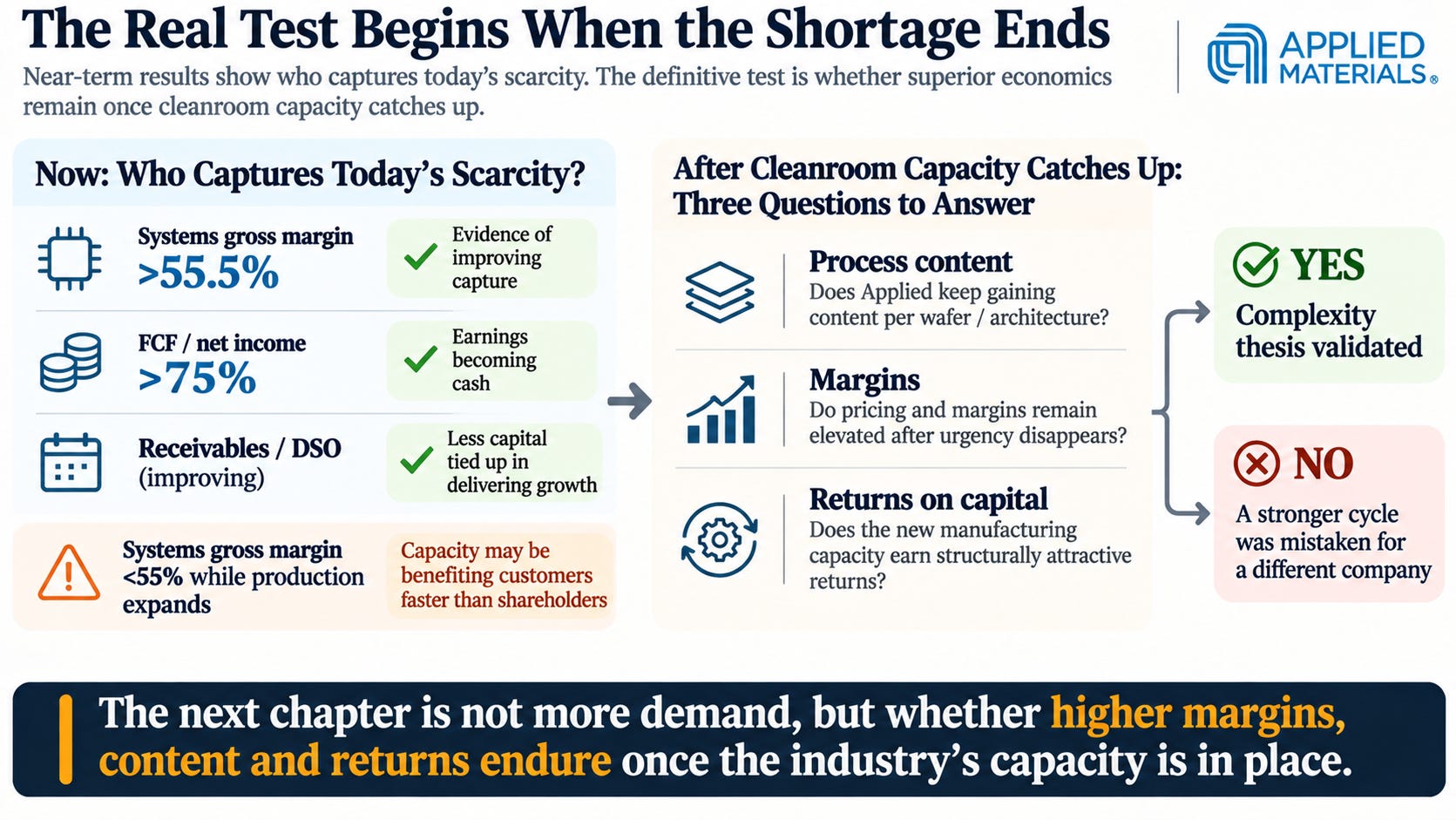
The next results should establish whether the company is beginning to capture more of the value it creates. Semiconductor Systems gross margin recovering above 55.5%, improving receivables collection and free-cash-flow conversion returning above 75% would be encouraging. Gross margin remaining below 55% while production expands would suggest that capacity growth is benefiting customers faster than shareholders.
The most important longer-term evidence will be what happens when cleanroom capacity catches up with demand. If Applied continues gaining process content, improving margins and earning higher returns on invested capital after delivery urgency subsides, the complexity thesis will have been vindicated. If growth moderates and margins retreat despite a larger installed base, we will have mistaken a more powerful cycle for a fundamentally different business.
In 2000, Applied’s extraordinary margins depended partly on customers continuing to build factories at an extraordinary pace. This time the company has a larger technological role, more sophisticated process-integration capabilities and substantially better visibility into customer plans. Those differences make a higher earnings floor credible.
But Applied and its customers are investing billions to solve today’s capacity shortage, and successful investment eventually changes the conditions that made it necessary. The lasting question is not whether Applied can help the semiconductor industry build enough capacity. It almost certainly can. It is whether, once the shortage has been resolved, the increasingly complex task of manufacturing the next generation of chips leaves Applied with more of the economics than it earned from building the last.
Applied’s conviction is justified by today’s demand. Its valuation must be justified by what remains after that demand has been satisfied.
Disclaimer:
The content does not constitute any kind of investment or financial advice. Kindly reach out to your advisor for any investment-related advice. Please refer to the tab “Legal | Disclaimer” to read the complete disclaimer.