


TL; DR
The strategic position is stronger than we thought: data-center royalties doubled, Arm expects roughly 60% server CPU share by year-end, and independent licensing surged despite Arm’s move into its own CPU. The evidence suggests customers may tolerate Arm being both platform supplier and chip vendor better than feared.
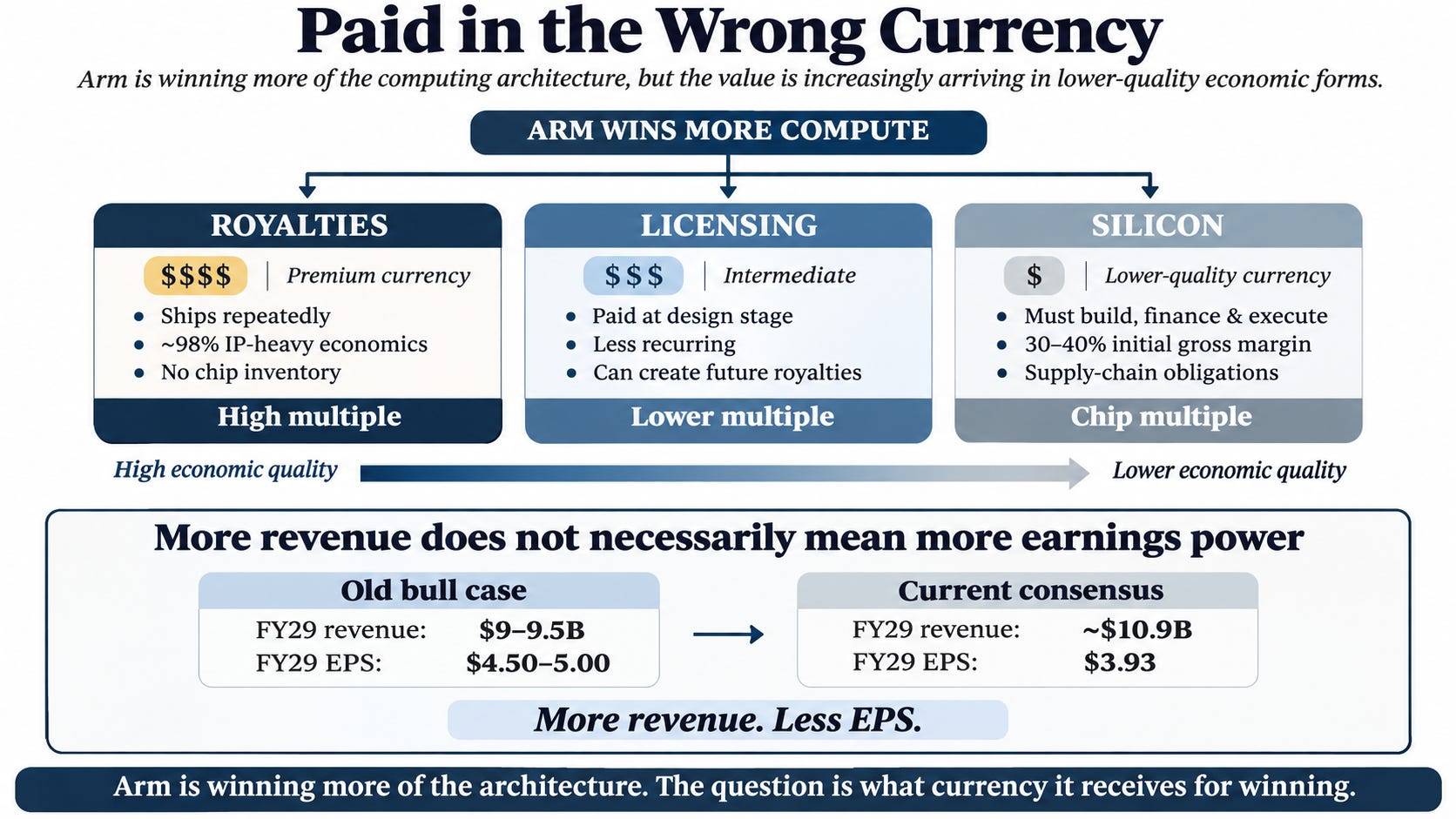
But the economic mix is deteriorating: royalties grew only 8% while licensing rose 50%, reducing royalties to 46% of revenue. Licensing is less recurring, and silicon is materially more capital-intensive, with initial AGI CPU gross margins expected at just 30–40%.
That makes valuation the real problem: consensus now expects Arm to generate substantially more revenue than our old bull case, but less EPS. The company can become strategically more important while the incremental dollar of revenue becomes less valuable.
In 2015, activist Jana Partners urged Qualcomm to separate its patent-licensing business from the chips it sold into the same mobile market. Qualcomm declined, arguing that the combination was worth more than the parts. The disagreement was not about whether making chips was useful. It was about whether revenue earned competing for hardware sockets deserved the same valuation as royalties collected across an industry.
Arm is moving toward a similar structure from the other direction. It collects license fees when chips are designed and royalties when they ship; from the March quarter it expects to sell its own AGI CPU. Qualcomm’s patent licensing and Arm’s processor architecture are different businesses, but the valuation problem is recognizable. At the $191.80 pre-results close, Arm traded around 64 times FY2028 consensus earnings. The question is whether an increasingly hybrid business can keep earning a licensor’s multiple.
What May Got Right and What Changed
In May’s AI Upside, Platform Risk, I argued that Rene Haas was choosing to monetize Arm’s architectural position more directly, at the possible cost of neutrality. We wrote:
The risk is asymmetric in time. The capture benefit is realized first, in the FY27 and FY28 AGI CPU revenue ramp. The neutrality cost is realized later, in the FY29 through FY31 royalty growth that disappoints because licensees have spent the intervening years quietly hedging.
The capture is now more credible, but it has not yet reached the income statement. Management sees up to $2 billion of AGI CPU revenue across FY2027 and FY2028, supported by purchase orders extending through calendar 2027; first commercial deliveries are expected in the quarter ending March 2027. That is evidence of customer commitment, not yet proof of profitable silicon sales. Meanwhile, our February test for data-center royalty growth at least 70%, was passed as management reported a doubling. Consolidated royalties rose just 8%, however, well below our approximately 20% expectation. Rising memory prices and weak lower-end phones, rather than demonstrated licensee retaliation, explain the immediate shortfall.
I had been too quick to assume that an Arm chip and an independent Arm chipmaker must be enemies. The quarter offers evidence that customers may want both. It also exposes a second error: my earlier price target depended on earnings Arm has not yet generated. The shares reached roughly the price I expected years later before the silicon ramp had begun.
A Larger Opportunity Than Server Share
Haas described the data-center expansion on the call:
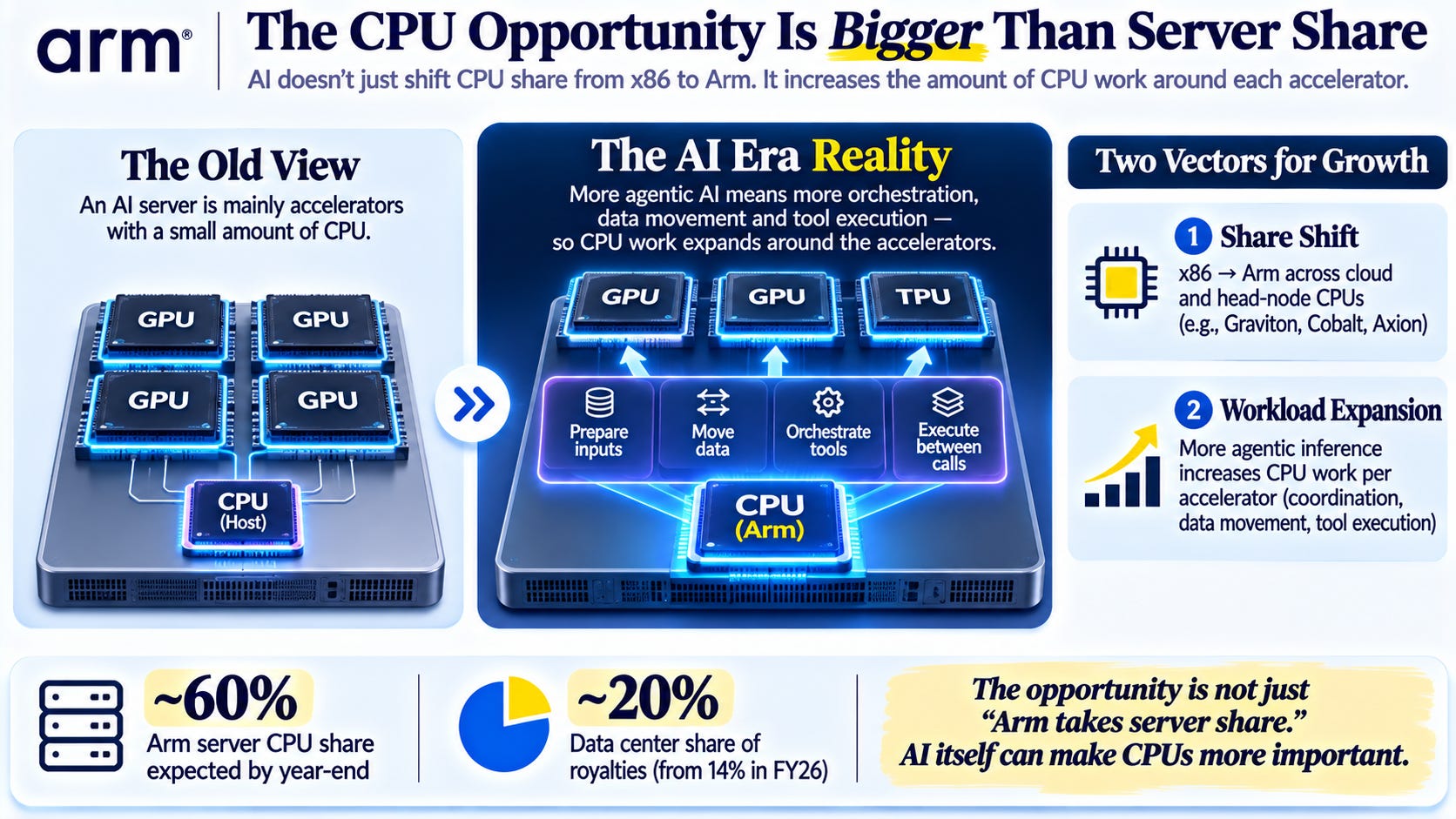
I think there is two vectors independent of the Arm AGI CPU on the royalty. One is Arm taking market share, which I mentioned before. Now we think it is going to be 60% by the end of the year. That market share gain is driven both in terms of units going up, agentic AI driving increased design starts for Graviton, Cobalt, Axion, et cetera. In addition, we are seeing a transition away from x86 to Arm for the head node CPU that connect to accelerators. We already know about Vera Rubin, but Google has already announced the conversion of x86 to Axion, connecting to TPU version 8.
The second vector changes the size of Arm’s opportunity. The AI server is not simply an accelerator with a few attached CPUs. It needs hosts to prepare inputs, move data, coordinate tools and execute the software between accelerator calls. More agentic inference can mean more CPU work per accelerator, while x86-to-Arm conversion adds new royalty-bearing designs. Even a hyperscaler market in which Arm is already dominant can therefore produce additional royalty growth through a larger amount of CPU work.
The timing is less attractive. Arm earns a license when designs begin, but royalties when silicon ships, often 12–24 months later. Data-center royalties can double while the larger smartphone base still determines consolidated growth. Cloud AI was just 14% of royalties in FY2026, and management says data center is approaching one-fifth today. The market for Arm architecture is changing faster than the royalty mix, which is why a stronger roadmap has not yet become stronger recurring earnings.
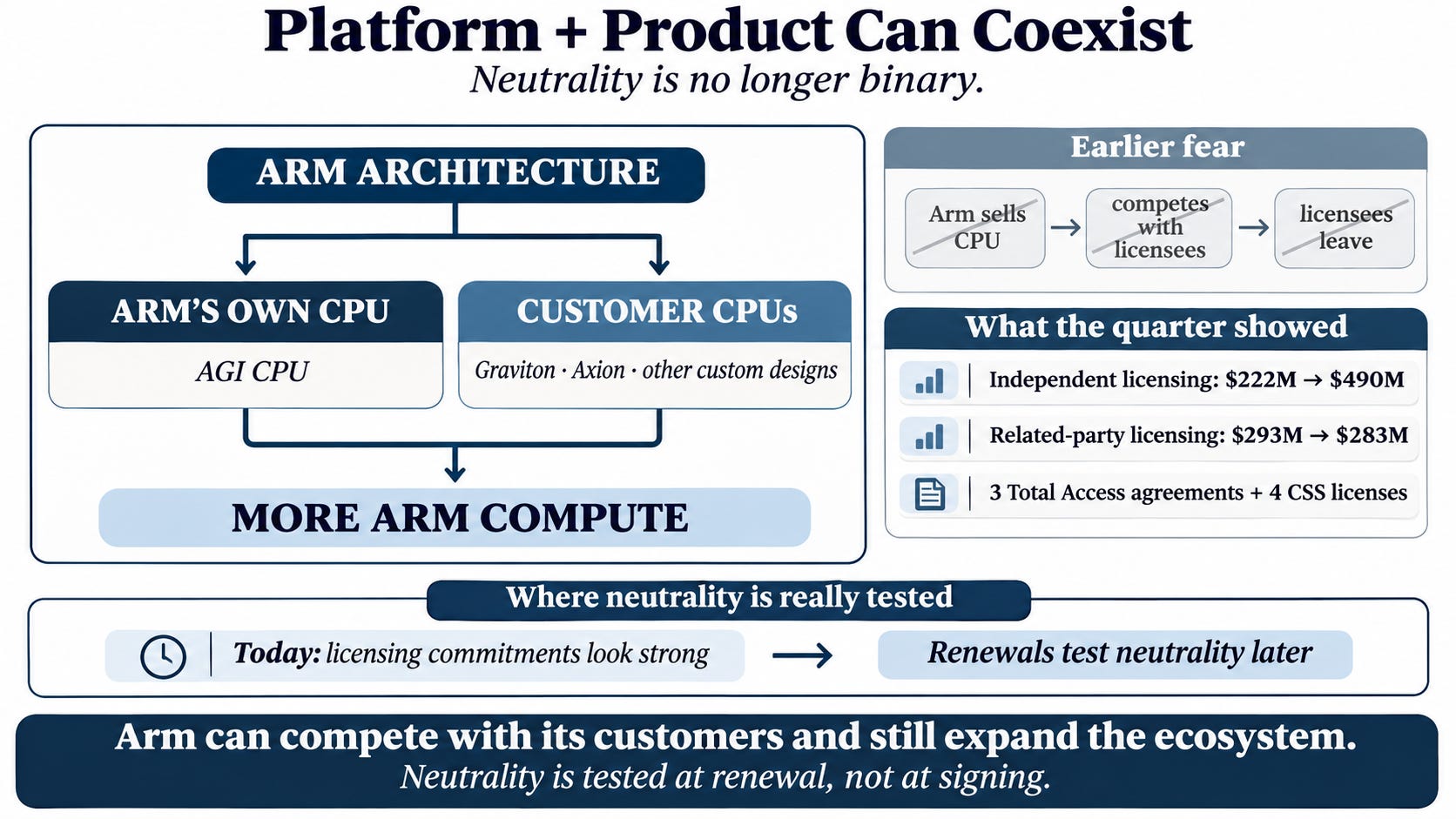
The most telling new evidence on neutrality comes from the 6-K. Independent-customer license and other revenue increased from $222 million to $490 million, while related-party licensing declined from $293 million to $283 million. Three Arm Total Access agreements, including a major customer’s first, and four Compute Subsystem licenses reinforce the point: customers are committing more resources to Arm despite knowing it plans to compete in processors. Oracle’s intention to offer both Arm’s own CPU and NVIDIA’s Arm-based Vera shows how buying Arm silicon and designing with Arm IP could coexist. The better analogy may be Microsoft’s Surface strengthening the Windows ecosystem, rather than Windows Phone alienating it.
Here lies the paradox of Arm’s success. Graviton, Axion and other custom CPUs can make the architecture ubiquitous while leaving hyperscalers to capture most of the value from the finished systems. The AGI CPU is an attempt to claim more of that surplus. But Arm cannot both demand the economics of the finished chip and assume its customers will continue investing in their own implementations on unchanged terms. The licensing surge suggests it can offer both paths; it does not mean it can force customers down the more profitable one.
That does not settle the neutrality question. Arm’s position depends on licensees believing they can obtain competitive access to architecture, roadmaps and commercial terms while Arm sells against them. That belief will be tested at renewals, not during a single strong licensing quarter. Arm is becoming a more useful platform; whether it can remain a trusted one is still open.
Three Currencies
In July, CFO Jason Child said that licenses could offset weaker royalties:
I would expect similar trends for the rest of the year, and that is any softness or weakness that we experienced in royalties will be at, I would say, at least as much license revenue to overcome that. So, I don’t really expect overall to be any sort of a slowdown.
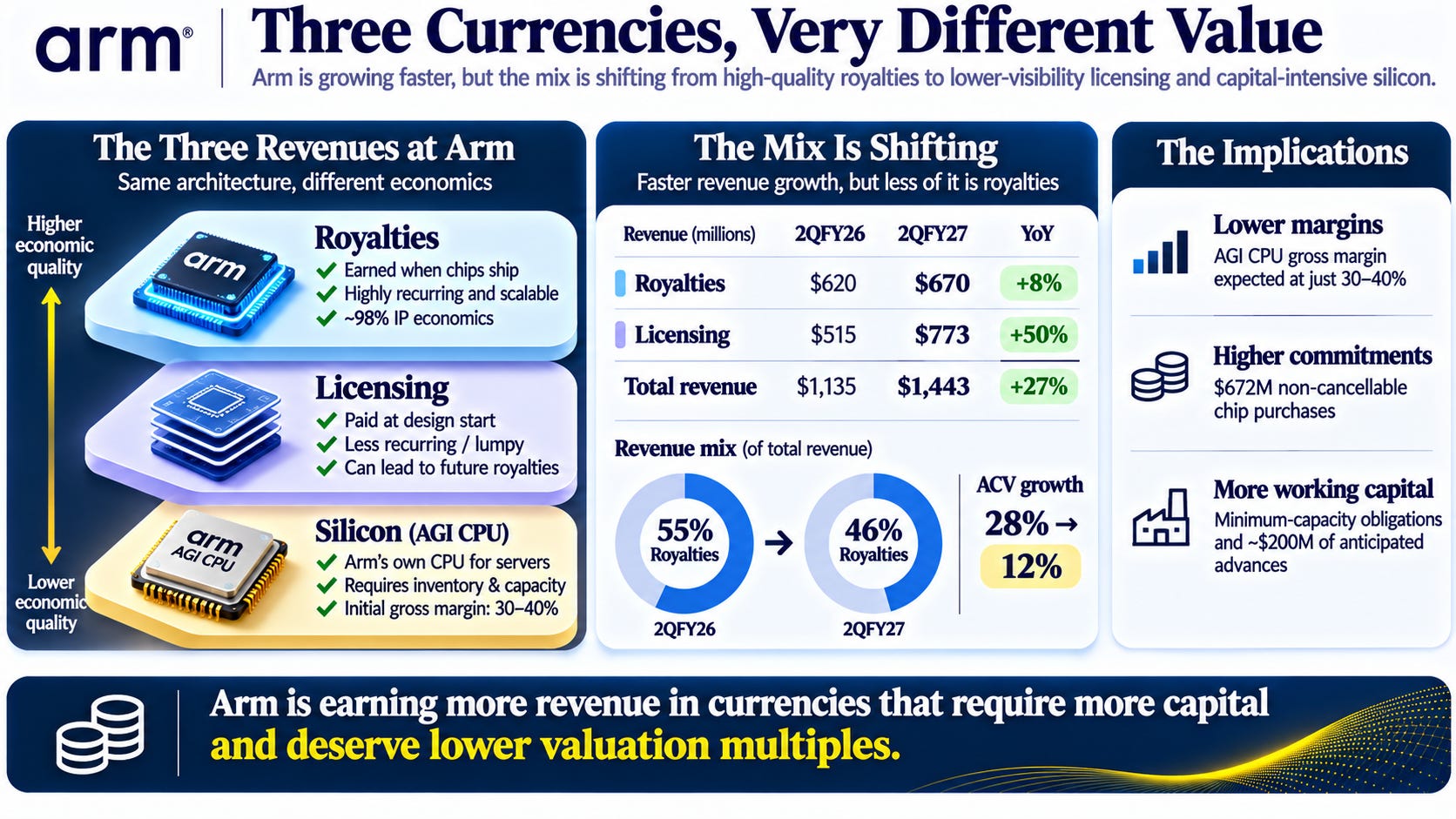
That is what happened: total revenue rose 27% to $1.44 billion, but the kind of revenue Arm collected changed.
Royalties are the premium currency. Once a design is shipping, Arm receives a claim on production without financing the chip.
Licensing is a payment for engineering access today and a possible source of royalties later. Its 50% revenue growth looks less extraordinary beside just 12% growth in annualized contract value and deferred revenue declining from $1.05 billion in March to $875 million in September. When asked whether $770 million was now the quarterly licensing baseline, Child replied:
We have not talked about next year, whether or not that is the new number every quarter. I do not know if I would say that.
Arm has also dropped RPO and active license counts from its shareholder letter, saying the metrics are less relevant as it moves into production silicon, although the filing still shows $2.42 billion of RPO. These are reasons to investigate the quality of licensing growth, not dismiss it.
Silicon is the third currency and changes the company’s obligations. The first AGI CPU is expected to earn 30–40% gross margin, versus nearly 98% for Arm’s current IP-heavy business. Future versions may reach conventional chip margins above 50%, but that improvement must be earned through product performance, volumes and supply-chain execution. The 6-K describes $672 million of non-cancellable chip purchases matched by a related-party reseller agreement; it does not identify that arrangement as AGI CPU backlog. Separately, Arm faces minimum-volume capacity obligations and anticipated $200 million of advances. An IP licensor can earn across many customers without taking these manufacturing risks. A chip vendor cannot.
Cash conversion illustrates the distinction. Free cash flow was $110 million against $566 million of adjusted net income this quarter, though first-half conversion was much stronger. Stock compensation remains about 26% of revenue, and $407 million of first-half employee share-tax payments sat in financing cash flows outside Arm’s free-cash-flow definition. The point is not to treat one weak quarter as permanent. It is that the new revenue engine will increasingly demand cash and capital from a company valued for licensing economics.
The paradox appears in consensus. Our February bull case assumed FY2029 revenue of $9–9.5 billion and EPS of $4.50–5.00. FactSet now expects about $10.9 billion of revenue but only $3.93 of EPS. Arm is forecast to sell far more than our most optimistic case anticipated, while earning less from those sales. The market is getting the growth story; it has not yet settled what kind of growth it is buying.
What the Hybrid Is Worth
I would retain our three outcomes, valued at end-2029 on forward FY2031 earnings. They differ less in whether Arm participates in AI than in how much of that opportunity remains high-margin IP, how much becomes silicon, and what investors should pay for the blend.
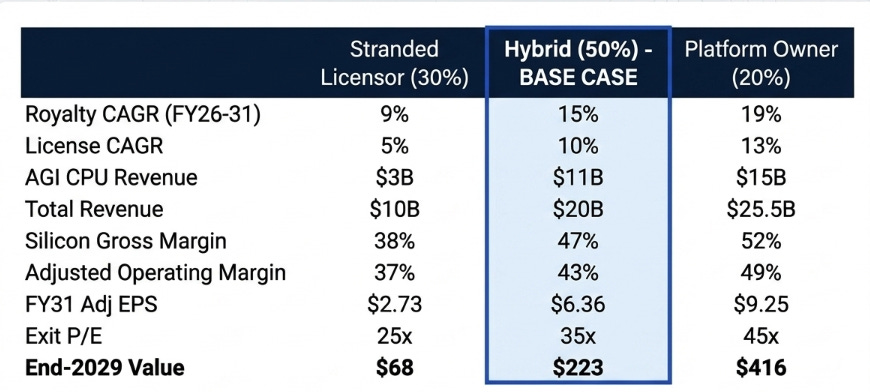
The base case is more ambitious than its name suggests: silicon supplies over half of sales, yet the IP business must still support much of the profit. The probability-weighted value of approximately $215 leaves only modest annualized appreciation from $192. Even if Arm more than doubles forward earnings, a lower multiple can consume much of the gain. The issue is not whether the AGI CPU sells; it is whether selling it expands the high-return architecture franchise or gradually changes the kind of company investors own.
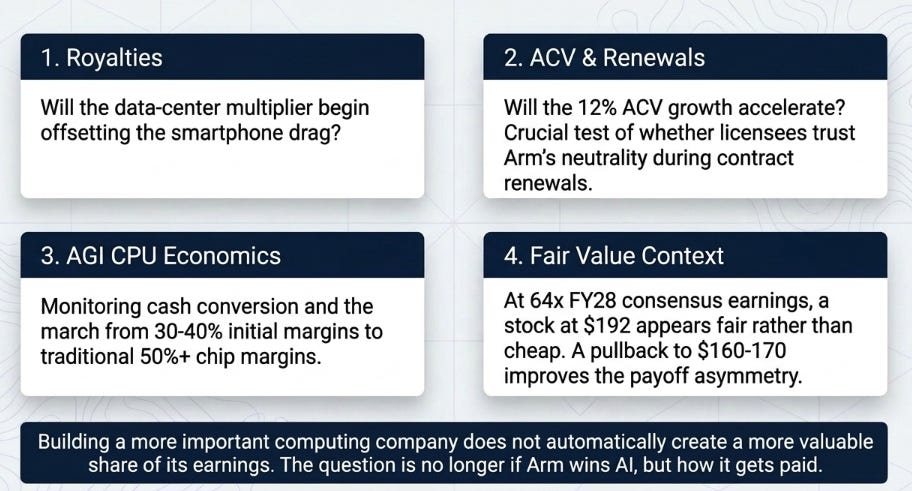
I am more confident in Arm’s computing position and less concerned about immediate licensee abandonment than I was in May. I am also less willing to give the new revenue a licensor’s multiple. At $192, the stock appears fair rather than cheap; nearer $160–170, the prospective payoff becomes more attractive if royalty recovery and customer commitments remain intact. Next quarter’s royalties, subsequent ACV growth, AGI CPU shipment economics and licensing renewals will reveal which revenue currency is becoming dominant.
Qualcomm’s board decided that licensing and chips belonged together. Arm may reach the same strategic answer, and its customers have so far given us reason to believe coexistence is possible. But building a more important computing company does not automatically create a more valuable share of its earnings. The crucial distinction is no longer whether Arm can win more of the AI market, but how it gets paid when it does.
Disclaimer:
The content does not constitute any kind of investment or financial advice. Kindly reach out to your advisor for any investment-related advice. Please refer to the tab “Legal | Disclaimer” to read the complete disclaimer.