


TL; DR
Scarcity has become financial, not theoretical. Customer advances surged, orders carry meaningful cancellation pain, and ASML is rationing future capacity rather than simply taking every order customers want to place.
ASML has used that scarcity to renegotiate its share of the economics. Customers accepted higher pricing on critical products. The key question is no longer demand; it is whether those higher prices survive the capacity ramp and show up in gross margin.
Our variant view is margin. Consensus implies roughly 57.5% gross margin in 2028; we expect about 59%. If ASML cannot lift 2027 gross margin despite higher pricing, better mix and more volume, the thesis is wrong.
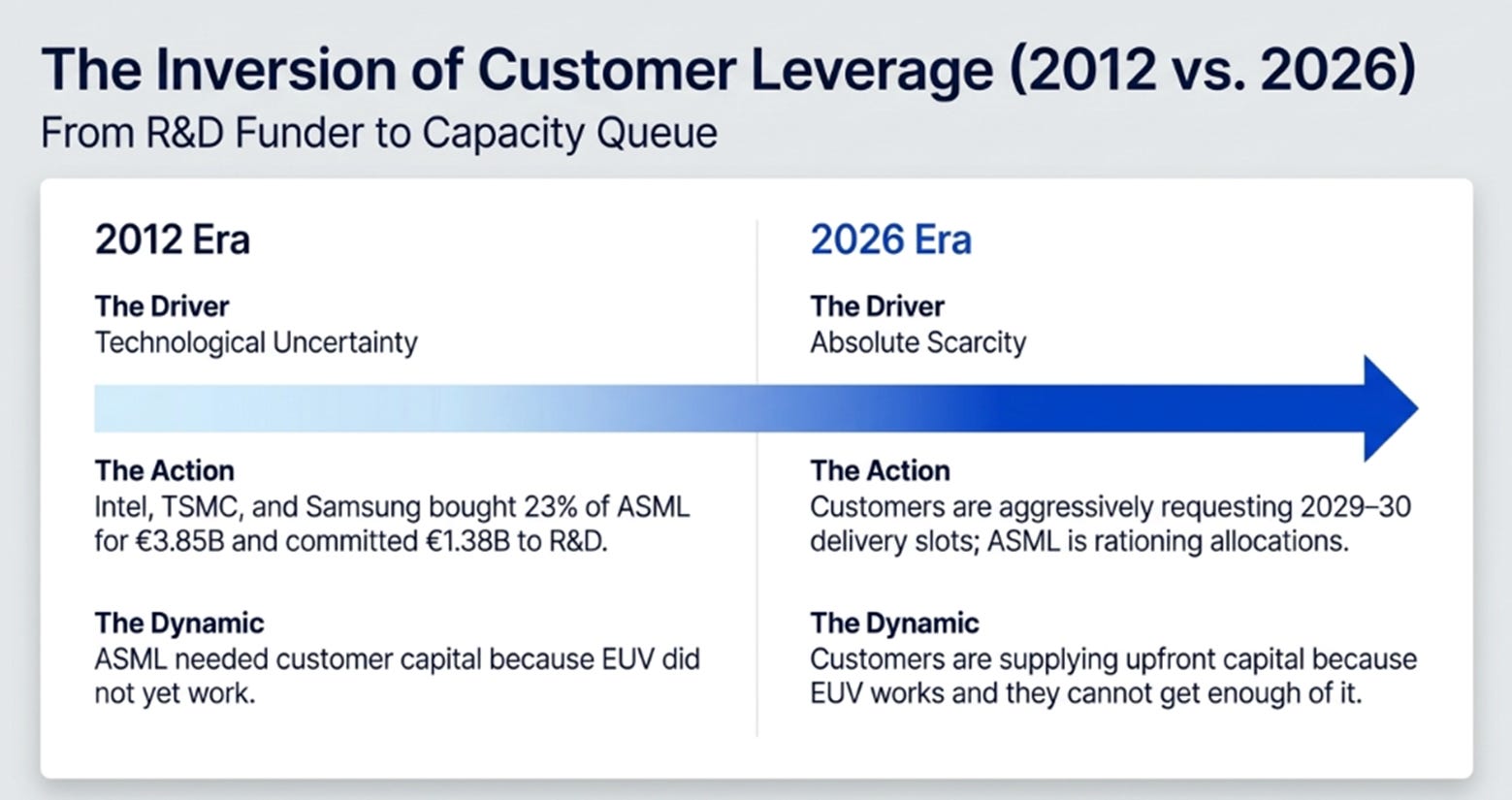
In July 2012, ASML asked its three largest customers to help pay for a machine that did not yet work. Intel, TSMC and Samsung bought 23% of the company for about €3.85 billion, while separately committing roughly €1.38 billion to research over five years. Part of that funding went toward 450-millimetre wafers, which never arrived. The other part helped push EUV toward high-volume manufacturing.
Fourteen years later, the customers are paying again. This time the machine works; the problem is getting enough of them. ASML says planned supply will remain below demand through at least 2028, customers are already requesting 2029–30 delivery positions, and management is holding back from accepting all of those orders while it decides how future capacity should be allocated.
The financial evidence has changed too. Customer advances surged in Q3, orders require down payments large enough, in CFO Roger Dassen’s words, “to hurt,” and ASML has completed negotiations that raised prices on its most critical products. That matters more than the earnings beat because it suggests scarcity is changing the bargaining relationship between ASML and its customers.
The tension is straightforward. ASML is using scarcity to extract better economics while simultaneously investing to remove that scarcity. The investment question is whether the higher economics survive once the queue gets shorter.
What We Said, What Happened
Our ASML thesis has moved from demand to capacity. In January, the question was whether AI spending would become semiconductor-equipment demand. By April, that looked too narrow: ASML was increasingly controlling access to scarce production capacity. In July, the better framework became two connected production systems—the factory building new tools and the installed fleet creating additional capacity through upgrades and service.
Q3 strengthened that framework, but corrected one earlier claim. We had described Installed Base Management as something close to an “infrastructure annuity.” That overstated its independence from the equipment cycle. Routine service is recurring, but productivity upgrades are especially valuable when customers cannot get new machines quickly enough. The fleet is not separate from the cycle; it is ASML’s second way of monetising it.
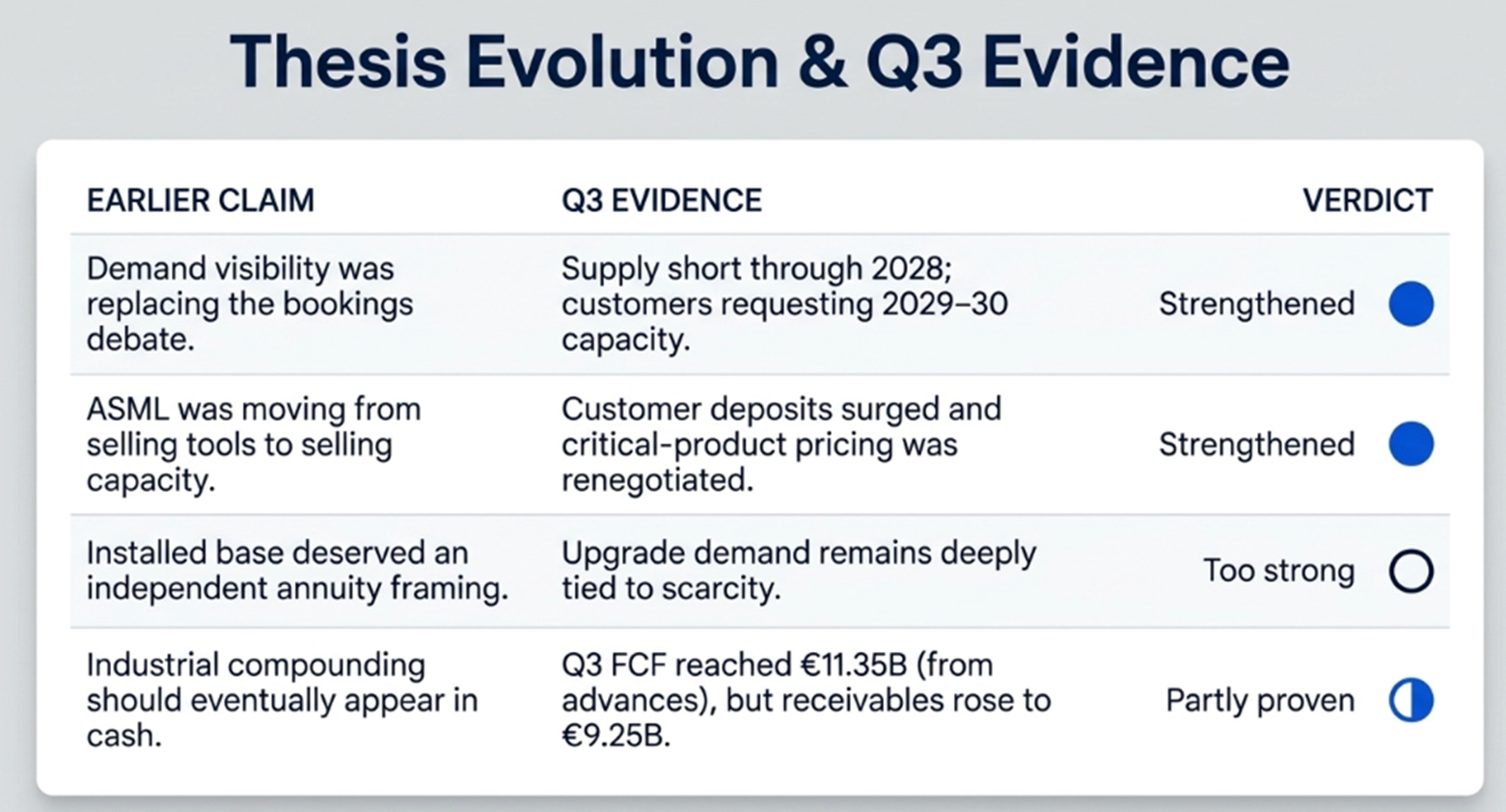
There is an important distinction inside that cash result. Customers are clearly willing to finance future deliveries, but collections on machines already shipped have not materially improved. Receivables rose from €7.25 billion to €9.25 billion while receivable days stayed around 72. The demand side of the cash test passed; the collection side remains open.
The Fleet Covered for the Factory
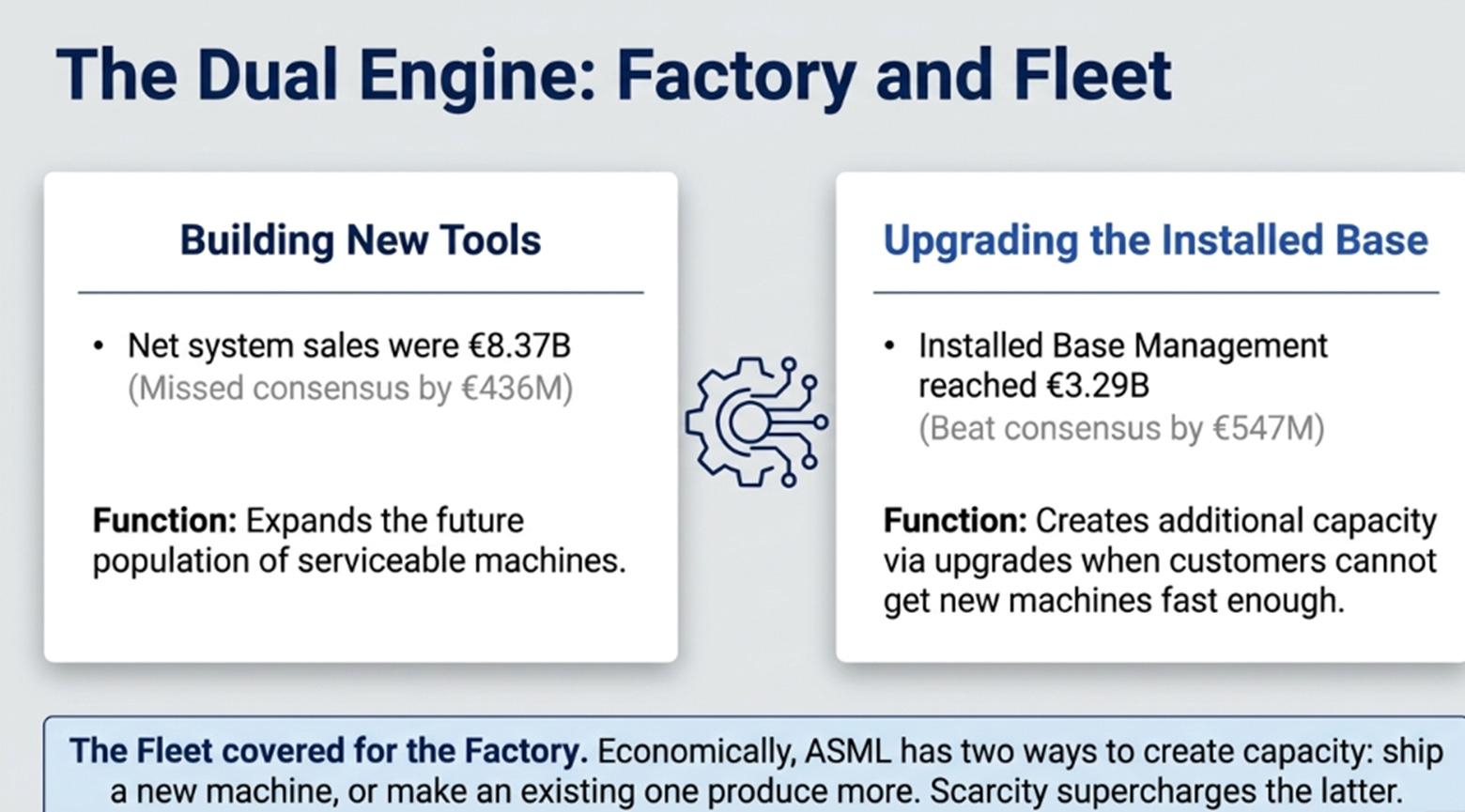
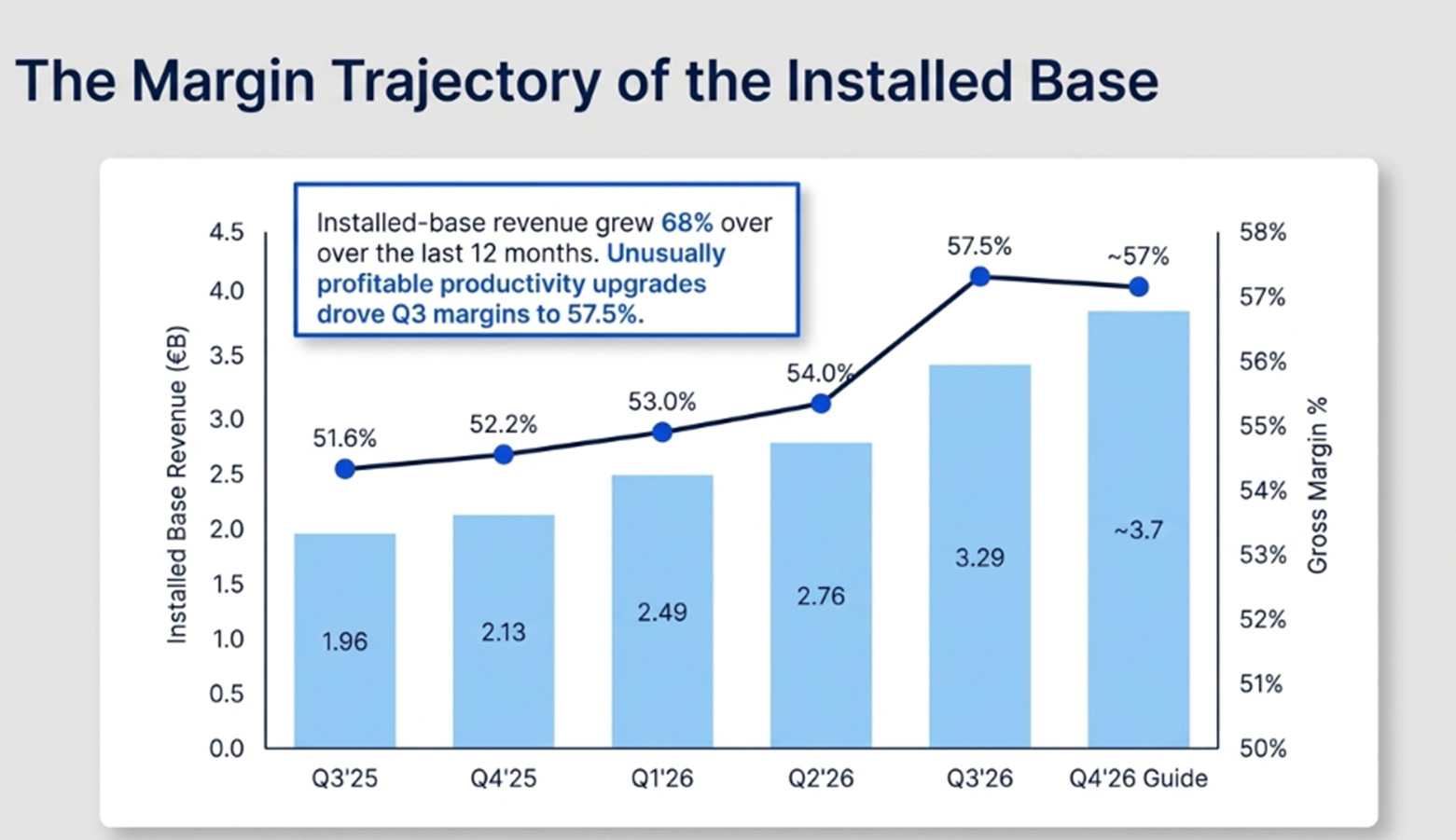
Q3 gave us the clearest example yet of the factory-and-fleet framework. Net system sales were €8.37 billion, about €436 million below consensus. Installed Base Management reached €3.29 billion, roughly €547 million above consensus and almost €400 million above ASML’s own guidance. Gross margin rose to 57.5%, helped by unusually profitable productivity upgrades in EUV and Deep UV.
The factory therefore ran behind expectations while the fleet more than compensated. Economically, that matters because ASML has two ways to create incremental semiconductor capacity for customers: ship another machine or make an existing machine produce more.
Installed-base revenue grew 68% over the last twelve months. Every new scanner expands the future population that ASML can service, upgrade and improve, which means today’s system growth creates tomorrow’s fleet opportunity.
The qualification is that upgrade demand partly reflects scarcity. When a customer cannot obtain another EUV system, improving throughput on an existing one becomes exceptionally valuable. As the factory catches up, some of that urgency should fade. Dassen himself called upgrades the “swing factor” for 2027 margins. The fleet is real, but its unusually strong profitability cannot simply be annualised.
The Queue Has a Price
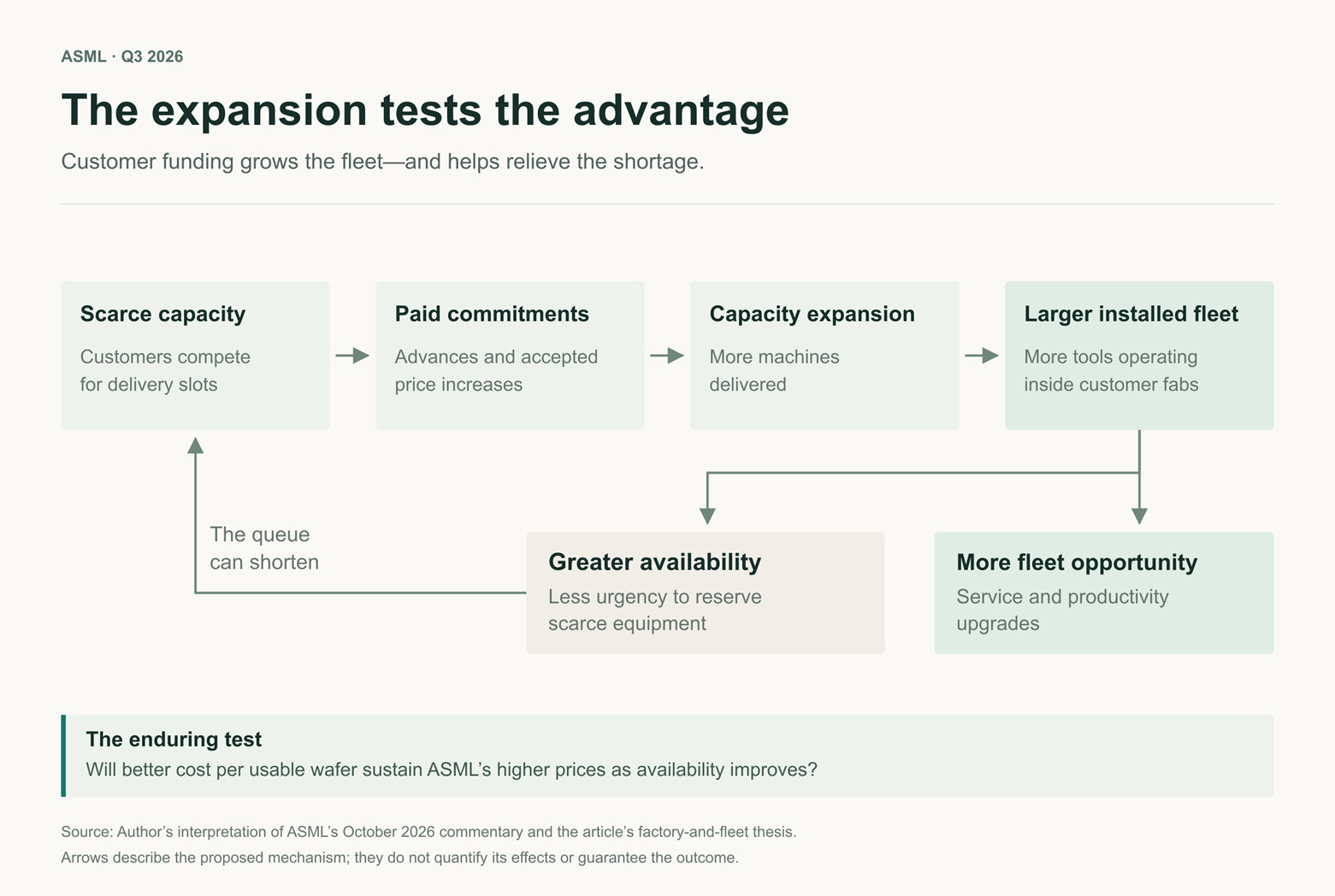
The most important Q3 development was on the balance sheet. Non-current contract liabilities, which had sat near €3.5 billion for five quarters, jumped to €9.30 billion. Dassen said the account largely represents customer down payments and called it a useful proxy for order intake now that ASML no longer reports bookings.
That gives the demand signal more substance. A customer forecast can change. A purchase order backed by cash and cancellation penalties is more consequential. When UBS asked whether customers could be over-ordering to reserve scarce capacity, Dassen replied:
“If you put an order with ASML, that’s not a frivolous piece of paper that you put your name under... it’s a down payment that is enough to hurt.”
The queue also appears broad. Management said interest in 2029–30 capacity was not concentrated in one customer and explained that ASML is deliberately avoiding filling every future slot before deciding how supply should be distributed. The company is no longer simply asking how many tools it can sell. It is deciding who gets access to a scarce industrial capability.
Then came the more important development: price. ASML has always charged more for better-performing machines, but this year management reopened the question of how the value created by those machines should be divided between ASML and its customers.
CEO Christophe Fouquet described the discussion this way:
“There was a clear acceptance that maybe the overall value in the ecosystem is shifting.”
Dassen was more direct:
“We thought that we were entitled to a higher percentage. We were able to get there with customers.”
That is the sentence that matters. ASML decided it had been receiving too small a share of the value its tools create, asked customers to change the split, and succeeded.
TSMC confirmed the customer side of the transaction the next day: tool-price inflation is real and tool supply is tight. In 2012, ASML needed customer capital because EUV did not yet work. In 2026, customers are giving ASML capital because EUV works and they cannot get enough of it.
Scarcity has become a price.
The Price Must Become Profit
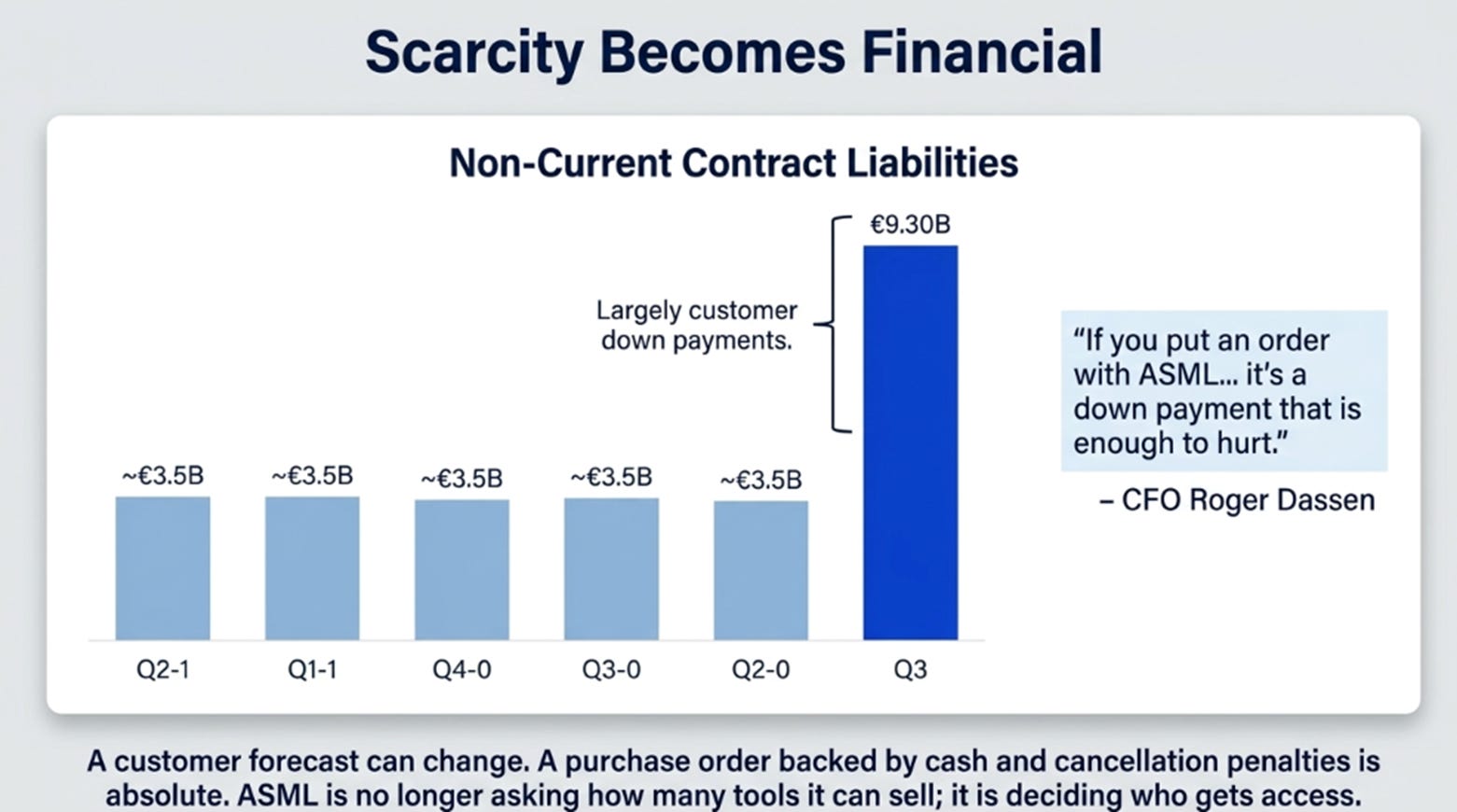
The next question is whether ASML gets to keep it. The company plans roughly 30% more Low-NA EUV and immersion capacity in 2027 and is considering further expansion in 2028. That requires facilities, supplier investments, specialist equipment, engineers and field support before the resulting revenue arrives.
This is why Q4 gross margin is guided around 57% despite revenue rising roughly 26% sequentially. More volume does not immediately mean more profit when ASML is simultaneously paying to create even more volume.
The pricing benefit follows a different timetable. Dassen said the new prices have some impact in 2027 and the full effect begins in 2028. Consensus appears to assume that expansion costs and normalising upgrades absorb much of that benefit: FactSet’s FY28 estimates imply gross margin around 57.5%.
My view is that they will not absorb all of it. I expect higher pricing, stronger EUV mix and manufacturing leverage to push 2028 gross margin toward approximately 59%. At roughly €72 billion of revenue, a 1.5-point margin difference is worth more than €1 billion of operating profit.
That is the key variant perception. The case no longer depends on ASML simply staying scarce forever. Permanent scarcity would constrain growth. The stronger argument is that the shortage allowed ASML to renegotiate its economics, and that customers will continue paying more because the tools still improve their cost per usable wafer even after availability improves.
That is also why the factory and fleet belong in the same thesis. The factory expands the installed base; the fleet extracts more capacity from it. Both create value only if ASML’s customers continue earning enough from the wafers those tools enable.
What the Market Sees and What I Think Is There
The conventional view is reasonable. ASML is the world’s most important semiconductor-equipment company near the top of an extraordinary capital-spending cycle. Logic and memory investment are rising together, TSMC is expanding aggressively, DRAM is adding EUV, and ASML itself is building capacity to satisfy the demand.
A bear case therefore does not require EUV to fail. Customers can simply digest the equipment they bought; upgrade demand can normalise, margins can fall back and investors can decide that 2026–28 represented peak economics.
My disagreement is narrower. I do not think investors are missing ASML’s technology or current demand. I think they may be underestimating what scarcity has allowed ASML to change about its share of the economics.
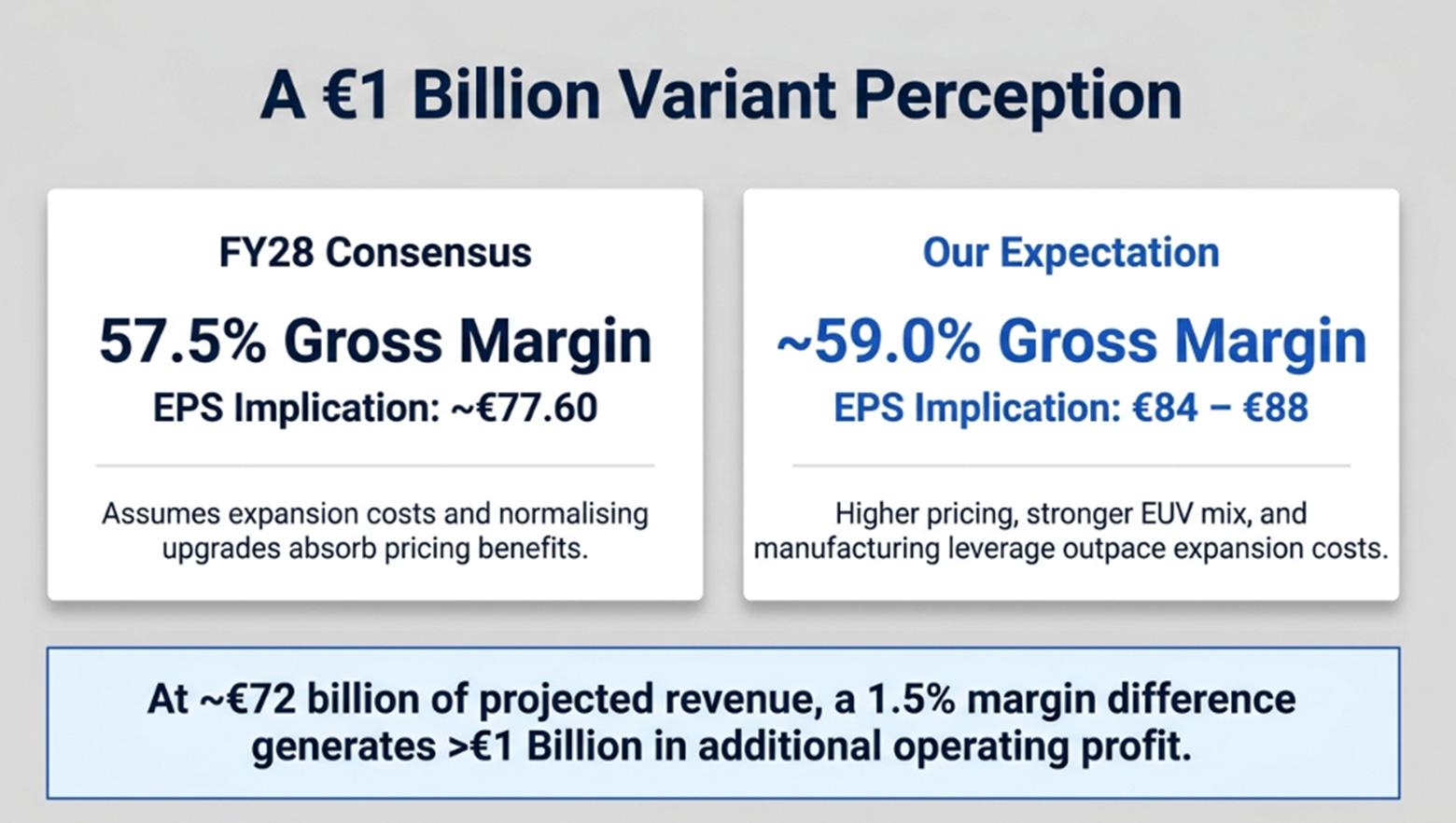
Customers have accepted higher prices. The question is whether those prices survive the expansion. That is why 2028 gross margin is the cleanest expression of the thesis. Consensus FY28 EPS is around €77.60; my estimate is approximately €84–88, with almost the entire difference coming from gross margin.
The debate is therefore not “How big will AI be?” It is “How much of the value created by this investment cycle belongs to ASML shareholders?”
Three Years Out
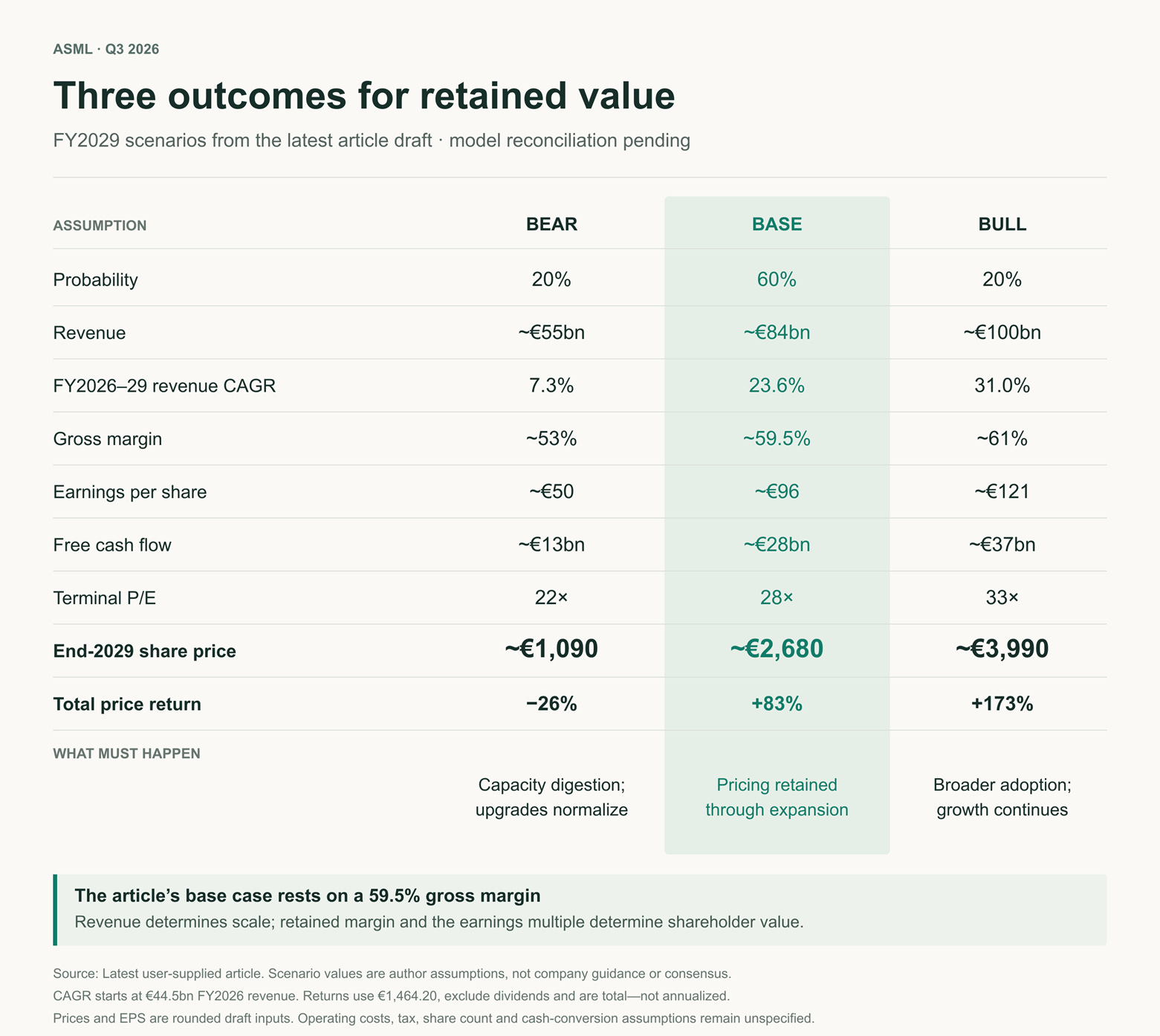
The bear case needs no technological failure. Customers digest capacity, upgrades slow, margins retreat and investors assign a lower multiple. A restriction on servicing China offers a separate and more severe downside because it would directly damage fleet economics.
The bull case requires ASML to build additional capacity and find profitable demand beyond the current TSMC-heavy cycle. DRAM EUV must broaden, Samsung and Intel need to matter more, and the market must believe FY29 earnings are not the peak.
I have reduced the bull probability from July because TSMC now points toward High-NA adoption around 2030 rather than the earlier commitment we had hoped to see. The base probability rises because deposits and completed pricing negotiations provide stronger evidence for the margin path.
The most important base-case assumption is therefore not €84 billion of revenue. It is the 59.5% gross margin. Every percentage point of FY29 gross margin is worth roughly €1.90 of EPS. Revenue tells us how large ASML becomes; margin tells us how much of the ecosystem’s economics it keeps.
The Test
Several things now matter. Receivable days should remain around or below 75. Q4 installed-base revenue should approach the roughly €3.7 billion management indicated. Contract liabilities should remain strong as customer deposits migrate between current and non-current accounts. By the June 2027 Capital Markets Day, management should quantify the scale and cost of 2028 capacity expansion.
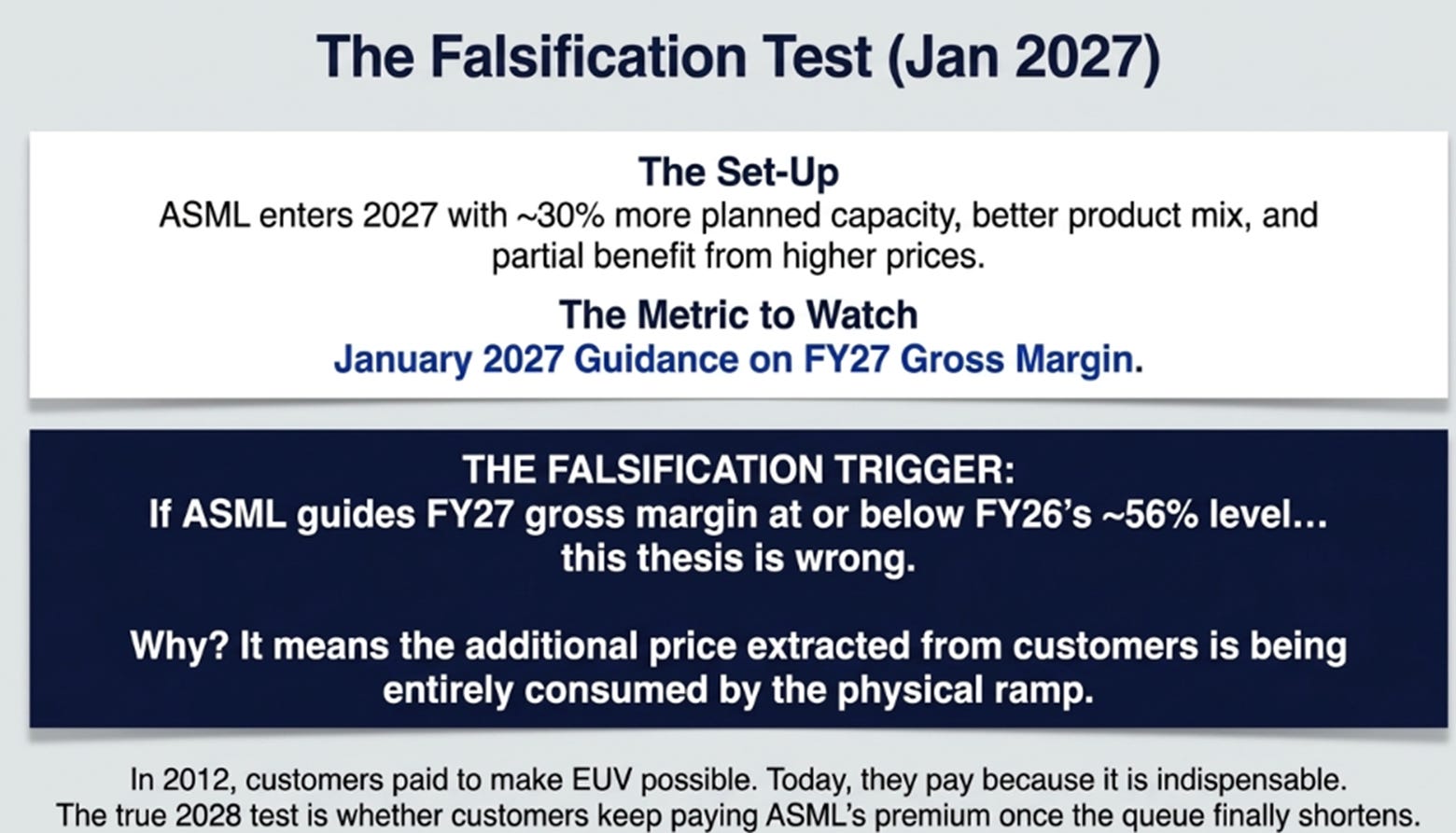
But one test comes earlier and goes directly to this article’s argument. ASML enters 2027 with roughly 30% more planned Low-NA EUV and immersion capacity, a better product mix and at least some benefit from higher prices. If none of that improves gross margin, the simplest conclusion is that the additional price is being consumed by the ramp.
If ASML guides FY27 gross margin at or below FY26’s roughly 56% level in January, this thesis is wrong. Saying that the “full” pricing benefit arrives in 2028 would not be enough to postpone that judgment. Partial pricing, volume and mix should already be visible.
In 2012, ASML’s customers paid because they needed the company to make EUV possible. In 2026, they are paying because EUV is indispensable and they cannot get enough of it. The technological uncertainty has been replaced by scarcity, and scarcity has given ASML the opportunity to renegotiate the economics of the relationship.
The 2028 test is whether customers keep paying ASML’s price once they no longer have to.
Disclaimer:
The content does not constitute any kind of investment or financial advice. Kindly reach out to your advisor for any investment-related advice. Please refer to the tab “Legal | Disclaimer” to read the complete disclaimer.