


TL; DR
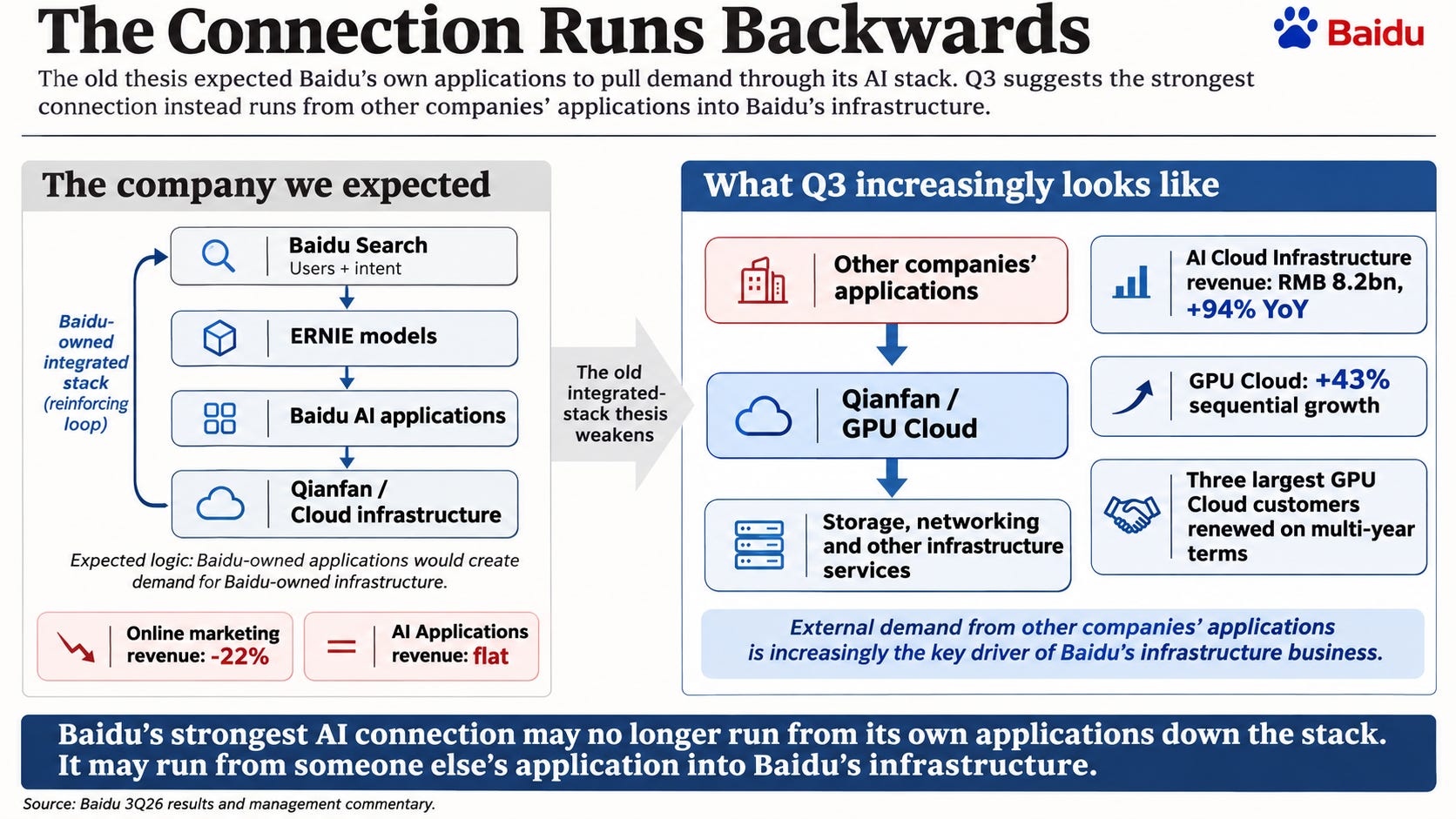
The cloud opportunity is stronger than we thought, but the original integration thesis is weaker: AI Cloud Infrastructure revenue grew 94%, while search advertising declined 22% and AI Applications were flat. Baidu’s fastest-growing AI business is increasingly serving applications it does not own.
That changes the economics materially: search monetized consumer intent at low incremental physical cost; cloud requires Baidu to finance compute, power and replacement before earning a return. Strong cloud growth can therefore coexist with weaker margins and negative free cash flow.
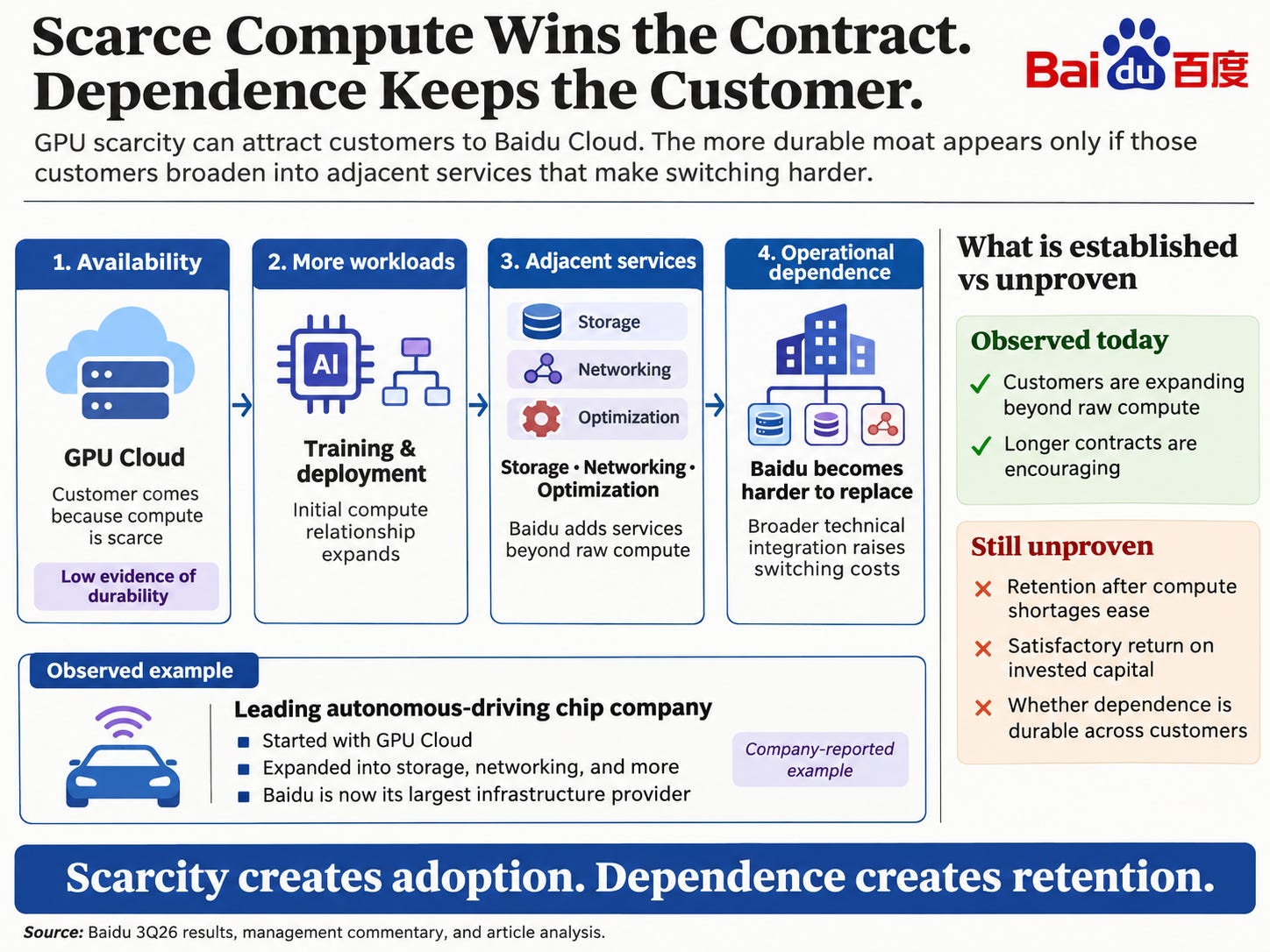
The durable moat must move from scarcity to dependence: customers renting GPUs because capacity is scarce may leave when supply normalizes. The better evidence is customers expanding from GPU Cloud into storage, networking and other services—turning raw compute into a harder-to-replace enterprise relationship.
Thomas Chong of Jefferies asked why Baidu’s third-quarter capital expenditure had fallen by approximately RMB4 billion even as cloud demand accelerated. CFO Henry He offered the most revealing answer of the call:
Two things make this possible. First of all, we have built ample computing reserves earlier, so as the demand grows, we can meet part of it with the capacity we already have. Second, we keep raising the utilization of the existing compute capacity, which frees up more capability to serve external customers.
AI Cloud Infrastructure revenue increased 94% to RMB8.2 billion, while GPU Cloud grew 43% sequentially. Meanwhile, online marketing declined 22%, AI Applications revenue was flat, and consolidated gross margin fell to 35.4%.
In September’s The Missing Connection, I argued that Baidu had assembled many of the ingredients of a successful AI company—models, chips, computing infrastructure and applications—without demonstrating how owning them together created superior economics. The missing connection was supposed to be between the businesses themselves: search supplying users and data to models, models improving applications, and applications creating demand for Baidu’s infrastructure.
Q3 suggests something different. Baidu’s cloud is finding substantial demand from applications developed by other companies, even as its own consumer franchise deteriorates. The connection we were looking for may exist, but it runs backwards—from somebody else’s application into Baidu’s computing infrastructure, without necessarily bringing the customer back to Baidu.
That could still be a valuable business. Whether it replaces the economics of the one Baidu is losing is another question.
The Company We Expected
Our October 2025 article, The Elephant’s Dance, compared Baidu’s transformation to IBM under Lou Gerstner. IBM had spent decades building computing systems, but Gerstner recognized that customers increasingly valued help solving complex enterprise problems more than ownership of the individual machines.
The analogy seemed attractive for Baidu. Search generated consumer intent and cash, ERNIE transformed queries into intelligent answers, Kunlunxin supplied computing efficiency, and Qianfan provided access to models and infrastructure. We expected these capabilities to reinforce one another.
By May’s The Second Threshold, I had become more demanding. An increasing AI revenue contribution was not enough; gross margin needed to remain above 40%, cloud growth had to exceed 50%, advertising declines needed to moderate, and free cash flow had to recover.
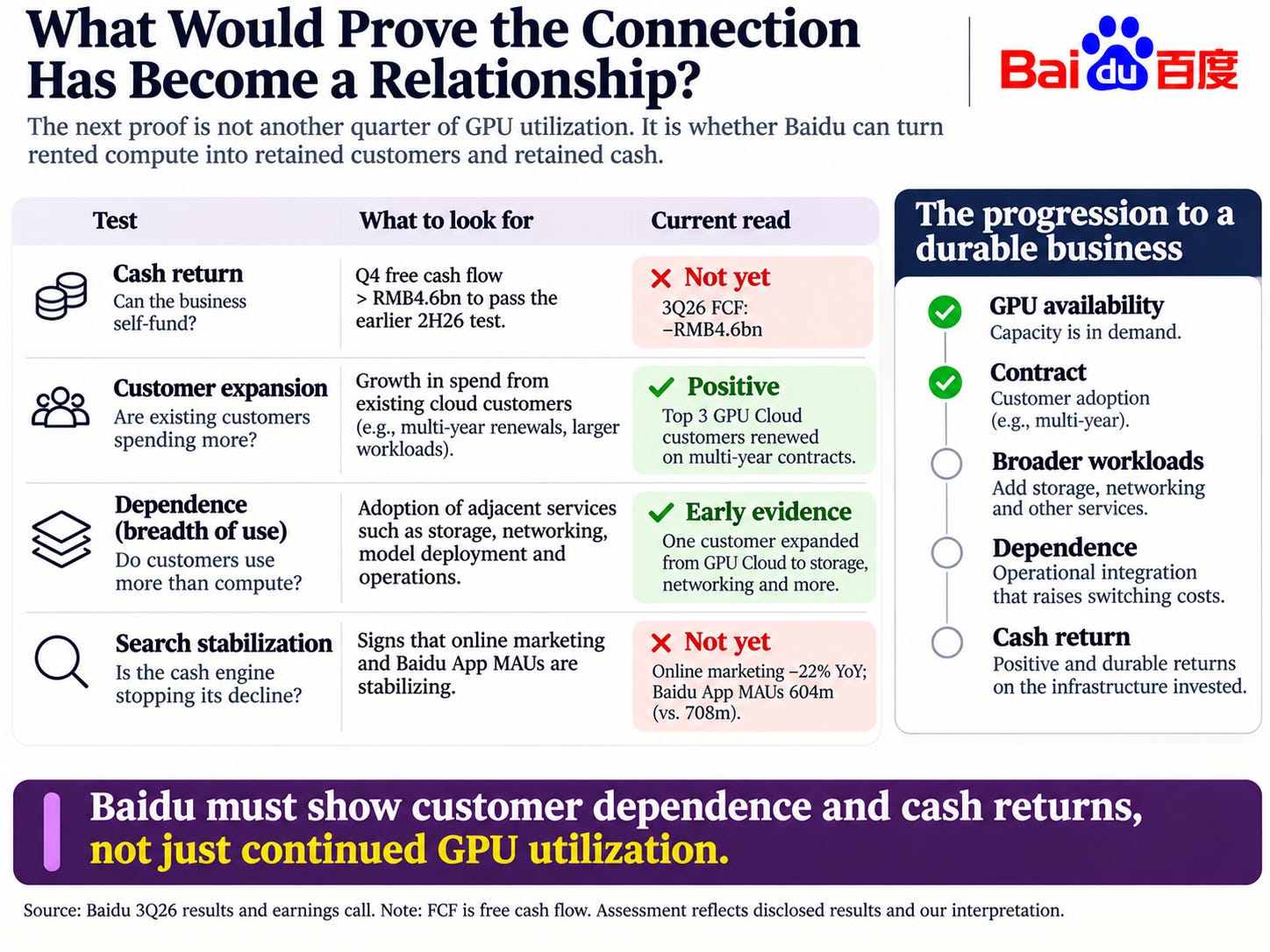
Q3 delivered two successes and several failures. AI-powered businesses reached 53% of General Business revenue, and AI Cloud Infra grew 94%. But gross margin fell to 35.4%, online marketing declined 22%, and AI Applications remained flat at RMB2.6 billion. Free cash flow was negative RMB4.6 billion, putting our second-half recovery target at substantial risk.
The old expectation that search would stabilize by late 2025 was wrong. The more recent hope that AI growth would restore the economics of the combined business remains unproven.
What has changed is that Baidu may not need all its businesses to reinforce one another for cloud to succeed. It does, however, need cloud to earn attractive returns on its own.
Who Owns the Demand?
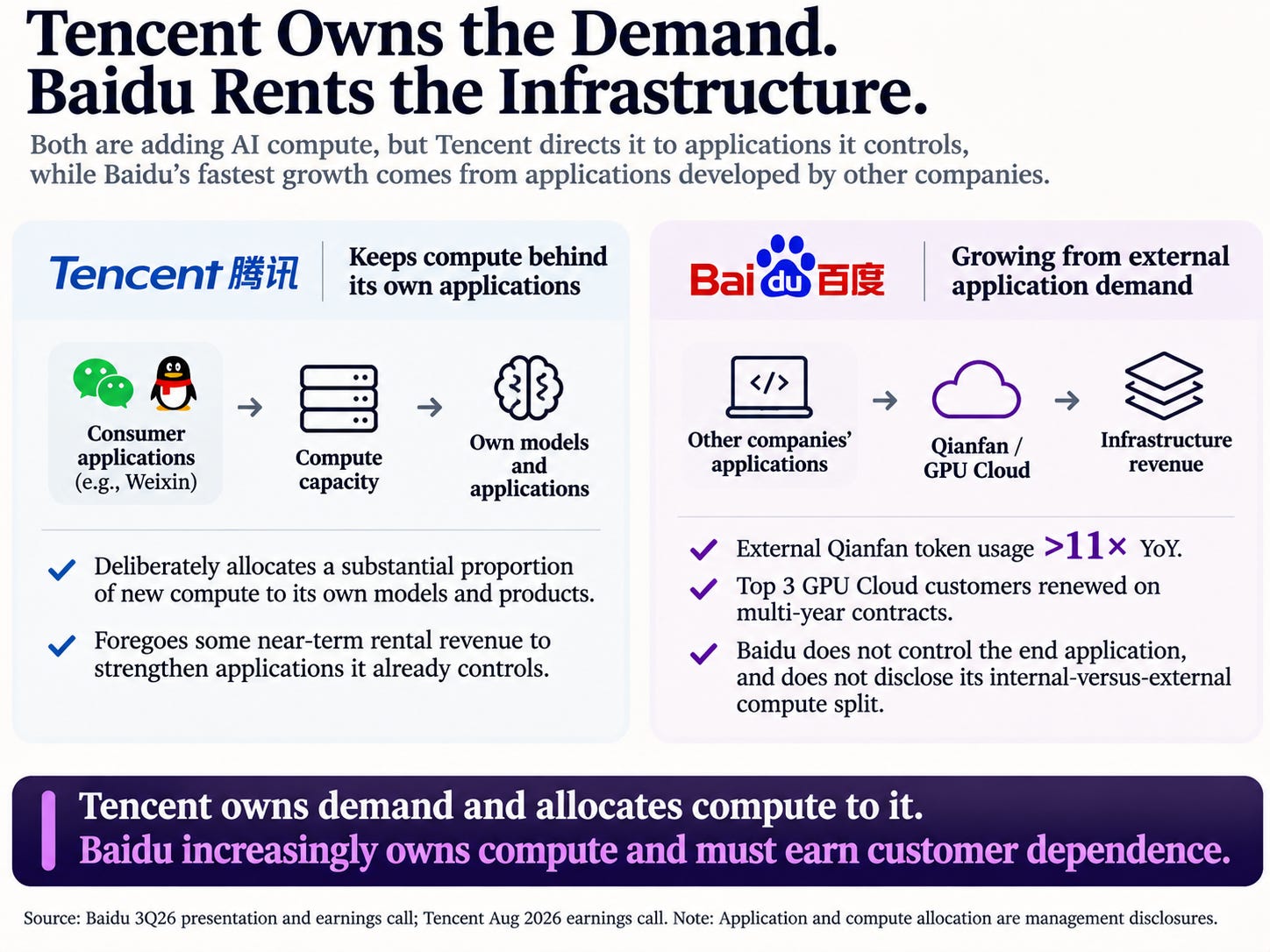
The most useful comparison is Tencent, which faces much of the same Chinese computing market but is allocating its capacity differently.
During Tencent’s August earnings call, Chief Strategy Officer James Mitchell explained:
Given the surge in demand and therefore rental pricing for compute, we could recover the depreciation almost immediately by renting the compute out to third parties as many neo-cloud businesses are doing. And we would then achieve a decent return in an immediate timeframe. However, in reality, we’re playing a different game or executing a larger strategy, and we’re allocating a very substantial proportion of the new compute to building our own models to state-of-the-art status and also to deploying, popularizing and bringing our own AI applications to market leadership in China.
Tencent believes the long-term economic value of its compute may be greater inside Weixin and its own applications than as a service rented to other companies. It is deliberately foregoing some near-term infrastructure revenue to strengthen products that already control enormous consumer relationships.
Baidu is demonstrating a different opportunity. External customers are adopting Qianfan, GPU Cloud and associated services even without Baidu owning the applications those customers are developing. Revenue from external customers’ token usage on Qianfan increased more than elevenfold year over year, while the three largest GPU Cloud customers renewed on multi-year terms.
That distinction does not establish why Baidu has capacity available. Perhaps it deliberately built ahead of external demand. Perhaps its internal requirements grew more slowly than anticipated. Or perhaps external workloads currently offer more attractive incremental returns. Baidu does not disclose the internal-versus-external compute split, and flat AI Applications revenue does not measure the computing consumed by ERNIE training, search inference or autonomous driving.
What we can establish is the difference in commercial position.
Tencent has powerful applications capable of creating demand for its computing capacity. Alibaba combines a substantial enterprise cloud business with commerce and consumer relationships. Baidu’s clearest new growth engine serves customers whose applications it does not control.
This does not make Baidu’s infrastructure irrelevant to its own AI products. It means those products are not proving necessary to sustain cloud growth.
The surprising possibility is that Baidu becomes a more important supplier to China’s AI economy precisely as it becomes less important to China’s consumer internet.
The Annuity Is Leaving
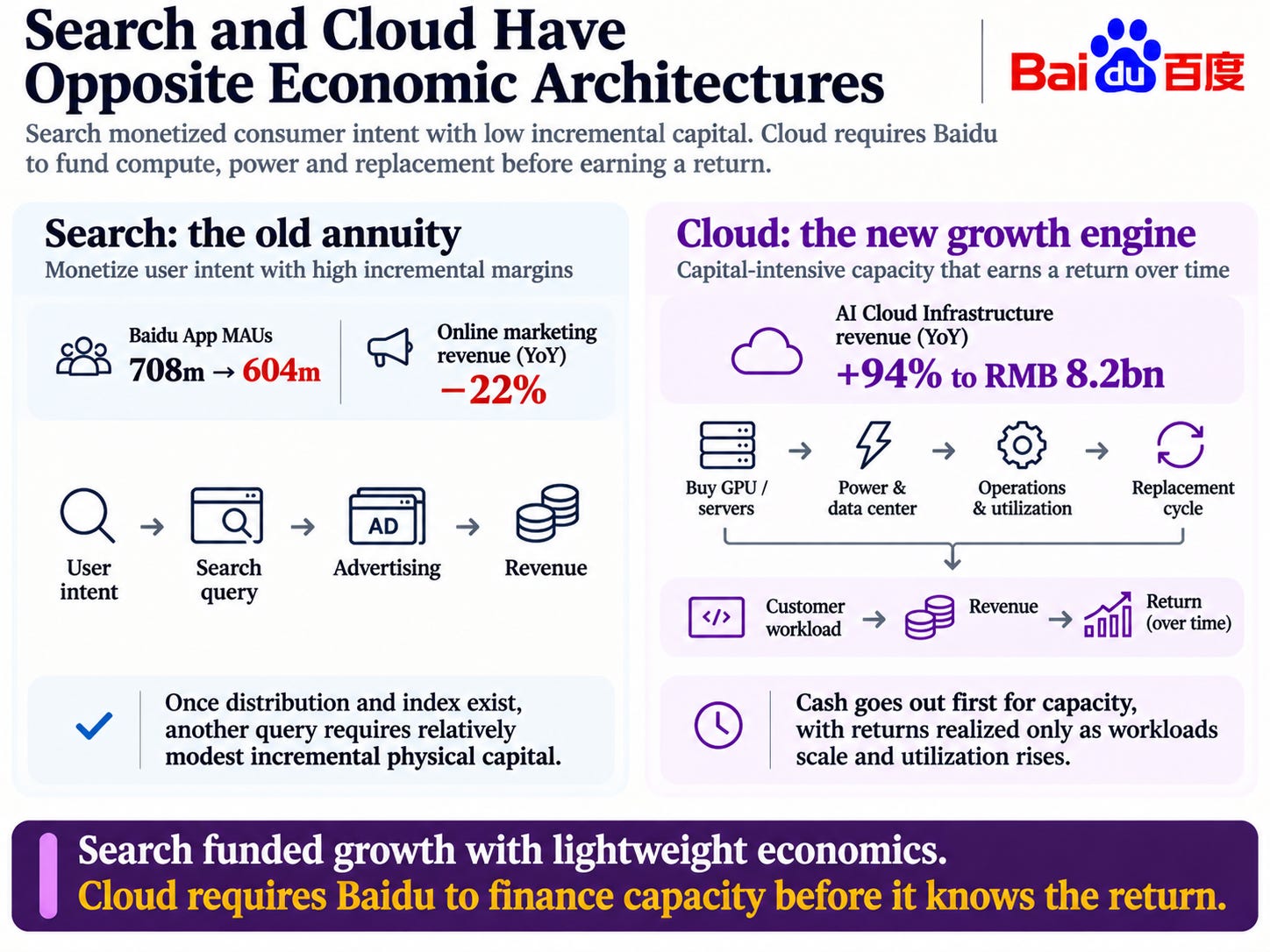
The deterioration in search makes that possibility consequential rather than merely interesting.
Baidu App monthly active users declined from 708 million in September 2025 to 604 million this September. Online marketing revenue fell 22%, while AI-native marketing services declined 15%.
Robin Li attributed part of the pressure to the deliberate transformation of search:
Looking ahead, we will continue to prioritize user experience over near-term monetization as we advance our AI search transformation. While this will weigh on our online marketing revenue and overall profitability in the near term, we believe it is the right path to strengthen our long-term competitiveness and unlock the full potential of AI search.
The argument is reasonable as far as it goes. Showing fewer advertisements while improving AI-generated answers can sacrifice immediate revenue to preserve long-term engagement.
But a company choosing to monetize users less aggressively should not automatically be losing users. Baidu is doing both.
Some of the decline reflects weaker Chinese advertising demand. Some reflects competition from WeChat, Douyin, Taobao and other applications that increasingly retain consumer discovery and transactions inside their own ecosystems. AI assistants make that competition more consequential by allowing users to receive answers and complete tasks without beginning with a conventional search engine.
Google’s Search revenue increased 12% in the September quarter, while Tencent’s Marketing Services grew 22% in its June quarter. These are imperfect comparisons across different markets and business models, but they demonstrate that AI does not inevitably destroy advertising.
Baidu’s problem is therefore not simply that AI answers are harder to monetize than traditional search results. It is that fewer valuable consumer interactions may begin with Baidu at all.
That undermines the original economic advantage of search. Once a search index and distribution system existed, another query could produce advertising revenue at relatively modest incremental physical cost. Ownership of intent generated a lucrative relationship between users, advertisers and Baidu.
Cloud reverses that structure. Baidu must first acquire the computing infrastructure, then persuade external customers to use it, and finally earn enough to cover the hardware, power, operations and eventual replacement.
The revenue can grow spectacularly without reproducing search’s historical returns.
Rent Is Not Return
This is why the distinction between computing scarcity and customer dependence matters so much.
Baidu’s cloud profitability is reportedly improving, supported by higher utilization, a richer revenue mix, proprietary Kunlunxin capabilities and operating scale. But management does not disclose a standalone cloud margin or enough information to isolate cost improvements from pricing.
The wider market provides a reason for caution. Tencent has raised compute prices, while Alibaba’s management believes the current shortage could persist until at least 2030. That would support Baidu’s near-term economics, but neither forecast guarantees that today’s pricing survives the capacity being built across China’s AI industry.
Consider the financial results.
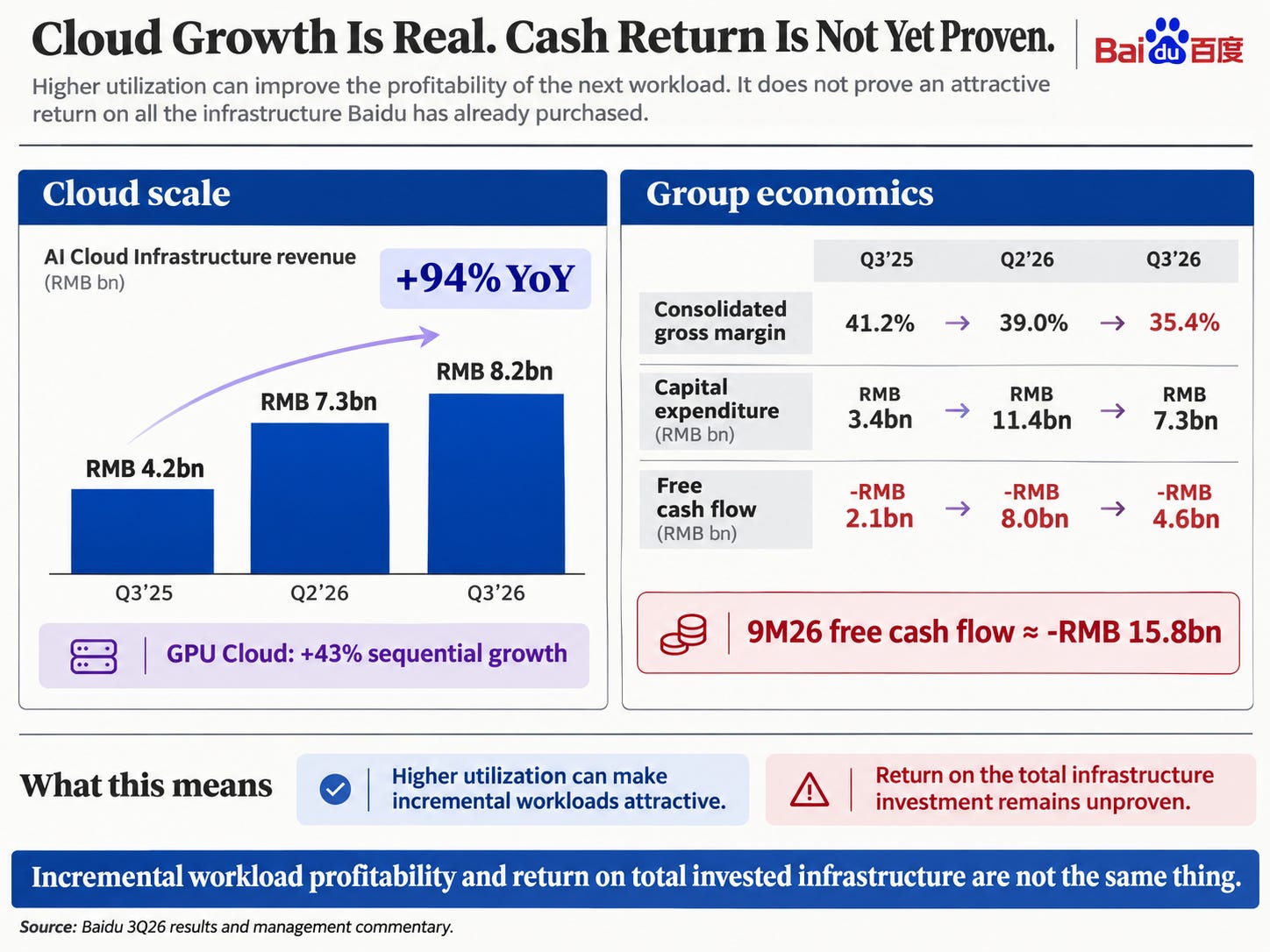
Higher utilization of existing servers can produce attractive incremental profits. But the cost of acquiring those servers does not disappear because spending falls in a subsequent quarter. Baidu generated approximately negative RMB15.8 billion in free cash flow during the first nine months of 2026.
This is not evidence that cloud cannot become profitable. It is evidence that the profitability of incremental workloads and the return on the entire infrastructure investment are different calculations.
The more important question is what customers are buying.
A company renting GPUs because capacity is scarce may switch when cheaper alternatives become available. A company relying on Baidu for model deployment, networking, storage, inference optimization and operational reliability faces a more consequential switching decision.
Dou Shen, who leads Baidu AI Cloud, provided the first meaningful evidence of that transition:
One example is a leading autonomous driving chip company. As it iterates on its models, its training needs have grown quickly. Our work together actually started with GPU Cloud and then expanded into storage, networking, and more, and we are now its largest infrastructure provider.
The initial GPU contract opened the relationship. Additional workloads expanded it beyond raw compute.
That is closer to the IBM transformation we originally envisaged. Gerstner’s IBM did not simply rent more computers; it made enterprises dependent on its ability to combine technologies into functioning solutions.
Baidu could occupy a similar position for AI infrastructure, serving customers that use competing models without requiring them to adopt ERNIE or Baidu’s consumer applications. Qianfan’s support for multiple models may become an advantage for enterprises unwilling to depend entirely on another company’s preferred AI architecture.
But this is a hypothesis with preliminary evidence, not a completed transformation.
Longer contracts and increasing purchases of adjacent services are encouraging. They do not establish retention after capacity shortages ease, nor do they demonstrate satisfactory returns on invested capital. Customer deposits and deferred revenue have not yet shown the sustained increase that would make the reported commercial commitments more convincing.
The distinction is fundamental: scarce capacity attracts customers; operational dependence is what might keep them.
What the New Business Is Worth
The shares have reached the HK$73 review level identified in September’s The Missing Connection. Yet the operating outlook has deteriorated enough that the stock is less attractive than the price decline alone suggests.
Search is weaker, gross margin is lower, and cash consumption remains substantial. Cloud demand is stronger, but its long-term earnings quality remains uncertain.
I would revise September’s valuation by assigning lower multiples to the operating businesses and explicitly allowing for further cash consumption. The outcomes value FY2029 after-tax operating earnings, while adjusting for financial assets and minority interests. Kunlunxin and long-term strategic investments receive no speculative standalone premium.
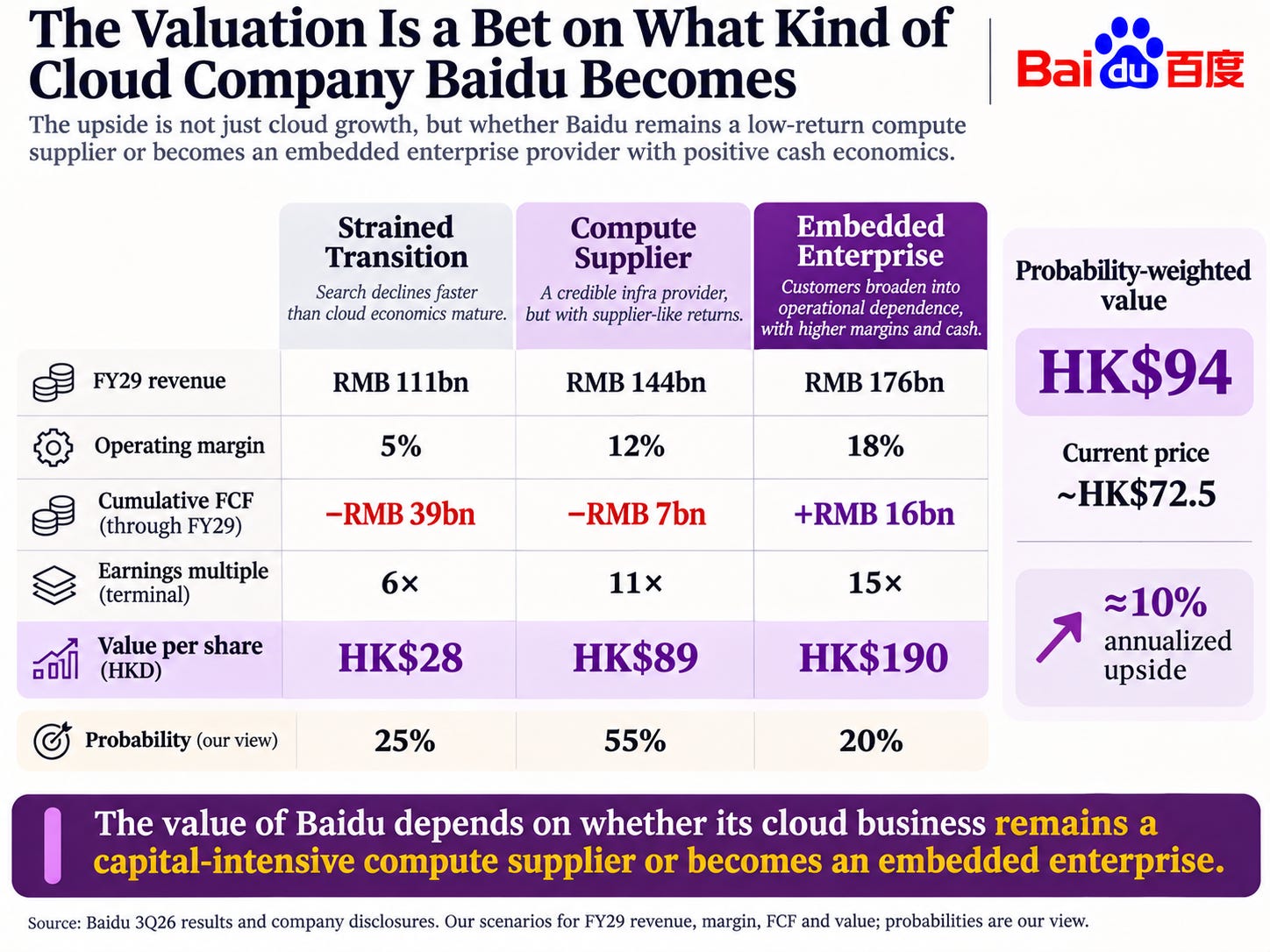
The probability-weighted value is approximately HK$94, implying roughly 10% annualized appreciation from a share price around HK$72.5. That is positive, but hardly compelling for a business undergoing such a fundamental change in its economics. The central case needs cloud growth to become profitable enterprise business while the declining search franchise stops absorbing an increasing share of the gains.
Our previous valuation gave too much credit to the idea that owning the entire AI stack would create superior economics. The new one recognizes that Baidu may instead become a successful infrastructure supplier whose earnings deserve a different multiple.
I would not add aggressively merely because the shares have returned to our September review price. The next evidence must demonstrate that external cloud growth is producing durable cash returns rather than temporarily improving utilization of capacity already purchased.
The original second-half 2026 free-cash-flow test remains outstanding, although Q4 must generate more than RMB4.6 billion to pass. During 2027, sustained cloud growth accompanied by improving cash flow and margins would strengthen the thesis. More revealing would be rising revenue from existing customers, longer contracts and expanding adoption of services beyond compute. Search must also show signs of stabilizing, because a shrinking cash-generating franchise makes the transition harder to finance.
Our original IBM analogy was not entirely wrong. The mistake was assuming that Baidu’s transformation would be driven by connections among businesses it already owned. Instead, the strongest emerging connection is between its infrastructure and other companies’ applications.
That can produce a substantial enterprise franchise. But the economic advantage will not come from owning every layer of AI, nor simply from having GPUs available during a shortage. It will come from making Baidu sufficiently valuable to enterprise customers that they continue choosing it when computing capacity is plentiful.
The old Baidu earned money because users came to it with questions. The new Baidu is finding customers whose questions, applications and businesses belong to someone else. The connection runs backwards; the investment succeeds only if that connection becomes a relationship durable enough to pay for the infrastructure beneath it.
Disclaimer:
The content does not constitute any kind of investment or financial advice. Kindly reach out to your advisor for any investment-related advice. Please refer to the tab “Legal | Disclaimer” to read the complete disclaimer.