


TL; DR
Cloud is the strongest evidence in the quarter: AI Cloud Infra grew 50%, GPU cloud revenue rose 283%, and Baidu is increasingly proving it can serve large-scale AI demand. But almost all incremental AI revenue came from cloud, not applications or AI-native marketing.
The original full-stack thesis has weakened: Qianfan can serve ERNIE and competing models, which is good for customers but means Baidu can succeed in infrastructure without its own model, search and applications reinforcing one another economically.
The missing connection is shareholder economics: search MAUs are falling, application growth is weak, free cash flow remains negative and capex is high. Baidu has shown that AI changes its revenue mix; it has not shown that owning the whole stack makes the combined business more valuable.
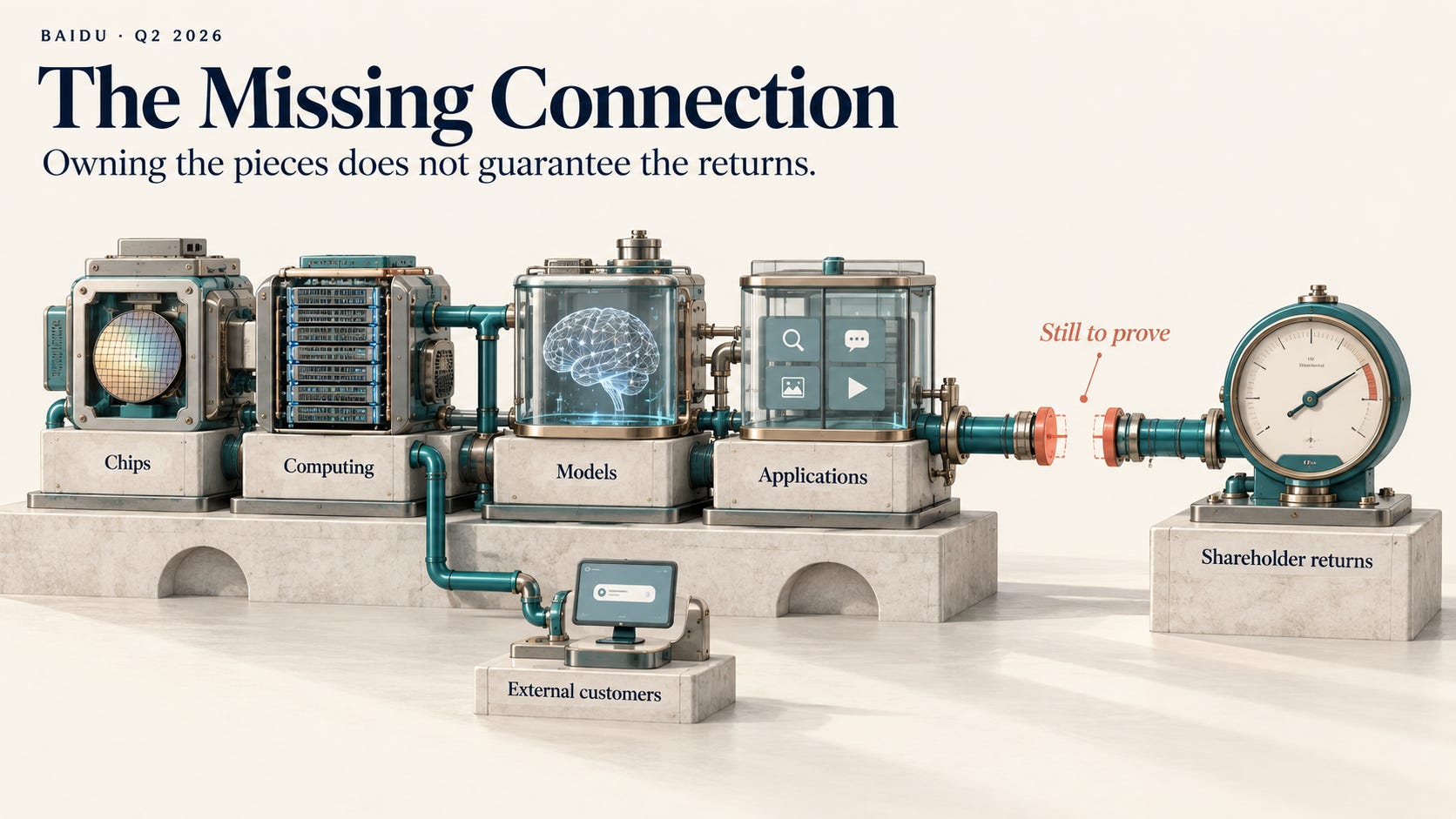
Baidu’s potential compounding mechanism is that more AI workloads improve infrastructure utilization and serving efficiency, attracting customers whose usage finances further improvements. Scale strengthens that mechanism only if customers stay and Baidu retains some of the savings after price competition and replacement spending. It breaks if computing capacity becomes interchangeable while search deteriorates and Baidu’s broader AI ambitions consume the profits.
Owning the pieces
Robin Li described the quarter’s strongest business on the earnings call:
AI Cloud Infra delivered another quarter of strong growth, with overall revenue increasing 50% year-over-year, once again outpacing the broader market. Within AI Cloud Infra, GPU cloud revenue nearly quadrupled year-over-year, growing 283% and accelerating significantly from an already strong 184% growth rate last quarter.
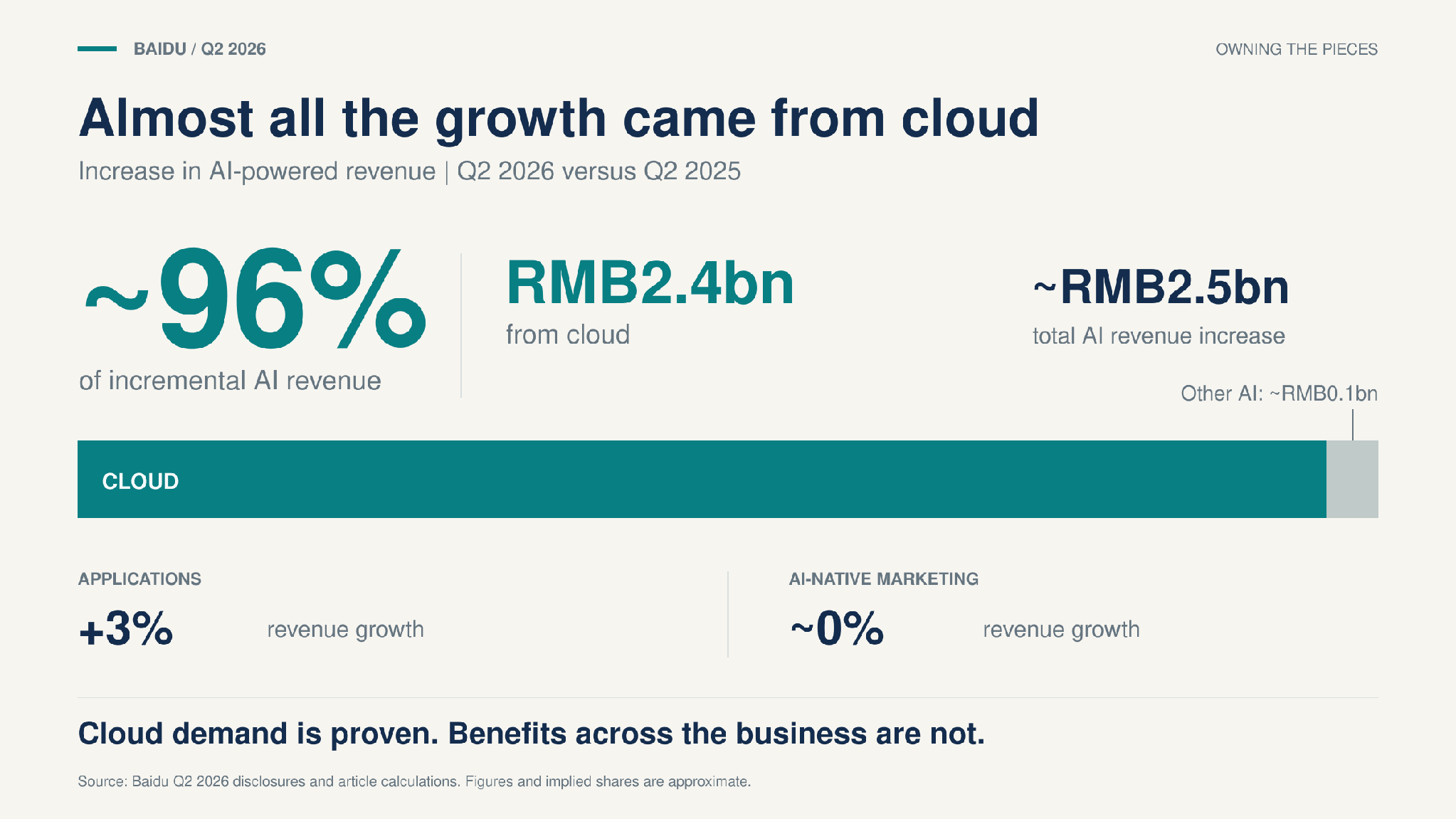
I think these results validate Baidu’s engineering more clearly than they validate our original investment thesis. In October’s “The Elephant’s Dance,” we described search intent, models, chips, infrastructure and applications as components of a reinforcing system. By May’s “The Second Threshold,” we had added a qualification: integration had to appear in margins, cash flow and application monetization.
That qualification is now the argument. Of the roughly RMB2.5 billion increase in AI-powered revenue from a year earlier, RMB2.4 billion came from cloud. Applications grew 3%; AI-native marketing was approximately flat. Baidu owns the pieces, but almost all the incremental revenue came from one of them.
The call’s most revealing passage explained Qianfan, Baidu’s platform for serving AI models:
On MaaS, our Qianfan MaaS platform offers one of the most comprehensive model libraries, covering Baidu’s ERNIE family, as well as virtually all of China’s leading models. A key priority for Qianfan is to make model inference at scale more reliable and cost-efficient for customers.
This is a good customer proposition. Enterprises want their chosen models to run reliably and economically. Supporting competing models expands Baidu’s opportunity and reduces dependence on ERNIE winning. But when Baidu sells computing capacity to a customer running somebody else’s model, that transaction does not automatically improve Baidu’s consumer products or bring users back to search.
A valuable business can nevertheless emerge. More workloads can improve utilization; better serving software can lower costs; integration into customers’ operations can encourage retention. This is a different mechanism from the one we originally emphasized. Our variant perception is that Baidu can succeed by serving competing models, but owning its own model and applications does not, by itself, justify a premium valuation.
Alibaba’s 45% external cloud growth in the June quarter also shows that infrastructure demand extends beyond Baidu. Baidu’s advantage must appear in customer economics and returns on capital, not simply participation in a growing market.
The audience is shrinking
Search makes that distinction consequential. Baidu App monthly active users fell from 735 million in June 2025 to 644 million in June 2026, a 12.4% decline. An argument built around capturing consumer intent becomes harder to sustain when the audience supplying that intent is shrinking.
Management attributes advertising pressure both to restrained AI-search monetization and to intensified competition for attention. We previously gave too much weight to deliberate cannibalization. Choosing to show fewer advertisements and losing users to alternatives can happen simultaneously, but they offer different prospects for recovery.
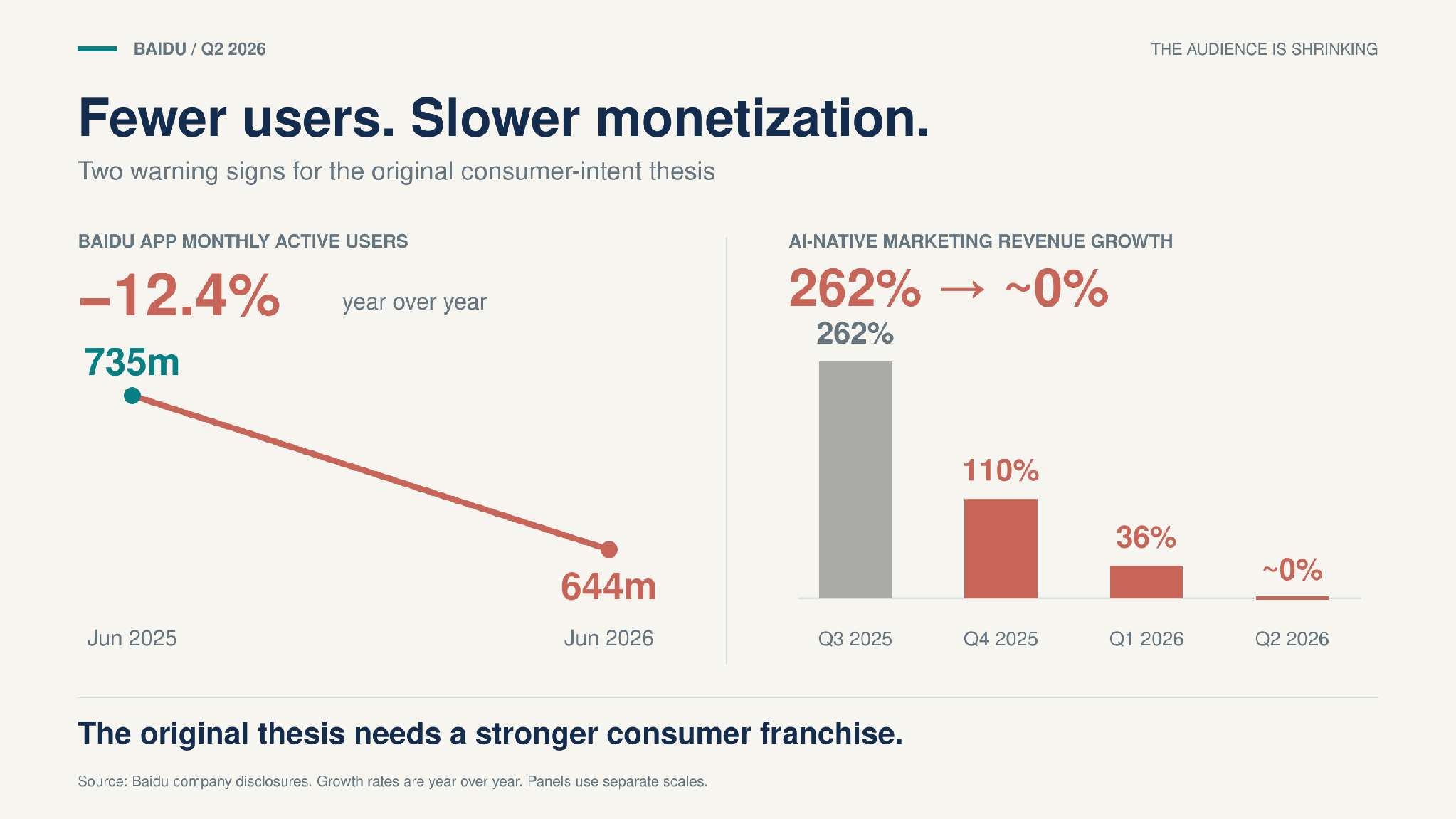
The slowdown in AI-native marketing is particularly uncomfortable. Its growth fell from 262% to approximately zero in three quarters. Comparison bases matter, and this does not establish that AI advertising has reached its ceiling. But it weakens the claim that a new monetization engine is already replacing the old one. Online marketing revenue declined 19% to RMB13.1 billion, improving from Q1’s 22% decline but still deteriorating substantially.
Cloud requires a similarly careful reading. Revenue fell 17% sequentially; management said profits and margins improved year over year. Those comparisons answer different questions. Profitability is reportedly stronger than a year ago, but sequential revenue remains uneven. Without sufficient disclosure of utilization, customer retention and investment payback, we cannot establish how durable the economics are. GPU revenue growth also cannot be treated as evidence of equivalent growth in Kunlunxin’s external chip sales.
AI now represents approximately half of General Business revenue. That confirms its importance, but the percentage rises partly because advertising contracts. The competitive question is whether Baidu is building a stronger customer franchise, not simply a different revenue mix.
The ambition has a carrying cost
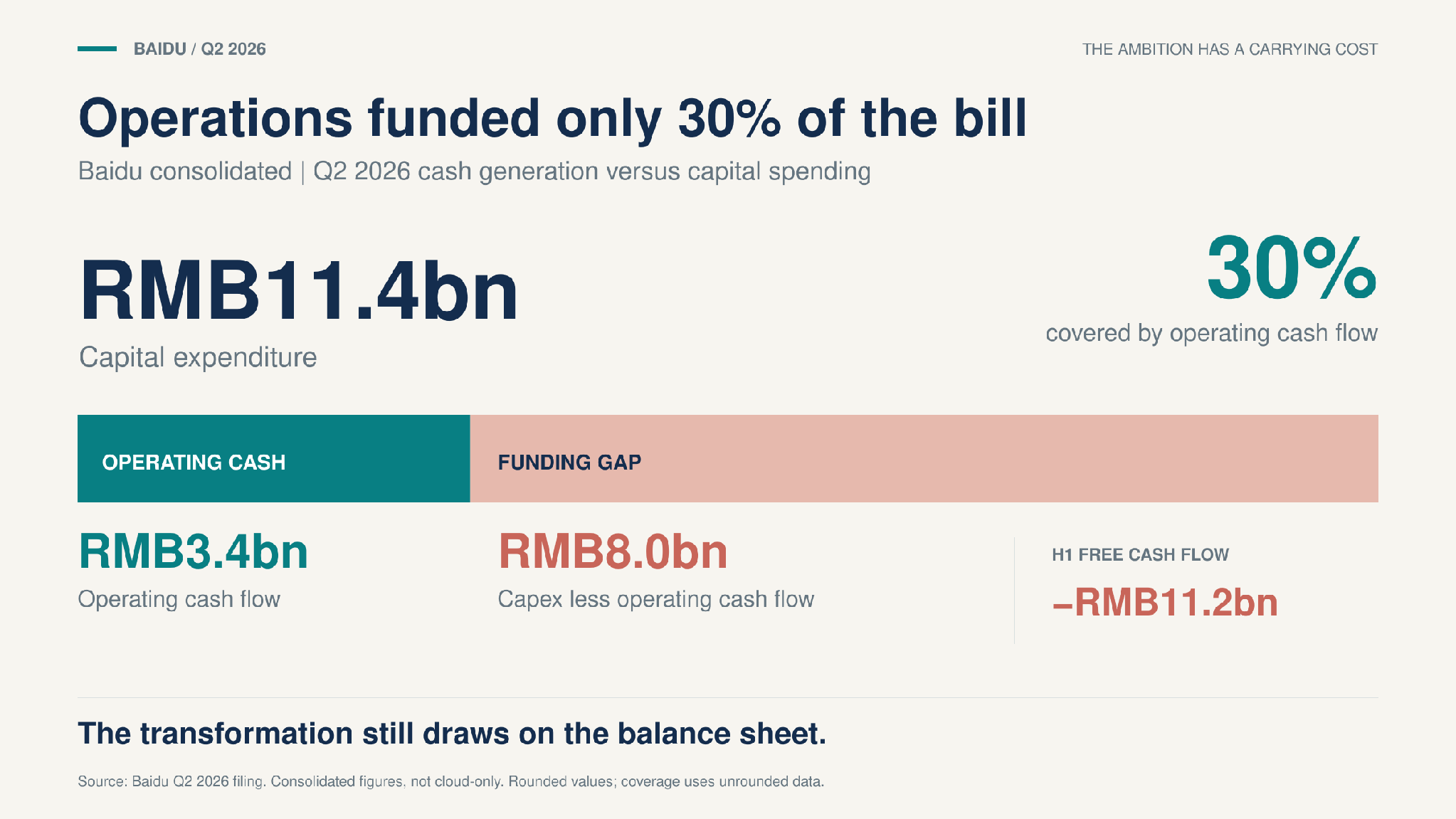
Baidu is moving from advertising, which required comparatively little physical capital, toward computing infrastructure, which requires substantial spending before shareholders receive the returns. The transformation therefore changes the balance sheet as well as the income statement.
Q2 operating cash flow was RMB3.4 billion against RMB11.4 billion of capital expenditure, approximately 36% of revenue. First-half free cash flow was negative RMB11.2 billion. Interest-bearing debt increased RMB14.3 billion from December. The RMB1.2 billion quarterly foreign-exchange loss adds earnings volatility, although it is not equivalent to recurring operating cash burn.
Nor should investors spend a dividend before it exists. February’s policy allowed a potential first payment by year-end; it did not declare a distribution. The absence of a payment announcement in these results leaves the timing and amount unresolved.
Meanwhile, Robin Li reaffirmed another claim on capital:
ERNIE has likewise always been an important part of Baidu’s AI strategy and full-stack AI capabilities. We were among the first companies in China to invest in foundation models. There were trials and errors along the way, but our commitment to make ERNIE competitive remains unwavering.
He subsequently described bringing ERNIE “back into the top-tier of foundation models.” Li also described feeding search experience back into model training. That is a plausible improvement loop, and model expertise could help infrastructure efficiency. But the declining audience and weak application growth leave its financial benefits unproven. Shareholders are financing both a platform that serves competing models and an effort to restore Baidu’s own model leadership. The economic connection between those investments still needs demonstrating.
Our May tests remain intact: cloud growth above 50%, consolidated gross margin above 40%, advertising declines better than 15%, stronger application growth and sustainable positive free cash flow in 2H26. This quarter delivered 50%, approximately 39%, a 19% decline, 3% application growth and another cash outflow.
The cash-flow deadline has not passed. However, the spending assumptions below now imply it will be missed. That is a downgrade to our forecast, not permission to move the deadline silently. Baidu’s infrastructure opportunity remains credible; confidence in how quickly it benefits the parent’s shareholders has weakened.
What the balance sheet buys
At HK$89.50, the September 22 close, Baidu sits just below May’s HK$90–105 bear range. That was a conditional future valuation, not a floor. Our former HK$185–205 base range assumed a more successful conversion of AI growth into shareholder earnings than we can presently underwrite.
The revised model separates operating value from financial assets. At June 30, cash, short-term investments and longer-term deposits and held-to-maturity investments, less interest-bearing debt, totaled approximately RMB136.7 billion. That is substantial protection, but it will change with spending, repurchases and operating performance.
These scenarios value the shares in September 2029 using FY2029 operating earnings. They begin with FactSet’s RMB127.4 billion FY2026 revenue estimate. Capital spending and cash flow are explicit assumptions, not management guidance.
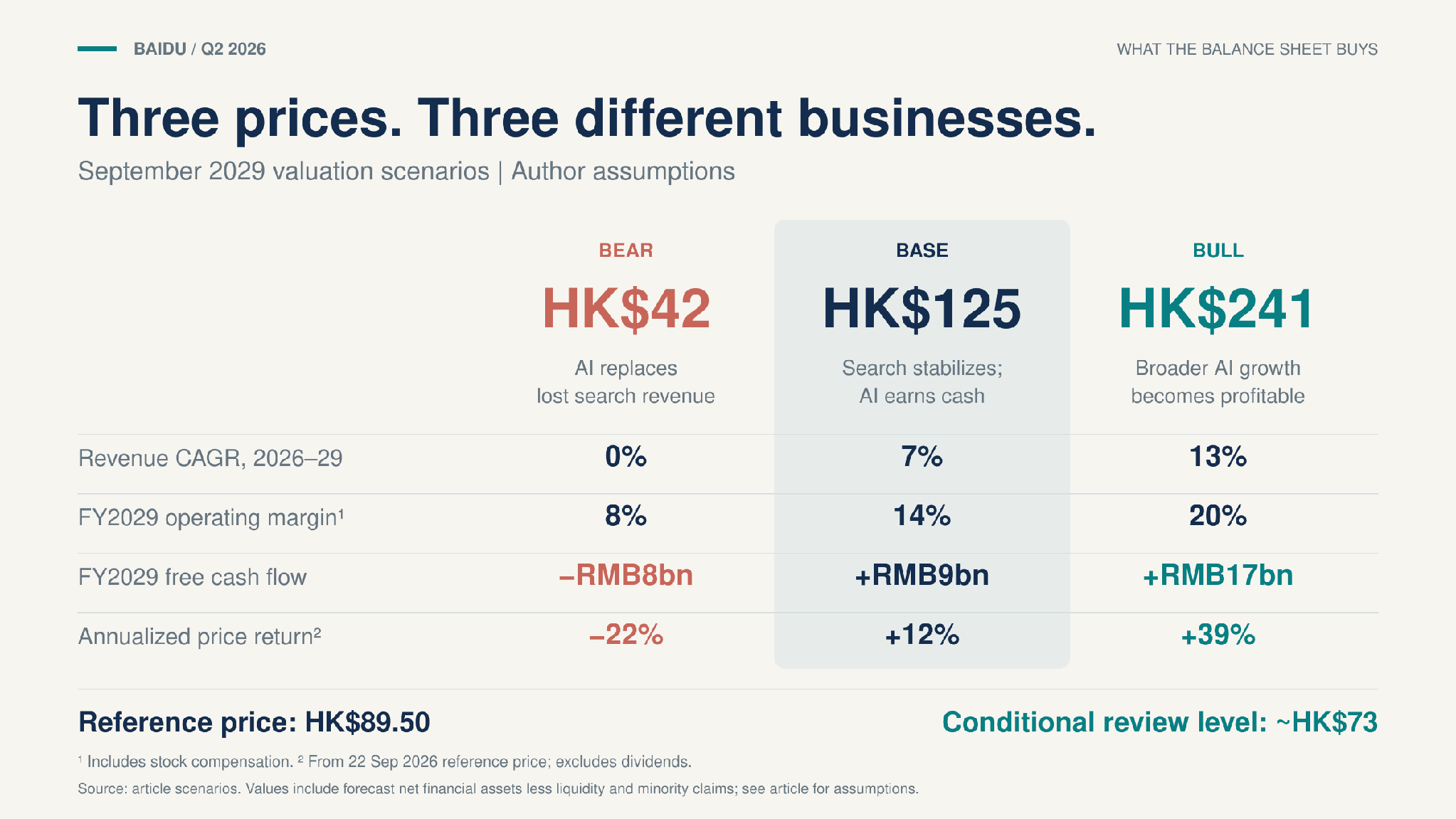
Equity value equals after-tax operating earnings times the multiple, plus forecast net financial assets, less a RMB25 billion operating-liquidity reserve and RMB23.3 billion for minority claims. The latter uses current book values as an explicit proxy, not a market valuation. Tax is 25%; the assumed exchange rate is HK$1.15 per RMB. This avoids adding cash to an earnings multiple that already capitalizes its interest income.
Financial assets incorporate the cash-flow paths through September 2029, including three-quarters of 2029’s annual cash flow. Base and bull cases deduct RMB8 billion of cumulative buybacks, assumed to offset issuance and keep diluted ordinary shares at 2.755 billion. The bear assumes no repurchases and 1% annual dilution. No dividends, acquisitions or listing proceeds are assumed. Strategic equity investments are excluded, as is any separate Kunlunxin or robotaxi premium; this is a conservative operating valuation rather than a complete asset appraisal.
The base case requires annual operating cash flow to rise to RMB32 billion by 2029 while capex settles at RMB23 billion, still nearly 15% of revenue. It depends on better utilization, stronger margins and search stabilization, not the disappearance of replacement spending. The bull requires profitable growth across a broader business. The bear assumes continued cash consumption; if that persists indefinitely, even its operating multiple could prove generous.
Investor constituencies will read these results differently. Value investors will focus on financial assets but demand control of cash burn. Growth investors need evidence of durable margins. Event-driven investors can focus on September’s Stock Connect inclusion and Kunlunxin’s proposed listing, but access is not guaranteed buying and a subsidiary valuation is not a distribution. A listed Kunlunxin could also let chip investors bypass the parent. These are interpretations of investor incentives, not verified changes in ownership.
My call is to wait at HK$89.50. The base case offers approximately 12% annual appreciation, against roughly 53% downside in the bear case. I would reconsider around HK$73, where the base case implies approximately 20% annually, provided the operating thesis remains intact. That is a review level, not an automatic purchase or a claim that cash prevents further losses.
The cautious view would weaken if Baidu produced two consecutive quarters of positive free cash flow while sustaining cloud growth above 50%, restoring gross margin above 40% and narrowing advertising declines below 15%. Continued audience losses, flat application revenue and capital spending above operating cash flow would instead strengthen the bear case. Better disclosure of customer retention and investment payback would help distinguish temporary spending from structurally poor returns.
We were right that AI would change Baidu’s business mix. We were too quick to assume that owning the entire stack would make the combined business more valuable. The next increase in conviction should come when growing AI demand leaves more cash for shareholders after financing the rest of the ambition.
Disclaimer:
The content does not constitute any kind of investment or financial advice. Kindly reach out to your advisor for any investment-related advice. Please refer to the tab “Legal | Disclaimer” to read the complete disclaimer.