


TL; DR
The operating thesis is working: revenue rose 138%, product margins improved, and customers are clearly paying for something scarce electricity delivered months or years before the grid can provide it. Pasted markdown Pasted markdown
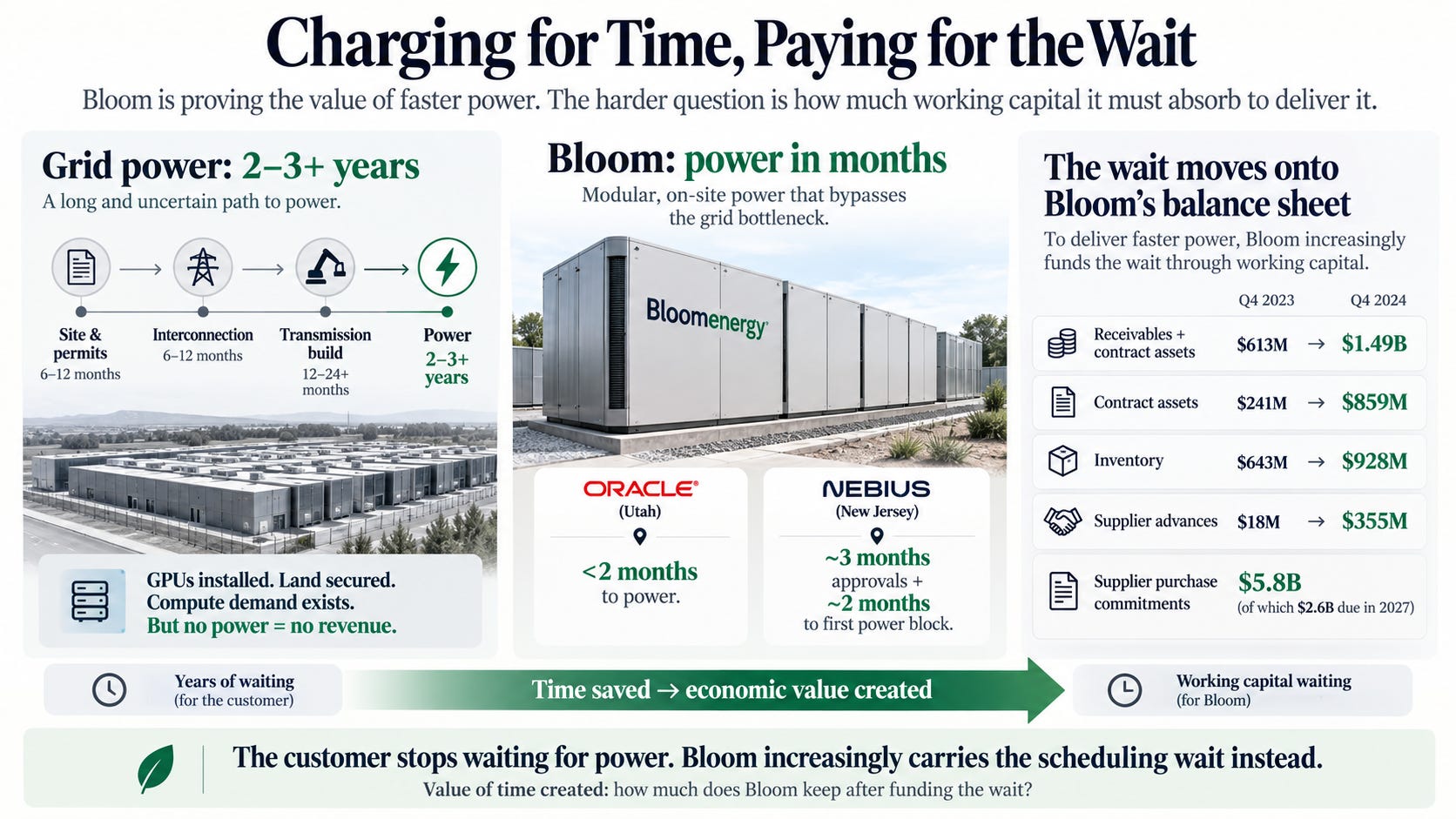
But the balance sheet is carrying more of the delay: receivables, contract assets, inventory and supplier advances have all risen sharply, while Bloom has committed $5.8 billion to suppliers. The company is increasingly absorbing scheduling risk, so customers do not have to wait. Pasted markdown
That changes the investment question: Bloom may create enormous value by delivering power early, but shareholders only benefit if the company can retain enough of that value after funding inventory, supplier commitments, installation and customer timing.
In May, we borrowed Matthew Boulton’s famous description of his business: “I sell here, Sir, what all the world desires to have, POWER.” Boulton and Watt did not merely sell steam engines. They charged customers for a portion of the coal their machines saved, capturing some of the economic value of removing a constraint. Their engines also freed factories from the rivers that had determined where industrial production could take place.
Our argument was that AI had made the electricity grid the new river. A data center cannot earn anything until power arrives at its chosen site. Bloom’s fuel cells offered a way to move electricity generation to where computing demand already existed, rather than waiting years for the grid to catch up.
We ended with a more demanding test:
“Bloom will deserve its premium only when it can charge for the time it saves without giving too much of that value back through warrants, financing structures, margin concessions, or accounting complexity.”
The third quarter answers the first half emphatically. Revenue rose 138% to $1.24 billion, beating our $1.09–1.15 billion forecast, while adjusted earnings reached $0.94 per share against consensus near $0.69. Management raised full-year revenue guidance to $4.4–4.6 billion. The factory is delivering, and customers are buying.
The second half is becoming more complicated. Bloom generated $303 million of adjusted net income but reported negative $181 million of free cash flow. Contract assets and supplier advances are rising, and the 10-Q disclosed $5.8 billion of supplier commitments, including $2.6 billion payable in 2027.
Bloom has become a better business. Whether it has become a better stock depends on what the company must spend, commit and finance to sustain that growth.
The Factory Is Proving Itself
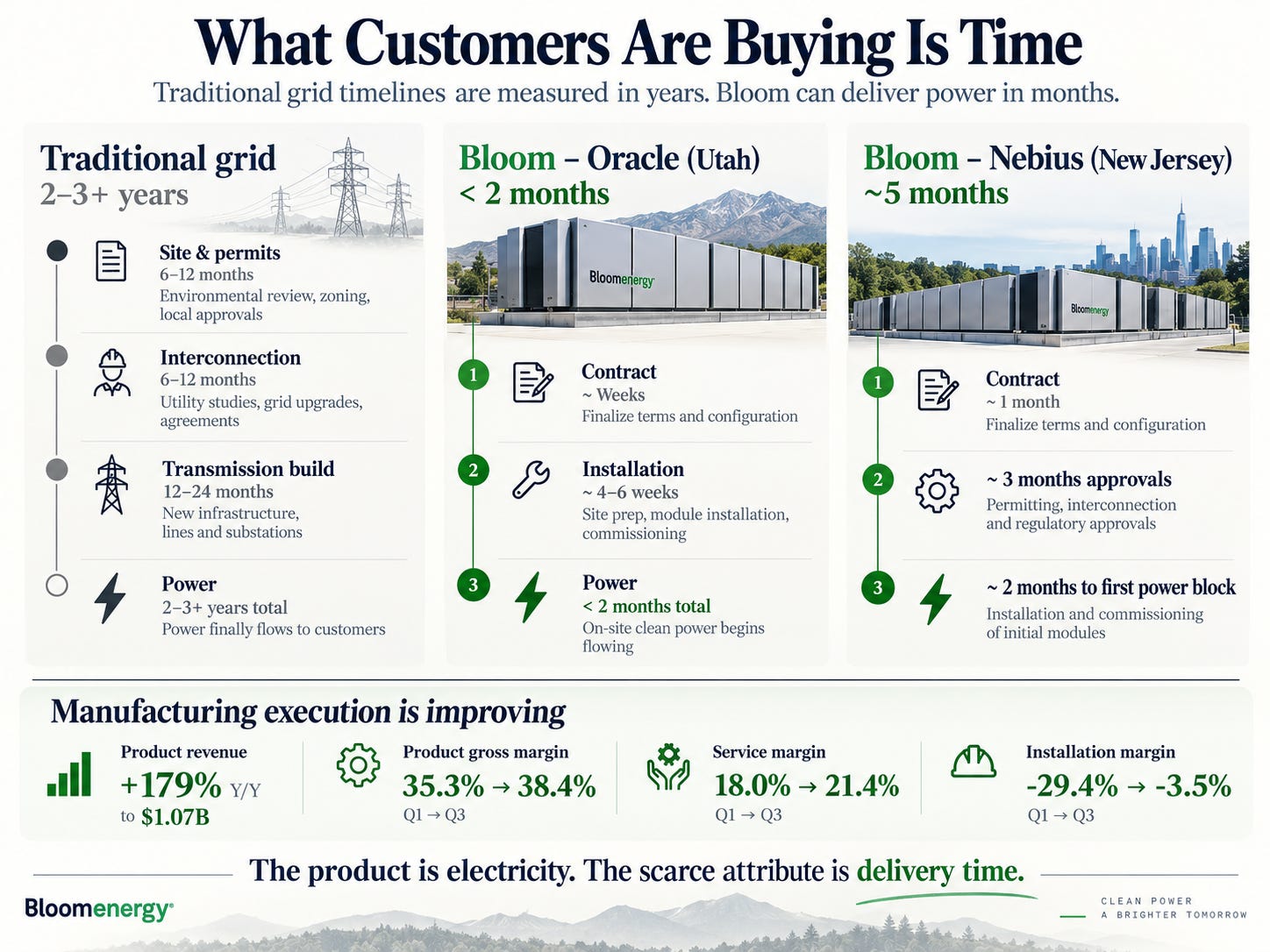
The electricity shortage is no longer a debate about future demand. Large AI campuses require power at a scale and timetable that traditional utility infrastructure often cannot accommodate. For a customer with billions of dollars of computing equipment awaiting deployment, electricity available in six months may be worth substantially more than cheaper electricity available in three years.
Bloom’s solid-oxide fuel cells address that constraint. They convert natural gas into electricity without combustion, can be installed in modular increments, and may face fewer local-emissions and water-use obstacles than conventional generation. They still need fuel, permits and construction, but they can shorten part of the deployment process.
CEO KR Sridhar offered two examples:
“Just 15 months ago, we announced our first project with Oracle and delivered power to their Utah site in less than two months. We are achieving the same thing with Nebius in New Jersey.”
At Nebius, planning approvals took approximately three months after contract signing, followed by another two months before the first power block was ready.
That is what customers are buying: time.
The manufacturing results reinforce the point. Product revenue rose 179% year over year to $1.07 billion. Non-GAAP product gross margin improved from 35.3% in Q1 to 38.4% in Q3 despite capacity expansion. Service margin rose from 18.0% to 21.4%, while installation margin recovered from negative 29.4% to negative 3.5%.
These were the operational improvements we expected to see in May. The first large installations establish reliability and operating records; subsequent projects should become easier for customers, financiers and regulators to accept. We called this acceptability as a moat.
In physical industries, trust can compound. A successful installation provides evidence for the next, while greater manufacturing volume supports automation, lower costs and better execution.
The question is whether that process eventually makes Bloom easier to finance as well as easier to manufacture.
So far, the evidence is stronger on manufacturing.
The Customer Base Is Broadening, but the Proof Is Incomplete
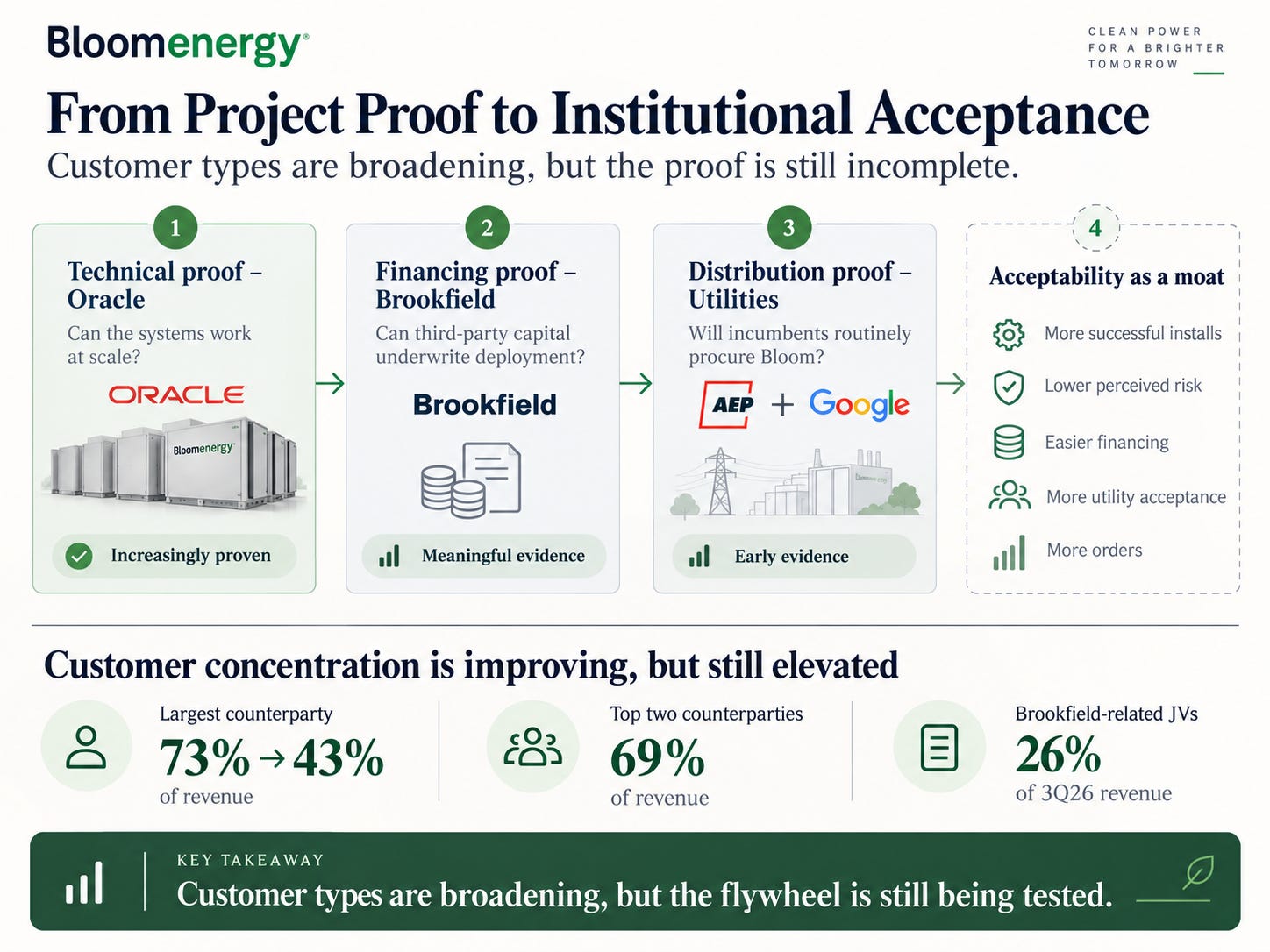
Our May thesis distinguished three kinds of progress: Oracle provided technical proof, Brookfield provided financing proof, and utilities could eventually provide distribution proof.
Q3 brought encouraging evidence of broader demand. Bloom’s largest contractual counterparty accounted for 43% of revenue, compared with 73% for the largest counterparty in Q2. Yet the top two still represented 69%, and revenue from Brookfield-related joint ventures returned to $322 million, approximately 26% of the quarter.
That matters because the contractual buyer is not necessarily the ultimate electricity consumer. A project-financing entity purchasing Bloom’s equipment is evidence of demand and financing capacity but not equivalent to a diversified collection of end customers independently underwriting projects.
Oracle remains another source of uncertainty. Its Jupiter campus has faced pipeline-related delays, and Bloom’s Oracle-related warrants create accounting adjustments as contractual conditions are met. The Q3 net warrant adjustment was only about $0.5 million, but that figure cannot reliably tell us how many Oracle systems shipped. It would be a mistake to treat an accounting adjustment as a delivery schedule.
The broader improvement in revenue concentration is encouraging. It does not establish complete independence from any particular project.
The more interesting customer development may be American Electric Power’s planned 702 MW Bloom installation with carbon capture to serve Google.
A utility purchasing fuel cells to meet demand is different from a data center buying equipment because the utility cannot supply it. The incumbent is adopting the alternative technology. If other utilities follow, Bloom could become part of routine power procurement rather than merely an emergency solution to grid delays.
That would be stronger evidence of institutional acceptance than another large announcement from a project-financing affiliate.
But utilities have alternatives. AEP also works with Mainspring, while Caterpillar and conventional generator suppliers are pursuing the same data-center opportunity. Bloom’s faster delivery, modular design and permitting characteristics may remain valuable, but scarcity alone cannot establish a permanent pricing advantage.
For now, Bloom is demonstrating that it can supply a fast-growing market. Whether successful installations translate into preferential financing and recurring orders remains open.
The Wait Moves Onto Bloom’s Balance Sheet
This is the quarter’s most important finding.
Bloom recognizes revenue when equipment meets the relevant delivery and acceptance requirements. Cash collection can occur later because contractual billing milestones do not necessarily coincide with revenue recognition.
That difference is manageable when projects proceed on schedule. It becomes more consequential when the factory accelerates faster than customers can commission, finance or permit their sites.
In Q3, operating cash flow was negative $27 million. After $153 million of capex, free cash flow was negative $181 million.
The balance sheet shows the accumulation:
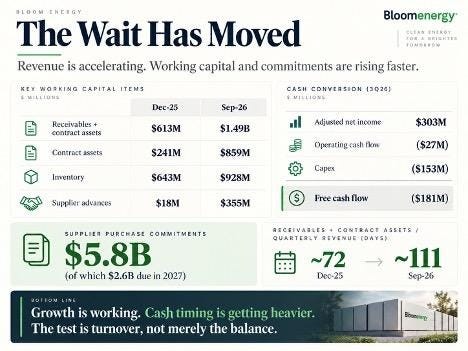
Receivables plus contract assets increased from approximately 72 days of quarterly revenue at the end of 2025 to 111 days in September. That indicates more revenue is tied up in collection and billing milestones, although the ratio is affected by timing and revenue growth.
Management’s explanation deserves consideration. Bloom generated $395 million of free cash flow in Q4 2025 and $473 million in Q4 2024. Large installations and year-end collections can create substantial quarterly swings. Rising contract assets are not automatically bad if they convert predictably into invoices and cash.
CFO Simon Edwards made the distinction explicit:
“While contract asset balance might grow, what’s really important for us is that they’re turning because we’re reaching those billing milestones and we’re collecting cash.”
That is the claim we need to test.
The more consequential disclosure is the $5.8 billion of supplier commitments extending beyond twelve months, including $2.6 billion scheduled for 2027. Some arrangements contain minimum-purchase or take-or-pay provisions.
Those commitments are not debt, nor can they be compared directly with the $661 million of reported remaining performance obligations. The latter is an accounting disclosure that excludes certain customer contracts, not Bloom’s complete order book.
But the underlying asymmetry is real.
To deliver power in months, Bloom must order components, reserve capacity and build supplier relationships before every customer project is fully ready. If customers encounter permitting or financing delays, some commitments remain even while payments and deliveries move later.
Customer deposits provide an important offset, and strong demand may eventually absorb the inventory. Bloom is not necessarily lending customers money. It is carrying some of their scheduling uncertainty.
The customer pays Bloom to stop waiting for power. Bloom increasingly commits its own capital so the customer does not have to wait.
That is the financial cost of its competitive advantage.
Who Keeps the Value of Time?
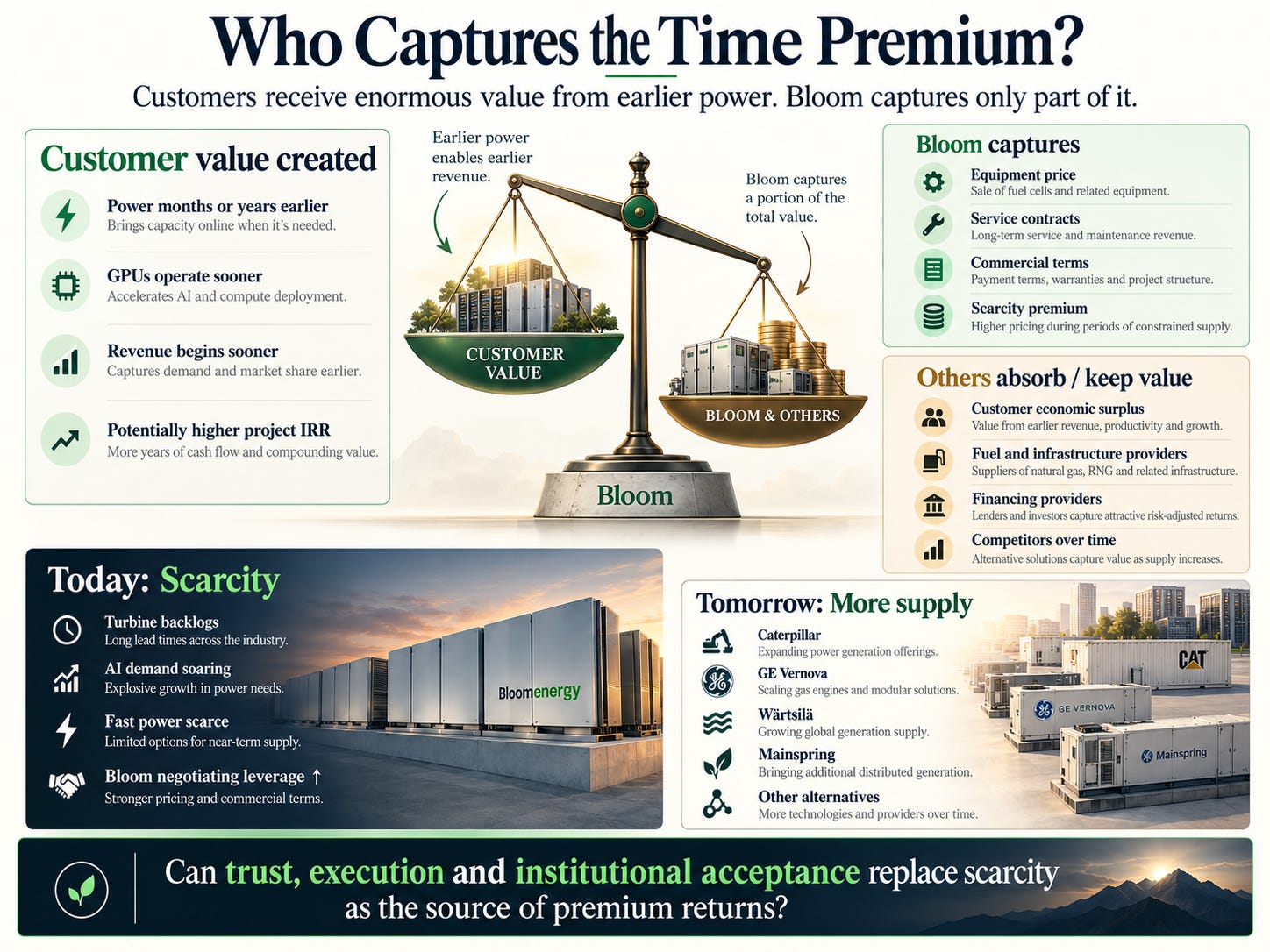
Boulton’s achievement was not simply producing more efficient engines. He developed a commercial arrangement that allowed his company to capture a share of the savings customers received.
Bloom’s customers may generate extraordinary returns by powering GPUs months or years earlier. Bloom captures only the portion of that value it can negotiate through equipment pricing, service contracts and commercial terms.
Today, scarcity strengthens that negotiating position. Turbine manufacturers have long backlogs, AI electricity demand is accelerating, and the ability to deliver quickly is exceptionally valuable.
But supply is responding. Caterpillar, GE Vernova, Wärtsilä and others are expanding their offerings. Bloom’s long-term advantage cannot depend solely on rivals being unavailable.
The strongest bull case is that manufacturing experience and successful installations make Bloom increasingly trusted by utilities, regulators and infrastructure investors. If that reduces customer-acquisition costs, financing friction and deployment uncertainty, the company can retain attractive margins even after alternative capacity becomes more available.
The opposite outcome is also possible. Bloom could become an excellent industrial supplier that must continuously out-execute competitors, fund inventory and absorb scheduling risk to sustain growth.
Its installed-base economics have not yet resolved the distinction. Service revenue grew 15% year over year, against 179% product growth, while performance guarantees continue to consume cash. The recurring service business is improving, but it has not yet become a powerful independent source of economic value.
Our May framework described three possible futures: Newcomen, where Bloom supplies temporary bridge power; Toll Road, where it becomes a strong industrial supplier; and Boulton, where its technology becomes sufficiently trusted and economical to sustain premium returns.
Q3 moves our confidence toward Toll Road, with a credible path to Boulton. It does not yet prove the final outcome.
A Better Business at an Expensive Price
We have rebuilt the three-year valuation around revenue growth, normalized profitability, stock compensation, dilution and cash conversion. The figures below are illustrative end-2029 values, not present values or company guidance.
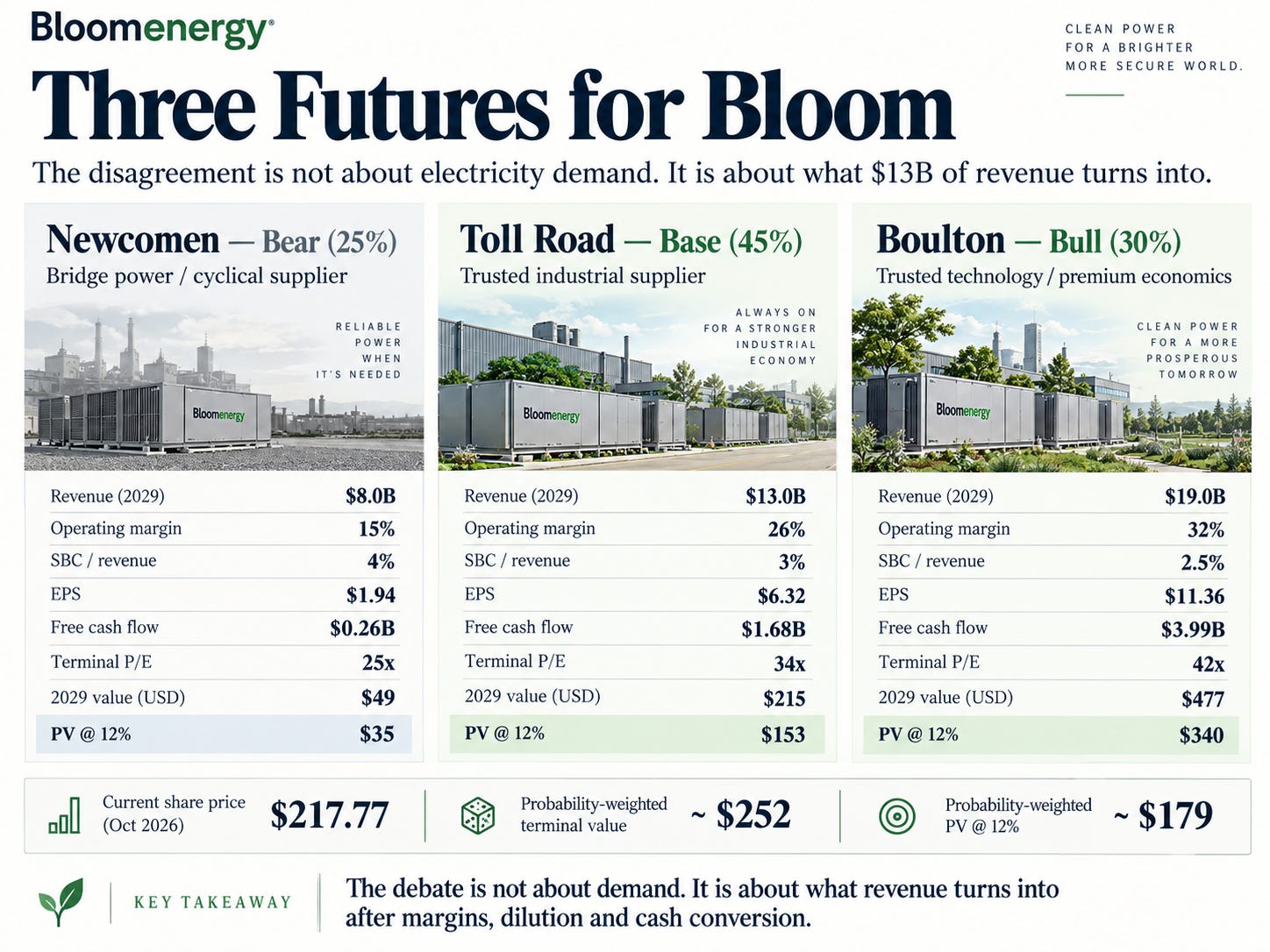
Our base-case revenue is close to the Street’s approximately $13.2 billion FY2029 estimate. The disagreement is principally about what that revenue becomes.
We model $1.68 billion of FCF in 2029, well below the roughly $2.7–2.8 billion consensus. We are not disputing the electricity demand opportunity. We are questioning how much cash Bloom will retain after funding growth.
At the October 22 pre-results close of $217.77, the base-case terminal value of $215 implies essentially no nominal appreciation over three years. At a 12% required return, that future value is worth only $153 today.
Even the base-case 34-times terminal earnings multiple assumes investors continue assigning Bloom a substantial premium after years of rapid expansion. At 25 times, the same earnings would support a share price of approximately $158 in 2029.
The probability-weighted terminal value is around $252, worth approximately $179 today using the same discount rate. The upside is real, but the expected return is insufficient at the reference price.
We would hold rather than add near $218. A price closer to $150 becomes interesting if cash conversion and customer diversification are improving. A falling share price without that evidence would not justify increasing exposure.
The Next Test Is Cash, Not Another Contract
October 22’s broader AI-related selloff began before Bloom reported. The stock fell alongside other companies exposed to AI infrastructure financing. That price action cannot be attributed entirely to Bloom’s quarterly results, but the concern has a direct counterpart on its balance sheet.
The next two quarters should provide a clearer answer.
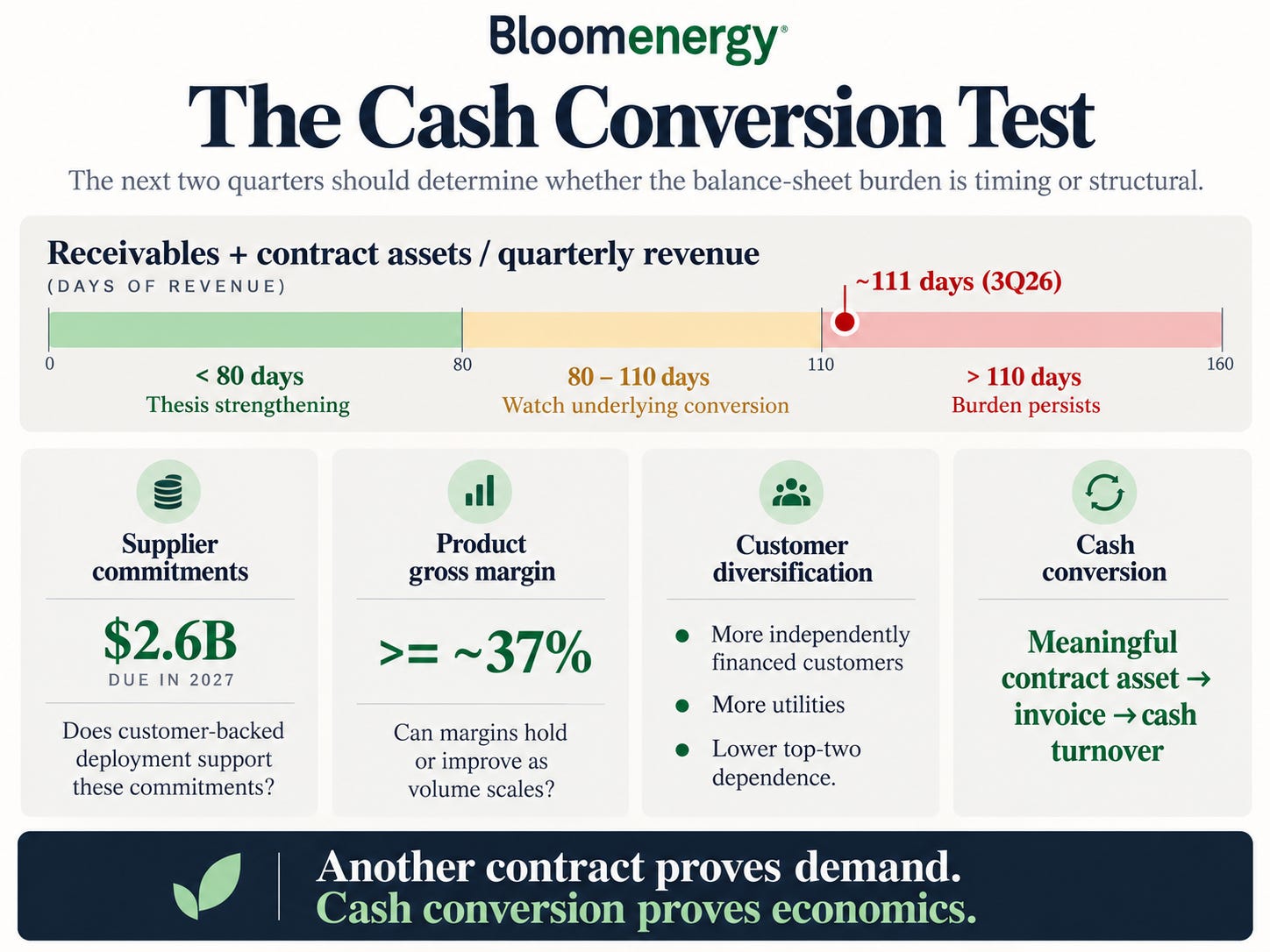
At September’s end, receivables plus contract assets represented approximately 111 days of quarterly revenue. Revenue growth alone would lower that ratio mechanically, so we need more than a smaller headline number.
Below 80 days at year-end, accompanied by meaningful invoice conversion and cash collections, would support management’s timing explanation. Remaining above 110 days would indicate that the burden persists despite higher sales. Between those levels, the underlying movement in contract assets and actual collections matters more than a binary verdict.
We also want 2027 guidance showing that customer-backed deployments can support the $2.6 billion of scheduled supplier commitments, sustained product margins near or above 37%, and more evidence of utility adoption and independently financed customers.
Bloom has already demonstrated something important: it can manufacture and deliver power at a speed increasingly valuable to AI customers. The original technology thesis is stronger than it was in May.
But the investment thesis requires one more step. As the installed base grows and institutional acceptance improves, Bloom should need to carry less scheduling and financing risk relative to the revenue it generates. If that happens, acceptability really can become a moat. If it does not, the business may continue growing impressively without delivering the returns shareholders expect.
Boulton got paid for the coal his customers saved. Bloom must now demonstrate how much of the time it saves customers it can keep, rather than pay for itself.
Disclaimer:
The content does not constitute any kind of investment or financial advice. Kindly reach out to your advisor for any investment-related advice. Please refer to the tab “Legal | Disclaimer” to read the complete disclaimer.