


TL; DR:
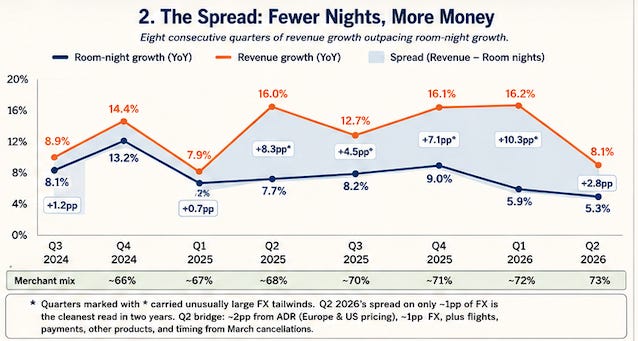
The transaction is getting richer: Revenue grew 8% against room-night growth of 5.3%, extending an eight-quarter pattern in which monetisation has outpaced volume as merchant mix has risen to 73%.
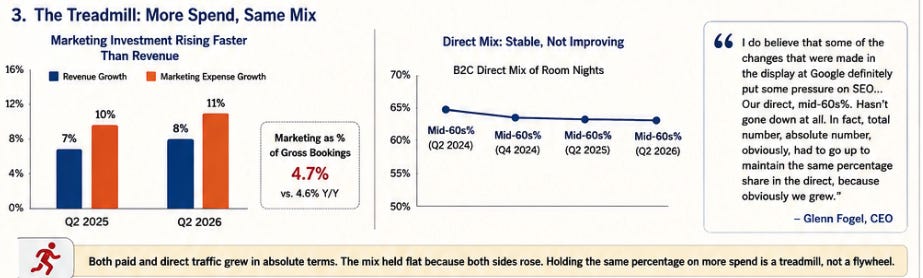
The acquisition treadmill remains: Marketing expense grew faster than revenue, marketing intensity increased to 4.7% of gross bookings, and direct mix remained stuck in the mid-60%s despite greater Genius and app engagement.
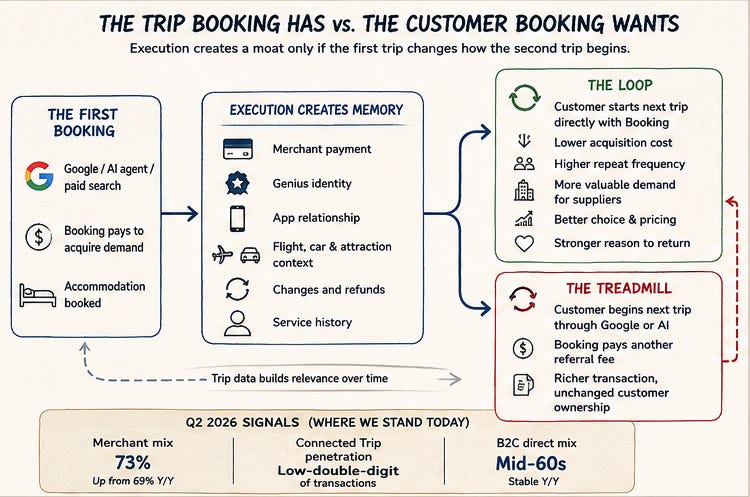
The decisive test is the second booking: Booking has shown it can extract more value from the trip it executes today. The moat will be proven only when that trip lowers the cost of acquiring the customer tomorrow.
From Booking Holdings’ Q2 earnings call:
Room nights, gross bookings, revenue, and adjusted EBITDA all exceeded the high end of our guidance for the second quarter... Overall, if I also may point you to our full-year guidance, actually, if you look at our full-year guidance, we are at a high single-digit level for gross bookings and revenues and at mid-teens level for EPS at the high end. That is still in line with our long-term algorithm and is also in line at a constant currency basis with our original guidance for the year, even though in our assumptions we have seven out of twelve-month impact of the Middle East.
That last sentence from CFO Ewout Steenbergen is the quarter. Booking absorbed seven months of a regional war, a war that closed the Strait of Hormuz, grounded flights across the Gulf, and pushed airfares up across every long-haul corridor, and held its original full-year guidance at constant currency. Not a trimmed guide with an asterisk. The original algorithm.
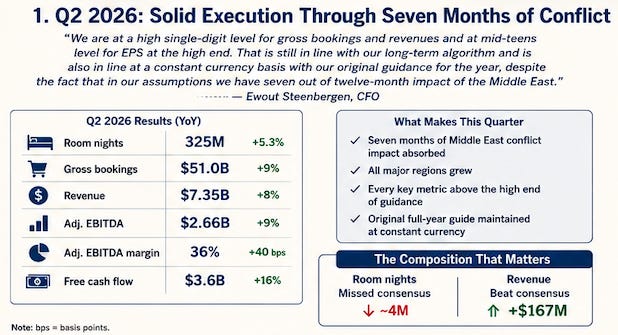
The numbers underneath: room nights grew 5.3% to 325 million, gross bookings rose 9% to $51 billion, revenue grew 8% to $7.35 billion, adjusted EBITDA grew 9% with margins expanding 40 basis points to 36%. Every metric above the high end of guidance.
And yet the composition is what caught my attention. Room nights missed the street, consensus was around 329 million, while revenue beat it by $167 million. Fewer nights, more money. That gap, roughly three percentage points between revenue growth and volume growth, is where this quarter’s real argument lives.
In my Q1 piece I set a threshold I refused to explain away: if room nights missed even the lowered 2-4% guide, the thesis needed revision rather than another external excuse. They came in at 5.3%. The threshold held. I’ll also note, because the series deserves the honesty, that I’ve overreached before, the “fintech disguised as travel” framing, the Amazon analogy, the suggestion that Booking’s payment rails could escape travel entirely. I’m retiring that. What survived the pruning is narrower and better: Booking is moving from discovery, which AI is commoditising, toward execution, payments, settlement, refunds, service, coordination, which it is not. The question was always whether the execution layer captures its own economics. Q2 gave evidence on both sides.
The Spread
Start with the side that worked.
The three-point spread between revenue growth and room night growth needs careful handling, because I’ve learned the cost of assigning too much causality to one quarter. Walk the bridge: constant-currency ADRs rose about 2%, driven by genuine pricing in Europe and the US, management was explicit this wasn’t a mix artifact. FX added roughly a point. Flights and other verticals contributed. Revenue timing from March’s elevated cancellations added noise. Those factors get you close to the full spread without invoking merchant economics at all.
So, the single quarter proves less than I’d like. The pattern is what matters:
Eight consecutive quarters of positive spread, widening as merchant mix climbs from 66% to 73%. Merchant revenue grew 15% this quarter while agency revenue declined 7%. Management confirmed again that incremental payment revenues exceeded incremental payment costs over the trailing twelve months, a statement that has appeared before, but one that survived another quarter at higher mix while sales and other expenses still showed cost efficiency despite the heavier merchant load. The payment economics are confirming, not arriving.
If the pattern holds, room night growth systematically understates Booking’s earnings trajectory, and a market that values this stock on volume is using the wrong gauge. That’s the bull case, and the table is the best evidence for it that exists. But a pattern is not yet proof of permanence. Two quarters of the spread collapsing toward zero and this argument weakens considerably.
The Treadmill
Now the side that didn’t work.
If executing more of the trip, payments, service, loyalty, bundling, makes each transaction richer, the next test is whether it makes the next customer cheaper to acquire. That’s the difference between a better margin and a genuine moat. And Q2 did not show it.
Marketing expense grew 11% against revenue of 8%. Marketing as a percentage of gross bookings rose to 4.7% from 4.6%. B2C direct mix held in the mid-60%s, stable, not improving. SEO declined, and when Mizuho’s Lloyd Walmsley pushed on whether that reflected AI search or something else, Fogel answered more directly than I expected:
I do believe that some of the changes that were made in the display at Google definitely put some pressure on SEO... Our direct, mid-60s%. Hasn’t gone down at all. In fact, total number, absolute number, obviously, had to go up to maintain the same percentage share in the direct, because obviously we grew.
The deflection is fair as far as it goes. Both direct and paid traffic grew in absolute terms; the ratio stayed flat because both sides rose. But a ratio can stay flat on a treadmill. Booking is spending more on paid channels to hold direct mix steady while organic discovery erodes underneath it. That is not what a flywheel looks like.
I want to be careful here too, because one quarter of marketing deleverage doesn’t invalidate customer loyalty. Booking is still investing in the US and Asia. Connected Trip is a low-double-digit share of transactions, large enough to matter directionally, too small to move the consolidated marketing line. Paid spend can rationally grow during geographic expansion. But the strategic metrics have reached enough scale that some evidence should be showing up in acquisition economics. Genius Level 2 and 3 members generate a high-50% share of room nights, up from mid-50%s. Mobile app mix is in the high-50%s, up from mid-50%s. These loyalty layers are supposed to convert engagement into cheaper demand. Q2 showed the engagement. It did not show the conversion.
The Second Booking

Steenbergen gave the behavioural disclosure the whole thesis rests on:
Travelers who book with us across multiple travel verticals return more frequently.
That’s the mechanism, one trip creates context, trust and service history, and the next booking should come back more directly and more cheaply. The mechanism is visible. Its economics are not. In my Q4 piece I called the real AI risk toll extraction rather than replacement: Booking stays essential while paying rising rent to whichever interface controls customer intent. Google collects that rent today through $8 billion-plus of annual marketing spend. Q2’s evidence on the interface itself was actually encouraging, LLM referral traffic remains below 1% of room nights and flat, Google launched agentic booking with Booking as a first partner, OpenAI went CPC, which Fogel called “right in our wheelhouse.” The AI layer is fragmenting, not concentrating. But the rent did not fall. Both things were true in the same quarter, and the tension between them is now the entire investment debate.
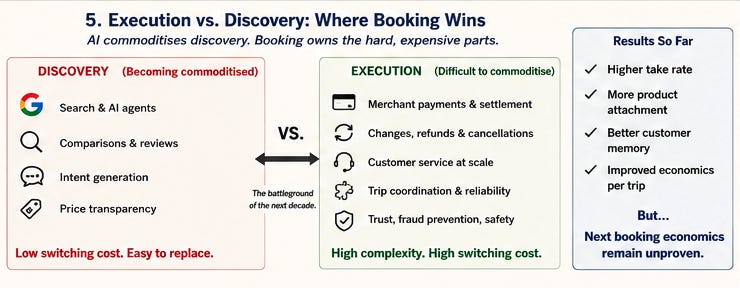
AI’s clearest contribution so far is on the other side of the P&L anyway. Customer service cost per booking is falling at a double-digit rate. Voice AI handles most eligible inbound calls. Steenbergen disclosed internal metrics, AI cost per merge request, declining, that tell you this management team treats AI spending the way it treats marketing spending: measured, ROI-gated, unsentimental. AI is making the execution layer cheaper to run before it makes demand cheaper to acquire. That’s worth something. It isn’t the moat.
So, the question I’ve been circling for four articles has narrowed to one sentence: can Booking turn the trip it executes today into the customer it owns tomorrow? The merchant model makes each trip richer; the table shows it. Genius, the app and Connected Trip give the traveller reasons to return, Steenbergen’s disclosure confirms it. But until the return shows up as lower acquisition cost, the moat is behavioural rather than financial, and the market won’t pay a premium multiple for behaviour.
Three Years Out
From roughly $195:
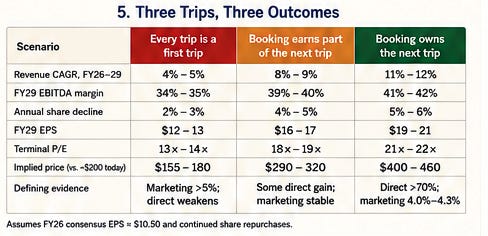
The bull case requires no new category label; I’ve spent enough of this series asking the market to rename the company. It requires direct mix rising above 70%, Connected Trip reaching 20-25% penetration, and marketing falling toward 4.0-4.3% of gross bookings. Operational outcomes, not a reclassification event. The bear case, the toll road, marketing intensity rising, margins flat, is roughly what’s already priced in.
Management is making its own bet on which scenario plays out. Booking returned a record $4.1 billion to shareholders in Q2 and repurchased $7.4 billion of stock in the first half at an average price of $173, a pace that retires roughly 6% of the float per year. When a company with a $10 billion free cash flow engine buys back its own equity that aggressively at these levels, it is telling you where it thinks intrinsic value sits.
I own it here, and I’d add meaningfully toward $175, near the company’s own buyback average, absent new evidence of thesis deterioration. Sized for patience, not certainty: two of three scenarios pay you, and the one that doesn’t cost almost nothing from here.
What Settles the Argument
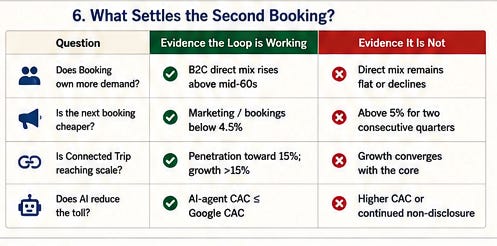
The Q1 threshold was met, so here is the new one, and I will not attribute a breach to conflict, channel mix, or geographic investment: if marketing exceeds 5.0% of gross bookings in any of the next four quarters, the switching-cost thesis at the core of my bull case needs revision. Below 4.5% in any quarter, and the conflict-distortion explanation is confirmed and the flywheel is turning. Between those bounds, watch B2C direct mix, above the mid-60%s means repeat behaviour is converting into cheaper demand, and watch for the number nobody has disclosed: what it costs Booking to acquire a customer through an AI agent versus Google Search. Every quarter of silence on that number extends the uncertainty discount.
Booking has shown it can earn more from the trip in front of it. The moat will be proven only when that trip lowers the cost of winning the next one.
That proof will not come from AI demos or partnership announcements. It will come from the income statement.
It always does.
Disclaimer:
The content does not constitute any kind of investment or financial advice. Kindly reach out to your advisor for any investment-related advice. Please refer to the tab “Legal | Disclaimer” to read the complete disclaimer.