


TL; DR
The core consumer business is still improving: room nights grew 7%, Connected Trip activity expanded, merchant penetration increased, and B2C marketing showed leverage. The original “marketing treadmill” concern has not been triggered.
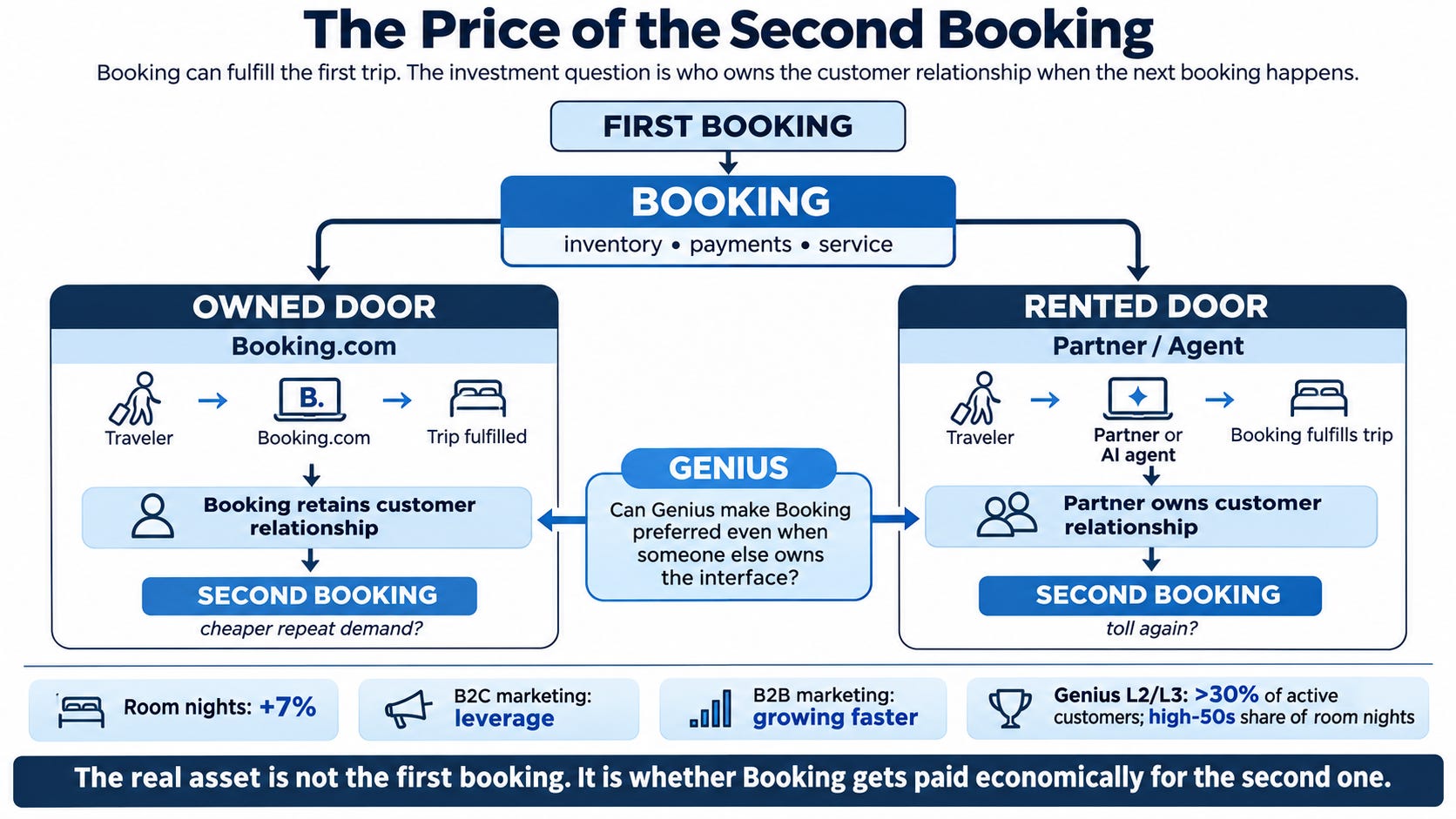
But Booking increasingly operates through two different doors: direct consumer distribution creates the possibility of cheaper repeat demand, while B2B distribution creates profitable volume but leaves the partner owning the customer. AI agents could accelerate both models.
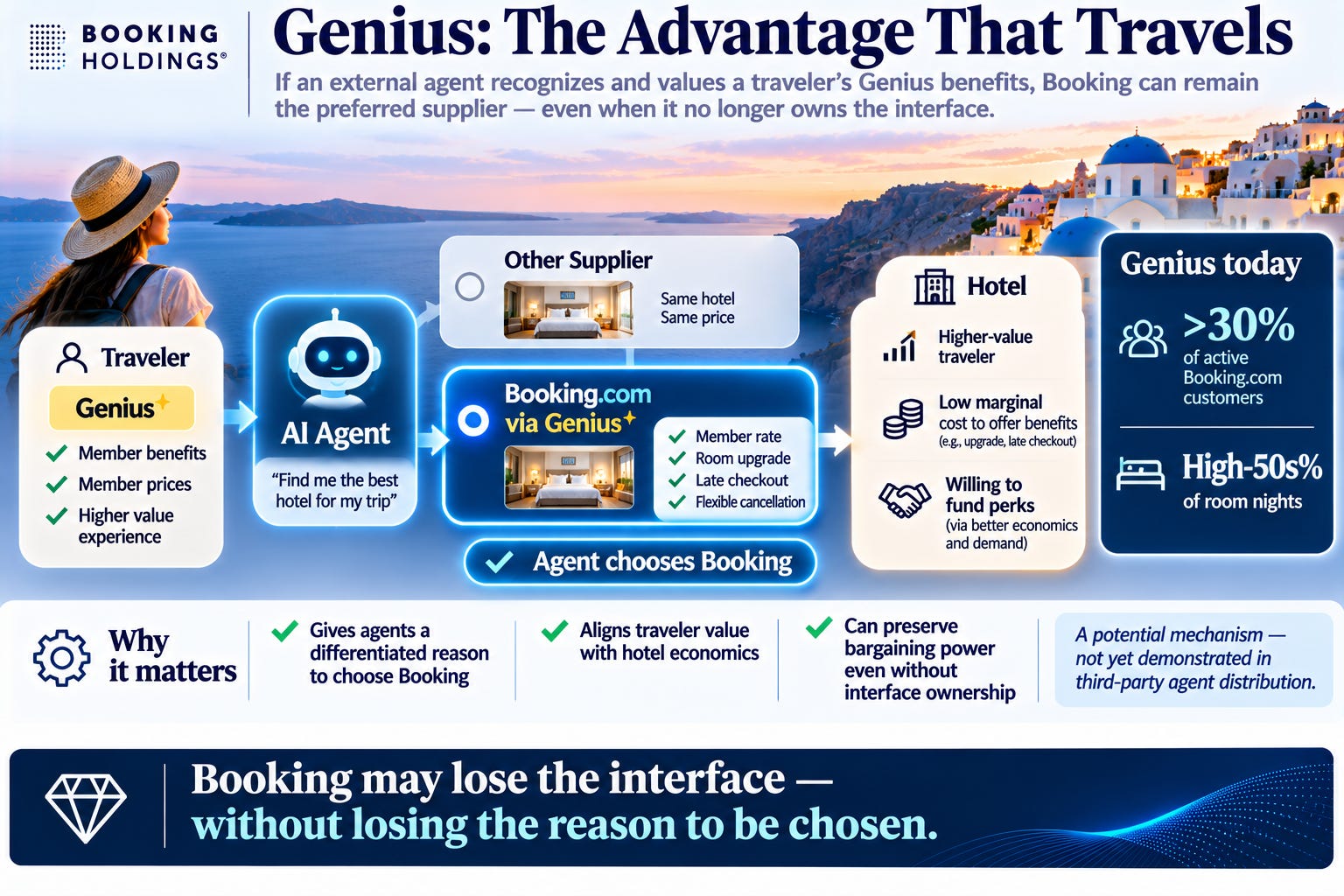
Genius is becoming more strategically important than a loyalty program: if an external agent recognizes and values a traveler’s Genius benefits, Booking can remain the preferred supplier even when it no longer owns the interface. That is the clearest path to retaining bargaining power in an agent-mediated world.
From Booking Holdings’ third-quarter earnings call, CFO Ewout Steenbergen:
Marketing expense increased 11% year-over-year, slightly faster than gross bookings, driven primarily by faster growth in B2B affiliate marketing expenses. Excluding our B2B affiliate business, our B2C business had marketing leverage in the quarter as we continue to aim to grow our topline metrics faster than marketing investments.
In August’s Fewer Nights, More Money, I argued that Booking had become better at extracting value from each trip but had not demonstrated that completing one trip made the next customer cheaper to acquire. Steenbergen’s distinction changes how to test that proposition. Booking is increasingly operating two distribution businesses: one in which it attracts and retains the traveler, and another in which a partner owns the relationship while Booking provides inventory and fulfillment. AI agents could make both businesses larger. The investment question is which one gets paid for the second booking.
Revisiting August’s Test
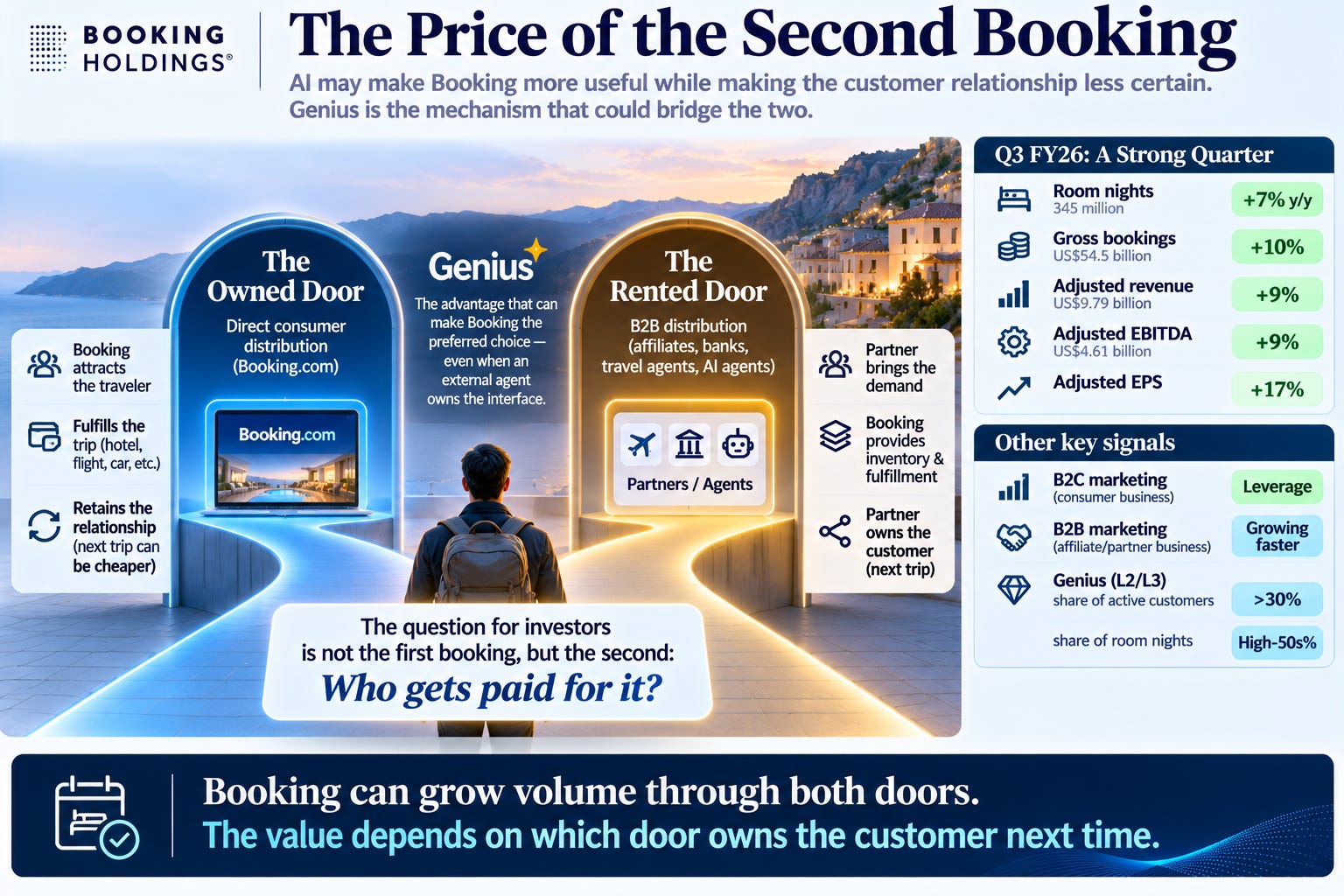
August established a measurable threshold: marketing above 5% of gross bookings in any of the next four quarters would force a reassessment of the thesis; a quarter below 4.5% would suggest improving customer-acquisition economics. Q3 came in at 4.75%, versus 4.71% a year earlier. Neither condition was met, but the original interpretation needs refinement.
The underlying quarter was strong. Room nights rose 7% to 345 million, accelerating from 5% in Q2 and beating management’s 3–5% guidance. Gross bookings increased 10% to $54.5 billion, adjusted revenue 9% to $9.79 billion, and adjusted EBITDA 9% to $4.61 billion. Adjusted EPS grew 17%, partly because repurchases amplified adjusted net-income growth of 8%. The reported revenue decline reflected a $900 million regulatory adjustment, not falling transaction volume.
Still, more activity does not automatically mean richer economics. Merchant bookings reached almost 75% of gross bookings and Connected Trip transactions grew nearly 20%, yet adjusted revenue as a share of bookings slipped from 18.14% to 17.98%, reflecting flight mix and booking-versus-travel timing, partly offset by payments. I also overstated the earlier marketing deterioration: shifting merchandising discounts from contra-revenue to performance marketing can raise both reported revenue and marketing expense without increasing profit. Part of August’s apparent spread and treadmill was the same spending decision. The better evidence this quarter is B2C marketing leverage, not an unqualified claim that each transaction has become more lucrative.
The Owned Door and the Rented Door
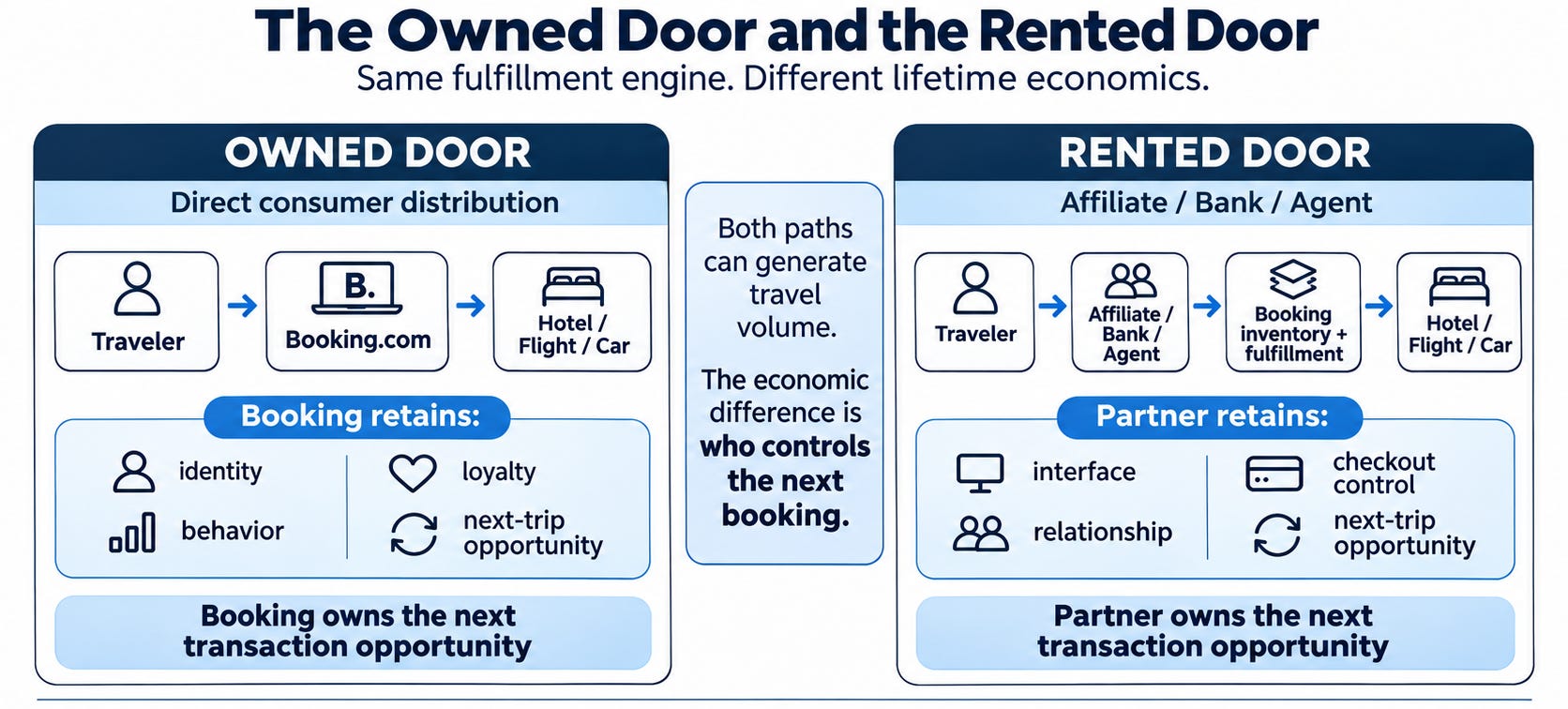
Steenbergen attributed B2C leverage to improving returns on paid channels and increasing direct traffic. But B2C direct mix remained in the mid-60s. Booking is getting more direct traffic without yet demonstrating a sustained increase in its share of consumer bookings, much less disclosing the cost of an incremental repeat customer. The other part of the story is more revealing. Asked about B2B’s increasing importance, Steenbergen explained:
...that is a business that is getting more focus and attention internally. I think, you know about our plans that we’re launching on January 1, a combined B2B business. So, you will also see then more details about the numbers, because most likely we’ll break that out going forward. What is happening there is if the business is growing and they are reporting more revenues, usually the commission structures are based on a rev share. So, therefore also the rev share and the commissions are going up, and that is flowing through the marketing line.
Booking’s combined B2B business begins operating in January 2027, with additional disclosure likely, though not promised. The economics are straightforward: a partner brings demand, Booking supplies inventory and execution, and the partner receives a share of revenue. That can be attractive incremental business, as management insists, but the partner, not Booking, may control the next transaction. If the rounded direct-mix figures for B2C and total room nights are comparable, B2B already represents roughly one room night in seven. This is an inference, not a disclosed figure.
In the consumer business, loyalty can reduce reliance on paid distribution. In B2B, volume can grow even while commission costs remain attached to every transaction. Consolidated marketing expense blends the two, obscuring whether Booking’s customer relationship is becoming stronger or simply being rented more efficiently. It is therefore possible for the company to become indispensable to travel fulfillment while having less control over how travelers reach it.
When the Agent Chooses
The supply side favors Booking. The ten largest hotel chains represent only a low-double-digit percentage of Booking.com room nights; the remainder includes fragmented suppliers that cannot maintain commercial and technical integrations with every new AI interface. Booking already assembles availability, pricing, payments, service and reliability at global scale. An agent that wants to complete a trip, rather than merely propose one, has strong reasons to connect to it.
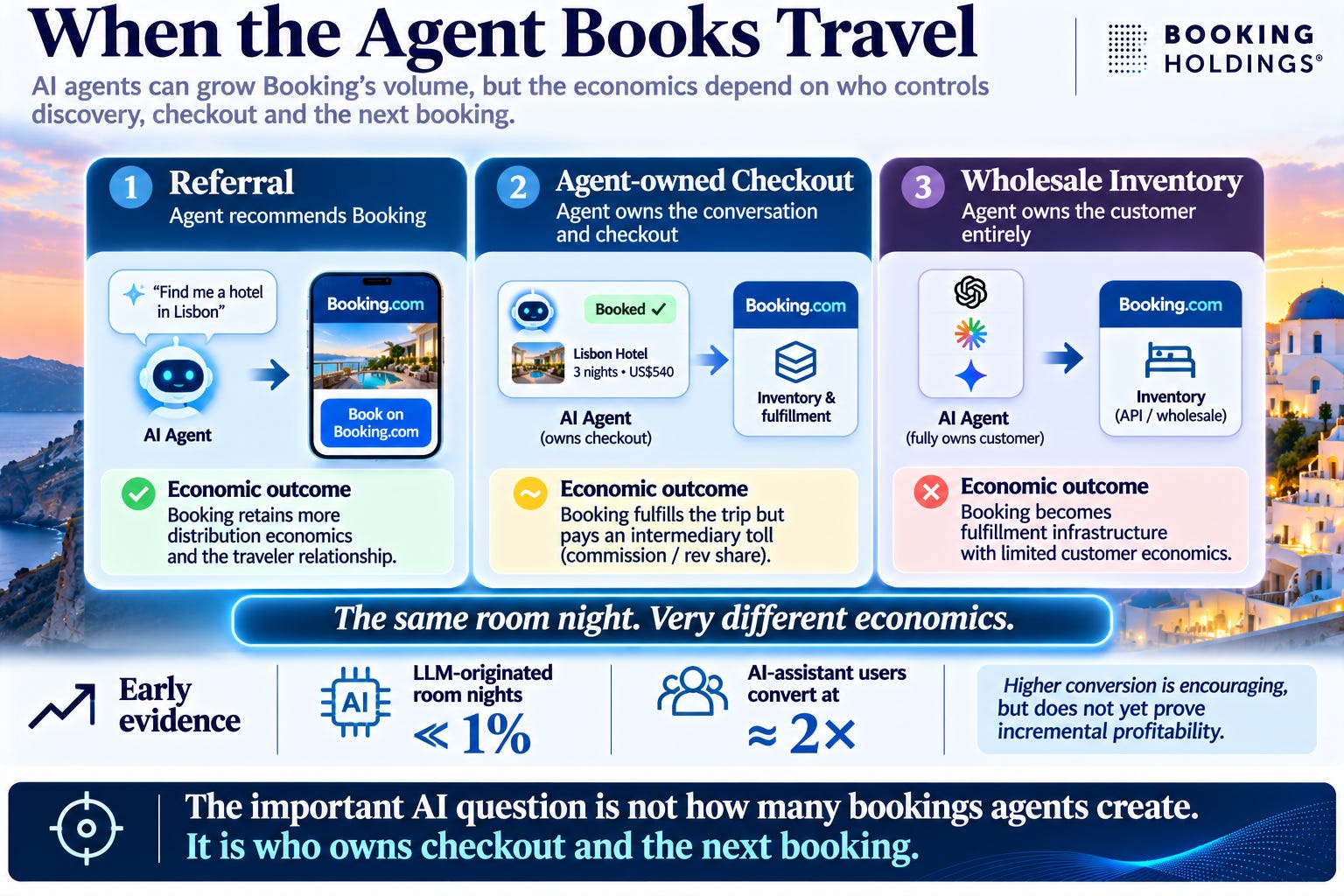
But useful infrastructure need not command attractive distribution economics. An agent can refer the customer to Booking, leaving checkout and repeat engagement largely intact. It can instead own the conversation and checkout while Booking remains responsible for fulfillment. Or it can treat Booking as wholesale inventory and control the customer outright. In the first arrangement Booking may retain the relationship; in the others the intermediary can demand a lasting share of its economics. Expedia’s integration with Meta’s Muse illustrates the second route, while Booking’s existing B2B business illustrates the third.
We should not confuse strategic possibility with present financial impact. LLM-originated room nights remain significantly below 1% at Booking.com. Management’s reported roughly twofold conversion for AI-assistant users is encouraging but cannot establish incremental profitability, because those users may be different to begin with. The agents’ importance lies less in today’s bookings than in the bargaining structure they could create as distribution migrates.
Genius as a Reason to Choose Booking
Booking has an answer that is more interesting than simply protecting its website. When discussing Genius, CEO Glenn Fogel described a program whose benefits are often funded by hotels because those hotels receive attractive returns:
We are going to improve Genius. It’s going to be an even better program down the road... Genius works right now very well because the partner is funding a lot of it, and it’s getting a good ROI out of that. And of course, the traveler’s getting a great deal too, because again, a lower cost for their holiday. So, it works both ways. But there are a lot of other ways we can improve upon that tremendously. There are other things that travelers want, and maybe the partner will be willing to give it up either at no cost because there’s very little marginal cost to them, or perhaps they’d be willing to do it at a lesser cost that we can help work with.
The economics deserve attention. A late checkout, flexible cancellation privilege or upgrade can be worth considerably more to a traveler than it costs the hotel to provide. Booking can coordinate such benefits across thousands of suppliers. Genius Levels 2 and 3 already represent more than 30% of active Booking.com customers and a high-50s share of room nights, concentrating travelers who are especially valuable to hotels. That concentration is not evidence that Genius caused their loyalty, but it gives Booking a network of entitlements to build on.
Now suppose a traveler asks an independent agent to book a hotel. If the agent can recognize the traveler’s Genius benefits, Booking’s offer may be preferable even when another supplier provides the same room at the same headline price. The agent owns the conversation, but Booking supplies a reason for the agent to choose it. Fogel’s discussion of extending Genius to travel and non-travel partners, including in response to a question about loyalty when an external agent controls the interface, suggests management understands the opportunity.
This remains an inference, not an announced capability. Booking has not shown that Genius benefits will be portable to third-party agents, that they change agent selection, or that the resulting commissions leave better margins. Hotels can fund rival programs, and agents may develop loyalty systems of their own. Nevertheless, Genius offers a plausible route between two extremes: controlling every customer interaction and becoming interchangeable fulfillment infrastructure. Booking might lose the interface without surrendering all the bargaining power behind it.
What Is the Second Booking Worth?
The near-term evidence argues against complacency. Q4 guidance implies only 1–3% room-night growth and roughly flat adjusted EBITDA, against prior Street expectations of substantially higher profit growth. International demand has softened, and Expedia’s cautious outlook suggests a common travel headwind rather than proof that agents are already taking share. Booking is also reinvesting in AI and adjacent travel products, so its $650 million transformation program cannot simply be treated as permanent margin expansion.
Regulation adds risk. A $900 million revenue reduction and a separate $100 million accrual relate to an FTC matter involving Priceline and a B2B affiliate; additional costs remain possible. Repurchases also fell from $3.7 billion in Q2 to $2.1 billion in Q3, undermining my earlier treatment of buybacks as an unambiguous management signal. Neither observation disproves the franchise’s strength, but both belong in the underwriting.
At approximately $171, Booking traded near 14 times revised FY2027 consensus EPS of $12.25. The valuation looks more consistent with a future in which intermediaries take an increasing share of transaction economics than one in which Booking retains meaningful customer preference. Our base case does not require beating the limited FY2029 consensus, which is near $17 per share. It requires the franchise to preserve its earnings power and recover a more appropriate multiple.
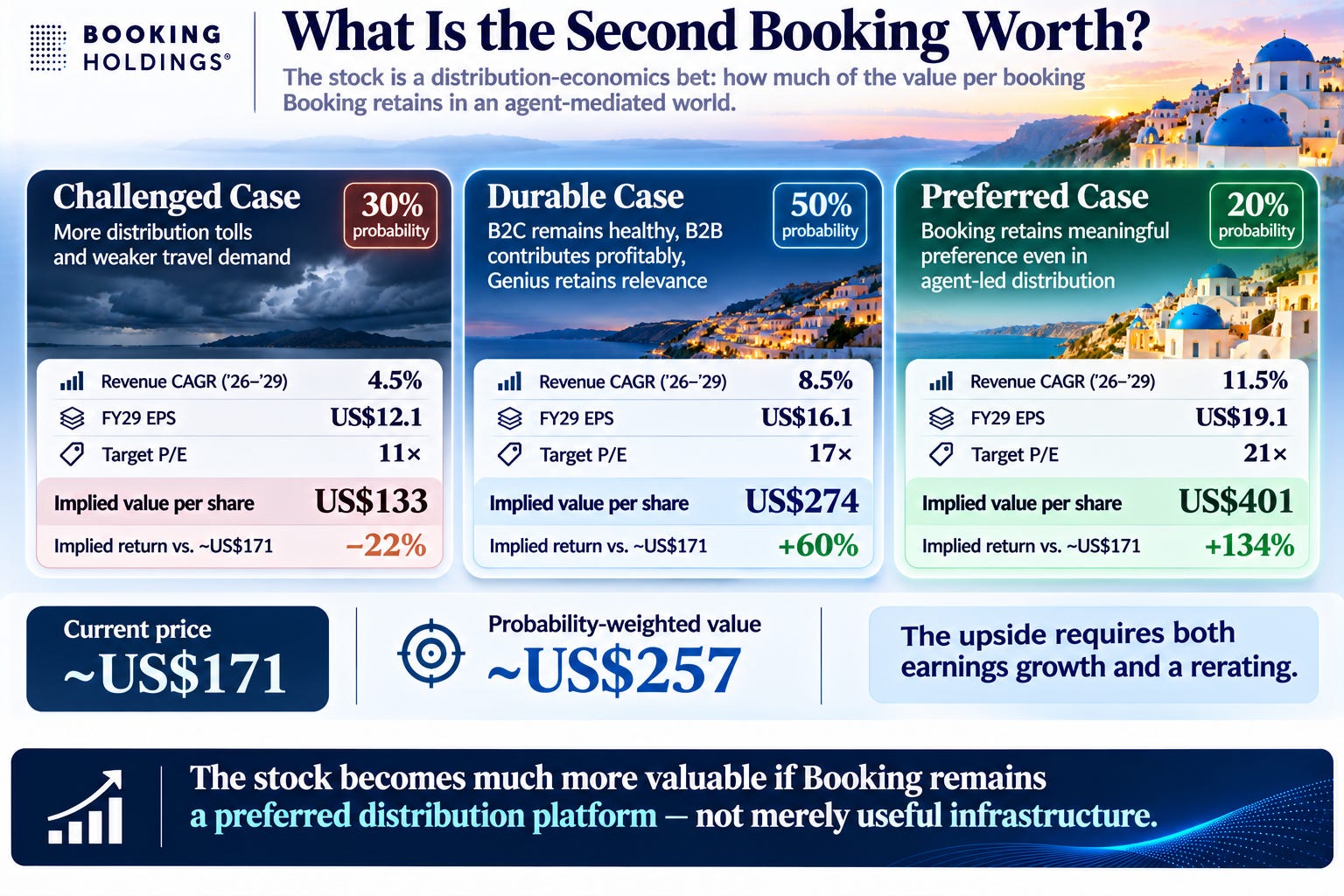
The scenarios start with about $29.1 billion in FY2026 adjusted revenue and 750 million diluted shares, use net share reductions consistent with the table, and allow approximately $1 billion annually for depreciation, net financing and other items below EBITDA. Normalized tax rates are 21–22%. The Durable case assumes roughly 5–6% room-night growth, additional pricing and payments contribution, and enough cash generation to fund repurchases. Challenged reflects weaker demand and greater distribution tolls; Preferred requires stronger growth, retention economics and margins. At end-2029, their probability-weighted value is approximately $257, about 50% above $171 before dividends. The $274 base outcome depends on both EPS growth and a rerating from 14 to 17 times; the upside is not purely an earnings story.
These outcomes are below August’s published ranges of $290–320 for the base case and $400–460 for the bull case. The reduction reflects greater weight on distribution costs, regulatory exposure and the uncertainty of an agent-driven rerating, rather than a newly discovered weakness in Booking’s operating franchise.
What Would Change My Mind
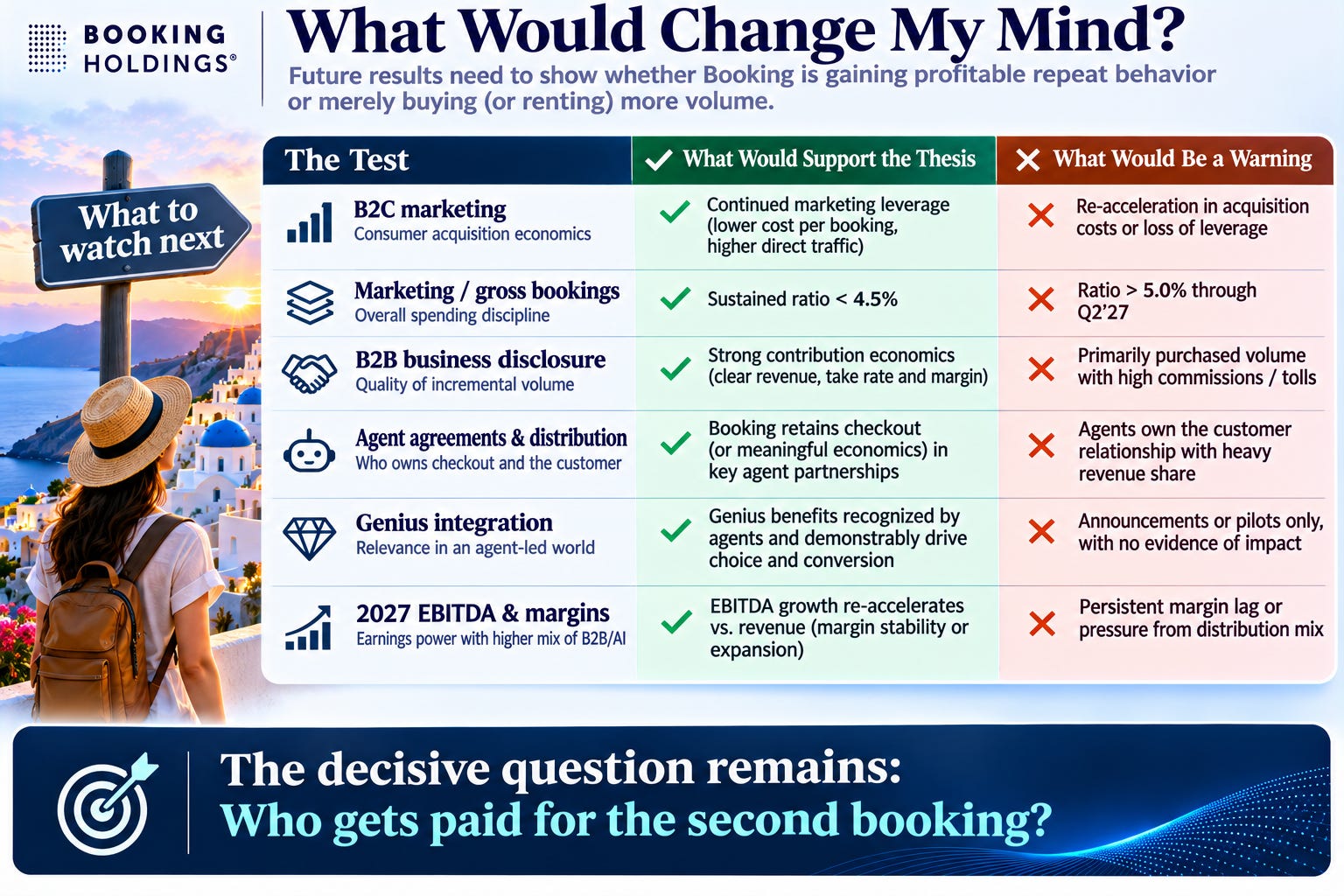
The next results should distinguish travel weakness from deteriorating economics. I want B2C marketing leverage to persist, 2027 EBITDA growth to recover relative to revenue, and any new B2B disclosure to show whether affiliate growth brings attractive contribution rather than merely purchased volume. August’s 5% consolidated marketing test remains in force through Q2 2027, but channel mix must inform its interpretation. More importantly, agent agreements should reveal who controls checkout and how commissions work; Genius integrations must demonstrate actual benefit recognition, incremental repeat business and profitable selection, not simply partnership announcements.
I would retain August’s conditional willingness to add toward $175 and add around $171, with sizing that acknowledges the $133 downside scenario. Booking has not proved it can preserve the customer relationship when an agent handles the conversation, but neither has the quarter supplied evidence that its role is being commoditized. The company already makes the first booking work. The investment opportunity is that its supply, execution and loyalty advantages may also give the next agent a reason to choose Booking and leave Booking with a meaningful share of the economics of the second booking.
Disclaimer:
The content does not constitute any kind of investment or financial advice. Kindly reach out to your advisor for any investment-related advice. Please refer to the tab “Legal | Disclaimer” to read the complete disclaimer.