


TL; DR
The scale is no longer in doubt: Broadcom now sees AI semiconductor revenue rising from roughly $58 billion this year to $115 billion in FY27 and $230 billion in FY28, driven by six XPU customers and extraordinary deployment visibility.
But Broadcom’s model is fundamentally different from NVIDIA’s: NVIDIA integrates the AI factory around itself; Broadcom gives hyperscalers the tools to integrate it themselves. That makes customers more capable and potentially less dependent on any individual supplier.
Networking is the key test of economic power: if Broadcom can expand Ethernet content across both custom-silicon and GPU clusters, scale may translate into greater value capture. If not, Broadcom may become enormous while the hyperscalers retain most of the strategic leverage.
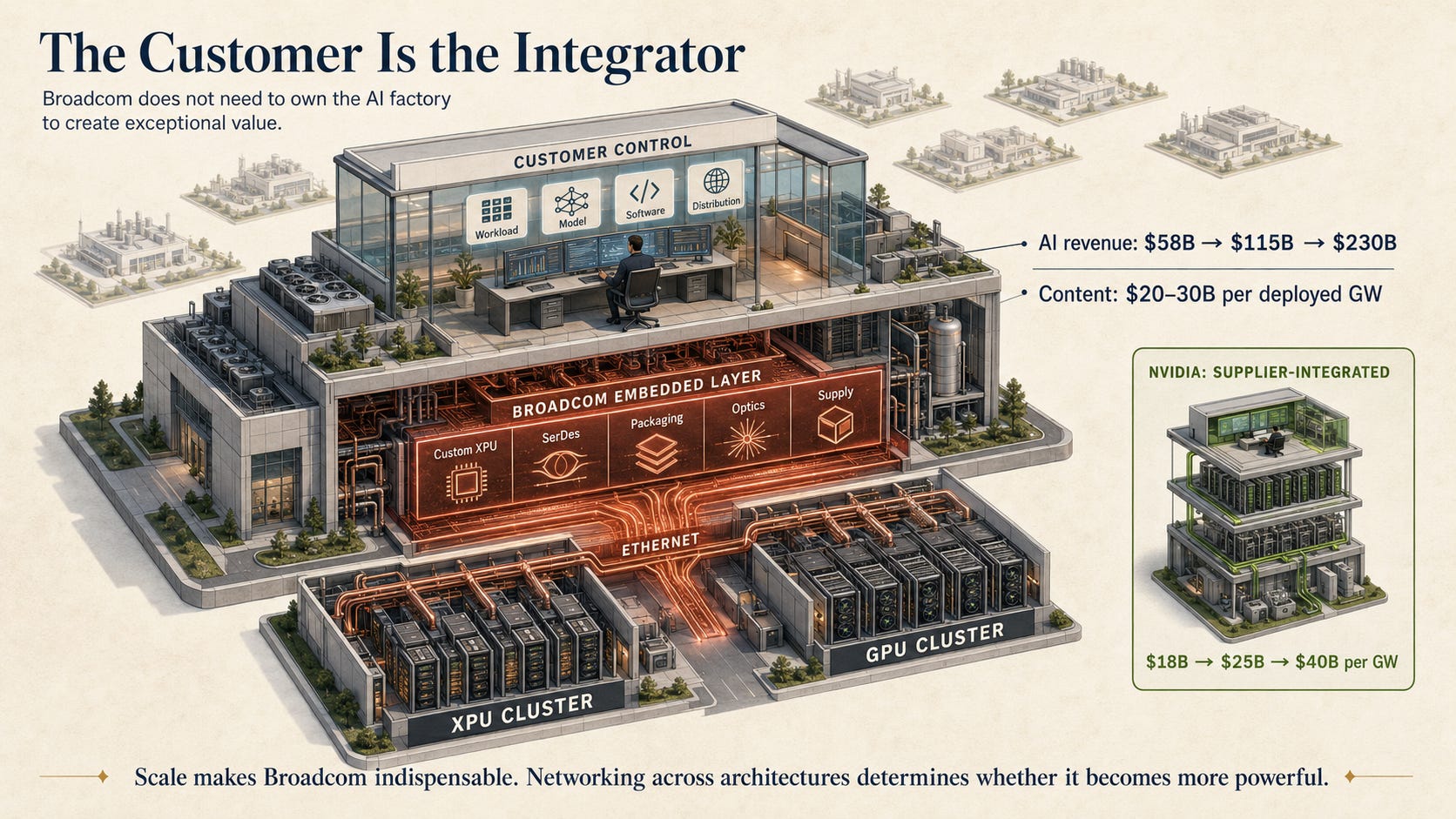
The easiest mistake in investing is to confuse becoming larger with becoming more powerful. Broadcom’s fiscal third-quarter report made that distinction impossible to ignore: management described an AI semiconductor business expanding from roughly $58 billion this year to $115 billion in fiscal 2027 and $230 billion in fiscal 2028 yet left unanswered whether Broadcom’s share of the resulting economics will improve at all.
We were right that Broadcom would become one of the indispensable industrial companies of the AI buildout. We were less right about why. Broadcom is not integrating the AI factory around itself, as NVIDIA does; it is giving Google, Meta, OpenAI, Anthropic and other hyperscalers the tools to integrate the factory themselves.
That makes Broadcom’s opportunity larger than we previously imagined, but its power less certain. Revenue reached $29.6 billion, adjusted earnings were $3.32 a share, and AI semiconductor revenue rose 221% to $16.7 billion, beating Bloomberg consensus by 0.5%, 2.8% and 4.8%. Broadcom guided fourth-quarter revenue to $34.8 billion and AI revenue to $21.7 billion, but the shares ended our frozen after-hours window near $364, down 0.8%, because the guide cleared consensus without clearing the buy-side whisper. The quarter proved the volume. It did not yet prove the value capture.
Bigger Is Not More Powerful
Our original Broadcom thesis was that AI would increasingly be governed by the “physics economy”: advanced-node wafers, HBM, packaging yields, optics, power, delivery schedules and cash commitments rather than announcements about models and partnerships. That thesis has held up. We then stretched it too far by describing Broadcom as the prime contractor for the AI rack. Last quarter we corrected the metaphor: Broadcom does not own the rack but makes other companies’ systems deployable. Q3 supports that narrower and more durable formulation.
The evidence on execution is formidable. Broadcom now serves six XPU customers; Q3 XPU shipments grew more than 3.5 times year over year, AI networking grew more than 2.5 times, and management says supply has been secured for the $115 billion and $230 billion forecasts. Google is receiving two TPU generations, OpenAI’s first accelerator is shipping, Meta begins production shipments in Q4, and Anthropic is expected to become Broadcom’s largest XPU customer in fiscal 2027. These are no longer isolated design wins. Broadcom is operating several of the world’s most demanding semiconductor programmes simultaneously, although Hock Tan was careful to distinguish visible demand from deployed capacity:
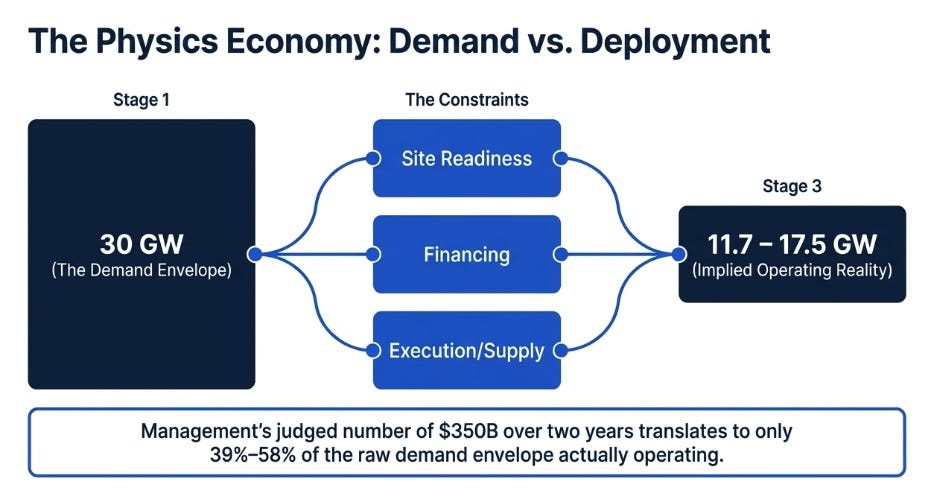
“It will be 30 GW between the customers we have, the six customers we have. Question is, will all 30 come into production within these two fiscal years? We are giving you a judged number of $115 billion of chips to these guys in fiscal 2027, another $230 billion in 2028, which would add up, I know, to about $350 billion. Another way of saying is, we believe with a pretty high degree of confidence, we will ship $350 billion of AI semiconductors to these customers in the next two years. That’s the best way to look at it. It doesn’t necessarily mean all 30 GW need to have been deployed within that period.”
Thirty gigawatts is a demand envelope; $350 billion is management’s judgment about what can be funded, built, supplied and commissioned. If that forecast and Broadcom’s $20 billion–$30 billion of content per deployed gigawatt use comparable definitions, the arithmetic implies 11.7–17.5GW operating during those two years, or 39%–58% of the envelope. That is our inference, not guidance. It makes site readiness, financing and execution as important as chip demand.
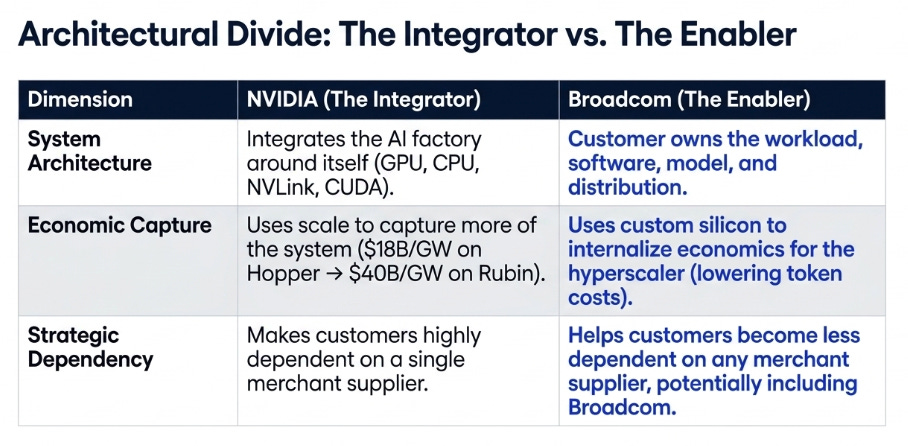
The more consequential comparison is with NVIDIA. NVIDIA integrates the AI factory around itself: GPU, CPU, NVLink, networking, systems, algorithms and CUDA. Its stated revenue opportunity rises from roughly $18 billion per gigawatt with Hopper to $25 billion with Blackwell and $40 billion with Vera Rubin because each generation adds more NVIDIA-controlled content. NVIDIA uses scale to capture more of the system.
Broadcom enables the opposite architecture. The customer owns the workload, software, model and distribution, then uses custom silicon to internalize economics that NVIDIA would otherwise capture. Tan stated the proposition directly:
“The lesson here is when you co-develop a chip that is optimized for your particular LLM workloads, you will outperform any GPU. Like GPUs, Jalapeño demonstrates that it can also run other frontier models, and you can do all this at half the cost of a GPU.”
This is a management claim about selected workloads, not an independently demonstrated universal advantage. If it holds, the first-order benefit accrues to the customer: greater volume amortizes the design, lower token costs stimulate usage, and higher usage justifies more custom capacity. NVIDIA makes customers more dependent on NVIDIA; Broadcom helps customers become less dependent on any merchant compute supplier, potentially including Broadcom.
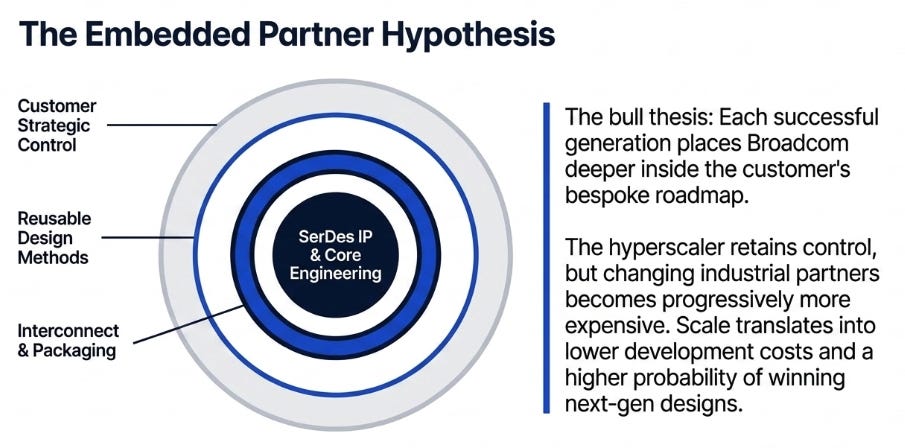
The strongest bull counterargument is what I would call the embedded-partner hypothesis. Each successful generation places Broadcom’s engineers, SerDes IP, packaging knowledge, interconnect design and supply commitments more deeply inside the customer’s roadmap. The hyperscaler retains strategic control, but changing industrial partners becomes progressively more expensive. Broadcom can also reuse design methods and supply knowledge across otherwise bespoke programmes. That could turn scale into lower development costs, stronger access to scarce components and a higher probability of winning the next generation.
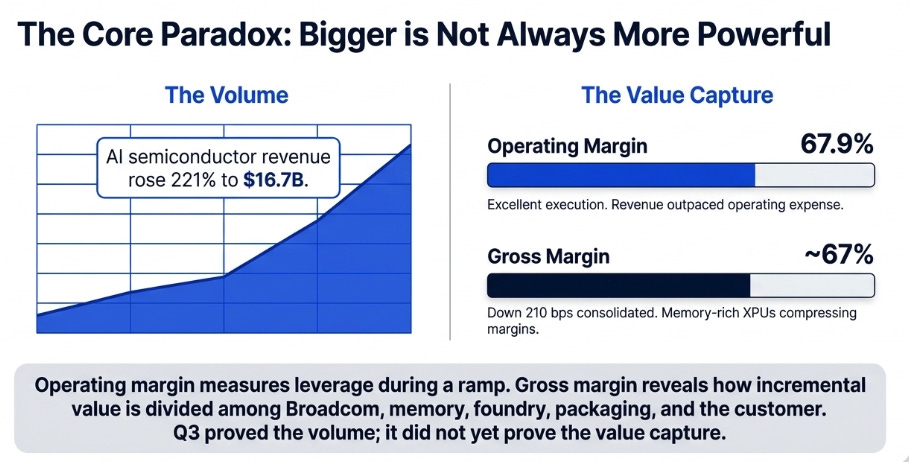
The financial evidence is not yet conclusive. Q3 consolidated gross margin fell 210 basis points sequentially to 75%, and semiconductor gross margin was corrected on the call to approximately 67%, as memory-rich XPUs became a larger part of the mix. Operating margin still reached 67.9% because revenue grew far faster than operating expense. That is excellent execution, but the distinction matters: operating margin measures leverage during the ramp, while gross margin helps reveal how incremental value is divided among Broadcom, memory, foundry, packaging and the customer. We were right about scale and wrong about control. Broadcom is becoming essential to the AI factory, but the hyperscaler still owns the architecture, workload and distribution.
Hock Borrowed NVIDIA’s Grammar, Not Its Economics
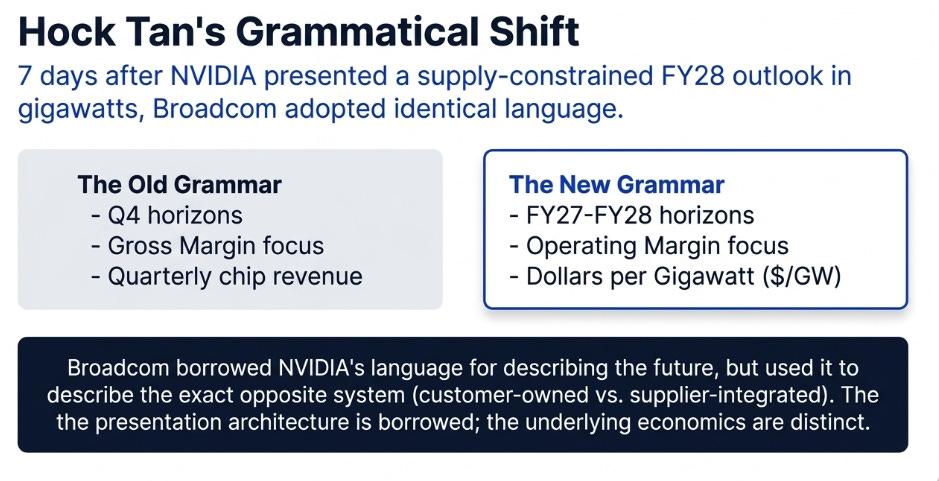
Management made three revealing substitutions on the call. The horizon moved from Q4 to fiscal 2027–2028, gross margin was displaced by operating margin, and quarterly chip revenue became dollars per gigawatt. Each substitution is economically defensible. Each also directs attention away from a present weakness: the Q4 guide did not clear the whisper, product mix is compressing gross margin, and Broadcom’s content per gigawatt is expected to remain broadly stable while NVIDIA’s rises.
The timing was striking. Seven days after NVIDIA broke its quarter-only convention by presenting a supply-constrained fiscal 2028 outlook in gigawatts and revenue per gigawatt, Broadcom used almost the same grammar to describe its future. Broadcom’s customer roadmaps and supply commitments clearly predated NVIDIA’s call; what appears borrowed is the presentation architecture, not the demand. Hock borrowed NVIDIA’s language for describing the future and used it to describe the opposite system customer-owned rather than supplier-integrated.
Management’s story is that Broadcom knows the customers, workloads, chip roadmaps, supply requirements and deployment schedules well enough to forecast two years of extraordinary growth. I believe it. Our story is that this visibility establishes Broadcom as the preferred execution partner but does not establish increasing bargaining power or a rising share of customer economics. The stories reconcile on demand and execution. They diverge on value capture.
This reporting system will naturally appeal more to long-duration growth investors than to quarterly beat traders, although deliberate investor-base curation remains an inference. Investors should not accept management’s choice between gross and operating margin. Both matter, and the tension between them is part of the story rather than an inconvenience to be explained away.
The Network Is the Test
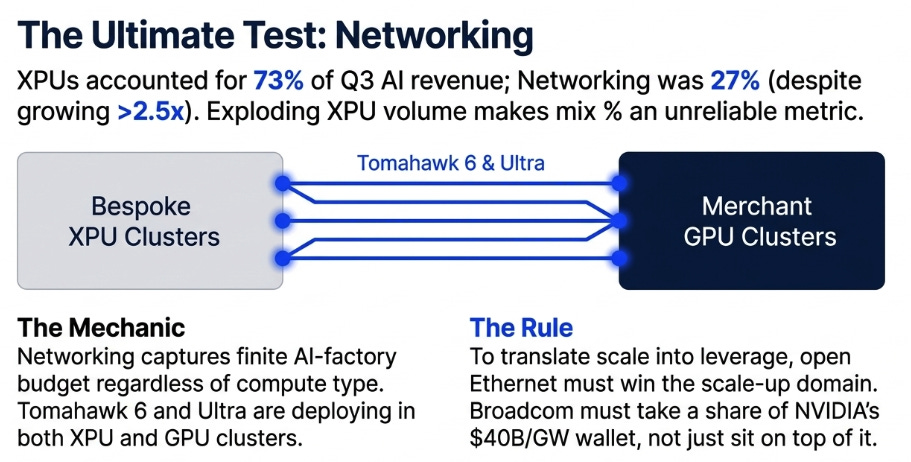
Networking is the best observable test of whether greater deployment can make Broadcom more powerful because it can spread across bespoke XPUs and third-party GPUs. XPUs accounted for 73% of Q3 AI revenue, leaving roughly 27% for networking, even though networking itself grew more than 2.5 times. Our previous requirement that networking remain above 40% of AI revenue was wrong: an exploding XPU denominator makes mix an unreliable measure of network strength.
The better measures are absolute networking revenue, networking dollars per deployed gigawatt, attachment within Broadcom-designed XPU clusters, and penetration of GPU clusters. Charlie Kawwas said Tomahawk 6 is deployed by “pretty much all” hyperscalers building XPUs with Broadcom and also by customers not using Broadcom XPUs; Tomahawk 6 and Tomahawk Ultra are appearing in both XPU clusters and some GPU clusters. If open Ethernet wins more of the scale-up domain while Tomahawk and Jericho retain scale-out leadership, the network can turn customer independence into Broadcom leverage.
The NVIDIA comparison still requires discipline. NVIDIA’s $40 billion-per-GW figure already includes NVIDIA networking and other system content, so Broadcom Ethernet in a GPU cluster takes a share of that wallet rather than adding another $20 billion–$30 billion on top. The contest is over who captures a finite AI-factory budget. Networking is where Broadcom can participate whether the compute is custom or merchant, making it the clearest bridge between revenue scale and economic power.
Certainty Is the Product
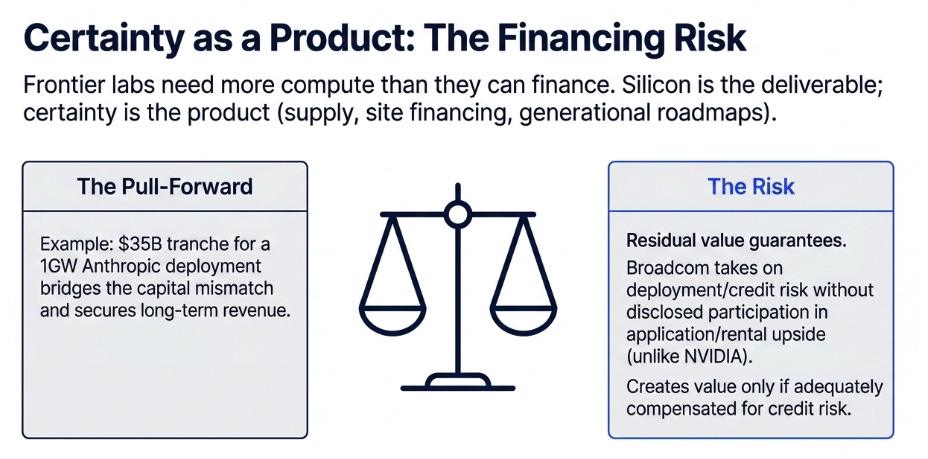
Frontier laboratories want more compute than their cash flows and credit profiles can independently finance. Broadcom’s financing vehicle bridges that mismatch with third-party capital; the first $35 billion tranche supports a 1GW Anthropic deployment, while Broadcom may provide residual-value guarantees. Silicon is the deliverable, but certainty is the product: certainty that the design will work, supply will arrive, the site will be financed, and successive generations will match the customer’s model roadmap.
That service can deepen relationships and pull revenue forward, but it changes the risk. Asked whether the roughly $29 billion of maximum exposure referenced from the previous filing indicated future backstops, management declined to provide a ceiling:
“We don’t have anything to announce today on residual value guarantees or backstop. There’s nothing new to add. The numbers that you outlined around what we’ve already done remain true. As I mentioned in my prepared remarks, we’re going to evaluate any strategic financing really on a deal-by-deal basis. We expect that any that we do in the future, they’re going to have unique features, and they’re going to be tailored specifically to the lab and to the investor needs. I can’t give you an overarching look at what’s the max and what each one’s going to look like.”
NVIDIA argues that its financed systems are fungible and redeployable, and its structure pays it on the hardware plus a share of rental revenue above a floor. Broadcom’s customer-specific XPUs are likely less fungible, while no comparable participation in application or rental upside has been disclosed. Financing does not prove weak pricing power; it proves that desired deployment exceeds some customers’ independent financing capacity. It creates value only if Broadcom is adequately compensated for deployment and credit risk.
Broadcom can absorb some risk. Q3 free cash flow was $13.7 billion, or 46% of revenue, and VMware’s 94% gross margin and 84% operating margin provide substantial ballast. Yet free cash flow missed consensus by 6%, receivables absorbed $2.86 billion of cash during the quarter, and Q4 capital expenditure is expected to rise from $532 million to $1.4 billion. The physics economy must eventually collect the cash it manufactures.
Three Prices, Three Worlds
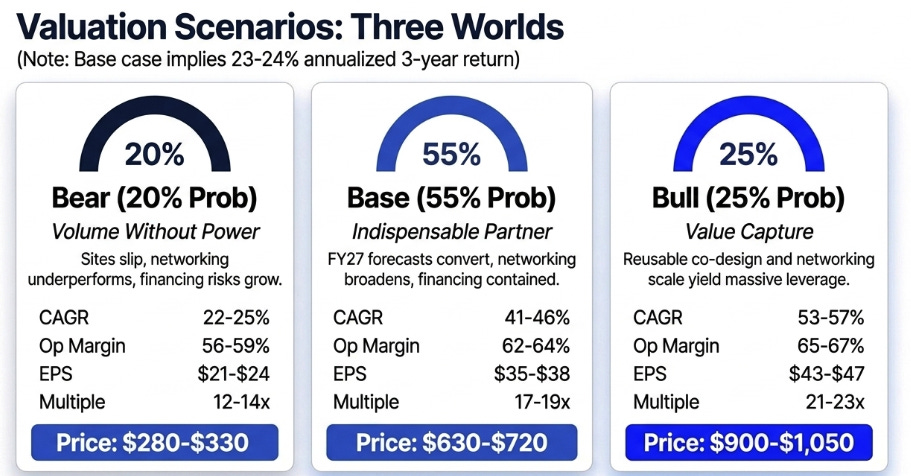
At the frozen after-hours price of approximately $364, the bear case carries a 20% probability. Fiscal 2026–2029 revenue grows at 22%–25% annually, operating margin falls toward 56%–59%, fiscal 2029 adjusted EPS reaches $21–$24, and a 12–14 times multiple produces approximately $280–$330. This is the world in which Broadcom achieves volume without power: sites slip, customers preserve alternatives, networking capture disappoints, and financing obligations grow faster than cash flow.
The base case carries a 55% probability. Revenue compounds at 41%–46%, operating margin settles near 62%–64%, adjusted EPS reaches $35–$38, and a 17–19 times multiple yields approximately $630–$720. Broadcom remains the preferred industrial partner for customer-owned AI, the fiscal 2027 forecast largely converts, networking broadens, and financing stays contained. The company becomes indispensable without acquiring NVIDIA-like control.
The bull case carries a 25% probability. Revenue grows at 53%–57%, operating margin holds at 65%–67%, adjusted EPS reaches $43–$47, and a 21–23 times multiple supports $900–$1,050. Networking and reusable co-design knowledge turn greater scale into higher value capture, while financing proves both profitable and limited. A probability-weighted value near $675 implies an annualized three-year return of approximately 23%–24%, including dividends, but most valuation variance comes from how much of the $230 billion forecast is deployed, recognized, collected and achieved without underpriced guarantees.
The expected return is attractive, but another increment of conviction must be earned through networking growth across XPU and GPU clusters, fiscal 2027 revenue converting into cash, and maximum financing exposure becoming measurable. I would reduce the position if customer savings coincide with declining Broadcom gross economics or if receivables, deployment delays and guarantees grow faster than free cash flow.
Necessary Is Not Yet Powerful
Q3 increases my confidence that Broadcom will become much larger, while increasing only modestly my confidence that it will become structurally more powerful. The quarter confirmed the physics thesis, demonstrated rare execution across six programmes, and advanced Ethernet as the reusable layer across fragmented compute architectures. It also showed why the prime-contractor thesis was too generous: the customer integrates the system, owns the workload, captures the cost advantage and deliberately preserves alternatives.
Two observations would strengthen the thesis. Absolute networking revenue and networking content per deployed gigawatt must rise across both XPU and GPU clusters, and the fiscal 2027 ramp must convert into cash without a comparable increase in guarantees or working capital. Two developments would weaken it: falling semiconductor gross economics despite operating leverage, or hyperscalers adding alternative design partners without impairing their roadmaps.
The fiscal 2026 10-K and the next two deployment updates should resolve more than the next quarterly beat. Broadcom has become the company that makes hyperscaler independence possible. The next question is whether it can make itself indispensable without making its customers dependent.
Disclaimer:
The content does not constitute any kind of investment or financial advice. Kindly reach out to your advisor for any investment-related advice. Please refer to the tab “Legal | Disclaimer” to read the complete disclaimer.