


TL; DR
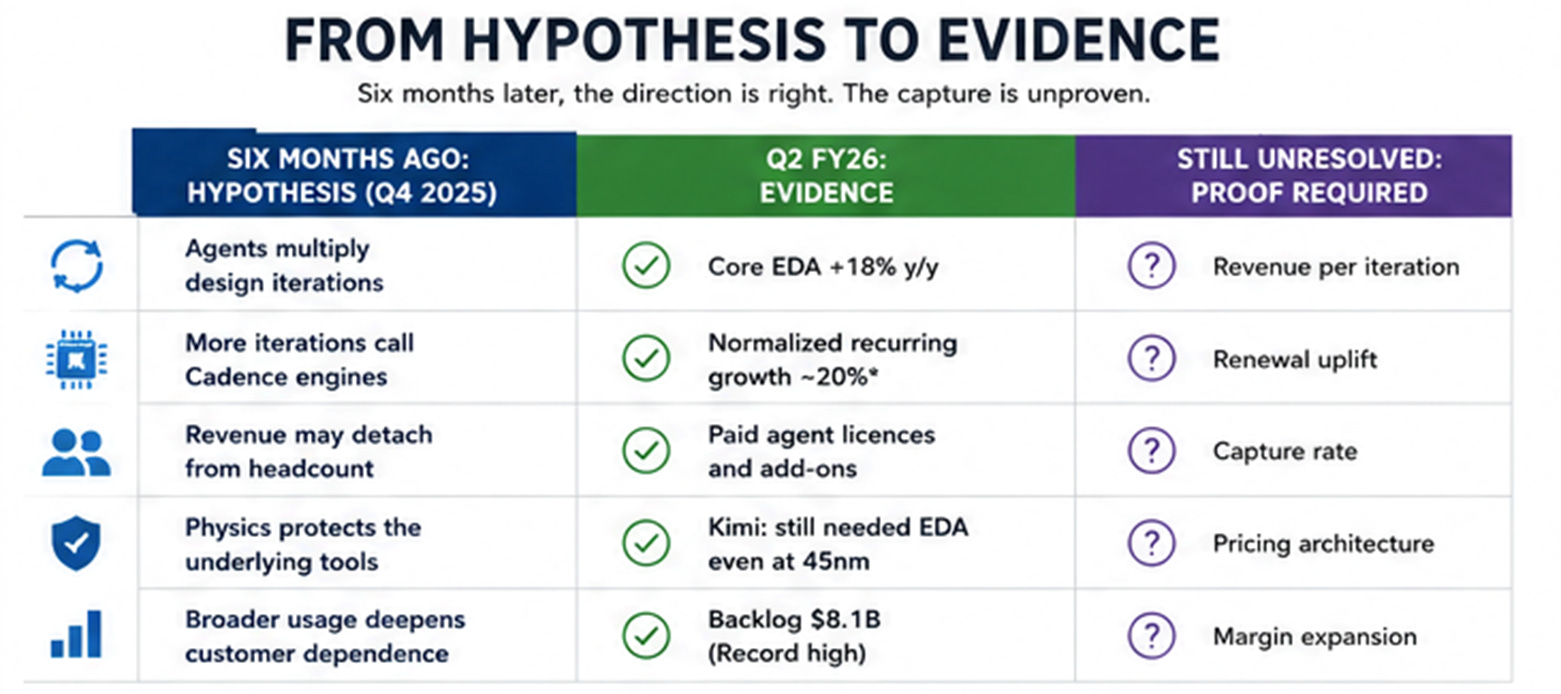
Agents are not replacing EDA tools; they are calling them more often. Core EDA grew 18%, recurring revenue approached 20% organically, and backlog reached a record $8.1 billion.
Cadence has begun monetizing the agent layer through incremental licences and add-ons. However, it has not yet shown that revenue scales with design iterations or customer productivity.
The next test is economic, not technical. Rising revenue per customer and margins above 45% in FY2027 would support the throughput-toll thesis; slower growth and weaker margins would suggest customers retain most of the AI productivity gains.
Ten days before Cadence reported earnings, the stock fell almost 10% after Moonshot AI’s Kimi reportedly designed and verified a chip using open-source tools.
The conclusion seemed obvious. If a general-purpose model could design a chip, the expensive software beneath chip design was about to matter less. Cadence had spent years presenting AI as a source of demand; Kimi appeared to turn the same technology against it.
Then Anirudh Devgan explained what the demonstration had shown.
The design was a small block built on a 45-nanometer process, technology roughly two decades old and, in Devgan’s telling, running at a frequency 20 to 30 times slower than current leading designs. Even there, the agent still needed EDA tools. It could generate intent, coordinate tasks and propose a design, but the result still had to be simulated and verified.
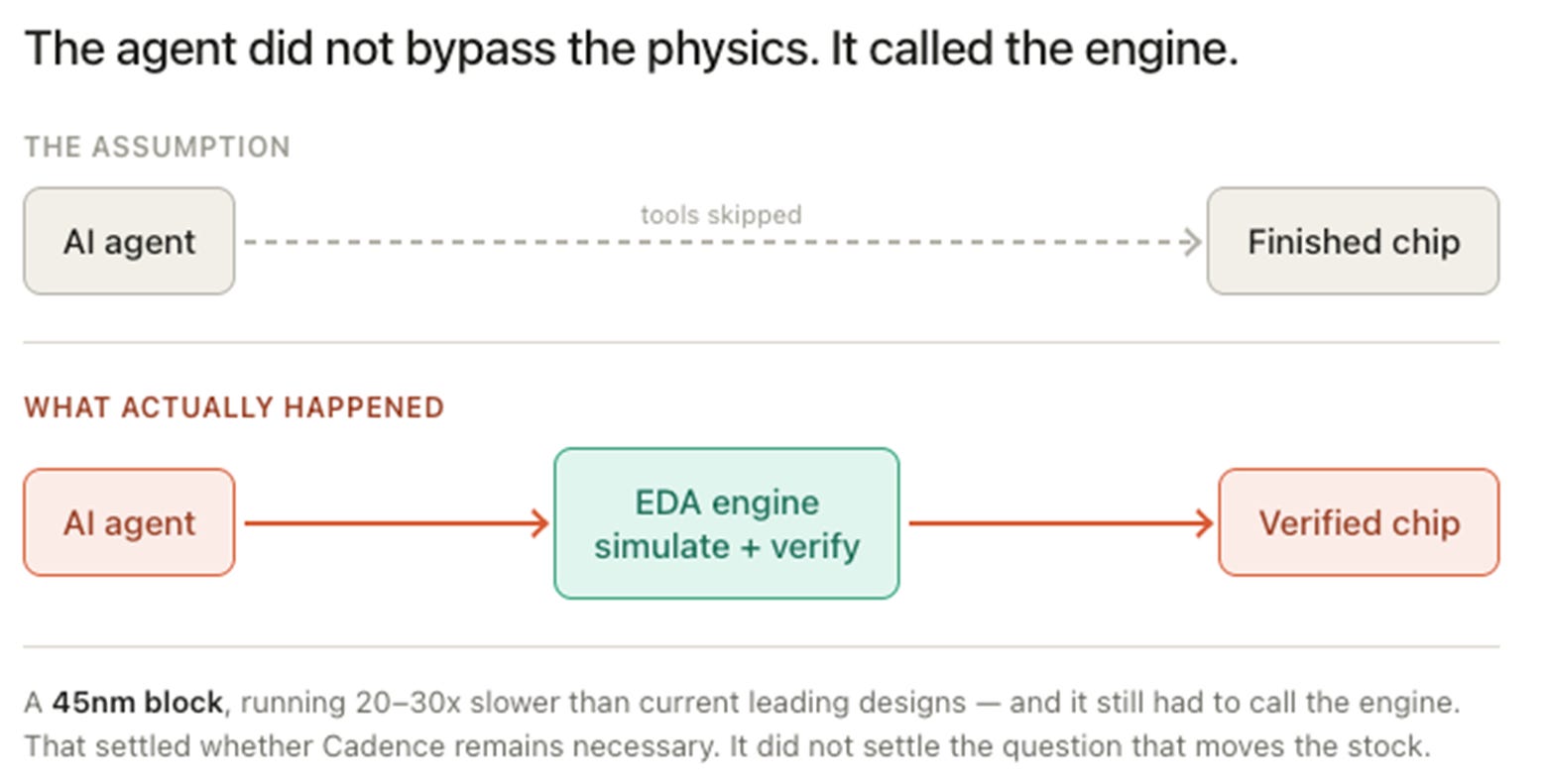
The agent did not bypass the physics. It called the engine.
That should have settled the question of whether Cadence remains technically necessary. It did not settle the more important question for the stock.
Six months ago, in Design Throughput Toll, we argued that Cadence’s historical growth was tied to engineering headcount. More engineers meant more seats, which meant more revenue. Agents offered a way out of that constraint: one engineer, assisted by autonomous design tools, could explore vastly more possibilities, and every possibility would call Cadence’s simulation, verification and sign-off engines.
The thesis was attractive because the technology apparently threatening Cadence could become the mechanism that accelerated its growth.
It was also too neat.
We treated greater tool consumption and greater value capture as if they were the same step. They are not. An agent can run one hundred times more design iterations while the customer remains on a contract negotiated before the agent existed. Cadence’s software becomes more useful. The customer becomes more productive. Whether Cadence gets paid in proportion to either outcome depends on how the commercial terms evolve.
We were right about the direction of demand.
We were too quick about the direction of value.
That is what Q2 clarified.
The Question Has Changed
The old question was whether agents would reduce the need for Cadence’s tools.
I think that question is largely answered.
At advanced nodes, an agent cannot hallucinate its way to a manufacturable design. Timing, power, electromagnetic interference, thermal behaviour, signal integrity and foundry rules are physical constraints. They have to be computed against process-specific models correlated with real silicon over many years.
The number of trusted tools capable of doing this remains very small.
Needham’s Charles Shi pushed Devgan on the extreme version: could a future model generate tape-out-ready files without commercial EDA at all?
Devgan’s answer was blunt:
“The ground truth will prevail.”
The new question is harder:
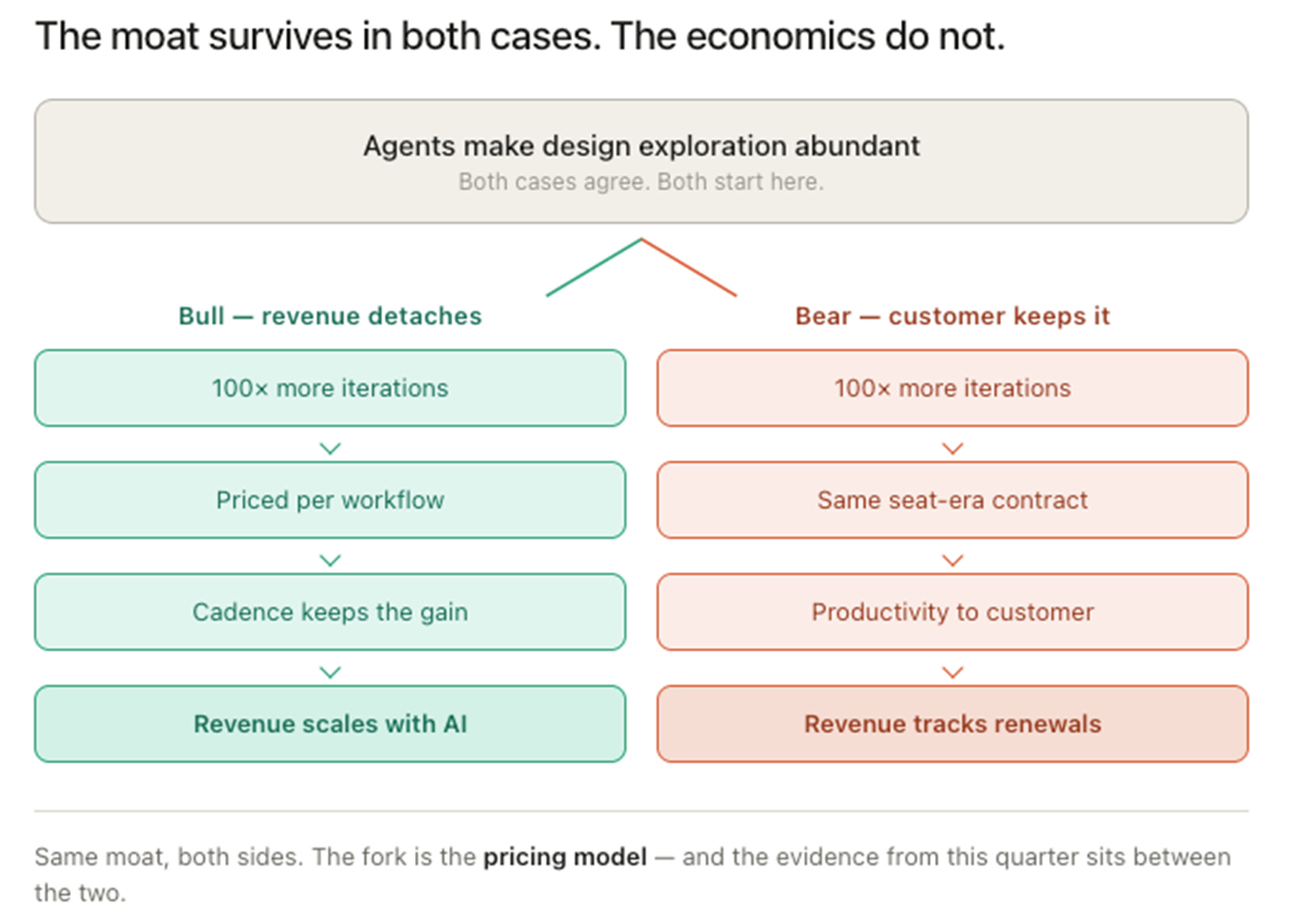
As AI multiplies the number and complexity of designs engineers can attempt, can Cadence make revenue scale with every additional iteration—or will customers capture the productivity while Cadence remains tied to contracts built for a seat-based world?
This is the Big Fundamental Question because the bull case and the bear case begin with the same event: agents make design exploration abundant.
In the bull case, every additional exploration creates demand for agent licences, more engine capacity, more verification hardware, more IP and eventually higher renewal value. Revenue detaches from human headcount.
In the bear case, those explorations run inside fixed agreements. Cadence becomes more indispensable, but the productivity accrues mainly to the customer. Revenue continues to grow with contracts and renewals rather than with the amount of design work performed.
The moat survives in both cases. The economics do not.
The Sentence That Mattered
The most revealing moment on the call came near the end, when Wolfe Research’s Joshua Tilton asked how Cadence was capturing financial value from becoming more central to its customers.
CFO John Wall replied:
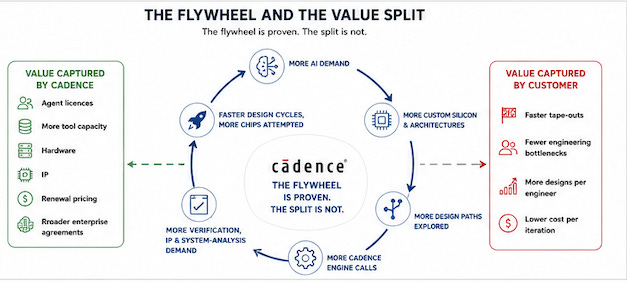
“Customers continue purchasing our underlying EDA software. What they do is they purchase Cadence agent licenses that orchestrate engineering workflows. Generally, our economics scale with customer adoption.”
This is the first real commercial answer Cadence has given.
The base tools continue. The agent is sold on top. Cadence is not simply giving away every productivity gain and waiting years for contracts to renew. There is already an incremental product, an incremental selling motion and at least some incremental revenue.
That matters.
It also leaves plenty unanswered.
Wall did not say revenue scales with the number of iterations. He did not disclose agent revenue, renewal uplift, revenue per customer or pricing linked to design output. Management gave engagement counts—more than 20 for ChipStack and more than 25 for ViraStack—rather than dollars. That usually means the commercial contribution is real but still small.
Cadence has shown that agents can be monetized. It has not shown whether monetization rises in proportion to the value the agents create.
The flywheel has a meter.
We still do not know how sensitive it is.
The Evidence Appears
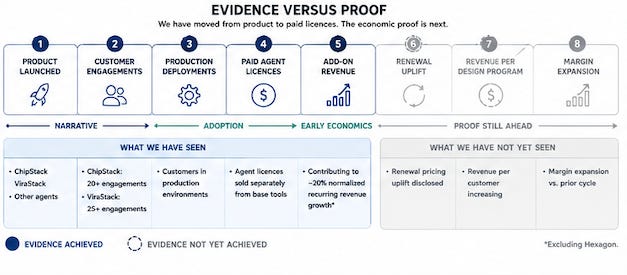
The quarterly numbers matter only because they tell us whether the throughput thesis has started to appear in the business.
It has.
Recurring revenue grew about 24%. Hexagon contributed roughly four points, leaving normalized growth in the high teens to around 20%. Core EDA grew 18%. Wall attributed the strength to share gains, healthy renewals and add-on demand from both “design for AI” and “AI for design.”
This occurred in what management described as a low year in Cadence’s three-year renewal cycle. First halves also usually draw backlog down as revenue is recognized. Instead, backlog increased to a record $8.1 billion.
That is the first convincing financial evidence that growth is no longer being driven mainly by engineers renewing conventional licences.
The rest of the company broadened with it. Semiconductor IP grew more than 40%, with management saying most of the increase was organic. System Design and Analysis grew 37%. Hardware delivered another record quarter and remains, in Wall’s words, “supply-constrained by customer demand.”
These are not four unrelated businesses.
They are four ways of getting paid for the same increase in design activity.
More custom chips require implementation and sign-off. More architectures require interface and memory IP. More alternatives require verification capacity. More chiplets create packaging, thermal and structural problems.
The design problem keeps expanding outward.
Cadence keeps following it.
The annual guidance raise confirms that this was not a backward-looking quarter. FY2026 revenue guidance moved from $6.125–$6.225 billion to $6.260–$6.340 billion. The midpoint increased by $125 million despite a quarterly revenue beat of only about $9 million against the Bloomberg estimate we used before earnings. Q3 revenue guidance of $1.595–$1.625 billion also replaced the feared second-half slowdown with sequential acceleration.
I had expected a good quarter and a modest raise.
I underestimated both the breadth of demand and the second-half setup.
The decoupling is no longer just a product argument. It is beginning to appear in recurring revenue.
The Twenty-Year Gap

The Intel agreement deserves more attention than a normal customer announcement.
Devgan described Intel as a “10 or 20-year-old problem.” Cadence had long been strong in the TSMC ecosystem. Its relationship with Samsung has improved. Intel remained the gap.
The new multi-year agreement covers Intel 14A, design-technology co-development, agentic EDA and Cadence IP. Management said the arrangement is entirely incremental and that most of the benefit remains ahead.
The near-term revenue is less important than what the agreement says about the scarce layer beneath the agent.
Models can proliferate. Customers can build their own orchestration. Interfaces will change. But leading-edge design still depends on process-specific rules, qualified flows and sign-off tools created through years of work with foundries.
Kimi can choose which engine to call.
It cannot create twenty years of correlation knowledge on demand.
Intel deepens Cadence’s process-specific position and raises the probability that Cadence participates in more designs built around Intel processes. It does not guarantee exclusive routing; Synopsys remains formidable, and sophisticated customers mix tools. But it closes a historical weakness at the exact moment physical truth is becoming more valuable.
The technical position is stronger than it was three months ago.
Which makes the pricing question more valuable, not less urgent.
The Cost of Capturing It

Cadence is not converting all the growth into near-term margin.
Q2 non-GAAP operating margin reached 45.5%, but Q3 guidance falls to 43.5%–44.5%. FY2026 non-GAAP expenses are expected to grow about 20%, while the full-year margin midpoint of 44.25% remains below 2025’s 44.6%. Management says it is investing in Intel, Hexagon integration, IP and the broader System Design and Analysis business.
That explanation is credible.
It also creates a promise.
If Cadence is becoming central to a wider set of customer decisions, the broader portfolio should eventually produce higher revenue per customer and better margins. If margins fail to recover in 2027, Cadence may be adding faster-growing businesses that lack the economics of Core EDA.
The accounting gap deserves attention as well. Stock compensation reached $147 million in Q2, more than 9% of revenue. Acquired-intangible amortization rose to $80 million from $24 million a year earlier. The gap between GAAP and non-GAAP operating margin now exceeds 17 percentage points.
Free cash flow softens the concern. Cadence generated $582 million in Q2, up 74% from a year earlier. The growth is producing cash.
Still, the 2027 test is clear.
Revenue growth above 14% with non-GAAP margin recovering beyond 45% would suggest the wider portfolio is improving both strategic relevance and economic quality. Strong growth with margins stuck below 44% would suggest Cadence widened the business without improving the revenue model.
What We Thought, and What We Think Now
Consensus can reasonably view Cadence as a high-quality EDA franchise enjoying an unusually strong AI design cycle. Hardware, IP, acquisitions and custom silicon are lifting 2026 growth toward 19%, after which revenue should normalize toward the low teens.
Our prior view was different. We thought agents could break the link between revenue and engineering headcount by turning design throughput into a new unit of demand.
Q2 makes that view more credible, but also more precise.
The decoupling may already be starting through recurring add-ons, agent licences and increased engine consumption. The market may still spend too much time asking whether agents replace EDA and too little time asking how much more EDA an agent consumes.
But agent adoption alone is no longer the variant perception. It is now visible.
The variant view has narrowed:
Cadence may be able to convert rising design activity into higher revenue per customer before the next renewal cycle fully arrives.
Wall’s description of agent licences suggests the commercial structure is moving in that direction.
What remains unproven is the capture rate.
Cadence does not need to adopt a literal per-call tariff. It could capture the value through premium agent tiers, larger enterprise agreements, more engine capacity, verification hardware, project-based pricing or higher renewals. The test is simpler than the contractual form:
Does revenue per customer rise as agent-enabled design output expands?
Three Possible Cadences
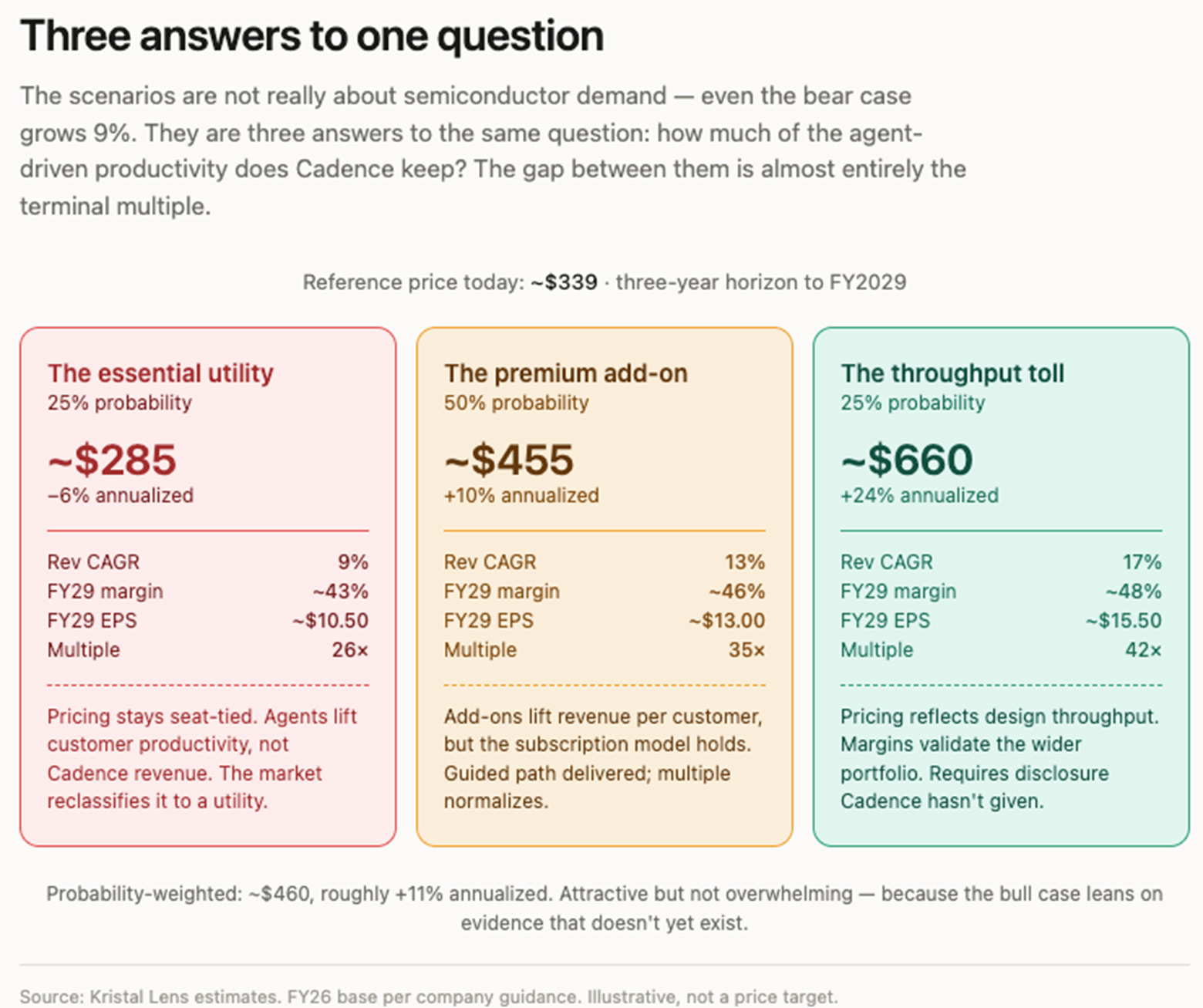
The scenarios are not really about semiconductor demand. They are three different answers to the same value-capture question.
The Essential Utility
Agents raise customer productivity, but pricing remains attached to seats and conventional renewals. Revenue compounds at about 9% through 2029, non-GAAP margin settles near 43%, EPS reaches roughly $10.50, and the market pays 26x.
Implied price: approximately $275–$290.
The Premium Add-On
Agent licences, IP, hardware and system analysis lift revenue per customer, but the basic subscription model remains intact. Revenue compounds around 13%, margin reaches about 46%, EPS approaches $13, and Cadence retains a 35x multiple.
Implied price: approximately $450–$460.
The Throughput Toll
Commercial terms begin to reflect agent workflows, engine capacity and the value of design output. Revenue compounds around 17%, margins approach 48%, EPS reaches roughly $15.50–$16, and Cadence earns a low-40s multiple.
Implied price: approximately $650–$670.
At a reference price around $339, the three-year annualized returns are roughly:
Bear: -6%
Base: 10%
Bull: 24%
The probability-weighted value is around $460, or roughly 11% annualized over three years. That is attractive, but not overwhelming, because the bull case requires commercial evidence Cadence has not yet provided.
What Would Change the View
The next evidence should be hard to fake.
Normalized recurring growth above 15% would support the decoupling thesis; below 13% would suggest 2026 was mainly a strong cycle.
Core EDA growth above 15% would show that the main software engine remains healthy. Agent revenue, renewal uplift or rising revenue per major customer would move the thesis from usage evidence to pricing proof.
FY2027 guidance matters more than the next quarterly beat. Revenue growth above 14% with non-GAAP margin above 45% would show that Cadence can sustain growth while absorbing its investments. Growth below 12% or margin below 44% would suggest the current expansion is less durable or less profitable than it appears.
Backlog should remain near or above $8.1 billion despite revenue recognition. Stock compensation moving beyond 10% of revenue would weaken the per-share economics. DSO should return below 60 days rather than remain in the mid-60s.
These are the markers.
The Next Turn
Six months ago, we asked whether agents would create enough additional design activity to break Cadence’s dependence on engineering headcount.
Q2 answered the first half.
Agents are being deployed. They are calling the underlying engines. Customers are buying add-ons. Recurring software growth is approaching 20%. The base tools remain intact, and the foundry relationships beneath them are getting stronger.
The second half is harder.
Cadence must turn abundant design exploration into higher revenue per customer before customers learn to treat the productivity as part of the old contract. Agent licences are the first answer. Renewal pricing, revenue per customer and margin recovery will tell us whether it is enough.
The flywheel is real.
The open question is where the value goes every time it turns.
Disclaimer:
The content does not constitute any kind of investment or financial advice. Kindly reach out to your advisor for any investment-related advice. Please refer to the tab “Legal | Disclaimer” to read the complete disclaimer.