


TL; DR
The competitive position is strengthening: AI agents can generate far more design possibilities, but those designs still need simulation, verification, signoff and implementation. Cadence’s 16 full-flow wins suggest it is becoming more deeply embedded in that underlying engineering stack.
The monetization thesis is less automatic than we previously assumed: an agent can call Cadence tools more often without creating equivalent revenue if the activity stays inside existing licences. Incremental value only becomes incremental revenue through new agents, more capacity, hardware or larger contracts.
The stock already reflects a lot of quality: the quarter was strong and guidance rose, but underlying growth is still mid-teens, cRPO has stalled at $4.2 billion, cash conversion needs scrutiny, and the valuation requires evidence that agent-driven adoption accelerates earnings rather than merely customer productivity.
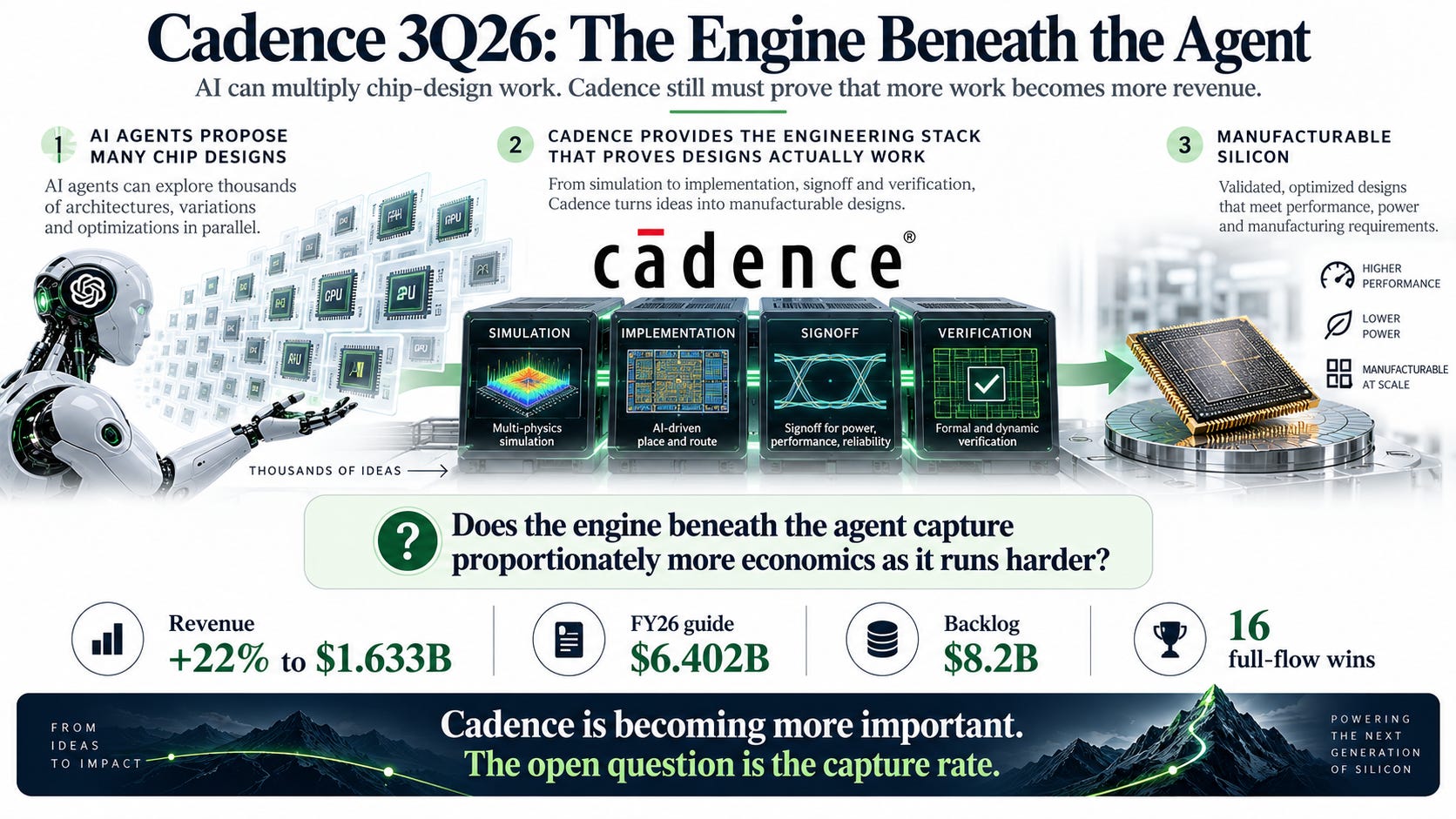
On September 30, Synopsys announced GPT-Synopsys, a specialized chip-design model being developed with OpenAI. Four weeks later, alongside its third-quarter results, Cadence introduced Maestro, a family of domain-specialized models integrated with its engineering tools and capable of routing tasks to whichever model performs best, including frontier AI models.
The announcements appeared to establish competing strategies. Synopsys was partnering with a frontier AI laboratory, while Cadence was developing more of the intelligence itself. Both, however, are pursuing the same objective: remaining central to the customer’s design workflow as engineers increasingly delegate work to autonomous agents. Asked why customers should choose Cadence, CEO Anirudh Devgan made his ambition explicit:
We want to be the primary interface to our customers.
The quarter was strong. Revenue grew 22% to $1.633 billion, backlog reached a record $8.2 billion, and management raised its 2026 revenue outlook for the third time, to $6.4 billion. Yet the more interesting development is what the announcements and earnings call reveal about the industry’s changing economics.
Cadence does not need to own every AI agent. It needs the proliferation of agents to increase customers’ paid dependence on its engineering capabilities. Q3 strengthens the evidence for the first half of that proposition. The second remains the investment question.
The Engine Beneath the Agent
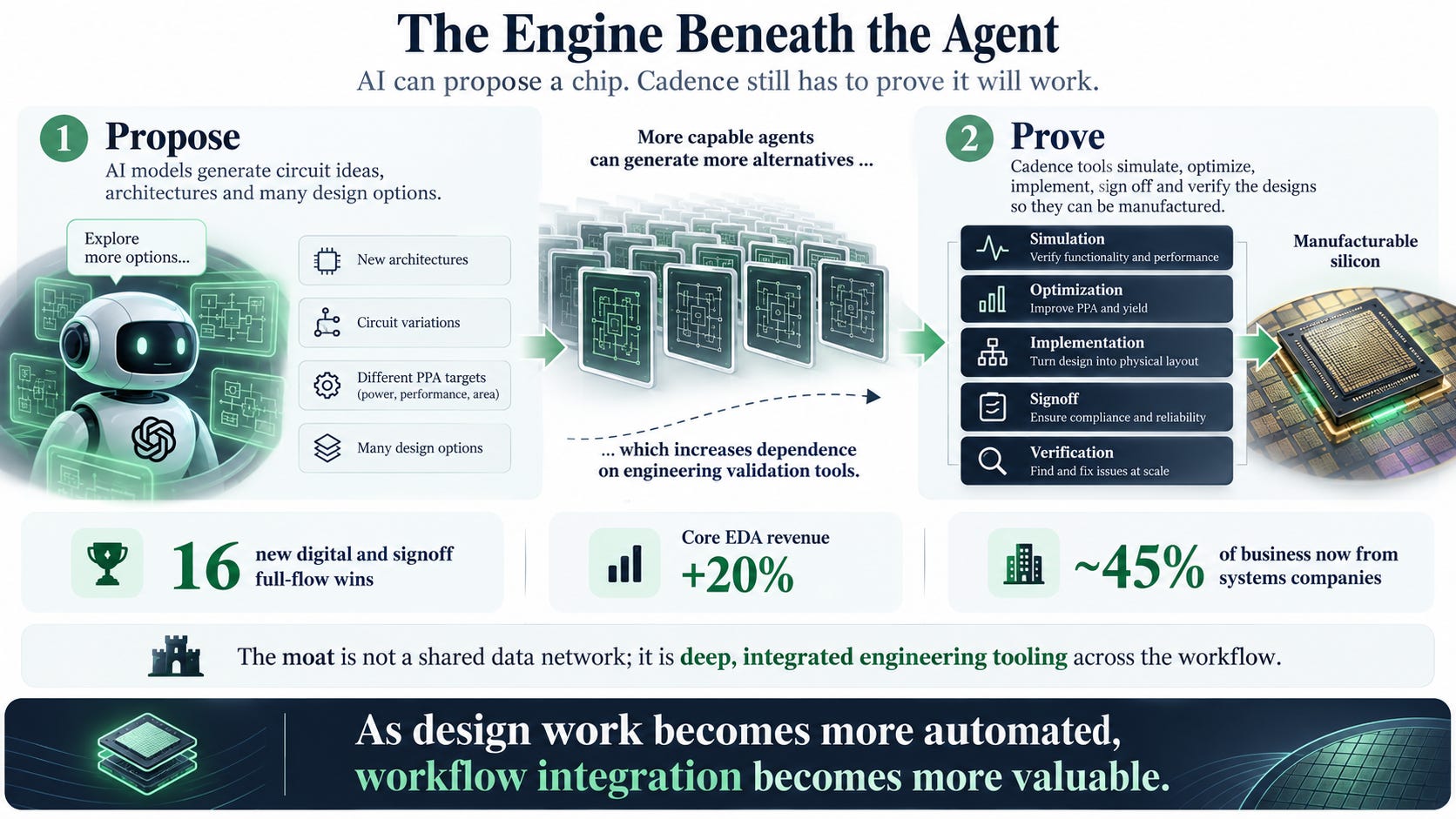
The essential distinction in semiconductor design is between proposing a chip and proving that it works.
A sophisticated AI model can generate circuit descriptions, explore architectures and optimize design objectives. But those proposals must still satisfy timing, power, physical and manufacturing constraints. Engineers depend on specialized tools to translate promising designs into silicon that can be manufactured and operate reliably.
This creates an important distinction between the intelligence generating the work and the engineering infrastructure validating it. As agents become more capable, they may explore substantially more alternatives than human engineers could evaluate manually. Each proposed design requires simulation, optimization and verification. Better models can therefore increase demand for the underlying engineering tools even when Cadence does not supply the agent.
CFO John Wall acknowledged that customers have always built workflows around Cadence tools and will increasingly develop their own agents. Cadence’s strategy accommodates that choice.
This gives the company two opportunities. When customers adopt ChipStack, ViraStack, InnoStack or AuraStack, Cadence can sell agents and orchestration alongside its existing tools. When customers use their own agents, Cadence can still benefit from demand for implementation, simulation, signoff and verification capacity.
Maestro strengthens the first opportunity without sacrificing the second. Its specialized models can use Cadence’s engines to evaluate their outputs, while its router preserves flexibility to use frontier models when those perform better. Cadence owns the engineering tools supplying the feedback, but that is not the same as possessing a cross-customer data network effect. Confidential customer designs cannot simply be pooled into a shared learning system.
The competitive advantage is instead the depth of qualified engineering tools and their integration across workflows. Devgan emphasized that customers increasingly want synthesis, implementation and signoff to work together. An agent operating across a complete design flow makes that integration more valuable because the performance of one tool increasingly depends on its interactions with the others.
Cadence reported 16 new digital and signoff full-flow wins during Q3. That is the most persuasive evidence of competitive momentum. Core EDA revenue grew 20%, but this includes emulation hardware, so the growth rate cannot independently establish software market-share gains.
The opportunity also extends beyond conventional semiconductor companies. Devgan said approximately 45% of Cadence’s business now comes from systems companies, including businesses developing their own silicon. Easier design tools may encourage more companies to undertake custom-chip programs, creating additional demand for software, IP, hardware and services.
There are two possible growth mechanisms: Cadence earns more from existing design programs, or a broader population of customers begins designing chips. Neither requires Cadence to impose a tariff on every design iteration. Both depend on its engineering tools remaining competitive.
More Work Is Not More Money
This brings us back to the distinction we established in July.
In February’s Design Throughput Toll, we argued that AI agents could eventually break the relationship between Cadence’s revenue and the number of engineers its customers employ. If agents could run vastly more design iterations, Cadence might capture value from engineering throughput rather than primarily from conventional licences.
The technological logic remains plausible. The commercial logic was too compressed.
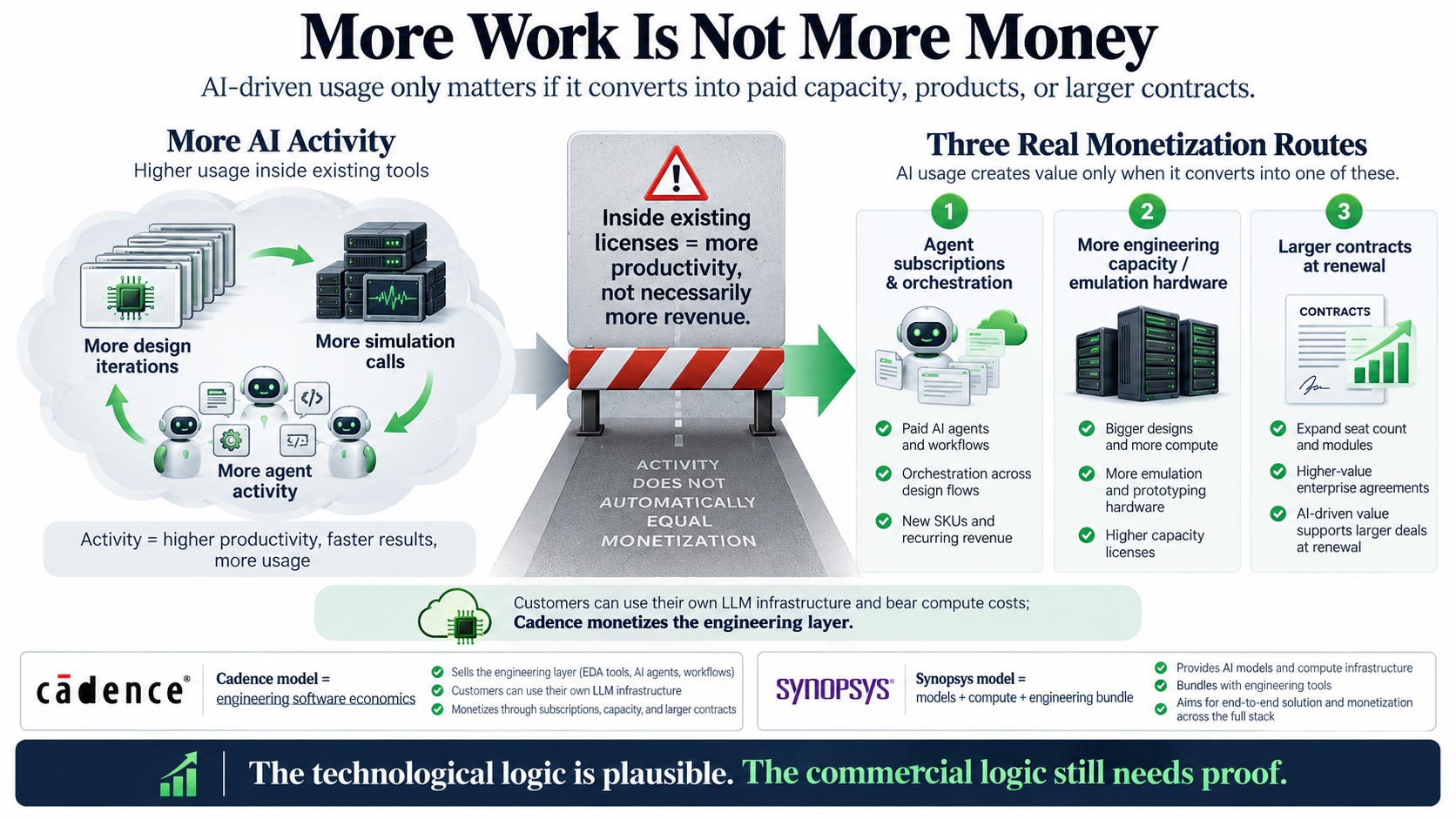
An agent can call a simulation engine a hundred times more often without producing a hundred times more revenue. If those calls fall within an existing licence, Cadence may earn nothing incremental. Greater usage creates revenue only when it requires additional contracted capacity, new products or larger agreements.
Wall clarified Cadence’s intended economic model this quarter. Customers can use their own LLM infrastructure and bear the associated compute costs. Cadence monetizes design agents and orchestration, while continuing to earn revenue from its engineering software and hardware.
This is a sensible division of the value chain. Cadence can participate in AI-enabled engineering without becoming a reseller of general-purpose inference compute. Synopsys’s GPT-Synopsys offering, by comparison, is intended to bundle models, compute and engineering licences. Neither model is inherently superior, but Cadence’s approach is designed to preserve its attractive software economics.
The distinction matters when non-GAAP gross margin is already 88.8%. Owning more AI infrastructure would not necessarily improve the quality of that business.
There are three realistic routes to incremental monetization: customers purchase agent subscriptions and orchestration capabilities; increased workloads require additional engineering licences, compute capacity or emulation hardware; and broader dependence on Cadence’s products supports larger contracts at renewal.
The company has demonstrated the products and described these routes. It has not disclosed the commercial contribution from agents or established how much incremental usage translates into incremental spending.
There is another uncertainty. Better agents might reduce wasted iterations per design even as they increase the number of designs attempted. The net effect on engine consumption is therefore not automatic.
The economic opportunity depends on whether faster, cheaper design expands the total amount of engineering work enough to outweigh greater efficiency within individual projects, and whether Cadence captures a meaningful share of that expansion.
A Strong Quarter, but Not a New Growth Regime
The headline results were excellent, although Cadence has made beating expectations something of a habit.
Revenue exceeded Bloomberg consensus by approximately $20 million and non-GAAP EPS beat by six cents. More importantly, management raised its full-year revenue guidance by $102 million to a midpoint of $6.402 billion. Only about $23 million reflected Q3 exceeding the previous guidance midpoint; the remaining $79 million increased implied fourth-quarter expectations.
This was a genuine forward raise, not simply the arithmetic of a quarterly beat. The historical comparisons nevertheless require some care.
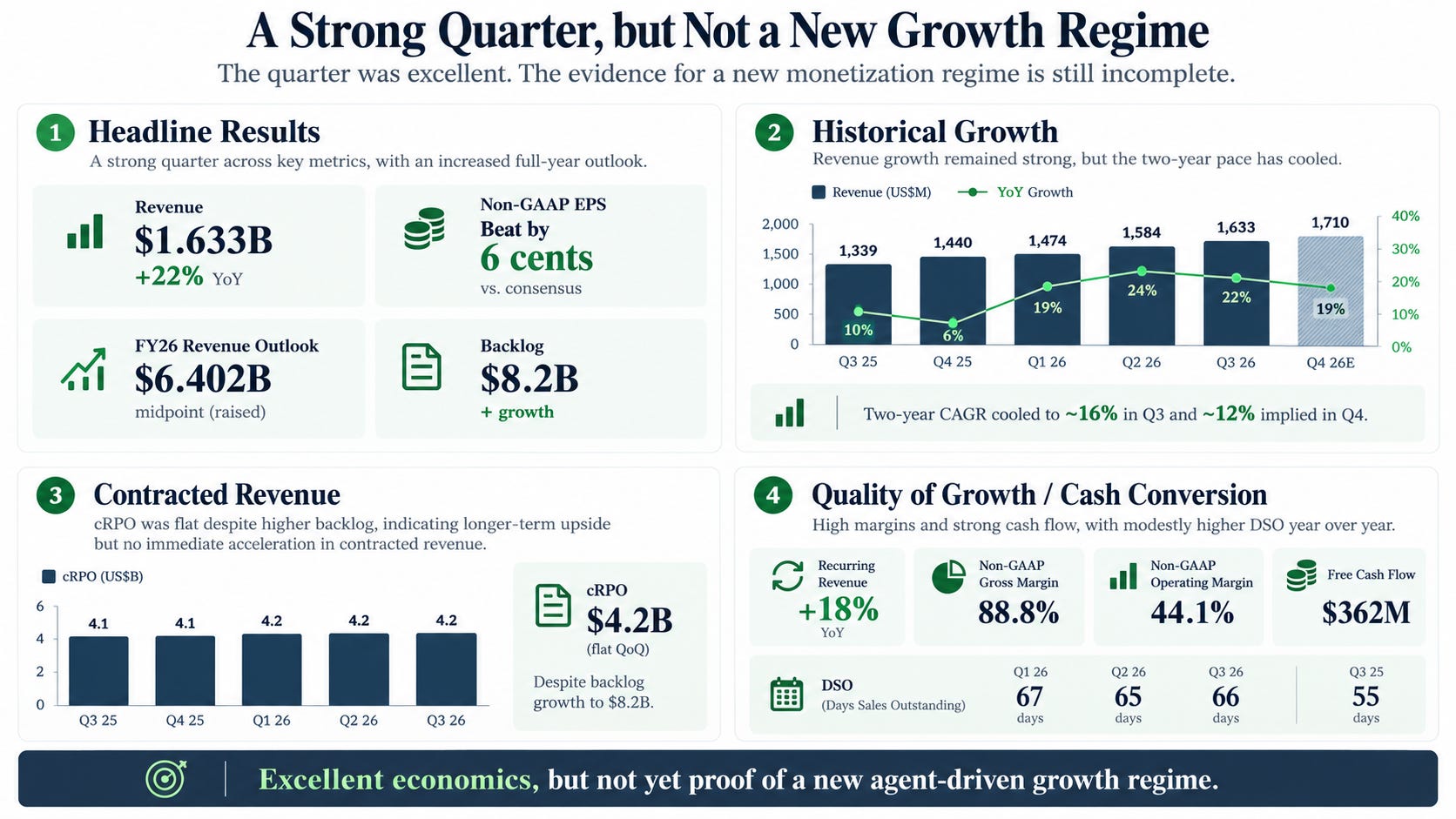
Sources: Cadence, Bloomberg. Q4 2026 uses the guidance midpoint. Two-year comparisons include acquisition effects.
Management describes growth as accelerating and broadening. The description is reasonable against the weak second half of 2025, but the two-year figures tell a more restrained story. Q3’s two-year revenue CAGR was approximately 16%, while Q4 guidance implies about 12%.
Part of the apparent acceleration reflects easier comparisons, hardware-delivery timing and the acquired Hexagon design-and-engineering business. Wall characterized underlying revenue growth excluding Hexagon as mid-teens, with high-teens EPS growth and incremental margins around 54–55%.
Those are excellent economics. They are also broadly consistent with Cadence’s established business rather than proof of a new agent-driven growth regime.
Contracted revenue is similarly encouraging but inconclusive. Backlog reached $8.2 billion, yet current remaining performance obligations, representing revenue expected over the next twelve months, remained flat sequentially at $4.2 billion.
Wall attributed strong bookings during a relatively light renewal year to customer expansion and add-on opportunities. That is precisely where agent monetization could appear before major renewals. But without quantified add-on growth or revenue per comparable customer, we cannot separate agent-driven expansion from ordinary design activity and competitive wins.
Recurring revenue grew 18%, compared with approximately 24% in Q2. The earlier quarter included Hexagon’s contribution, while Q3 faced an unusual prior-year China comparison. Cadence has not provided enough comparable information to isolate underlying agent-driven growth.
Our July claim that decoupling was already becoming visible in recurring revenue was therefore premature. The business is growing strongly, but the evidence does not yet identify the source of that growth.
Profitability adds another qualification. Non-GAAP gross margin rose from 88.0% to 88.8%, while operating margin fell from 47.6% to 44.1%. Hexagon integration and investment explain much of the pressure, but operating leverage needs to recover as the acquired business matures.
Q3 free cash flow rose 31% to $362 million, although full-year operating cash flow guidance remains around $2 billion despite the earnings raise. Days sales outstanding have remained elevated at 67, 65 and 66 days across 2026, compared with 55 days in Q3 last year.
We had already identified persistent DSO elevation as a warning. Three quarters are enough to treat it as something requiring explanation rather than dismissing it as timing.
These figures do not undermine Cadence’s technological advantage. They determine how much of that advantage reaches shareholders.
Three Possible Cadences
The valuation question is whether stronger adoption produces enough incremental earnings and cash flow to justify today’s premium.
Bloomberg’s pre-release 2027 consensus stood near $7.18 billion of revenue and $9.55 of adjusted EPS. Against the new 2026 guidance, those forecasts imply roughly 12% revenue growth and 14% EPS growth.
At the October 26 closing price of $322.17, Cadence trades at approximately 38 times 2026 adjusted earnings and 34 times pre-release 2027 consensus.
An opening 2027 revenue guide near 12% would not itself signal slowing demand. Cadence has a history of conservative initial guidance followed by upward revisions.
I would retain July’s three operating scenarios and 25%/50%/25% probabilities, rebase the forecasts to the higher 2026 revenue outlook, and explicitly model the financial assumptions that were previously implicit.
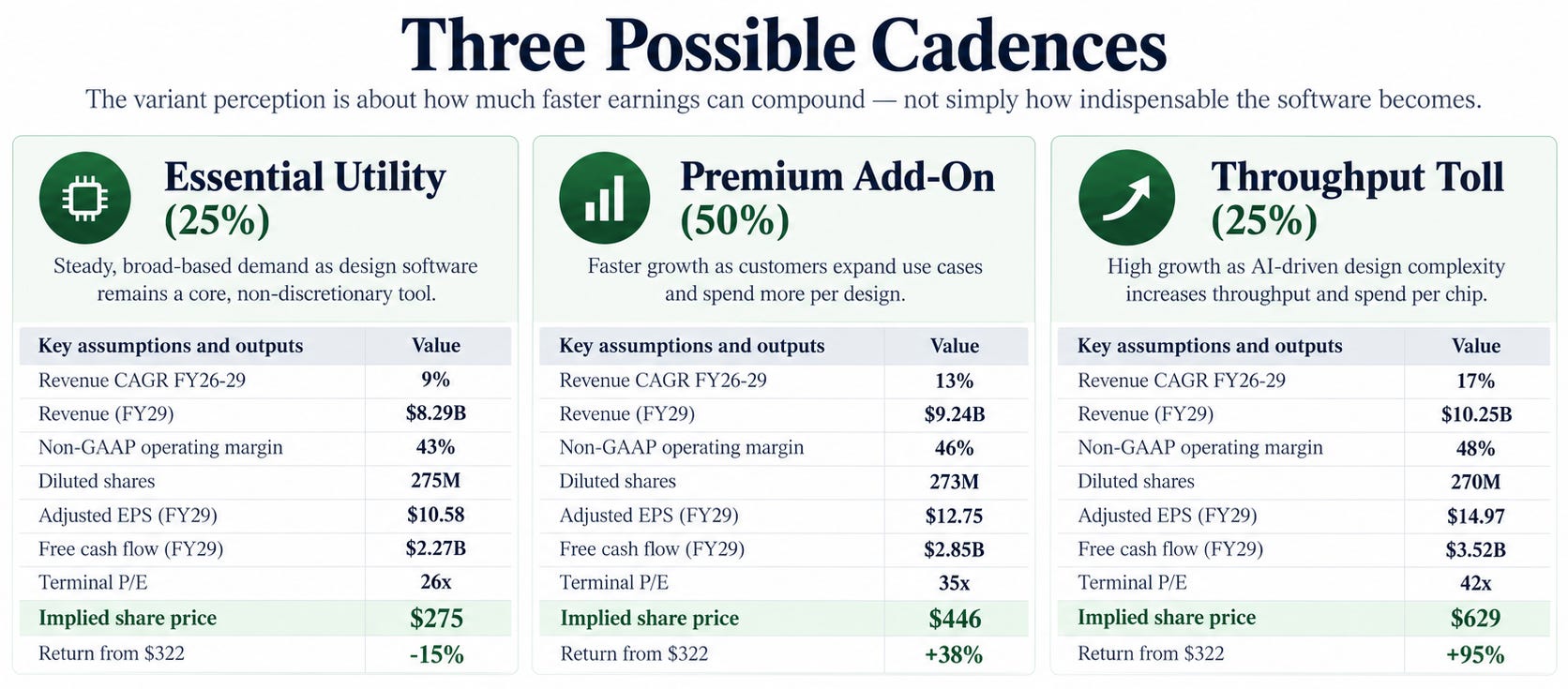
Estimates, not company guidance. Assumes 16.5% tax, $80 million annual net non-operating expense, and scenario-specific free-cash-flow conversion of 78–87% of adjusted net income. Share assumptions reflect net dilution after repurchases.
In Essential Utility, agents improve customer productivity without materially expanding paid engineering capacity. Growth settles at 9%, hardware normalizes and the premium multiple contracts. Earnings rise, yet shareholders lose money because the valuation falls faster.
In Premium Add-On, agents, broader tool attachment, full-flow wins and system-company expansion sustain 13% revenue growth. Operating margins recover to 46%, and earnings compound without requiring a radical change in Cadence’s commercial model.
In Throughput Toll, a meaningful share of additional engineering work becomes paid capacity and larger recurring commitments. Revenue compounds at 17%, margins reach 48%, and the company earns a premium multiple on substantially higher profits. This scenario does not require literal per-call pricing.
The market already recognizes Cadence as an exceptional business. Our variant perception must therefore concern how much faster its earnings can compound; not simply how indispensable its software becomes.
What Would Change Our View
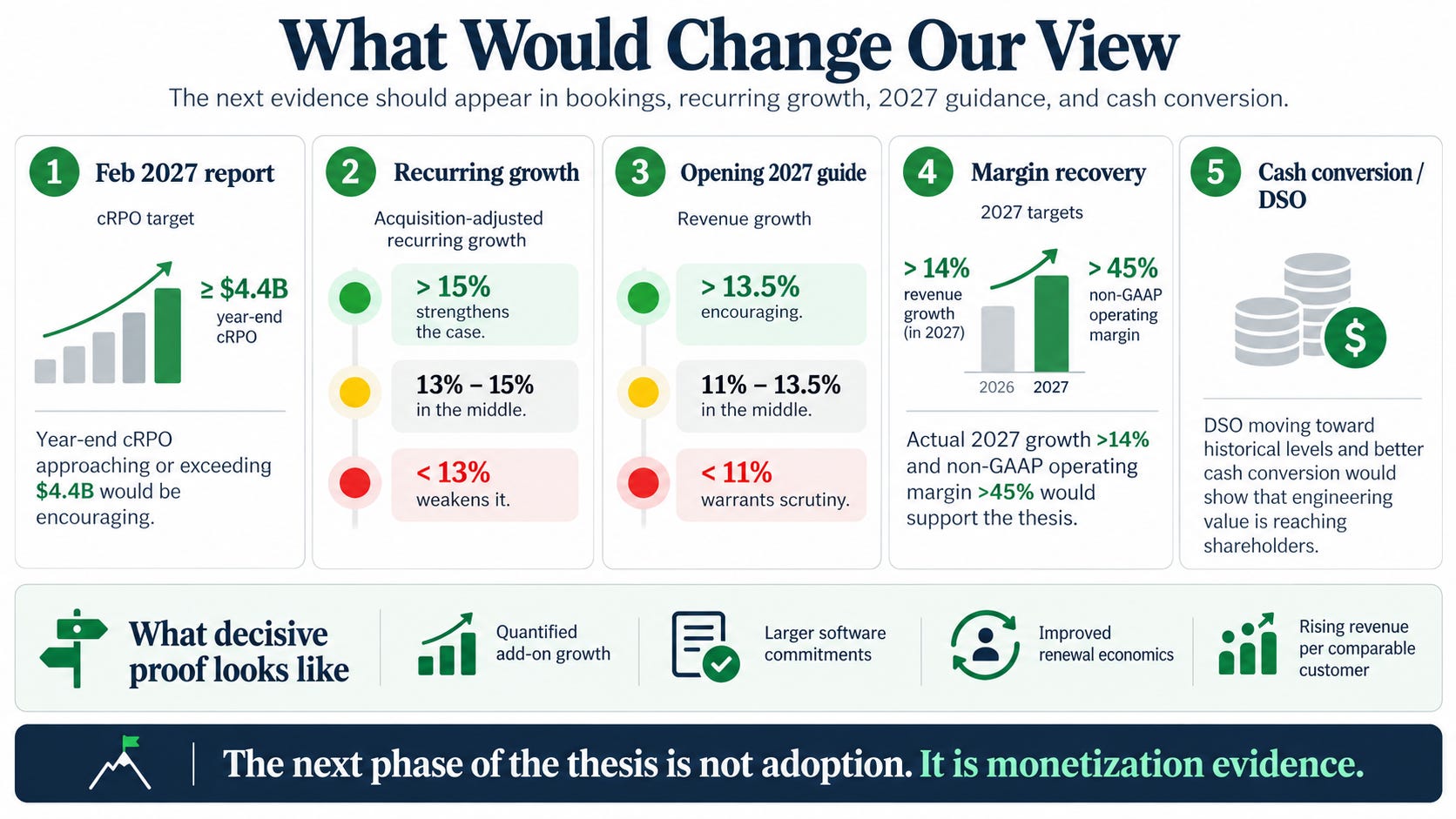
The February 2027 report provides the first meaningful test. Q4 is traditionally Cadence’s strongest bookings quarter, and year-end cRPO approaching or exceeding $4.4 billion would indicate a contracted book growing more convincingly with the business. Acquisition-adjusted recurring growth above 15% would reinforce that evidence; sustained growth below 13% would weaken it.
Neither metric would independently prove agent monetization. Renewal timing, hardware mix and conventional customer expansion still matter.
The next test is the opening 2027 outlook. Guidance above 13.5% revenue growth would be encouraging, while below 11% would warrant greater scrutiny. More important is whether actual 2027 growth ultimately exceeds 14% while non-GAAP operating margins recover above 45%.
The decisive evidence should emerge through 2027: larger software commitments, quantified add-on growth, improved renewal economics, or rising revenue per comparable customer. Better cash conversion and DSO moving toward historical levels would establish that the additional engineering value is reaching shareholders.
There are also risks outside the thesis. Synopsys may capture more of the agent interface through its OpenAI partnership, frontier models could erode the advantage of domain-specialized models, and Chinese demand remains exposed to export-control uncertainty. None is resolved by a strong quarter.
The Next Turn
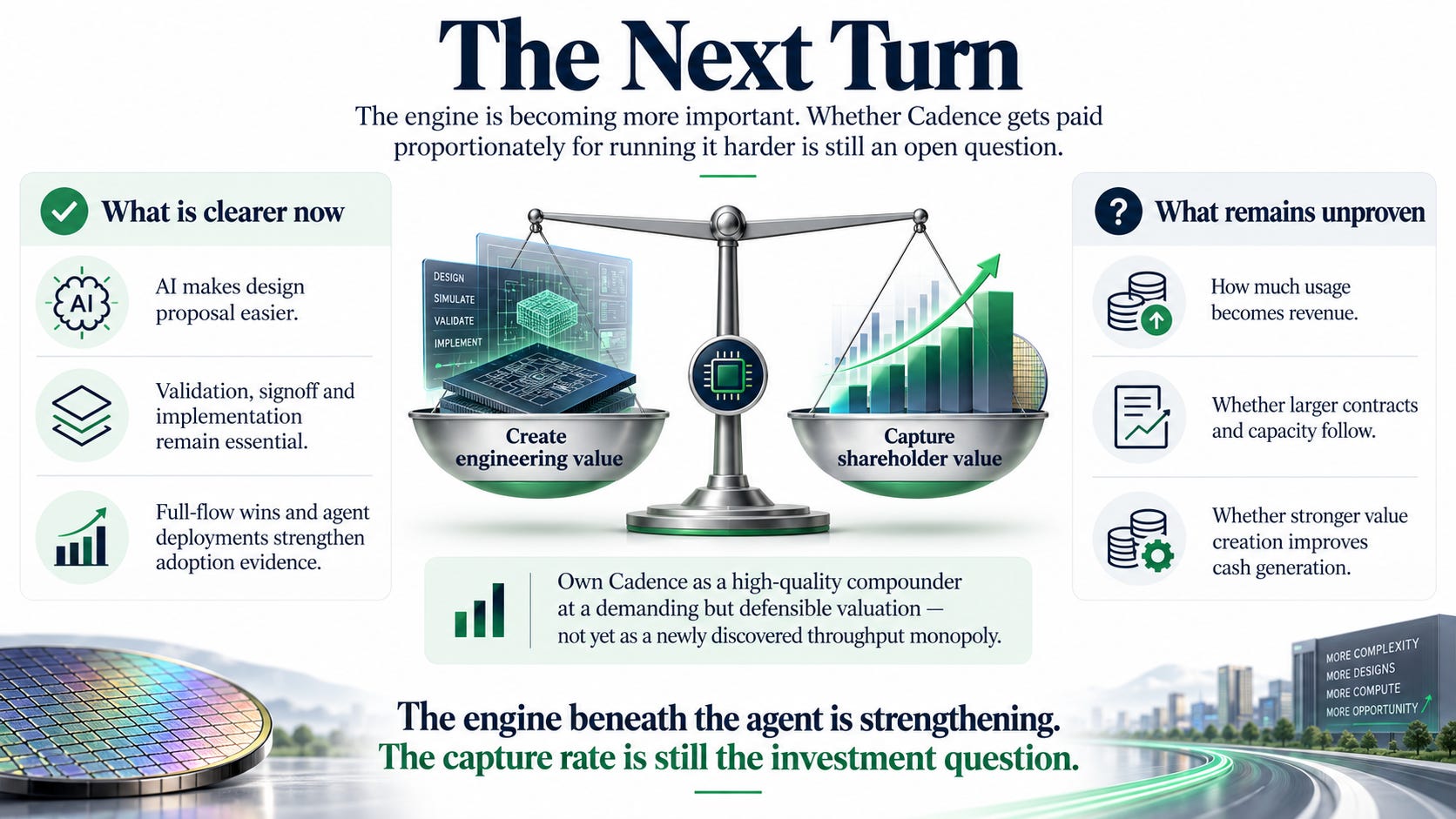
July ended with a distinction between creating engineering value and capturing it. Three months later, Cadence has clarified how it intends to monetize that value, while full-flow wins and agent deployments provide stronger evidence of adoption.
The underlying advantage is clearer. As AI makes it easier to propose designs, the engineering infrastructure required to validate, optimize and manufacture them remains essential. Cadence has an opportunity to become more valuable as that infrastructure serves increasingly automated workflows.
What remains unproven is the capture rate. More design activity must eventually translate into larger contracts, additional capacity and stronger cash generation, rather than simply allowing customers to accomplish more under existing agreements.
The engine is becoming more important. Whether Cadence gets paid proportionately for running it harder is still an open question.
Until that evidence arrives, I would own Cadence as a high-quality compounder at a demanding but defensible valuation, not underwrite it as a newly discovered throughput monopoly whose pricing power the market has missed.
Disclaimer:
The content does not constitute any kind of investment or financial advice. Kindly reach out to your advisor for any investment-related advice. Please refer to the tab “Legal | Disclaimer” to read the complete disclaimer.