


TL; DR
The core thesis is being validated: Constellation signed roughly 920 MW of long-term nuclear agreements averaging 18.5 years, raised 2026 EPS guidance, and progressed Crane and the Calpine integration. The “boring” contracting thesis is working.
Regulation looks more like friction than a veto: the new PPAs were signed before PJM and FERC rules were fully resolved, suggesting scarce, already-connected generation can be monetized even without perfect regulatory clarity.
The rerating case is increasingly about earnings quality, not estimate upside: the opportunity is for more of Constellation’s already-expected earnings to become long-duration, contracted and defensible not necessarily for 2029 EPS to dramatically beat consensus.
“I recognize that the last time we spoke, I indicated that we expected to be done with an important transaction by this call, but we’re not ready to announce anything today.”
That was Joe Dominguez in March. Constellation had just laid out 20% base-EPS growth through 2029, authorized $5 billion of repurchases, and presented a financial framework designed to make the company look less like a merchant generator and more like a business with increasingly visible earnings. The stock fell 9.3% because none of that was what investors had shown up to hear. They wanted a hyperscaler deal.
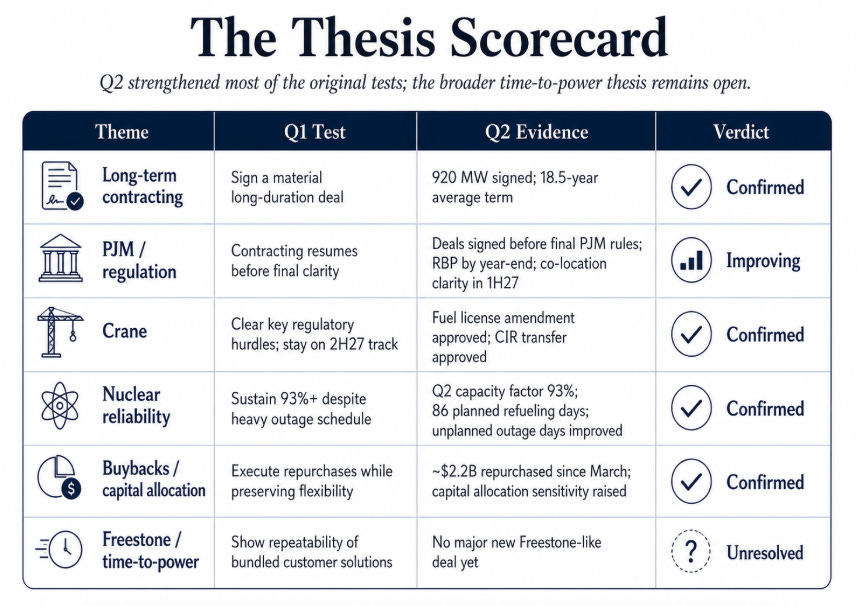
Four months later, Constellation delivered one. Or rather, several. The company signed approximately 920 MW of long-term nuclear agreements averaging 18.5 years, raised 2026 adjusted EPS guidance to $11.50–$12.50, cleared two important regulatory hurdles for Crane, and reached agreement on the final Calpine disposal required by the DOJ. Dominguez’s summary of the fears from March was direct: “Those concerns have not materialized.”
And yet I don’t think Q2 changed the thesis. What it did was more useful: it reduced the probability that the thesis we already had would fail.
The Big Fundamental Question remains the same:
Can Constellation convert the growing scarcity of reliable, already-connected power into durable contracted earnings faster than new supply and regulation erode that scarcity?
Q2 moved the answer toward yes.
What We Said, What Happened
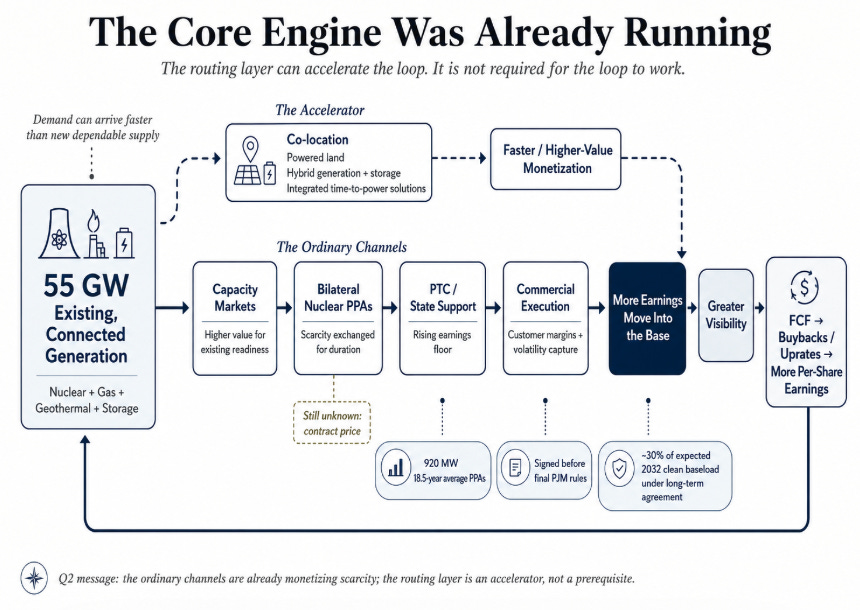
Our view of Constellation has evolved less than the language around it suggests. In August 2025, we argued that Constellation sold pressure rather than power. Nuclear was the reservoir: dependable, carbon-free generation available whenever customers needed it. The PTC was the levee protecting economics when power prices weakened; capacity markets rewarded readiness; long-term contracts were the pipes carrying that dependable output to customers.
We then corrected ourselves. We were right about the reservoir and early on the pipes. Co-location proved slower and more regulated than expected, while Calpine widened the ways Constellation could reach customers through gas, storage, retail relationships and powered sites. After Q1, we sharpened the customer problem again: increasingly, the buyer was not simply purchasing clean electricity but a date, power delivered when a data centre or industrial project needed it.
Q2 does not invalidate any of this. It does make one distinction clearer. The core thesis, that scarce operating generation can be converted into increasingly durable earnings, is working. The more ambitious extension, that Calpine lets Constellation repeatedly sell Freestone-like packages combining site, connection, generation and delivery schedule, remains unproved.
That matters because the 920 MW signed this quarter were not spectacular transactions. They were long-term nuclear PPAs. The boring version of the thesis worked.
The Pipe Moved Before the Permit
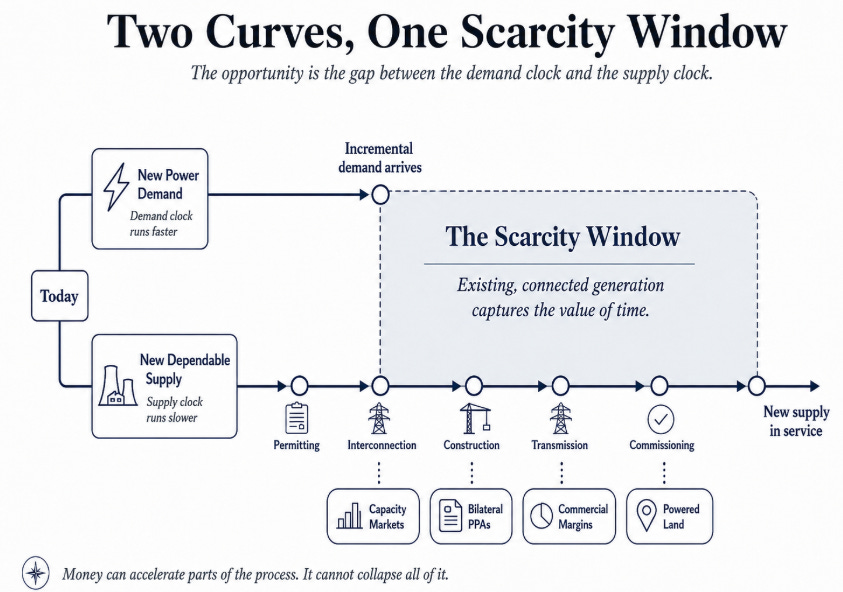
This is the most important fact from Q2.
In March, management blamed regulatory uncertainty for slowing contract execution. Customers did not know what PJM would require of large loads or how future rules would affect procurement. The obvious bear chain was straightforward: no clear rules meant no customer certainty; no certainty meant no contracts; no contracts meant scarcity remained stranded.
Q2 broke that chain.
When Jefferies’ Julien Dumoulin-Smith pressed management on whether the signed deals depended on the Reliability Backstop Procurement or future FERC decisions, management said they did not. These are executed contracts, not placeholders waiting for regulation to catch up.
PJM still matters. Management expects the RBP process to produce results by year-end and broader co-location clarity around the first or second quarter of 2027. But regulation increasingly looks like a constraint on pace and structure rather than a veto on monetizing the fleet.
The deeper reason is the time asymmetry underneath the entire power story. Large customers can commit capital and add load much faster than new dependable generation, and transmission can be permitted, interconnected and built. Existing, grid-connected generation is therefore the scarce asset during that gap, and Constellation owns 55 GW of it; management estimates that rebuilding the fleet today would cost more than three times the company’s current enterprise value.
Dominguez explained the same point in grid language:
“We have plenty of unused capacity in generation and in the wires grid over 99% of the hours of the year. We have a peak capacity concern, not an energy concern.”
His argument is that batteries, demand response, backup generation and curtailment can handle the relatively small number of difficult peak hours while existing generation serves incremental load during the rest.
That mechanism does not require a landmark co-location agreement. Capacity markets already pay more for scarcity. Bilateral PPAs already monetize long-term nuclear value. Commercial margins capture volatility. Buybacks turn cash into per-share earnings. The routing layer could make the flywheel turn faster, but Q2 showed that the flywheel does not depend on it.
Optionality Gets Attention; Base Gets a Multiple
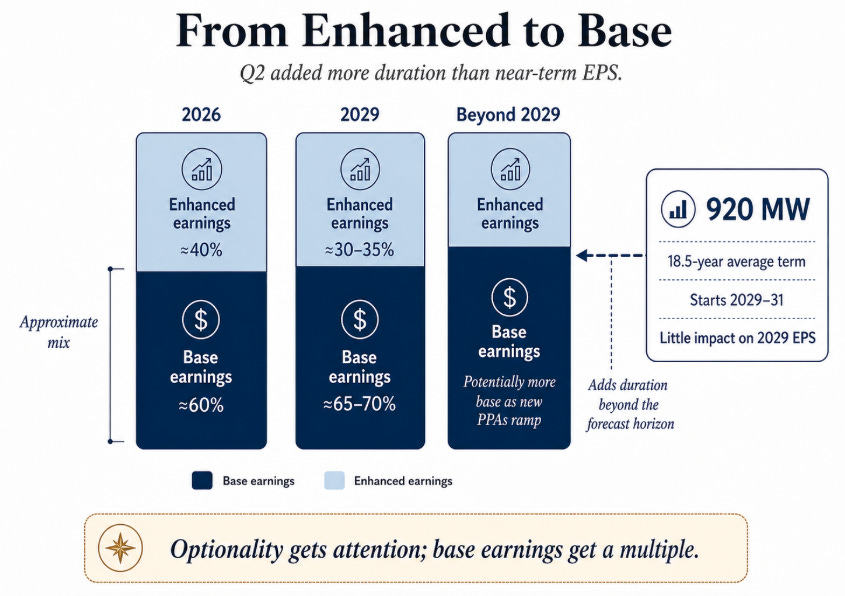
Our Q1 article contained the line that still best explains the financial mechanism: “Optionality gets attention; base earnings get a multiple.”
An uncontracted nuclear MWh is an option on tighter power markets, rising capacity values and customer urgency. Sign an 18-year agreement and Constellation gives away some of that open-ended upside. In return, it gets duration.
The new contracts average 18.5 years and take roughly 30% of expected clean baseload generation under long-term agreement by 2032. Yet Shane Smith made clear that they start late enough that they do not materially affect 2029 earnings.
That sounds disappointing until you look at what is already in the model. Bloomberg expects adjusted EPS of roughly $11.75 in 2026, $13.06 in 2027, $16.61 in 2028 and $19.10 in 2029, despite very little revenue growth after Calpine enters the base. The Street is already assuming earnings conversion.
What the new contracts do is improve the durability of earnings beyond the period that dominates today’s forecast.
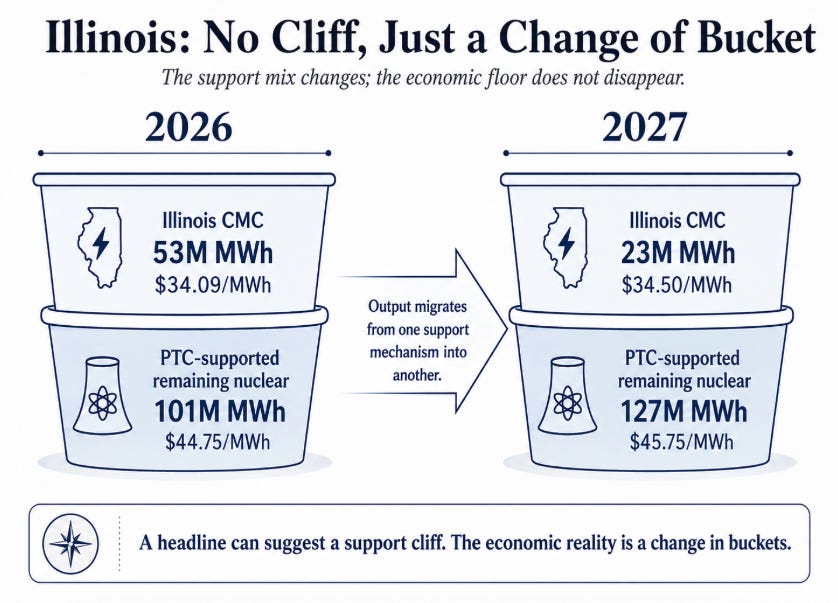
The same idea appears in the Illinois transition. Constellation models 53 million MWh of Illinois CMC nuclear output in 2026 at $34.09/MWh, falling to 23 million MWh in 2027, while nuclear volumes supported in the PTC bucket rise from 101 million to 127 million MWh and the assumed floor increases from $44.75 to $45.75/MWh. A casual reading sees a subsidy ending. The economic reading sees a large block of output migrating from one support mechanism into another.
That is what management’s base-earnings architecture is trying to show.
The obvious bull case is no longer differentiated. Nuclear scarcity is well understood. AI electricity demand is well understood. Twenty-one analysts rate CEG a Buy and none rate it a Sell.
I do not think the interesting bet is that $19.10 of 2029 EPS is wildly too low. The interesting bet is that the character of those earnings changes faster than the multiple anticipates. If more of the $19 becomes long-term contracted, inflation-linked and backed by assets that cannot be quickly replicated, then CEG does not need a dramatic estimate beat to work. It may simply deserve a better multiple on the earnings already expected.
The risk is the mirror image. Constellation could deliver the EPS and still fail to re-rate if enhanced earnings remain large, PPA pricing sits near the low end of management’s $20–$50/MWh premium range, and the broader customer-solutions business never becomes repeatable.
Steve Fleishman pushed Shane Smith directly on the pricing range. Smith refused to narrow it. That leaves an important gap in the evidence. Volume is disclosed. Duration is disclosed. Counterparty quality is disclosed. The economic premium is not.
What Management Is Really Selling
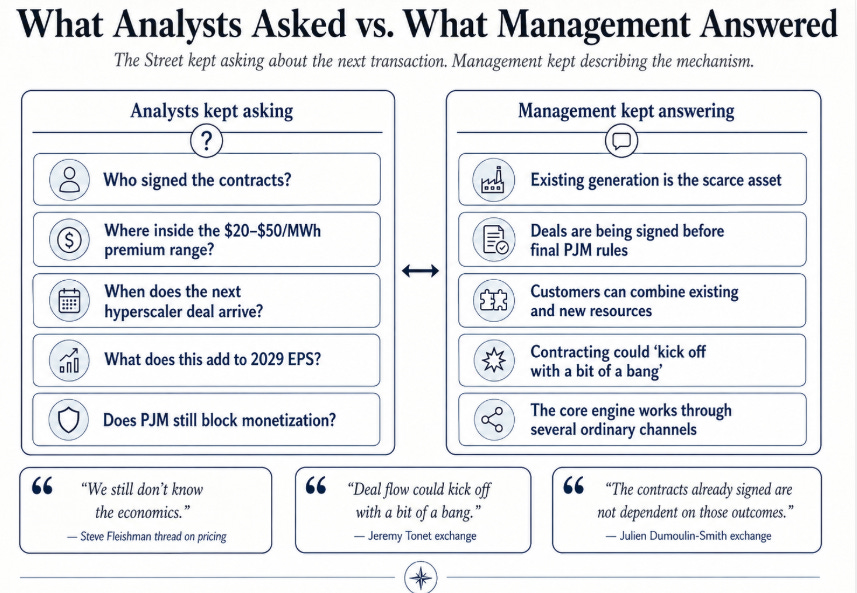
The prepared remarks and Q&A suggest management is trying to make three arguments at once.
The first is that the existing fleet, not speculative new build, is the asset. When KeyBanc’s Sophie Karp asked about new nuclear, Dominguez said conversations in New York were interesting but “not that imminent.” Management wants investors focused on the value of megawatts that already exist.
The second is that regulatory clarity will increase deal velocity rather than create demand from scratch. When JPMorgan’s Jeremy Tonet asked how customer conversations had changed, Dominguez said ambiguity had been the enemy of deal execution and predicted that contracting could “kick off with a bit of a bang” once rules settle. That is a strong claim, and it now has a timetable.
The third is that Calpine should be judged as more than $2 of EPS accretion. Calpine contributed $1.028 billion of Q2 RNF, $2.147 billion of operating revenue less $1.119 billion of purchased power and fuel, while Brazos Valley is being sold for about $1,420/kW. Required disposals should generate roughly $5.9 billion at close to $1,200/kW against approximately $960/kW implied by the acquisition.
That supports the asset-value argument. It does not yet prove the full time-to-power thesis. We said after Q1 that if Freestone remained a one-off, Constellation could still own an excellent clean-firm contracting business while the broader opportunity turned out to be less valuable than we imagined.
That test remains open.
A Good Quarter With Messy Accounting
Adjusted EPS of $2.55 beat Bloomberg’s $2.32 estimate, and management raised full-year guidance by $0.50 to $11.50–$12.50. But adjusted EPS was also $1.13 above GAAP EPS of $1.42.
The bridge is substantial. Unrealized fair-value adjustments added $0.94 per share to the reconciliation, acquired commodity-contract amortization added $0.41, Calpine merger and integration costs added $0.23, pension and OPEB added $0.06 and legal/environmental items added $0.10, partly offset by $0.61 of decommissioning-related activity.
I think most of those adjustments are understandable for a power business absorbing a large acquisition. Still, an improving earnings-quality thesis eventually needs to appear in cash. H1 operating cash flow was $1.55 billion versus $1.58 billion last year, while capex rose to $2.52 billion as Calpine, Crane and other projects absorbed capital.
Bloomberg expects free cash flow to reach about $6.1 billion by 2029 and net debt to fall below $14 billion. If that does not happen, the multiple argument weakens considerably.
Three Years From Now
For an August 2029 value, I care more about earnings composition than revenue growth.
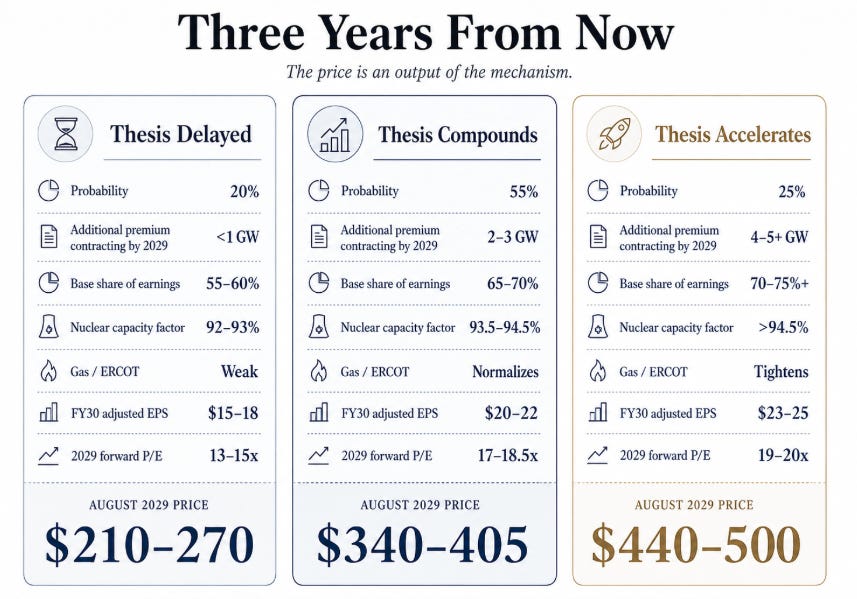
The base case is not heroic. Bloomberg already has $19.10 of EPS in 2029. It requires continued contracting, Crane broadly on schedule, nuclear reliability near historical levels, higher free cash flow and a growing base share of earnings.
The bull case needs more: several gigawatts of premium contracting, stronger gas utilization, at least one repeatable Freestone-like model and continued accretive capital allocation. The bear is not “AI disappears.” It is that supply and regulation catch up before Constellation converts enough scarcity into contracts, while enhanced earnings normalize and the market returns the stock toward conventional power-company valuation.
The Scoreboard
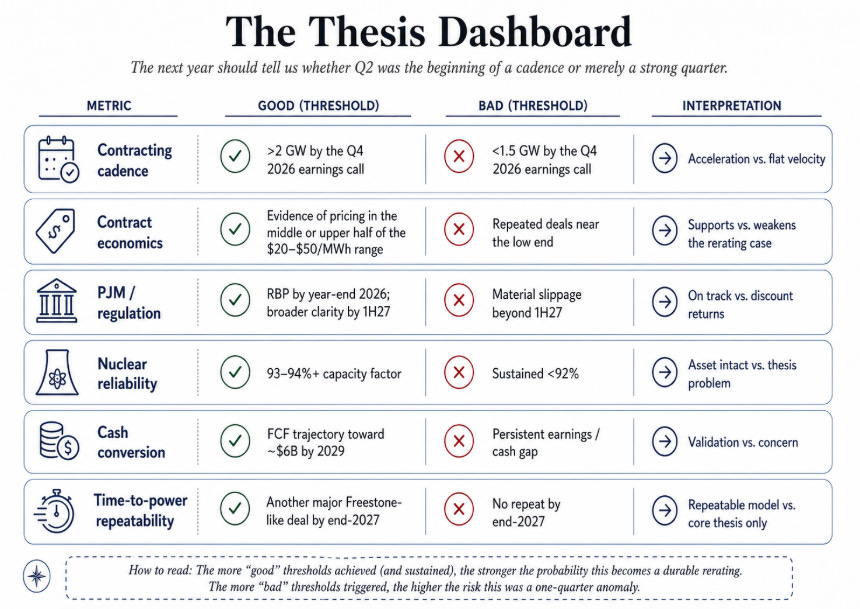
The next year should tell us whether Q2 was the beginning of a cadence or merely a strong quarter. Cumulative new long-term nuclear contracting above 2 GW by the Q4 2026 earnings call would signal acceleration; below 1.5 GW would suggest that Q2 did not change velocity. Contract pricing remains harder to observe, but evidence that deals are clearing comfortably inside the $20–$50/MWh premium range would strengthen the rerating case; repeated deals near the low end would weaken it.
PJM needs to deliver the expected RBP outcome by year-end and broader co-location clarity by 1H27. Meaningful slippage beyond that would restore some of the regulatory discount. Nuclear capacity factor should remain around 93–94% or better outside planned-outage noise; sustained readings below 92% would raise a different and more serious question about the asset itself.
Finally, the accounting has to catch up with the story. The absolute GAAP-to-adjusted gap should shrink as Calpine purchase-accounting and integration effects fade, while free cash flow should begin moving toward the $6 billion level Bloomberg expects late in the decade. And if Constellation signs another material Freestone-like agreement by the end of 2027, the broader time-to-power thesis would finally begin to move from possibility to repetition.
The Same Bet, Better Evidence
For a year, we kept asking when the routing layer would activate. Q2 suggests that was too narrow a question.
The structural advantage is the time gap between demand and new supply. Capacity markets monetize it one way. Long-term PPAs monetize it another. Commercial execution captures volatility. The PTC raises the floor. Buybacks turn cash into per-share growth. None of those mechanisms requires the spectacular transaction investors have spent eighteen months waiting for.
The routing layer could make the machine better. It could give Constellation more ways to solve a customer’s entire power problem rather than simply sell electricity. But Q2 showed that the core engine can already compound without it.
The thesis did not change.
The evidence did.
Disclaimer:
The content does not constitute any kind of investment or financial advice. Kindly reach out to your advisor for any investment-related advice. Please refer to the tab “Legal | Disclaimer” to read the complete disclaimer.