


TL; DR
The core thesis has worked faster than expected: Constellation signed 4.56 GW of long-term agreements in Q3 and 5.48 GW across two quarters, while contracted 2030 clean output has already reached the volume threshold we were watching. The scarcity of operating nuclear generation is being converted into duration.
But the trade is not free: every megawatt-hour moved into a long-term contract gives up some exposure to future power-price spikes in exchange for predictability. Peak+ shows how far Constellation will go, accepting weaker economics on storage or new capacity if those assets unlock attractive twenty-year nuclear contracts.
The investment question has shifted from volume to price: contracting volume is no longer scarce evidence. What matters now is whether those deals were signed at sufficiently high prices to preserve the scarcity premium after tax credits fade and competition from Vistra, Talen and others increases.
I ended the first article in this series, in August 2025, with a metaphor this series has used ever since:
Chasing short-term power price “rain” is speculation. It’s thrilling when it pours and wholesale prices spike, traders capture a windfall but it’s unpredictable, and it disappears just as fast.
Investors, I argued, should own the reservoir, the nuclear fleet, and the pipes that carry its output to customers on long contracts. The third quarter tested that advice, because it rained hard. Adjusted earnings of $5.06 per share beat the FactSet consensus of $3.90, helped by Calpine’s first summer inside Constellation and a 50% rise in PJM West power prices. Four days after an election that sent the stock to $239.65, the shares rose 10.5% to $276.09.
The more important news was what Constellation did with the rain. It signed 4,560 MW of long-term agreements in the quarter, and by 2032 its agreements will cover 45% of its clean baseload output. In effect it is selling the weather, turning volatile earnings like this quarter’s into contracted earnings for two decades. The question this series asks is unchanged: can Constellation convert the scarcity of reliable, already-connected power into durable contracted earnings faster than new supply and regulation erode it? This quarter settled “faster.” “Durable” now depends on a number the company has not disclosed, which is the price.
The Narrow Thesis Won
Our August article drew a line this quarter has sharpened:
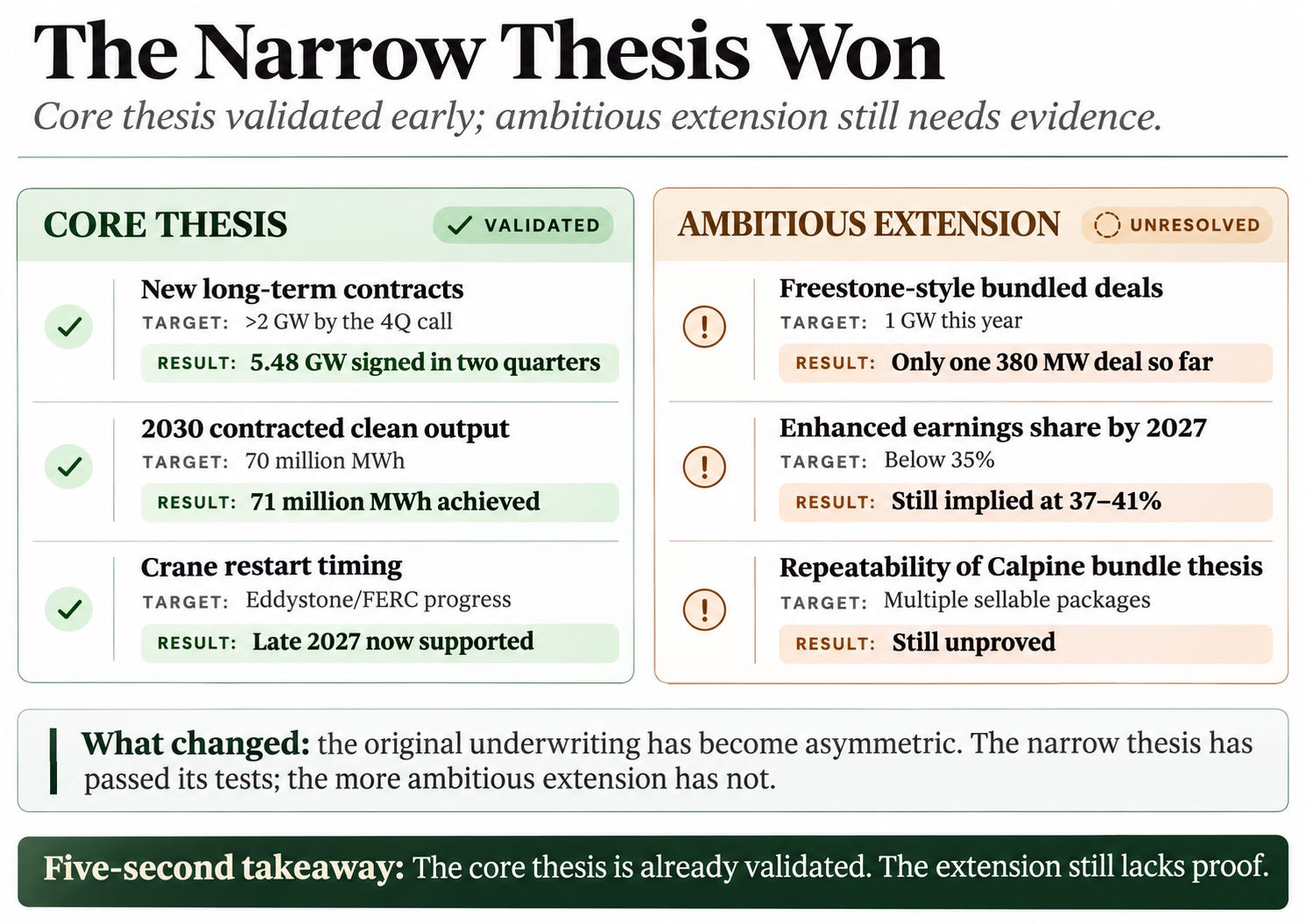
The core thesis, that scarce operating generation can be converted into increasingly durable earnings, is working. The more ambitious extension, that Calpine lets Constellation repeatedly sell Freestone-like packages combining site, connection, generation and delivery schedule, remains unproved.
Everything on the core side has now passed. We asked for more than 2 GW of new long-term nuclear contracts by the fourth-quarter call, and Constellation has signed 5,480 MW in two quarters, so the bar was too low. Contracted volume for 2030 delivery is 71 million MWh, against the 70 million we asked for, and FERC’s approval of the Eddystone grid rights pulled Crane’s restart into late 2027.
The ambitious side has not moved. There is still only one 380 MW Freestone deal, against the 1 GW we wanted this year. Our target of enhanced earnings below 35% of the total by 2027 is off track, at about 46% of 2026 by my estimate and 37-41% implied for 2027. I also withdraw April’s claim of a hard bid below $240. The rebound from $239.65 proves nothing, because the tax credit supports the plants’ economics, not the share price.
The Rain and the Trade
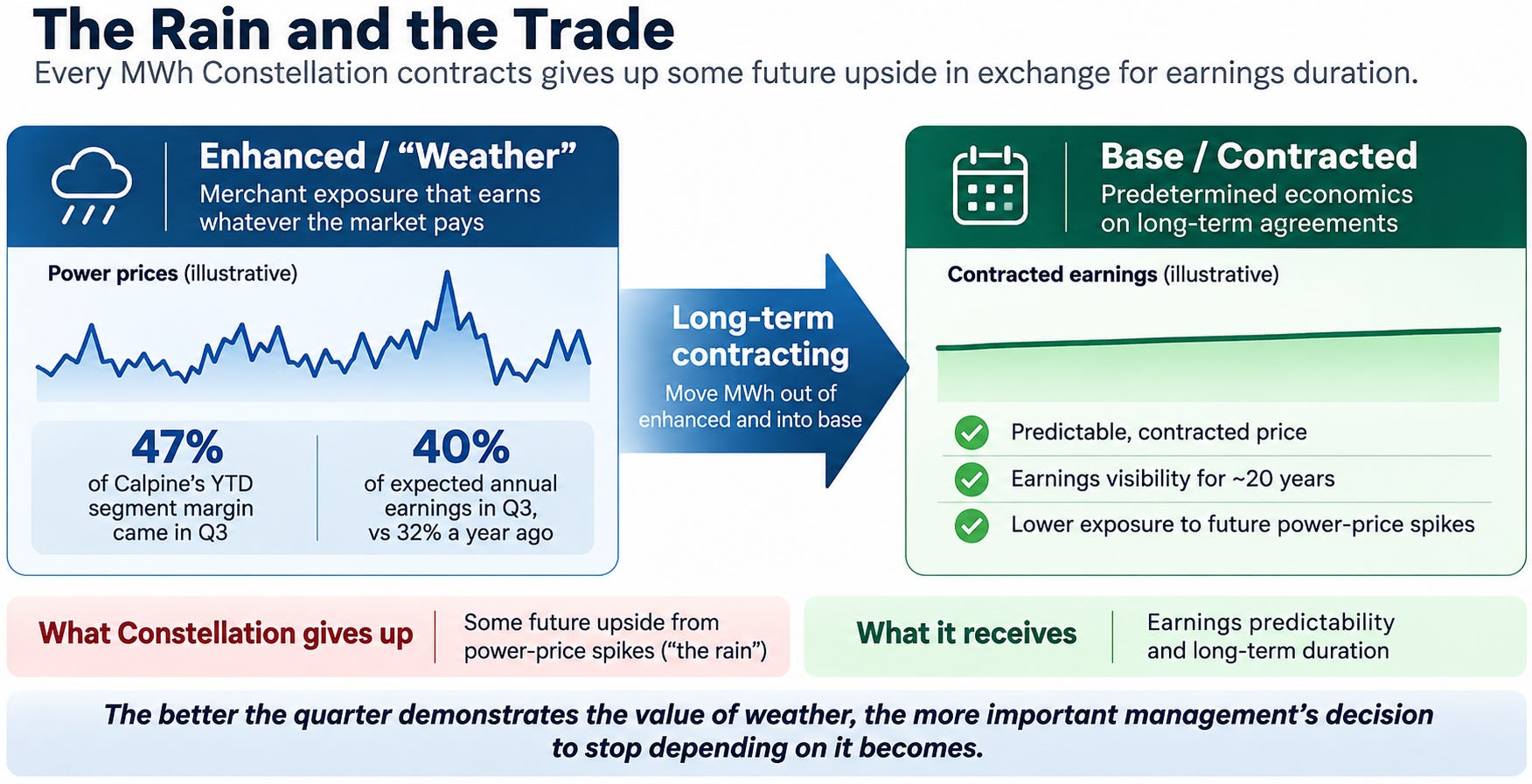
No bridge to consensus exists, but the quarter was plainly seasonal. Calpine earned 47% of its year-to-date segment margin in these three months, and the quarter produced 40% of the year’s expected earnings, against 32% a year ago. Asked how much of that was structural, CFO Shane Smith gave the most important answer of the call:
So, you are also, in the long run, as you are moving those into more of a contracted area, you are probably going to get a smaller contribution out of the enhanced.... Commercial team did a great job through the volatility, and also we had the benefit of higher generation performance, like I highlighted in the summer months. So, those two both contributed to this year, but I would not say that is transferable to all years.
The end of that answer is the warning not to annualise the summer. The beginning is the strategy. Every long-term agreement moves megawatt-hours out of the enhanced bucket, where they earn whatever the weather pays, and into the base, where they earn a contracted price for decades. Constellation gives up future rain and gets duration in return.
Peak+ shows how far management will go to make that trade. In August we quoted Joe Dominguez on why existing plants can serve new demand:
We have plenty of unused capacity in generation and in the wires grid over 99% of the hours of the year. We have a peak capacity concern, not an energy concern.
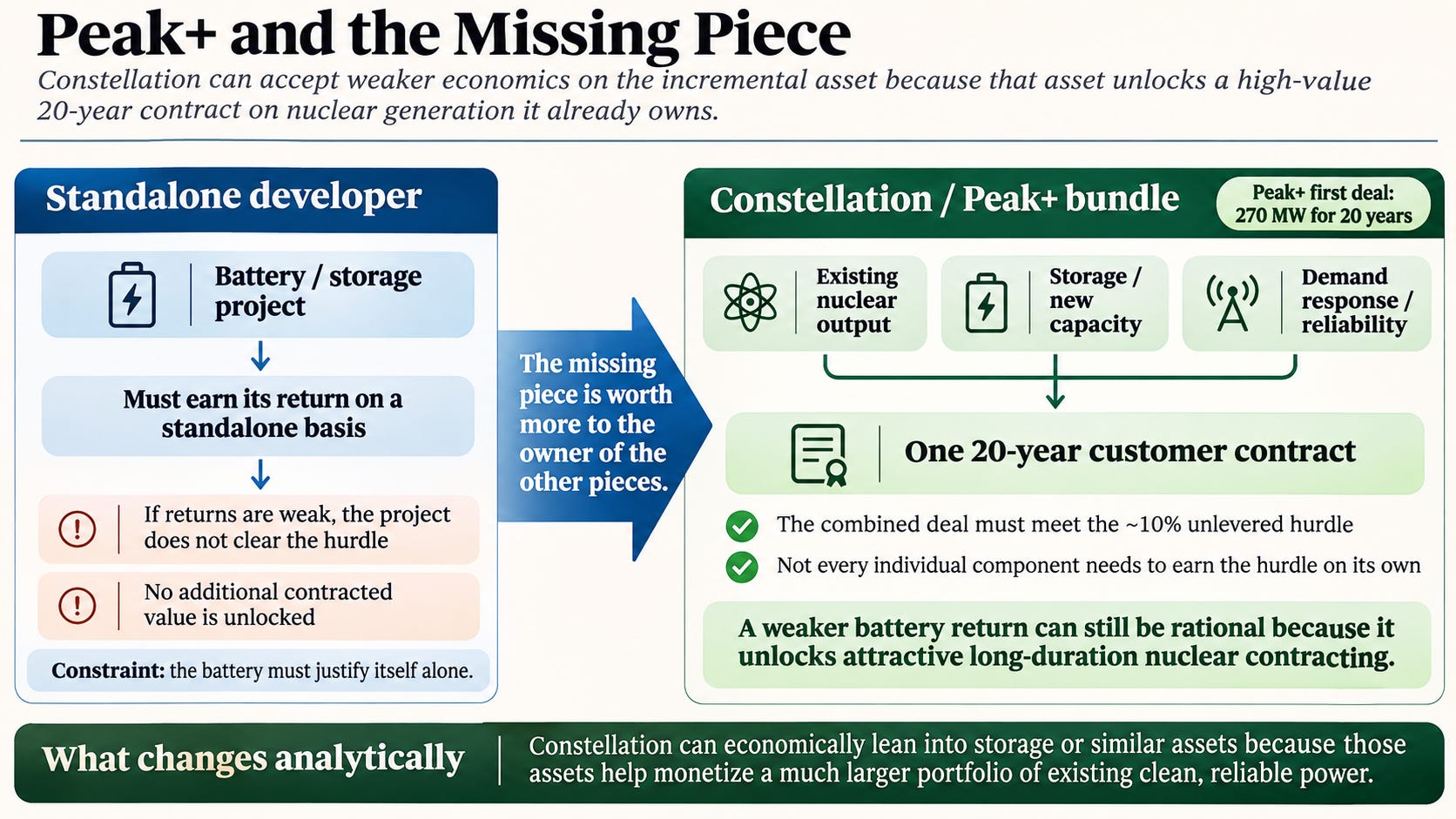
Peak+ is the commercial answer to that concern. Its first contract, for 270 MW over twenty years, pairs existing nuclear output with new capacity and demand response for the few hours when the grid is stretched. Asked about returns on that new capacity, management restated its 10% unlevered hurdle and explained:
We think about it as part of the bigger deal, including the sale of our existing megawatts, and that has to be attractive and meet our hurdle rates, but not every individual component is going to need to be. That allows us to kind of lean into storage solutions, perhaps, that others may not be interested in, because for us, it unlocks this contracting opportunity for our large portfolio of existing clean and reliable energy.
A battery developer must earn a return on the battery alone. Constellation can accept a weak one, because the battery lets it sell twenty years of nuclear output it already owns. The missing piece is worth more to the company that owns the other pieces. The risk is that if regulators require new capacity in every large deal, more of each contract’s value goes into equipment, and the bundle earns less even when the nuclear premium holds.
Constellation is not the only seller, either. Vistra signed twenty-year agreements with Meta in January for 2,176 MW of existing nuclear plus 433 MW of uprates, and Talen’s Amazon agreement reaches 1,920 MW through 2042. Buyers are spreading their purchases, which is why price matters as much as volume.
Where the Pipes Add the Most
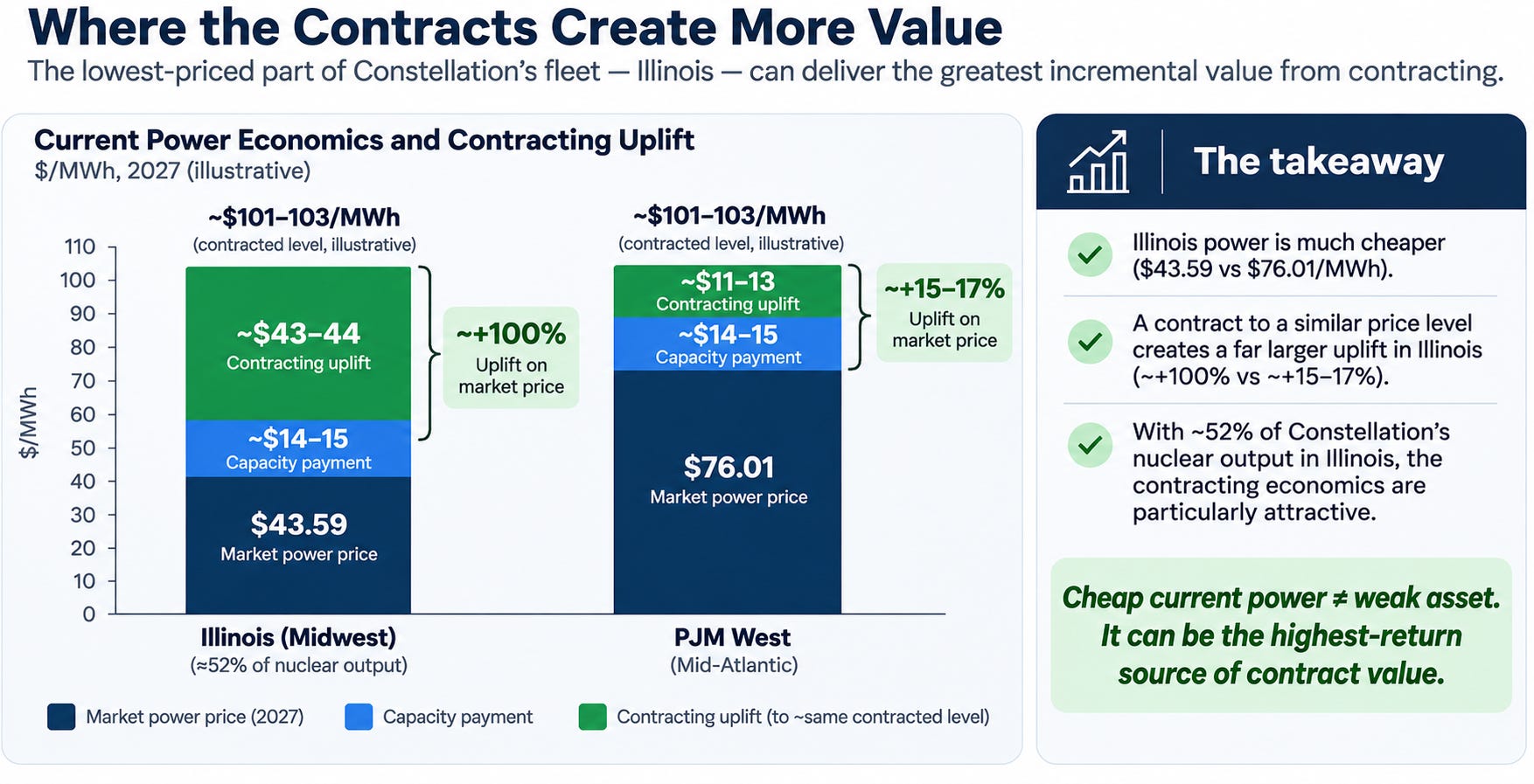
In the third quarter 52% of Constellation’s nuclear output came from the Midwest, mostly Illinois, where 2027 power trades at $43.59 per MWh against $76.01 at PJM West. Capacity payments add roughly $14-15 to both, so Illinois earns less but is not stuck at the tax-credit floor; only 5% of the fleet sits in that zone. Until mid-2027, however, Illinois’ carbon mitigation credit returns revenue above a set price to customers. That is why the summer price spike lifted Mid-Atlantic margin 15% while Midwest margin fell 1%. We noted in August that this output was migrating to the federal credit. What I missed is that a contract priced as a premium to that floor adds more to an Illinois megawatt-hour than to a Mid-Atlantic one, where the market already pays close to a low-end contract.
Two Separate Clocks
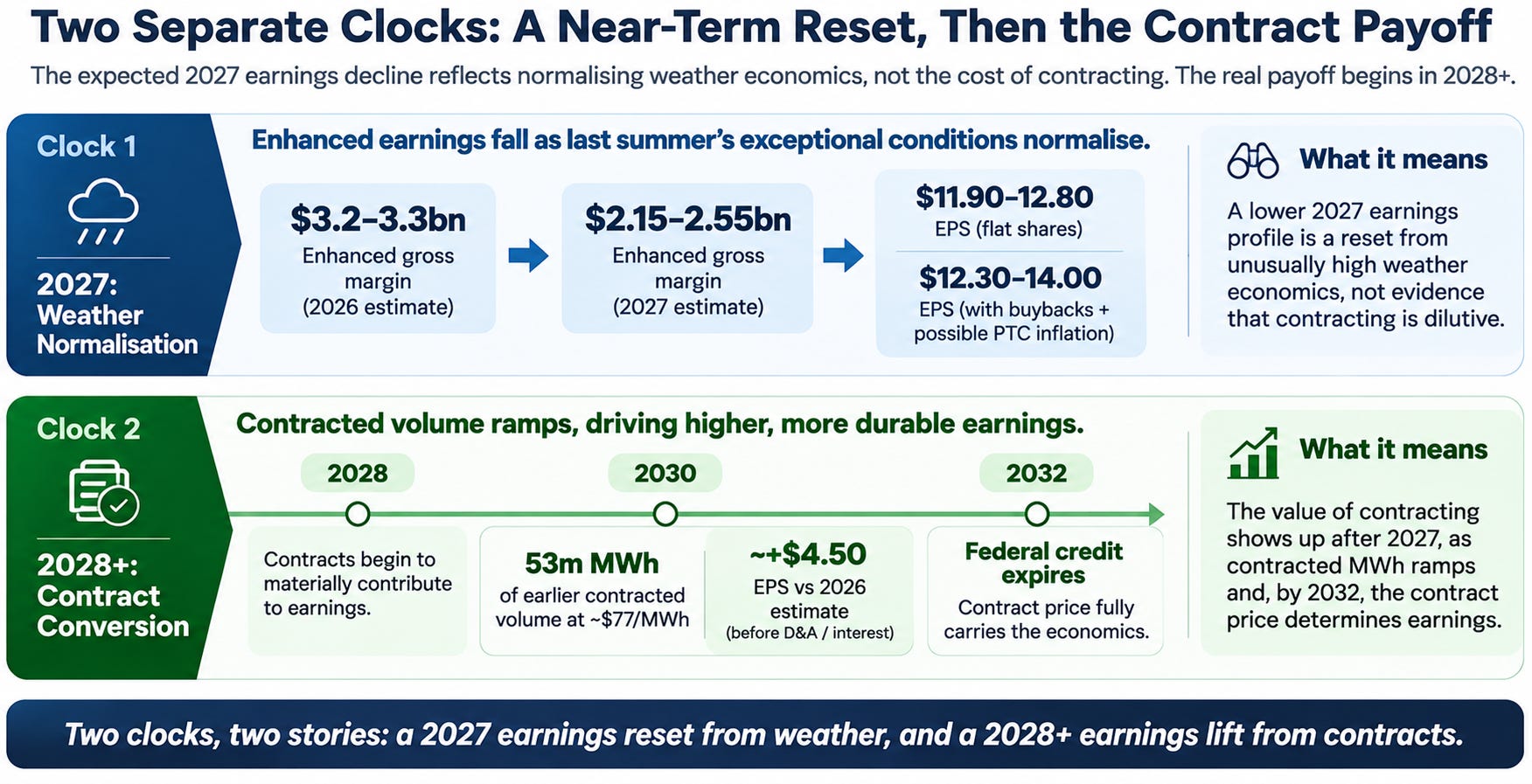
It is tempting to call 2027 the cost of this trade, but that would be wrong. The contracts mostly start in 2028, and the 2027 decline in enhanced earnings was in management’s March outlook, which Smith called “still a good starting point.” Management’s inputs cut enhanced gross margin from $3.2-3.3 billion this year to $2.15-2.55 billion next. Rebuilt from those inputs, 2027 earnings come to about $11.90-12.80 per share at the flat share count the slides use, and $12.30-14.00 with buybacks and a possible inflation step-up in the tax credit. A guide on flat shares may look flat, which is a real headline risk, but it reflects the weather fading, not a price paid for contracts.
The 2028 clock is more visible than the stock implies. Even excluding this year’s agreements, management’s inputs move Illinois volumes onto a federal floor of $48.88 and lift earlier contracted volume to 53 million MWh at $77. By my estimate that adds about $4.50 per share over 2026 before depreciation and interest, against a $4.31 consensus step. The federal credit ends in 2032, though, and many new contracts run into the 2040s, so after 2032 the contract price alone carries the economics.
What Did the Weather Sell For?
In August our scenarios differed mainly in contracting volume. After 4.56 GW in one quarter, what separates them now is the price Constellation got for the weather, so I have renamed them.
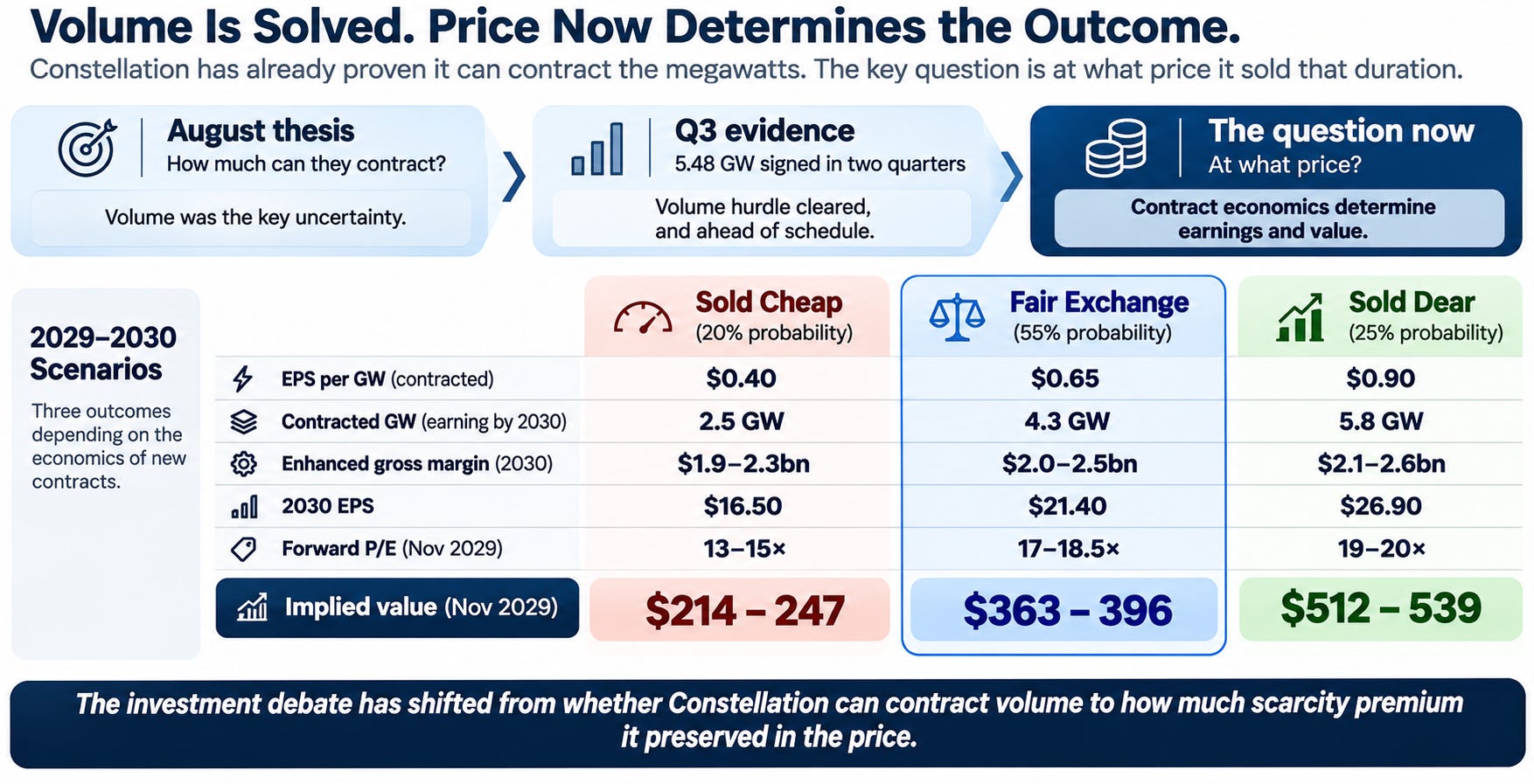
In “sold cheap,” contracts land at the bottom of the range, nothing more is signed and the multiple falls to power-producer levels. “Fair exchange” is essentially August’s middle case, at $21.40 of 2030 earnings against $20-22. “Sold dear” is higher than August’s top case because its contracting requirement has already been met. I have kept the probabilities unchanged, because the quarter raised earnings in every case without revealing which price Constellation achieved. Weighted together they give about $385 in three years, against $370 in August, or roughly 12% a year including the dividend.
That return is almost entirely earnings growth. In the fair exchange, earnings rise 60% from the 2027 consensus while the multiple falls from 20.7 times to about 17.75 times. Constellation does not need a rerating, only to hold 17-18 times as growth slows, and a mix that is roughly three-quarters contracted by 2030 supports that. The business has improved since August. At $276 the stock is fairly priced for that improvement, not cheap.
What February Should Tell Us
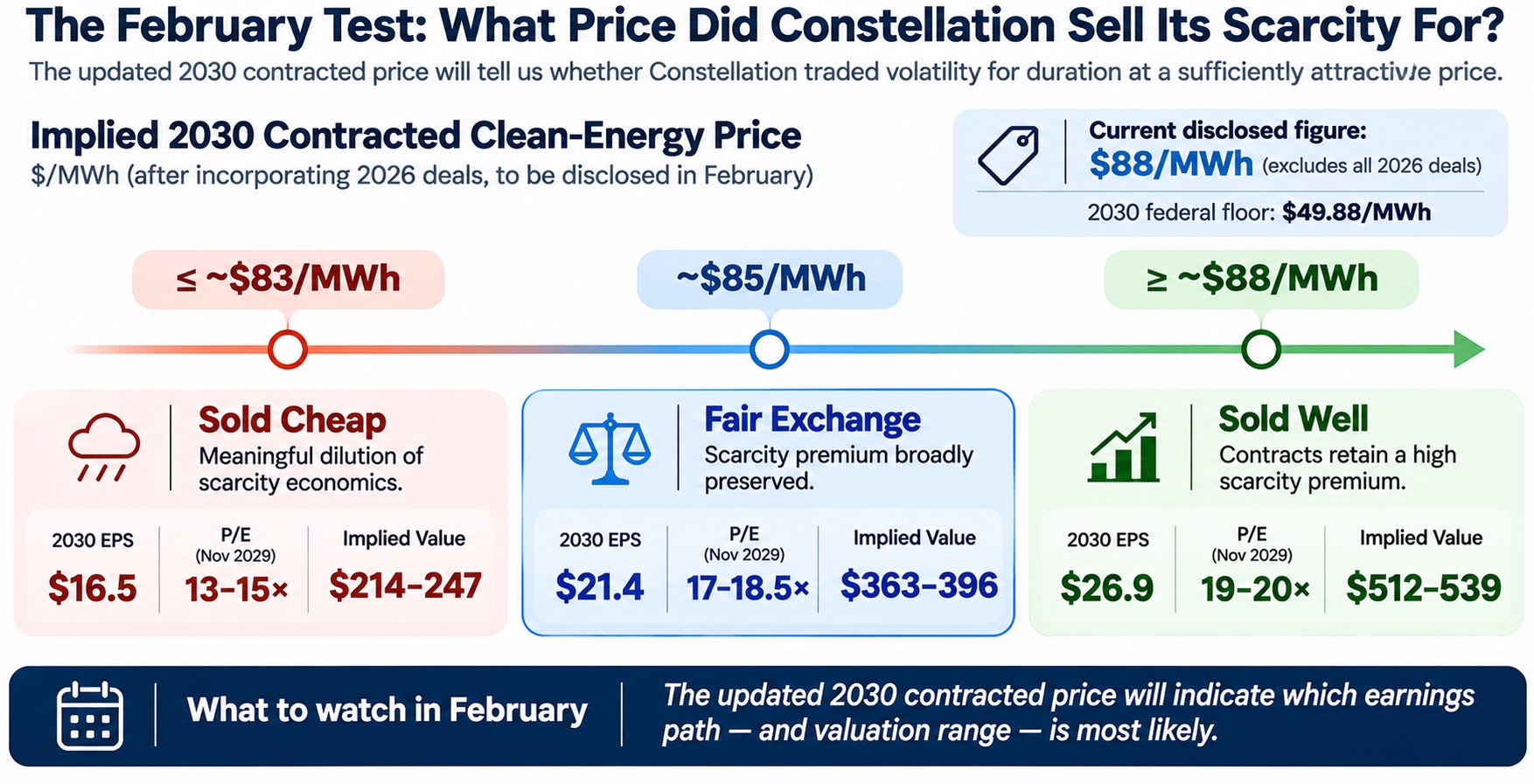
The best signpost is one management has promised. Smith said the year-end call would update the modelling disclosures for this year’s agreements, which today price 2030 contracted clean output at $88 per MWh excluding every 2026 deal. With the 2030 floor at $49.88, a mid-range contract is worth about $85. If the updated price holds at $88 or more with the new deals included, the weather was sold fairly or dearly; if it falls to about $83 or less, it was sold cheap.
My view differs from consensus less on the numbers than on what they are made of: $13.33, $16.96 and $19.82 for 2027-2029 look about right; what the market underrates is that each year more of those earnings come from contracts and less from the weather. If February’s 2027 guide reads as the end of a good summer, and the modelling update shows the weather sold well, that will be the moment to add.
Fifteen months ago, I wrote that investors should own the reservoir, not the weather. This quarter Constellation took the same view of its own business and began selling the weather.
Disclaimer:
The content does not constitute any kind of investment or financial advice. Kindly reach out to your advisor for any investment-related advice. Please refer to the tab “Legal | Disclaimer” to read the complete disclaimer.