


TL; DR
The strategic thesis strengthened: Credo is moving beyond selling individual interconnect components toward understanding the health of the entire link, with PILOT turning diagnostics and failure prediction into a potentially system-level advantage.
But technical importance is not yet economic ownership: the first major DustPhotonics photonic-chip wins did not include Credo DSPs, showing that customers may value Credo’s technology while still preserving modular supplier choice.
The cost of the ambition is already visible: inventory, receivables and R&D are rising well ahead of the proof that optical attachment, margins and cash conversion will resemble AEC economics. The next test is whether broader technical relevance turns into broader wallet share.
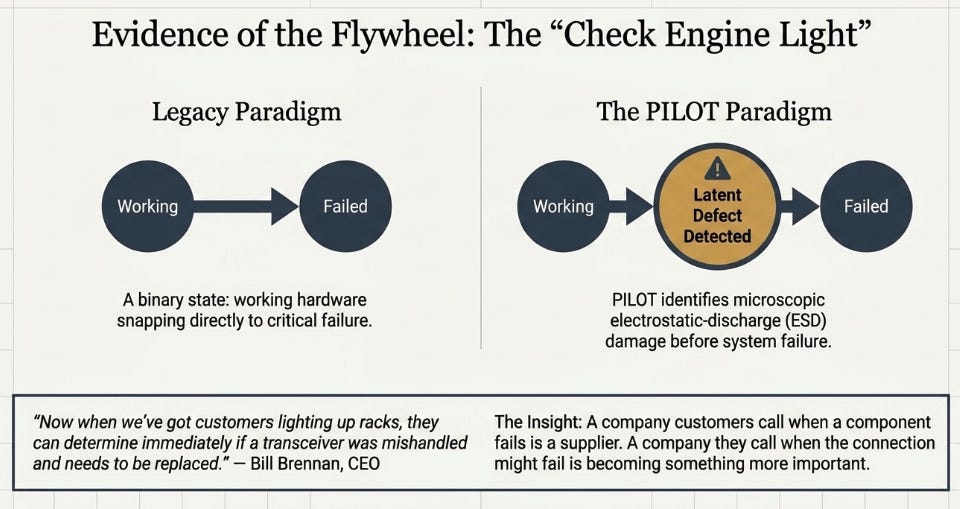
A customer recently asked Credo whether its software could detect the slightest electrostatic-discharge damage to an optical transceiver. Not enough damage to stop the transceiver from working, but enough to create a latent defect that might eventually bring down a connection. Credo found a way to detect it.
“Now when we’ve got customers lighting up racks, they can determine immediately if a transceiver was mishandled and needs to be replaced.” — Bill Brennan, CEO
The striking part of this story is not that Credo’s technology worked. It is that the customer asked Credo to understand a failure before it occurred. A company customers call when its component fails is a supplier; a company customers call when the connection might fail is becoming something more important.
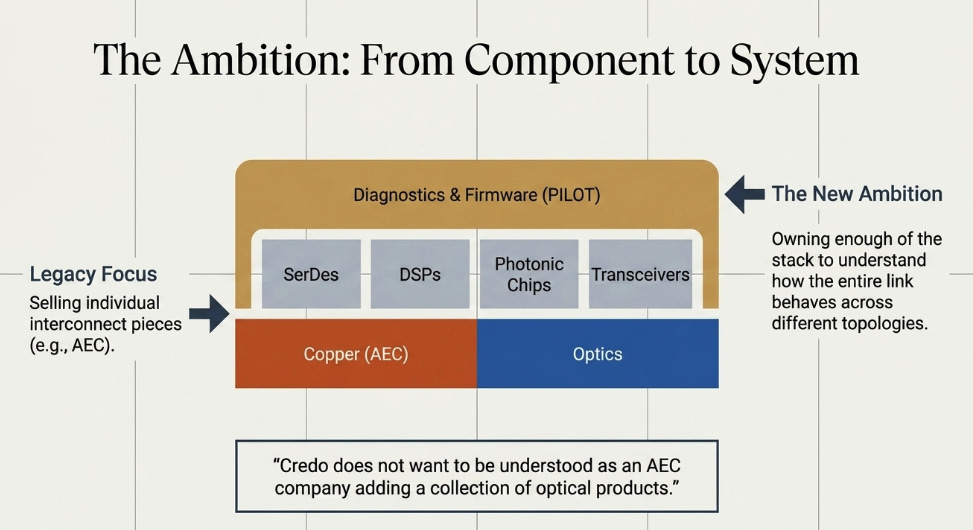
That distinction captures what management is selling. Credo does not want to be understood as an AEC company adding a collection of optical products. It wants to own enough of the connection from SerDes and DSPs to photonic chips, transceivers, firmware and diagnostics to understand how the entire link behaves. The more of the link Credo can see, the better it should become at identifying failure modes, improving its products and winning more of the customer’s next design.
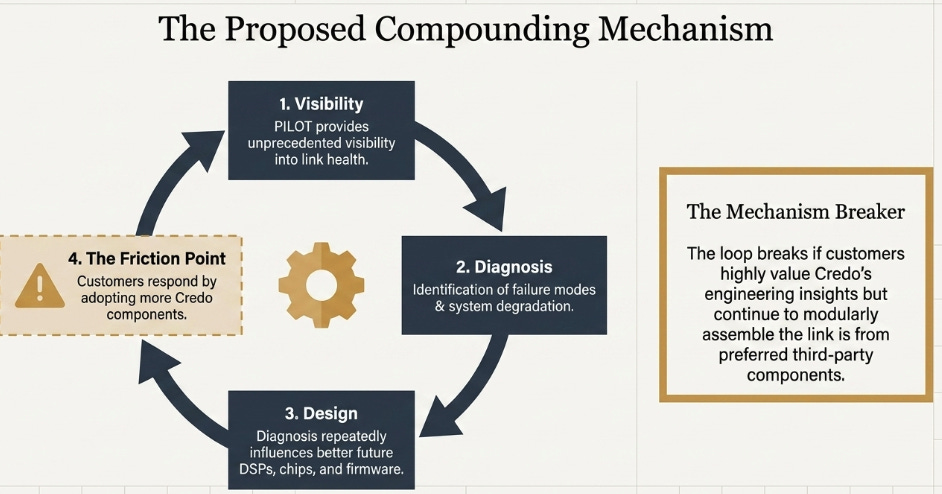
The big fundamental question is whether that creates a compounding system or merely a wider product catalogue. The mechanism strengthens if every additional product gives Credo more visibility, that visibility produces better diagnostics and designs, and customers respond by adopting more Credo components. It breaks if customers value Credo’s engineering while continuing to assemble the link from whichever individual components they prefer.
Q1 supplied the best evidence yet that the first half of this mechanism is real. It left the second half unresolved.
The Test We Set Was Incomplete
Our previous article ended with a test:
“Credo has moved the proof from copper to light. Now the margin line will tell us whether the toll road followed.”
The logic was straightforward. AEC demonstrated that customers would pay Credo for a complete, reliable copper connection. If Credo could move into optics without sacrificing its economics, its advantage had travelled beyond the product that created the company.
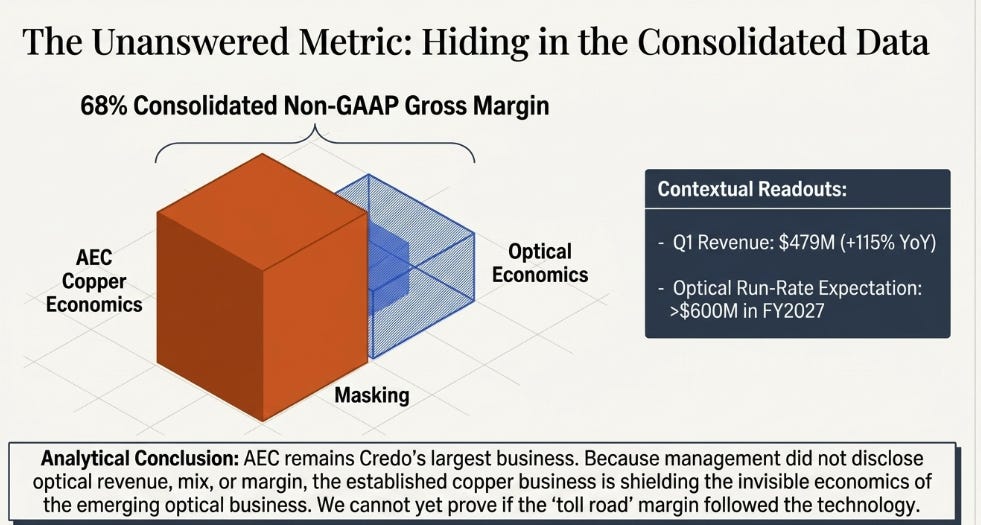
Q1 appeared to pass. Revenue reached $479 million, up 115% year over year, while non-GAAP gross margin held at 68%. Credo reported record optical DSP revenue, recognized its first silicon-photonics revenue following the DustPhotonics acquisition and began production shipments of ZeroFlap optical transceivers. Management continues to expect more than $600 million of optical revenue in FY2027, with DSPs, photonic chips and ZeroFlap each contributing more than $100 million.
The problem is that consolidated gross margin cannot answer a product-level question. AEC remains Credo’s largest business, and management did not disclose optical revenue, optical mix or optical gross margin. The established business can therefore preserve the consolidated number while the economics of the emerging business remain invisible.
We chose the right question but an insufficient metric. Credo has now proved that its technology can travel into optics. It has not proved that AEC-like economic ownership travels with it.
The Layer Between Products
Management’s story begins with heterogeneity. Future AI systems will not use one architecture, protocol or physical medium. Copper will remain appropriate for shorter reaches; optics will dominate longer ones; different scale-out and scale-up connections will demand different combinations of power, latency, reach and serviceability.
“Future AI systems will combine optical and copper interconnects across different reaches, protocols, and topologies.” — Bill Brennan
That world rewards product breadth, but breadth alone is not the thesis. Broadcom, Marvell and several optical suppliers can also provide pieces of the connection. Credo’s claim is that its products are joined by a common capability: understanding whether a link is healthy, why it is degrading and what should happen before it fails.
PILOT is the layer that potentially turns a group of products into a system. Brennan compared existing link monitoring to a green light when a connection works and a red light after it fails. Credo is trying to add the yellow “check engine” light in between. Its hardware continuously measures indicators such as eye height, signal-to-noise ratio and error patterns; its software looks for deterioration and can help remove a vulnerable processor or transceiver before a link flap disrupts the cluster.
This matters because AI clusters contain tens or hundreds of thousands of interdependent connections. Management says link instability can cost more than 10% of processor utilization, while slow cluster commissioning can leave enormously expensive equipment idle for weeks. A reliable connection is therefore valuable not because the cable itself is expensive, but because everything connected to it is.
The ESD example turns that argument from a presentation into customer behaviour. Credo is learning about defects beyond the normal responsibility of a component supplier. The accumulated failure cases should influence future DSPs, photonic chips, firmware and qualification methods. More deployments can create better products, which can make the next design easier to win.
This is not an automatic data network effect. One additional link does not mechanically improve every other link, and customers may limit how operational data is shared. The advantage compounds only if learning changes product performance and product performance increases attachment. PILOT is strategically important when diagnosis repeatedly becomes design; otherwise it remains an excellent feature bundled with hardware.
Importance Is Not Ownership
The ESD request and the DustPhotonics wins are mirror images. In the first, a customer asked Credo to understand the behaviour of the entire connection. In the second, customers selected one Credo component while declining another. Q1 therefore contained both the strongest evidence for integration and the clearest warning against assuming attachment.
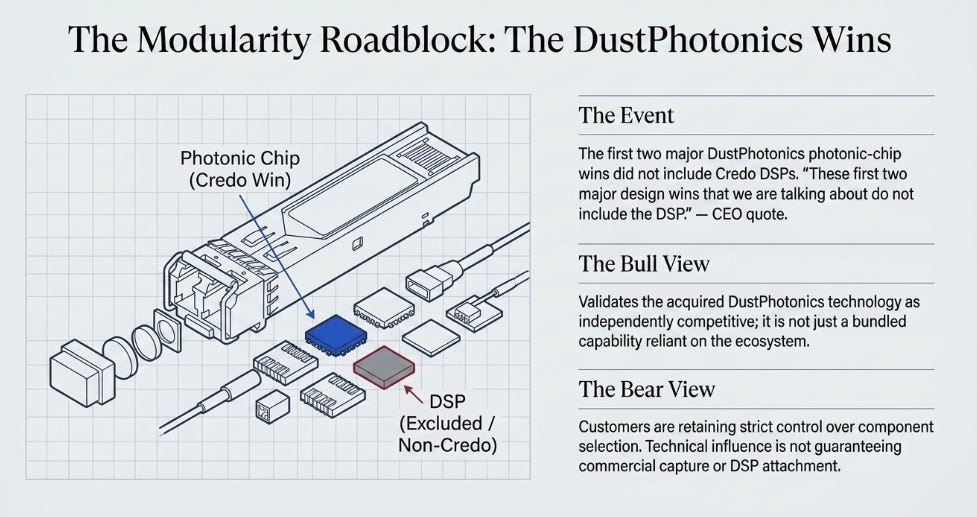
The DustPhotonics wins provide the quarter’s cleanest counterargument. Asked directly whether the first two major photonic-chip design wins included a Credo DSP, Brennan answered:
“These first two major design wins that we are talking about do not include the DSP.”
That is simultaneously good and incomplete news. The wins validate the acquired photonic technology independently, which suggests Credo purchased a genuinely competitive product rather than a capability that only works inside its own bundle. They also show customers retaining control over component selection. Credo has won a place in the optical module without winning the integrated DSP-and-photonic-chip combination that management says should improve performance, power, yield and cost.
The modular challenge described in our previous article therefore remains. Customers may prefer an architecture in which validated components can be combined across suppliers. Credo believes that owning more of the stack will allow it to innovate faster and deliver better system outcomes. The customer will decide how much integration is worth and how much supplier dependence it is willing to accept.
This is the distinction the next phase of the thesis must preserve: Credo may own the customer’s problem before it owns the customer’s bill of materials. Technical influence often precedes commercial capture, but the second does not inevitably follow the first.
The Cost of Becoming a System
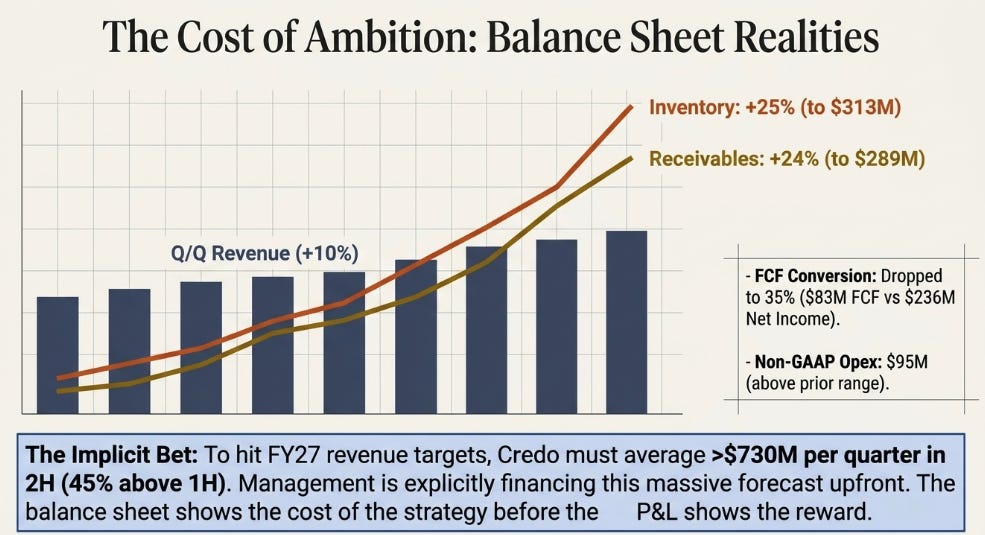
The financial statements show the cost of this ambition earlier than the product disclosures show its reward. Revenue grew 10% sequentially, but inventory increased 25% to $313 million and receivables increased 24% to $289 million. Free cash flow was $83 million against non-GAAP net income of $236 million, a conversion rate of 35%. Non-GAAP operating expenses reached $95 million, above management’s prior range, as Credo increased research and development across a much broader portfolio.
It would be easy to treat this as an earnings-quality complaint. That misses the strategic issue. Moving from a dominant AEC product into DSPs, photonic chips, complete optical transceivers, near-package optics and new scale-up connections requires more designs, qualifications, supply commitments and inventory configurations. Credo must incur those costs before the new products reach volume.
Management is explicit about the bet. Brennan said the company was “leaning in from a supply-chain standpoint” and playing the long game. The full-year arithmetic shows the scale of that commitment. More than 85% growth on FY2026 revenue of $1.335 billion implies at least $2.47 billion in FY2027. Q1 revenue plus the midpoint of Q2 guidance produces approximately $1.01 billion in the first half, leaving more than $1.46 billion for the second half—or over $730 million per quarter, 45% above the first-half quarterly average.
Inventory is not proof that this demand exists. It is proof that management is willing to finance its forecast. If inventory converts into the promised optical ramp while gross margin remains in the high 60s and cash conversion recovers, Q1 will look like the necessary investment behind a larger company. If product attachment remains limited and inventory continues outgrowing revenue, Credo will have broadened its technical capabilities faster than its economic ownership.
The balance sheet is therefore not a side issue. It is where the cost of management’s strategy has become measurable.
What Changed in Our View
Before Q1, we believed AEC gave Credo a wedge into the customer and that optics would determine whether its reliability advantage could travel. We expected gross margin to reveal the answer.
The quarter strengthened the strategic thesis. Optical participation is no longer theoretical. PILOT has moved from a diagnostic claim to a real customer workflow. Credo’s involvement increasingly extends beyond whether its own component functions, and management is committing capital as though the second-half ramps are real.
The quarter also made the economic thesis more demanding. Consolidated gross margin cannot isolate optical economics. The first photonic-chip wins do not attach Credo DSPs. PILOT has no disclosed pricing, attachment or separately observable contribution. Working capital and operating expenses are rising before investors can see how much of the broader connection Credo will capture.
I think Credo is building a genuine system-level advantage, and Q1 increased my confidence in that conclusion. What I am not yet prepared to assume is that customers will buy the entire system simply because they increasingly depend on Credo’s understanding of it. The probability that Credo becomes strategically important across copper and optics has increased; the amount of that importance it will monetize remains the central uncertainty.
Three Futures
The scenarios should be understood as three outcomes for the same mechanism, not three predictions about the semiconductor cycle.
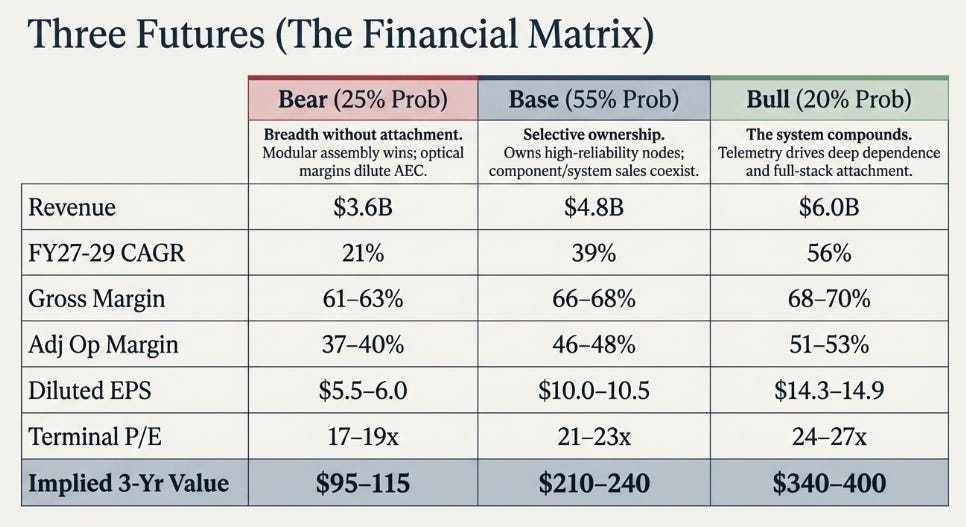
The share-count assumptions reflect different outcomes for dilution and Credo’s ability to offset it through future cash generation. The ranges expose the operating assumptions that matter; they are not predictions of the path the shares take between now and then.
In the bear case, customers select Credo products but assemble the link modularly; optical margins dilute AEC economics, development and inventory remain elevated, and breadth does not produce attachment. In the base case, Credo owns the portions of the link where reliability is most valuable, while component and complete-system sales coexist. In the bull case, telemetry improves product design, better products deepen customer dependence, and that dependence produces greater attachment across DSPs, photonic chips and transceivers.
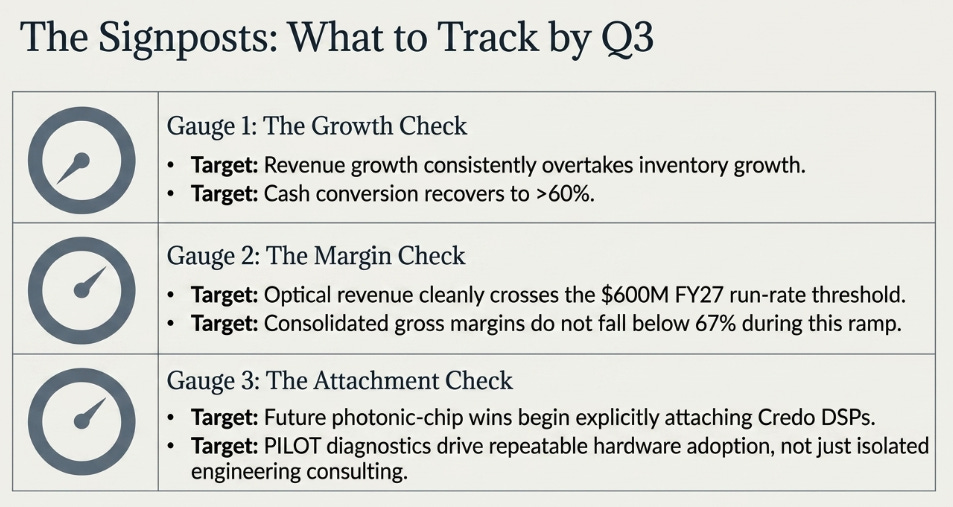
The signposts follow directly. By Q3, revenue growth should overtake inventory growth and cash conversion should recover above 60%. Optical revenue should exceed $600 million for FY2027 without consolidated gross margin falling below 67%. Over the next year, Credo should show that photonic-chip wins attach its DSPs, and that PILOT influences repeatable product adoption rather than isolated customer engagements. Failure on those measures would not mean the products are weak; it would mean the proposed compounding mechanism is.
The Company Customers Call
Credo did not cause the customer’s ESD problem. That was precisely why the incident mattered. The company was valuable not because its component worked, but because it could explain why the connection might eventually fail.
That is a more ambitious role than selling a cable, DSP or photonic chip. It gives Credo the opportunity to learn across products and become embedded in how customers design, qualify and operate their networks. It also requires Credo to carry more products, inventory and development expense before that opportunity becomes revenue.
The previous chapter of the Credo story asked whether its advantage could travel from copper into light. Q1 suggests that its technical relevance can travel. What remains unanswered is whether product attachment, margins and cash returns will travel with it.
Credo is learning to understand more of the link. The next question is how much of the link it will own.
General Disclaimer: The information presented in this communication reflects the views of the author and does not necessarily represent the views of any other individual or organization. It is provided for informational purposes only and should not be construed as investment advice, a recommendation, an offer to sell, or a solicitation to buy any securities or financial products.
While the information is believed to be obtained from reliable sources, its accuracy, completeness, or timeliness cannot be guaranteed. No representation or warranty, express or implied, is made regarding the fairness or reliability of the information presented. Any opinions or estimates are subject to change without notice.
Past performance is not a reliable indicator of future performance. All investments carry risk, including the potential loss of principal. This communication does not consider the specific investment objectives, financial situation, or particular needs of any individual.
The author and any associated parties disclaim any liability for any direct or consequential loss arising from the use of this material and undertake no obligation to update or revise it.
Disclaimer:
The content does not constitute any kind of investment or financial advice. Kindly reach out to your advisor for any investment-related advice. Please refer to the tab “Legal | Disclaimer” to read the complete disclaimer.