


TL; DR
Q2 looked structural, not merely strong: net-new ARR reached $333 million, up 51%, while revenue, operating income and free cash flow all accelerated.
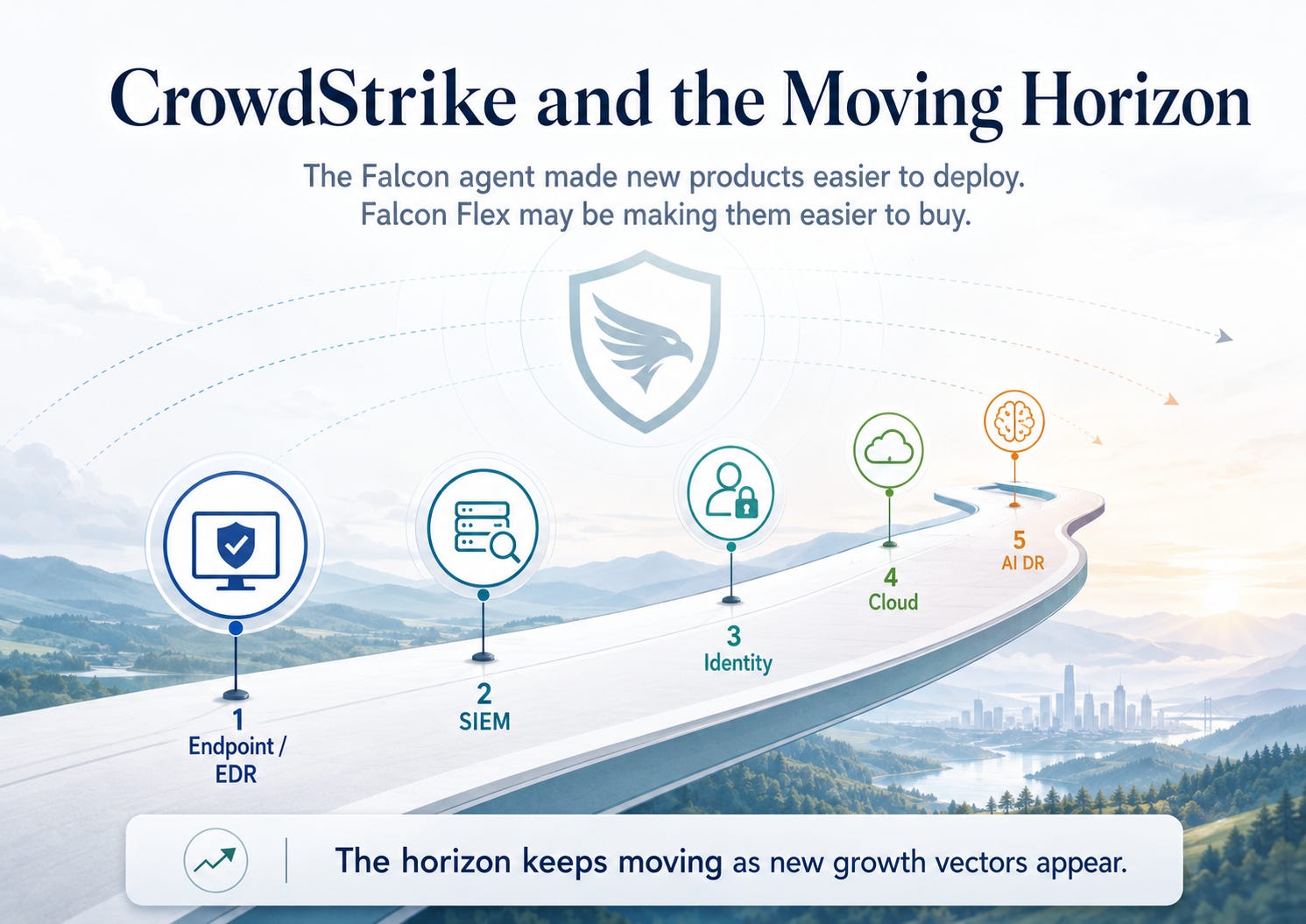
The business model may be improving: Falcon acts as technical distribution for new products, while Falcon Flex increasingly acts as commercial distribution, letting customers add capabilities without restarting deployment or procurement.
The valuation depends on postponing maturity: CrowdStrike does not need to grow 25% forever. It needs new products like AIDR and SIEM to become meaningful before older growth vectors fade, continually pushing the visible maturity point further out.
“Inflection has become acceleration.” — George Kurtz, CrowdStrike Q2 FY27 earnings call.
There are earnings beats, and then there are quarters that change the question investors should be asking.
CrowdStrike’s fiscal second quarter was the latter. Net-new ARR reached $333 million, up 51% year over year, versus roughly $286 million embedded in published expectations. Revenue increased 26% to $1.47 billion, ending ARR reached $5.84 billion, non-GAAP operating income rose 46% to $372 million, and free cash flow increased 33% to $377 million. CrowdStrike also lifted its FY27 net-new ARR growth expectation to 34%, 1,150 basis points above where management began the year.
Those numbers explain why the stock went up. They do not explain why the quarter matters.
Before earnings, the important question was whether AI, Falcon Flex and CrowdStrike’s broader product portfolio were changing the shape of the business or merely giving management better stories to tell around an already excellent cybersecurity franchise. The market did not need another routine beat. It needed evidence that something structural had changed.
Q2 provided the first convincing evidence.
The Question is now this: can CrowdStrike turn the proliferation of AI agents into a compounding security cycle in which its existing endpoint distribution makes new products easier to deploy, Falcon Flex makes them easier to buy, and each additional workload broadens the customer relationship and strengthens CrowdStrike’s data advantage?
If so, the importance of Q2 is not that growth accelerated once. It is that CrowdStrike may have developed a mechanism capable of repeatedly postponing maturity.
The Agent Is Already There
A reasonable concern about AI is that it should make traditional endpoint security less strategically important. Intelligence increasingly lives in frontier models and cloud infrastructure; perhaps security therefore shifts toward OpenAI, Anthropic, Microsoft, Google and AWS rather than remaining with companies built around protecting PCs and servers.
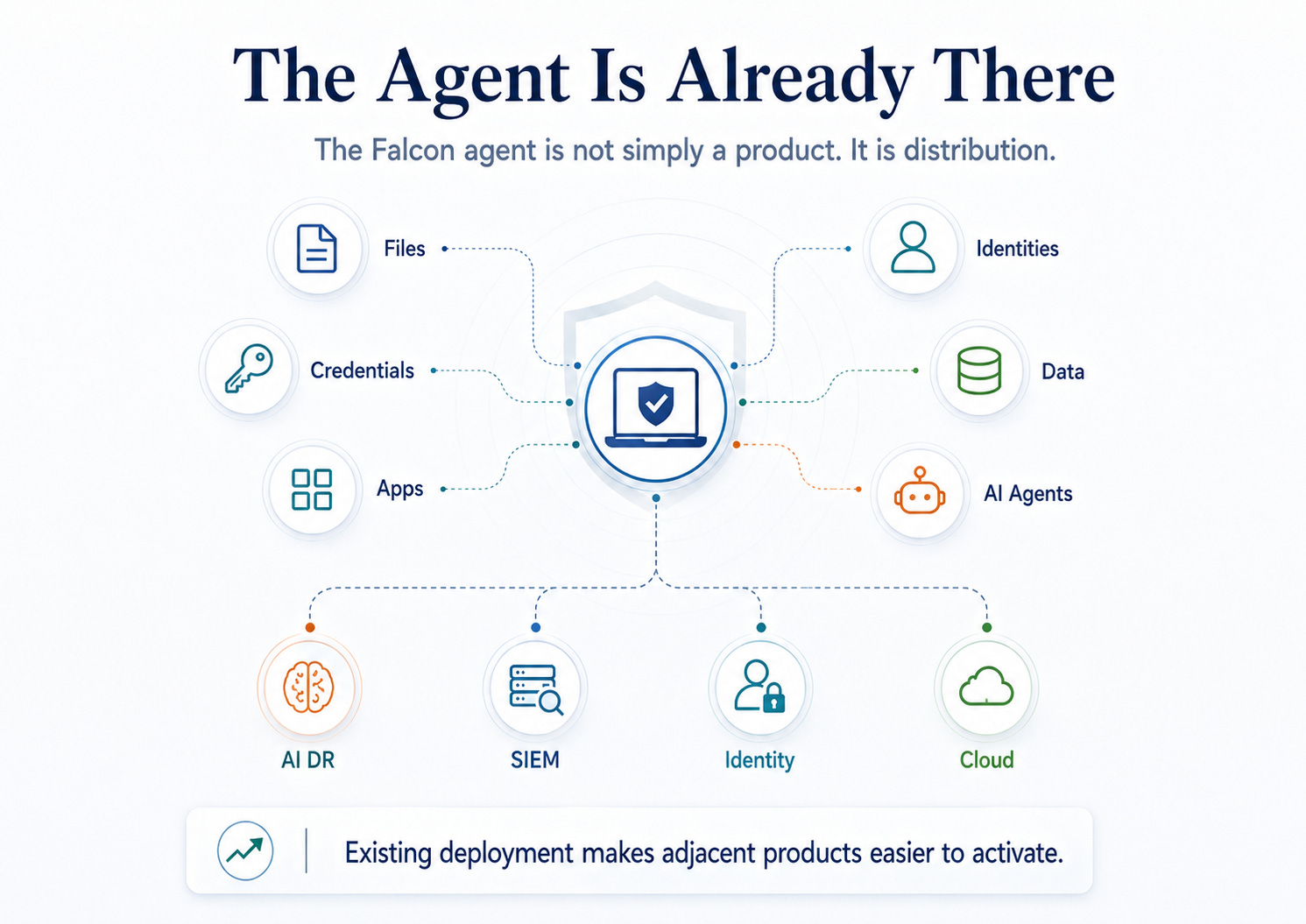
The better way to think about AI security, though, is as several overlapping control layers. Model providers will secure models and inference. Hyperscalers will secure infrastructure and cloud workloads. But agents eventually must act: they access identities, files, credentials, applications and enterprise data. CrowdStrike does not have to monopolize AI security. It needs the layer where AI activity becomes observable and enforceable to remain sufficiently important that more AI makes Falcon more valuable.
The Q2 evidence supports that argument. CrowdStrike said that, within a sample of customers, Claude usage on endpoints had increased more than 400% in recent months and custom-agent usage more than 100%. Meanwhile the endpoint business accelerated for a fourth consecutive quarter.
This matters because Falcon is already installed. CrowdStrike already receives telemetry from the customer environment and already has an enforcement point. A new product does not necessarily require another agent, another deployment project or another technical architecture.
That was why one exchange in the earnings call mattered more than most of the AI rhetoric. Raymond James analyst Adam Tindle asked whether AI Detection and Response was genuinely incremental to endpoint security. George Kurtz answered:
“It is separate, and incremental. It’s another module, and it’s priced separately.”
AIDR therefore sits on the same Falcon agent but creates another entitlement and another revenue stream. The technical footprint already exists; CrowdStrike can monetize another problem without recreating distribution from scratch. AIDR ending ARR nearly tripled sequentially in Q2.
The same mechanism is increasingly apparent in SIEM. Next-generation SIEM exceeded $695 million of ARR and grew 60%, but the architectural advantage matters more than the number. CrowdStrike’s own endpoint telemetry is already in Falcon, which means existing customers can activate SIEM without beginning from an empty data environment. Kurtz described the product as unusually quick to deploy precisely because CrowdStrike already owns the first-party data.
Cloud Security is above $905 million of ARR, Identity above $585 million, and endpoint itself is still accelerating.
The Falcon agent, then, is not simply a product. It is distribution.
That solves one half of the problem.
Falcon Flex Solves the Other Half
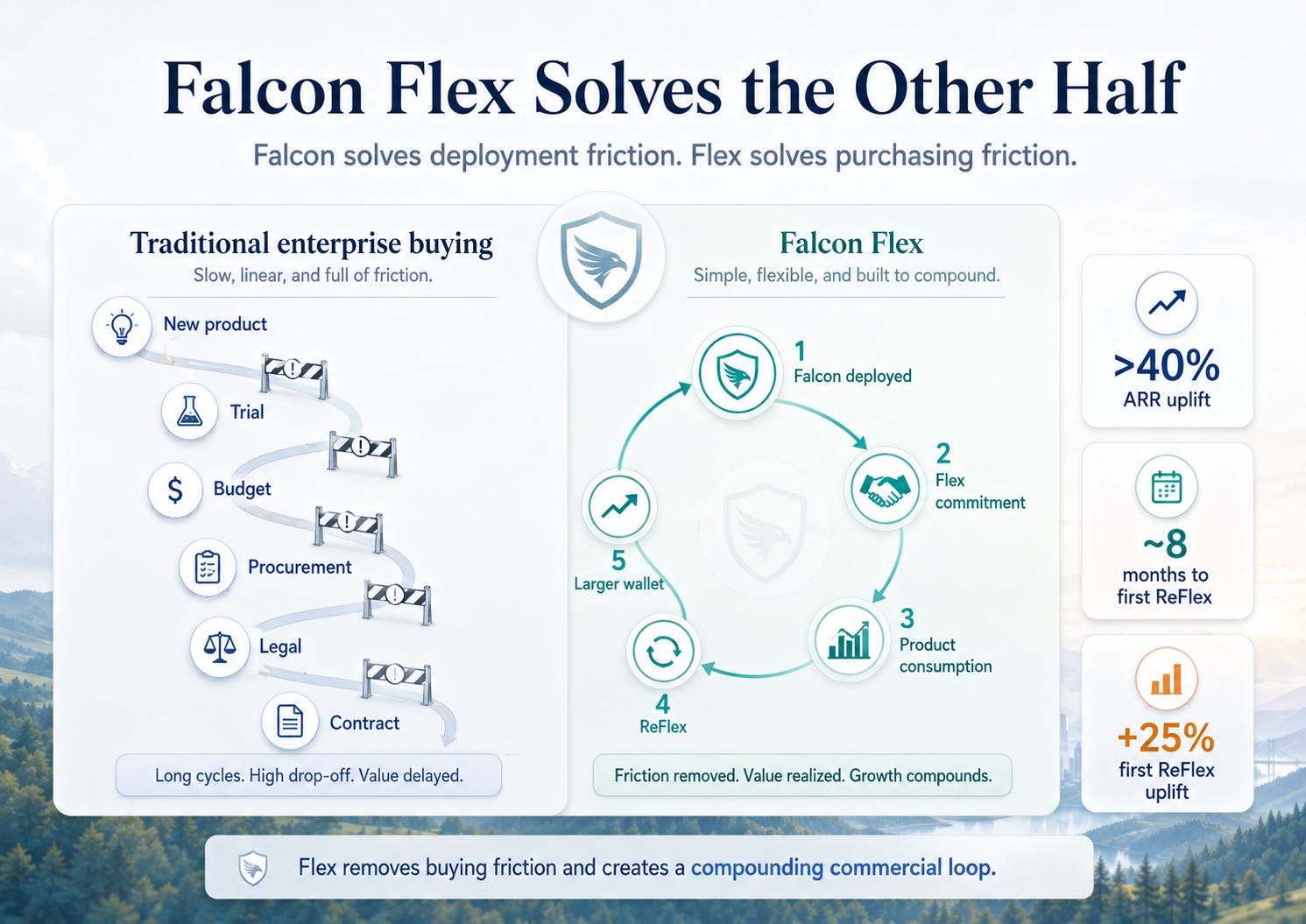
Technical distribution does not eliminate enterprise software’s commercial friction. A customer can already trust a vendor and still spend months navigating budget cycles, procurement, legal review and contract negotiations before adding another capability.
Falcon Flex increasingly appears to attack this second problem.
Instead of repeatedly buying discrete modules, customers commit a larger pool of spending to CrowdStrike and consume additional Falcon products over time. CrowdStrike consequently gains something valuable: a commercial channel through which its next product can be monetized without restarting the purchasing process from zero.
Q2 was the first quarter in which the scale of that mechanism became difficult to dismiss. CrowdStrike added more than 935 Flex accounts, more than during the previous three quarters combined. Its ten largest deals were all Flex transactions. Flex new-logo ARR represented 34% of total Q2 net-new ARR, while ARR associated with Flex customers exceeded $2.29 billion and grew 101%.
The more important evidence is what customers do afterward. Standard subscription customers moving into Flex increase ARR by more than 40% on average. Customers completing their first ReFlex subsequently expand ARR by another 25%, while customers that have ReFlexed at least twice are running 53% above their original Flex commitment. The first ReFlex occurs after roughly eight months.
That eight-month figure matters because it addresses the obvious bear case.
Perhaps Flex merely pulls demand forward. Customers sign larger commitments today, CrowdStrike records more ARR, and future expansion disappears because customers eventually must consume what they already bought.
ReFlex is the test. If customers return after only eight months and voluntarily increase commitments again, then consumption appears to be catching contractual capacity rather than lagging it.
The loop becomes visible: Falcon is already deployed; deployment produces telemetry; telemetry supports new products; those products are easy to activate technically; Flex makes them easier to consume commercially; customers use more modules and ReFlex into larger commitments; the larger relationship creates more workloads, more data and more opportunities for the next product.
AIDR may become a very large product. Flex may matter more because it can make every future product larger faster.
This is the potentially important change in CrowdStrike’s business model. The Falcon agent lowers deployment friction. Falcon Flex lowers purchasing friction. AI increases the number of problems CrowdStrike can sell through both.
What We Underestimated
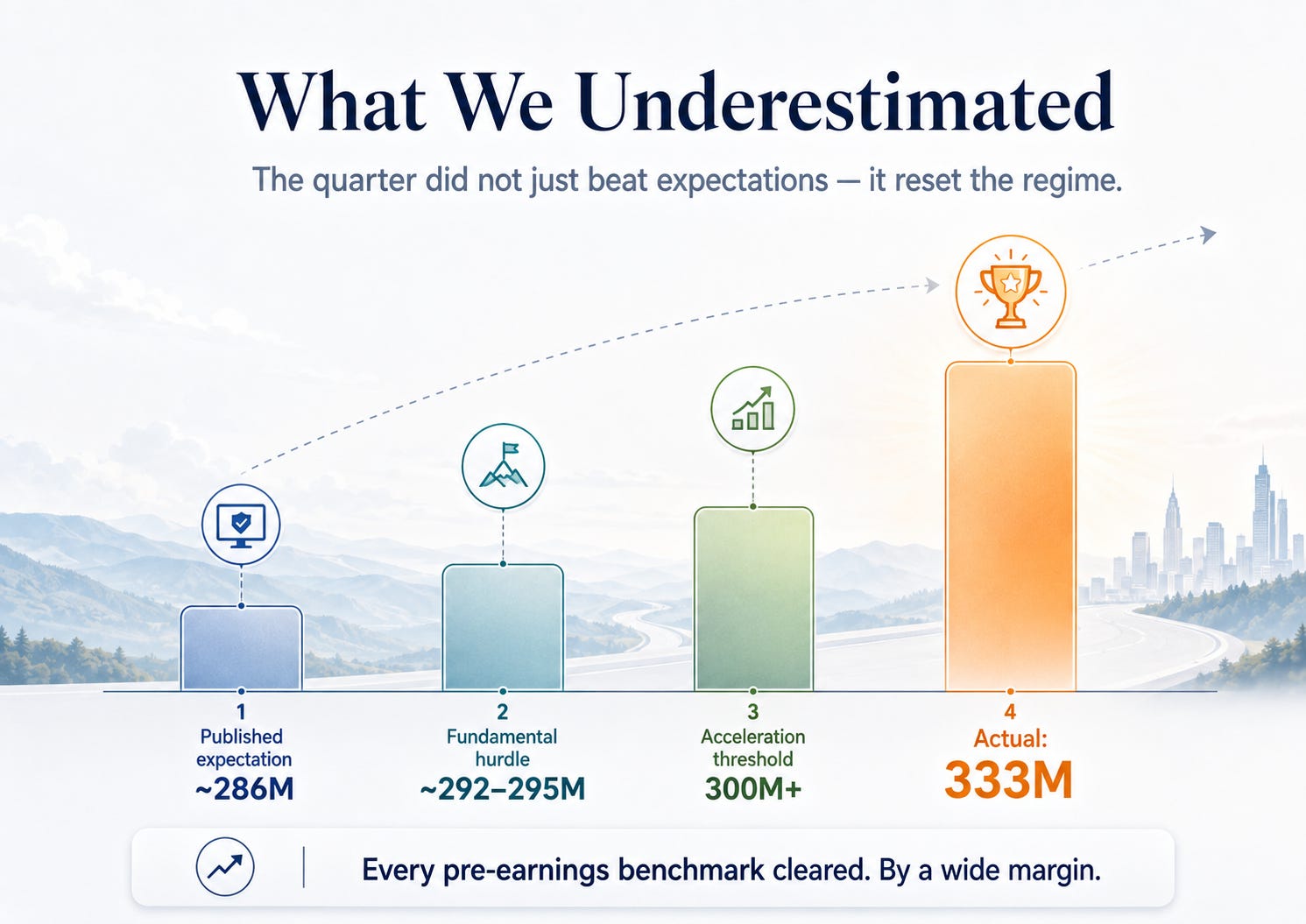
Our pre-earnings framework correctly identified net-new ARR as the metric that mattered, and roughly $300 million as the threshold at which the quarter would begin to look like genuine acceleration rather than another conventional beat. What it underestimated badly was the magnitude: our central expectation was closer to the high-$290 millions, not $333 million.
That mistake is useful. We anchored too heavily on the previous quarter’s beat pattern and not enough on the possibility that the demand regime itself had changed. Q2 did not simply clear a difficult expectation. It forced the expectation framework upward.
That is why the next question is no longer whether CrowdStrike can produce a $300 million quarter.
It is whether CrowdStrike can make $333 million look ordinary.
Management formally guided Q3 net-new ARR to $343–347 million and said it entered the quarter with record pipeline. After a quarter in which the company beat ARR guidance by more than $45 million, though, the formal guide is unlikely to remain the actual market hurdle.
Before Q2, the regime was proving the acceleration. After Q2, it is prove the compounding.
The Moving Horizon
This is also the only sensible way to think about CrowdStrike’s extraordinary valuation.
CrowdStrike has spent most of its public life trading at multiples that look unreasonable by conventional software standards. Simply assuming those multiples must eventually revert to something “normal” has repeatedly been a poor investment framework.
The more useful question is what allows an abnormal multiple to persist.
CrowdStrike does not need investors to believe it will grow 25% forever. It needs investors to keep postponing the year in which they expect growth to become ordinary.
Suppose investors once imagined CrowdStrike fading from the mid-20s toward 20%, then into the teens. A quarter like Q2 changes more than the current year. It introduces the possibility that the whole deceleration curve begins later because another growth vector has appeared before the old one fully matured.
Kurtz made the boldest possible version of this claim when JPMorgan asked about AI-security durability:
“I think the AIDR business can be bigger than the EDR business, just given the pure number of agents which each person will have.”
That should not be treated as a forecast. CrowdStrike has not even disclosed absolute AIDR ARR, and “nearly tripled” tells us little about ultimate scale without the denominator.
But it states management’s duration bet explicitly.
CrowdStrike was built on EDR. If a newly emerging product can someday rival the business that built the company, then the maturity point moves dramatically further away. If SIEM scales toward another billion-dollar-plus franchise while that happens, it moves again. If Flex lets subsequent products monetize faster, it can move again after that.
This is why Q2’s valuation significance is larger than its revenue beat.
The multiple survives not because CrowdStrike grows into it, but because CrowdStrike continually postpones the moment when investors feel compelled to normalize it.
That is also what makes the stock dangerous.
The multiple probably does not collapse because investors suddenly notice that it is high. Everyone already knows it is high. It collapses when investors can finally see maturity.
If AIDR remains small, the horizon moves closer. If customers take 15 months rather than eight to ReFlex, the horizon moves closer. If SIEM decelerates before another product becomes material, the horizon moves closer. If endpoint growth turns down and FY28 or FY29 estimates stop moving upward, investors will eventually have to answer the question CrowdStrike’s execution has repeatedly allowed them to defer:
What is a mature CrowdStrike worth?
That is when an extraordinary multiple becomes a source of extraordinary downside.
Q2 Did Not Make CrowdStrike Cheap
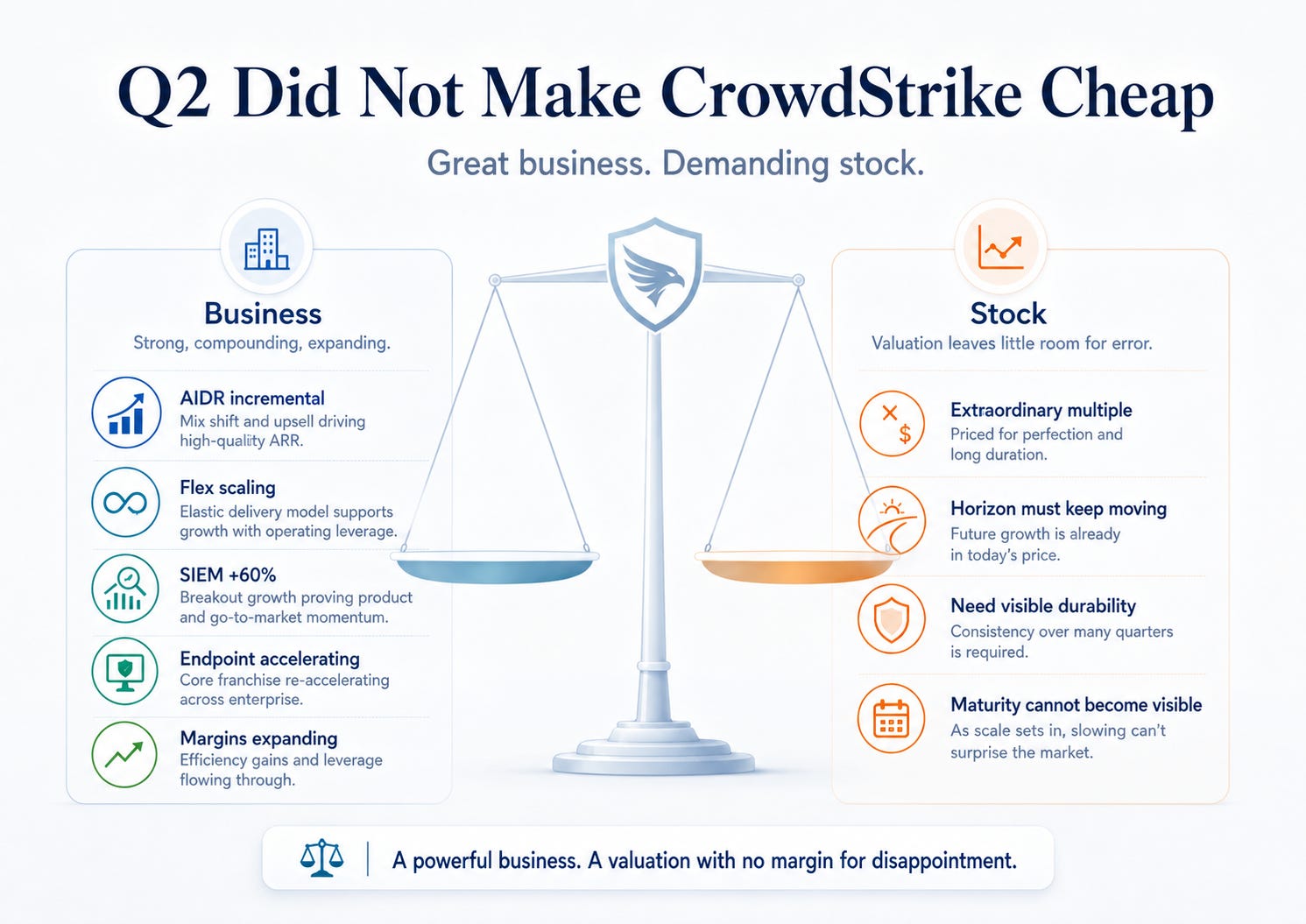
Q2 did not make CrowdStrike cheap. It made the extraordinary valuation more intelligible.
The quarter gave us strong evidence that Falcon is technical distribution, Falcon Flex is becoming commercial distribution, and AI is creating incremental workloads that can be sold through both. AIDR is separately monetized. Flex customers are increasing commitments. ReFlex is happening quickly. Endpoint is reaccelerating. SIEM, cloud and identity are scaling. Growth is occurring alongside operating leverage.
What Q2 did not prove is that these mechanisms will continue producing new growth vectors before existing ones mature.
That is now the investment case.
The Question and the valuation question are ultimately the same question viewed from opposite sides. The business question is whether CrowdStrike can repeatedly turn new security problems into products that become easier to deploy and easier to buy as the customer relationship deepens. The valuation question is whether it can do so frequently enough that visible maturity always remains several years away.
Before Q2, CrowdStrike needed to prove that AI could create another acceleration.
After Q2, the harder and considerably more valuable question is whether the Falcon agent and Falcon Flex can keep turning each new security problem into another reason that maturity remains just beyond the horizon.
If they can, the multiple can continue looking irrational for years.
If they cannot, the multiple will be the first thing investors discover was rational only while the horizon kept moving.
Disclaimer:
The content does not constitute any kind of investment or financial advice. Kindly reach out to your advisor for any investment-related advice. Please refer to the tab “Legal | Disclaimer” to read the complete disclaimer.