


TL; DR
The business is growing much faster than we expected, but the source of growth matters: revenue rose 51%, product revenue 77%, and FY2027 guidance moved to $5.20–5.21 billion. Yet much of the acceleration came from higher-priced arrays rather than hyperscale licensing, so the near-term numbers are more hardware-driven than our earlier thesis assumed.
Hyperscale licensing remains the more attractive long-term engine, but it is still hard to measure: gross margins are 75–85%, a second top-five hyperscaler has signed, and RPO rose 44%. But revenue is lumpy, excluded from RPO, and management does not disclose enough to isolate the contribution, which argues against capitalizing it too aggressively today.
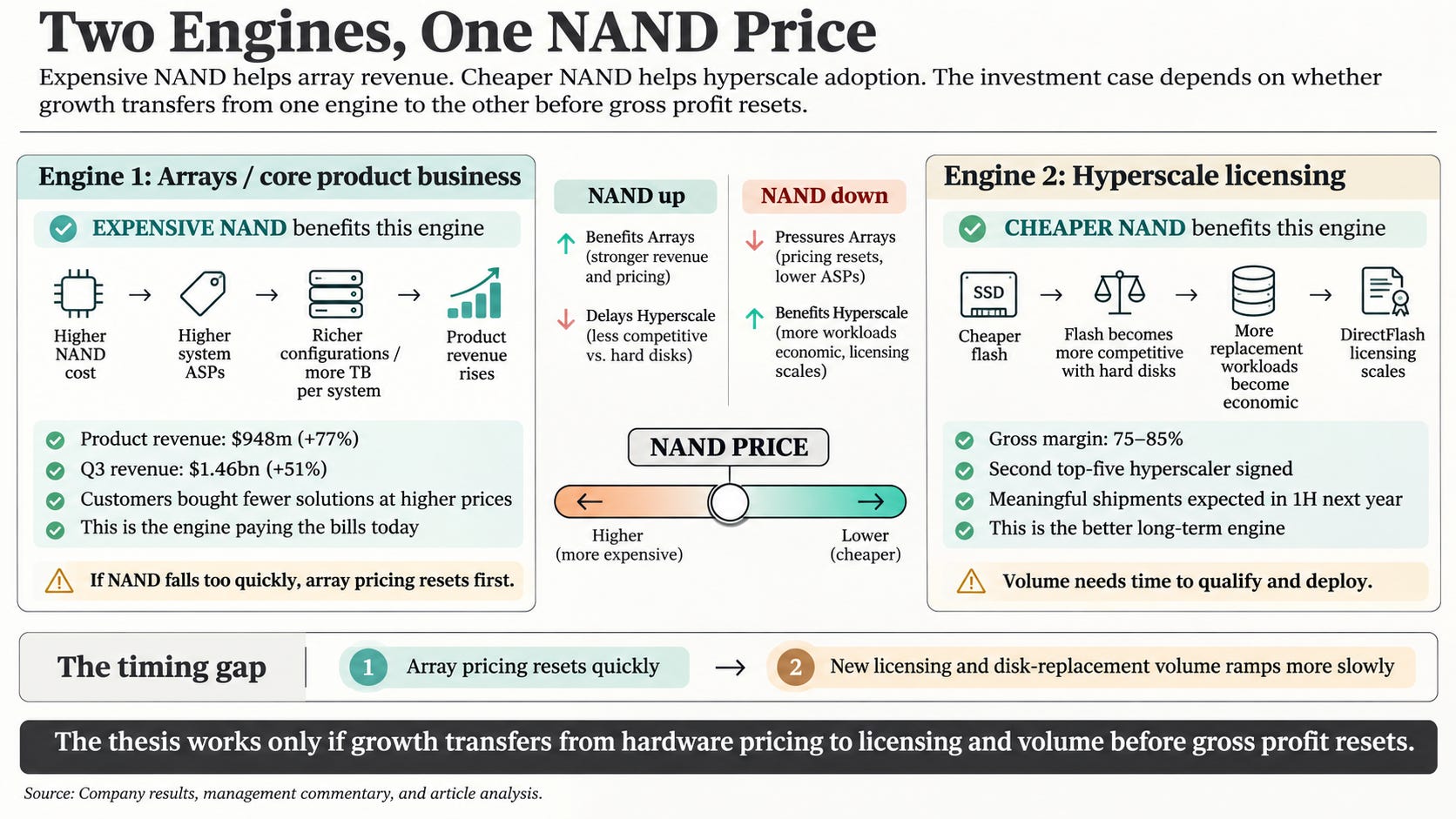
The real risk is not whether NAND falls, but how fast: expensive NAND supports array pricing; cheaper NAND makes flash more competitive with hard disks and can restart hyperscale replacement. A slow decline can transfer growth from one engine to the other. A fast decline can reset array prices before volume catches up, recreating the 2019 problem.
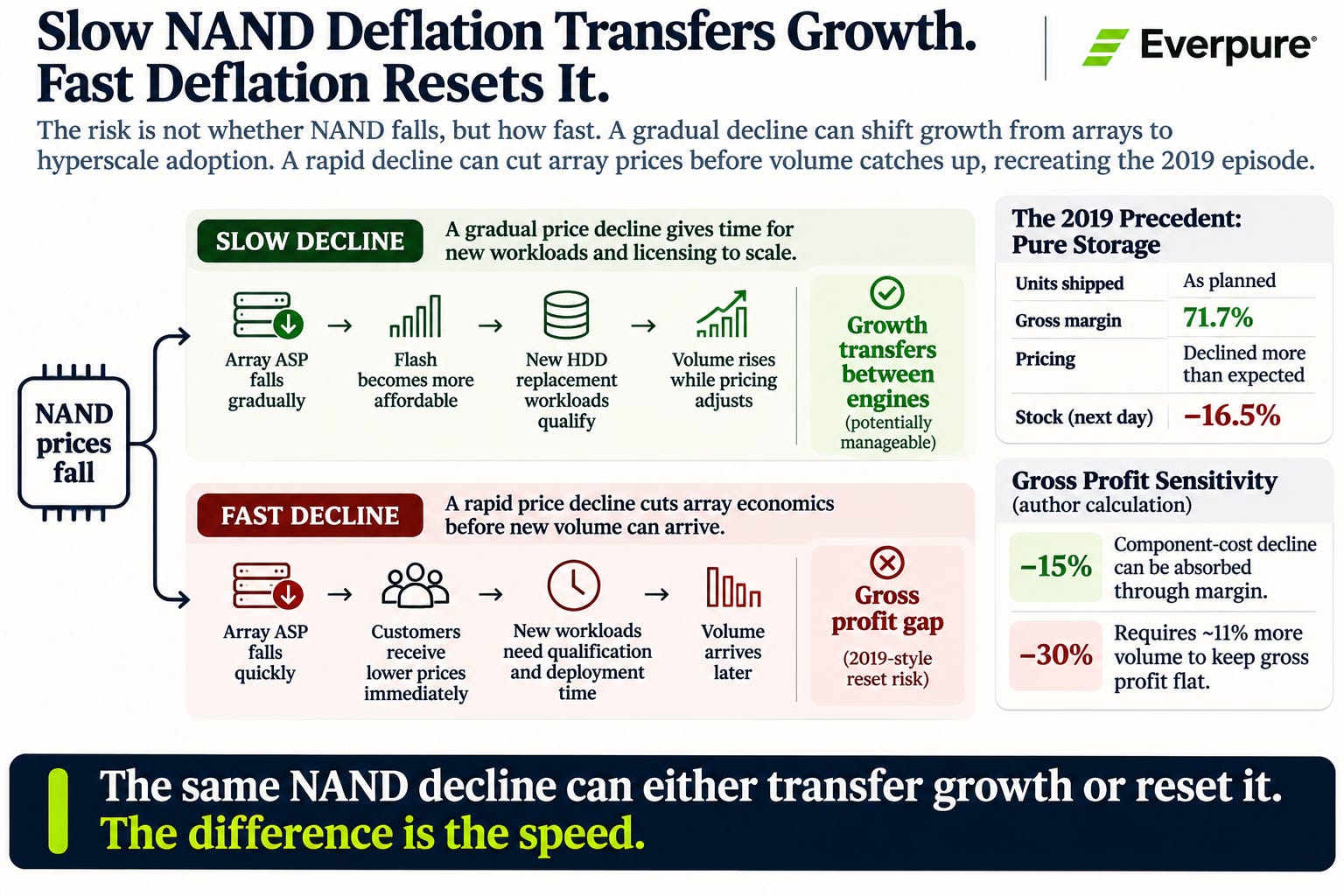
In November 2019, Pure Storage missed its own revenue forecast. Charlie Giancarlo blamed “continued pricing declines, which were higher than we expected.” Pure had shipped every unit it planned, and gross margin hit a record 71.7%, yet the stock fell about 16.5% the next day. NAND prices were falling fast, Pure sells NAND inside its arrays, and customers took the savings before they bought more capacity.
That episode is the best guide to the quarter Everpure just reported, because the company’s results now depend on the same thing: the price of flash, and how fast it moves.
The business is growing much faster than I expected
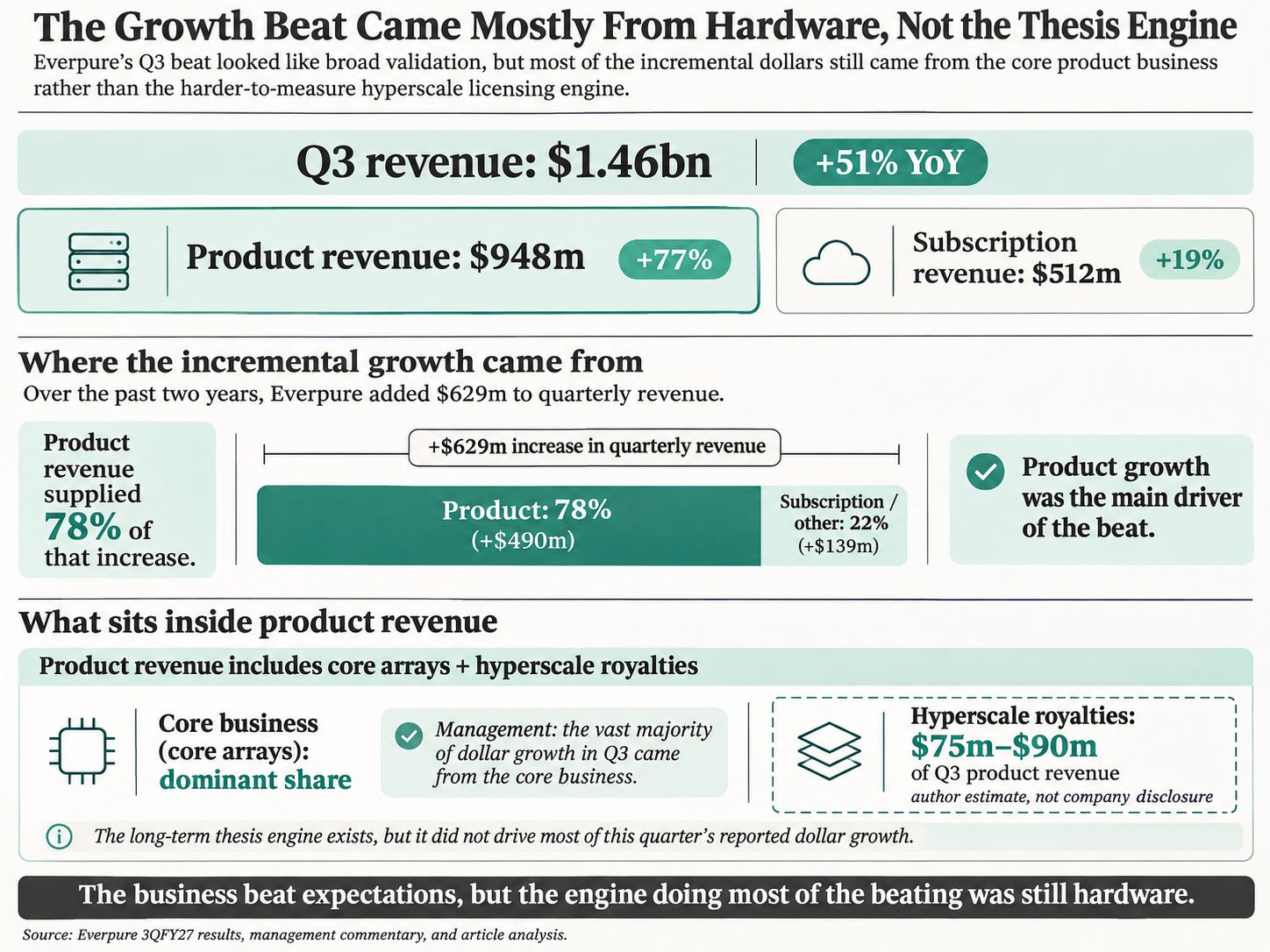
Third-quarter revenue rose 51% to $1.46 billion, and Everpure raised its fiscal 2027 outlook to $5.20 to $5.21 billion. In February the company was guiding to $4.3 to $4.4 billion for the same year, and an operating margin of about 18.4%. It now expects 20.8%. On revenue and profit, the business is well ahead of where I thought it would be.
The growth came from one place. Product revenue rose 77% to $948 million, while subscription revenue rose 19% to $512 million. Over the past two years, product revenue supplied 78% of the $629 million Everpure added to quarterly revenue. Product revenue includes royalties from hyperscalers, but by my estimate those were only $75 million to $90 million of this quarter’s total, and Giancarlo said “the vast majority of our dollar revenue growth in Q3 came from our core business.” In August, CFO Tarek Robbiati explained what drove that core:
“In fact, we are operating at a pricing level that we have not seen in 10 years... First, customers are buying fewer solutions at higher prices. Second, we have observed a mix shift to higher performance configurations with terabyte capacity up across our portfolio.”
So, customers bought fewer systems, with more capacity in each, at higher prices. Some of that is real volume, measured in terabytes. Much of it is the price of the NAND inside the box. NetApp, which raised its prices, grew product revenue about as fast as Everpure in the one calendar quarter both have reported, roughly 52% against 54% by my estimate. A rising tide lifted both.
This changes three things I wrote earlier this year. I said licensing would be predictable, recurring revenue; it is booked when partners ship, so it is lumpy. I said Pure had escaped the hardware trap; hardware drove the growth, and the figures I used in January were already a year old. I said NAND inflation would speed up the shift to licensing; it boosted array sales instead. What held was the licensing model itself, RPO growth above 25% (it was 44%), and the second hyperscaler.
Hyperscale licensing earns high margins, but the revenue is lumpy and hidden
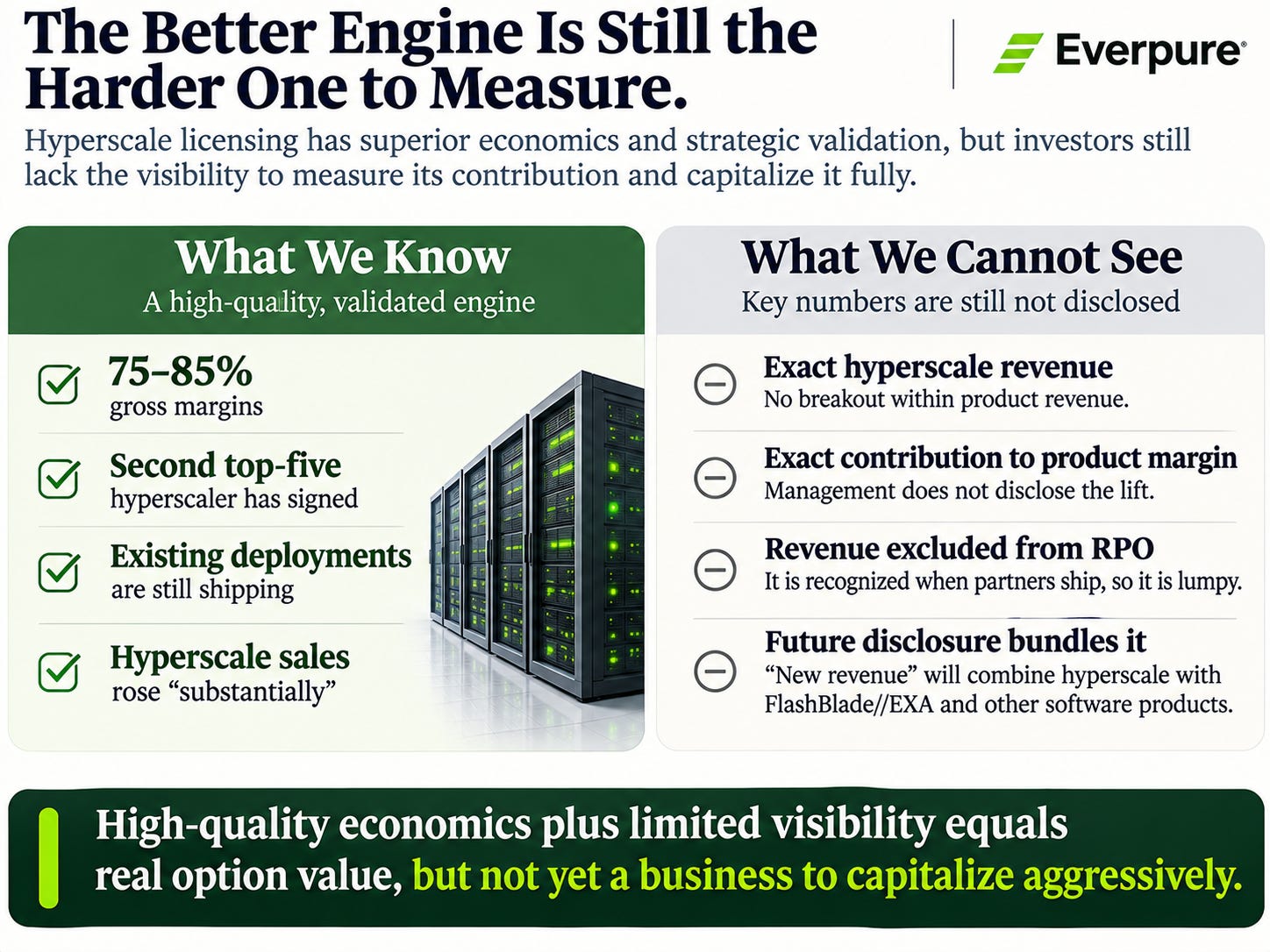
The hyperscale business works the way I described in February. Hyperscalers buy their own NAND and pay Everpure for DirectFlash software and some supporting components, at gross margins of 75% to 85%. A second top five hyperscaler signed in August, which validates the model, but it will not ship in meaningful volume until the first half of next year.
The revenue is uneven because it follows partner shipments. Robbiati said so in February: “hyperscalers revenue is recognized in product revenue... it’s not ratable, and we do not include it in the remaining performance obligation.” It is also hard to see. Everpure will not say how much hyperscale added to product margin, and from February it will report “new revenue” once a year, combining hyperscale with FlashBlade//EXA and several software products. When TD Cowen’s Eddy Orabi tried to read the number off a chart at the September analyst day, Robbiati was blunt:
“I tried to blur it. So that you don’t take a ruler and go, I do the geometrical arithmetic to come up with that number. No, seriously, I’m not going to break that out, okay.”
I do not think management is hiding a bad business. It is showing the part that looks best this year. But investors cannot yet measure the engine the long-term case depends on, and that argues for a lower multiple until they can.
The speed of the NAND decline matters more than its direction
Robbiati told investors in September that the NAND cycle does not matter:
“First, again, please understand this is really important, irrespective of the NAND cycle, we continue to gain share and deliver durable growth across all cycles despite component inflation or deflation.”
He is half right. Pure did keep growing through the 2019 decline, by 21% for that fiscal year. But growth fell from 28% to 15% in a single quarter. Giancarlo’s own answers on this call explain why both engines respond to NAND. Asked by Bank of America’s Wamsi Mohan about a slower data center build-out, he said:
“Not only that, as prices come down, again, our ability to be able to begin to substitute for hard disk will start all over again, and that opens up even more opportunity. So we are insulated, regardless of whether prices go up, in which case we are more competitive against SSDs, or go down, in which case we are more competitive against both SSDs and hard disk.”
Contracted hyperscale deployments are still shipping, and hyperscale sales rose “substantially” this quarter. But “will start all over again” means the next wave of disk replacement is waiting for cheaper flash. So cheaper flash helps the licensing engine and hurts array prices. The question is timing, and Giancarlo answered it when Morgan Stanley’s Erik Woodring asked:
“When prices come down, demand will go up. Now, that being said, it will still present a challenge for sure... Prices come down slowly. I expect to see demand come up along with that. If prices suddenly drop, we are going to have several different quarters, and that remains to be seen.”
A slow decline gives cheaper flash time to open new workloads and replace disks. A fast one resets array prices before customers can qualify and deploy more capacity, as in 2019. On my rough math, a 15% fall in component costs can be absorbed through margin, but a 30% fall needs about 11% more volume just to keep gross profit flat.
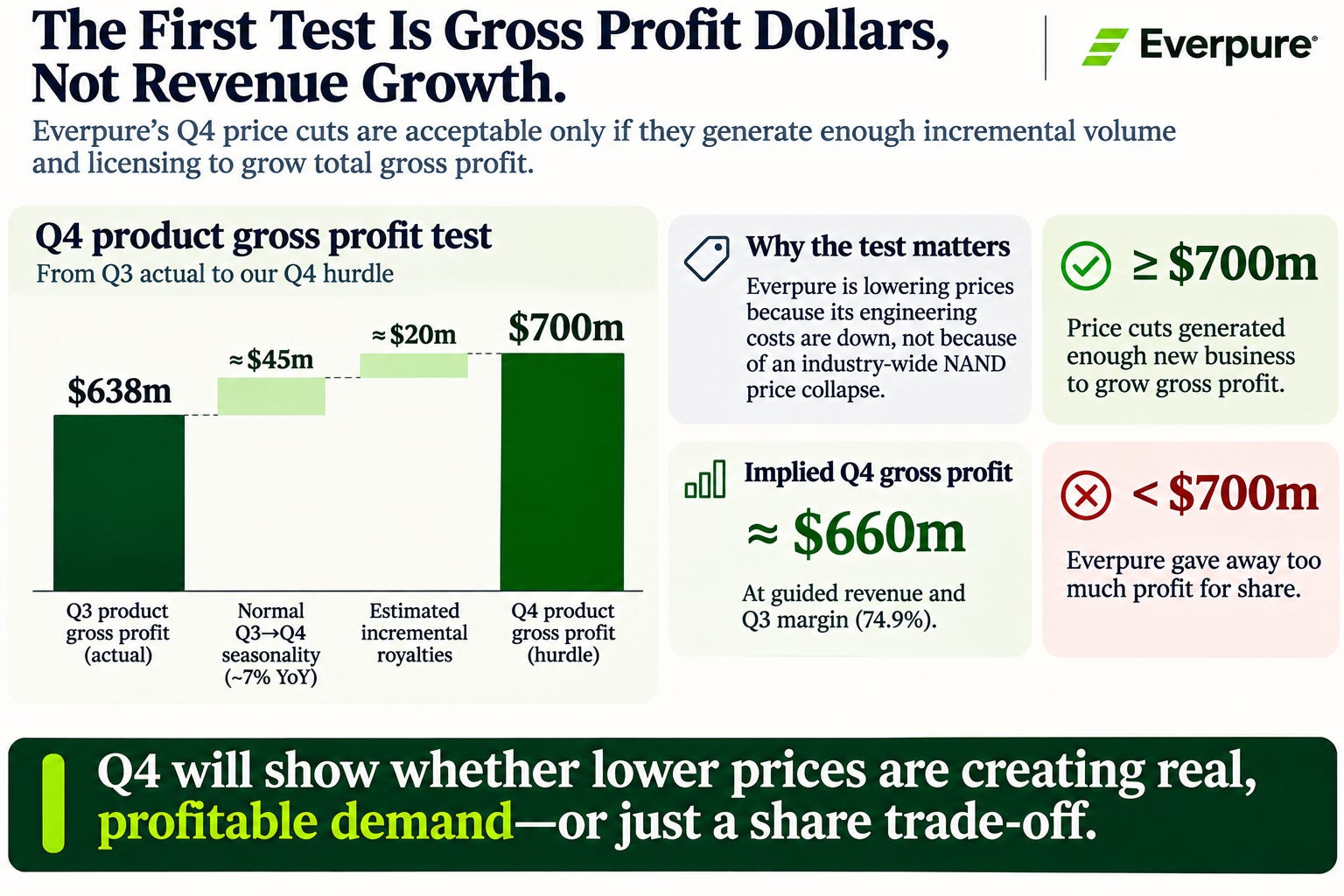
The fourth-quarter price cut is a useful first test, but it is not a repeat of 2019. Everpure cut prices on most models because its own costs fell through engineering, while competitors still pay peak prices for drives. That is a bid for share, not a forced response to an industry-wide decline. The right measure is gross profit dollars, because they capture price, volume and licensing together. Product gross profit was $638 million in the third quarter. It rose about 7% into the fourth quarter last year, and royalties should add perhaps $20 million more, so $700 million is my test. At the guided revenue and the third quarter’s margin, Everpure would make about $660 million. Reaching $700 million means the price cut won enough business to grow profit. Falling short means it gave away profit for share, and I will raise the weight on the bear case.
Cash flow is the second test
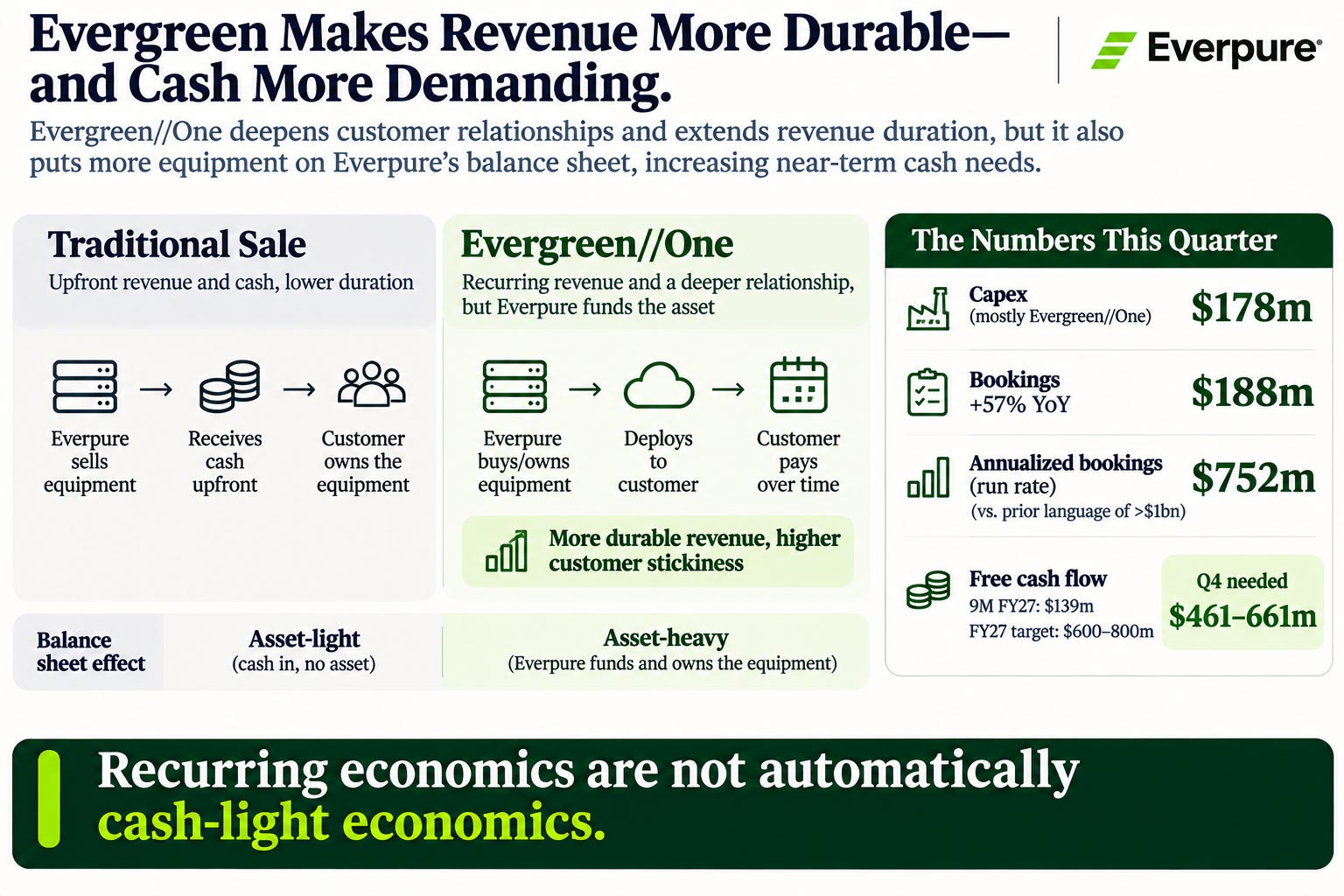
Evergreen//One makes customer relationships more durable, but it costs cash. Under it, Everpure owns the equipment and is paid over time, which is why capex reached $178 million this quarter, most of it for Evergreen//One. Bookings for that service were $188 million, up 57% from a year ago but down from the second quarter.
The language around those bookings has softened. In August they had “accelerated to an annualized run rate of above $1 billion.” In September they were “on track to surpass” it. This quarter they were “accelerating towards” it. Third-quarter bookings of $188 million annualize to $752 million.
The cash numbers are simple. Free cash flow was $139 million for the first nine months, and management’s full-year target is $600 million to $800 million, so the fourth quarter needs $461 million to $661 million. That will show whether Everpure can fund equipment-heavy growth and still turn earnings into cash.
I am still constructive, but I give the bear case more weight
The stock has followed earnings, not a re-rating. Since my January piece it is up 39%: consensus fiscal 2028 EPS rose 57%, and the multiple on it fell from 26.8 times to 23.7 times. Investors have not started valuing Everpure like Arm; they are paying for more earnings. The stock also trades with the memory makers. It fell after each of its previous four reports, despite beating every time, and on November 5 it fell 16% on the day SanDisk fell 22%.
In February my bear case was NAND staying expensive and squeezing margins. That turned out to be the good case for revenue. The bear case now is a fast NAND decline. On fiscal 2030 earnings:
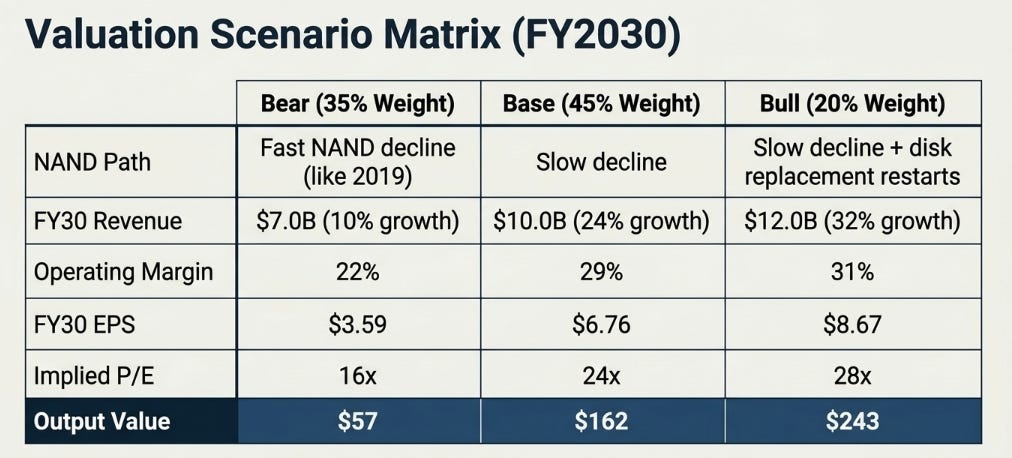
The cases assume an 18% tax rate, 352 million diluted shares, free cash flow of 80% to 95% of net income, and subscriptions growing 14% to 20% a year. The weighted value is about $141, roughly 40% above $100.74.
One cost sits outside these numbers. Non-GAAP earnings exclude stock-based compensation, which is about 13% of revenue, and Everpure spends cash on buybacks to keep the share count flat. Counting compensation as a cost, the base-case price is 39 times fiscal 2030 earnings if compensation falls to 11% of revenue, and 43 times if it stays at 13%. That is why I stop at 24 times. At $100 the stock is attractive if NAND falls slowly. On those terms I would own it and trim above $140.
In February I ended with the line that the value in storage isn’t the medium, it’s the mind. This year the medium paid the bills. The mind is still the long-term thesis, and the next two reports will show whether it starts paying before the medium gets cheap.
Disclaimer:
The content does not constitute any kind of investment or financial advice. Kindly reach out to your advisor for any investment-related advice. Please refer to the tab “Legal | Disclaimer” to read the complete disclaimer.