


TL; DR
The key shift is from communication to execution: Meta already creates the introduction and hosts the conversation between customers and businesses. Agents could reduce the work that still sits between an enquiry and a completed order. Pasted markdown
The business agent may be what makes the personal agent dependable: a customer’s agent can ask, but only the business side can make authoritative commitments on stock, price, delivery and policy. Giving both sides agents reduces ambiguity rather than merely adding more automation. Pasted markdown
The real thesis is a network effect, not an AI product bundle: Meta becomes more valuable if each participating business expands what customers can reliably accomplish and reusable capabilities make later deployments cheaper. If every new merchant adds bespoke work instead, the network does not compound.
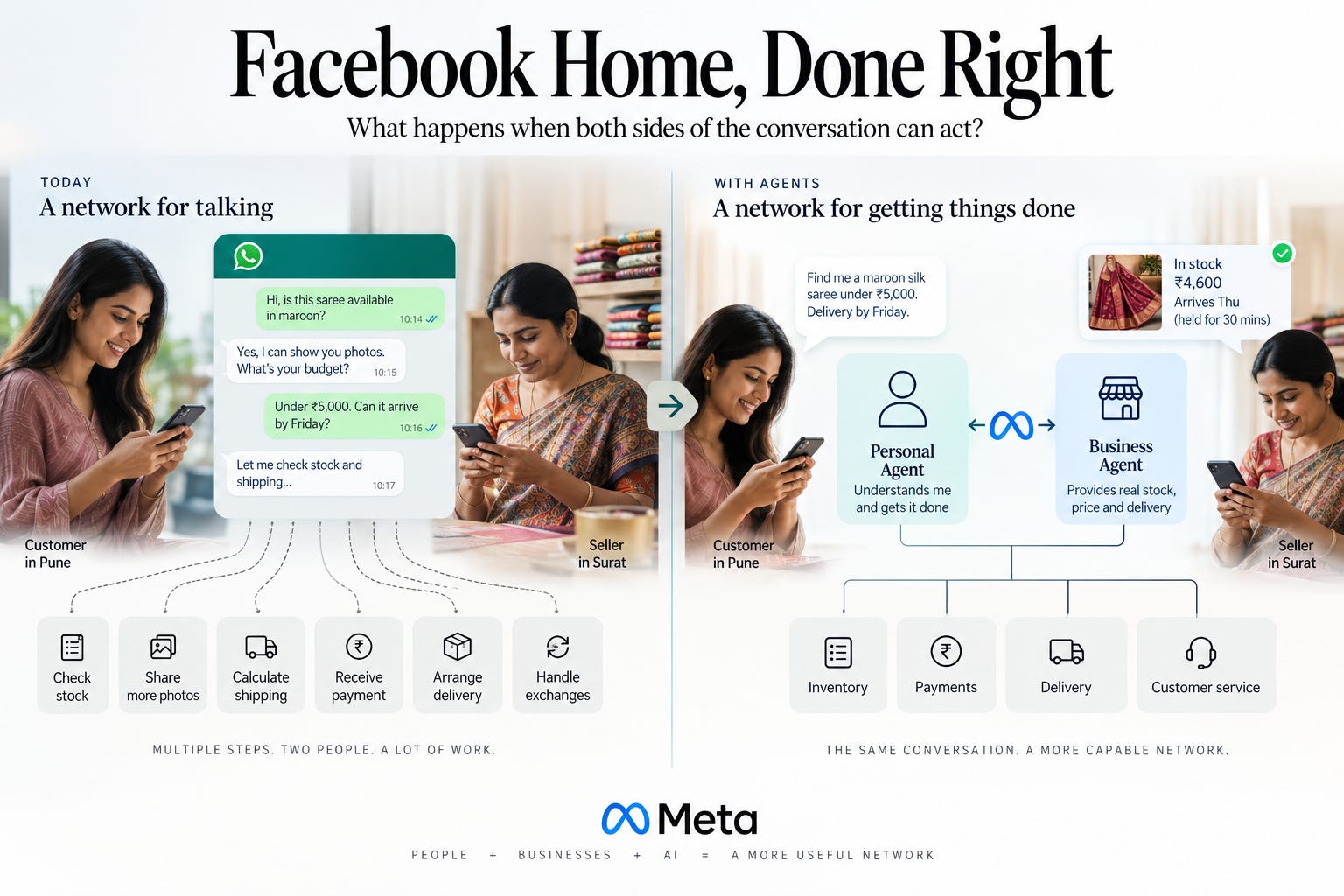
Imagine a woman selling sarees from her home in Surat. She posts a video of a new collection on Instagram and pays to promote it. A customer in Pune taps through to WhatsApp, where the familiar questions begin: the price, the available colours, more photographs, whether delivery by Friday is possible. The seller checks her stock, works out the shipping charge and sends payment details. After the money arrives, she packs the order and handles the messages about tracking, alterations and exchanges.
In this transaction, Meta has helped create the introduction and provided the place where the relationship develops. The seller and customer still carry information between messages, payment applications and delivery services themselves. What looks like one conversation is a small operating process held together by two people. The seller does not need more ways to communicate. She needs less work between an interested customer and a completed order.
That distinction changes how we read Meta’s recent announcements. In June, Meta invested $900 million in CRED and appointed its founder, Kunal Shah, to lead WhatsApp. On September 8, it launched Muse, a personal agent with a dedicated computer in the cloud. On September 28, it announced an enterprise business under CJ Desai, bringing personal and business agents together with developer tools. Each development fitted a familiar category: payments, consumer software, enterprise software. Their possible relationship was less obvious.
We did not anticipate these moves and initially treated the enterprise initiative as a potential distraction from the consumer product. That may have been the wrong starting point. When Apple introduced the iPhone through three familiar descriptions in 2007, the significance lay in their combination. The comparison is not a prediction of equivalent success; it is a reminder to ask whether apparently separate capabilities make one another more useful. For Meta, the question is whether agents can turn its network of people and businesses into a network for getting things done, where participation on each side improves the other and creates value Meta can capture. Pasted text
The ambition that failed
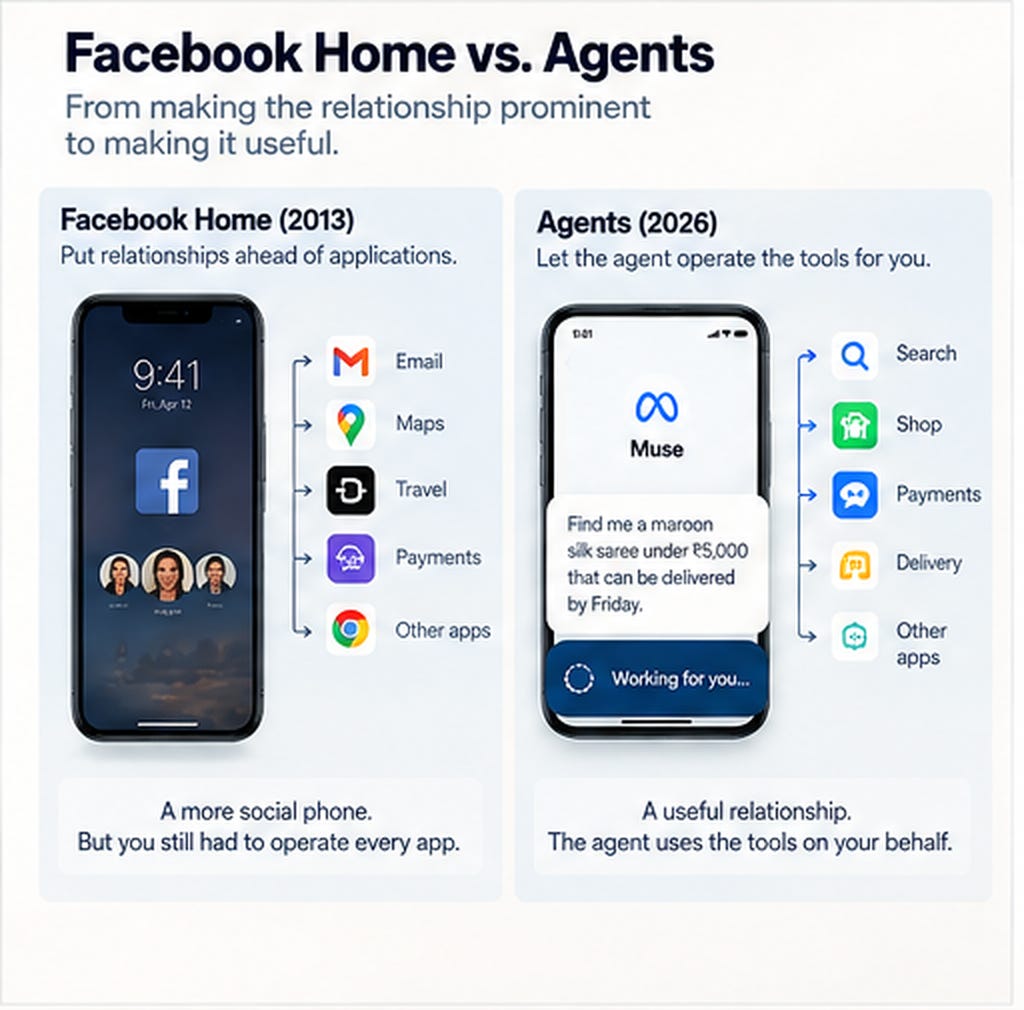
Facebook had an earlier answer to where the relationship should live. In April 2013, it introduced Home, an Android experience that placed friends’ updates on the lock screen and home screen. Its launch announcement asked, “if sharing and connecting are what matter most, what would your phone be like if it put your friends first?” The ambition was to make Facebook more central to the device by reorganising the experience around relationships rather than applications.
The problem was that the applications performed jobs. Someone looking for a boarding pass or transferring money was not expressing a preference for a less social phone; they were trying to accomplish something specific. Home confused the importance of the relationship with the usefulness of placing that relationship first. Putting friends ahead of the applications did not relieve the user of operating them, and could put another experience in the way.
Muse proposes a different arrangement. Meta describes it as an agent that can use a browser, operate connected services and continue working after the person closes the application, returning when approval is required. Instead of asking the user to put Meta ahead of the tools, it offers to use the tools on the user’s behalf. The computer doing that work runs in Meta’s cloud, although access to devices and outside services remains consequential.
The distinction is between making the relationship prominent and making it useful. A customer might express an intention through a conversation and let the agent determine which applications to use, what information to collect and when a decision is needed. The interface can be generated or selected around the task instead of becoming another system the customer must learn. But there is a limit to what the customer’s agent can achieve alone: it cannot know what the seller is genuinely prepared to do merely by becoming better at asking.
The other side of the conversation
The enterprise announcement is more interesting when read from the customer’s end of the problem. Rather than begin with a new technology market, Zuckerberg begins with relationships Meta already serves. His opening paragraph places the business ambition directly beside those existing relationships:
We believe superintelligence will create significant new opportunities for all people and businesses. Meta already serves billions of people at scale and helps hundreds of millions of businesses reach customers. Today we are starting the next major pillar of our business, Meta Enterprise Platform, to help businesses use AI to grow and transform in new ways as well. Pasted text
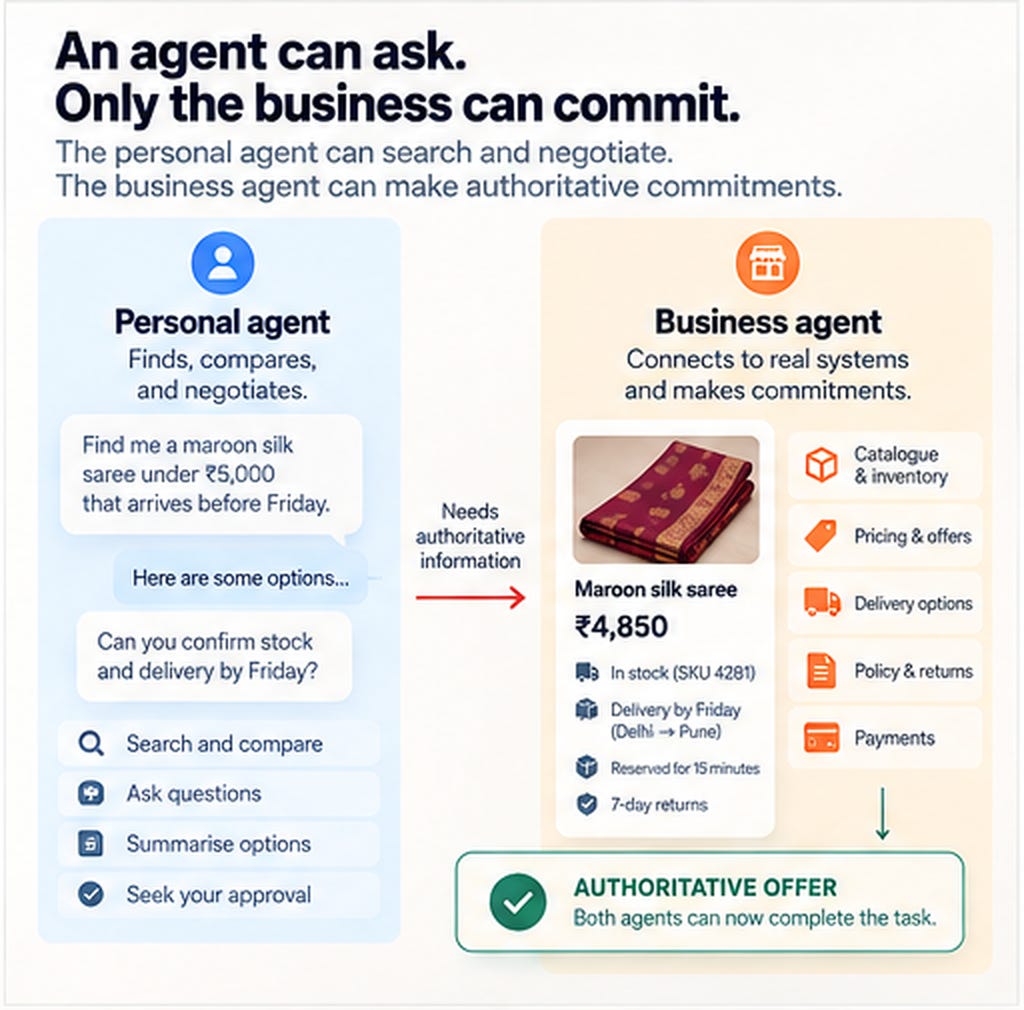
Our reading is that the business side could help fulfil the promise made to the individual. The customer in Pune can ask her agent for a maroon silk saree below ₹5,000 that arrives before the weekend. The agent can organise the search and send the questions, but it still needs valid information about stock, price and delivery. A reply is not yet an agreement, and a fluent answer cannot reserve a product.
Now give the seller an agent connected to her catalogue, available stock and operating rules. It could respond with a particular saree, an all-in price, delivery terms supported by the courier’s service and a time-limited reservation. The customer’s agent can compare that offer against the request and obtain approval. The business agent does not remove physical uncertainty; it makes the commitment explicit and connects it to what the business can authorise.
Nothing about the saree has changed. What changes is how confidently the parties can proceed. The customer’s agent has less ambiguity to resolve, while the seller no longer must reconstruct the same information for every enquiry. Straightforward checks can remain ordinary software operations; the agent handles the varied request and coordinates the appropriate actions. Giving the business an agent may therefore be part of making the customer’s agent useful, not simply another opportunity to sell computing capacity.
A recent difficulty shows why these matters. Reuters reported that Meta tested human contractors for some Muse calls, then rolled back the test following employee objections. An internal executive said human callers achieved success rates of 95% to 98% in some tests, without providing a numerical AI-only baseline. An employee also reported that an insurer kept hanging up when it recognised an AI caller. This does not prove the proposed solution, but it shows that completion depends partly on the counterparty, not only on the model making the request.
OpenAI’s March change to Instant Checkout offers another caution. Its announcement said the initial implementation lacked the desired flexibility and shifted toward merchant-owned checkout experiences, including a Walmart environment supporting accounts, loyalty and payments. The episode points to a requirement, not a predetermined winner: connecting a consumer interface to commerce means accommodating the business’s operations and its relationship with the customer.
Seen this way, Kunal, Muse and CJ could address complementary requirements: familiarity with commerce, execution for the individual, and dependable business participation. Their combination remains an interpretation rather than a disclosed organisational blueprint. Its attraction is that improving one side could improve the other, without requiring every participant to adopt simultaneously. A human customer benefits from a capable business agent; a personal agent can still use conventional websites and services.
What becomes more valuable
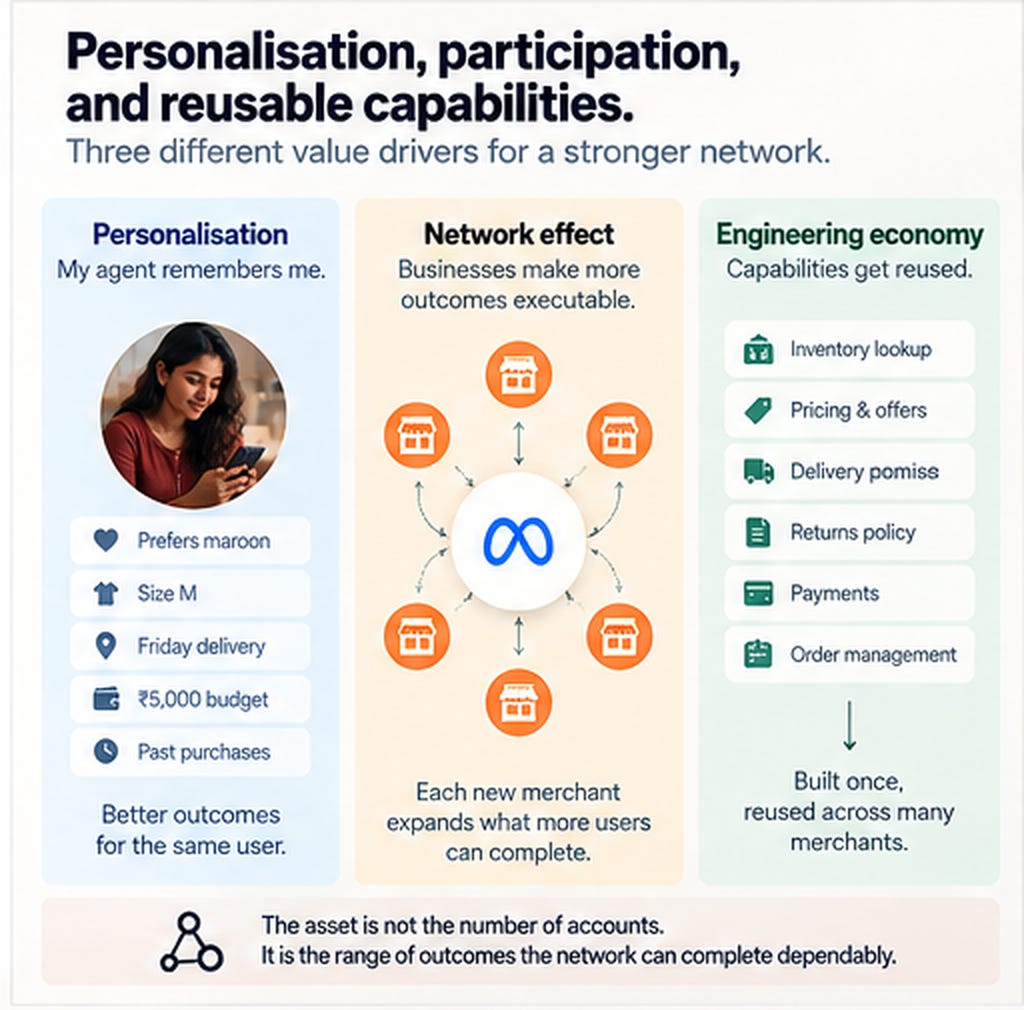
Meta’s existing reach can help people encounter an agent. That is a distribution advantage, but it is not yet the reason the product should improve with scale. The stronger mechanism begins when participating businesses make useful actions available: customers can complete more work, successful delegation encourages repeat use, and the resulting demand gives additional businesses a reason to participate. Their participation expands what the service can accomplish.
Personal memory is different. Remembering a customer’s preferred colours makes her agent better for her but does not necessarily improve anyone else’s experience. A merchant offering dependable stock and fulfilment information can improve the experience for relevant customers across the network. Reusable connections can also reduce the cost of serving additional businesses. Personalisation, network effects and engineering economies reinforce one another, but they are not the same advantage.
Nor does every additional merchant make every customer better off. Another seller matters when it adds a relevant product, useful availability, better service or an alternative the customer can use. Counting accounts would obscure the real asset: the range of outcomes that participants can complete dependably. More messages are not sufficient evidence, particularly when the purpose of the product is to reduce how many messages a person must manage.
This creates a demanding test. Does bringing a business into the service make it more useful to existing users, or simply give Meta another customer to support? For a small seller, installation must become inexpensive enough to justify the expected return. Larger customers can support substantial implementation work, but that work should create reusable capabilities or sufficient profits. Self-service is an attractive route, not a universal requirement; continually rebuilding the same functions is the warning sign.
The customer is already here
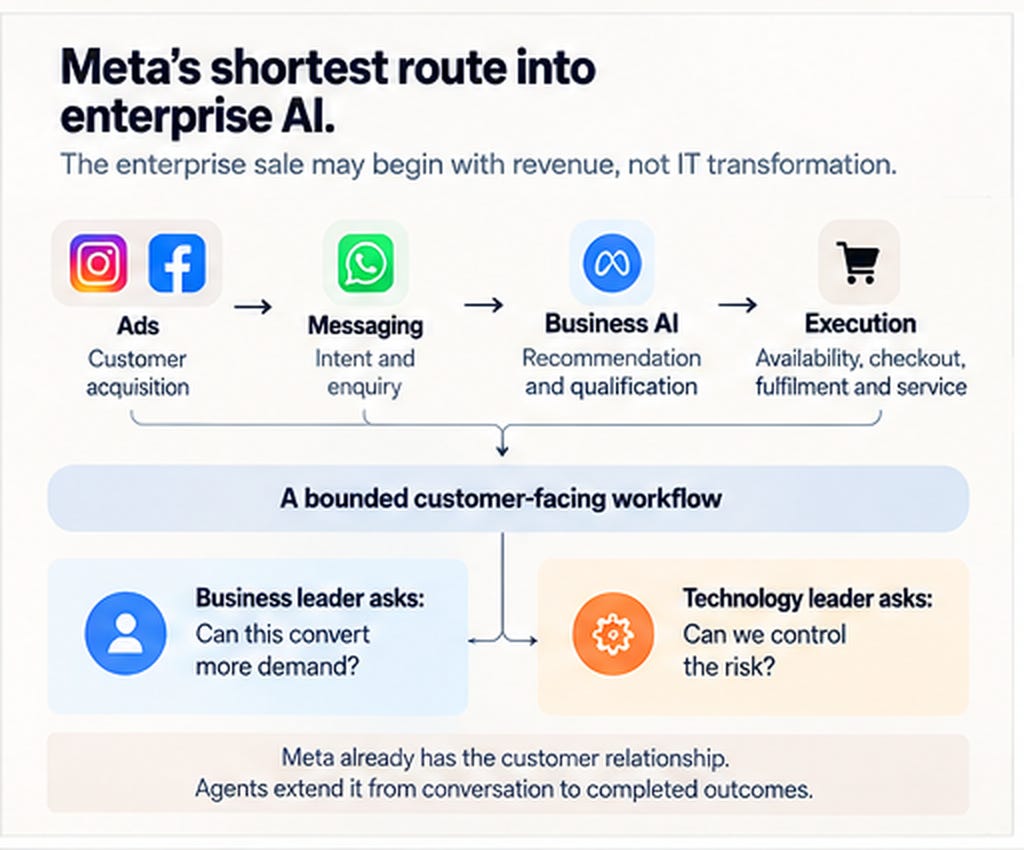
The seller in Surat already has a reason to consider the product: she wants more of her enquiries to become orders. A large consumer company can approach it for the same reason. Marketing wants better returns from customer acquisition, sales want completed transactions, and service wants fewer unresolved interactions. The company need not first decide to replace its internal technology; it can begin with a bounded opportunity in how it serves customers.
Meta has been developing that commercial connection. Its July 2025 announcement brought marketing across WhatsApp, Facebook and Instagram into Ads Manager, with common creative, setup flows and budgets. The same announcement discussed business AI that could recommend products, facilitate sales and follow up in WhatsApp. This predates the new enterprise division and provides a concrete route from an existing commercial relationship into a broader service.
In that setting, the chief executive’s question is how to pursue a customer opportunity within acceptable limits. Technology leadership still matters, but an architectural preference is not a complete reason to forgo profitable business. Equally, commercial enthusiasm is not evidence of incremental revenue. Both teams must account for their preferred decision: the risks of implementation and the business lost while waiting.
This also explains why Meta’s financial opportunity need not depend on building a large standalone subscription business. Suppose, purely illustratively, the seller receives twenty enquiries from a promotion and converts five. If faster responses, accurate availability and reliable follow-up help her convert eight at comparable margins, the same advertising expenditure becomes more productive. She might choose to spend more, pay for business capabilities or do both.
The agent could therefore improve the economics of Meta’s existing relationship rather than merely be subsidised by it. That is not automatic: an order moved from a website into WhatsApp is not necessarily a new order, and money shifted between Meta products cannot be counted twice. The relevant gain is incremental commercial value after delivery costs. Nor does the mechanism require private personal-agent information to enter advertising systems; Meta says Muse’s conversations and VM data are not shared with those systems.
The department she never had
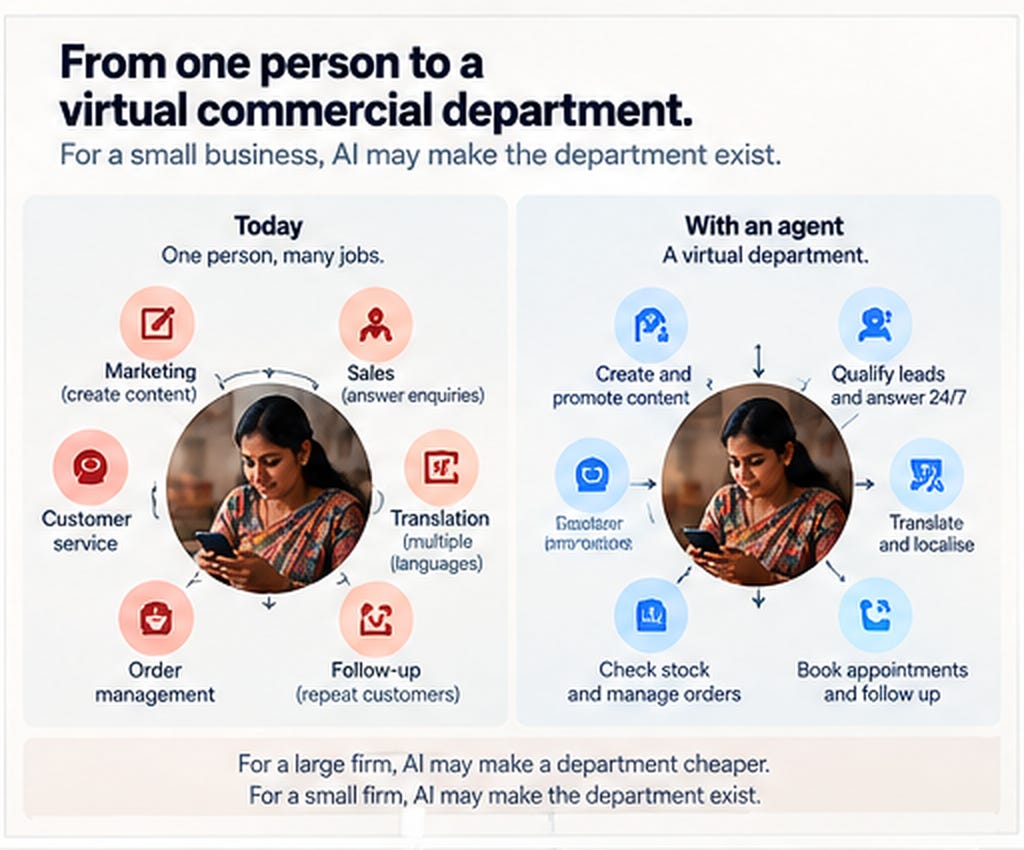
The same seller also reveals why the consequences could extend beyond companies with large technology budgets. An established retailer has specialised teams for sales, service and operations; our home-based merchant has herself. An agent might make a department more efficient in the first case and make some of its capabilities affordable for the first time in the second. Alexandr Wang’s explanation of Muse reaches beyond an efficiency calculation:
Most people never say what they want. It’s not because we don’t want. We want fiercely and constantly. It happens in the moments before falling asleep or while daydreaming on the car ride home. We want to spend more time with our families, overcome social anxiety, eat healthier food, open a bakery, build an app, or just find a few more moments of calm in a hectic life. But rarely do we get to even express these dreams, and even more rarely do they ever come true. Pasted text
The claim is aspirational, but the business implication is concrete. Our seller might handle more enquiries, communicate with customers in another language and manage repeat orders without first building a larger organisation. Meta’s May 2026 Business AI announcement in India describes multilingual customer responses, lead capture and appointment booking within WhatsApp Business. Its selected merchant testimonials are not representative outcome data, but the product is explicitly aimed at this gap in capabilities.
That is the geographic possibility worth keeping in view. An economy need not produce frontier models to benefit from making more of its businesses commercially capable. The constraint may be neither an absent product nor an uninterested customer, but the difficulty of bringing them together reliably. Better participating businesses would widen what consumers can accomplish, feeding the same network mechanism rather than creating a separate national-growth thesis.
When more makes it worse
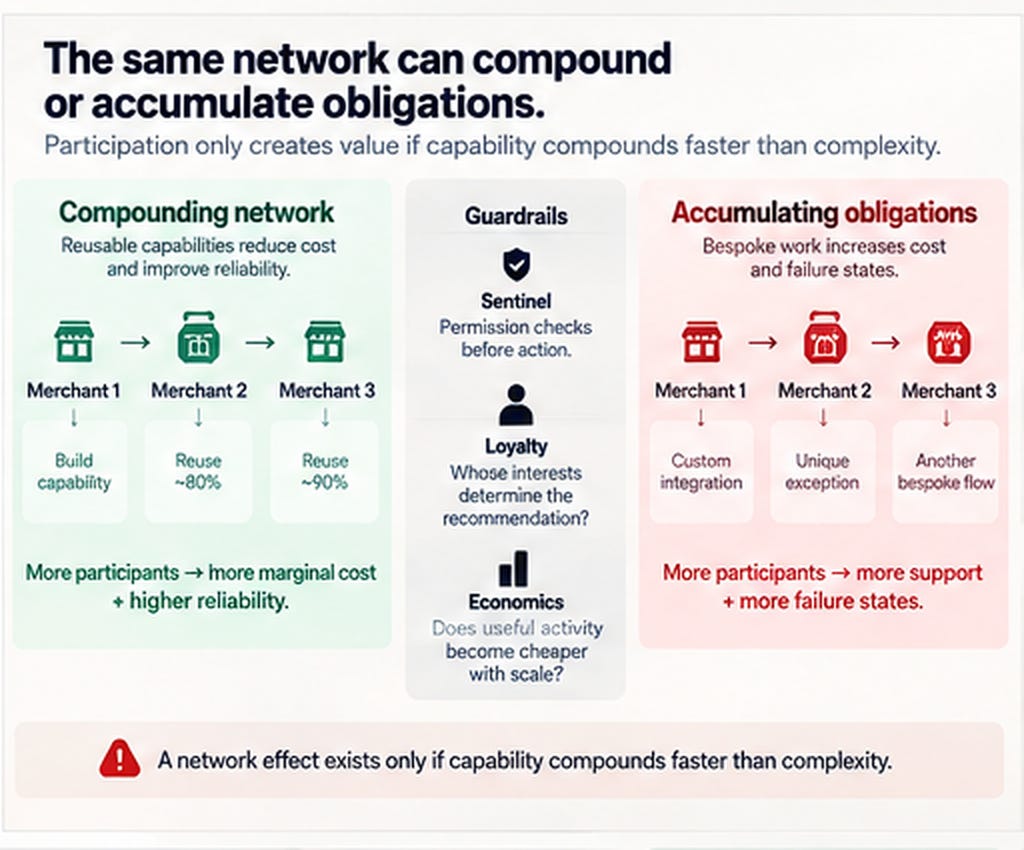
The customer chooses maroon, then changes to green after the seller has started preparing the order. The price differs, the original courier arrangement may no longer work, and the customer’s approval covered the previous version. Now someone must determine what was agreed, what can be changed and whether Friday delivery remains possible. The quality of the next sentence matters less than the accuracy of the underlying state.
This is where a network can accumulate obligations instead of advantages. If every merchant brings a different collection of exceptions requiring bespoke engineering and continual intervention, growth makes the service harder to operate. Desai’s potential contribution is not merely enterprise credibility; it is helping turn business requirements into dependable products. The question is whether later deployments reuse what earlier ones required Meta to build.
Meta’s technical design recognises part of this distinction. A separate system, Sentinel, decides whether proposed actions may proceed, should be denied or require approval. That separates the intelligence proposing work from the authority permitting it. The purpose is not to interrupt every step, but to put checks where they matter and allow appropriate routine actions to proceed. Building the control is necessary; demonstrating dependable outcomes under changing conditions is the harder test.
A second constraint is loyalty. The customer wants the right saree on acceptable terms; the seller wants a profitable order. Meta can help them reach an agreement without pretending their interests coincide. But if the customer’s agent favours the merchant paying Meta most, it risks weakening the relationship on which future delegation depends. Privacy protects information, while loyalty concerns whose interests determine the choice. The two promises must not be confused.
Finally, useful activity can remain expensive to provide. Computing, failed attempts, support, human intervention and capital investment all belong in the calculation. Neither high usage nor an expanding transaction count establishes an attractive return. The thesis requires repeat activity and reusable capabilities to support economics that improve, while recognising that agents on both sides can communicate without being owned by the same company. Meta has an advantageous starting relationship, not a guaranteed claim on every outcome.
The pattern and the proof
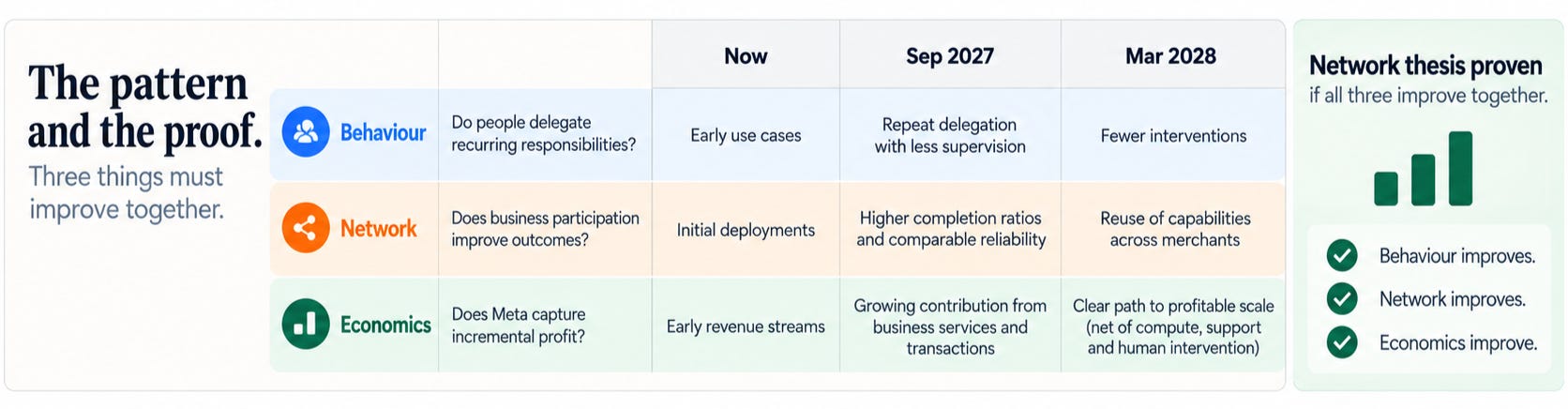
The evidence through September 2027 should begin to distinguish three separate propositions. The first is behavioural: do people entrust agents with recurring responsibilities and spend less total effort supervising them? The second is the network mechanism: as relevant businesses participate, do comparable tasks complete more reliably, require less intervention a`nd encourage further delegation? Improvements caused solely by a better model would strengthen the product but would not by themselves establish a benefit from business participation.
The third proposition is financial. By March 2028, can Meta demonstrate that it captures incremental profit through business services, transactions or improved advertising economics after the full delivery cost? New disclosures about delegated tasks would help identify management’s priorities, but definitions and outcomes would matter more than the decision to report them. Insufficient disclosure leaves a question unresolved; it does not turn an attractive narrative into evidence.
Our expectation is that this develops through bounded responsibilities rather than universal autonomy. Businesses make specific commitments executable, people delegate more after repeated success, and reusable capabilities connect those responsibilities into increasingly useful arrangements. Meta should prioritise those connections over the breadth of its product catalogue. If business adoption grows without improving consumer outcomes or delivery economics, the network thesis is wrong even if individual products remain useful.
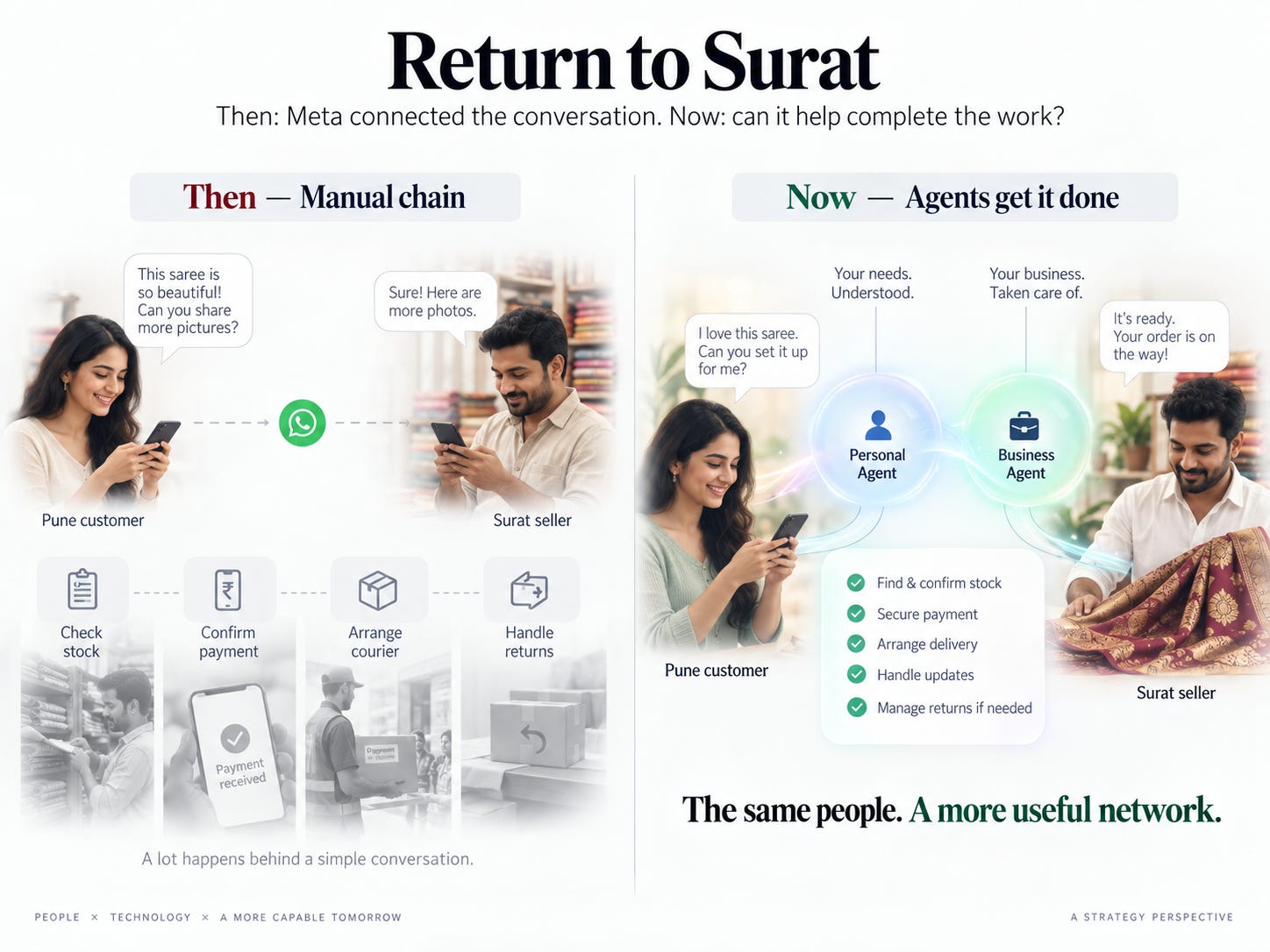
Return to the seller in Surat. At the beginning, her conversation with the customer was a record of work they were doing elsewhere: checking stock, agreeing terms, confirming payment and arranging delivery. The opportunity is to make that conversation a dependable means of performing the work, giving the seller greater capacity and the customer fewer reasons to intervene. If each additional capable participant improves that experience for others, Meta’s existing relationships take on a new economic role.
Facebook Home tried to make the relationship central by placing it ahead of the applications. Agents offer a different route: make the relationship more useful by operating the applications and involving businesses that can act on the other side. Whether Meta delivers that outcome remains to be seen, but it is the right ambition to evaluate. The prize is not another application people open; it is a network through which they can accomplish more together.
Disclaimer:
The content does not constitute any kind of investment or financial advice. Kindly reach out to your advisor for any investment-related advice. Please refer to the tab “Legal | Disclaimer” to read the complete disclaimer.