


TL; DR
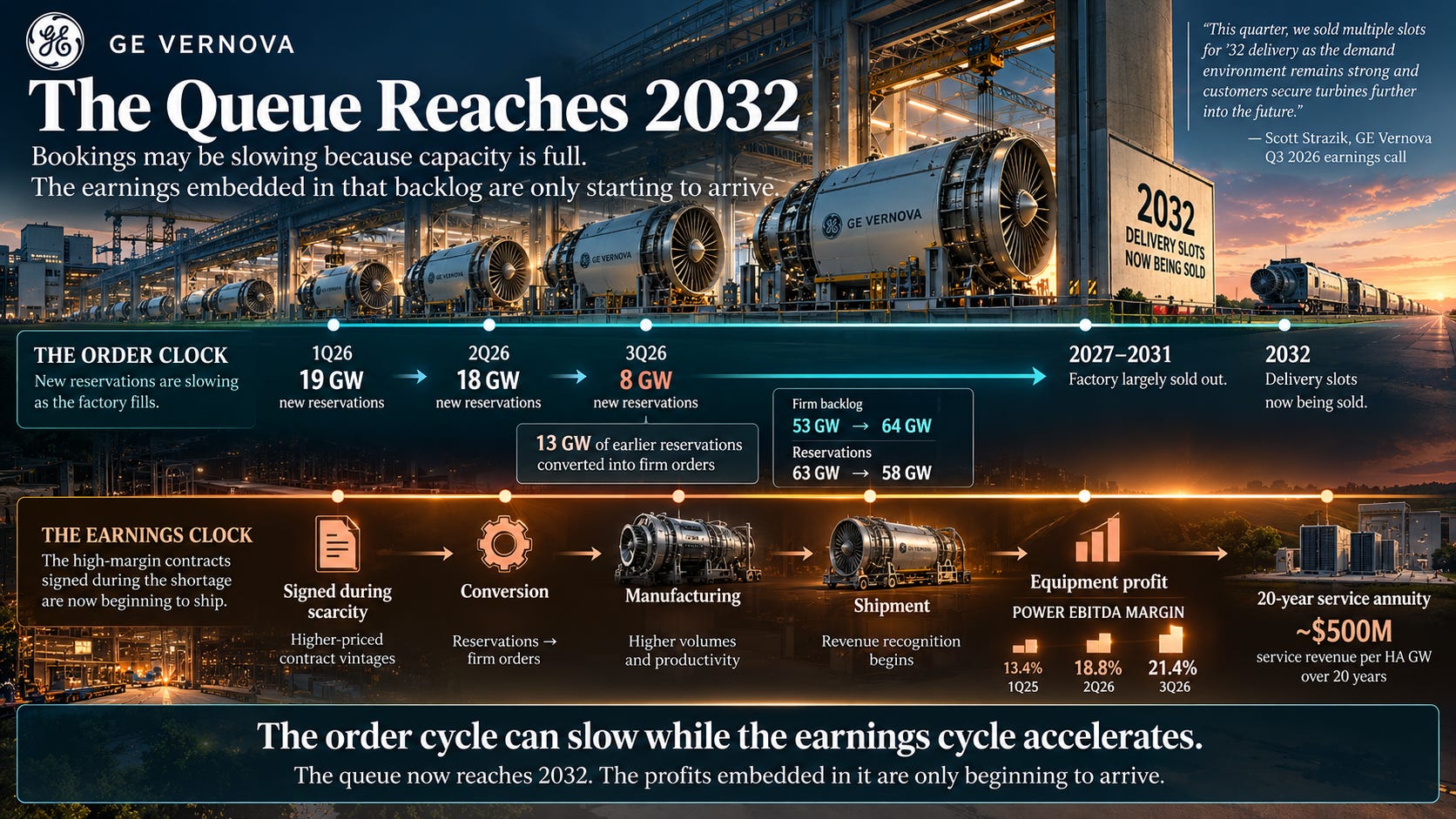
The booking slowdown is less bearish than it looks: new reservations fell sharply, but 13 GW of earlier reservations converted into firm orders and the delivery calendar now reaches 2032. The pace of bookings is increasingly constrained by remaining slots, not necessarily by weaker demand.
The earnings cycle is finally showing up: Power EBITDA margin reached 21.4% even as services became a smaller part of revenue, suggesting better-priced equipment, manufacturing productivity and higher volumes are improving the economics of the hardware itself.
The debate has shifted to valuation: much of the revenue path through 2029 is already visible. The key variables are now Power margins, contract-vintage economics, capital allocation and the multiple investors assign to those earnings. At $895, the prospective return is reasonable rather than exceptional.
In February, we proposed a warning signal for GE Vernova’s gas business:
If signings decelerate while existing SRAs convert to orders, the backlog may be peaking rather than compounding. That’s the difference between a cycle and a franchise.
Q3 delivered exactly that pattern. New slot reservations fell from 19 gigawatts in Q1 and 18 in Q2 to eight, while 13 gigawatts of earlier reservations converted into firm orders. It would be convenient to dismiss a test once it produces an uncomfortable result. But July’s Two Clocks had already offered a different interpretation: a factory sold out through 2030 must eventually report fewer new reservations because it has fewer slots left to sell.
“This quarter, we sold multiple slots for ’32 delivery as the demand environment remains strong and customers secure turbines further into the future.”
— Scott Strazik, GE Vernova Q3 2026 earnings call
Q3 makes that distinction more persuasive. GE Vernova’s delivery calendar now reaches 2032, while Power’s EBITDA margin has climbed to 21.4%, eight percentage points above last year. The company is beginning to earn the profits secured when customers competed for scarce capacity. Its order cycle can slow even as its earnings cycle accelerates.
That improves confidence in the business. It does not automatically improve the investment case at any price.
The Booking Paradox

GE Vernova reported $29.3 billion of orders, $12.6 billion of revenue, $1.94 billion of adjusted EBITDA and $5.4 billion of free cash flow. Behind those headline numbers, the gas backlog became more substantial.
During the quarter, GEV signed 11 gigawatts of new commitments, eight in reservations and three in firm orders, converted 13 gigawatts of previous reservations and shipped approximately five. Firm backlog rose from 53 to 64 gigawatts; reservations fell from 63 to 58. Firm backlog now exceeds reservations for the first time.
That matters because a reservation and a firm order are not equally valuable. The company’s $104 billion equipment remaining performance obligations already carry an expected recognition schedule: 60% within two years and 97% within five. Unconverted reservations sit outside that contracted revenue.
Morgan Stanley asked whether financing strain, cancellations or weaker customer commitments explained the slowdown. CEO Scott Strazik said there was no deterioration, including in the cash terms required to secure equipment. The customer mix provides further context: roughly 80% of gas customers are traditional power customers, with demand spanning around 100 customers in 25 countries. An AI infrastructure funding scare might hit the share price without immediately threatening the broader order book.
Management expects at least roughly 13 gigawatts of new commitments in Q4, bringing contracted capacity to 130 gigawatts or more. Strazik suggested that 2027 quarterly commitments could resemble the second half of 2026 rather than its exceptional first half. That makes 2026 a plausible peak in the rate of new signings, not necessarily a peak in demand or future earnings.
The relevant measures are now distinct: new commitments show how quickly the remaining calendar fills; conversions indicate project maturity; shipments measure execution; and the economics of each contract vintage determine the profits still ahead.
The Factory Starts Earning

The clearest evidence came from Power’s margin. EBITDA margin rose to 21.4% from 18.8% in Q2 and 13.4% a year earlier. More revealingly, equipment revenue climbed from $1.97 billion to $2.87 billion sequentially while services revenue fell from $3.51 billion to $3.20 billion. Services declined from 64% to 53% of Power revenue, yet the segment margin expanded.
Historically, services have been the more profitable business. This quarter’s improvement therefore cannot be explained by a richer services mix. Better-priced equipment, higher production, productivity and product mix are improving Power’s economics, although GEV does not disclose equipment margins separately.
When Goldman Sachs asked whether second-half margins were an appropriate starting point for 2027, Strazik answered:
There’s no reason to think that the second half of this year isn’t the right way to start to think about our projection into ‘27.
The next layer of profitability is not yet in the numbers. Management expects 2026 equipment orders to carry about 50% more revenue per kilowatt than 2025 orders, partly because of product mix. That is neither a pure price increase nor a 50% margin increase. Nevertheless, those later-vintage contracts, combined with improving factory output, support a meaningful earnings ramp through 2029.
GEV is increasing annual gas-turbine production from roughly 20 gigawatts toward 24 in 2028 and 30 in 2030. More shipments deliver equipment profits first and enlarge the installed fleet later. Management estimates roughly $500 million of service revenue per HA gigawatt over twenty years. April’s The Window and the Annuity emphasized that second revenue stream. Q3 demonstrates that the equipment sold during the shortage can also earn attractive margins before the service annuity develops.
The Price of a 2032 Slot

Slower reservations are not proof of weakening demand, but they should not be dismissed indefinitely. Scarcity induces supply. Siemens Energy and Mitsubishi Heavy Industries are expanding turbine capacity alongside GEV, creating the possibility that the price of future delivery slots eventually moderates.
Management expects Q4 order revenue per kilowatt below Q3, but Q3 benefited from a richer mix of aeroderivative and 60-hertz turbines. Without comparable pricing by product and delivery year, a lower blended figure does not establish weaker underlying prices. Nor does a sold-out calendar establish that prices will remain elevated forever.
The distinction between contract vintages is critical. Equipment already signed can produce attractive margins when shipped in 2028 or 2029 even if the economics of a new 2032 order become less favorable. Past turbine cycles ended painfully after manufacturers overexpanded; today’s customer advances and firm-order conversions offer some protection, but not immunity from oversupply.
For now, the most useful leading indicators are cancellations, conversion rates, available delivery slots and comparable new-contract pricing. A slowdown in bookings may precede any deterioration in reported earnings by several years.
Buying the Bottleneck

Electrification deserves a more measured interpretation. Q3’s reported EBITDA margin was 19.1%, but organic-adjusted margin was 17.9%, down from 19.1% in Q2. Organic revenue growth moderated from 29% to 16%, although book-to-bill stayed near 1.4. This is a strong business, not yet evidence of an inevitable 30% organic margin.
GEV’s $9 billion agreement to acquire Trench Group extends the logic of Prolec: control critical components that can delay the delivery of much larger systems. Bushings represent only 5–8% of a transformer’s bill of materials, yet their availability can determine when the whole project ships. Trench also supplies instrument transformers and coils used in high-voltage transmission.
Control has value; the question is the price. GEV expects Trench revenue to rise from $1.4 billion in 2026 to $1.9 billion in 2028 at around 36% EBITDA margins. The purchase represents roughly 13 times projected 2028 EBITDA and 22.5 times free cash flow before synergies. Expected annual cost synergies of $50–100 million by 2030 are relatively modest, leaving the investment case dependent on growth and wider supply-chain benefits.
A higher reported Electrification margin after Trench closes in late 2027 will not itself prove value creation. Organic margin improvement and returns on the capital invested are better tests.
Earnings Are Visible. The Multiple Is Not.
At the October 27 reference price of $895, the earnings ramp is hardly a secret. FactSet’s pre-revision 2029 consensus anticipates $69.6 billion of revenue, $16.5 billion of EBITDA and $45.4 in EPS. The Street expects Power to earn a 26.3% EBITDA margin on $39.1 billion of revenue.
Our positive variant is specific: newer turbine contracts and factory productivity can lift Power’s margin above that expectation. We are less optimistic than consensus about Electrification’s organic margins.
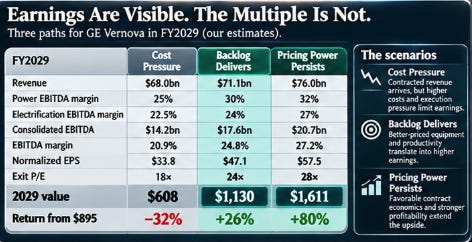
Cost Pressure assumes that contracted revenue arrives but cost inflation and execution dilute profitability. Backlog Delivers assumes better-priced equipment and manufacturing productivity flow through as expected. Pricing Power Persists adds stronger profitability across Power and Electrification. The revenue range is relatively narrow because much of the factory schedule is committed; margins and the exit multiple drive the differences.
Backlog Delivers implies a 30% Power margin versus 26.3% in consensus, but a 24% Electrification margin versus the Street’s approximately 24.6%. The resulting $47.1 EPS is only about 4% above consensus. At 24 times earnings, the $1,130 value offers 26% upside over three years, around 8% annualized before dividends. A 20-times multiple on identical earnings would yield $942; 26 times would yield $1,224.
Cash and capital allocation matter to that calculation. GEV generated $15.3 billion of free cash flow over nine months, aided by $19.5 billion of operating inflows from contract liabilities and deferred income. Customer advances finance growth but are not recurring profits. GEV has repurchased approximately $9.9 billion of stock through October 23, leaving roughly $10.1 billion authorized; at $895, that would retire about 11 million shares before dilution. The central scenario’s 255 million diluted shares therefore require continued repurchases, while roughly $4.5 billion of cash funding for Trench and foregone interest income constrain the benefit.
I would hold at $895 rather than chase the stock. Below $800, the same central valuation would offer approximately 12% annualized upside before dividends, a more attractive reward for the remaining execution and multiple risks.
The Next Test
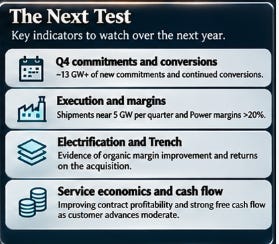
Q4 should bring approximately 13 gigawatts or more of new commitments and continued conversions. More useful still will be the profitability added to equipment backlog: management expects the 2026 figure to be substantially greater than 2025’s roughly $8 billion. Through 2027, shipments near five gigawatts per quarter and Power margins above 20% would support the earnings ramp; sustained margin deterioration despite healthy volumes would challenge it.
Electrification must demonstrate organic improvement, and Trench must eventually earn its purchase price. Service economics also warrant attention: the 10-Q records $293 million of adverse changes in estimated long-term service-contract profitability over the first nine months. Finally, free cash flow must remain strong when customer advances moderate.
GEV is operationally stronger than it was in July. The backlog is firmer, the delivery calendar stretches further, and better-priced equipment is already improving earnings. But consensus recognizes much of that progress. At $895, the prospective return is reasonable rather than exceptional.
The order cycle may be maturing, but the earnings cycle is only beginning to deliver. That is the distinction Q3 establishes, and the one that matters for the next three years.
Disclaimer:
The content does not constitute any kind of investment or financial advice. Kindly reach out to your advisor for any investment-related advice. Please refer to the tab “Legal | Disclaimer” to read the complete disclaimer.