


TL; DR
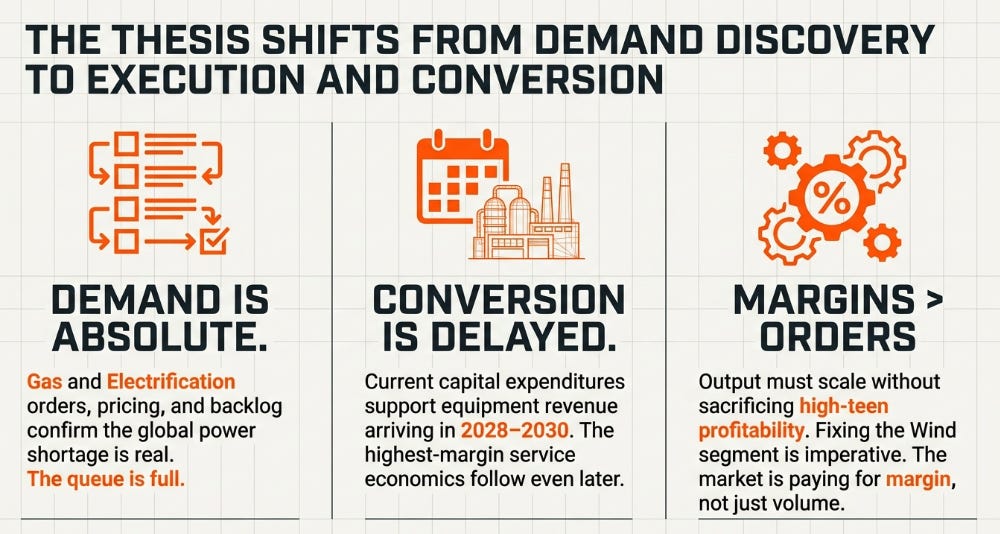
Demand is no longer the debate. Gas and Electrification orders, pricing and backlog confirm that the power shortage is real and global.
The conversion arrives later. Today’s spending supports equipment revenue from 2028–2030, while the higher-margin service economics follow after delivery.
Margins now matter more than orders. The next phase of the thesis depends on GEV expanding output, fixing Wind and preserving high-teen to low-20s profitability.
“We now see further opportunity to serve this growing demand with 30 gigawatts of annual output in 2030…all funded by customer down payments.”
— Scott Strazik
Three months ago, after GE Vernova’s first-quarter results, we wrote down a test for the thesis:
“The thesis strengthens if Electrification grows faster than Power while services backlog compounds. It weakens if orders stay high but margins plateau—that would signal scarcity without conversion, which is a cycle, not a franchise.”
On July 22, GEV reported $24.2 billion of orders, up 88% organically, and left its adjusted EBITDA margin guidance at 12% to 14%. The stock fell 8.7%.
By our own test, the thesis appeared to weaken.
I do not think it did. I think the test was wrong.
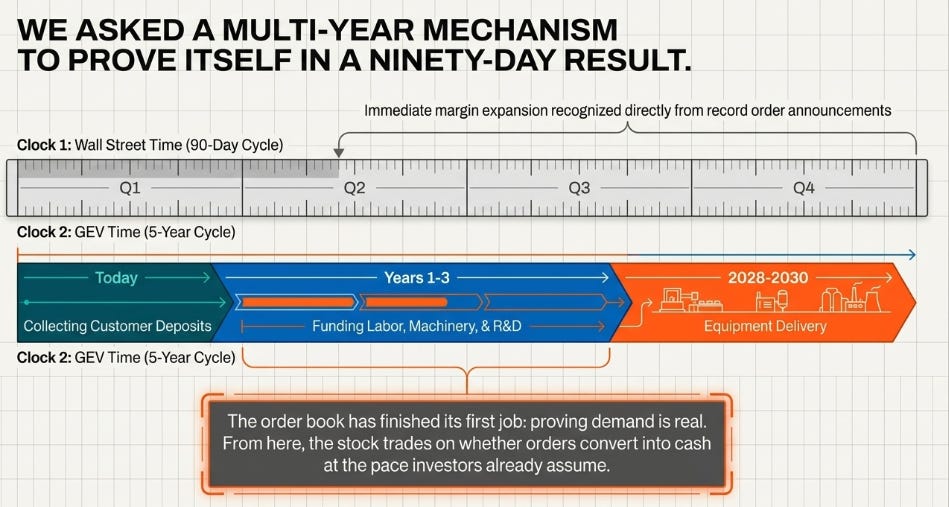
We assumed that the orders being signed today and the margins being reported today belonged to the same economic period. They do not. The gas equipment GEV is now pricing more than 20% above its late-2025 order book will largely reach revenue from 2028 through 2030. The revenue reported this quarter came from older contracts, while the labor, machinery, inventory, research spending, and supplier commitments needed to deliver the new backlog are being paid for now.
We asked a multi-year mechanism to prove itself in a ninety-day result.
That does not mean the financial miss was irrelevant. It means the order book has finished doing its first job. It proved that demand was real. From here, the stock will trade on whether those orders convert into revenue, margins, and cash at the pace investors already assume.
The queue created the rerating. Conversion will determine what comes next.
The Test That Could Not Pass
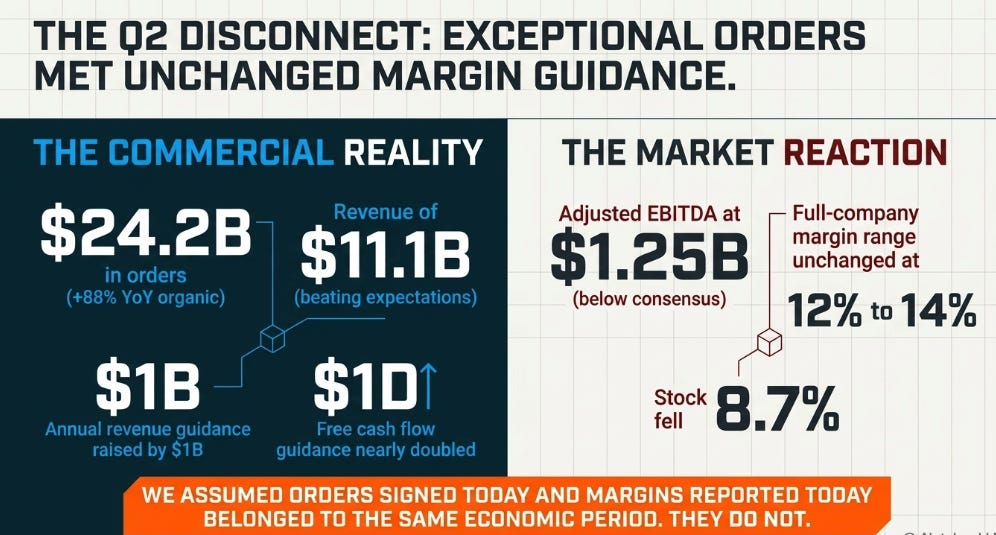
The headline result looked weaker than the business underneath it.
Revenue of $11.1 billion beat expectations, but adjusted EBITDA of $1.25 billion came in slightly below consensus. The company raised annual revenue guidance by $1 billion and almost doubled free cash flow guidance, yet kept its company-wide margin range unchanged.
That was the table investors read, and it was the right table to read. GEV is valued on the assumption that a large backlog will become a much more profitable company. More orders without a higher margin outlook do not automatically raise that future value.
Yet the segment results did not show a failure to convert. Power’s EBITDA margin reached 18.8%, up 240 basis points. Electrification’s organic margin reached 19.1%, up 700 basis points. The two businesses at the center of the thesis were already operating around the level that GEV targets for the whole company.
The gap sat elsewhere. Wind lost $275 million in the quarter, corporate costs remained meaningful, and equipment grew much faster than services. Equipment revenue rose 32% to $6.5 billion, while services grew 10% to $4.6 billion. Equipment increased from 53.7% of revenue a year ago to 58.2%.
That mix does not mean equipment is unattractive. Power and Electrification show that well-priced equipment can earn high-teen margins. It means that the higher-margin service revenue created by these shipments arrives later, while the cost of producing the equipment arrives first.
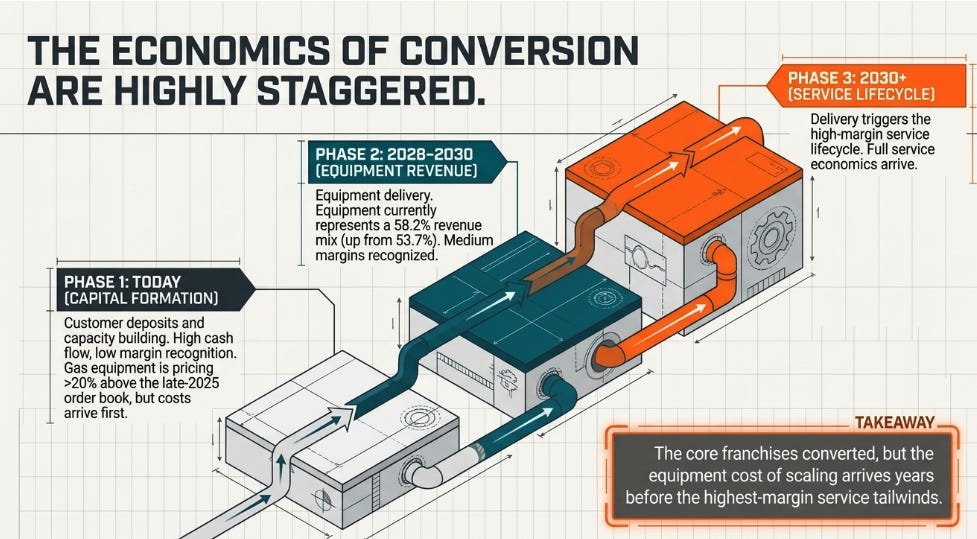
The core franchises converted. The portfolio did not.
This is a more demanding conclusion than blaming the market for being short-term. The market is already paying GEV for much of the future service value. It is entitled to ask when that value becomes visible in consolidated earnings.
Can GEV Scale Scarcity?
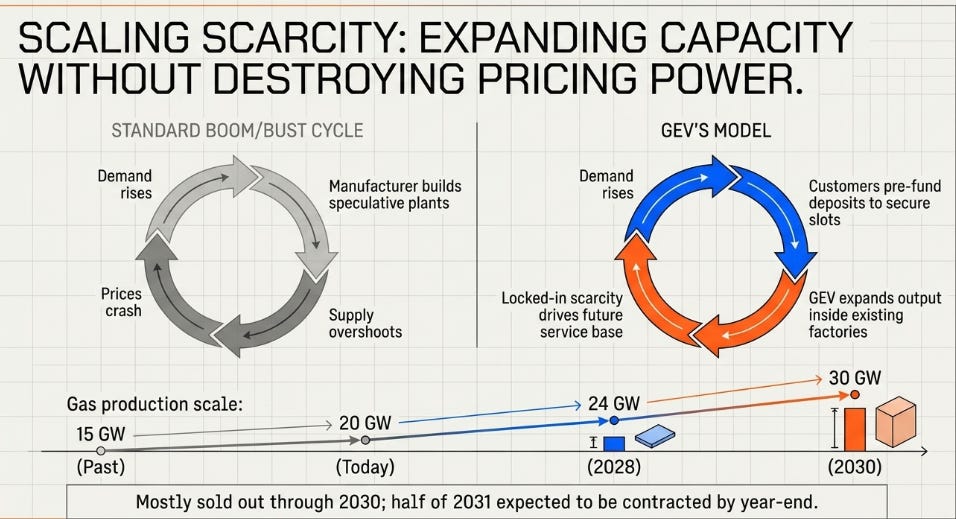
The new question raised by the quarter is not whether demand remains strong. It is whether GEV can double output without building away the shortage that created its pricing power.
Industrial booms usually contain the mechanism that ends them. Demand rises, prices increase, manufacturers add capacity, supply catches up, and returns return to normal. The producer benefits from the shortage and then helps solve it.
GEV is trying to reverse that sequence.
Customers are reserving capacity before GEV builds it. They are accepting higher prices and paying deposits that help fund machinery, inventory, and supplier commitments. The company then adds output inside an existing factory network rather than building speculative plants and hoping the demand arrives.
Gas production is moving from roughly 15 gigawatts annually to a 20-gigawatt rate now, 24 gigawatts in 2028, and 30 gigawatts in 2030. GEV expects to be mostly sold out through 2030 and to have more than half of 2031 capacity contracted by the end of this year.
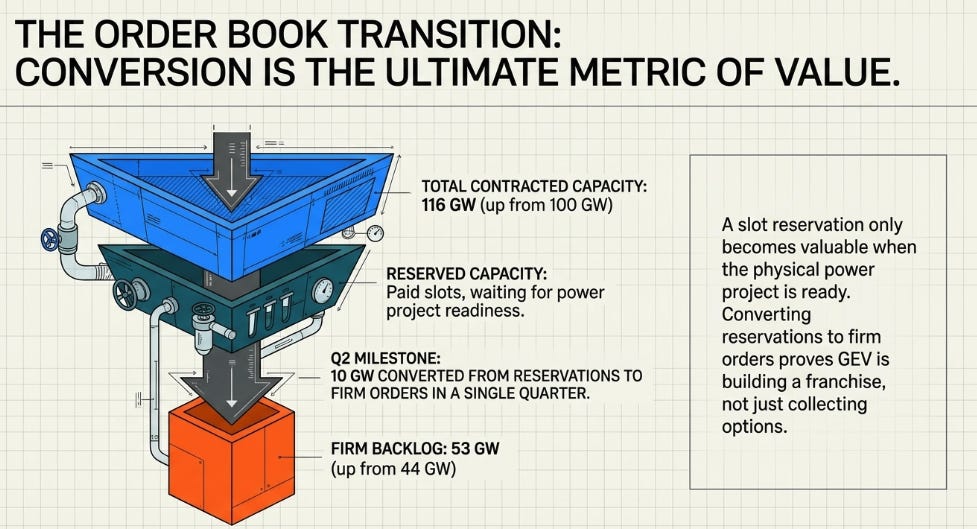
The commercial evidence remains unusually strong. GEV signed 20 gigawatts of new gas contracts and reservations during the quarter while shipping 3 gigawatts. Contracted capacity rose from 100 to 116 gigawatts, and management raised its year-end target to at least 125 gigawatts. First-half gas equipment orders were priced more than 20% above fourth-quarter 2025 orders.
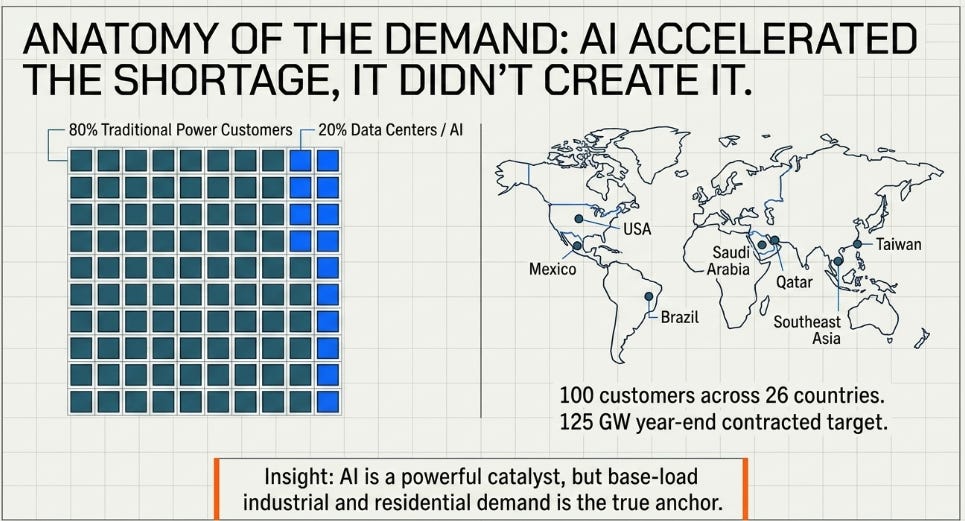
The demand is also broader than the easy AI framing. Roughly 80% of contracted gas capacity comes from traditional power customers, with data centers accounting for 20%. The order book spans about 100 customers across 26 countries. Management discussed demand in Taiwan, Saudi Arabia, Mexico, Qatar, Southeast Asia, Brazil, and the United States. AI accelerated the shortage; it did not create the entire need.
The capacity plan may therefore strengthen the loop rather than end it. Much of the output is sold before the capital is committed, customers provide part of the funding, and every turbine delivered enlarges the future service base.
Still, the risk has changed. It is no longer mainly demand discovery. It is execution.
GEV must train workers, secure castings and forgings years ahead, preserve quality as factory output rises, and coordinate with engineering contractors, pipelines, permits, and grid connections. A reservation only becomes valuable when the rest of the power project is ready.
The move from slot reservations into firm backlog is therefore more important than another record order headline. GEV converted 10 gigawatts of reservations into orders during the quarter, lifting firm gas backlog from 44 to 53 gigawatts. Management expects firm backlog to exceed reserved capacity as more projects mature.
That is the first test of whether GEV is scaling scarcity or simply collecting options on a distant future.
When Orders Stop Telling the Truth
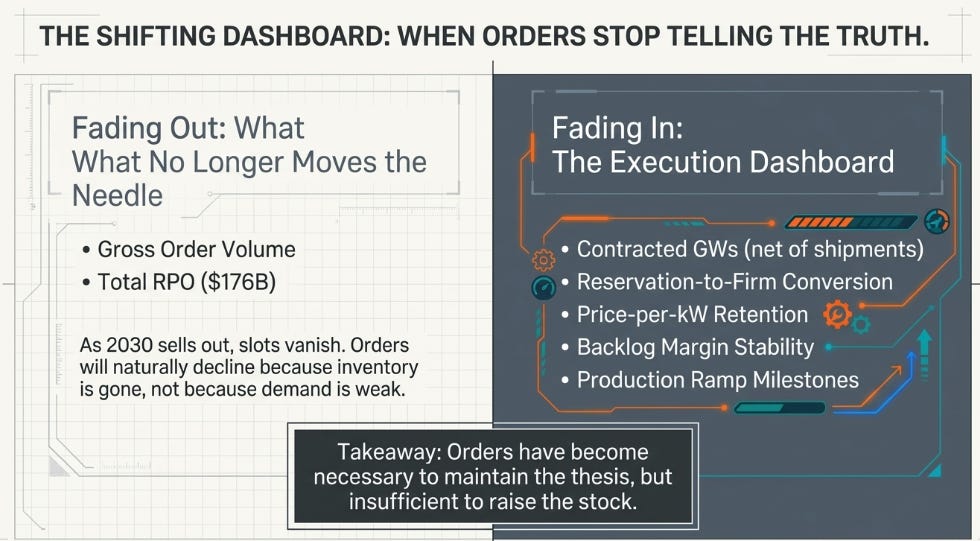
Orders have been the clearest evidence of GEV’s change since the spin. Quarterly orders rose from $9.7 billion in early 2024 to $24.2 billion in the latest quarter. Total RPO increased from $116 billion to $176 billion, while equipment RPO more than doubled.
That metric will become harder to read.
Once 2030 is mostly sold and 2031 begins filling, GEV has less near-term capacity left to book. Orders may decline because there are fewer available slots, not because customers have disappeared. Reported order growth can weaken at the same time that shipments accelerate, backlog pricing improves, and the installed fleet expands.
This matters because the next bearish argument is easy to anticipate. At some point, quarterly gas orders will fall from today’s exceptional level. That decline will be presented as evidence that the cycle has peaked.
Sometimes it will be.
But the correct dashboard is changing. The questions should become: are contracted gigawatts rising after accounting for shipments? Are reservations converting into firm orders? Is pricing per kilowatt holding? Are backlog margins intact? Is the production ramp on schedule? Are Power and Electrification retaining the economics as volume rises?
The order book now has an asymmetric role. Another record quarter may add little because strong demand is accepted. A sharp slowdown in commitments, weaker pricing, or stalled conversions would matter a great deal because those developments would challenge the duration supporting the valuation.
Orders have become necessary for maintaining the thesis, but insufficient for raising the stock.
The market has already paid GEV for winning the queue. From here, it will pay or punish the company for converting it.
Honest in Both Directions
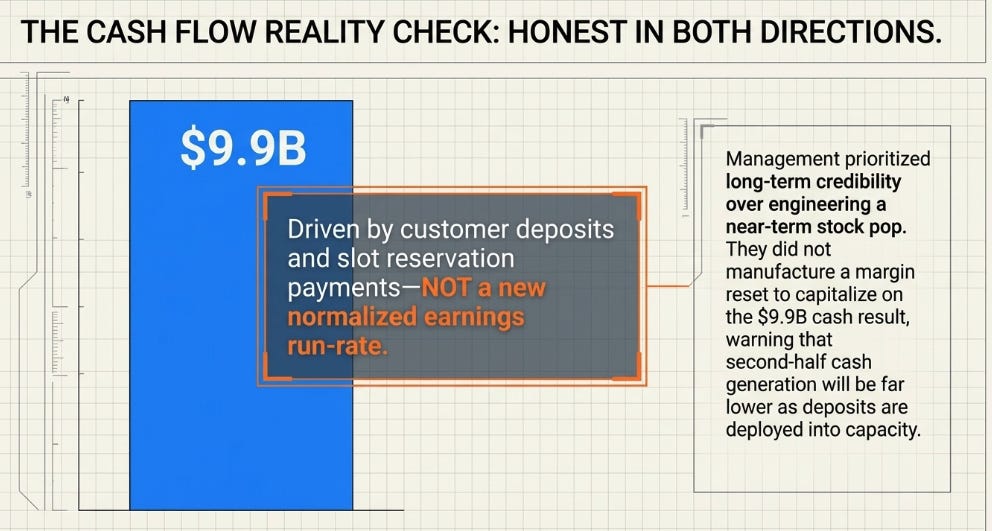
The call contained an unusual contrast.
GEV generated $5.1 billion of free cash flow in the quarter and $9.9 billion in the first half. Ken Parks could have allowed investors to treat that as a new earnings run rate. Instead, he explained that customer deposits and slot reservation payments drove much of the result, and that second-half cash generation would be far lower.
Scott Strazik then spent the call describing 2030 production, 2031 contracting, and service capacity needed in the middle of the next decade. He did not offset the caution on cash by manufacturing a near-term margin reset.
A more promotional management team could have narrowed the margin range to 13% to 14%, allowed the market to capitalize the first-half cash result, and dealt with the consequences later. GEV did neither.
That does not mean management communicated poorly. It means the company itself is operating on the longer clock. It appears more interested in being right about the capacity plan than in producing the cleanest possible quarterly reaction.
The 8.7% decline was partly the price of that choice.
The guidance arithmetic explains the disappointment. Revenue guidance increased by $1 billion, while the midpoint of the margin range stayed near 13%. That implies roughly $130 million of EBITDA on the additional revenue, an incremental margin close to the corporate average. A stock valued on fast margin expansion wanted more.
Yet the guidance table describes revenue being recognized in 2026, not the economics being contracted for 2028 through 2030. It can be accurate about this year and incomplete about the business being built inside the backlog.
Both clocks are real.
The Core Converted. The Portfolio Did Not.
Electrification now deserves to be treated as a second earnings engine rather than a supporting business.
Organic revenue grew 29%, organic EBITDA margin reached 19.1%, and equipment backlog passed $40 billion. Data-center orders exceeded $5 billion in the first half, more than twice the total booked during all of 2025. None of that requires solid-state transformers or medium-voltage uninterruptible power systems to succeed. Those products remain future possibilities rather than current earnings.
Power also showed that higher output need not destroy margin. Revenue grew 14%, EBITDA rose 31%, and the segment margin reached 18.8% while GEV continued hiring, adding machinery, and spending on capacity and research.
Wind remains the counterexample inside the same company.
First-half Wind losses reached $657 million, yet management retained its full-year expectation of roughly $400 million of losses. That requires about $257 million of positive EBITDA in the second half. Third-quarter Wind EBITDA is expected to be around breakeven, leaving a demanding fourth-quarter bridge.
Management has an explanation: more second-half deliveries, better tariff protection, improving Onshore service profit, and lower Offshore project costs. The plan is plausible. It is not proven.
Wind matters beyond its direct earnings drag. It shows how physical complexity can consume the value of a good market through poor contracts, policy changes, installation delays, and project costs. It is a reminder that backlog does not become shareholder value by itself.
The next quarter will therefore test two types of credibility at once. Gas and Electrification must show that GEV can expand capacity while retaining price. Wind must show that management can contain the part of the portfolio where physical execution has repeatedly overwhelmed the plan.
The Cost of the Long Clock
The business thesis strengthened during the quarter. Customer diversity is broader than expected, gas pricing is better, reservation conversion is progressing, and Power and Electrification are already producing high-teen margins.
The stock thesis is less straightforward.
At $1,017, GEV is already valued on the assumption that the long clock works. Bloomberg’s pre-print estimates expected adjusted EBITDA margin to rise from about 13.7% in 2026 to 18% in 2027 and 21.5% in 2028. The Street is not waiting to discover conversion. It is underwriting a fast version of it.
My base case sits between that optimism and the view that equipment mix delays the margin story until well after 2029.
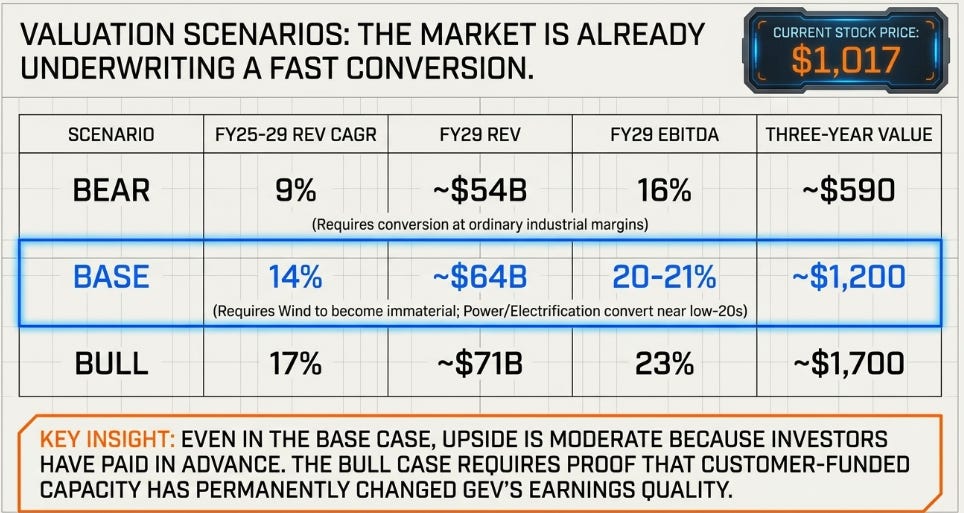
The base case assumes GEV broadly meets its long-term plan, Wind becomes immaterial, and Power and Electrification convert higher-priced backlog near low-20s margins. Even then, the expected return from $1,017 is moderate because investors have paid in advance for much of the improvement.
The bear case does not require an electricity-demand collapse. It requires conversion at ordinary industrial margins. The bull case requires evidence that services, Electrification, and customer-funded capacity have changed the earnings quality of the company, rather than simply enlarged its equipment business.
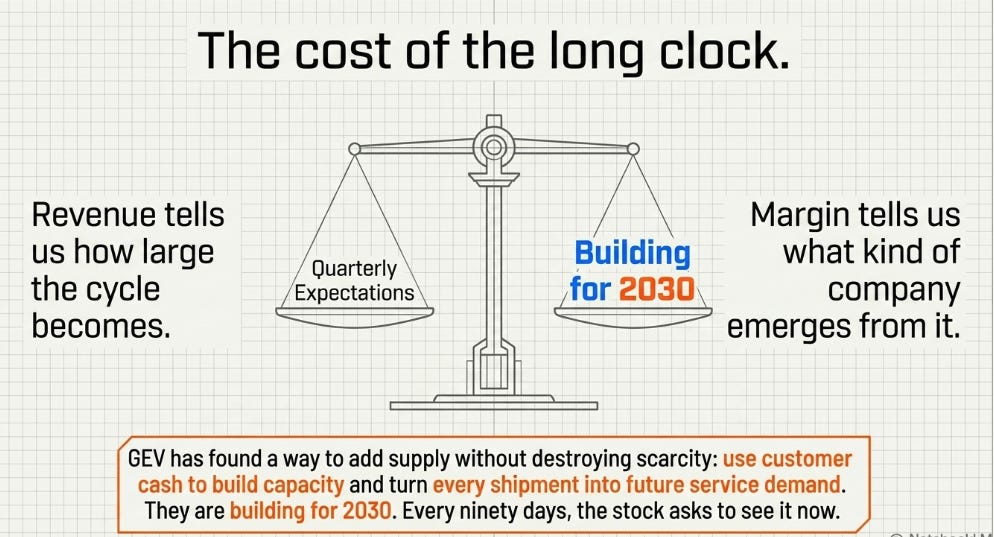
That is why margin matters more than another order record. Revenue tells us how large the cycle becomes. Margin tells us what kind of company emerges from it.
In April, we thought strong orders without faster margin expansion would tell us that scarcity was failing to convert. The second quarter showed that conversion is not absent. It is arriving on a different schedule.
GEV may have found a way to add supply without immediately destroying scarcity: sell the capacity first, use customer cash to help build it, and turn each shipment into future service demand. But the spending comes first, the equipment revenue follows, and the full service economics arrive later still.
Management is building for 2030.
Every ninety days, the stock asks to see it now.
Disclaimer:
The content does not constitute any kind of investment or financial advice. Kindly reach out to your advisor for any investment-related advice. Please refer to the tab “Legal | Disclaimer” to read the complete disclaimer.