


TL; DR
The pricing mechanism changed: Ibiden had historically assumed routine quarterly price reductions. In Q1, like-for-like prices held flat while new products reset higher, turning manufacturing difficulty into direct pricing power rather than merely richer product mix.
Customers are financing the scarcity: advance payments surged from ¥81.0 billion to ¥154.5 billion as customers continued asking Ibiden to build as much capacity as possible despite competing expansion elsewhere.
The remaining question is durability: Q1 shows that customers will pay for Ibiden’s capability today. The real test is whether pricing, margins and ROIC remain elevated after Cell 6, Cell 8 and competing capacity arrive. That determines whether Ibiden is a cyclical beneficiary, a compounder, or genuine infrastructure.
In April, I wrote that the core question about Ibiden was not whether AI substrates were getting harder, they obviously were, but whether that difficulty would compound into Ibiden’s economics or merely force the company to spend ever more capital to stay relevant. I framed three classifications: Cyclical, Compounder, Infrastructure. I identified customer advance payments as the leading indicator. And I said that if advances kept rising, the market had underestimated what Ibiden was becoming.
In May, the results offered a partial answer. The profit bridge showed a fourteen-to-one ratio of value to volume in the Electronics OP revision, ¥20.5 billion from ASP and product mix versus ¥1.5 billion from volume. Difficulty was entering the P&L. But the advance payment balance declined, from ¥92.1 billion to ¥81.0 billion, and I confronted that honestly: “I set the signpost. The direction was wrong. That deserves weight.” My classification: Compounder, with optionality toward Infrastructure. Check back in two quarters.
One quarter later, the evidence moved further than I expected, and differently from how I expected. I was right about the mechanism. I was wrong about the magnitude, and about the channel through which it would express itself. The gap between what I anticipated and what happened is where this article lives.
When the Price-Down Stopped
For most component manufacturers, productivity comes with an implicit obligation. The supplier learns how to make the product more efficiently, and the customer claims part of that improvement through regular price reductions. Ibiden’s own planning model reflected this convention. Every quarter, management assumed another price-down. In May, I wrote that the resolution of Ibiden’s pricing tension would probably come through mix rather than rate, each generation’s substrate larger, more complex and higher-priced, even if the pricing on any given product stayed disciplined. I cited CEO Kawashima’s statement that the company did not want to increase prices “beyond the standard zone” and framed this as the TSMC playbook: restrained pricing for long-term incumbency.
Q1 broke that framework.
Goldman Sachs’ Daiki Takayama asked management to decompose the ¥26.5 billion ASP and product mix contribution in the new Electronics OP revision. Shinji Miyazaki, the Director and Senior Executive Officer, was direct:
“According to our business plan, every quarter, we incorporate a price reduction. Because of our past engagement with the customers, we reflect that price reduction. However, in the negotiations since 11th of May, this price decline curve became less steep, or in some cases, we didn’t have to reduce the price throughout our negotiation.”
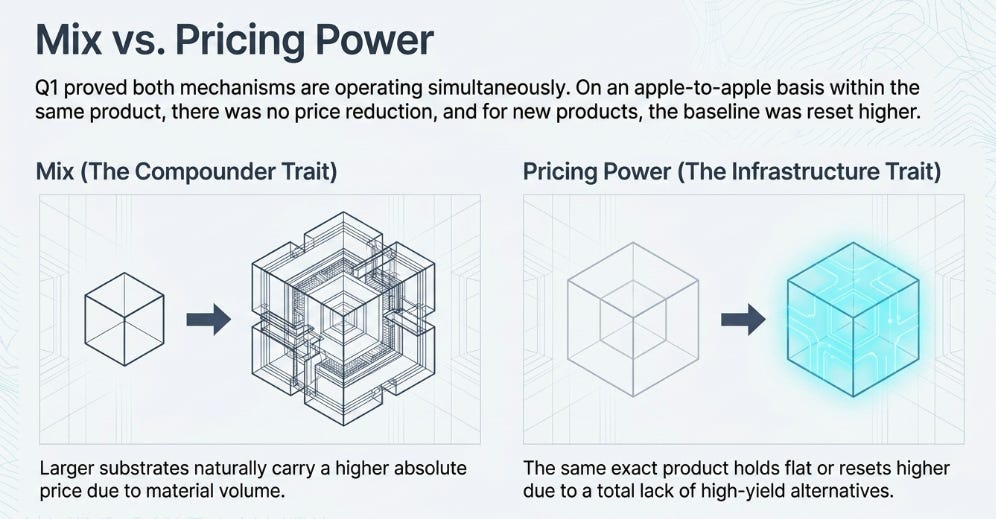
Takayama pressed to confirm his understanding: on an apple-to-apple basis within the same product, there was no price reduction, and for new products, the pricing was reset higher?
“Yes. Your understanding is correct.”
The quarterly price decline curve, the economic gravity of the ABF substrate industry, the assumption encoded in every sell-side model, in management’s own May 11 guidance, in my own May framework, stopped functioning. On existing products, prices held flat. On new products, the baseline was reset higher. JP Morgan confirmed that most of the ¥26.5 billion was pure ASP, not product mix. The combined effect was operating profit that was in nobody’s plan three months ago, including Ibiden’s.
A larger, more complex substrate naturally carries a higher absolute price because it contains more material and processing. That is mix. A customer abandoning the expectation that the same product gets cheaper every quarter is something else. That is bargaining power.
I had the right mechanism. Difficulty was compounding into economics, exactly as the yield-learning loop predicted. But I assumed it would express itself indirectly, through mix. What actually happened was more direct: the difficulty entered the price line itself, because at the highest complexity tiers, customers concluded they had no practical alternative at comparable yield and quality, and they stopped negotiating as though they did.
This distinction matters for classification. Mix-driven margin expansion is a Compounder characteristic, the products get harder and more valuable, but any given product remains competitively priced. Price-driven margin expansion suggests something closer to Infrastructure, the capacity itself becomes the scarce asset. Q1 showed both operating simultaneously.
Capacity Is Not Capability
The conventional response to high prices is more supply. Ibiden is investing. Unimicron, AT&S, Samsung Electro-Mechanics and others are investing. Eventually, the argument goes, capacity will arrive and margins will normalize.
That argument treats all capacity as equivalent.
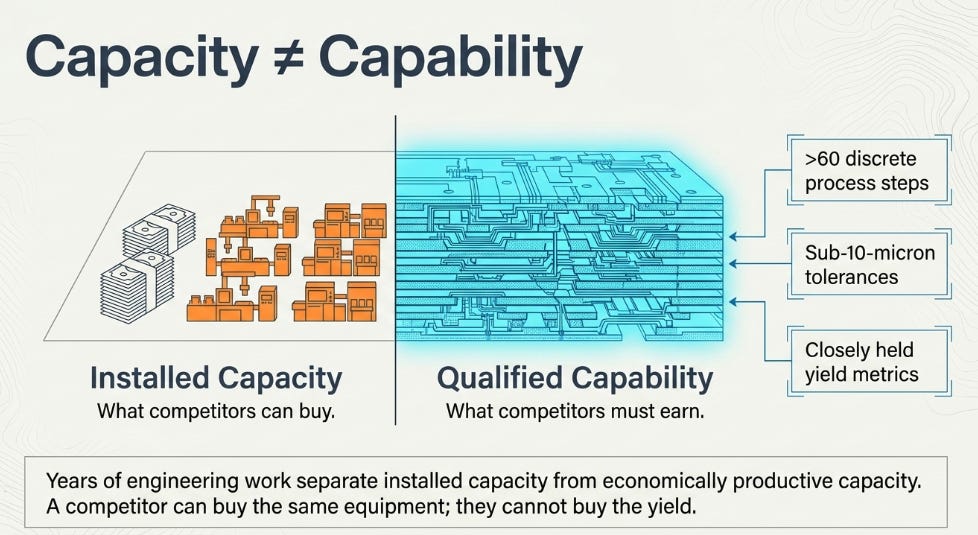
It is not. Installed capacity, qualified capacity and economically productive capacity are three different things, separated by years of engineering work and yield learning that capital alone cannot compress. An advanced AI substrate requires twenty-plus routing layers built across more than sixty discrete process steps at sub-ten-micron tolerances. Cumulative yield for the most demanding specifications is substantially lower than for prior generations, and the exact numbers are closely held. A competitor can buy the same equipment. They cannot buy the yield.
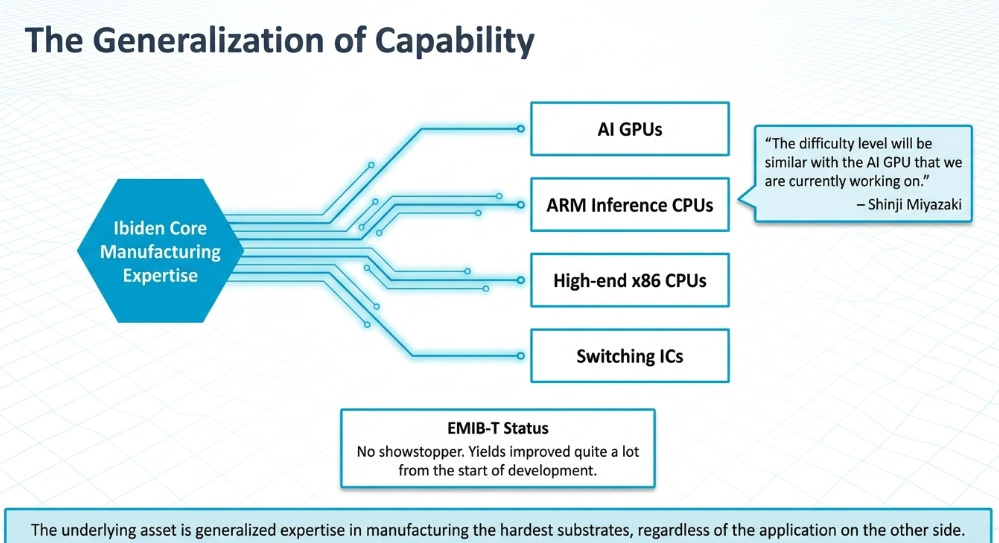
The more important development in Q1 was that this capability appears to be generalising. Ibiden is no longer responding only to GPU demand. UBS’s Shingo Hirata asked whether ARM-based CPU substrates would carry comparable complexity and margin to GPU products. Miyazaki’s answer:
“The difficulty level will be similar with the AI GPU that we are currently working on.”
High-end x86 CPUs, ARM inference CPUs and switching ICs are now consuming the same scarce manufacturing capability as GPU substrates. EMIB-T adds silicon-bridge embedding, higher power delivery and more complicated core structures. When Mizuho’s Fumihide Gotoh asked whether EMIB-T faced any barriers that might prove insurmountable at mass manufacturing scale, Miyazaki said there was “no showstopper” and that yields had “improved quite a lot” from the start of development.
Six months ago, I framed Ibiden’s advantage as potentially GPU-specific, which carried customer concentration risk. What Q1 suggests is that the underlying asset may be more general: expertise in manufacturing the hardest substrates, regardless of the application on the other side. That broadens the addressable market without requiring new capability development.
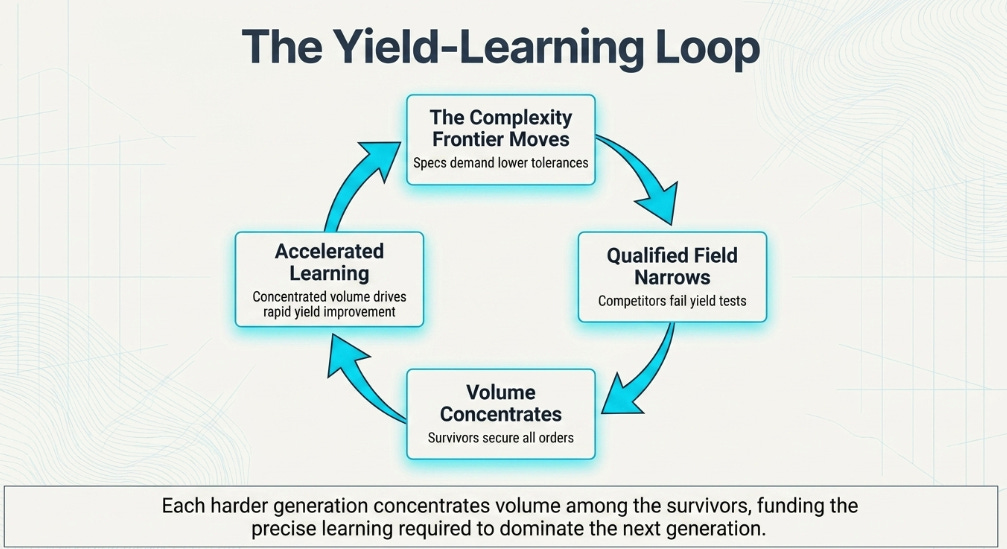
Our thesis is not that competition does not exist. It is that the complexity frontier may be moving faster than competitors can close the qualification gap. Each harder generation narrows the qualified field, concentrates volume among the survivors, and accelerates the learning that wins the next generation. That mechanism, which I described in April, received its most direct financial confirmation in Q1.
What the Customers Are Saying
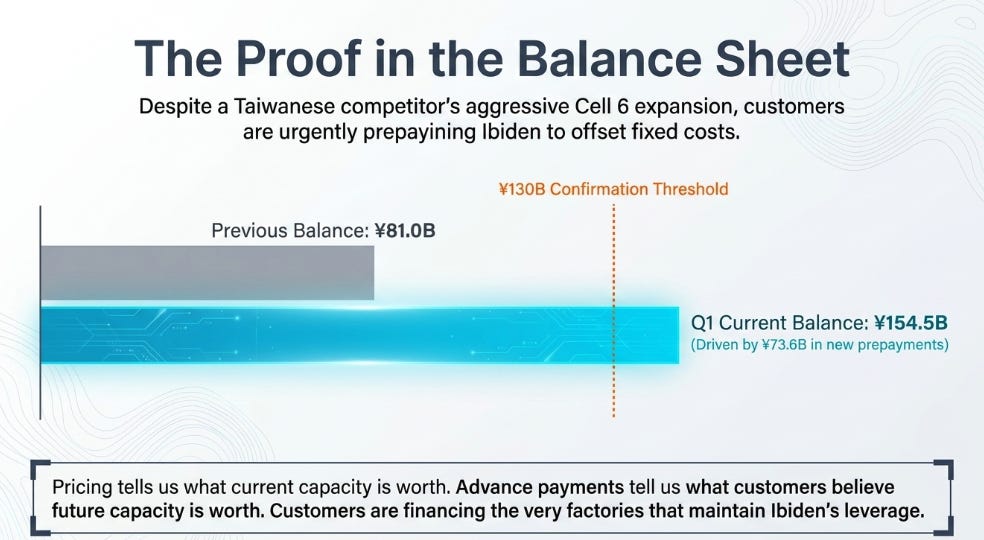
The balance sheet told a clearer story than the earnings release.
Customer advance payments rose from ¥81.0 billion to ¥154.5 billion during the quarter, driven by ¥73.6 billion of new prepayments. In April, I set ¥130 billion as the confirmation threshold and ¥70 billion as the reassessment floor. In May, I tightened to ¥90 billion after the decline. The balance is now ¥154.5 billion, through both thresholds, and decisively.
Nomura’s Manabu Akizuki asked whether a Taiwanese competitor’s aggressive expansion had made customers more reluctant to prepay. Miyazaki:
“Customers’ stance hasn’t changed from the Cell 6 situation. Taiwanese company is working very hard to grow their businesses. We understand that as well. At the customer side, it’s not that customers have become tougher and has become hesitant to pay the advance payments. We still see strong demand coming from them, we are asked to build the capacity as much as possible. That tone or nuance has remained the same.”
Customers see the competition being built. They are still prepaying Ibiden. That is not how you treat a supplier you expect to have leverage over in eighteen months.
When Citi’s Takayuki Naito asked whether Ibiden would offset the fixed costs of new capacity through customer prepayments, Miyazaki confirmed: “As much as possible, we’d like to receive the advance payments to compensate for the increase in the fixed costs.” Customers absorb part of the investment risk while Ibiden retains the manufacturing economics. That is an unusually favourable capital structure for a manufacturing supplier.
Pricing tells us what current qualified capacity is worth. Advance payments tell us what customers believe future qualified capacity will be worth. Both are moving in the same direction.
The Miss Was in the Model
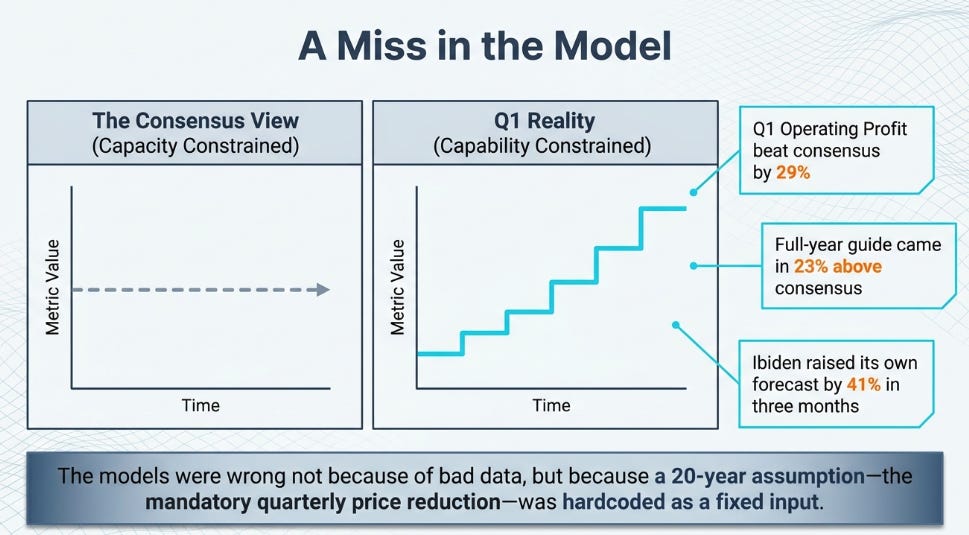
Q1 operating profit beat consensus by 29%. The full-year guide came in 23% above consensus. Ibiden itself raised its forecast by 41% in three months.
The failure was not primarily one of information. Sophisticated investors knew AI demand was strong. They knew capacity was tight. They knew Ono was improving and that customers were asking about future supply. The physical facts were hardly secret.
A channel check saying that every factory is full can lead to two conclusions. The first is that volume upside is capped. The second is that allocation to the existing volume has become more valuable. The first interpretation fits the old substrate model. The second describes what happened in Q1. The data was available. The framework for interpreting it was not.
The models were not wrong because the analysts are bad. They were wrong because the quarterly ASP decline assumption, correct for two decades, had been hardcoded as a fixed input rather than modelled as a variable that could change when the market crossed from capacity-constrained to capability-constrained. Even management’s own planning system contained the old rule. The customers invalidated it, and neither the company nor the Street knew until the negotiations took place.
The more interesting implication is about the remaining variant. Several sell-side houses already model consolidated operating margins above 30% by the end of the decade. The debate is not simply whether consensus is too low on the numbers. It is whether these earnings deserve to be treated as peak-cycle earnings or as evidence of a more durable economic structure. The variant perception, in other words, is about duration, not magnitude.
Scarcity or Moat?
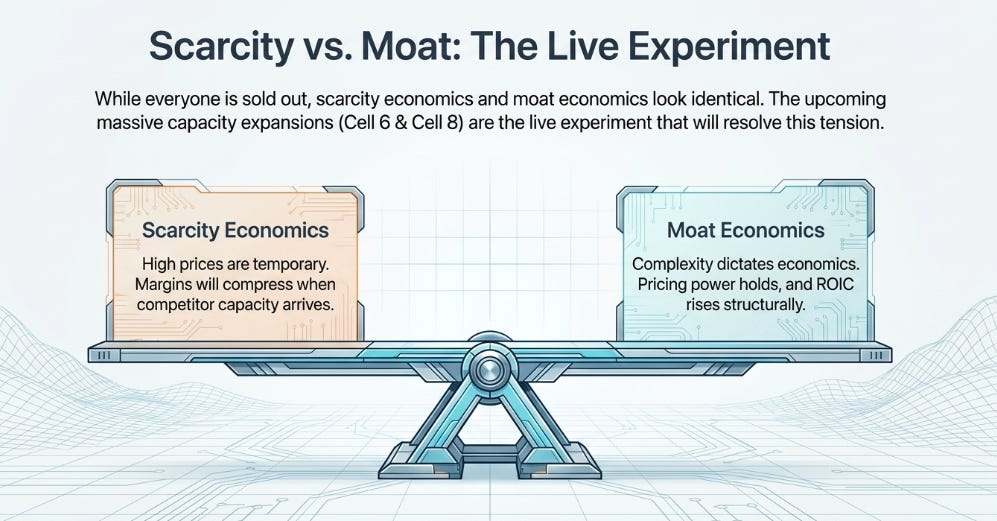
There is an uncomfortable problem with all of the evidence assembled above: scarcity economics and moat economics look almost identical while everybody is sold out.
Ibiden raising prices today does not prove pricing survives Cell 6, Cell 8 and competing capacity. Customers making advance payments today does not prove they keep doing so once credible second sources exist. Engineering scarcity today does not prove Ibiden can scale its organisation without turning its own talent constraint into a growth constraint. EMIB-T development progressing does not prove mass-production yields will generate attractive returns.
Our April question was whether difficulty compounds faster than capital consumes it. Q1 answered the first half: customers are paying for the difficulty. They are paying more for current capacity and financing the next generation of it. What they cannot answer is whether the economics survive the factories they are helping to build.
That is the experiment now underway. Ibiden is about to add substantial qualified capacity, and its competitors are doing the same. If like-for-like pricing holds, margins remain elevated and return on capital rises as Cell 6 and Cell 8 mature, then complexity rather than temporary scarcity is setting the economics. If price-downs resume and margins compress as supply arrives, Q1 will mark the most profitable shortage in the company’s history rather than a structural change in how the industry works.
In May, I said ROIC inflecting above 12% by FY2028 was “the ultimate verdict” separating a well-positioned cyclical from a structural compounder. That test has not occurred. It cannot occur yet. Everything between now and then is a leading indicator. The leading indicators are strong. But the verdict belongs to ROIC, not to a single quarter’s pricing data.
Three Futures
The scenarios below begin from Ibiden’s FY3/27 revenue guide of ¥550 billion and value the company on FY3/30 earnings. Each column answers a different version of the same question: what kind of company is Ibiden becoming? Prices are on the current pre-October 2026 split basis.
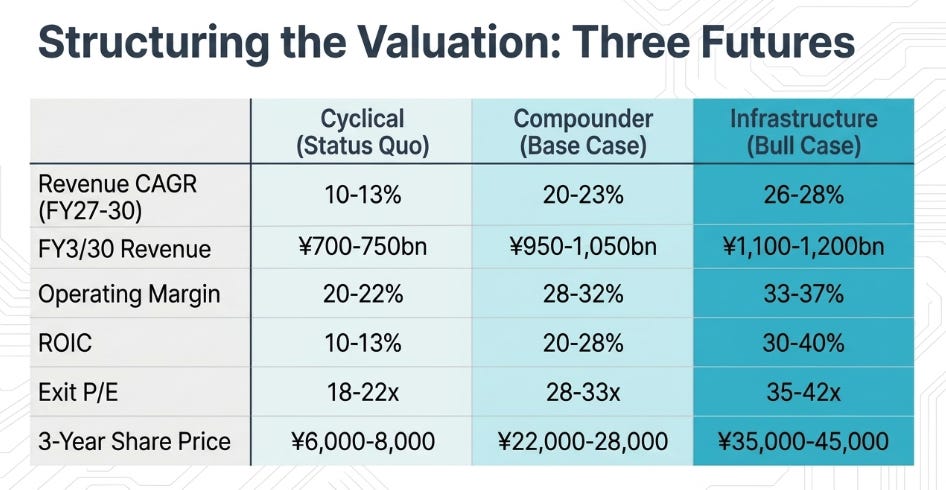
Cyclical: Complexity is real, but qualified capacity catches up. Price-downs return. The current scarcity rent is competed away as Cell 6, Cell 8 and competing capacity come online. Depreciation from the ¥210 billion annual capex program absorbs much of the margin expansion. The work keeps getting harder; the economics do not scale.
Compounder: Qualified supply remains constrained enough that like-for-like price erosion stays well below historical norms. New capacity fills. CPU and switching demand broaden the revenue base. Margins settle in the high-20s to low-30s. Customer co-funding continues around each new build. This is where the current evidence points, and it is my base case.
Infrastructure: The complexity frontier keeps moving faster than effective supply. EMIB-T succeeds at commercially viable yields. Ibiden generalises its manufacturing lead across GPU, CPU, switching and advanced bridge architectures. Margins expand even while capacity scales. ROIC rises despite the huge capital program. The market reclassifies.
What Resolves It
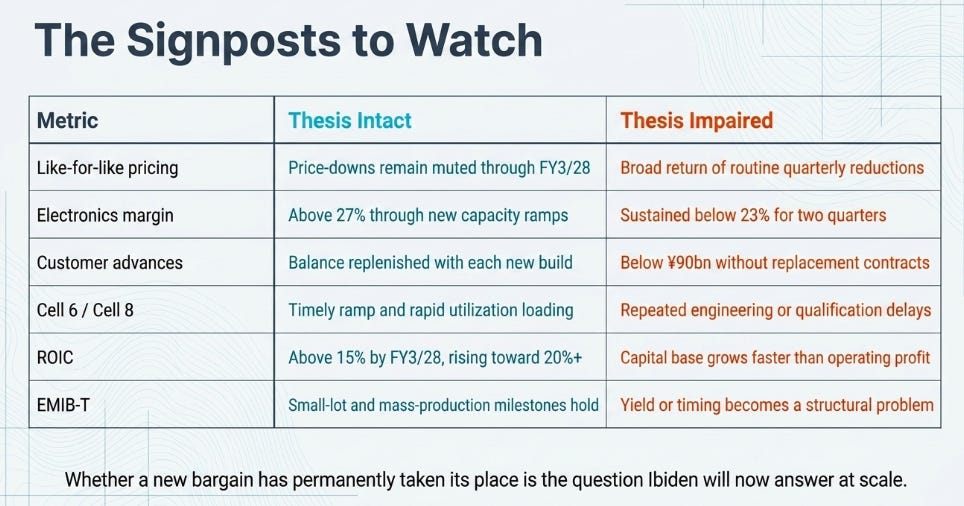
In April, I asked whether difficulty would compound faster than capital consumed it. The customers have now answered the first half of that question: they are paying more for Ibiden’s current capacity and financing the next one. The pricing mechanism that governed this industry for two decades has, for the first time, stopped functioning at the leading edge.
What the customers cannot answer is whether those economics survive the factories they are helping to build.
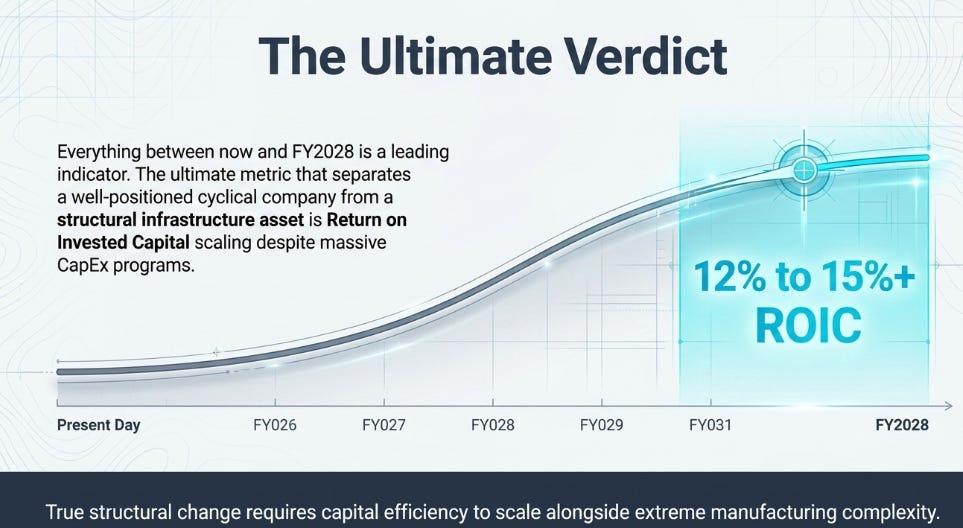
That is the experiment now underway. If pricing and returns hold as qualified supply expands, Ibiden is infrastructure. If they do not, this was an extraordinarily profitable shortage. The distinction is worth considerably more than one quarter’s earnings beat, and ROIC over the next two years will settle it.
The river in Gifu has not stopped flowing. The advance payments have spoken. The old bargain has broken. Whether a new one has taken its place is the question this company must now answer at scale.
Disclaimer:
The content does not constitute any kind of investment or financial advice. Kindly reach out to your advisor for any investment-related advice. Please refer to the tab “Legal | Disclaimer” to read the complete disclaimer.