


TL; DR
The CPU recovery is real: DCAI revenue rose 78%, operating margin reached 41.5%, Granite Rapids is margin-accretive, and capacity not demand is now the constraint in Intel’s server business. Pasted markdown
But vertical integration is still economically misaligned: Intel 3 is supply-constrained while 18A has underutilized capacity, forcing Intel to reallocate manufacturing toward the products customers want today. Node-level progress is real, but progress on one process does not automatically improve utilization or returns on another. Pasted markdown
The foundry thesis remains unproven: manufacturing capability is improving, but external foundry revenue is still small, packaging bottlenecks remain, and 14A requires substantial capital before external customer commitments are validated. The investment case now depends on synchronizing demand, process technology and capital, not merely proving that Intel can build competitive chips again.
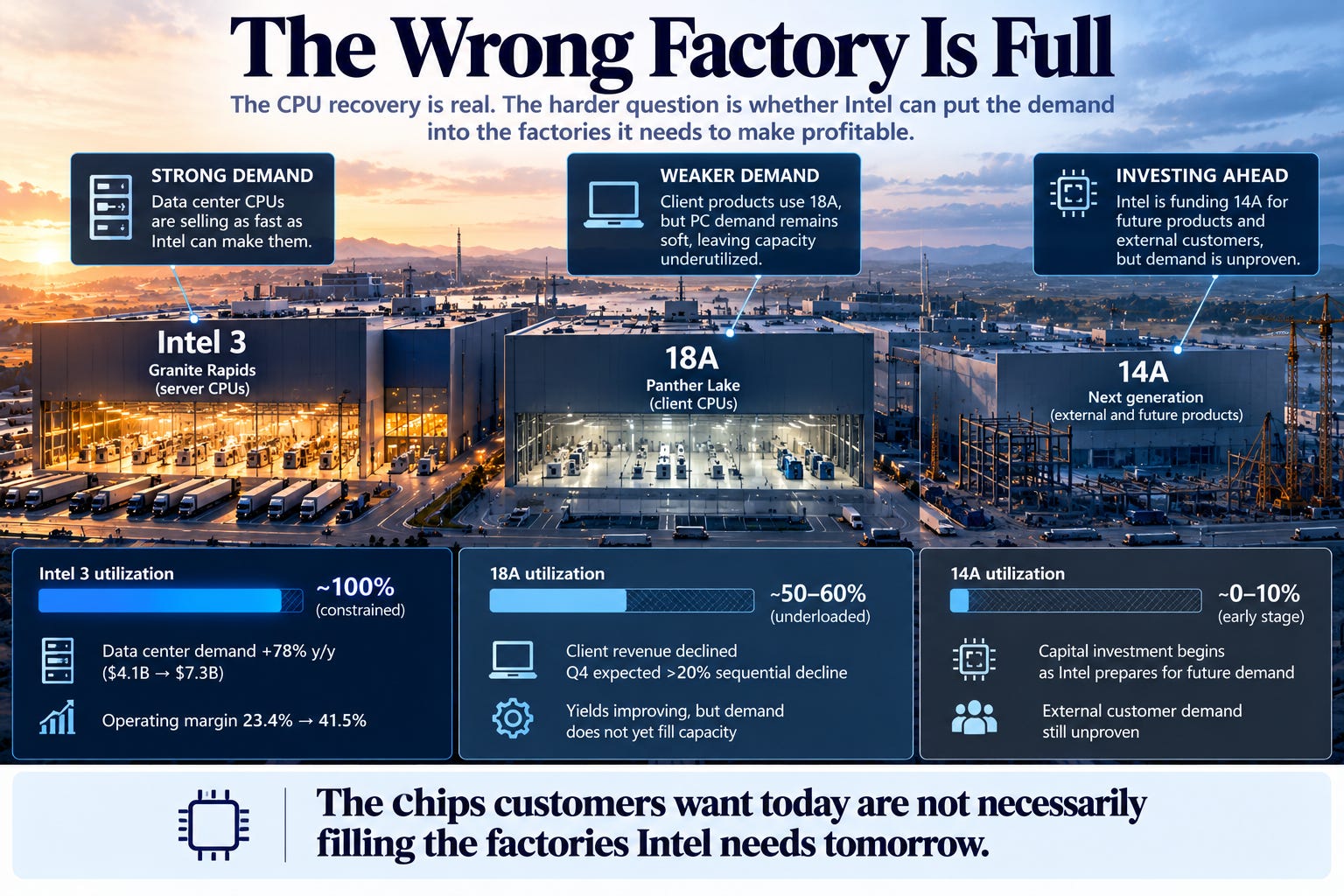
“What we’re taking offline to put Intel 3 into Oregon is 18A wafers, which we’re generally going to build Panther Lake products. We see the opportunity with some of that capacity freed up to go produce more data center wafers.”
- CFO David Zinsner, Intel Q3 2026 earnings call
I think that was the most revealing passage in Intel’s third-quarter earnings call. Intel has more demand than it can satisfy for its older Intel 3 process, and underused capacity on its newer 18A process. It is rearranging production to make the chips customers want today while funding the technologies they may want tomorrow.
The headline numbers obscured that predicament. Revenue increased 21% to $16.5 billion, non-GAAP earnings reached $0.52 per share, and the Data Center and AI business grew 78%. Yet fourth-quarter guidance of $15.0–16.0 billion was $1.6 billion below pre-earnings FactSet consensus at the midpoint, and guided gross margin fell from 44.1% to 38%. The selloff was understandable. The puzzle is why extraordinary server demand produces such an uneven earnings trajectory.
In April, I argued that Intel’s CPU thesis had arrived while its foundry thesis had not. In July, the argument advanced: TSMC’s capacity constraints and the complexity of AI systems were creating a market for a credible second manufacturing platform. Q3 doesn’t overturn either conclusion. It exposes the missing link between them: demand for Intel processors does not necessarily fill the factories Intel needs to justify.
The CPU Clock Accelerates
Intel’s CPU revival is no longer a hypothesis. DCAI revenue rose from $4.1 billion a year ago to $7.3 billion, while operating profit increased from $964 million to $3.04 billion. Roughly 65% of incremental annual revenue became incremental operating profit. Granite Rapids, Intel’s main server family, is now gross-margin accretive; capacity, rather than customer appetite, is the immediate constraint.
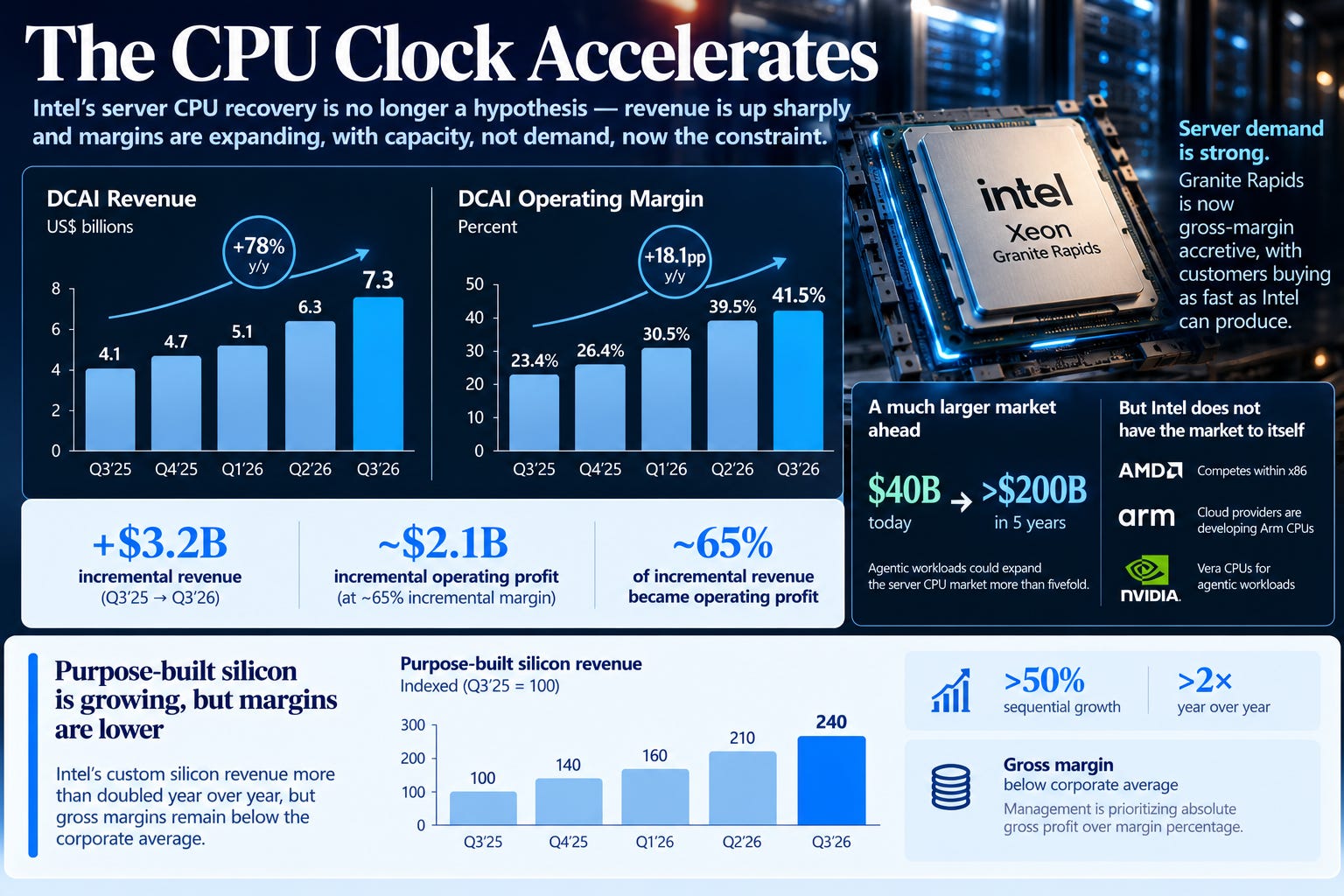
Lip-Bu Tan has given this recovery a much larger destination: he estimates that agentic workloads could expand the server CPU market from $40 billion to more than $200 billion in five years. The mechanism is plausible. GPUs handle accelerated reasoning; CPUs handle orchestration, tool execution and persistent workflows. As AI moves from answers to actions, the work surrounding each model call may expand.
Still, an expanding CPU market is not an Intel-specific moat. AMD competes within x86; cloud providers are developing Arm processors; Nvidia is selling Vera CPUs specifically for agentic workloads. Oracle illustrated the industry’s actual buying behavior in October: it announced a planned multiyear Xeon collaboration with Intel while also making Nvidia’s Vera CPUs available. Large customers want supply, flexibility and negotiating leverage, not necessarily allegiance to one architecture.
It matters inside DCAI, too. Intel’s purpose-built silicon revenue grew more than 50% sequentially and more than doubled year over year, but management acknowledged gross margins below the corporate average. Zinsner said he and Tan had decided to focus on growing absolute gross profit, even if the mix pressures margins. I agree with that priority: selling more economically valuable silicon is preferable to protecting a percentage. But Intel has not disclosed enough about custom-silicon revenue, associated design expenses or capital requirements to prove its returns will match Xeon’s.
The CPU clock is moving faster than anyone expected. What matters is how much Intel captures, and at what cost.
The Wrong Capacity Is Constrained
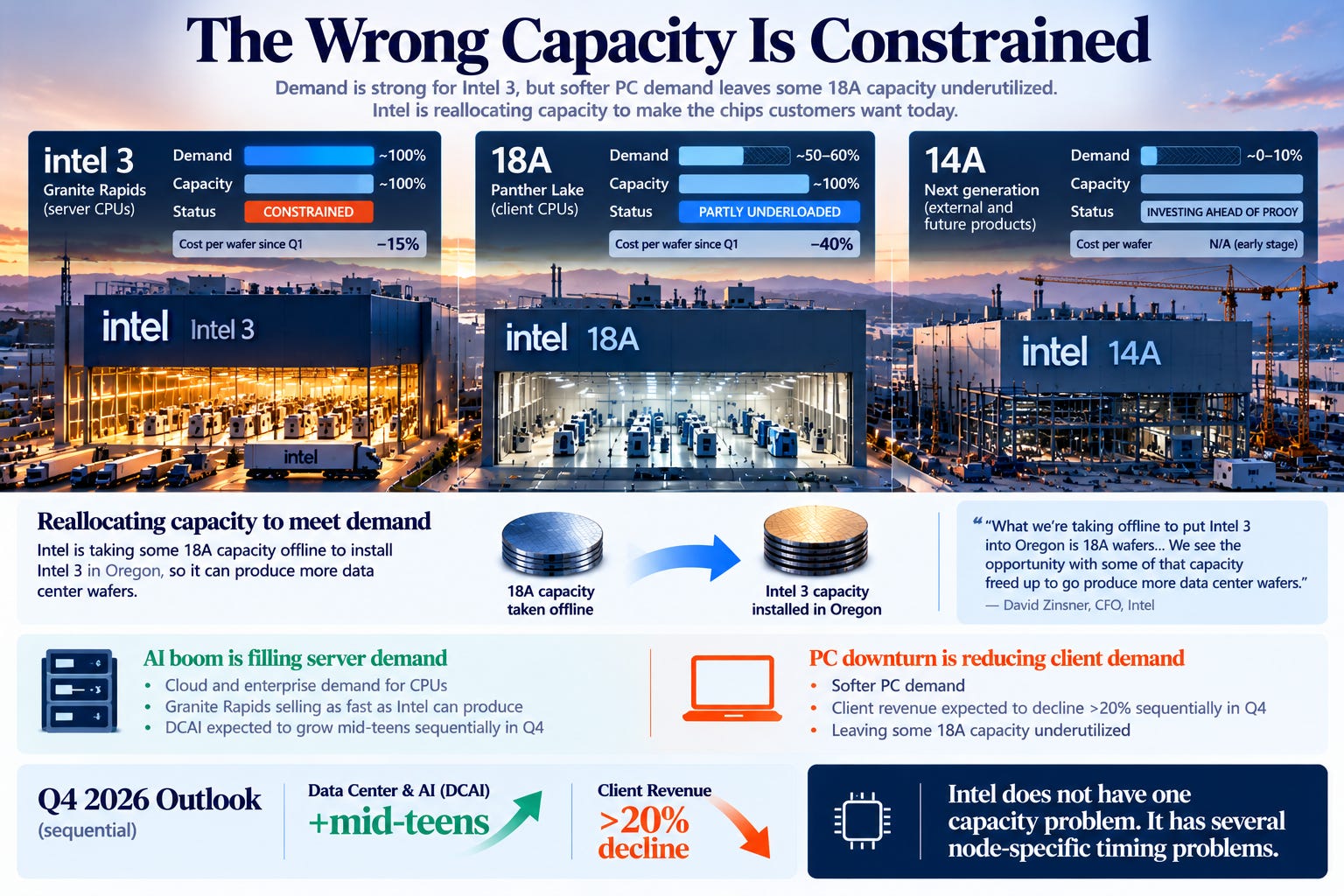
Intel spent years demonstrating the downside of vertical integration. Delayed manufacturing nodes weakened products; weaker products reduced fab loading; poor utilization raised costs further. Our July article argued that the cycle was beginning to reverse: better CPUs would fill factories, improve yields, lower unit costs and provide cash for the next process.
Q3 shows why this loop is more complicated than it looks on a diagram. Granite Rapids uses Intel 3 and sells as quickly as Intel can produce it. Panther Lake and other newer client products use 18A, where yields are improving but weaker PC demand leaves some capacity underutilized. Intel is therefore preparing to put Intel 3 into Oregon by taking some 18A capacity offline. It is a rational allocation decision, and a reminder that manufacturing learning, tooling and demand do not transfer effortlessly between nodes.
Node-level improvement is real. Intel 3 manufacturing costs have declined about 15% since Q1; 18A costs are down about 40%. Nearly one-third of client CPU revenue now comes from 18A, up from less than 5% in Q1. Yet progress on one node doesn’t fill another, nor prove external foundry economics.
The PC downturn makes the mismatch worse. AI infrastructure spending is contributing to memory shortages and higher memory prices, which are making conventional PCs more expensive just as OEMs liquidate inventory. Intel expects PC industry units to decline roughly 12% in 2026 and another 10% in 2027. Q4 client revenue is expected to fall by more than 20% sequentially, overwhelming another projected mid-teens increase in DCAI. The AI boom is simultaneously filling Intel’s server order book and emptying part of its client production schedule.
The resulting earnings leverage works both ways. At Q4 guidance midpoint, $15.5 billion of revenue and 38% adjusted gross margin imply $5.9 billion of gross profit. Deduct the guided $4.4 billion of adjusted operating expenses and operating profit falls to roughly $1.5 billion, from $3.2 billion in Q3. The Israel fab incident explains about $300 million of revenue and 200 basis points of margin pressure; it does not explain the remaining collapse in profitability.
Intel’s planned transition to 18A-P server products, including Diamond Rapids, may eventually bring demand and advanced-node capacity back into alignment. But much of the incremental Intel 3 and substrate supply is not expected until the second half of 2027. Intel is investing to exploit demand already visible while relying on future products to fill newer assets. The risk is not simply a late technology roadmap; it is that several correctly executed roadmaps still produce poor consolidated returns if their timing is wrong.
A Second Source Is Not Yet a Second Business
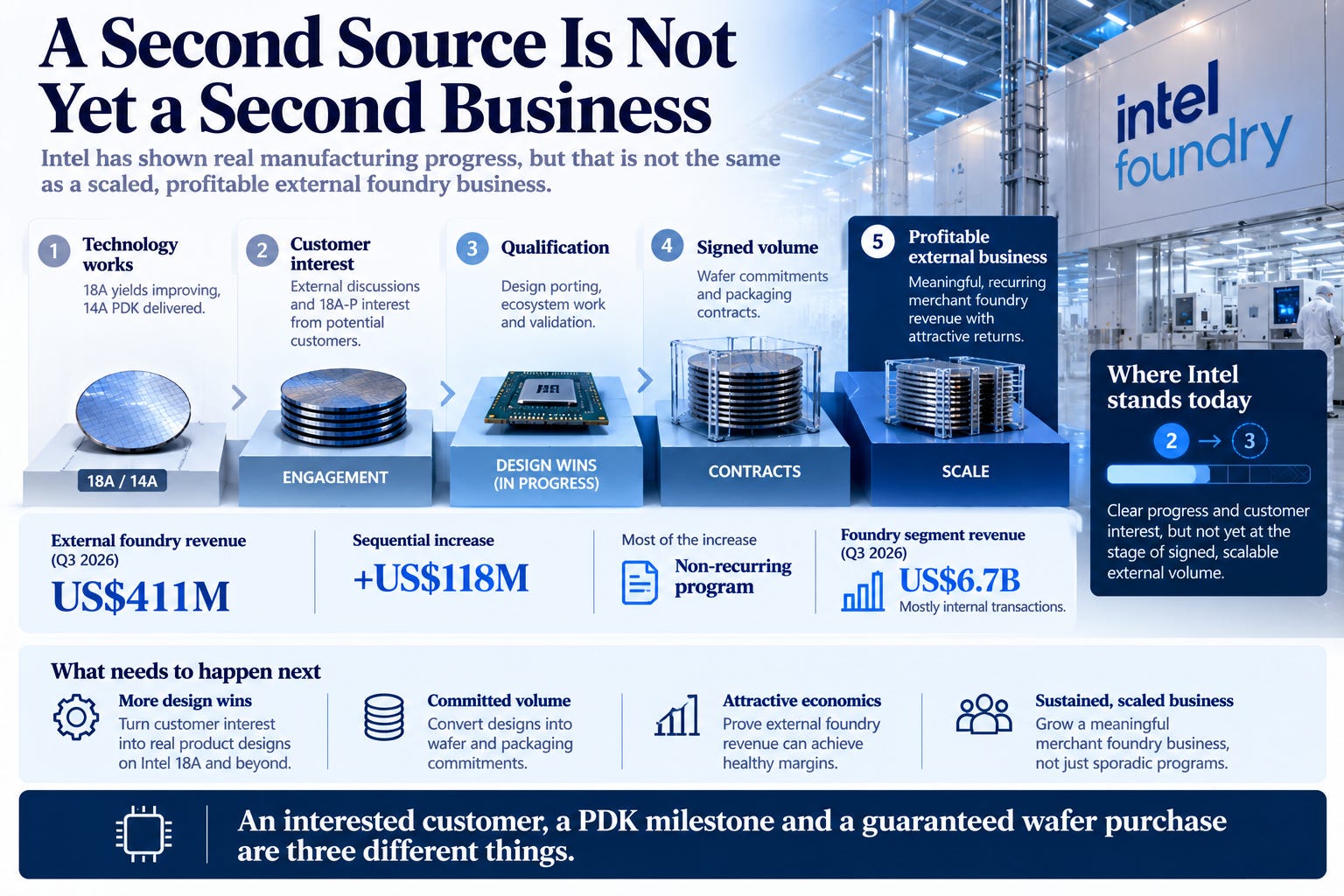
Our July argument was that Intel need not beat TSMC to find customers. A hyperscaler facing insufficient allocation at the world’s dominant foundry may value a credible alternative even if moving a design creates additional cost and risk. AI makes that case stronger because bottlenecks increasingly sit between chips, in substrates, memory interfaces, packaging and power delivery, not merely in wafer supply.
Q3 validates the existence of the bottlenecks, but not yet Intel’s ability to monetize them externally. Advanced substrates are restricting shipments of Intel’s own profitable server processors. Tan is working with suppliers to expand capacity; management expects meaningful relief mainly in late 2027. Intel is also improving EMIB and EMIB-T packaging and discussing external customer opportunities. Turning existing good dies into saleable processors may create value faster than adding wafer capacity.
The foundry evidence is simultaneously encouraging and incomplete. Intel delivered its 14A 0.9 process design kit on schedule, reported lower costs and better yields on 18A, and described external interest in 18A-P. But external foundry revenue was just $411 million in Q3; the $118 million sequential increase was primarily attributable to a non-recurring program. Most of the $6.7 billion of reported foundry segment revenue represents internal transactions. Manufacturing for Intel is becoming more capable; the merchant-foundry business remains largely unproven.
Nor is the second-source opening permanent. TSMC is expanding leading-edge capacity over 2027–28, and customers choosing an alternative foundry must still fund design-porting, qualification and ecosystem work. Intel needs contracts that justify those costs and its capital commitments. An interested customer, a PDK milestone and a guaranteed wafer purchase are three different forms of evidence.
Tan’s ambition to offer modular x86 IP for customer-specific designs, and to manufacture CPUs regardless of architecture, is strategically more interesting than a simple “Western TSMC” pitch. Intel could supply processing IP, custom silicon, packaging and manufacturing within systems it does not control. But Oracle’s simultaneous embrace of Xeon and Vera illustrates the challenge: being a useful component supplier does not mean owning the architecture or the customer. Breadth becomes an advantage only when customers pay enough for the combination.
The Price of Time
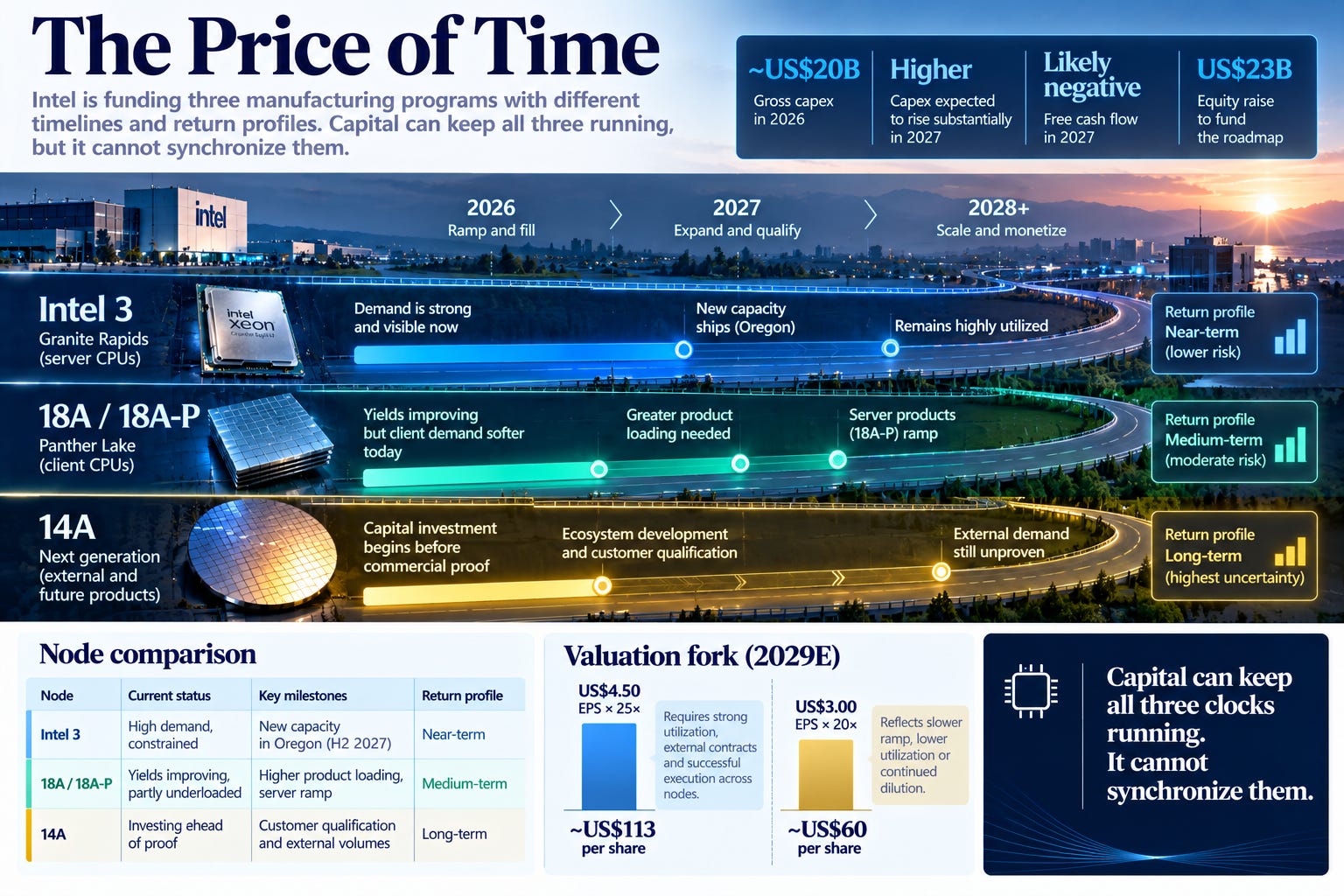
Zinsner’s clearest financial statement was that Intel probably will not produce positive free cash flow in 2027. Gross capex is expected to be around $20 billion in 2026 and rise substantially next year as Intel adds equipment for Intel 3, 18A and 14A. The $23 billion equity offering has bought time, but it has also increased the shares over which any eventual success must be divided.
I don’t regard negative free cash flow during an investment cycle as inherently bad. Intel’s capital spending on profitable, supply-constrained server processors may earn very attractive returns. The economics of expanding substrates and packaging may also be compelling. A new 14A production network built ahead of signed external volumes is a different risk. Management’s aspiration of 20% returns on node investments needs to be tested node by node, not averaged across the company.
That is the change Q3 makes to our two-clock thesis. The CPU clock is running exceptionally fast, but Intel does not have one foundry clock. It has several: Intel 3 is constrained, 18A is improving but partly underloaded, and 14A is consuming capital ahead of commercial validation. External funding can keep all of them running; it cannot make them economically synchronized.
The selloff improves potential returns but cannot settle the underwriting question. At around $72, $4.50 of sustainable 2029 earnings valued at 25 times would imply roughly $113 a share; $3 valued at 20 times would imply $60. Those outcomes require very different assumptions about server share, process utilization, external contracts and future dilution. Neither follows automatically from a $200 billion CPU market.
I am more convinced than I was in April that Intel has a valuable, recovering product franchise, and more convinced than I was in July that its manufacturing engineers are making tangible progress. What I am less willing to assume is that those successes combine seamlessly into one reinforcing business. The next evidence is not another CPU-demand forecast. It is whether Intel 3 capacity starts shipping, 18A-P earns good margins, packaging commitments become revenue, and 14A attracts customers prepared to pay for the factories required.
Intel has proved that customers want its chips again. It now must prove that the right factories can make them at the right time and at a return that belongs to shareholders.
Disclaimer:
The content does not constitute any kind of investment or financial advice. Kindly reach out to your advisor for any investment-related advice. Please refer to the tab “Legal | Disclaimer” to read the complete disclaimer.