


TL; DR
KLA’s structural position is getting stronger: HBM, advanced packaging and more complex logic are increasing the cost of late-stage defects, and the value of finding them earlier.
The market moved ahead of the business: the stock priced in KLA’s acceleration before it appeared in reported revenue, then punished a quarter that was strong but below elevated buy-side expectations.
Cash is now the key test: margins, memory exposure, packaging and services are tracking ahead of prior signposts, but free-cash-flow conversion must recover to validate the earnings trajectory.
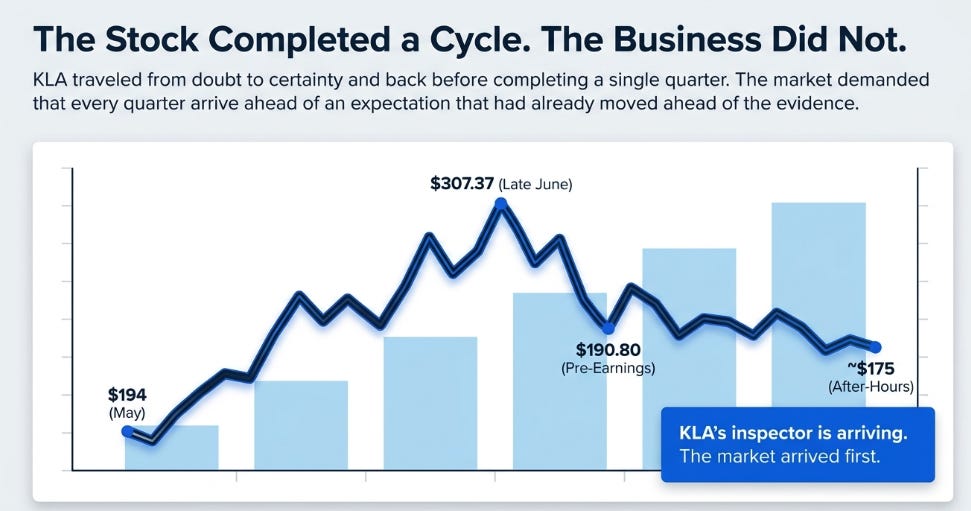
In early May, when I published The Complexity Tax Gets More Real, KLA traded around $194. It reached $307.37 by the end of June, returned to $190.80 before the July 28 report, then fell to roughly $175 after hours. The stock travelled from doubt to certainty and back before KLA completed a quarter. The thesis did not make the same round trip.
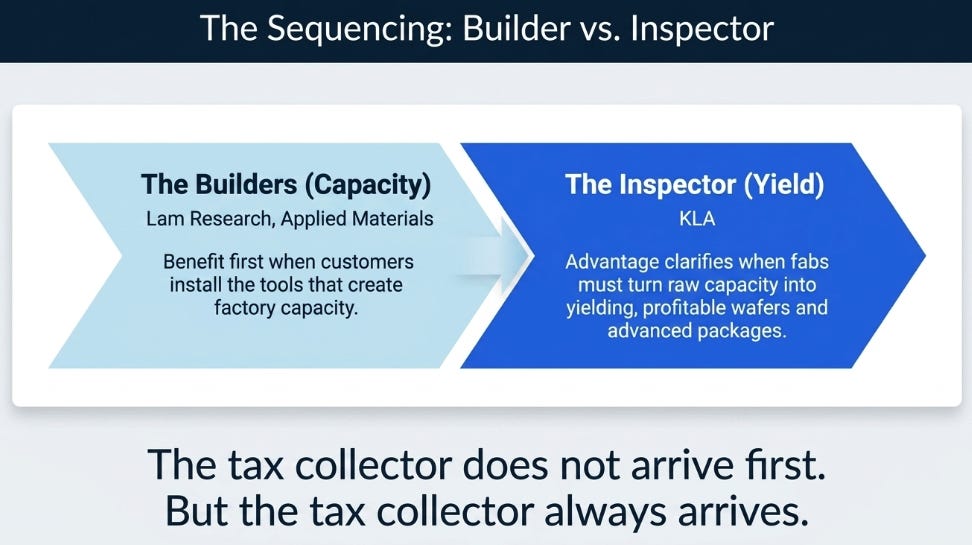
My first KLA article argued that the company is best understood as a tax on semiconductor complexity. The second added a sequencing point: the inspector arrives after the builder. Lam Research and Applied Materials benefit first when customers install the tools that create capacity; KLA’s relative advantage becomes clearer when those fabs must turn capacity into yielding wafers and packages. The tax collector does not arrive first, I wrote. The tax collector always arrives.
Both claims look better after this quarter. What I got wrong was the stock implication. I had treated the handoff from capacity to yield as a business sequence that the market would recognise as it happened. Instead, the market priced the handoff while the builders were still working, crowded into the cleanest beneficiary, and then demanded that every quarter arrive ahead of an expectation that had already moved ahead of the evidence. KLA’s inspector is arriving. The market arrived first.
Scoring Our Own Work
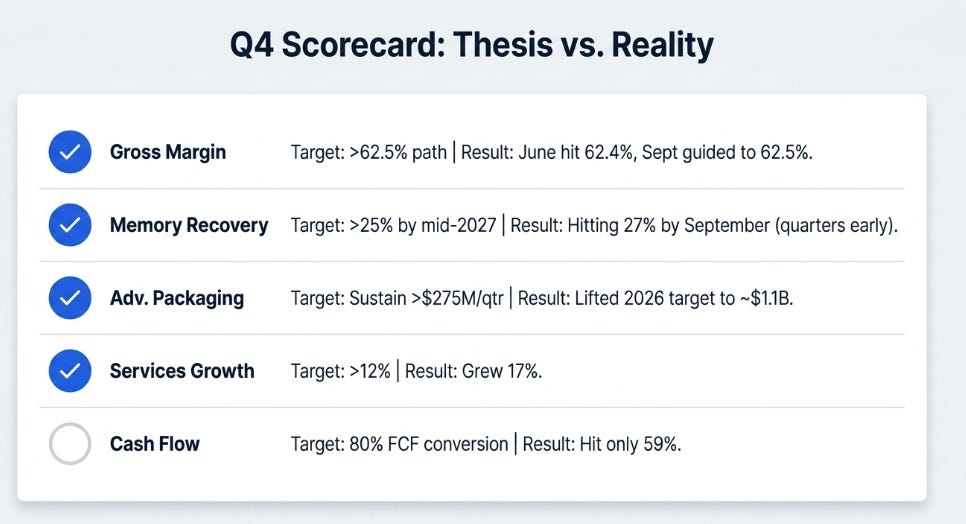
The prior article left a clear scoreboard. Gross margin above 62.5% by September would show that the 2030 path remained open; June came in at 62.4%, and September is guided to 62.5%. Memory needed to recover above 25% of systems revenue by mid-2027; management now expects 27% in September, several quarters early. Advanced packaging needed to sustain more than $275 million per quarter; KLA now expects roughly $1.1 billion for calendar 2026, up more than 70%. Services needed to grow above 12%; it grew 17%.
The miss is cash. Free-cash-flow conversion was 59%, far below the 80% threshold I set last quarter. The relative growth gap with the capacity builders is narrowing, but has not disappeared. Four signposts moved in the right direction, one is partly confirmed, and the one that matters most for earnings quality remains unresolved.
The Unit of Failure Has Changed
The fundamental question is whether rising semiconductor complexity permanently increases the share of customer spending devoted to KLA, or whether logic, HBM and packaging are simply three spending cycles arriving together.
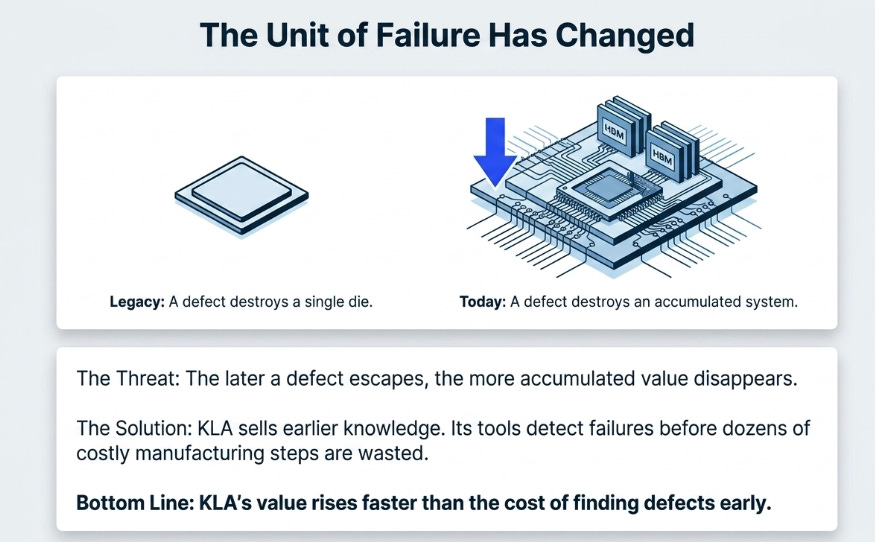
I think the structural answer has become stronger because the unit of failure has changed. A defect once destroyed a die. Increasingly, it can destroy a system containing a leading-edge logic chip, several HBM stacks, an expensive interposer and thousands of connections, after each component has absorbed dozens of costly manufacturing steps. The later the defect escapes, the more accumulated value disappears with it.
KLA sells earlier knowledge: its tools tell the customer that something has gone wrong before another ten, twenty or fifty process steps add more value to the defective object. The worth of that knowledge rises with the future cost it prevents the customer from wasting. KLA becomes more valuable because the cost of discovering a defect late rises faster than the cost of finding it early.
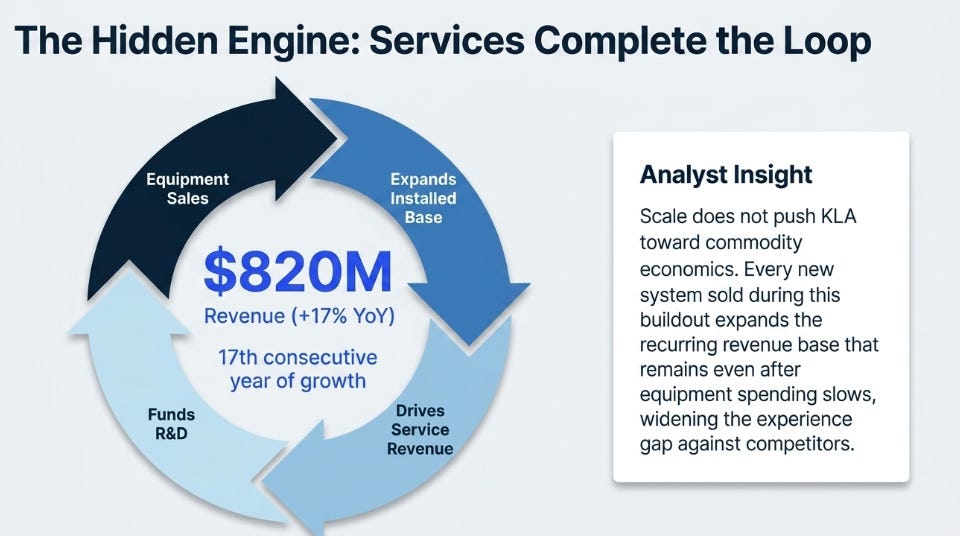
The mechanism compounds. More complex devices create more failure modes; those failures add to KLA’s application knowledge, defect libraries and field experience. Better detection improves yield learning, expands the installed base, and produces service revenue, customer contact and cash for the next generation of R&D. Scale does not push KLA toward commodity economics. It widens the experience gap between KLA and anyone trying to displace it.
This quarter shows that ratchet turning on three fronts.
Logic, Memory and Packaging
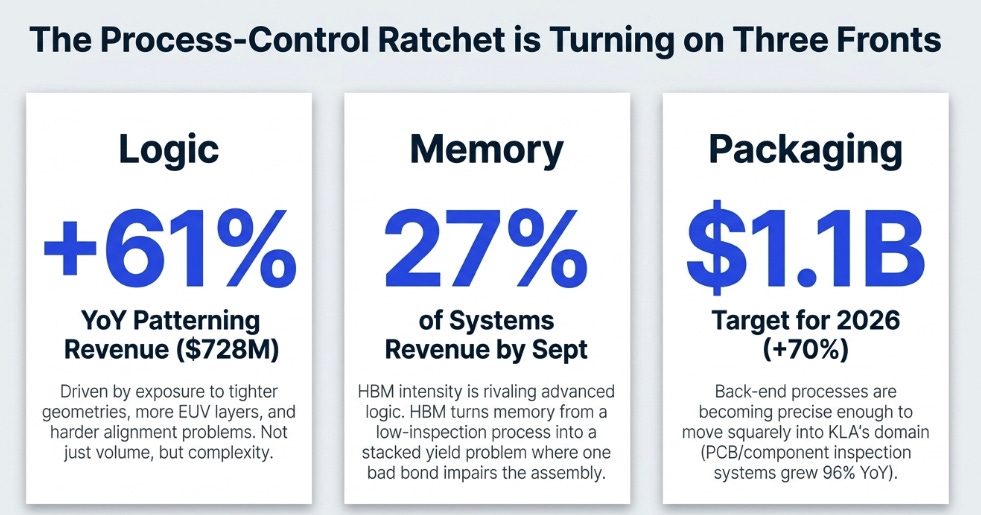
The logic arm appears in patterning, where revenue rose 61% year over year and 18% sequentially to $728 million. Patterning includes metrology and reticle inspection, the parts of KLA most exposed to tighter geometries, more EUV layers and harder alignment problems. Wafer inspection grew only 1%, so the quarter was not simply more of the same equipment sold into more wafers. Some of the 61% growth will be shipment timing. The direction is harder to dismiss.
The memory arm is more consequential. Memory represented 21% of semiconductor process-control systems revenue in June and should reach 27% in September, with DRAM making up about 90% of the category. CFO Bren Higgins said HBM intensity is “rivaling what we see in advanced logic.” HBM is turning memory from a relatively low-inspection process into a stacked yield problem where one bad die or bond can impair the whole assembly.
The packaging arm may matter most. KLA lifted its calendar 2026 advanced-packaging process-control target from high-50% growth to more than 70%, or about $1.1 billion. Rick Wallace said packaging roadmaps are moving toward “more sophisticated wafer front-end processes.” KLA is not forcing its way into an unrelated market; the customer’s back-end process is becoming precise enough to move into KLA’s established domain. PCB and component-inspection systems grew 96% year over year, while the broader segment grew 56%.
Services complete the loop. Revenue reached $820 million, up 17%, marking the seventeenth consecutive year of annual growth. Every new system sold during this buildout expands the recurring base that remains after equipment spending slows.
Why the Stock Fell
KLA reported $3.66 billion of June revenue against roughly $3.60 billion on the Street, but the reported buy-side bar was about $3.70 billion. The September guide of $4.0 billion cleared published consensus near $3.91 billion yet fell short of the roughly $4.05 billion bogey. Gross margin and EPS were strong; the two revenue numbers governing the acceleration story were merely good.
That explains why KLA gave sellers a reason. It does not explain the size of the move.
KLA entered the print in a semiconductor tape that had stopped rewarding good news. On July 28, before the release, KLA fell 6.2%; Applied Materials and Lam fell roughly 8%, ASML more than 4%, and Micron nearly 9%. KLA then lost another 8.4% after hours. The company-specific shortfall explains why KLA joined the selloff. The sector regime explains why a one-percent miss against an inferred bogey became a two-stage decline.
The call sounded far stronger than the price. Higgins disclosed backlog of about $12.5 billion, more than three quarters of current revenue, in response to Jefferies’ Blayne Curtis. Wallace said he had very few concerns about 2027, while Higgins said KLA was “sizing the company to serve the more bullish scenarios.”
I do not see a contradiction between that confidence and a $4.0 billion guide. Annual demand can be unusually visible while quarterly revenue remains dependent on tool completion, fab readiness, delivery and customer acceptance. The market wanted precision from a business that has visibility without perfect timing.
The Model May Already Be Too Low
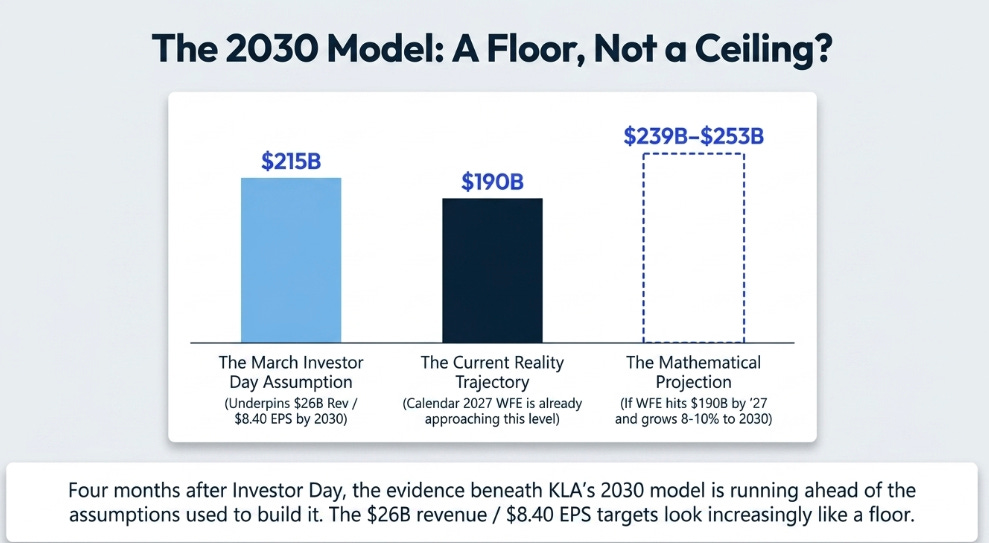
KLA’s March Investor Day model targets about $26 billion of revenue and $8.40 of EPS in 2030, based on wafer-equipment spending of roughly $215 billion. It assumes process control grows faster than WFE, KLA gains more than 150 basis points of WFE share, services compound at 13% to 15%, and advanced packaging adds another source of growth.
Bernstein’s Stacy Rasgon pressed Wallace on the awkward implication. If calendar 2027 WFE is already approaching $190 billion, the model allows only about 4% annual growth from 2027 to 2030. Wallace’s answer was candid: “We are not very good at forecasting.”
If WFE reaches $190 billion in 2027 and grows at 8% to 10% through 2030, it lands around $239 billion to $253 billion, not $215 billion. KLA will not capture every incremental dollar, and a digestion period could sit between 2027 and 2030. Yet the company’s own framework assumes share gains, rising intensity, mid-teens services growth and packaging expansion. If the higher industry path holds, $26 billion of revenue and $8.40 of EPS begin to look more like a floor than a destination.
I would not promote the most optimistic sensitivity—$30 billion-plus of revenue and $10 to $12 of EPS—to the base case today. I would say something narrower: four months after Investor Day, the evidence beneath KLA’s 2030 model is running ahead of the assumptions used to build it.
That is the variant view. The market is treating KLA’s second wave as a discrete revenue event. I think logic, HBM and advanced packaging are adding process-control steps that later generations will inherit rather than reverse.
The Number That Still Does Not Fit
KLA generated $817 million of free cash flow, equal to 22% of revenue and 59% of non-GAAP net income. Receivables absorbed $586 million, inventory $212 million and other assets $423 million, partly offset by a $312 million increase in deferred system revenue.
The benign explanation is credible: KLA is funding working capital ahead of a shipment ramp, and rising deferred revenue supports the claim that customer commitments are real. Management says it is investing in inventory and facilities to meet demand.
Still, this is a business whose quality should improve as the installed base and services grow. Cash should eventually compound faster than revenue, not trail accounting profit quarter after quarter. I need free-cash-flow conversion above 80% by December. If it remains below 60%, I will reconsider how cleanly the operating model scales.
Margins deserve similar care. The prior 62.5% threshold has effectively been met, even with memory rising. That is better than I expected. But Higgins said memory-component costs of roughly 100 basis points may persist through next year, and he told UBS’s Tim Arcuri that existing backlog cannot simply be repriced after orders have been accepted. The margin risk has receded; it has not vanished.
Three Years From Here
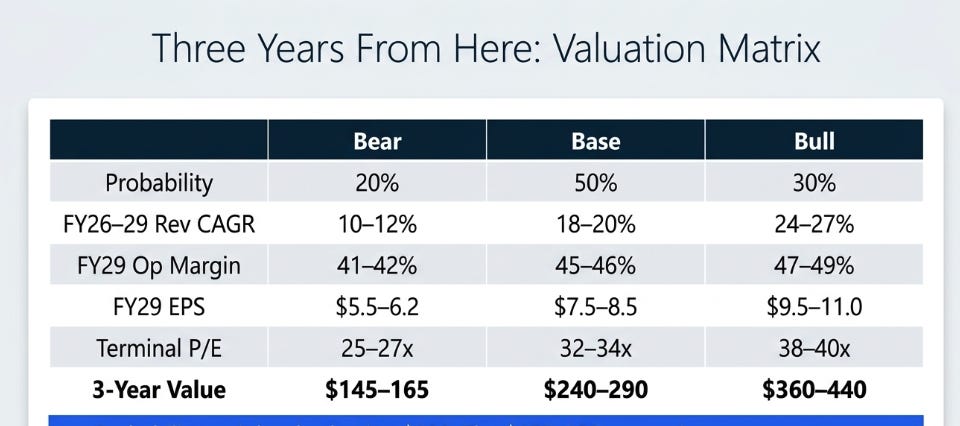
The bear case assumes a 2028 digestion period, tighter China restrictions, lower process-control intensity and cash conversion that never fully recovers. The base case assumes KLA grows faster than WFE through share, intensity, packaging and services, while gross margin gradually approaches the 2030 path. The bull case requires all three arms of the ratchet to keep turning, a formal increase to the 2030 model, and cash conversion that validates the income statement.
Using the midpoints, the probability-weighted value is around $280. It is not a twelve-month target, and the terminal multiple contributes nearly as much uncertainty as the earnings forecast. It does tell me that the $175–190 range around the print is materially different from the prices at which I called KLA a perfect business at an imperfect price. I would begin adding here rather than demand a lower entry.
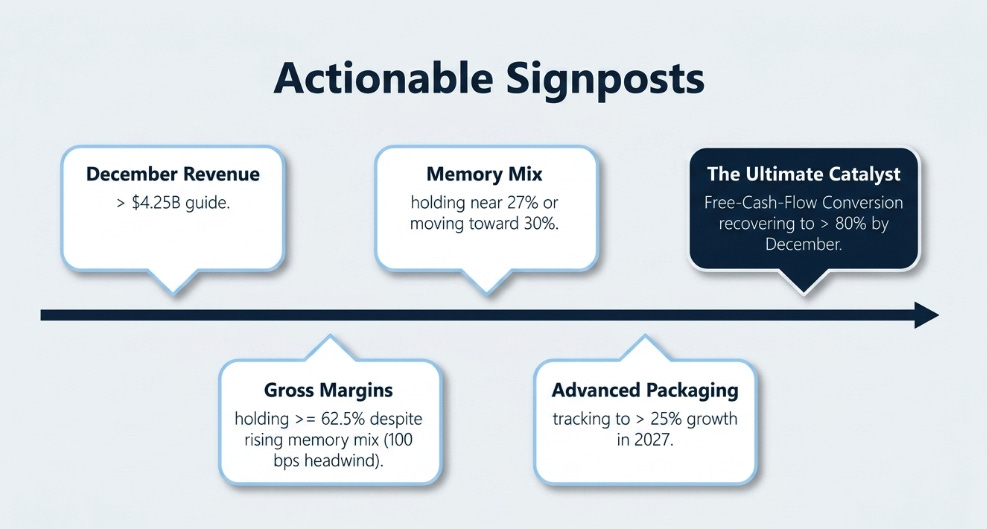
The signposts are clear: December revenue guidance above $4.25 billion; gross margin at or above 62.5%; memory holding near 27% or moving toward 30%; advanced packaging growing above 25% in 2027; services above 12%; and free-cash-flow conversion above 80% by December. If those conditions hold, the 2030 model will increasingly look conservative. If revenue accelerates while cash does not, the strategic thesis can be right and the stock thesis still fail.
The Market Arrived First
Three months ago, I argued that the inspector arrives after the builder. This quarter says the inspector is arriving: memory has recovered earlier than expected, packaging has become a billion-dollar business, patterning is surging, services are compounding and margins are holding.
What I missed was that the market would capitalise that arrival before it appeared in revenue, then sell the stock when the arrival was merely on schedule. The business question is now easier. The unit of failure is getting larger, the value of earlier knowledge is rising, and KLA’s process-control ratchet is turning across logic, memory and packaging. The stock question remains harder because valuation, timing and cash conversion can overwhelm a correct structural view for long stretches.
At the post-print price, I think the gap is wide enough to act. The thesis has advanced, the stock has retreated, and the one piece of proof I still need is cash.
KLA’s stock has completed a cycle. The business has not.
Disclaimer:
The content does not constitute any kind of investment or financial advice. Kindly reach out to your advisor for any investment-related advice. Please refer to the tab “Legal | Disclaimer” to read the complete disclaimer.