


TL; DR
The structural thesis is working: semiconductor manufacturing is getting more complex, Lam’s served market is expanding, Aether dry resist is gaining traction, and backside-power wins are adding new process positions. The physics is creating more places for Lam to participate. Pasted text
But the pricing-power thesis needs to be revised: ASML is showing long-dated customer commitments and negotiated price increases, while Lam’s evidence points more toward process wins, higher content and switching costs than true scarcity pricing. Pasted text
The investment case is therefore more cyclical than we previously assumed: ex-China growth is strong, but China supplied most of the latest sequential revenue increase, support revenue was nearly flat, and the current valuation still requires Lam to prove that more manufacturing steps translate into durable shareholder economics. Pasted text
In August 2013, Samsung began mass production of a flash memory chip constructed from 24 layers stacked vertically. For decades, the industry had made memory denser by shrinking it, requiring increasingly precise and expensive lithography. Stacking changed the manufacturing problem. Each layer needed to be deposited, and holes had to be etched through the resulting structure, deeper and narrower with every generation.
The difficult work was no longer only drawing the pattern. It was building the structure.
Lam Research was particularly well positioned for that transition. Its expertise in etching and deposition became increasingly important to the construction of three-dimensional memory, while every successful equipment installation established a position that could generate years of upgrades, spares and services.
Thirteen years later, the same architectural shift is spreading across DRAM, logic and advanced packaging. Lam has just reported the strongest quarter in its history: revenue of $8.22 billion, up 54% year over year, non-GAAP operating margin above 40% for the first time, and free cash flow of $3.24 billion. Management now expects calendar 2027 wafer fabrication equipment spending to exceed $200 billion.
The shares nevertheless fell after the announcement, having already declined sharply from their June peak of $438.50.
On July 30, The Physics Arrived Early ended with a distinction:
This quarter proved Lam captures more when customers spend. The next cycle will show how much persists when they stop.
I think the market has started pricing the second sentence. But this quarter reveals a more fundamental distinction that our earlier articles did not adequately recognize.
Lam is becoming more technologically important. That does not necessarily mean it is acquiring proportionately greater pricing power.
The Numbers Passed
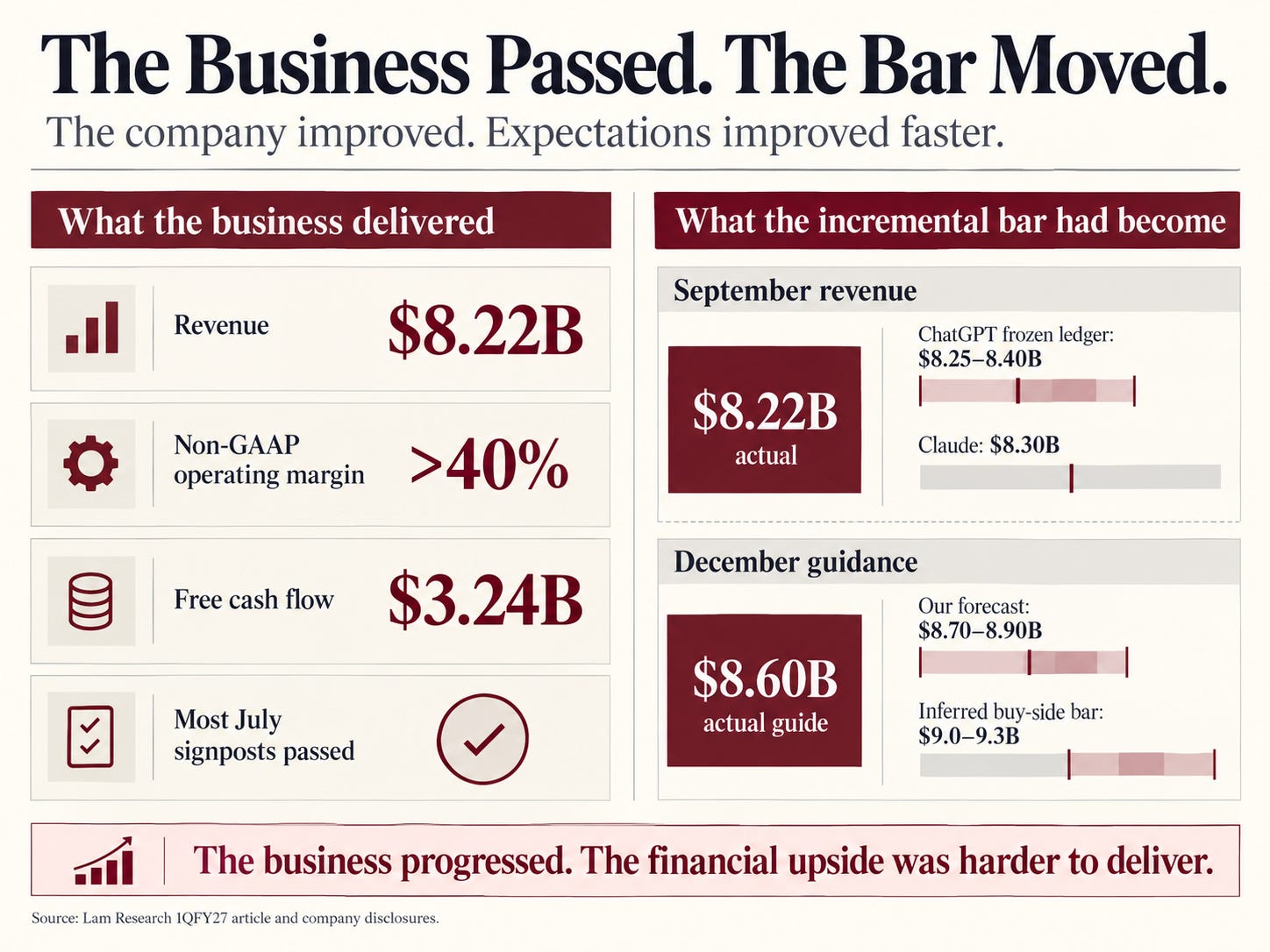
Our July article established six signposts. September cleared most of the near-term tests.
The financial progress is undeniable. Margins reached records, receivables collection improved, and free cash flow rose from $1.27 billion in June to $3.24 billion in September.
But the historical signposts are not the same as the current earnings bar.
Our two independent October 19 preparations both expected more. Claude forecast $8.30 billion in September revenue and a $9.10 billion December guide, with an inferred buy-side guide threshold of $9.0–9.3 billion. ChatGPT’s frozen ledger forecast September revenue of $8.25–8.40 billion and a December guide of $8.70–8.90 billion.
Actual revenue was $8.22 billion, and December guidance was $8.60 billion. Both forecasts were too optimistic, especially about the next quarter.
The July thesis passed several historical tests while our newer expectations failed. That is not a contradiction. It means the business is progressing, but the financial upside we expected was already harder to deliver.
Our earlier July estimate of approximately $8.20 in FY2027 EPS also needs care: it reflected a pre-June-results estimate that was already being revised upward around publication. Consensus near $9.54 by October is not entirely a post publication forecast victory.
More importantly, two of our earlier conclusions about what kind of business Lam is have become less defensible. Those conclusions determine the valuation multiple.
The Hard Part Moved. The Pricing Power Did Not Move Equally.
The technological argument has become stronger.
On the October call, UBS’s Tim Arcuri asked Tim Archer about Micron’s decision to prioritize three-dimensional DRAM over a proposed 4F² architecture. Lam’s shares had reacted negatively to the roadmap change, yet Archer argued that a more direct transition into 3D DRAM could accelerate the need for etching and deposition.
That is the original thesis arriving in another category.
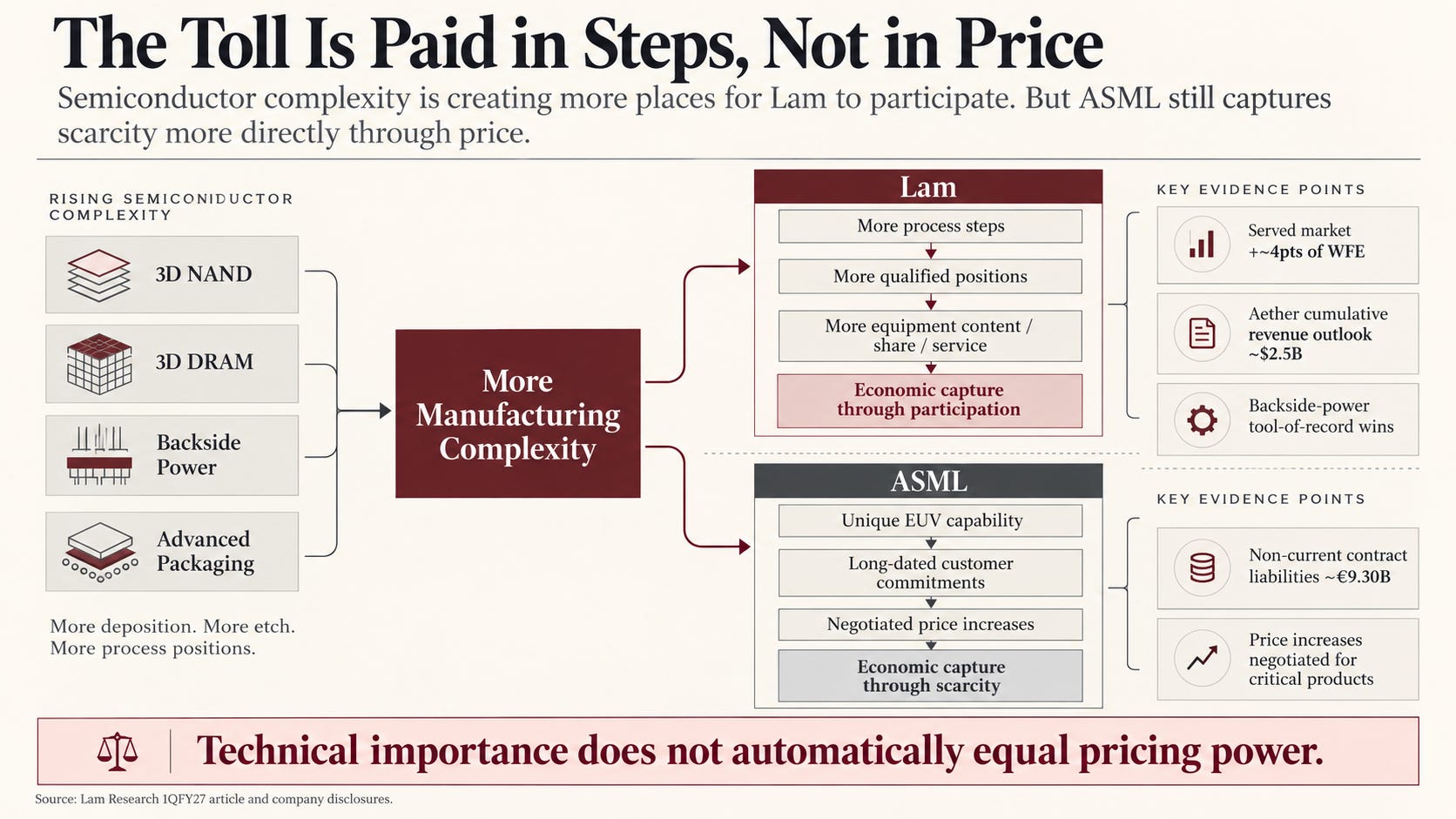
Lam says its served available market has expanded by approximately four percentage points as a share of WFE. Foundry/logic and DRAM contributed about 80% of systems-revenue growth during calendar 2026 to date, reflecting product investments begun several years earlier.
The company also increased its expected cumulative Aether dry-resist revenue to approximately $2.5 billion by the end of the decade, roughly $1 billion above its previous outlook. It reported additional backside-power process wins, including production tool-of-record positions for several technologies at a leading customer.
This is persuasive evidence that semiconductor complexity is creating new commercial opportunities for Lam.
The question is who captures the value.
In January, The Atomic Toll Booth argued that the industry’s manufacturing bottleneck was moving from lithography toward etching and deposition, and that Lam would increasingly capture the economics previously associated with ASML’s scarcity.
October provides a useful test of that claim because ASML and Lam reported within a week of each other.
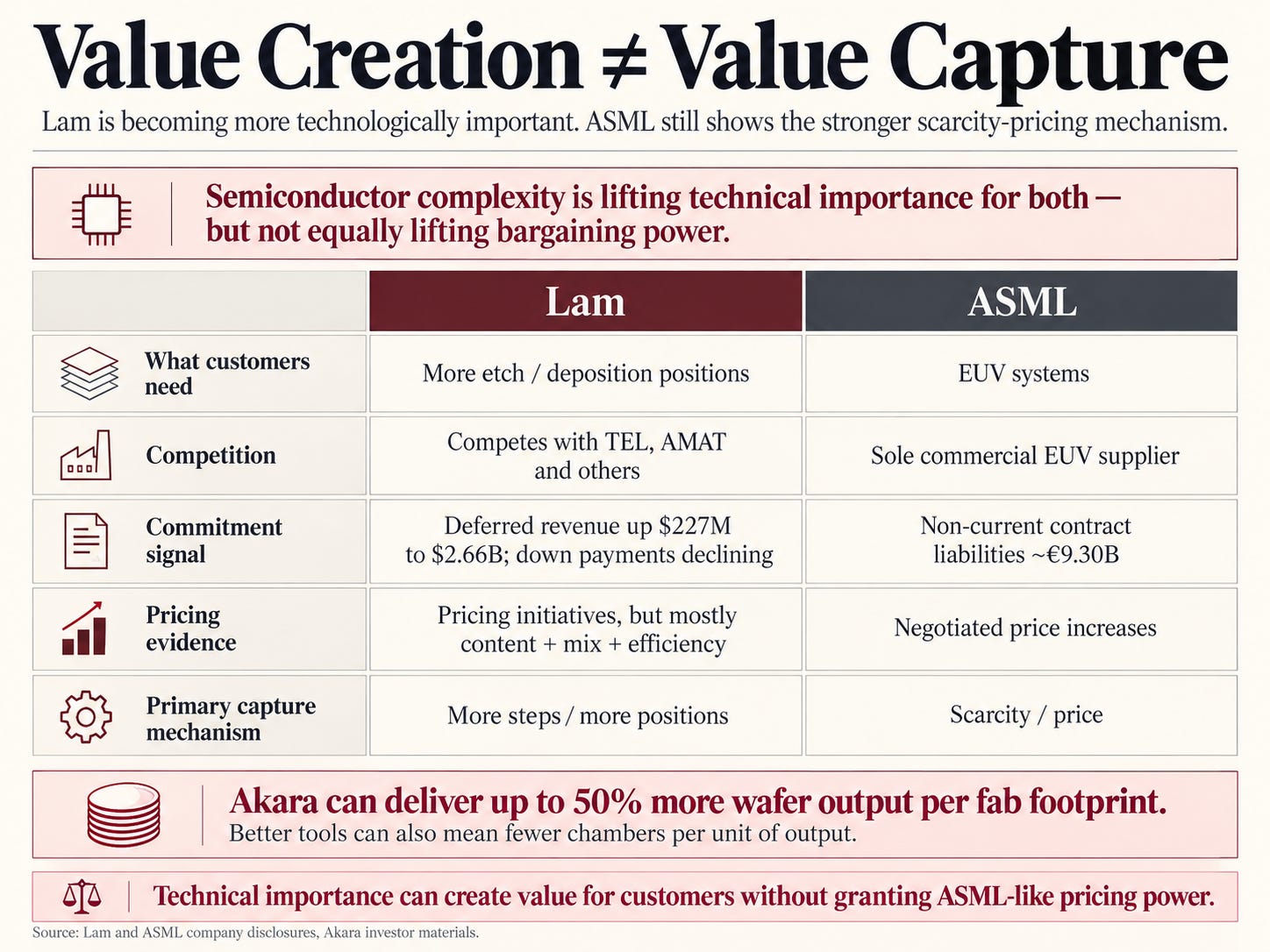
ASML’s non-current contract liabilities rose by approximately €5.73 billion during its September quarter, reaching €9.30 billion. These balances include customer commitments and advances associated with future deliveries, although the increase should not be interpreted as €5.73 billion of cash newly received during the quarter.
ASML also completed negotiations that increased prices for its most critical products. The company expects some financial benefit in 2027, with the full effect beginning in 2028.
These two observations reinforce one another: customers are making substantial long-dated commitments to secure ASML equipment, and ASML has been able to negotiate higher prices.
Lam’s customer behavior looks different.
Its deferred revenue increased by $227 million to $2.66 billion, but CFO Doug Bettinger explained that stronger sales volumes were partly offset by declining customer down payments.
That does not mean Lam lacks pricing power. Its gross margin has risen from approximately 48% two years ago to more than 52%, and management has identified pricing initiatives alongside product differentiation and manufacturing efficiency.
Nor are ASML’s contract liabilities directly comparable with Lam’s customer deposits. Equipment lead times, contract structures, delivery schedules and payment terms differ.
Nevertheless, the contrast is informative.
ASML is the sole commercial supplier of EUV lithography systems. Lam holds valuable positions in qualified etching and deposition processes, but it competes with Tokyo Electron, Applied Materials and other suppliers across a wider range of applications.
Once Lam wins a process position, customers face meaningful switching costs. The difficulty is that the next technology generation can reopen competition for the next position.
There is another complication our previous articles missed.
Lam says its Akara conductor-etch technology can deliver up to 50% more wafer output per fab footprint.
That is valuable to customers. It also means that better technology can reduce the number of chambers needed for a given amount of production.
More process steps do not automatically translate into proportionately more equipment revenue. Lam must capture the benefit through higher prices, additional process wins, greater market share or increased lifetime service economics.
The same technological improvement can create substantial value for a chipmaker without allowing Lam to retain all of it.
This is the central correction to our original thesis.
We were right that semiconductor complexity would increase the importance of the physical construction processes Lam specializes in. We were too quick to assume that increasing technical importance would translate directly into ASML-like bargaining power.
Lam’s toll is primarily paid through a growing number of economically valuable manufacturing applications. ASML has demonstrated a stronger ability to charge for the scarcity of its machines.
From Tokens to Wafers
The most interesting new business argument in Lam’s October call concerned NAND.
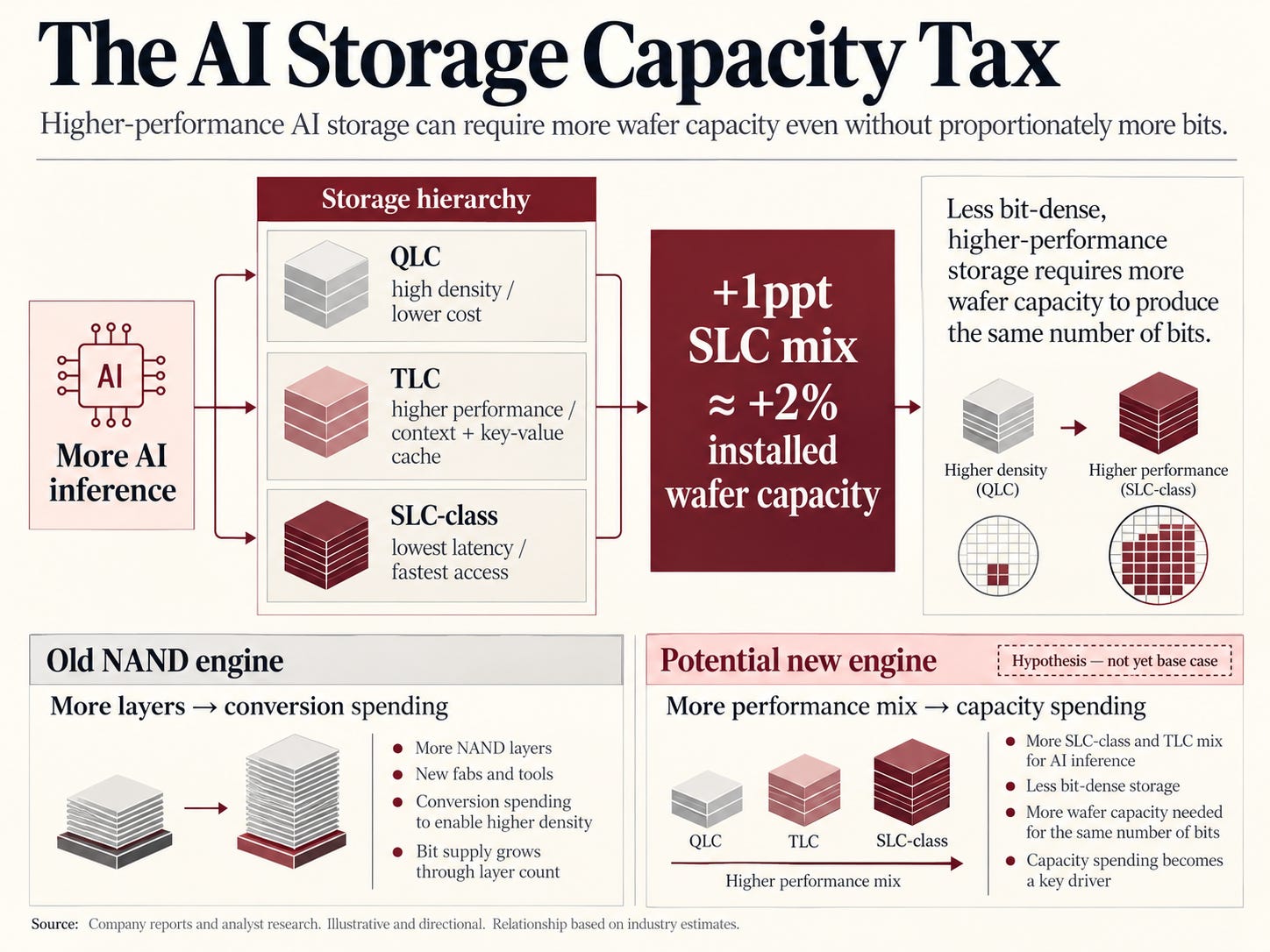
Archer traced AI demand beyond GPUs and HBM into the storage hierarchy. As inference workloads become more complex, the demand for storage increasingly separates into different performance requirements.
QLC NAND is suited to high-density, lower-cost storage. TLC can serve higher-performance applications, including context memory and key-value caches. SLC-class storage offers lower latency and faster access for workloads that prioritize responsiveness over density.
The economic consequence is potentially significant.
Moving data from TLC to SLC-class devices reduces the number of bits stored per device. Lam estimates that each percentage-point shift of NAND bit demand toward SLC-class storage could require approximately 2% more installed wafer capacity to produce the same number of bits.
This is a different growth mechanism from the NAND layer-count conversion cycle that dominated our earlier articles.
Conversions require customers to replace or upgrade equipment to manufacture more advanced devices. A lasting shift toward less bit-dense, higher-performance storage could create a need for additional manufacturing capacity even without proportionate growth in total stored bits.
That potentially answers the question we have carried since April: what replaces the NAND conversion spending once the current upgrade cycle finishes in 2027?
But it remains a hypothesis.
When Mizuho asked how much NAND demand might migrate toward SLC-class devices, Archer declined to provide an adoption forecast. He also did not quantify the resulting equipment opportunity.
Additional wafer requirements need not produce an immediate wave of new factories. Customers may first use available capacity, reallocate production or expand existing facilities.
Until memory manufacturers commit meaningful investment specifically to this architecture, the SLC opportunity remains an emerging source of optionality rather than a reliable component of our base-case forecast.
It strengthens the long-term explanation for why NAND could become more important to AI. It does not yet settle the investment case for Lam.
What Compounds, and What Cycles
Our July article distinguished between increasing manufacturing complexity and the cyclical spending through which that complexity becomes revenue.
September provided evidence of both.
Ex-China revenue has risen substantially, reaching approximately $5.34 billion in September, roughly 76% above the prior year. This is encouraging evidence that Lam’s growth is not dependent entirely on Chinese spending.
Yet China supplied approximately three-quarters of September’s sequential revenue increase. Domestic Chinese customers, together with multinational customers operating there, contributed to the unusually strong quarter.
Management expects the Chinese contribution to decline meaningfully in December, particularly from domestic customers.
At the midpoint of Lam’s $8.60 billion guide, a China revenue share of 25–30% would require ex-China revenue of approximately $6.0–6.5 billion—an increase of roughly 13–21% in a single quarter.
Those percentages are illustrative assumptions, not management guidance. But they establish the scale of the replacement demand required.
They also force a correction to July.
When gross margin reached 52% with China down to 26% of revenue, I wrote that the thesis of China-related margin compression had been falsified.
That was too categorical.
We demonstrated that Lam could deliver attractive margins with one particular customer and geographic mix. We did not prove that future China declines could never affect margins.
September’s return to 35% China exposure reinforces the need to distinguish operating efficiency, product mix, pricing and geography rather than treating a favorable result as permanent evidence.
The installed-base business raises a similar question.
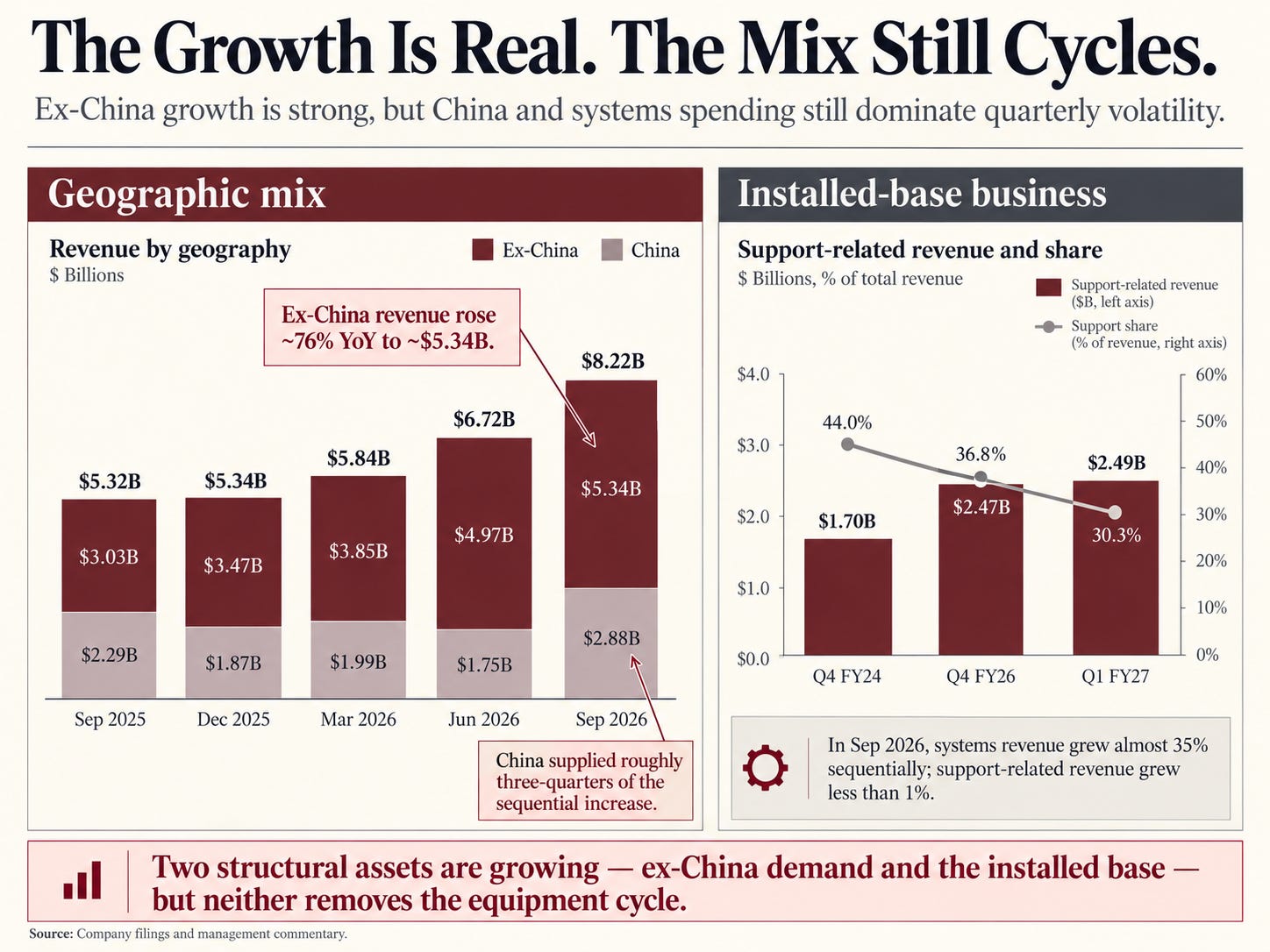
The support business has grown meaningfully in absolute dollars, but it has not become a steadily increasing share of revenue.
In September, systems revenue grew almost 35% sequentially, while support-related revenue grew less than 1%.
Management expects CSBG growth exceeding 15% in calendar 2027, following more than 30% in 2026. That is impressive, but the components have different economics.
Spares and maintenance benefit from a larger installed base and high utilization. Upgrades depend partly on technology transitions and customer spending. Reliant equipment remains exposed to mature-node investment, including China.
When JPMorgan asked management to rank the drivers, Bettinger emphasized the continuing strength of spares, the NAND upgrade cycle and Reliant. He did not disclose separate profitability or growth rates for those businesses.
That leaves an important question unanswered: how much of the reported support business is a durable annuity, and how much is another expression of the equipment cycle?
This is not an argument against the installed-base franchise. It is an argument for measuring its resilience rather than assuming it from the revenue category.
What the Physics Is Worth
My variant perception has changed.
I still believe Lam’s underlying engine is stronger than a conventional cyclical-equipment model suggests. The company is gaining exposure to increasingly complex semiconductor structures, its margins have improved materially, and the installed base creates valuable future opportunities.
But the January thesis went further. It argued that Lam’s position justified a structural re-rating toward the valuation of an indispensable infrastructure supplier.
The evidence for that conclusion is weaker.
ASML has demonstrated more pronounced supplier scarcity through future customer commitments and negotiated equipment pricing. Lam’s advantage is substantial, but it depends on repeatedly winning applications against credible competitors and turning those wins into profitable shipments.
Meanwhile, the industry outlook is no longer an undiscovered positive.
Before Lam’s results, Barclays had already estimated 2027 WFE spending at approximately $209.5 billion, and Bernstein had forecast $204 billion. Management’s preliminary outlook above $200 billion confirmed a large investment cycle, but it was not a new level of industry demand that investors had never considered.
At the October 21 regular-session closing price of $260.81, Lam traded at approximately 25 times contemporaneous next-twelve-month earnings expectations. This is a lower valuation than earlier in the year, but one that still assumes considerable earnings durability.
I would now use a more restrained terminal multiple, near 22 times FY2029 earnings in the central scenario, rather than the 28–32 times used in the January analysis.
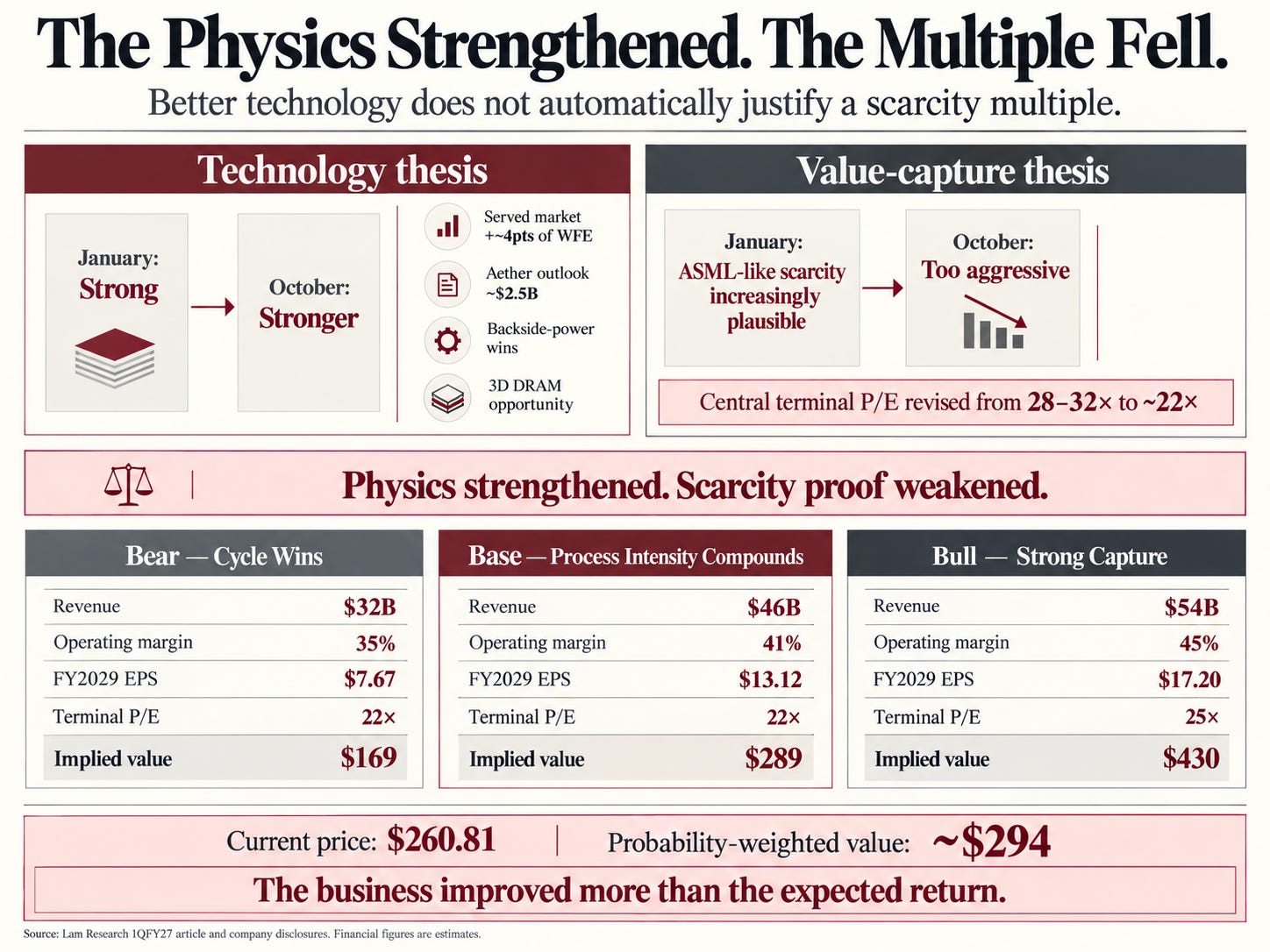
The probability-weighted value is approximately $294, or 13% above the October 21 close before dividends.
That is not an especially compelling expected return for an equipment company exposed to capital-spending cyclicality and a potentially hostile valuation regime.
An interesting comparison is ASML. On FY2028 consensus, it trades near 20 times earnings versus approximately 22 times for Lam. But ASML’s fiscal year ends six months later, and a matched next-twelve-month comparison makes ASML the more expensive stock—approximately 28 times versus Lam’s 25 times.
ASML therefore is not obviously cheaper on a consistent earnings horizon. The case for prioritizing it is that its scarcer competitive position may deserve the premium.
For Lam, the conclusion is more modest: I would retain existing exposure, but would not prioritize additional semiconductor capital here simply because the industry is entering another period of exceptional spending.
The January Test
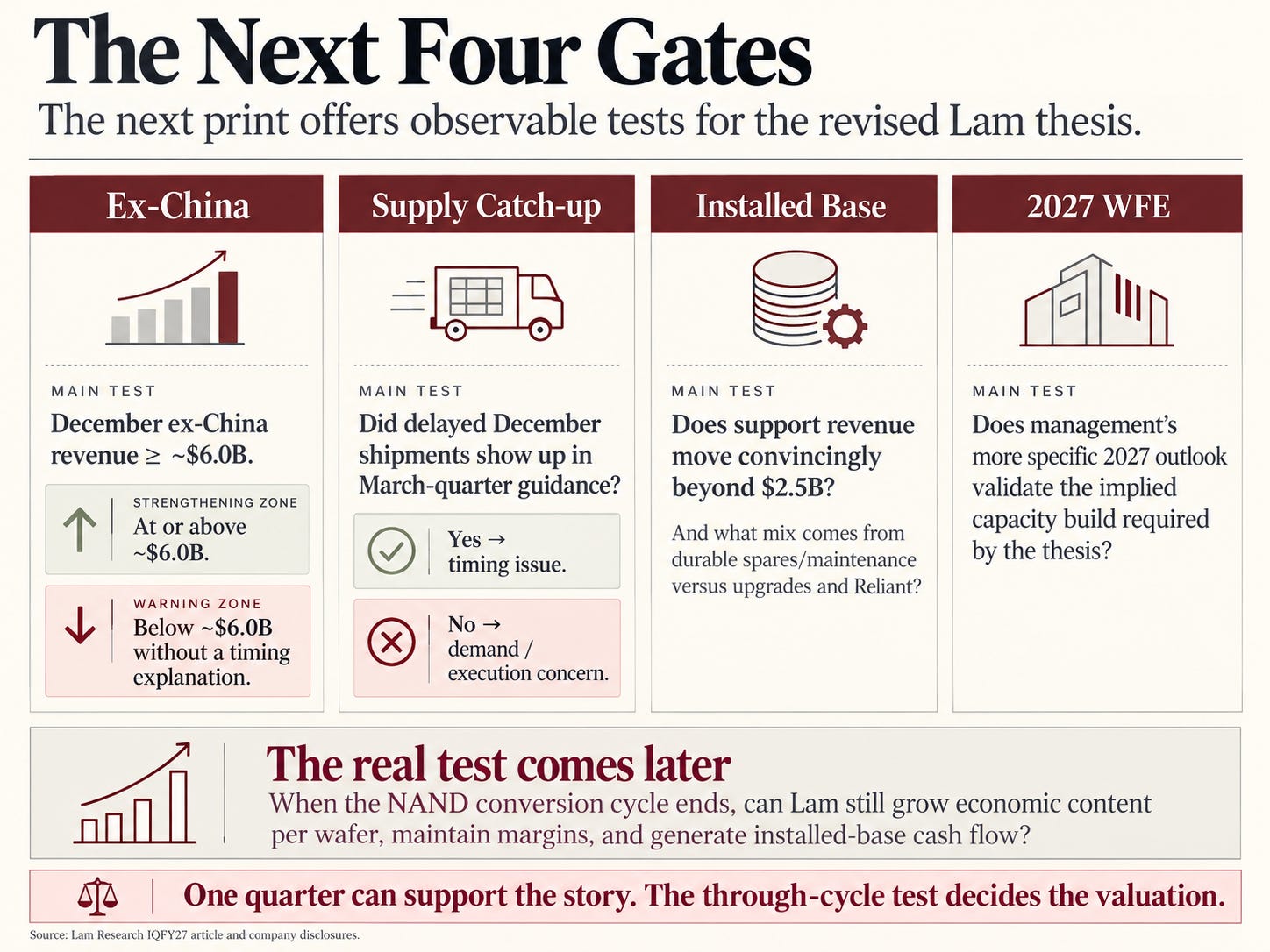
The next earnings report offers a direct test of our structural argument.
If December ex-China revenue comes in below $6.0 billion, Lam will have failed to sustain even approximately 12% sequential ex-China growth despite an expanding industry and extraordinary technology demand.
That would not by itself disprove the long-term process-intensity thesis; supply constraints and shipment timing could explain some of the shortfall. But it would weaken the argument that the underlying non-China engine is accelerating quickly enough to offset the current concentration in Chinese spending.
The same call should tell us whether December shipments delayed by supply constraints reached customers in March-quarter guidance, whether support revenue moves convincingly beyond $2.5 billion, and whether management’s more specific 2027 WFE outlook validates the implied equipment capacity requirements.
Beyond that, the decisive test comes when the existing NAND conversion cycle ends and the industry’s current wave of fab construction approaches completion.
If Lam continues growing its economic content per wafer, maintaining margins and generating installed-base cash flow through that period, the case for structural compounding becomes much stronger.
The physics is doing much of what our series anticipated. Semiconductor manufacturing is becoming more complex, and Lam’s products are increasingly relevant to the technologies making that complexity possible.
What the results have not established is that technical indispensability translates into the same economic leverage ASML possesses.
The distinction matters because it determines what we should pay for the business.
The toll is real, and the number of steps is rising. The question now is how much of the toll Lam gets to keep.
Disclaimer:
The content does not constitute any kind of investment or financial advice. Kindly reach out to your advisor for any investment-related advice. Please refer to the tab “Legal | Disclaimer” to read the complete disclaimer.