


TL; DR
The standalone operating thesis was emphatically validated: revenue rose 136.5%, gross margin reached 53.2%, operating margin hit 42.3%, and December guidance points even higher. Optical scarcity is producing extraordinary economics, although cash conversion remains much weaker than reported profit.
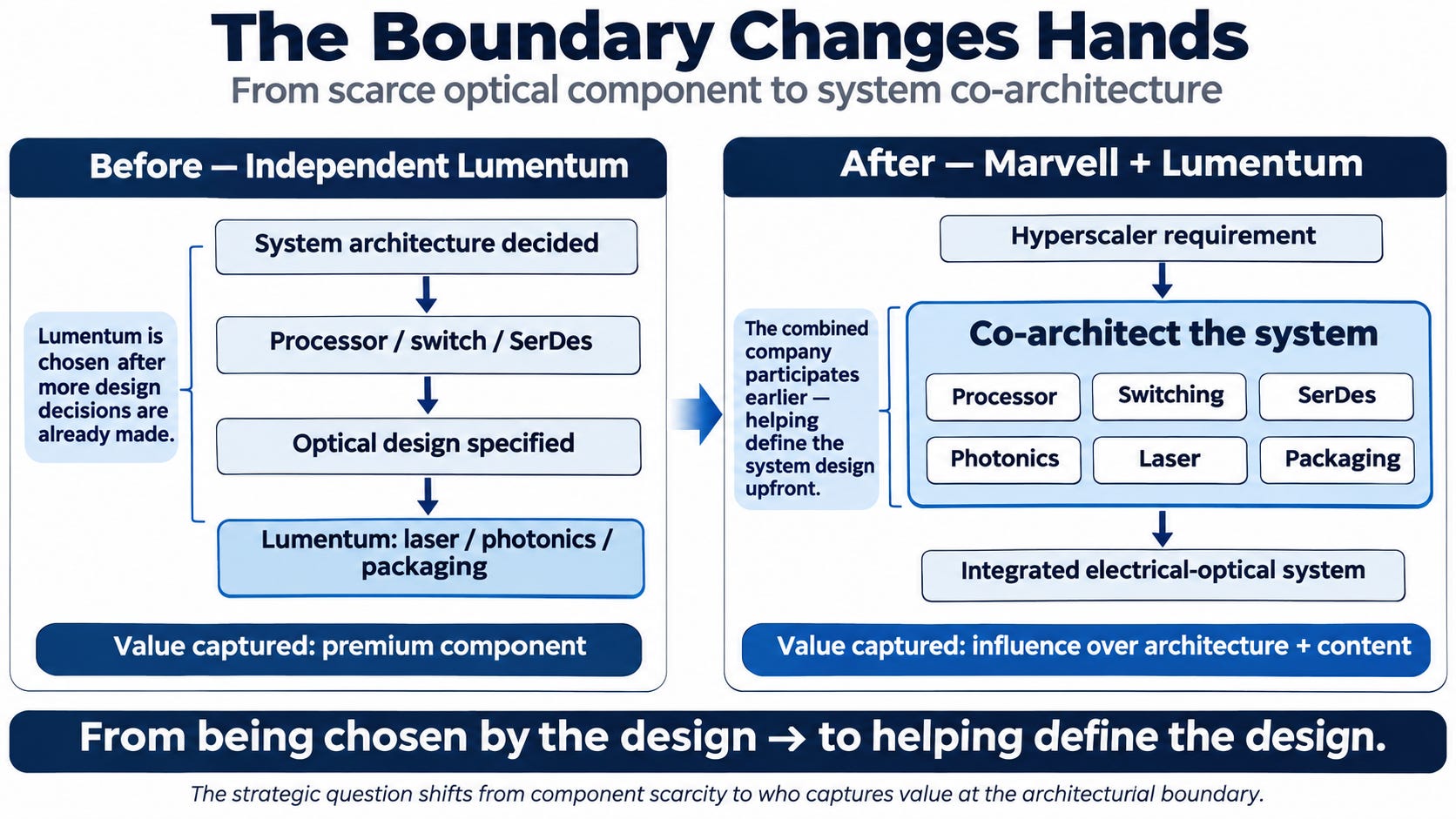
The merger changes the strategic question: Lumentum had already proved it could win major CPO commitments independently. What Marvell adds is earlier influence over system architecture processors, SerDes, switching, photonics and packaging potentially moving Lumentum from supplying a chosen component to helping define the design itself.
Shareholders are no longer underwriting pure optical scarcity: the all-stock structure turns Lumentum into a contingent claim on Marvell, with regulatory risk, Marvell share-price risk and uncertainty over whether integration creates enough incremental value to justify giving up independence.
In 2018, Michael Hurlston agreed to sell Finisar to II-VI. It is tempting to imagine an optical-industry veteran recognizing a cyclical peak. Finisar’s business was already under pressure, however, and much of the consideration was cash. The lesson is subtler: optical scarcity creates extraordinary value, but what matters is who can preserve that value when capacity and technology catch up.
Eight years later, Hurlston has agreed to sell another optical company under very different circumstances. On November 2, Lumentum reported the strongest quarter in its history and agreed to exchange each of its shares for 4.5 Marvell shares. The deal valued Lumentum at about $115 billion of enterprise value when announced. Instead of an earnings call, investors received a merger call, which began with an instruction not to ask about current business conditions.
The numbers were no longer the principal story. They were the evidence against which to judge the decision to sell.
The Earnings Call That Wasn’t
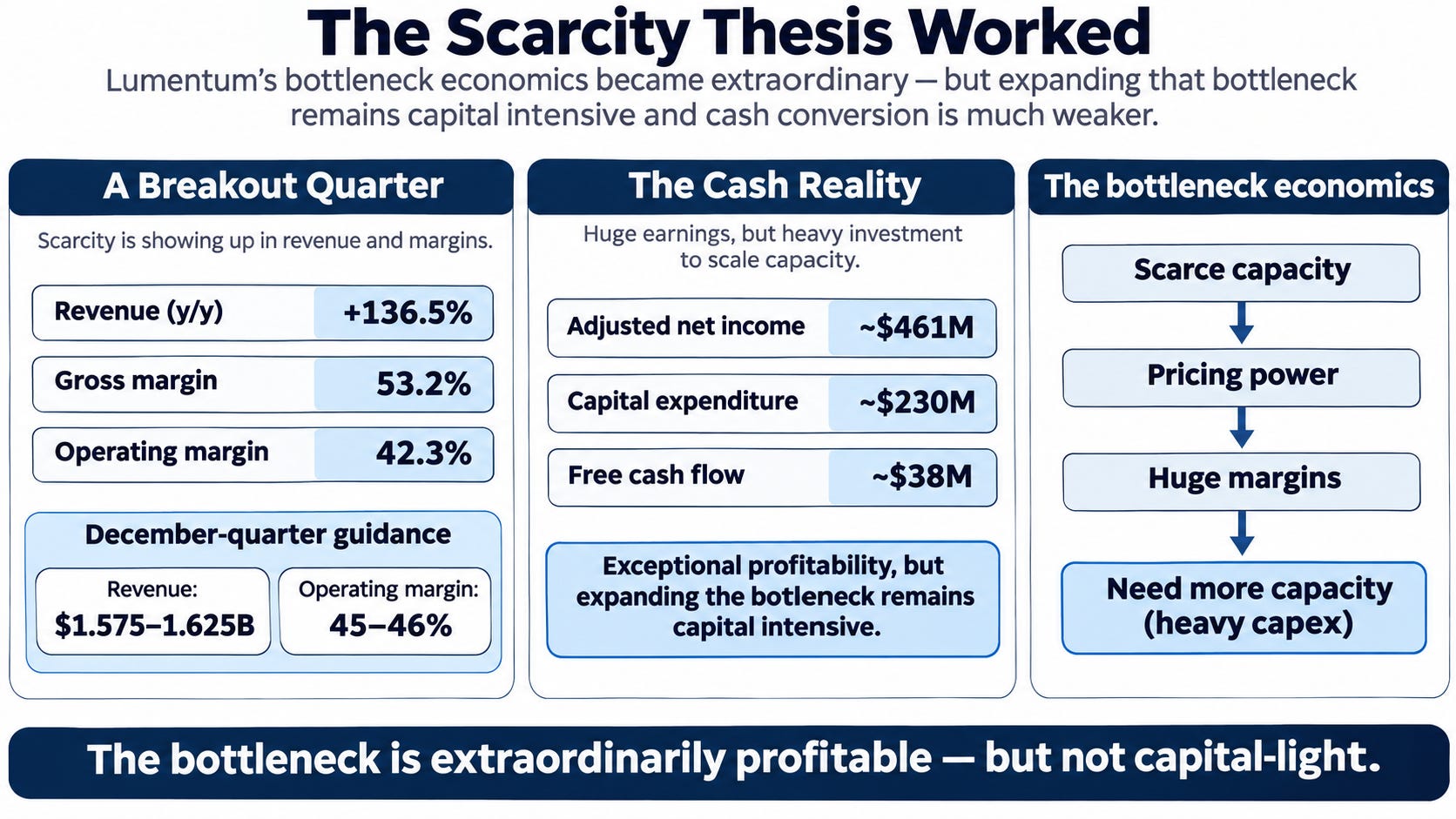
Revenue increased 136.5% year over year to $1.26 billion. Non-GAAP gross margin reached 53.2%, operating margin 42.3%, and December-quarter guidance pointed to $1.575–1.625 billion of revenue and 45–46% operating margin. August’s operating tests were passed: gross margin above 50%, operating margin above 40%, optical circuit switching exceeding its first $100 million quarter, and another NPO/CPO design win supported by more than $5 billion in purchase commitments. The full durability test—whether tightness survives new industry capacity—cannot be settled in one quarter.
Even the margin mix was remarkable. Systems rose to 40% of revenue without preventing gross margin expansion. Yet the cash picture was less spectacular: roughly $461 million of adjusted net income produced just $38 million in free cash flow, with capital expenditure near $230 million. Lumentum has built extraordinary pricing power in factories that remain expensive to expand.
What Hurlston Is Actually Selling
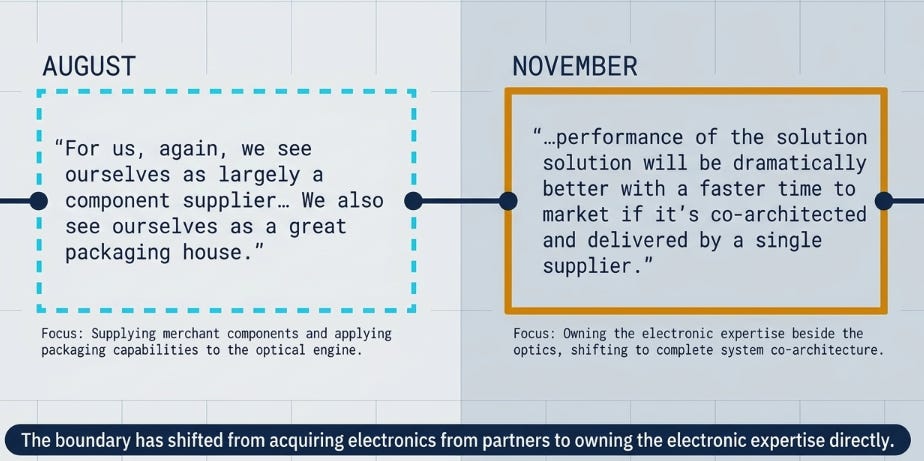
The most revealing evidence is a change in Hurlston’s description of his own business. In August he said:
For us, again, we see ourselves as largely a component supplier. We want to supply components. We also see ourselves as a great packaging house... We can apply that packaging capability to the whole optical engine.
On the merger call he argued:
While customers can try to source these independently from multiple suppliers, Lumentum and Marvell believe the performance of the solution will be dramatically better with a faster time to market if it’s co-architected and delivered by a single supplier. This is why we believe now is the time for this combination.
The shift is not from components to packaging: he already contemplated complete optical engines in August. It is from acquiring electronics from partners to owning the electronic expertise beside the optics. Marvell works with hyperscalers years earlier on processors, switching, SerDes and connectivity architecture; Lumentum has historically supplied critical lasers after more of those decisions were made. As light moves from connecting data centers to linking racks and eventually sitting beside processors, the electrical and optical design choices become harder to separate.
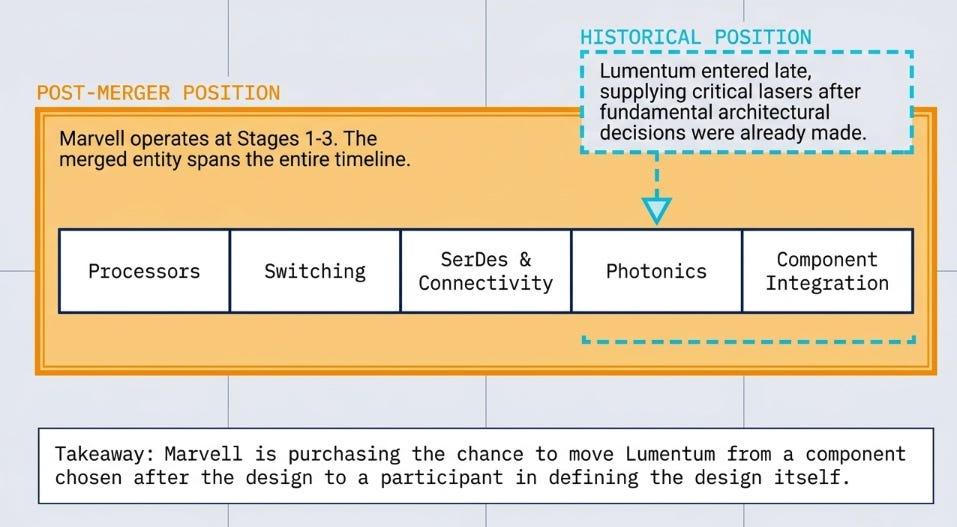
Consider a laser that improves optical yield. As a merchant component, Lumentum can charge a premium for the laser. But if the entire engine is co-designed: laser, photonics, driver electronics and packaging, the supplier involved at the architectural stage may influence both specifications and how much content it supplies. Marvell is purchasing the chance to move Lumentum from a component chosen after the design to a participant in defining the design.
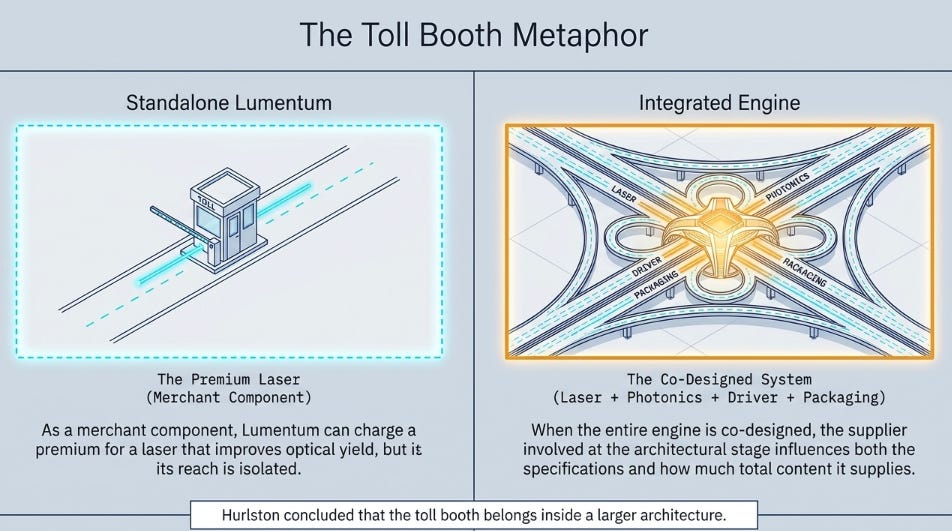
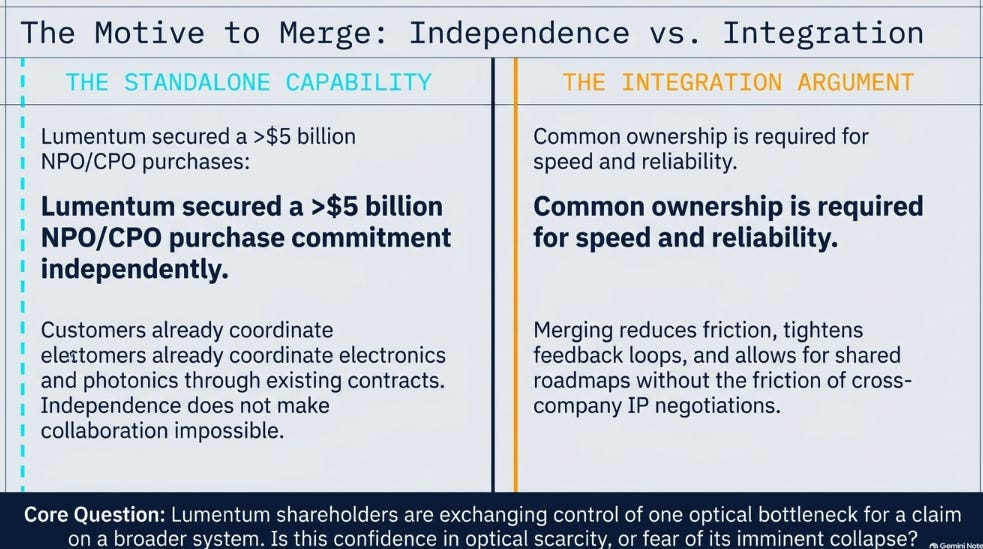
This is a credible reason to merge, but not proof common ownership is required. Lumentum won that $5 billion-plus CPO commitment independently. Customers already coordinate electronics and photonics through contracts. Hurlston’s stronger claim is that integration makes the collaboration faster and more reliable, not that independence made it impossible.
The form of payment matters too. This is not Finisar’s largely cash exit. Lumentum holders will own around one-third of the combined company, and Hurlston will join its board. They are exchanging control of one optical bottleneck for a claim on a broader system. That could express confidence in the future of optical scarcity, not fear of its imminent collapse. It could also diversify a highly concentrated manufacturing bet.
The price is not obviously generous either. On estimates for the year ending June 2028, Lumentum contributes roughly 31% of the two companies combined net income and receives approximately 33% of the shares. Marvell expects more than $1 billion in annual cost synergies, but those are forecasts, not value already earned. Lumentum shareholders are surrendering independent upside in exchange for participation in a potentially more valuable architecture, without a large cash premium protecting them if that promise disappoints.
A sale is evidence of management’s preferences, not privileged access to the cycle’s endpoint.
Nvidia’s Interest and Coherent’s Alternative
Nvidia’s role makes the decision more consequential. In March it committed $2 billion each to Lumentum and Coherent, and another $2 billion to Marvell, alongside arrangements supporting optical capacity and the NVLink Fusion ecosystem. Bloomberg reports that Hurlston and Marvell’s Matt Murphy sought Jensen Huang’s views before signing and received his support. That is evidence of influence, not proof that Huang originated or controlled the deal.
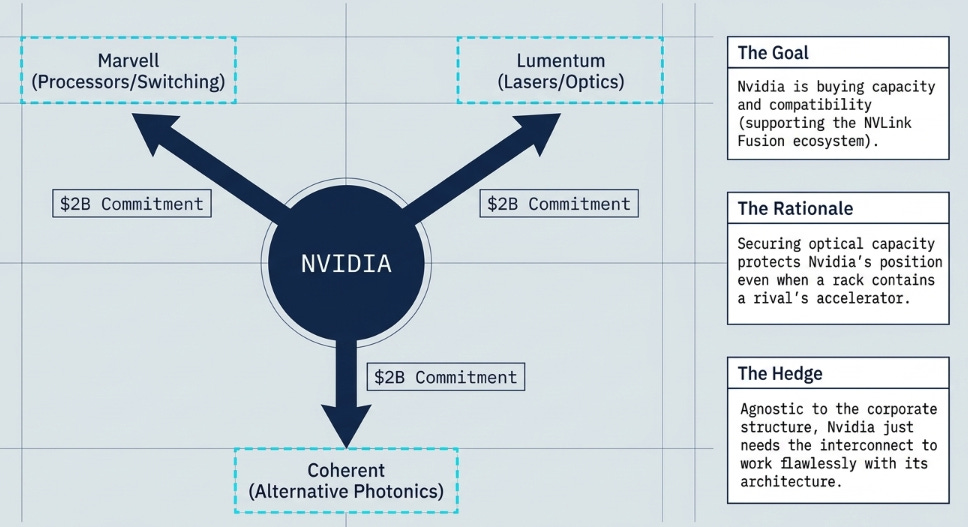
For Nvidia, the potential return extends beyond its investments. Hyperscalers building custom accelerators need not build an entirely separate connectivity system if Marvell can deliver chips and interconnect compatible with Nvidia’s architecture. Securing optical capacity and encouraging compatible integration can protect Nvidia’s position even when a rack contains someone else’s accelerator. An independent Lumentum purchased by a rival or hyperscaler might have constrained that flexibility. This is a possible motive, not a disclosed condition of Huang’s endorsement.
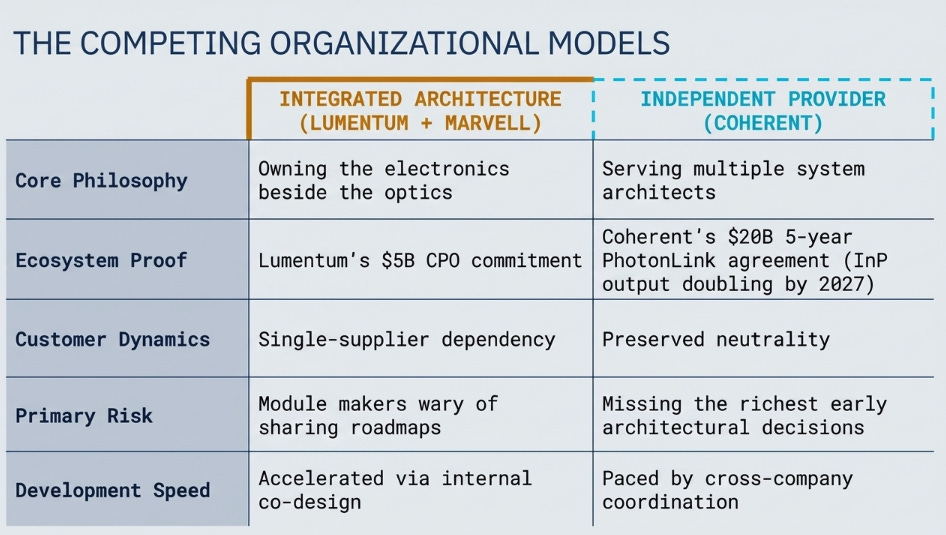
Coherent offers the competing organizational model. It has secured a roughly $20 billion five-year PhotonLink agreement and is expanding indium phosphide output, with capacity projected to more than double again by the end of 2027. Its management emphasizes the value of independence: a photonics provider can serve multiple system architects without making its customers depend on a competitor. Coherent’s contracts also demonstrate that optical suppliers can win integrated-system commitments without owning a large merchant DSP franchise.
The two models each have a cost. Combining electronics and optics may shorten development cycles and improve performance but could make competing module makers wary of sharing roadmaps with their own supplier. Remaining independent preserves neutrality but may leave the richest architectural decisions to semiconductor companies. On the merger call, Hurlston said Lumentum supplies lasers to nearly all its competitors and intends to continue. Customers will decide whether that promise is credible after ownership changes.
That is the deeper uncertainty. The optimal boundary for designing an optical engine need not be the optimal boundary for owning the companies that build it.
What Shareholders Own Now
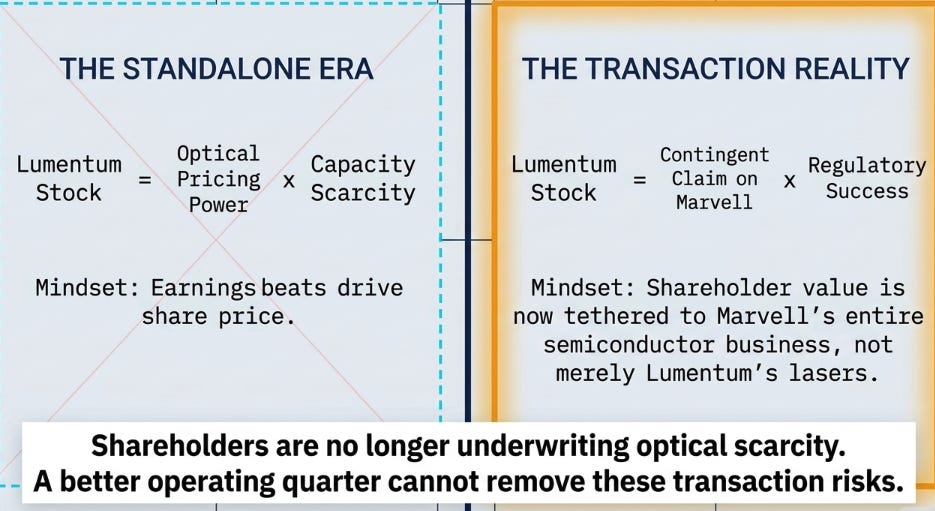
The all-stock structure has already transformed the investment. Marvell closed November 5 at $133.55, making the fixed consideration worth about $601 per Lumentum share; Lumentum closed at $509.70, a 15% discount to that floating value. This is not free arbitrage. Completion is expected in the first half of 2028, and investors face regulatory approvals, time, and Marvell’s share-price risk. The announced 24% premium against unaffected prices is no longer a cash amount anyone can collect.
The previous standalone valuation framework must therefore become a transaction-and-industry framework. My illustrative end-2029 values are:
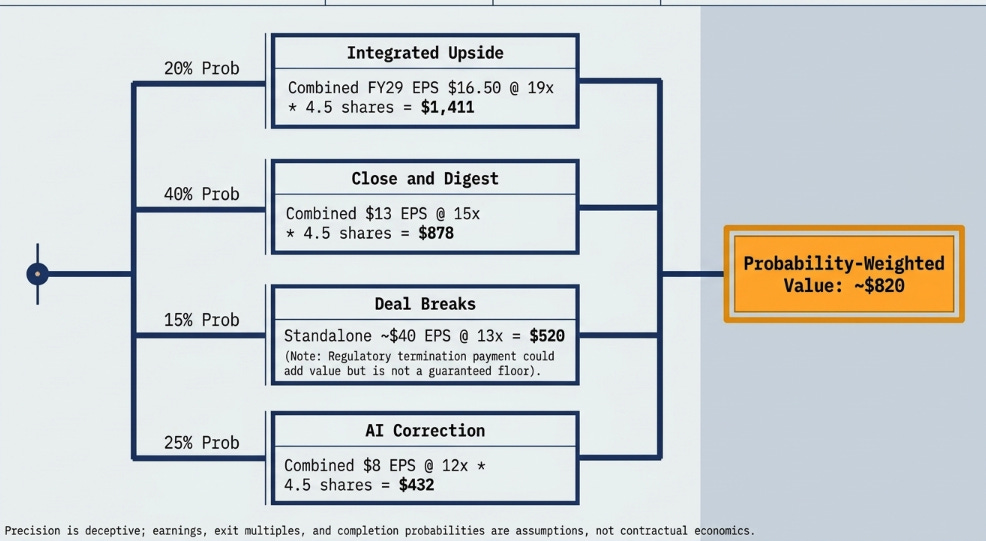
The probability-weighted value is roughly $820, although the precision is deceptive: earnings, exit multiples and completion probabilities are our assumptions, not contractual economics. A regulatory termination payment could add value in a qualifying break; it is not a floor in every failed-deal scenario. In successful-deal cases, the share-price outcome increasingly depends on Marvell’s entire semiconductor business, not merely Lumentum’s lasers.
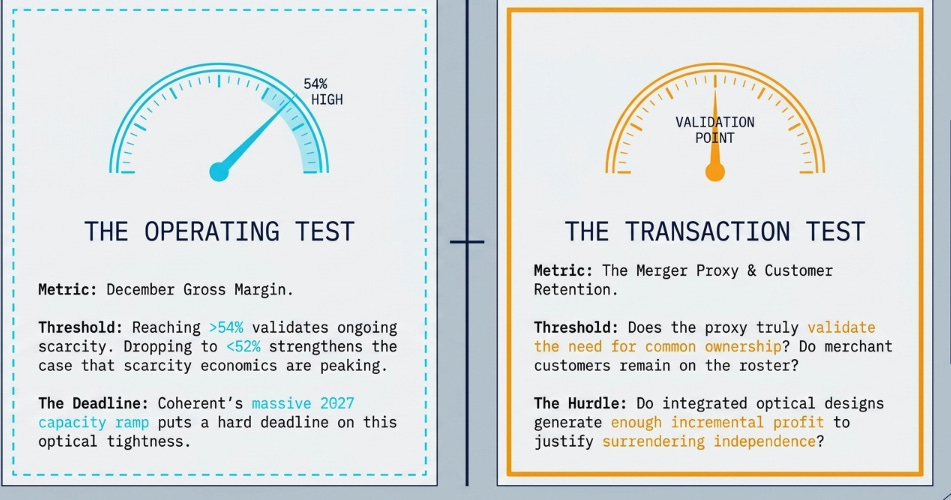
There are now two tests, and investors should not confuse them. The operating test is whether Lumentum’s December gross margin reaches approximately 54% or higher as revenue accelerates; 52% or lower would strengthen the case that scarcity economics are peaking. Coherent’s 2027 capacity ramp gives that test a deadline. The transaction test is whether the merger proxy supports the claimed need for common ownership, whether merchant customers remain, and whether integrated optical designs generate enough incremental profit to justify surrendering independence.
For now, I would not treat the stock’s fall as a reason to add mechanically. Lumentum is no longer simply a concentrated bet on optical pricing. It is a discounted, contingent claim on Marvell, with the independent business as an alternative if the deal breaks. A better operating quarter cannot remove those transaction risks.
In August, the thesis was that the optical boundary would keep moving closer to compute, making Lumentum’s lasers more valuable. November validated that movement emphatically. What we did not anticipate was management’s conclusion that the next portion of its value might be captured more effectively by the company designing the entire electrical-optical system.
Hurlston has not told us the window is closing. He has told us that, in his judgment, the toll booth belongs inside a larger architecture. Whether that architecture earns more than an independent Lumentum could have earned is now the investment thesis.
Disclaimer:
The content does not constitute any kind of investment or financial advice. Kindly reach out to your advisor for any investment-related advice. Please refer to the tab “Legal | Disclaimer” to read the complete disclaimer.