


TL; DR
The optical transition is broader than expected: demand is expanding simultaneously across scale-across, 1.6T, optical circuit switching, near-packaged optics, CPO and external laser sources.
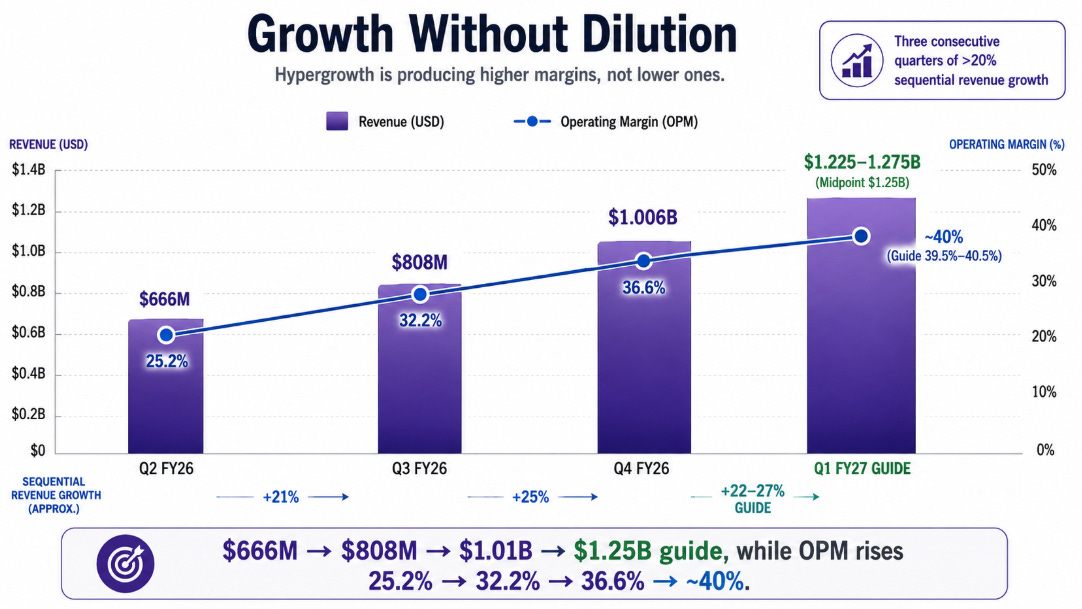
The economics are arriving faster than the architecture: revenue reached $1.01 billion, operating margin hit 36.6%, and management is already guiding to roughly 40% margins at a $1.25 billion quarterly revenue run-rate.
The real debate is duration: customers are helping fund capacity and signing multi-year commitments, but the thesis depends on Lumentum retaining its yield, reliability and qualification advantage as Chinese and other competitors’ scale.
Fourteen months ago, I wrote that AI had changed the nature of networking. Traditional data centers were built for computers that communicated intermittently: an application requested data, a browser called a server, a database returned a result. AI training was different. Thousands of processors needed to communicate continuously, and a processor waiting on the network was an extraordinarily expensive piece of silicon doing nothing. The network had stopped being plumbing around the computer and had become one of the constraints on the computer itself.
The conclusion of that article was that the optical transition would eventually become one of the most important battlegrounds in AI networking. Copper could be optimized, retimed and packaged more cleverly, but physics would eventually win ever-higher bandwidth would make electrical connections increasingly expensive in power and increasingly difficult in signal integrity.
I think that argument was broadly right. What I underestimated was the shape of the transition.
I imagined something relatively discrete: copper would dominate until it reached its limits, at which point technologies such as co-packaged optics would move light closer to the processor. Lumentum’s fiscal fourth-quarter earnings suggest the transition is happening much more continuously. Optics is spreading through several layers of the AI network at once, and each layer appears to create another demand vector before the previous one has finished growing.
The most striking evidence came from CEO Michael Hurlston:
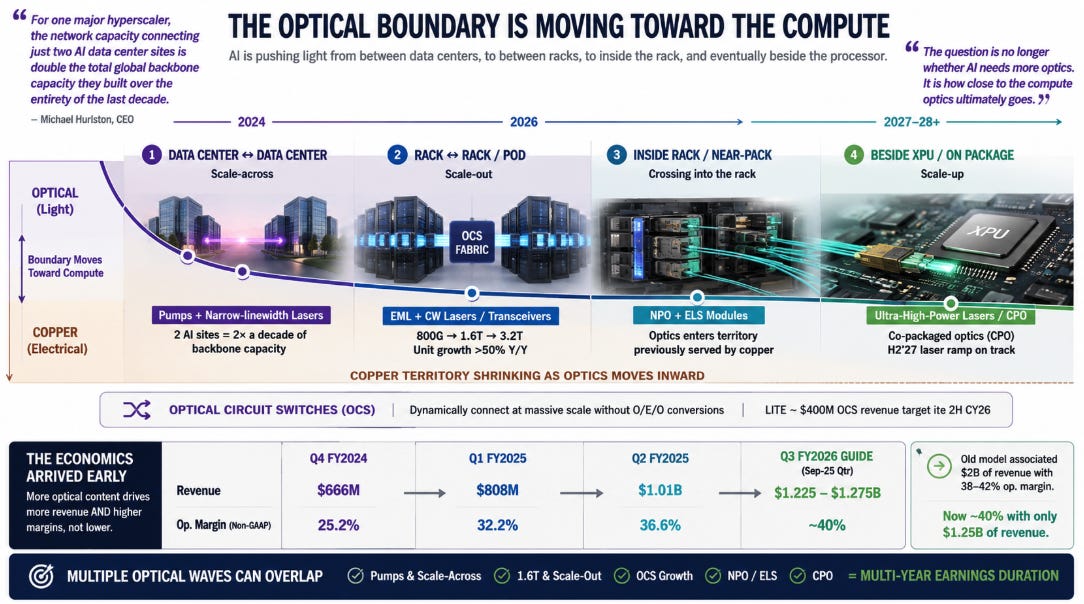
“For one major hyperscaler, the network capacity connecting just two AI data center sites is double the total global backbone capacity they built over the entirety of the last decade.”
Two sites require twice a decade’s worth of backbone capacity.
That sentence says more about Lumentum’s opportunity than its first billion-dollar quarter does. Revenue reached $1.01 billion, up 109% year-over-year, while non-GAAP gross margin crossed 50% and operating margin reached 36.6%. The company then guided the September quarter to $1.225–1.275 billion of revenue and approximately 40% operating margins.
The numbers are extraordinary. The more important question is whether they describe the top of an unusually violent optical shortage or the early financial expression of something more structural.
The Missing Layer
My previous networking article focused mainly on the companies deciding how AI networks were built: NVIDIA, Broadcom, Arista, Marvell and Credo. NVIDIA had understood earlier than most that a GPU was only as useful as the network connecting it to other GPUs; Mellanox therefore looked less like diversification and more like completing the machine. Meanwhile, the optical transition appeared as a future disruption to today’s hierarchy.
What that framing underweighted was the physical layer beneath those architectural choices: the lasers.
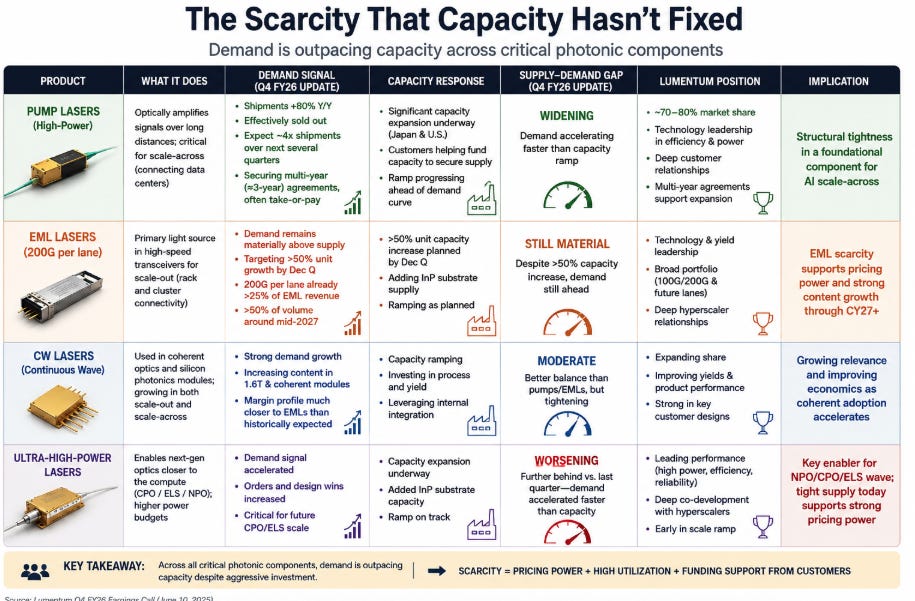
Lumentum’s pump lasers are a good example. Shipments increased more than 80% year-over-year, yet the company remains effectively sold out. Management expects shipment volumes to increase roughly fourfold over the coming quarters and estimates its market share at 70–80%. More unusually, customers are entering mostly three-year arrangements, many effectively take-or-pay, while helping offset the capital expenditure required to create additional capacity.
That is an odd form of customer behavior if this is simply a normal semiconductor shortage waiting to correct itself. Customers usually welcome new capacity because it creates negotiating leverage. Here they are helping finance that capacity because securing enough supply appears more valuable than preserving future optionality.
EMLs tell a similar story. Lumentum expects more than 50% year-over-year unit growth by the December quarter, yet management still expects to remain significantly behind customer demand. Two-hundred-gigabit-per-lane EMLs already represent more than a quarter of EML revenue and should become most volumes around the middle of 2027.
The strongest evidence, though, came from ultra-high-power lasers. Citi asked management whether the supply-demand imbalance had improved from the previous quarter. Hurlston replied:
“We are way behind in our shipments, unfortunately, on high-powered lasers... The demand signal has increased, and we are very much further behind relative to our ability to supply.”
Wupen Yuen immediately clarified the important part: Lumentum’s capacity ramp itself is on schedule. The company is further behind because demand accelerated faster than supply.
This is the central fact in the Lumentum thesis today. Capacity is expanding rapidly, but the demand curve is currently moving away even faster.
The Optical Boundary
The reason that can happen becomes clearer when Lumentum’s products are considered as parts of one architectural progression rather than separate businesses.
The earliest AI networking opportunity was largely scale-across. Vast AI campuses need enormous amounts of high-capacity connectivity between buildings and data centers. That is where pumps and narrow-linewidth lasers matter, and where the “two sites versus a decade of backbone” example is most revealing.
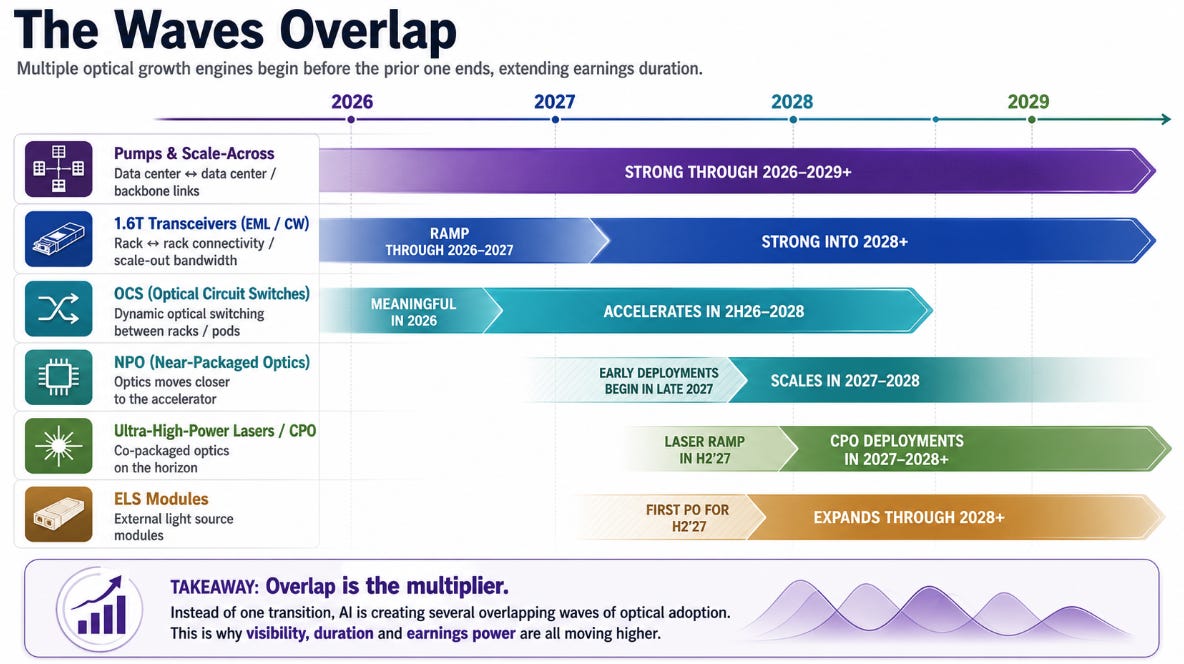
Then comes scale-out. The cluster itself becomes larger, pushing 800G toward 1.6T and eventually 3.2T. Lumentum began 1.6T production in Q4, but the majority of transceiver shipments were still 800G. Management expects 1.6T uptake to intensify beginning this quarter and sustain through calendar 2027. In other words, one of the most obvious growth drivers in the story has barely started.
Then there is switching. Optical circuit switches allow increasingly large clusters to change connectivity dynamically without converting optical signals back into electrical ones. Lumentum doubled OCS shipments sequentially in Q4 and says the current quarter will be its first with OCS revenue meaningfully above $100 million. Management remains on track for roughly $400 million of OCS revenue in the second half of calendar 2026.
The more interesting OCS development is competitive rather than financial. Hurlston described Lumentum as effectively the only scaled merchant supplier currently shipping at meaningful volume. He expects the company to become the largest supplier to one major customer in early 2027, while new higher-port-count, lower-port-count and in-tray designs expand an opportunity that was not fully contemplated in the previous market framework.
Finally comes scale-up, where the optical boundary moves inside the rack and closer to the accelerator itself.
This is where my 2025 framework was too binary. I treated co-packaged optics as the transition point: copper today, optics tomorrow. The industry appears to be developing an intermediate step in near-packaged optics, placing optical engines close to the accelerator before eventually moving them onto the package.
Lumentum benefits from both.
Hurlston addressed recent concern about CPO timing directly:
“Our lead CPO customer’s production plans remain very much on track, and their demand signal has increased since our last update.”
That would already have been an important answer. The next sentence made it more tangible:
“We were recently given our first external light source, or ELS, module purchase for delivery by the second half of calendar 2027.”
The word purchase matters. CPO has spent years existing in roadmaps, demonstrations and future market estimates. A purchase order does not prove the eventual size of the market, but it moves part of the opportunity from possibility to commercial evidence.
ELS also raises the amount of value Lumentum can capture. Instead of selling only the laser, Lumentum supplies a higher-ASP module to customers that do not want to integrate individual laser chips themselves. Management says margins will be lower than on the standalone laser but still above the corporate average.
The optical transition therefore looks less like one architectural event and more like a moving boundary: between data centers, between racks, inside racks, beside accelerators and eventually on the package itself.
Lumentum has exposure at nearly every step.
The Economics Arrived Early
That breadth would matter less if moving from components into systems destroyed the economics.
So far, the opposite has happened.
Revenue has progressed from roughly $666 million to $808 million to $1.01 billion and now to a $1.25 billion guidance midpoint. Over the same period, operating margin has moved from 25.2% to 32.2% to 36.6% and now approximately 40%.
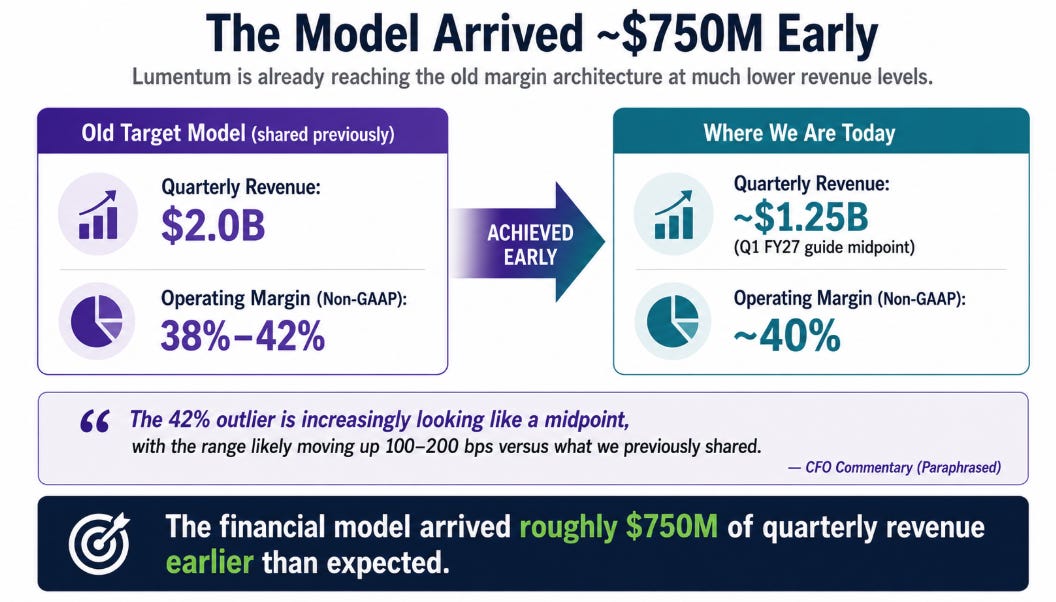
The old Lumentum financial model associated $2 billion of quarterly revenue with operating margins of 38–42%. The company is already around the midpoint of that range with only $1.25 billion of quarterly revenue.
When Mizuho asked CFO Wajid Ali what this meant for the longer-term model, the answer was unusually consequential:
“Think of the 42% outlier more as a midpoint, with the range probably moving up 100-200 basis points versus what we showed at OFC.”
That changes the earnings equation.
The usual high-growth semiconductor story asks investors to choose between revenue growth and margins. Capacity must be built before it is filled, new systems dilute component economics, R&D rises, and new customers require investment.
Lumentum currently has revenue estimates moving higher while the margins attached to those revenues also move higher.
My working FY27 assumptions are now roughly $6.2–6.5 billion of revenue and $23–25 of adjusted EPS. FY28 could reach $8.5–9.5 billion and $35–41 of EPS if the 1.6T, OCS, pump and CW ramps overlap as expected. Those numbers are estimates rather than company guidance, but the direction is more important than the exact decimal point: the company’s old financial model is no longer a useful ceiling.
The Other Fab
There is, of course, a familiar way this story can end.
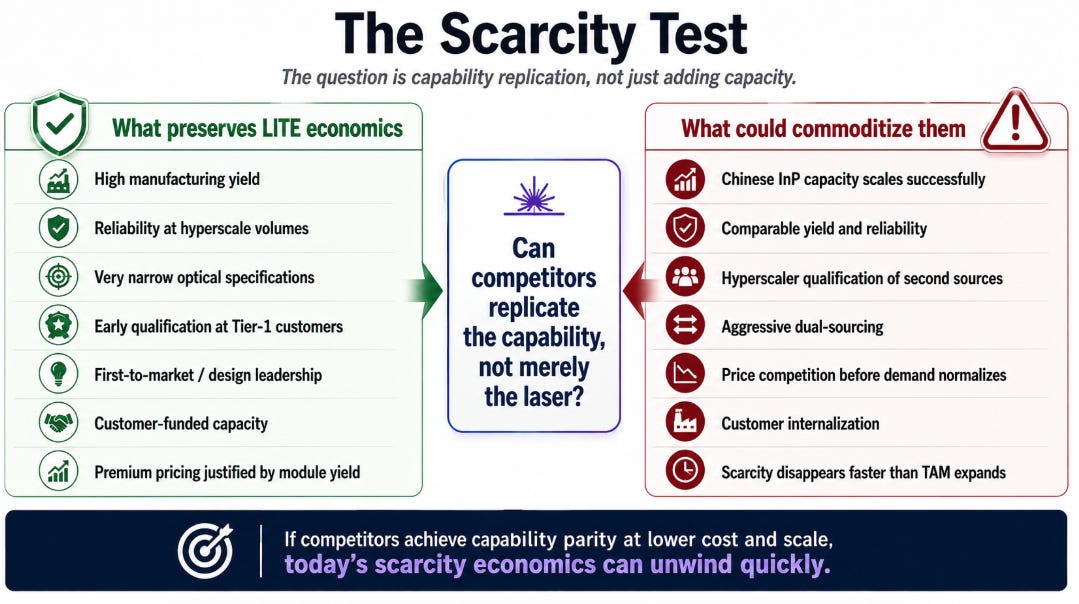
Scarcity produces extraordinary margins. Extraordinary margins attract capital. New fabs come online, customers qualify second sources, pricing weakens, utilization falls and what once looked structural turns out to have been cyclical.
The most important bearish question on the call therefore came from Raymond James, which asked about new Chinese indium phosphide capacity.
Hurlston’s answer was that Lumentum has not yet seen meaningful impact. He argued that EMLs and high-power lasers remain differentiated and that even CW lasers can command substantial premiums because consistency and narrow specifications improve customers finished-transceiver yields. A cheaper laser is not necessarily cheaper if it causes more modules to fail.
That is a credible advantage. It is not an immutable one.
The street discussion after earnings highlighted Source Photonics and other Chinese suppliers progressing through 100G and 200G EMLs and potentially toward high-power lasers. I would not treat every channel claim as established fact, but the strategic question is exactly right.
The bear case is not that China needs to invent a laser.
It is that Chinese suppliers eventually achieve comparable yield, reliability, specification consistency and hyperscaler qualification at meaningfully lower prices.
If they do, Lumentum’s current scarcity economics can unwind even if AI networking demand continues growing.
This is the counterweight to the entire thesis. It is also why I do not assume today’s valuation multiple or scarcity margins indefinitely.
The Price of Duration
The market already knows Lumentum is having an extraordinary year. The TMT discussion around the print suggested that many investors were already using a September-quarter revenue bogey of roughly $1.20–1.25 billion rather than published consensus. By the time earnings arrived, some investors apparently wanted $1.30 billion for the stock to work.
That explains the initially muted reaction to objectively spectacular guidance.
Lumentum is a consensus long. Existing optical and semiconductor specialists have enormous gains. Some will raise their earnings estimates and sell shares at the same time because the position has become too large.
The next leg therefore requires a different buyer: large-cap growth and generalist technology investors willing to believe this is a multi-year earnings-duration story rather than the last year of an optical shortage.
That brings the investment question back to duration.
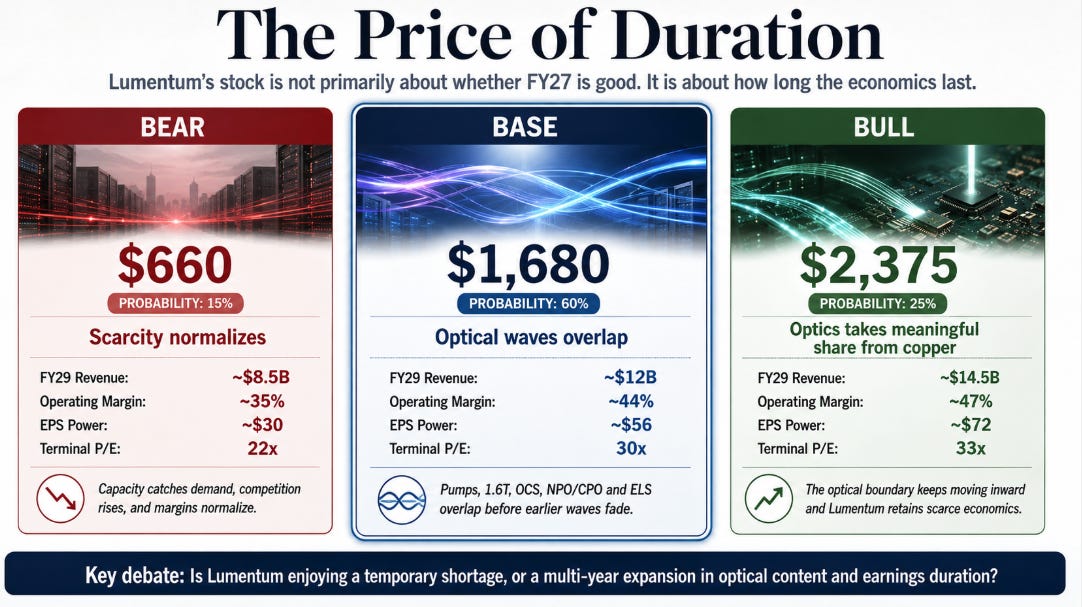
Using roughly $821 as the pre-earnings reference price, my probability-weighted three-year value is around $1,700.
The bear case assumes today’s scarcity is temporary. Capacity catches demand, Chinese and other suppliers close the technology gap, pricing normalizes and operating margins retreat toward the mid-30s.
The base case assumes several optical waves overlap. Pumps and scale-across continue growing; 1.6T and OCS drive FY27; NPO, CPO and ELS begin contributing before the previous growth vectors mature. The multiple can compress materially while earnings continue growing fast enough to carry the stock.
The bull case is more ambitious. It assumes optical connectivity meaningfully displaces copper closer to the compute and that Lumentum retains technological scarcity across enough of those connections to capture a disproportionate share of the value.
That produces my rough price path of $975 in three months, $1,100 in six months, $1,300 in twelve months and approximately $1,700 in three years.
I have the least confidence in the first number. Positioning can overwhelm fundamentals over three months. I have more confidence in the twelve-month question because by then investors should be valuing Lumentum against FY28 earnings rather than arguing about whether the September-quarter guide was $20 million above someone’s whisper.
What Would Change My Mind
The next quarter does not need to prove that AI demand is strong. That debate is largely finished.
It needs to show that $1.25 billion is another step rather than a peak. OCS should continue beyond its first $100 million-plus quarter. 1.6T should accelerate as promised. Gross margin should remain near or above 50%, and operating margin should remain above 40% rather than immediately mean-reverting.
More important for the three-year thesis, EML and pump demand should remain ahead of expanding supply; high-power laser capacity should convert into revenue without eliminating scarcity; additional ELS or NPO orders should turn architectural discussion into commercial evidence; and the lead CPO customer should remain on schedule for the H2 2027 laser ramp.
The bear signals are equally clear. Pricing weakness before supply is fully available would matter. Gross margin falling below roughly 49% while revenue continues growing would suggest today’s economics are more cyclical than I think. A closing supply-demand gap caused by softer demand rather than better output would change the interpretation quickly. Most importantly, credible Chinese products qualifying at hyperscalers with comparable yields would challenge the scarce-layer thesis at its foundation.
The useful thing about Lumentum today is that the argument has become testable.
When the Bottleneck Became Optical
My 2025 article ended with the idea that the next phase of AI networking would be won by companies building for requirements that seemed extraordinary today but would later appear inevitable.
A year later, two AI data centers apparently require twice the networking capacity one hyperscaler built across its entire global backbone over the previous decade.
That is an extraordinary requirement.
It is also increasingly real.
The network became a bottleneck because AI turned thousands of processors into one distributed computer. What Lumentum is now showing is that the bottleneck is moving again from protocols and switches toward the physics of moving an ever-growing amount of information.
That is why the company’s first billion-dollar quarter is almost beside the point. Lumentum is already guiding to $1.25 billion. OCS is crossing $100 million quarterly revenue. 1.6T has barely started. Pump output is heading toward four times today’s level. High-power laser demand is outrunning that expansion. NPO is appearing before CPO. ELS has moved from a concept to an order. And the operating-margin structure once associated with $2 billion of quarterly revenue has arrived hundreds of millions of dollars early.
Perhaps this is simply what the top of an optical cycle looks like when demand is unusually strong and supply unusually scarce. Capacity will arrive, competitors will qualify, customers will dual-source and margins will normalize.
But the alternative is more interesting.
AI may not simply require more networking. Each generation of AI may require optics in places where the previous generation could still use copper.
If that is true, Lumentum’s opportunity is not one shortage or one product cycle. It is the movement of the optical boundary itself.
General Disclaimer: The information presented in this communication reflects the views of the author and does not necessarily represent the views of any other individual or organization. It is provided for informational purposes only and should not be construed as investment advice, a recommendation, an offer to sell, or a solicitation to buy any securities or financial products.
While the information is believed to be obtained from reliable sources, its accuracy, completeness, or timeliness cannot be guaranteed. No representation or warranty, express or implied, is made regarding the fairness or reliability of the information presented. Any opinions or estimates are subject to change without notice.
Past performance is not a reliable indicator of future performance. All investments carry risk, including the potential loss of principal. This communication does not consider the specific investment objectives, financial situation, or needs of any individual.
The author and any associated parties disclaim any liability for any direct or consequential loss arising from the use of this material and undertake no obligation to update or revise it.