


TL; DR
The recovery is real: Core Local Commerce returned to a 7.9% margin, food and non-food delivery unit economics turned positive, and subsidy discipline improved. But the old margin structure has not returned.
The fight has moved upstream: Meituan remains excellent at fulfillment, but rivals can attack discovery, local services and customer intent without recreating the entire delivery network. Merchant-services growth of just 4% shows that monetizing this influence remains difficult.
Staying essential increasingly requires owning more: and sharing more: grocery adds supply control but also capital intensity, while Tencent may become an important source of customer demand. The investment works only if better supply and distribution leave enough economics with Meituan.

In September, we described Meituan as the digital bellhop: valuable because it understood the city and could get things done. We expected its operating advantages to outlast competitors’ subsidies. By March, we had separated the durability of that capability from the margins it could earn; by June, we argued that competition had moved into discovery, grocery supply and the customer relationship.
Q2 passes June’s clearest test. We said Core Local Commerce needed to reach breakeven in Q2 or Q3; it earned RMB5.7 billion. But our earlier confidence that competitors’ financial constraints would settle the contest was excessive. Spending can become more disciplined while the battle for customers continues.
The question governing this update is therefore: can Meituan preserve its influence over local purchasing decisions at a cost that leaves attractive earnings for shareholders? Q2 makes me more confident in the durability of its operating capabilities. The evidence that those capabilities will produce attractive returns after reinvestment remains incomplete.
The recovery has a price
Meituan’s underlying mechanism is straightforward. More orders within the same neighborhoods can improve courier utilization, merchant selection and delivery reliability. Better service encourages repeat purchases, reinforcing local density; the mechanism breaks economically when keeping those customers costs more than the additional density saves.
This quarter showed that Meituan can reduce subsidies and recover earnings. Revenue rose 14.4% to RMB104.6 billion, and adjusted net profit reached RMB2.5 billion against StreetAccount’s RMB736 million expectation. Core Local Commerce supplied 84% of the sequential improvement in group operating profit.
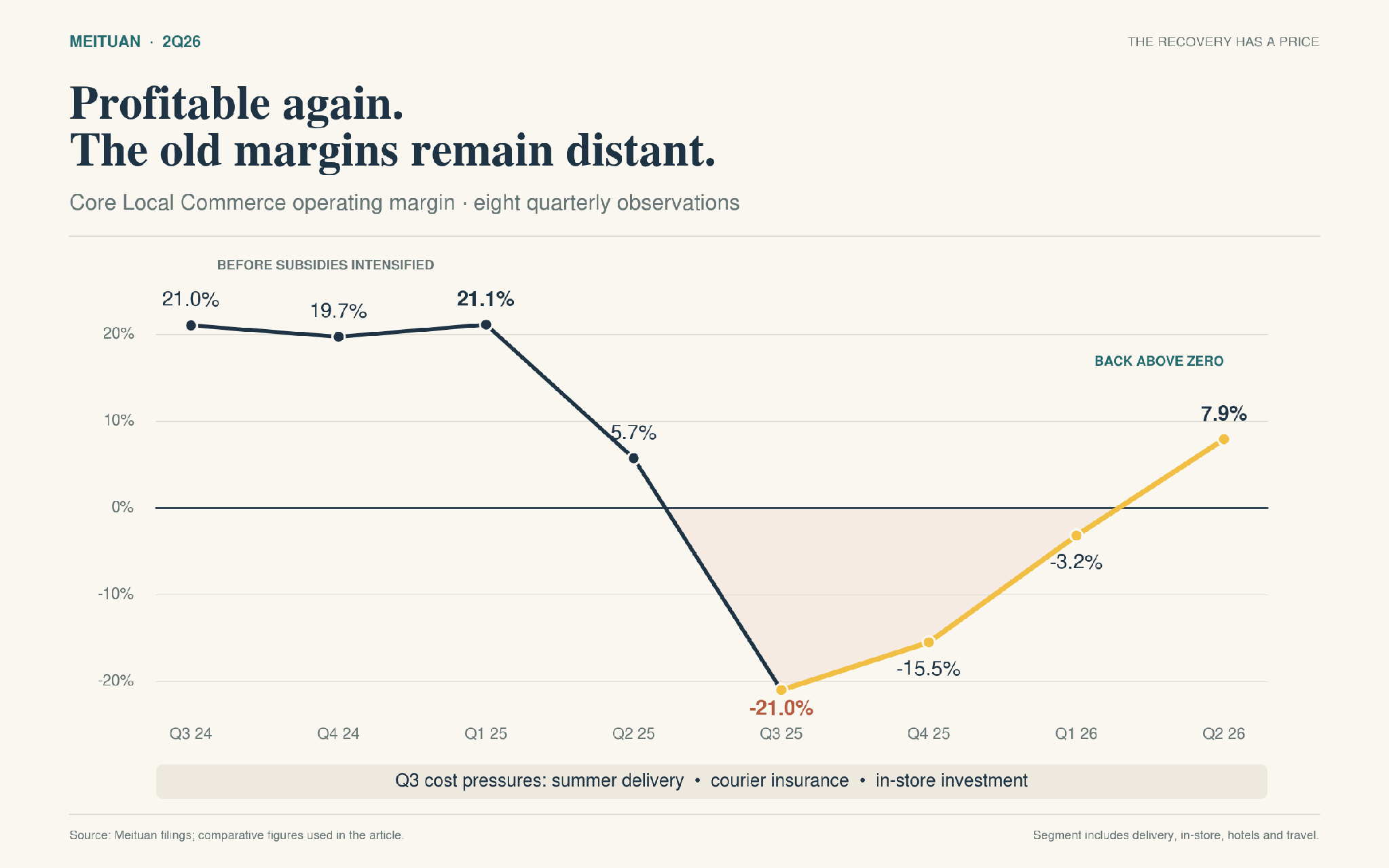
The recovery matters, but the segment includes in-store services, hotels and travel alongside delivery. Management separately disclosed positive food and non-food delivery unit economics. Neither measure establishes that every order is profitable or that the former margin structure has returned.
Regulatory pressure supports greater discipline, but management’s outlook describes a gradual adjustment:
“Even so, we expect UE to stay positive in Q3 as we continue to optimize operational efficiency. Specifically, the industry subsidy level is still much higher than 2024 level, and it will take a few quarters to normalize. At the same time, seasonal headwinds will weigh meaningfully on our UE.”
Summer courier costs, marketing and occupational injury insurance will absorb some gains. Management also expects in-store margins to decline in Q3 and Q4 as investment increases. I expect Q3’s core margin to retreat from 7.9%; sustaining more than 5% would be a reassuring result, rather than company guidance.
The accounting reinforces the need for care. Some incentives reduce reported revenue, so withdrawing them can improve both sales and profit without equivalent transaction growth. Management describes stronger retention, frequency and order mix, but provides insufficient figures to measure how much demand survives without incentives.
The stock’s response is less mysterious when viewed through future earnings. By September 22, the shares were 5.5% below their pre-results close. Between August 27 and September 22, FactSet’s 2027 normalized EPS mean fell 5.8%, leaving the corresponding forward P/E almost unchanged at 16.5 times. The analyst samples changed, and this does not establish trading causality. It does show that the stronger quarter failed to lift the following year’s aggregate earnings expectation.
The lobby is still contested
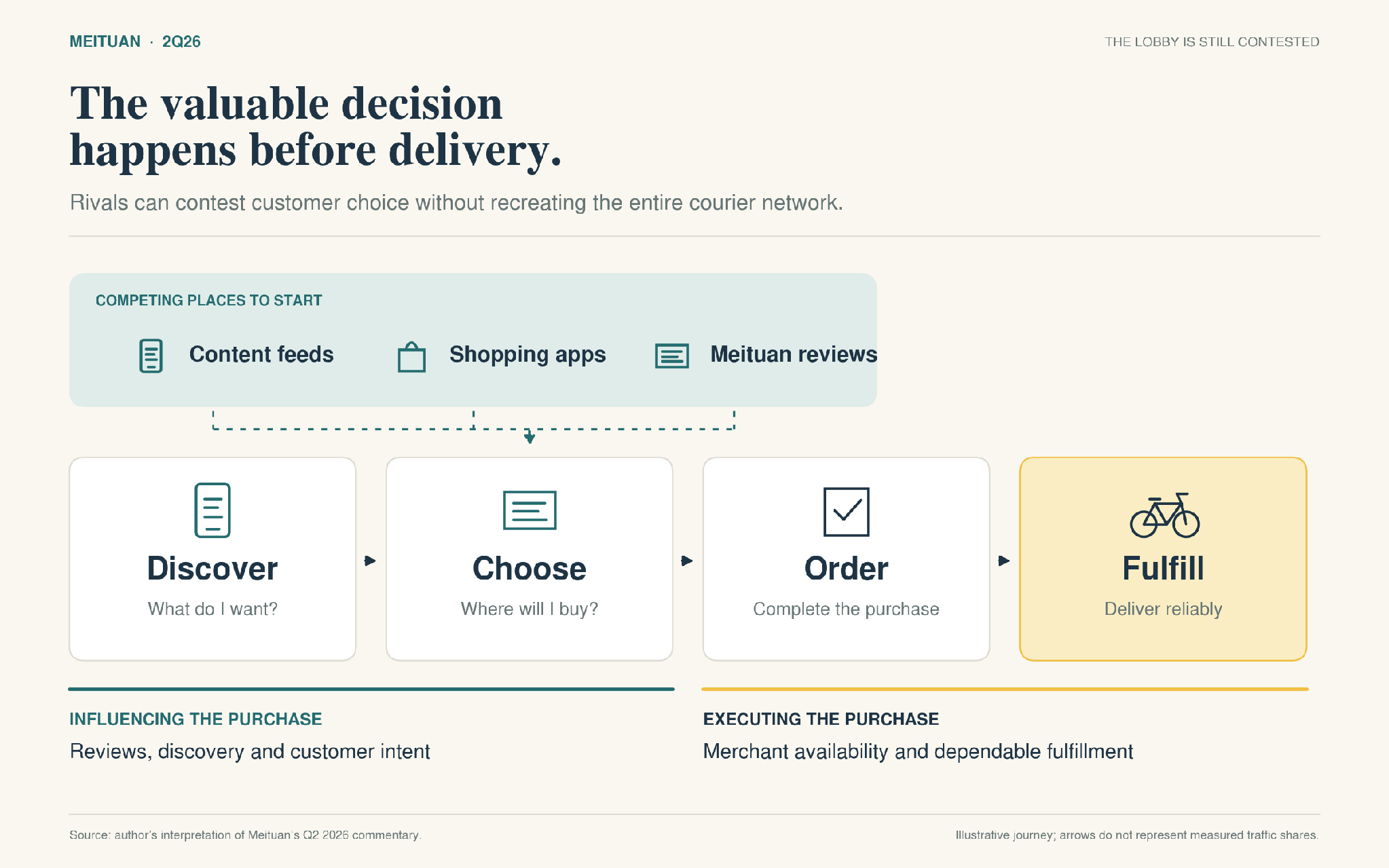
Our original competitor-exhaustion argument assumed rivals would judge delivery primarily by its own profits. Alibaba’s June-quarter release exposes the weakness in that assumption: quick commerce increased Taobao engagement and contributed incremental customer-management revenue, while delivery unit economics improved without sacrificing market share. My inference is that an order can create value for Alibaba elsewhere in its business, extending its willingness to compete.
Meituan faces a related problem in local services. Completing the transaction and influencing the purchasing decision are different sources of value. A competitor can take valuable restaurant discovery or hotel demand without recreating Meituan’s entire delivery operation. Management described the current attack:
“Over the past few quarters, we’ve seen competitors stepping up investment in local service space through a dedicated shelf-based app. They have been subsidizing heavily to redirect the traffic from their content-driven model to accelerate the adoption of the new app.”
Core Local Commerce merchant-services revenue grew only 4.0%. That is a warning, but it combines commissions and advertising across activities. Without comparable transaction growth and category mix, it cannot establish that Meituan’s pricing power has deteriorated. It does establish that merchant monetization is growing much more slowly than the headline business.
Meituan’s response is to improve supply, merchant tools and customer experience while spending more in-store. These investments could deepen relationships; they could also become permanent costs of defending existing ones. The distinction will appear in retained customers and contribution profit after incentives, rather than in management’s description of its expanding capabilities.
June’s argument therefore survives, with a harder economic test. Meituan still coordinates something difficult and useful. Shareholders benefit when that coordination gives customers and merchants reasons to stay without requiring a matching increase in defensive spending.
Buying the pantry, sharing the front door
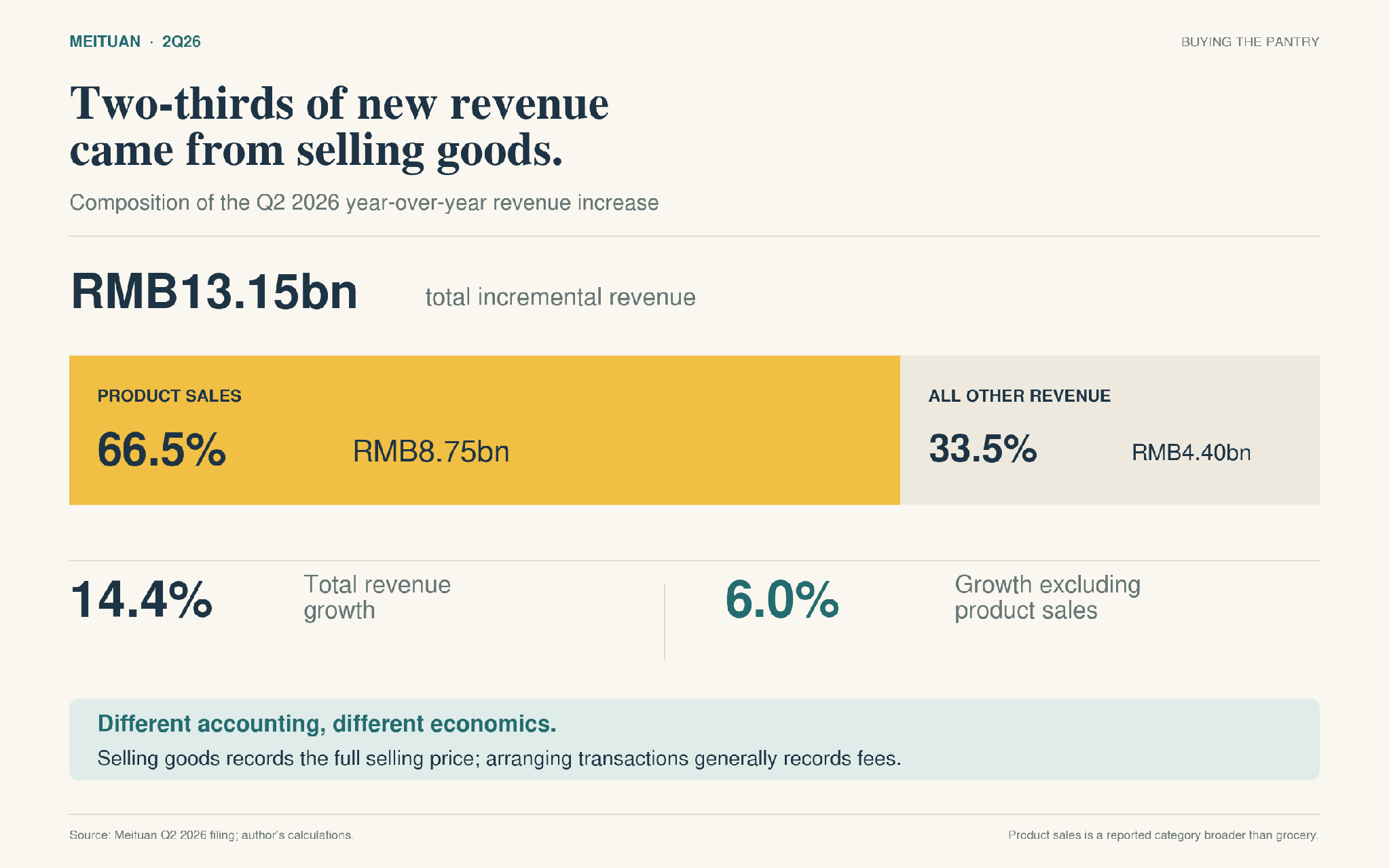
The most revealing number this quarter concerns what Meituan increasingly owns. Product sales rose 48.8% to RMB26.7 billion and supplied 66.5% of incremental revenue. Excluding product sales, revenue grew 6.0%. Selling goods adds their full selling price to revenue; arranging a transaction generally adds only the associated fees.
This is why grocery belongs at the center of the investment argument. Customers want reliable availability, quality and delivery. Where independent merchants cannot consistently provide them, owning supply can strengthen Meituan’s service. But that ownership brings inventory, operating complexity and capital requirements that a revenue-growth comparison misses.
Xiaoxiang reached 68 cities. Grocery margins improved, yet absolute losses increased sequentially as expansion continued. Total New Initiatives losses narrowed because improvement elsewhere, including Keeta, offset that spending. Our June test must become more precise: grocery should earn its own justification rather than receive credit for overseas progress inside the same segment.
Keeta provides encouraging evidence that operating knowledge travels. Hong Kong is sustainably profitable, and management says Saudi Arabia reached profitability in July. The disclosed milestones use different definitions, so they do not establish a precise acceleration in time to breakeven. Brazil must still demonstrate its own economics.
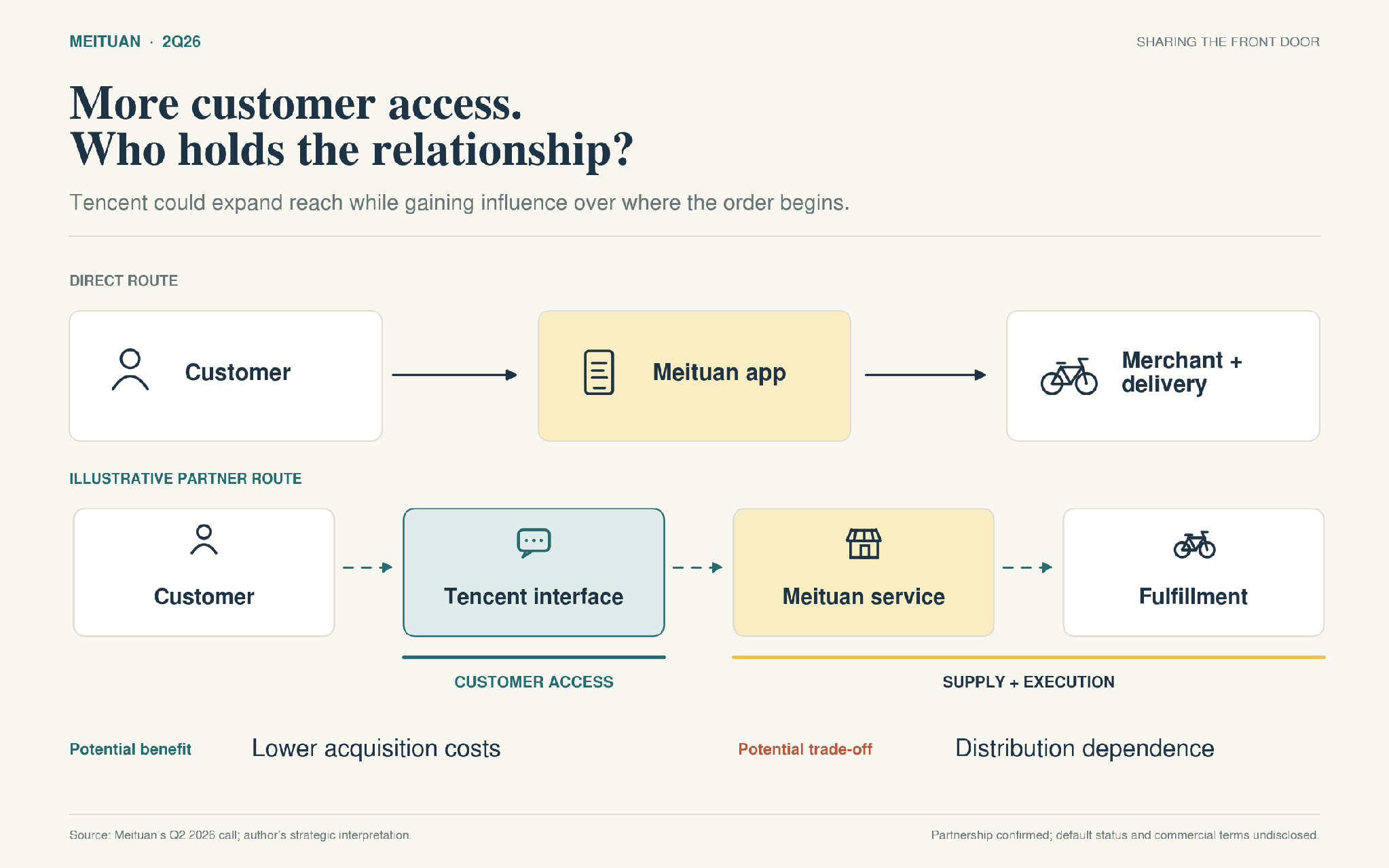
AI introduces a different ownership question: who controls the customer’s request? Meituan is developing its own assistants and merchant tools, while pursuing an external route to demand. Management said:
“Our partnership with Tencent is progressing rapidly, with both teams refining the product to deliver faster, more convenient services.”
The opportunity is substantial. A request originating within Tencent’s services could reach Meituan without Meituan paying to acquire that customer directly. But a better distribution channel can also gain negotiating power over the businesses fulfilling its requests. The announcement establishes cooperation; it does not establish default status inside WeChat or disclose the commercial terms.
Meituan’s defense is the difficult work behind the recommendation: accurate availability, trusted merchants and reliable execution. Those capabilities can remain valuable when another company originates the order. Their value weakens if competing providers become interchangeable and the outside assistant controls customer choice.
The pantry and the front door belong in the same argument. Meituan is investing to make its service harder to replace while accepting that it may not control every customer interaction. The return depends on whether differentiated supply and execution outweigh the cost of building them.
Three prices for staying essential
My variant view is that Meituan can deliver attractive returns without recovering its former margins. A larger business earning moderate operating profits, supported by valuable financial assets, can justify more than today’s price. The risk is that maintaining its position consumes both the recovered earnings and part of those assets.
At June-end, net cash before leases was RMB79.6 billion, alongside RMB77.3 billion of investments: roughly HK$30 per current share combined. After lease liabilities, net liquidity was RMB72.5 billion. Those assets matter, but their value to shareholders depends on what management does with them. On potential disposals, management said:
“Going forward, we will weigh market conditions, valuation, funding needs, and our broader capital allocation priorities. When time is right, we are very open to exit or monetizing selected positions to free up capital. This will give us greater flexibility to reinvest in our own business and return value to shareholders.”
The choice between reinvestment and shareholder returns remains open. Q2 operating cash flow recovered to RMB9.7 billion, but the first-half total was only RMB2.7 billion, down 81.8%. Without corresponding capital expenditure, that cannot be presented as verified free cash flow. Asset sales would improve liquidity without proving better operating economics.
The revised valuation separates operating earnings from financial assets. It charges stock compensation and depreciation in operating margins, assumes 20% tax, and excludes financing and investment income from the earnings being capitalized. Cash and investments are then added separately, avoiding double counting.
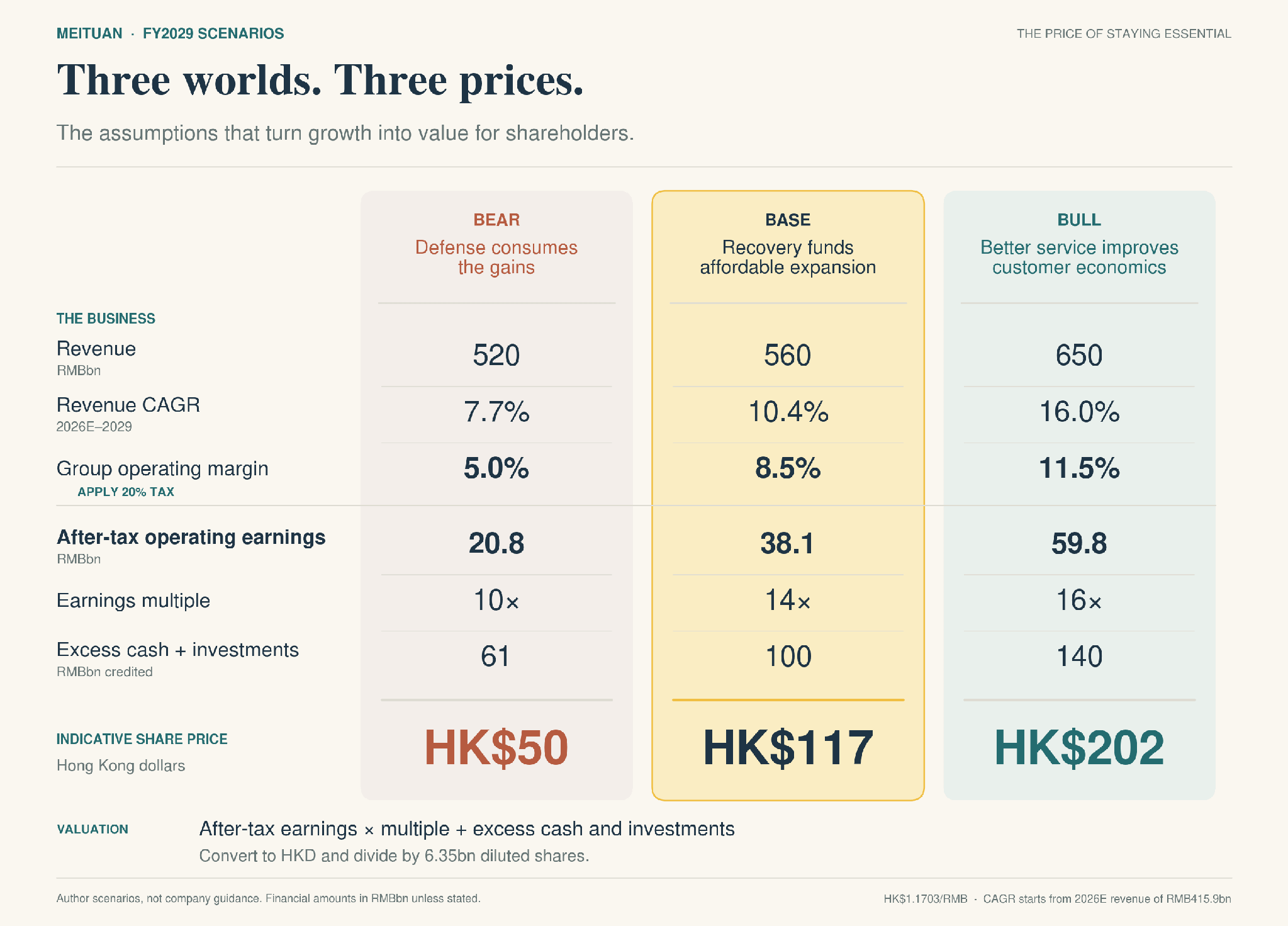
These are my assumptions, using 6.35 billion diluted shares and HK$1.1703 per RMB. I reserve RMB30 billion of current net liquidity for operations; bear, base and bull cases then credit cash changes of minus RMB20 billion, zero and plus RMB20 billion through 2029. Investment haircuts are 50%, 25% and zero, reflecting realization and tax uncertainty. The base gives no credit for additional cash accumulation. Revenue growth starts from FactSet’s RMB415.9 billion 2026 estimate.
The bear assumes persistent competitive spending and grocery investment consume the benefits of scale. The base requires profitable delivery, resilient in-store earnings and manageable expansion costs. The bull requires grocery, merchant tools and wider distribution to improve customer economics sufficiently to support higher group margins.
At the September 22 close of HK$73.20, the base implies roughly 17% annualized price appreciation over three years; the bear implies approximately 32% downside. The HK$117 base remains within June’s HK$105–135 range. I remain moderately bullish, with a more attractive entry around HK$65–68, rather than assuming a strong quarter has removed execution risk.
The tests are specific. Negative food-delivery unit economics in Q3 would contradict management’s outlook. A core margin below 2% would be a warning; two consecutive quarters below that level alongside renewed subsidy spending would challenge the recovery thesis. Negative H2 free cash flow after disclosed capex would weaken the capital-discipline case. Grocery losses rising without evidence of improving mature-location returns would challenge the case for owning more supply.
The bellhop has demonstrated that he still earns his place in the building. What remains unresolved is how much he must spend on the pantry, the reservation desk and access to the guests. Q2 strengthens my belief that Meituan can remain essential. The investment succeeds when doing so leaves more cash for its owners.
Disclaimer:
The content does not constitute any kind of investment or financial advice. Kindly reach out to your advisor for any investment-related advice. Please refer to the tab “Legal | Disclaimer” to read the complete disclaimer.