


TL;DR
Commerce worked; the stock didn’t. Brazil volume accelerated and unit shipping costs fell, but the market wants proof of returns, not just growth.
Margins are not fully discretionary. MELI can “set the dial,” but Shopee, Temu, Amazon, TikTok, and Nubank increasingly set the floor.
The thesis is now conditional. MELI remains a great business, but the stock depends on who captures the surplus: MELI, customers, sellers, or credit losses.
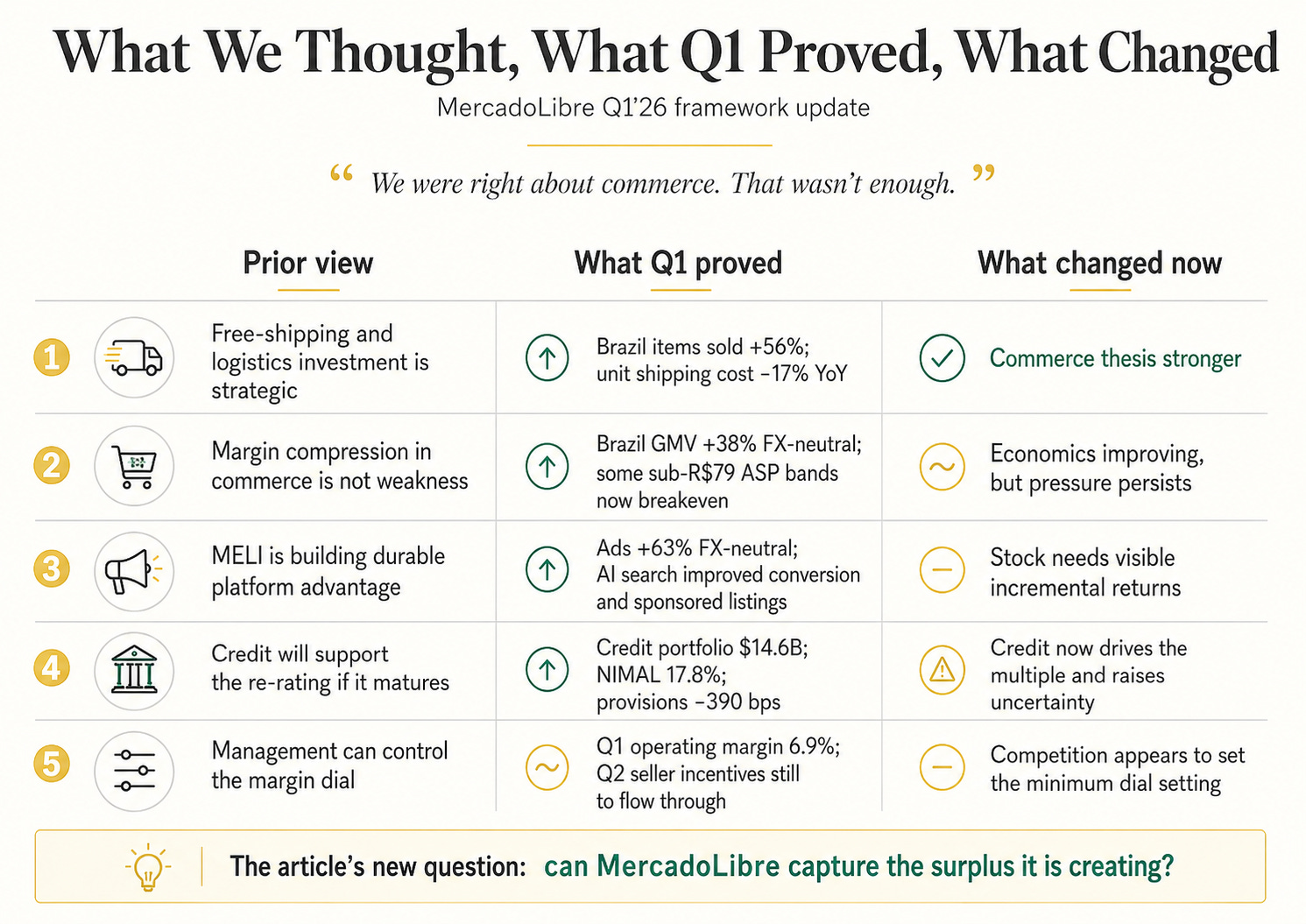
For the last year, our argument on MercadoLibre was simple enough to be dangerous: the margin compression was not weakness; it was the strategy.
The company had built the missing infrastructure for Latin American commerce, payments, logistics, credit, fulfillment, trust,and was now using that infrastructure as a weapon. Lower the free shipping threshold, accelerate low-ASP orders, force competitors to match a customer promise they could not deliver at the same cost, and then monetize the resulting activity through payments, credit, advertising, and seller services. In Q3, we called it the margin compression strategy. In Q4, we refined the view: commerce was working, but credit had become large enough to decide the multiple. The stock did not care.
Q1’26 is where those two ideas collide.
MercadoLibre reported net revenue and financial income of $8.845 billion, up 49% year over year and 46% FX-neutral. GMV reached $19.0 billion, TPV reached $87.2 billion, and the company again framed the quarter as proof that its investments are working. But operating income was only $611 million, down 20% year over year, and operating margin collapsed to 6.9%.
The lazy conclusion is “strategically stronger, margins weaker.” That was a useful formulation once. It is now insufficient.
The better conclusion is this: we were right about what MercadoLibre was doing; we were wrong about what the market would pay for it before the economics became visible.
That is not a minor distinction. It is the entire stock.
The Commerce Call Was Right
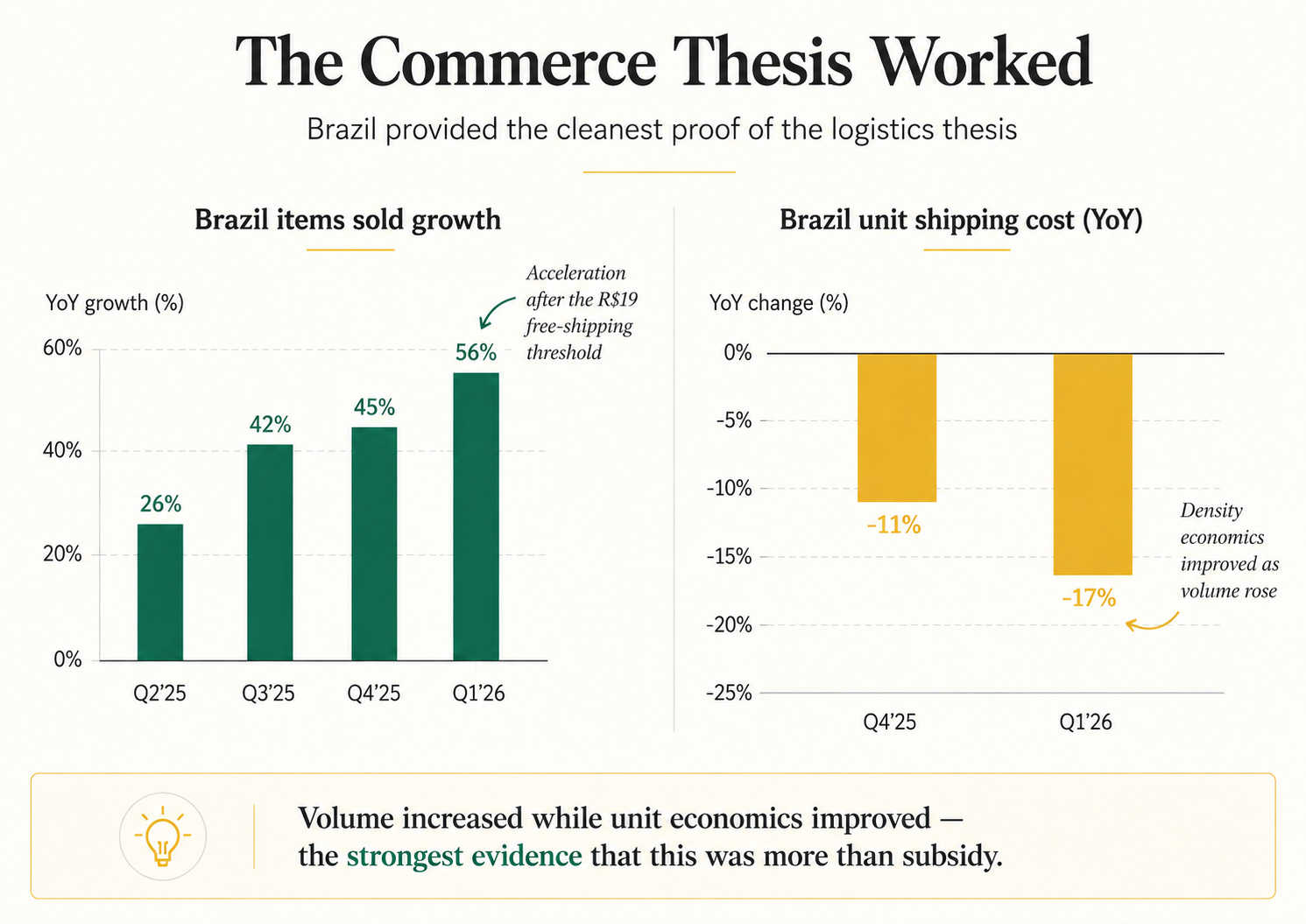
The strongest part of the quarter was Brazil.
This matters because Brazil was the test of our prior thesis. When MercadoLibre lowered the free shipping threshold to R$19, the market read it as a defensive response to Shopee, Temu, and other low-price competitors. Our view was different: if MercadoLibre’s logistics density was real, then the company could use lower shipping thresholds to pull more volume through the network, reduce unit costs, and deepen buyer habit.
Q1 was the cleanest evidence yet that this was directionally right. Brazil GMV grew 38% FX-neutral; items sold grew 56%, up from 45% in Q4, 42% in Q3, and 26% in Q2; unique buyer growth accelerated to 32%, the fastest pace in five years. Just as important, Brazil unit shipping costs fell 17% year over year in local currency, accelerating from an 11% decline in Q4. Management also said almost half of the variable contribution decline from the threshold cut had already been offset and that some ASP bands below R$79 are now breakeven.
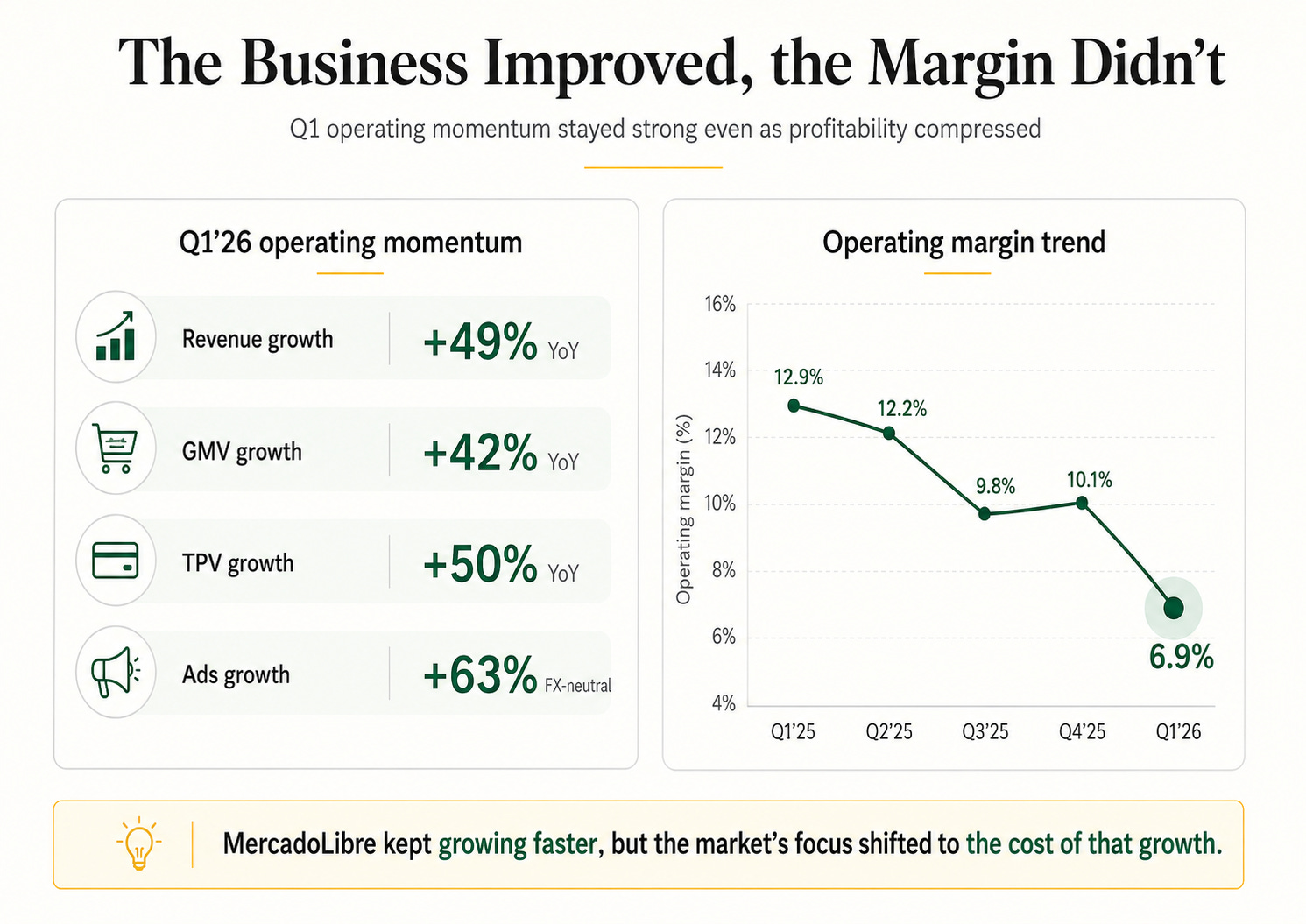
That is not what defensive spending usually looks like. Defensive spending produces activity but worsens unit economics. What MercadoLibre showed in Brazil was activity and improving unit economics at the same time.
The prior commerce framework therefore still holds: logistics density is not merely an operating advantage; it is a competitive instrument. The more packages MercadoLibre moves, the more efficient the network becomes. The more efficient the network becomes, the more aggressively the company can price shipping. The more aggressively it prices shipping, the more buyer frequency and seller liquidity it attracts.
The mistake was assuming that proving this would be enough.
It is not enough to prove that MercadoLibre creates value. The stock now turns on whether MercadoLibre captures that value.
The Margin Dial Has a Minimum Setting
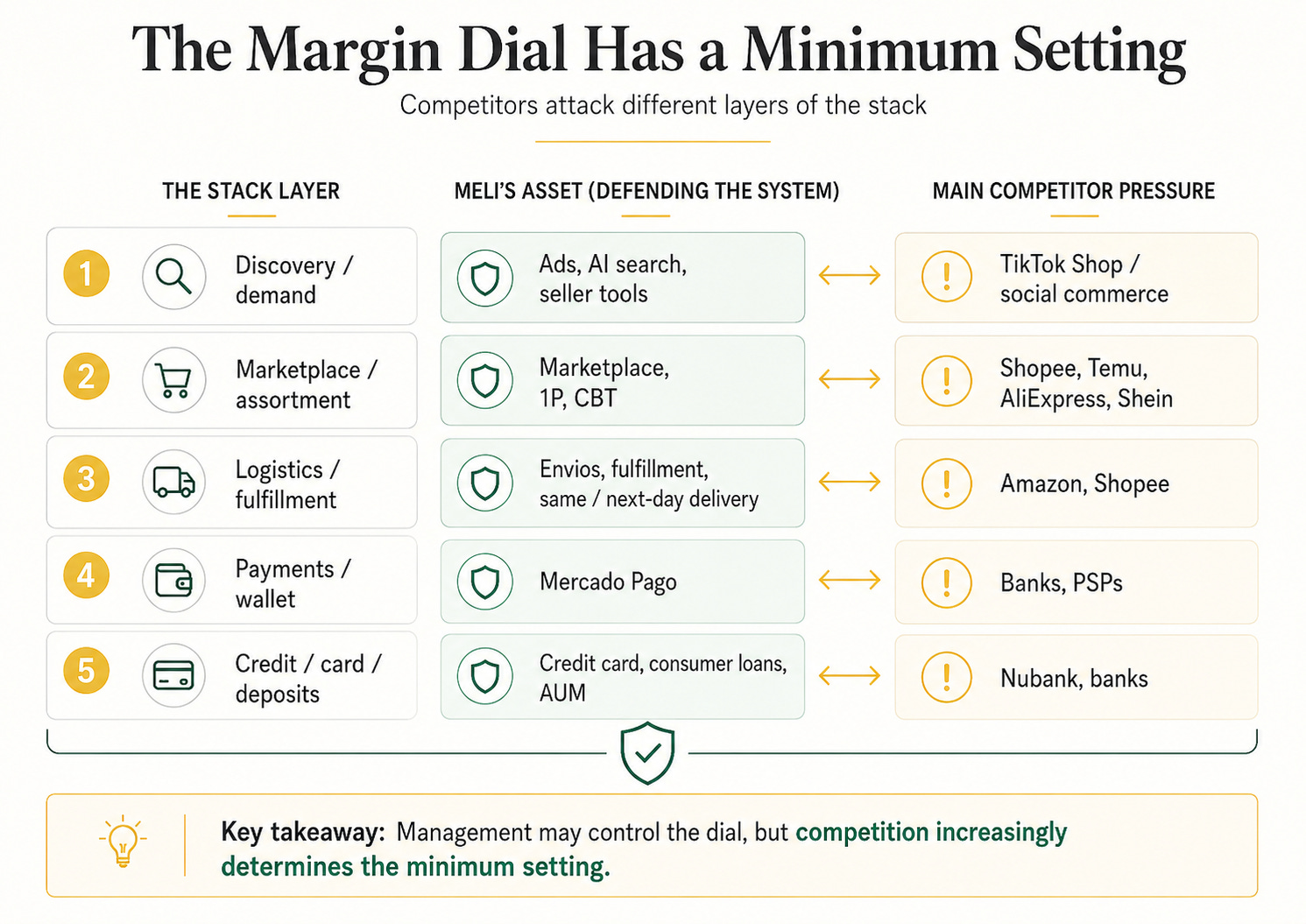
Management knows exactly what investors are worried about. The shareholder letter used unusually direct language: MercadoLibre said it has the ability to “dial margins up or down,” that Q1 reflects where it chose to set the dial, and that it does not expect this to change materially in the near term.
That sentence is doing a lot of work. It tells investors that the margin compression is deliberate. It tells them management believes the investments are working. It tells them not to expect a quick margin snapback. And it asks them to believe that lower margins are a choice.
The problem is that the competitive environment determines how much of a choice it really is.
Shopee attacks low-ASP frequency. Temu, Shein, and AliExpress attack cross-border supply and price perception. Amazon attacks premium fulfillment expectations. TikTok Shop attacks discovery and impulse buying. Nubank and banks attack the financial relationship. None of these competitors replicate the full MercadoLibre stack, which remains the company’s core advantage. But each attacks one layer intensely enough that MercadoLibre cannot simply harvest margins without giving up something strategically valuable.
If MercadoLibre raises the free shipping threshold, it risks ceding low-ASP habit. If it stops seller incentives, it risks worse price competitiveness. If it slows credit-card issuance, it risks losing financial primacy. If it slows CBT, it risks letting Chinese supply live outside its rails. If it slows fulfillment investment, it risks letting Amazon narrow the delivery gap.
This is a better way to understand management’s “dial.” MercadoLibre may control how aggressively it invests above the required level, but competition increasingly sets the minimum level.
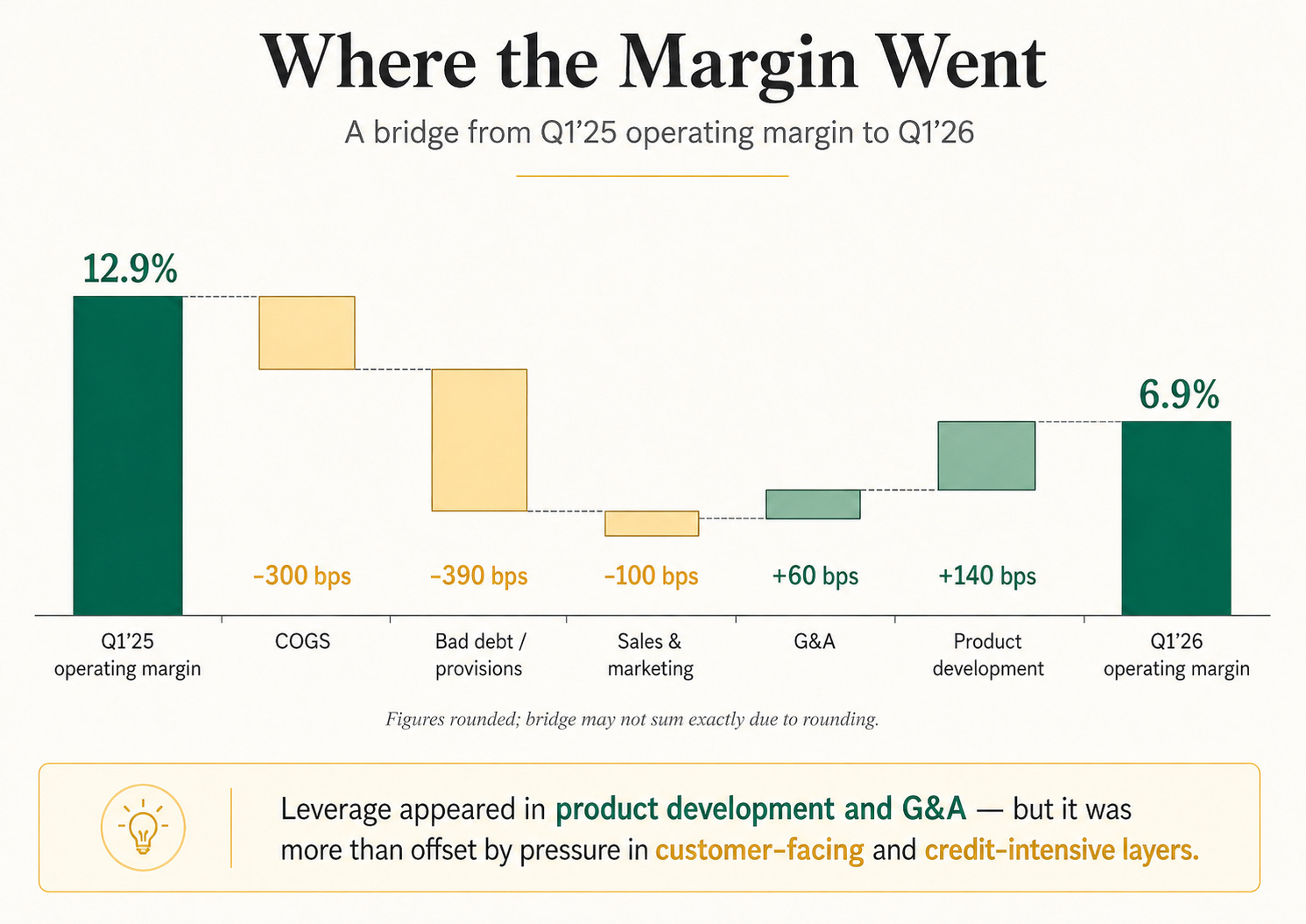
This showed up clearly on the call. Management explained that recent Brazil seller take-rate reductions were targeted, conditional on competitive seller pricing, and implemented late in Q1; crucially, they did not flow through Q1 P&L and will flow through Q2.
That is not a one-time investment cycle ending. That is a competitive system still absorbing new moves.
Who Captures the Surplus?
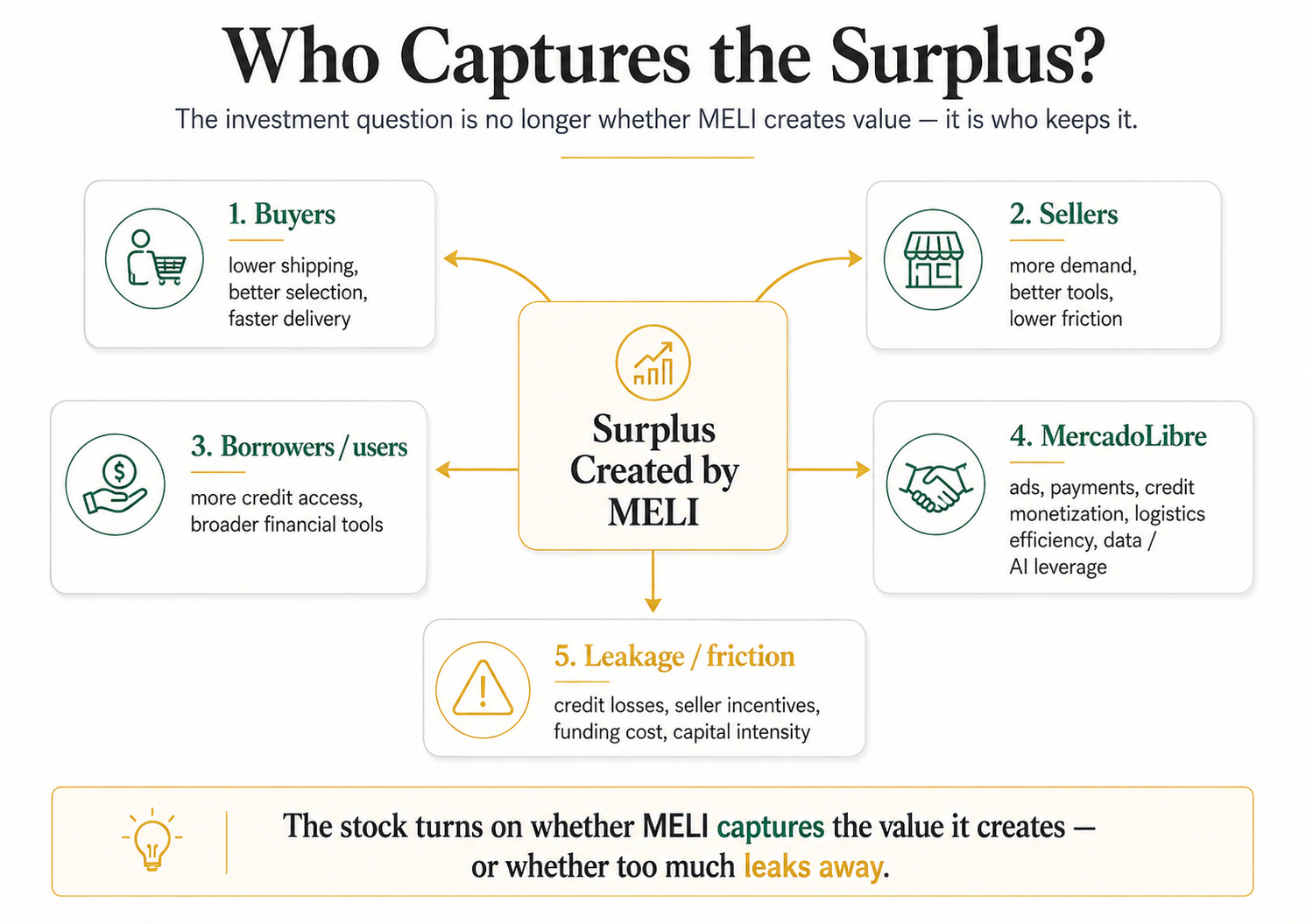
The right question after Q1 is not whether MercadoLibre is growing. It is.
The right question is: who captures the surplus MercadoLibre is creating?
The company is creating enormous value across Latin America. Buyers get cheaper shipping, faster delivery, broader selection, easier credit, and better financial tools. Sellers get more liquidity, advertising products, fulfillment services, payments, and access to more buyers. Borrowers get credit that banks may not provide. Advertisers get purchase-intent data. The ecosystem gets larger and more useful.
That is the business case. The stock case is narrower: how much of that value accrues to shareholders after shipping subsidies, seller incentives, provision expense, credit losses, fulfillment capex, and funding costs?
That distinction is why Q1 was both impressive and unsatisfying.
Advertising grew 63% FX-neutral and 73% in U.S. dollars; AI search improved product relevance, conversion, and sponsored listing click-through rates; product development expense scaled from 9.3% of revenue to 7.9% as AI productivity and slower headcount growth helped absorb investment. These are the parts of MercadoLibre that look most like the old dream: software-like monetization layered on top of an enormous transaction base.
But they remain buried inside a company whose most visible marginal cost is now credit and logistics. The good businesses are growing. The question is whether they are large enough, soon enough, to offset the cost of defending the whole system.
Credit Is Not Logistics
This is where our framework needed the biggest revision.
Logistics gets better with density. Move more packages through the same network and fixed costs get spread across more volume. Better routing, better utilization, better line haul density, better fulfillment flow,all of it can make the next package cheaper than the last.
Credit is different.
Credit does not automatically improve with scale. It improves if underwriting, funding, repayment behavior, and cohort seasoning improve faster than provisions consume the P&L. That may happen at Mercado Pago; the company has better first-party data than traditional lenders, strong engagement, and an increasingly broad financial relationship with users. But Q1 raised the burden of proof.
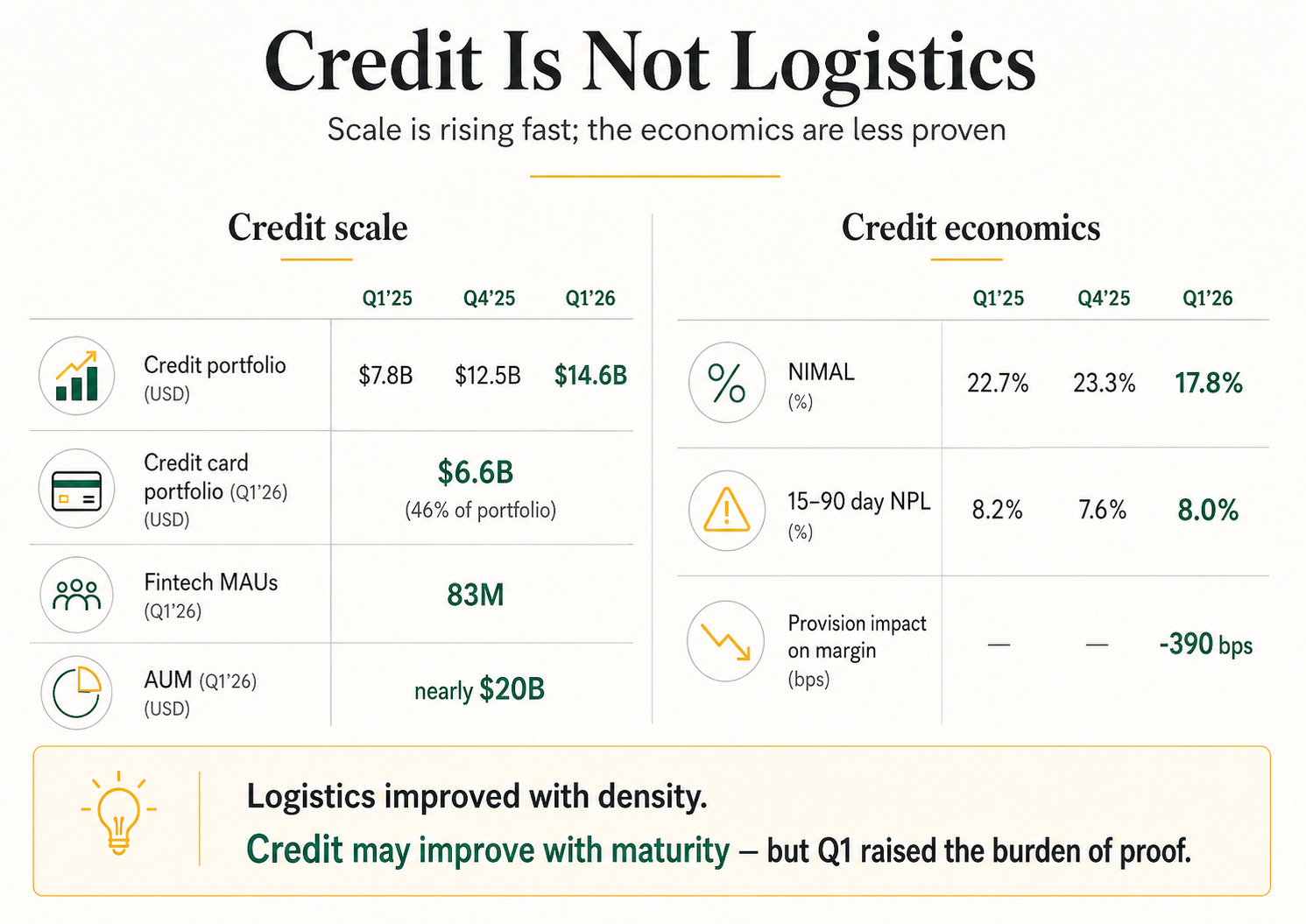
The credit portfolio reached $14.6 billion, up 87% year over year. The credit card portfolio more than doubled to $6.6 billion and now represents 46% of the portfolio. Fintech MAUs reached 83 million, and AUM approached $20 billion. Those are powerful engagement numbers.
But NIMAL fell to 17.8%, down 4.9 percentage points year over year, and provisions for doubtful accounts drove 3.9 percentage points of operating margin compression. Management attributed two-thirds of that provision impact to the credit portfolio growing much faster than consolidated revenue and the remaining third mostly to Brazil consumer loans, where the company extended loan terms and broadened reach.
On the call, management gave more detail: average Brazil loan duration moved from around five months to eight months, and the company is reaching customers who may require lower spreads or carry higher risk. Management emphasized that asset quality remains stable and that underwriting is working, but this is exactly the kind of explanation investors should treat respectfully and skeptically at the same time.
Credit can be a ladder to financial primacy. It can also be a treadmill: every new product, geography, or cohort pushes maturity further into the future.
Our prior Q4 framework said credit would decide the multiple. Q1 confirms that. It also shows our prior credit bar was too generous. The commerce thesis is ahead of schedule; the credit thesis now requires proof through time.
The Missing Metrics Are Now the Thesis
MercadoLibre disclosed many of the right activity metrics. Brazil items sold. Unit shipping costs. Credit card growth. Ads growth. AUM. AI productivity. 1P GMV. CBT growth.
The missing metrics matter more now:
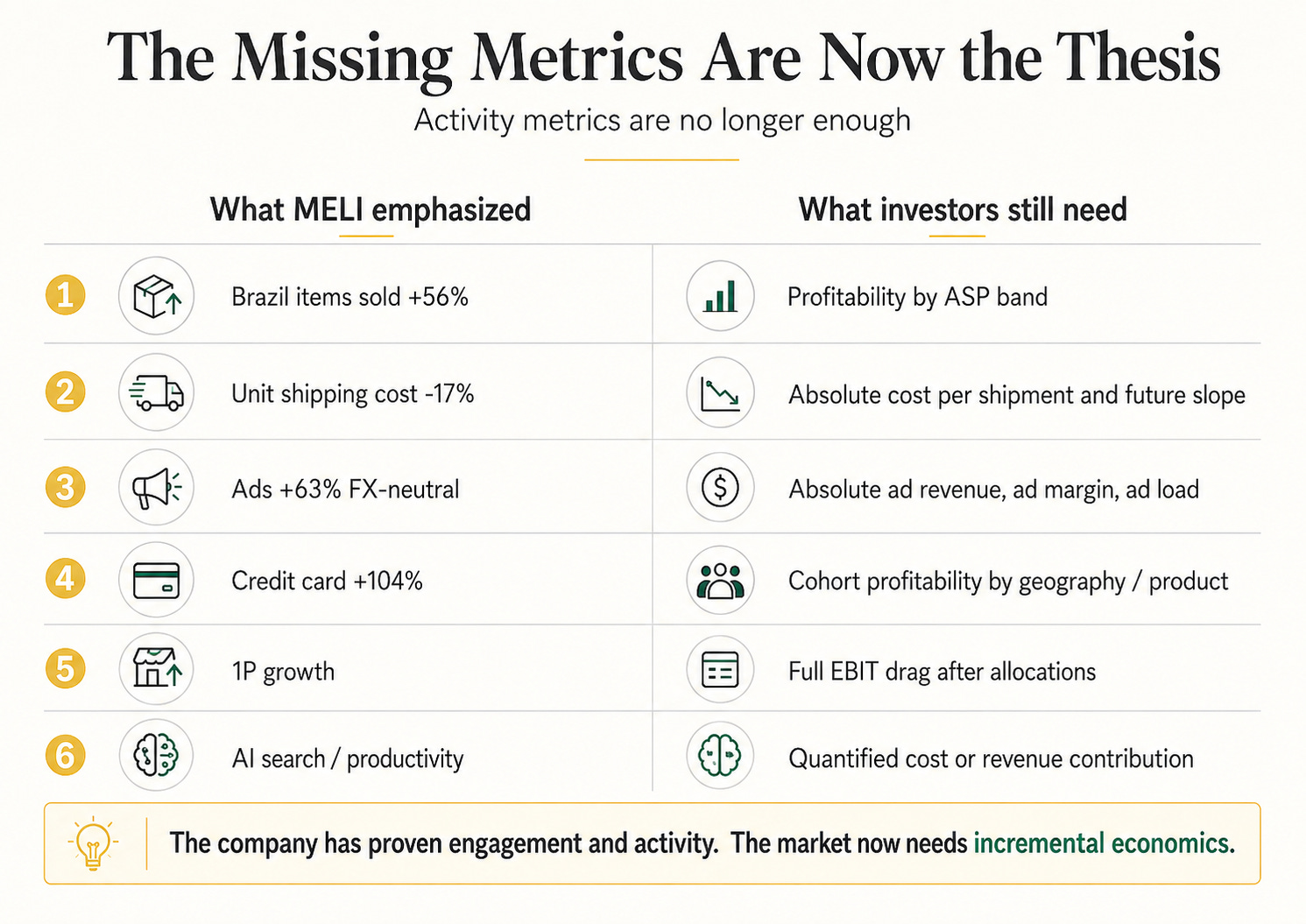
Activity metrics prove the system is more engaged. They do not prove the incremental user, seller, or borrower earns enough profit to justify the lower margin structure.
That is where the variant perception has changed.
The old variant perception was: margin compression is strategy, not weakness.
The new variant perception is: MercadoLibre is not a broken marketplace; it is a stronger platform with a harder-to-underwrite economic model.
The market is not stupid. It is not ignoring the Brazil data. It is asking whether this model, in a more competitive Latin American digital economy, deserves the old valuation architecture.
That is a much better question than we gave it credit for.
Three Endings to the Same Story
The scenarios should not start with EPS. They should start with who captures the surplus.
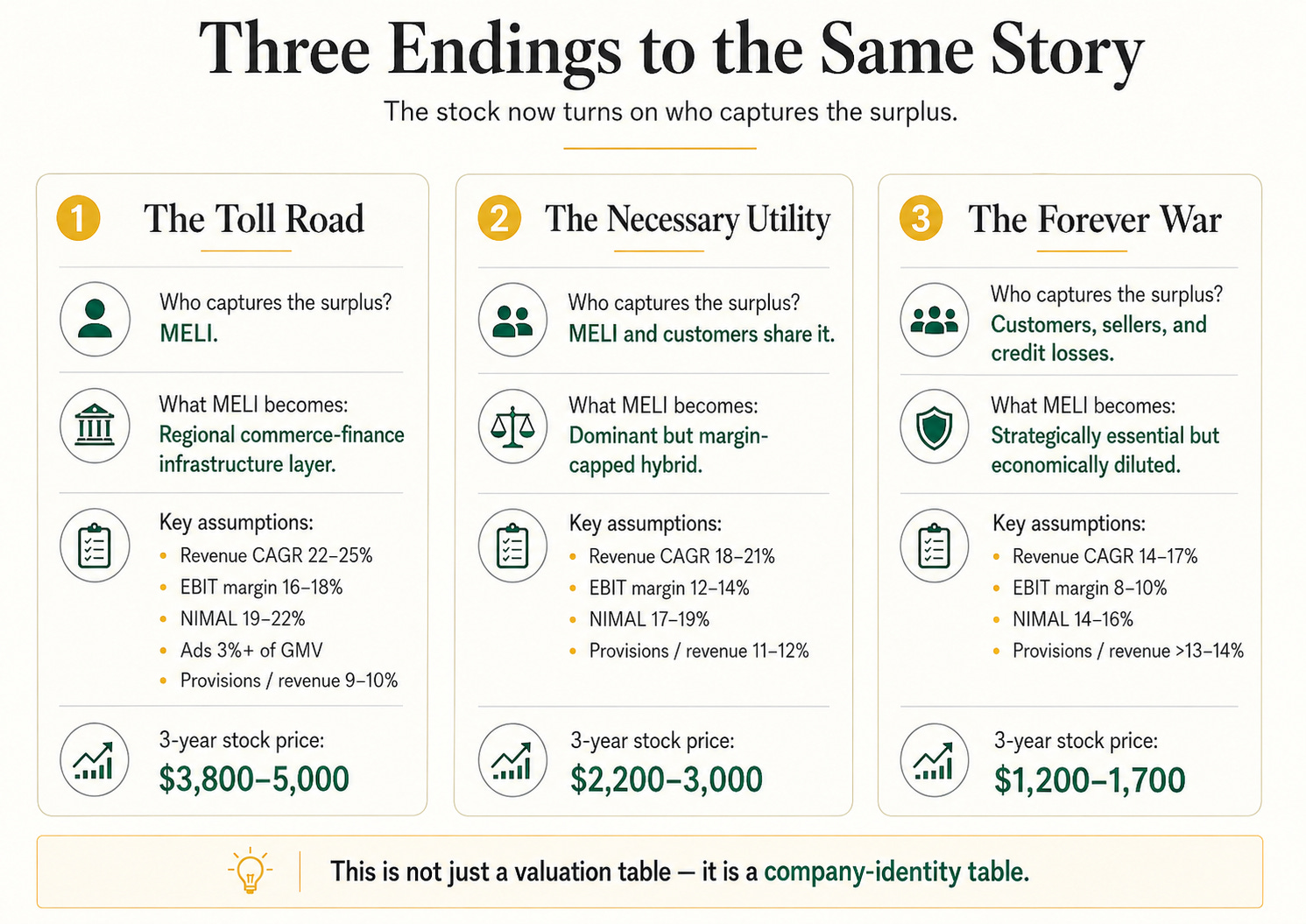
The bull case is the original dream, but delayed. MercadoLibre’s investments mature into visible economics. Advertising, AI, deposit economics, fulfillment density, and credit-card seasoning reveal that today’s lower margins were not permanent dilution but investment in the region’s most valuable commercial interface.
The base case is now the most honest starting point. MercadoLibre stays dominant, competitors find their natural ceilings, credit stabilizes, ads scale, but the steady-state cost of defending the system is higher than we once assumed. The stock works, but not explosively.
The bear case is not “MercadoLibre loses.” That is too simple. The bear case is that MercadoLibre wins customers, sellers, and volume, but too much of the value goes to customers through free shipping, sellers through lower fees, and borrowers through credit losses. The business remains essential. The stock does not.
This is the uncomfortable possibility Q1 forces us to name: dominance does not guarantee returns.
What Would Change Our Mind
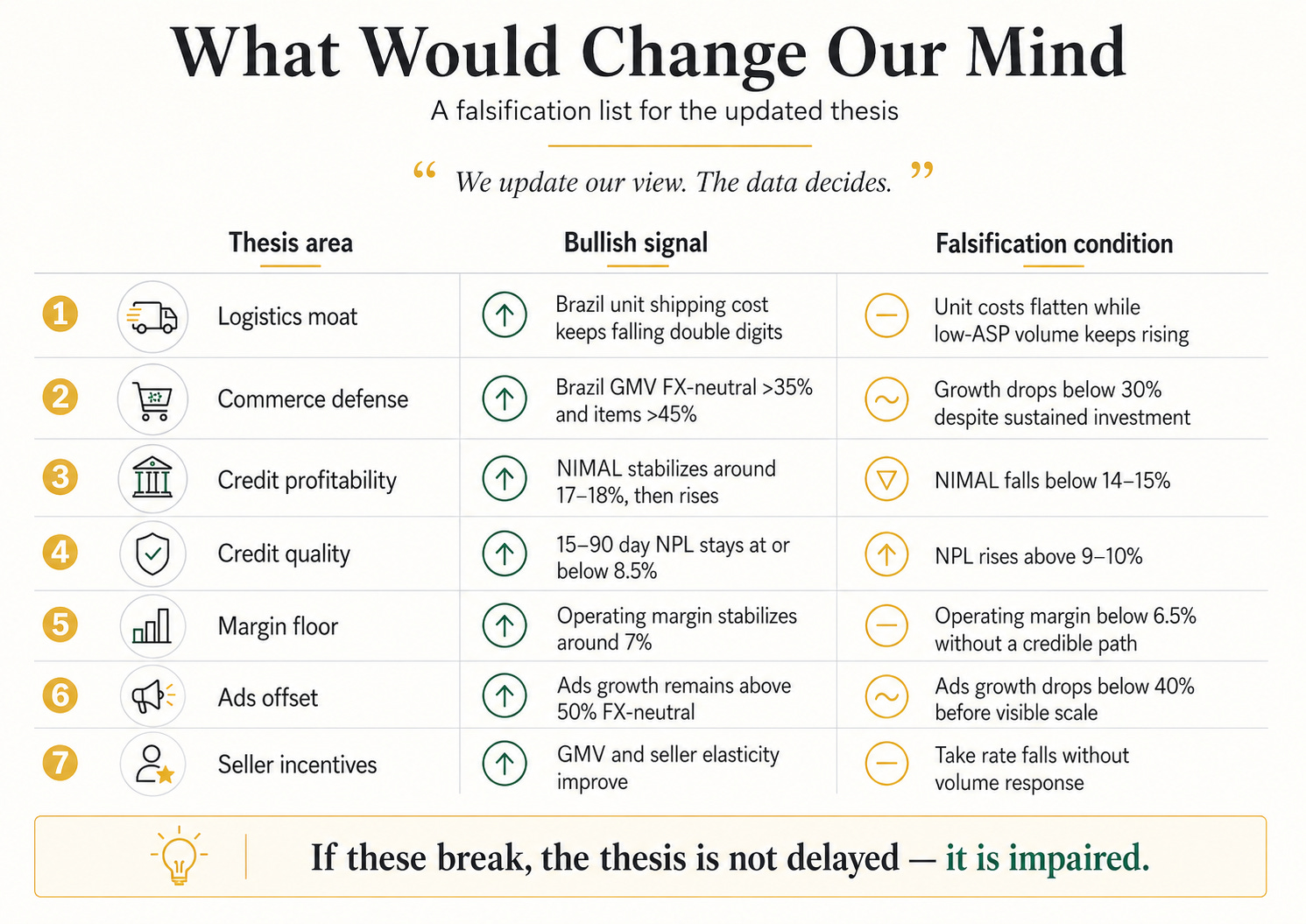
The thesis is no longer “trust the flywheel.” It is conditional.
The logistics advantage is intact as long as Brazil unit shipping costs keep falling while low-ASP volume grows. It is impaired if unit costs flatten while volume keeps requiring subsidy.
The commerce defense is intact if Brazil GMV remains above 35% FX-neutral and items growth stays above 45%. It becomes questionable if growth falls below 30% despite sustained investment.
The credit thesis is intact if NIMAL stabilizes around 17–18% and starts to rise. It is impaired if NIMAL falls below 14–15% or if 15–90 day NPL moves above 9–10%.
The margin dial is credible if operating margin stabilizes around 7% and management can show a path upward. It is not credible if margins break below 6.5% while new investment lines keep appearing.
The ad offset is real if ads continue growing above 50% FX-neutral and the company begins to disclose enough scale to matter. It is not enough if growth slows below 40% before becoming visible in consolidated margins.
If those signposts break, the thesis is not delayed. It is impaired.
The Surplus War
MercadoLibre may still be the best business in Latin America. Q1 probably reinforced that. The company is creating more value for buyers, sellers, merchants, borrowers, and advertisers than ever before. Its logistics network is becoming denser, its marketplace more active, its fintech relationship deeper, and its advertising business more relevant.
But the stock no longer works simply because the platform is stronger. It works when investors can see that strength turning into incremental economics after shipping, seller incentives, credit losses, funding costs, and capital intensity.
That is the gap between the business and the stock.
The commerce war looks increasingly winnable.
The surplus war is still open.
Disclaimer:
The content does not constitute any kind of investment or financial advice. Kindly reach out to your advisor for any investment-related advice. Please refer to the tab “Legal | Disclaimer” to read the complete disclaimer.