


TL; DR
The logistics thesis is working operationally: Brazilian items per buyer rose 16%, cost per shipment is 14% below its pre-threshold level, and lower-value free shipping has become contribution-positive. The network is delivering the efficiencies MercadoLibre intended.
But competition is capturing more of the surplus: shipping economics have weakened, Brazil’s revenue growth barely translated into higher direct contribution, and Shopee now has enough scale and funding to force MercadoLibre to reinvest more of its efficiency gains into the customer proposition.
The moat is migrating from logistics toward the integrated customer relationship: customers who shop and use Mercado Pago are substantially more valuable, while social commerce and AI increasingly threaten to own discovery. The key question is whether commerce, finance, loyalty and data together remain more valuable than the components rivals can match individually.
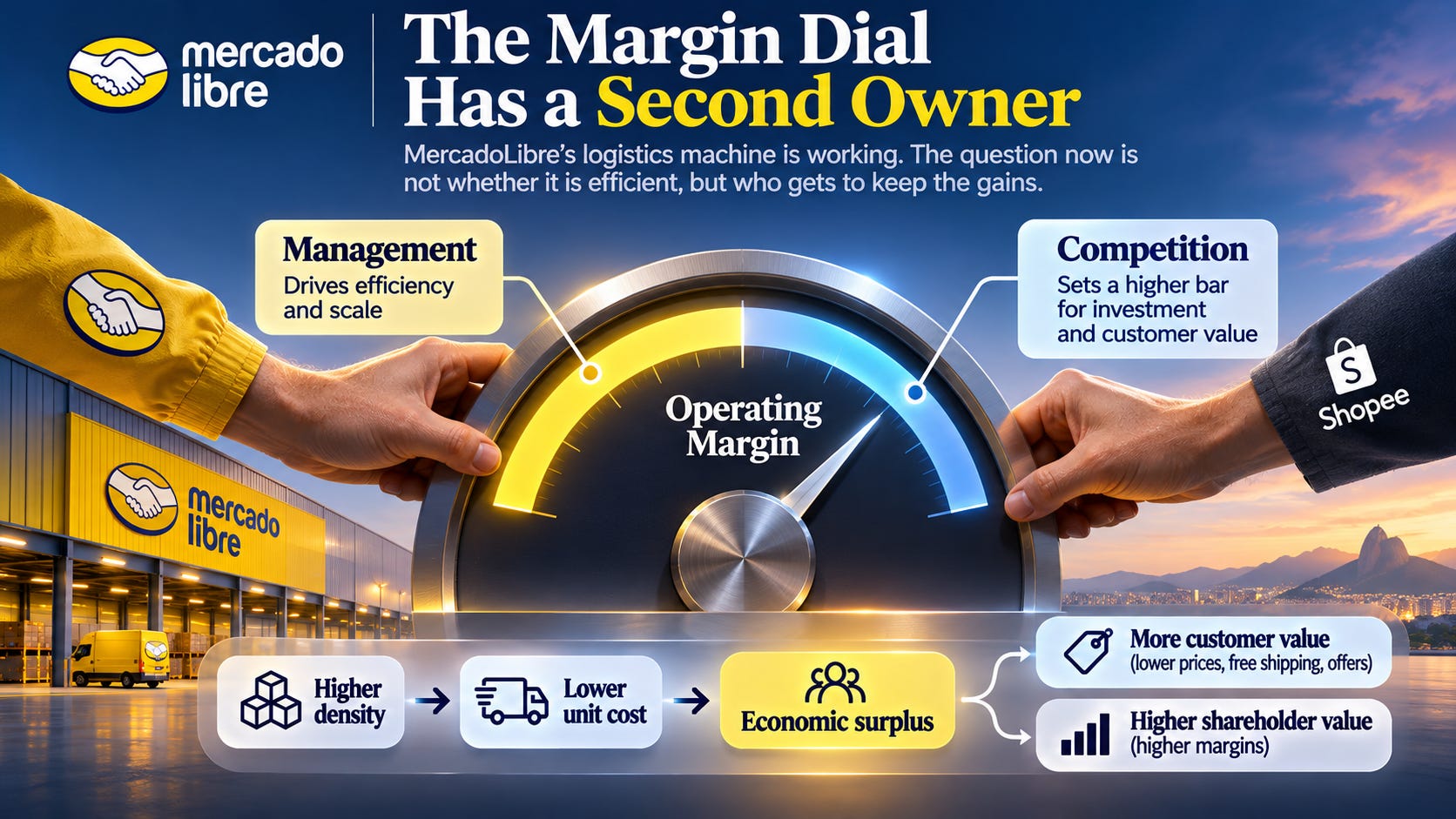
MercadoLibre’s third-quarter shareholder letter contains perhaps the most revealing statement in our five quarters of coverage:
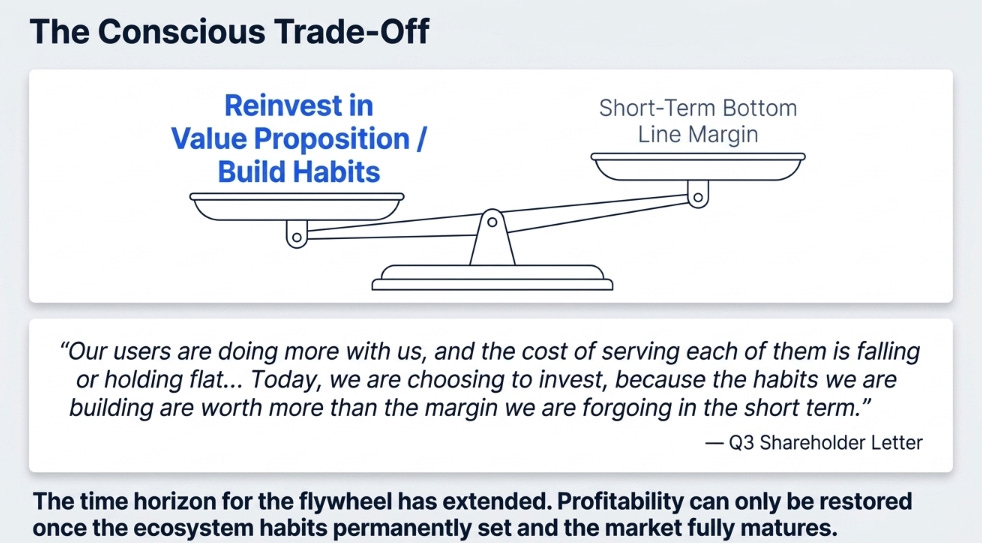
Across Commerce and Fintech, the pattern is the same. Our users are doing more with us, and the cost of serving each of them is falling or holding flat. That efficiency creates a choice: how much to reinvest in the value proposition, and how much to let through to the bottom line. Today, we are choosing to invest, because the habits we are building are worth more than the margin we are forgoing in the short term to build them. That is the trade-off. As those habits set and the market matures, that balance will shift.
The choice sounds familiar. In August, we concluded that MercadoLibre’s integrated system was working and that the price of its flywheel was time: management was deliberately sacrificing present margins for future earnings power. We also established a condition under which that explanation would no longer suffice. Operating margins below 6.5%, accompanied by continuing investment requirements, would impair the proposition that management could restore profitability when it chose.
Third-quarter revenue rose 45% to $10.75 billion, but operating income declined 7% to $676 million, missing the $729 million FactSet consensus. Operating margin fell to 6.3%, its third consecutive quarterly decline. The stock initially dropped approximately 8% after hours.
The uncomfortable finding is that MercadoLibre’s operating advantages are improving exactly as expected. What has changed is our confidence that it can retain the economic benefits. Management still controls the intensity of investment, but competition increasingly determines the minimum. The margin dial has acquired a second owner.
The Warehouse Advantage Is Working. Its Economics Are Not.
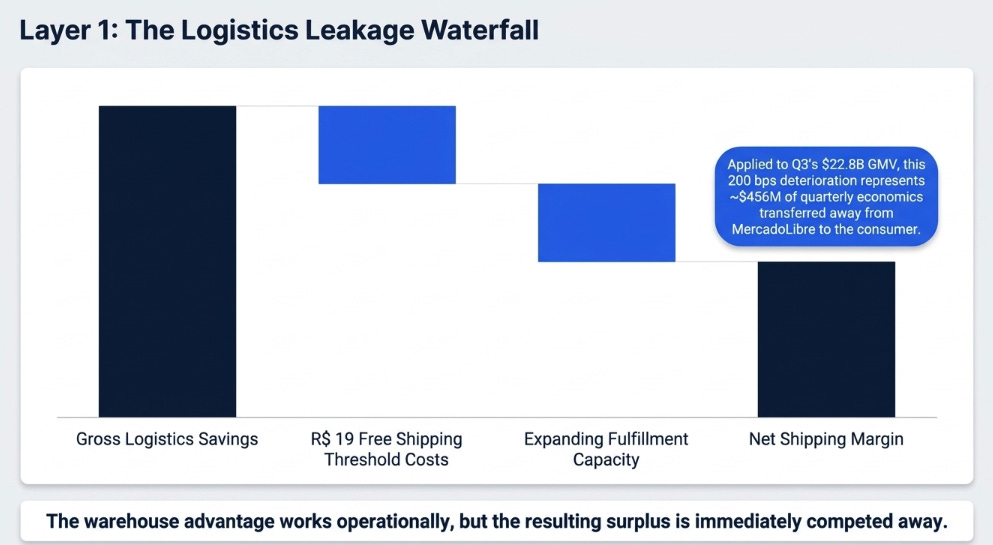
In July 2025, we described MercadoLibre’s reduction of Brazil’s free-shipping threshold from R$79 to R$19 as the weaponization of logistics density. More shipments through an established network would lower unit costs, allowing MercadoLibre to offer economics that competitors could not easily match. Q3 provides compelling evidence that the mechanism works.
Brazilian items per buyer increased 16%, even after the threshold change had been fully lapped. Cost per shipment is 14% below its pre-threshold level, and in September, free shipments in the R$19–79 range became variable-contribution positive in aggregate. The infrastructure is generating the efficiencies we anticipated.
Yet net shipping margin has deteriorated by approximately 200 basis points of GMV since early 2025. Applied illustratively to this quarter’s $22.8 billion GMV, that represents about $456 million of quarterly economics transferred away from MercadoLibre. This is not recoverable profit: much of today’s additional volume might not exist without cheaper shipping. It nevertheless establishes the scale of the trade-off.
Brazil provides an even starker illustration. Revenue increased from $4.0 billion to $6.0 billion year over year, while direct contribution barely moved, from $475 million to $479 million. Across the company, $3.34 billion of additional revenue produced $48 million less operating income.
Some pressure is temporary. MercadoLibre expanded fulfillment capacity nearly 20% sequentially ahead of peak season, incurring costs before the associated volume arrives. But management acknowledges that continued growth requires continuing capacity additions. An individual warehouse can mature; a perpetually expanding network always contains another immature warehouse.
We have seen this story before. Between 2016 and 2019, MercadoLibre’s operating margin collapsed from roughly 23% to negative 7% as it subsidized shipping and built infrastructure. Investors ultimately funded the strategy because the incumbent Brazilian retailers lacked both its marketplace economics and the resources to respond. We were too quick to invoke that precedent when, in August 2025, we suggested competition had effectively ended.
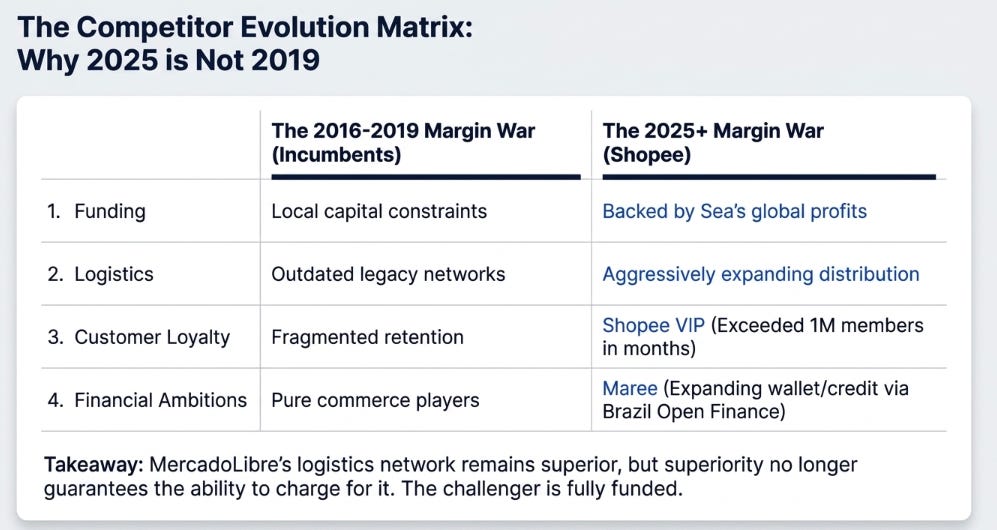
Shopee is a different challenger. Its Brazilian distribution network has expanded dramatically, its VIP program exceeded one million members within months, and Sea can support investment using profits generated elsewhere. Shopee has not replicated MercadoLibre’s fulfillment density or merchant relationships, but it no longer needs to be dismissed as an underfunded competitor. It needs only to match enough of the proposition to prevent MercadoLibre from charging for its full advantage.
The distinction changes our thesis. MercadoLibre’s logistics network remains superior, but superiority no longer guarantees the ability to harvest the resulting surplus.
The Wallet and the Missing Denominator

If warehouses are increasingly contestable, MercadoLibre’s stronger advantage may lie in customers who both shop and bank with it.
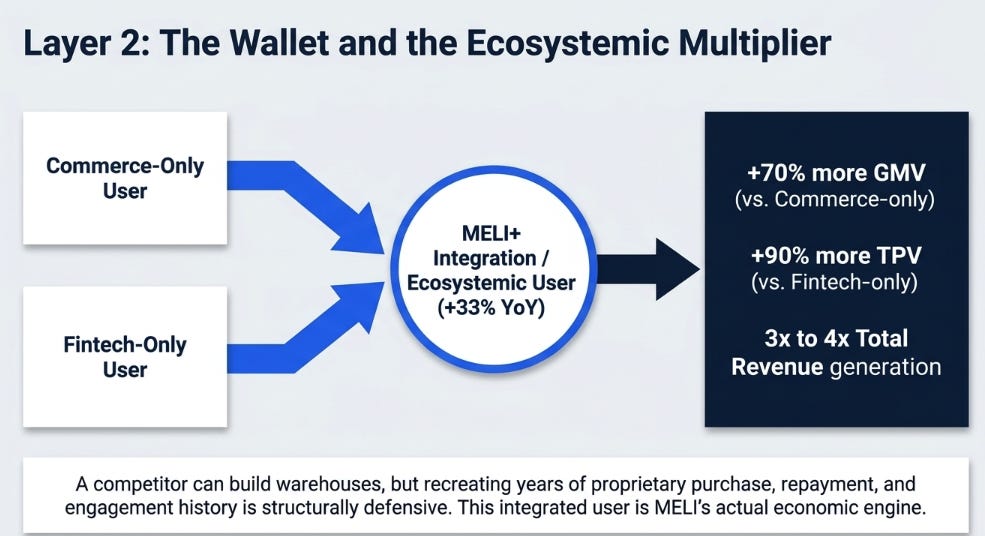
Our Q2 article identified the ecosystemic user as the relevant economic unit. A subsidized delivery might be unprofitable in isolation but worthwhile if it produces a customer who subsequently saves, pays and borrows through Mercado Pago. Such users increased 33% in Q3, generating 70% more merchandise value than commerce-only customers, 90% more payment volume than fintech-only customers, and three to four times the revenue of single-service users.
These relationships are harder to reproduce than delivery capacity. Commerce supplies Mercado Pago with distribution and purchasing information; Mercado Pago returns financing, savings products and loyalty benefits that make commerce more attractive. MELI+ increasingly bundles these advantages. A competitor can build warehouses, but recreating years of purchase, repayment and engagement history is considerably harder.
The credit portfolio, approaching $18 billion, illustrates both the opportunity and its cost. Brazilian credit-card cohorts issued during 2021–2024 are profitable on a net-interest-margin-after-losses basis and represent more than half the country’s card portfolio. New issuance, however, initially requires provisions before meaningful interest income develops. Consolidated NIMAL declined from 20.7% to 20.1%, while loans overdue more than 90 days increased to 19.3%. The relatively stable 7.0% early-delinquency ratio does not eliminate that concern.
More importantly, management’s disclosures have become less useful for establishing the economics of integration. Q2 emphasized that ecosystemic users generated multiples of the combined contribution profit of single-service users. Q3 emphasized revenue multiples instead. We still lack penetration, acquisition costs and incremental contribution profit. Fintech’s roughly $1 monthly cost to serve excludes credit losses and funding costs. Nine-month adjusted free cash flow fell from $718 million to $443 million despite extraordinary revenue growth.
None of this invalidates the integrated relationship. It means we cannot yet capitalize engagement as though it were cash earnings.
And Shopee is following MercadoLibre beyond commerce. Its Monee financial-services platform, formerly ShopeePay, is expanding wallet and credit capabilities using transaction data and Brazil’s Open Finance infrastructure. That cannot instantly reproduce MercadoLibre’s proprietary history, but it makes the financial-services moat contestable too.
The question is whether shopping, payments, savings, credit and loyalty together create customer value that exceeds what competitors can offer through their individual products.
The War Moves Upstream
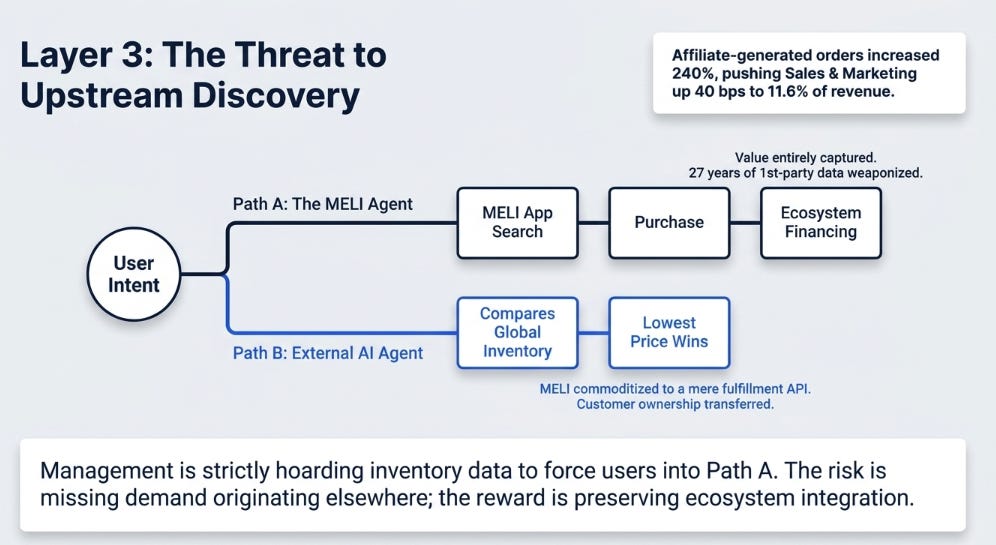
The competition is now moving toward the beginning of the transaction itself. Asked about social commerce, CEO Ariel Szarfsztejn was unusually candid:
On the one hand, we can do as much as we can or want to design the way we want to capture demand, but in the end, we need to be where the demand and the attention is, and affiliate marketing is part of that playbook. There’s some broader shift in how consumers discover and potentially buy some products. Social media in general is becoming an additional channel for discovery, many times incremental, and that happens whether we like it or not.
Affiliate-generated orders increased 240%, while sales and marketing rose 40 basis points sequentially to 11.6% of revenue. Management described the quarter’s spending intensity as tactical, but the channel itself as strategic.
This creates a second pressure on the flywheel. MercadoLibre may reduce the cost of completing a transaction through greater logistics density while spending more to attract that transaction in the first place. Shopee and social platforms do not need to replicate its entire infrastructure to claim part of the economic surplus.
AI agents introduce a more consequential choice. Szarfsztejn explained management’s position:
For now, we have decided not to provide our inventory to any external platform. Our priority is still to build the best agentic experience inside MercadoLibre, taking advantage of the 27 years of first-party data that we have, our unique combination of selection, pricing, logistics, financing, loyalty, and so on. E-commerce is much more than just search and find.
The distinction matters. An affiliate sends customers into MercadoLibre, where checkout, financing, delivery and future engagement remain inside its ecosystem. An external AI agent could control product comparison and purchasing decisions, reducing MercadoLibre to one inventory provider among several. The first arrangement raises customer-acquisition costs; the second potentially transfers customer ownership.
Management is defending the latter boundary, even at the risk of missing demand originating elsewhere. Its own shopping agent is available to a limited portion of users in its largest markets, but there is insufficient evidence to establish whether this strategy will succeed.
Mercado Ads offers a partial counterweight. By using purchase data to measure advertising effectiveness across social and streaming platforms, including Netflix, MercadoLibre can sell advertisers something external discovery channels lack: visibility into completed purchases. Whether commerce-media economics can offset rising distribution costs remains unproven.
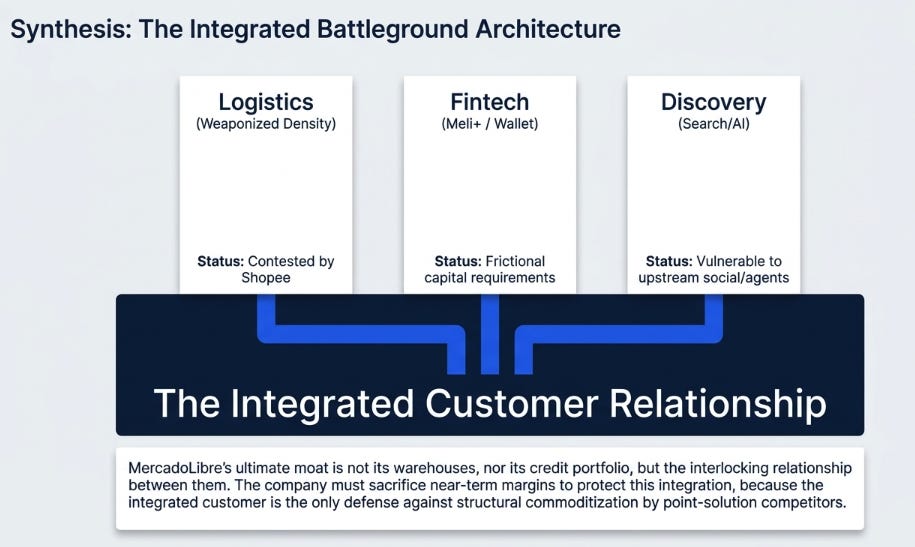
The company’s most valuable asset may therefore be neither the warehouse nor the wallet individually, but a customer relationship that makes the combined offering preferable even when rivals match particular components.
What Is the Integrated Moat Worth?
Our earnings expectations must change. August’s published 2029 base case assumed operating margins of 10–12% and EPS of $105–120. With margins now at 6.3%, Shopee investing aggressively and customer-acquisition costs rising, that recovery looks too optimistic. I now expect margins around 7% in 2027 and 8.5% in 2029, closer to the profitability previously embedded in our downside case.
For a consistent three-year investment horizon, the scenarios below value FY2030 forward earnings at the end of 2029.
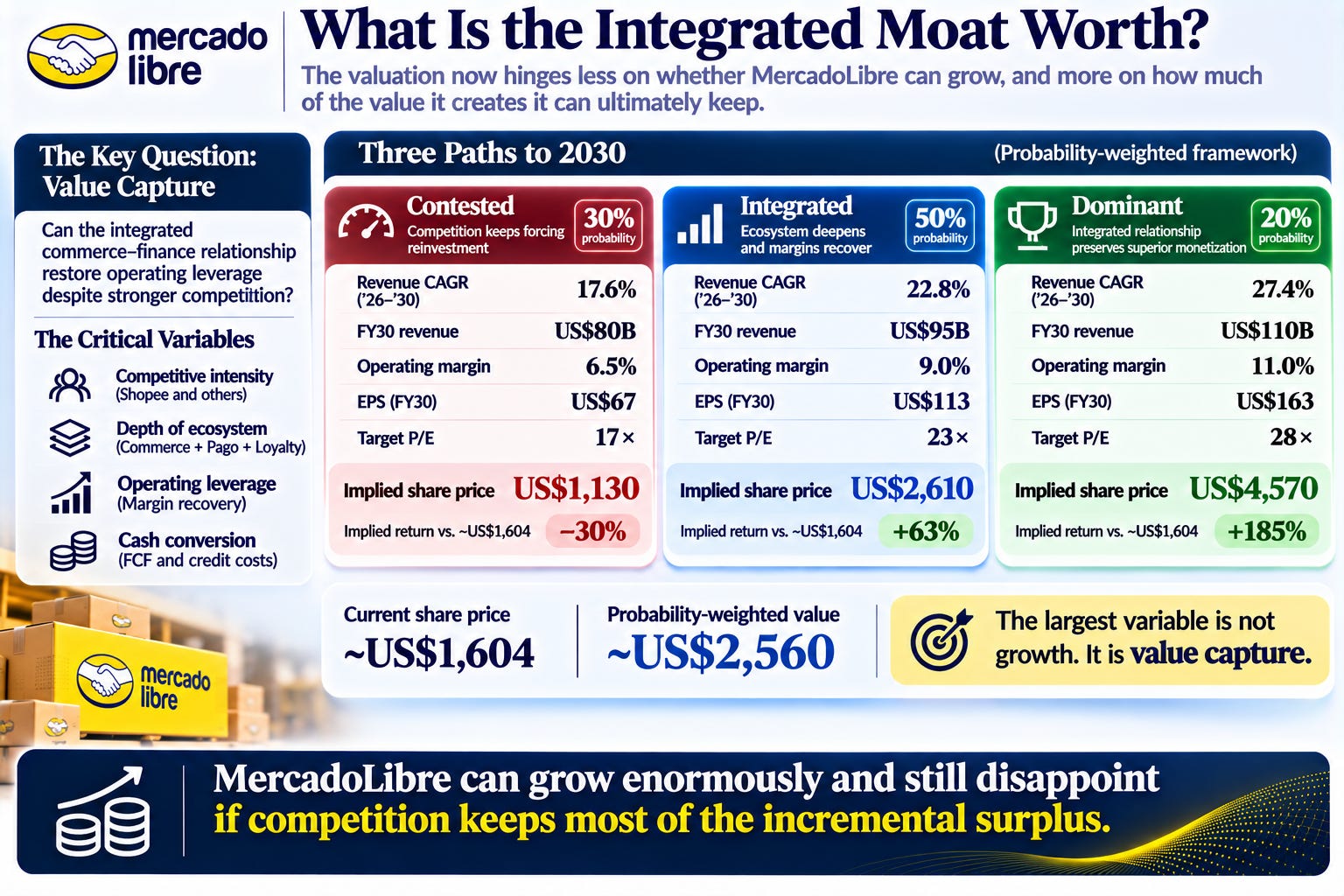
These are our estimates, not consensus. They start from approximately $41.8 billion of FY2026 revenue, assume $450 million in annual net non-operating expense, a normalized 29% tax rate and 50.7 million shares. The integrated case requires sustained commerce growth, credit maturation and a recovery in operating leverage; the dominant case additionally requires the customer relationship to preserve superior monetization despite competition. Cash conversion must support the multiples, particularly as credit growth absorbs capital.
The probability-weighted value is approximately $2,560, against the indicative $1,604 post-results price. That implies roughly 60% potential appreciation through end-2029, before discounting for time and uncertainty. These targets are not directly comparable with August’s because the valuation now uses FY2030 rather than FY2029 earnings. The underlying margin and earnings expectations have been reduced.
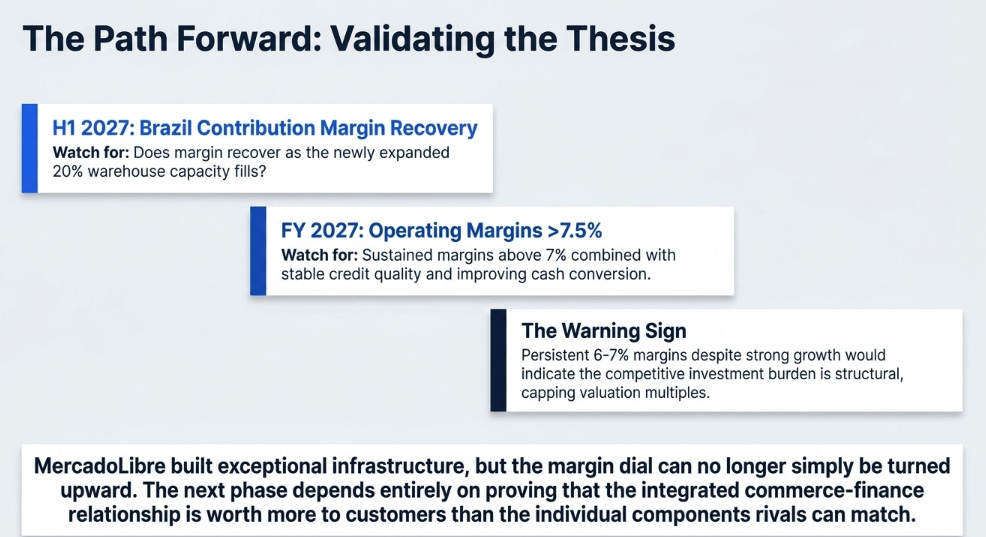
The investment case is attractive but no longer rests on assuming the margin dial can simply be turned upward. The next two quarters must establish whether Brazil’s contribution margin recovers as new capacity fills. During 2027, operating margins moving sustainably above 7.5%, improving cash conversion and stable credit quality would support our base case. Continued 6–7% margins despite strong growth would suggest the competitive investment burden is structural.
MercadoLibre won its first free-shipping war by building infrastructure competitors could not afford to reproduce. Shopee has made that advantage contestable, while social commerce and AI threaten to move customer decisions outside the marketplace. We were right that MercadoLibre could create extraordinary operational efficiencies, and wrong to assume those efficiencies would inevitably accrue to shareholders.
The next phase depends on whether the integrated relationship across commerce and finance remains worth more to customers than the individual components rivals can match. The infrastructure still works. What MercadoLibre must now prove is how much of the value it creates it can keep.
Disclaimer:
The content does not constitute any kind of investment or financial advice. Kindly reach out to your advisor for any investment-related advice. Please refer to the tab “Legal | Disclaimer” to read the complete disclaimer.
Every time Meli finds a cost saving Shopee seems to be standing right there with its hand out, reinvesting makes sense but it does feel a bit like running on a treadmill.