


TL; DR
The flywheel is working: Brazil items sold rose 56%, ecosystemic users grew 37%, credit quality improved, and operating expenses gained 260 basis points of sequential leverage.
Shareholders still cannot see the payoff: management reinvested all the operating leverage into lower prices and incentives, while declining to disclose the ecosystemic-user penetration and economics needed to value the strategy.
The debate is now about time: MercadoLibre appears to be building a more valuable integrated system, but the stock needs evidence that customer value will eventually become reported margins and per-share earnings.
From MercadoLibre’s Q2 2026 shareholder letter:
Contribution profit per ecosystemic user is multiples of the sum of the profit of a marketplace-only user and a fintech-only user. Profitability doesn’t simply add when a user becomes ecosystemic, it multiplies.
A year ago, we called the free shipping threshold cut a strategic gambit, a victory lap disguised as a skirmish. Since then: four articles, one consistent thesis, and a stock that went from roughly $2,700 to $1,888. Down 30%.
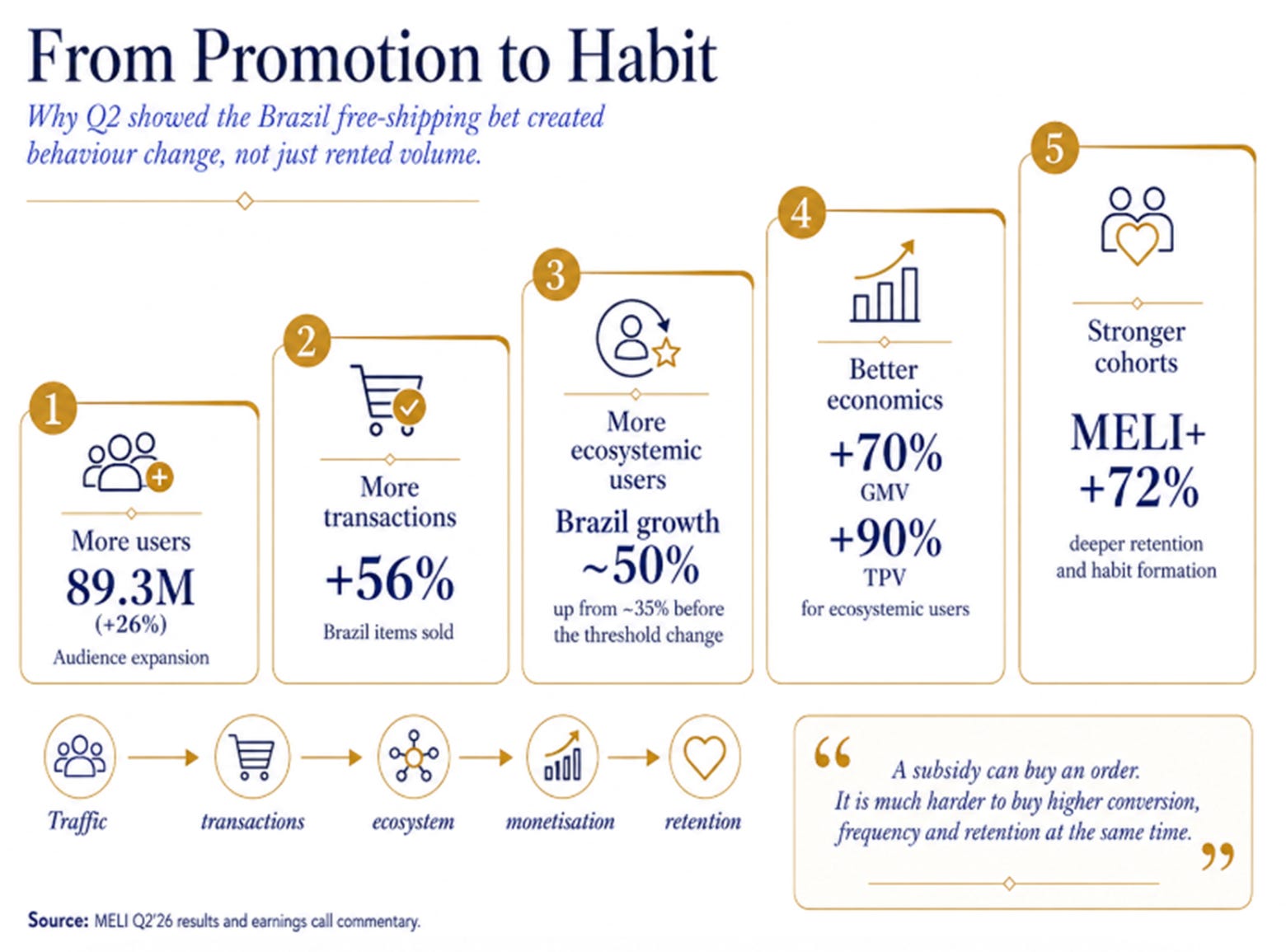
The commerce call was right. Every signpost cleared. Brazil items sold grew 56% year-on-year. Unit shipping costs kept falling. The managed network hit 96% penetration. Ecosystemic user growth in Brazil accelerated from 35% before the threshold change to almost 50%. The logistics density thesis played out exactly as we described in the first article, then the second, then the third.
The credit call was wrong in Q4 and Q1. We underestimated how fast a $12.5 billion lending operation would change how the market categorized the entire business. We wrote about the logistics war while the credit transformation happened in peripheral vision. Q2 materially weakened the immediate bear case, NIMAL improved 290 basis points, NPLs dropped to historic lows, but the damage to the stock was already done.
The margin call was half right and half wrong. We said operating leverage would emerge. It did, opex improved 260 basis points sequentially this quarter. We assumed management would show some of it. They showed none. They reinvested every dollar.
The hard lesson, five quarters in: being right about the flywheel was necessary but not sufficient. The market doesn’t pay for flywheels it can’t see in the P&L. What we underestimated, across every article, was that management would reinvest 100% of the operating leverage, every quarter, with no signal of when it ends. The gap between the business and the stock is not analytical error. It is a time horizon mismatch between a management team playing a decade-long game and a market that prices in quarters.
Q2 doesn’t close that gap. But it gives us, for the first time, the economic unit that might explain what’s on the other side of it.
The Surplus Question Gets a Candidate Answer
Our Q1 article asked the question that matters: who captures the surplus MercadoLibre is creating? The company was producing enormous value, cheaper shipping, faster delivery, broader selection, easier credit, better financial tools, but the stock case required showing that value accrued to shareholders after subsidies, provisions, capex, and funding costs.
Q2 gives that question a candidate mechanism. Not yet a complete answer. A mechanism.
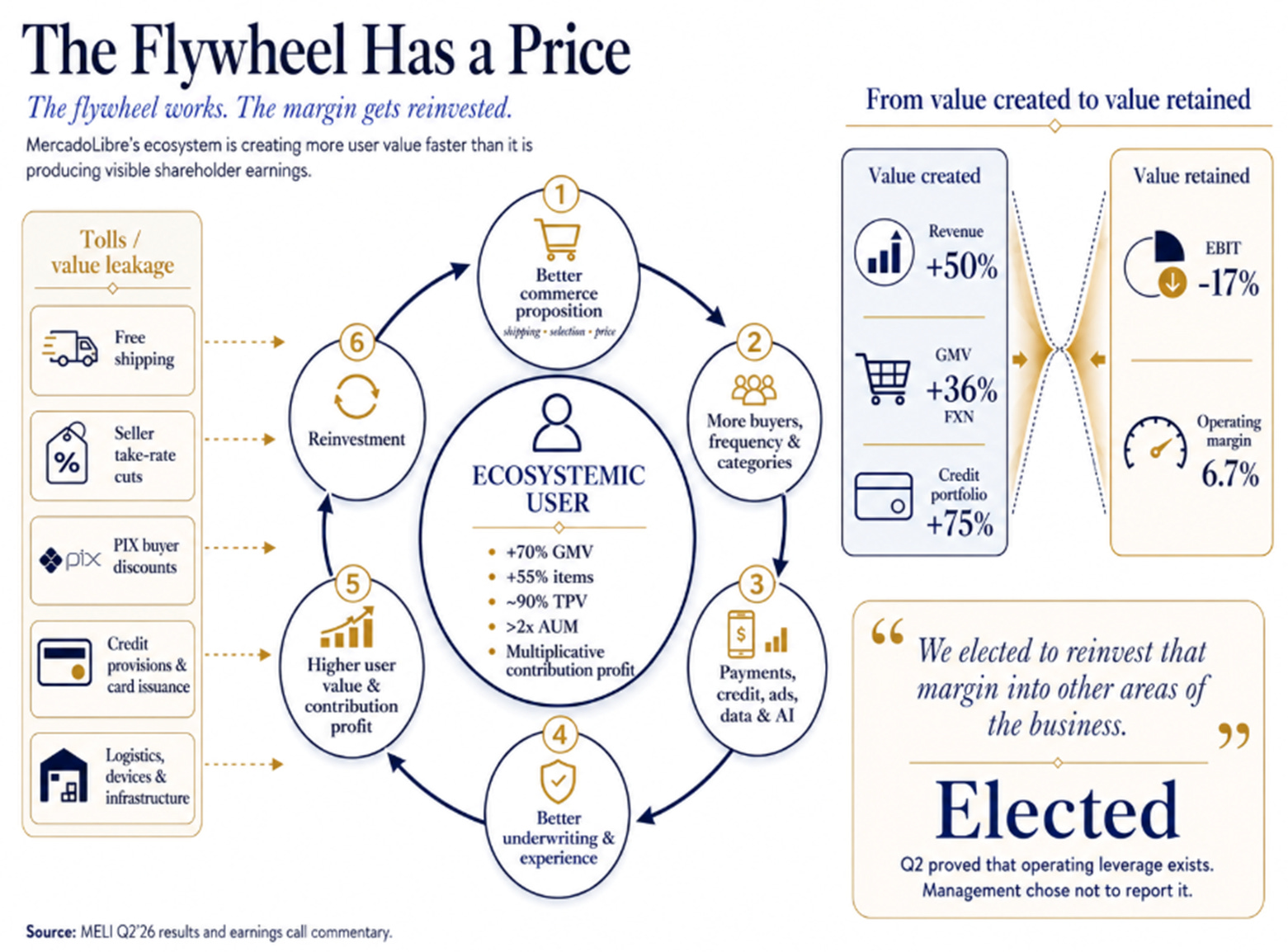
The concept is the ecosystemic user, someone who engages with both the marketplace and Mercado Pago. Management says these users generate 70% more GMV than marketplace-only users. They buy 55% more items. Their payment volume is 90% higher. Their assets under management are more than double. And their contribution profit is not additive but multiplicative, multiples of the combined profit of a marketplace-only and fintech-only user.
These users are growing at 37% year-on-year, the fastest-growing segment since Q4 2023, and their share of the total user base has expanded by eight percentage points over that period. Credit card holders are two to three times more likely to become ecosystemic than users without the card. MELI+ subscribers grew 72%.
Here is what connects every investment we’ve written about across four articles. The free shipping threshold converts marketplace-only buyers into more frequent buyers who adopt Mercado Pago. The credit card converts Pago users into marketplace shoppers. PIX discounts drive payment adoption. 1P and cross-border trade expand selection that pulls users deeper into the ecosystem. MELI+ bundles it explicitly. These are not separate initiatives with separate ROI calculations. They are different doors into the same room.
The argument is credible. The disclosure is incomplete. MercadoLibre did not tell us what percentage of users are ecosystemic. It did not disclose absolute contribution profit, conversion cost, or the time required to recover that cost. Management gave us the uplift because it supports the story. It withheld the denominator that would let us value it. When BTIG’s Marvin Fong asked directly for the penetration number, Martin de los Santos declined:
We don’t disclose the actual share of users. We just want to make sure that those are important users to us, growing very fast.
Management wants the concept in the narrative without the number that constrains it. That tells you the ecosystemic user may be MercadoLibre’s real economic unit, but investors still cannot build an ecosystemic-user model.
Three things need to be separated. Q2 provides strong evidence that the system creates more user value. It provides meaningful evidence that the system creates more company-level economic value. It provides incomplete evidence that this value will accrue to shareholders within a reasonable period. The article, and the investment case, rests on preserving that hierarchy.
Management Is Selling the Ecosystem. The Market Is Pricing the Balance Sheet.
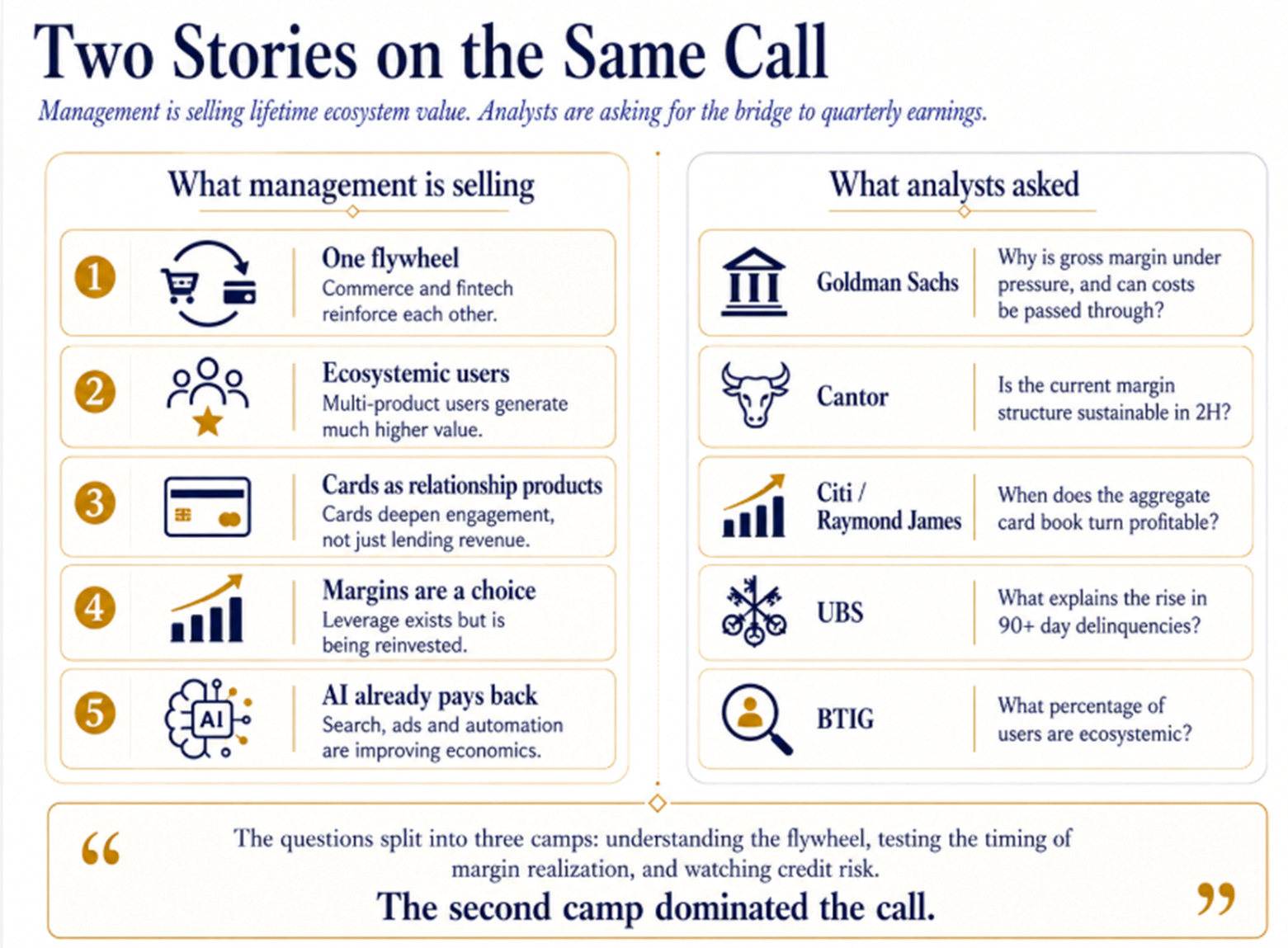
Management spent the entire shareholder letter and earnings call selling this reframing. CEO Ariel Szarfsztejn closed the call with the thesis stated as plainly as a management team will ever state it:
We are building something quite unique globally, an ecosystem of commerce and financial services that compounds on itself. These are not two businesses running in parallel. This is one flywheel, each side making the other one more valuable.
No timeline. No margin target. No guidance the market can model against.
The questions on the call revealed where the disagreement sits. Goldman’s Irma Sgarz led with “feel obliged to ask about margin” and pushed on gross margin compression sources. Cantor asked whether current margin levels were sustainable through the second half. Citi pressed on credit card NIMAL inflection. UBS challenged the 90+ day NPL metric. BTIG fished for the ecosystemic penetration number.
The questions split into three camps: analysts exploring the flywheel and its upside, analysts testing the timing of margin realisation, and analysts still focused on credit risk. The second group dominated the call. Nobody disputed that engagement improved. Everyone wanted the bridge from engagement to earnings.
Management’s answer was consistent: credit profitability recovered, opex scaled, and management then reinvested those benefits into commerce. That is exactly the pattern we’ve tracked for five quarters. The analysts accept the evidence that the investments work. They are not willing to pay today for profits management has neither quantified nor scheduled.
“Elected”
Here is the section that matters for the stock.
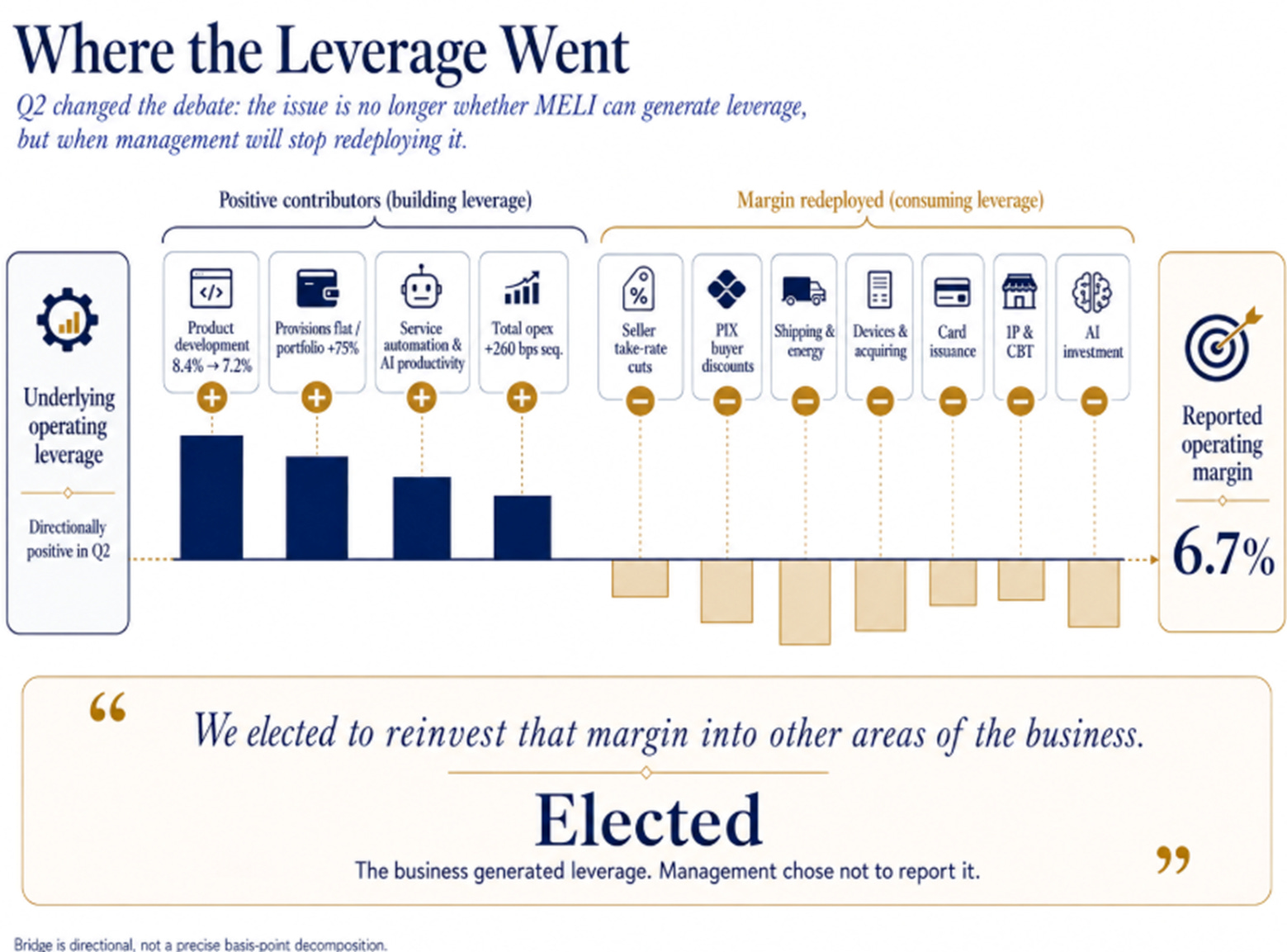
Product development expense scaled from 8.4% of revenue to 7.2% year-on-year. AI productivity drove it: code submissions up 110%, engineering headcount flat for the first time in years, more than half of Help Portal requests resolved by the AI assistant without human intervention. Provisions flat quarter-on-quarter despite credit portfolio growing 75%. Total opex improved 260 basis points sequentially. The operating leverage we spent four articles waiting for showed up in the numbers.
Then management launched new PIX buyer discounts and seller take rate cuts in Brazil. In April. During the quarter. Gross margin compressed 280 basis points sequentially, consuming every dollar of opex improvement. Martin de los Santos on the call:
We elected to reinvest that margin into other areas of the business.
Elected. He used the word three times.
The business gets stronger. The margin doesn’t move. The stock sits.
Our Q1 article asked whether the dial has a minimum setting that competition enforces. Q2 doesn’t fully answer that. Whether the new Brazil initiatives were proactive or reactive doesn’t determine whether they’re discretionary in an economic sense. Management may invest proactively because it sees competitive dynamics, Shopee in low-ASP, Amazon in logistics, Nubank in financial services, that make it necessary even without an immediate threat. The earlier framework remains the honest one: management controls the intensity, but competition and customer expectations influence the minimum.
What Q2 does clarify is that the leverage mechanism works. The opex lines proved it. If management ever chose to let two or three quarters of opex improvement flow through without launching a new initiative, operating margin would move above 8% rapidly. They have not chosen to. There is no external catalyst that forces them to. It comes when they decide, and they have given no signal of when that will be.
Behind the reinvestment decision, though, something structural is building that deserves attention. The AI-driven productivity gains, Product Development at 7.2% and falling, customer service running on 30% fewer humans while the business tripled, 2026 the first year engineering isn’t growing, represent 100-200 basis points of annual operating leverage that compounds regardless of management’s commerce and fintech investment decisions. This happens in the background. Over three years, it could contribute meaningfully to margin recovery even if management continues to invest aggressively elsewhere. The market is not modelling this because it is distributed across multiple line items. It may be the most underappreciated structural feature of the entire P&L.
Credit Recovered. The Clock Did Not.
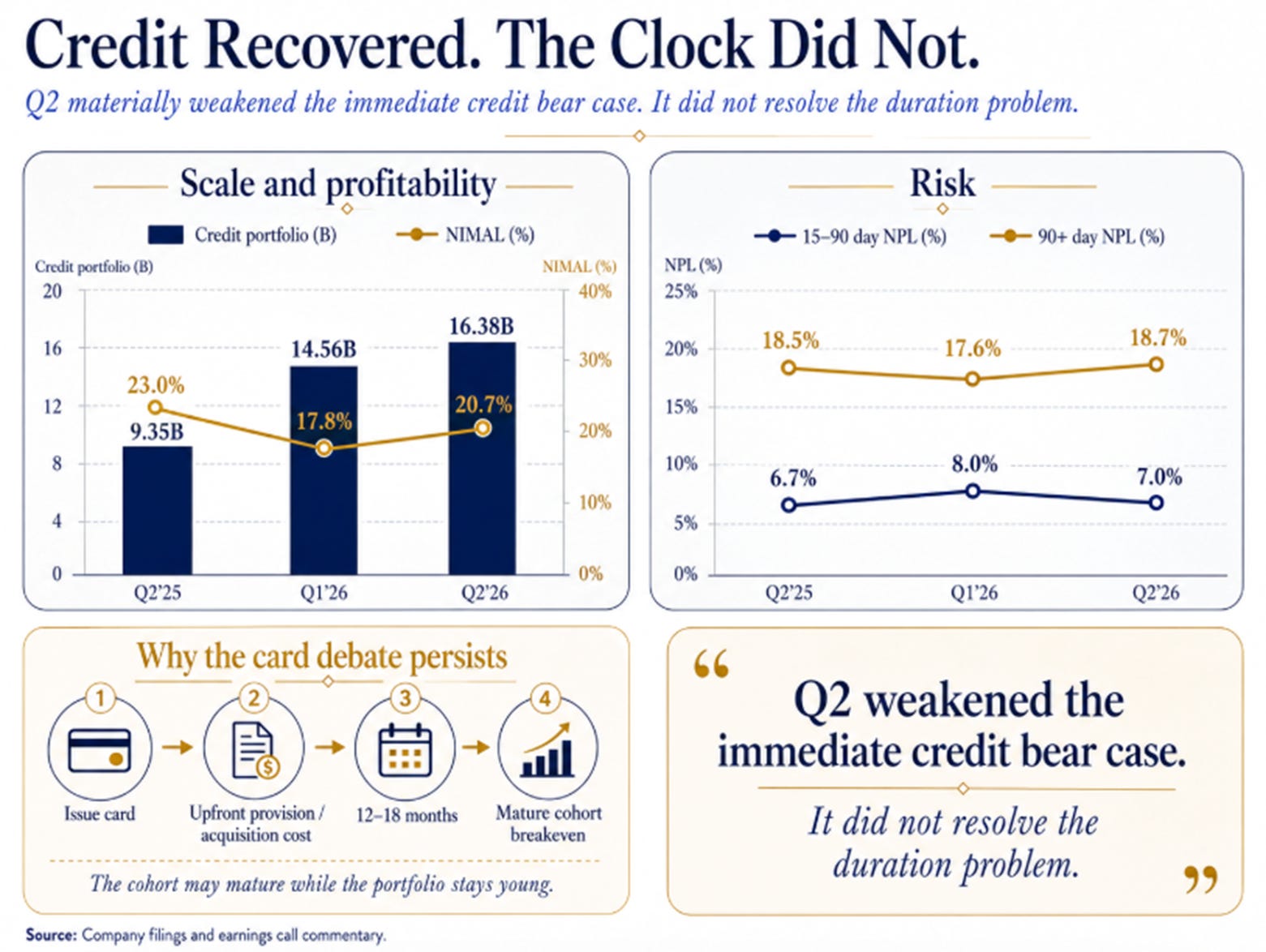
The Q4 article’s $12.5 billion identity crisis, the market re-categorizing MELI from tech platform to Latin American lender, has a materially better data set now. Not a resolution. A better data set.
NIMAL recovered from 17.8% to 20.7%. The 15-90 day NPL dropped from 8.0% to 7.0%, near historic lows. Credit card NPL at 4.6%. Provisions flat quarter-on-quarter. Credit revenue net of provisions as a share of revenue higher than a year ago. The portfolio is scaling profitably at the current level of growth.
Our Q4 signpost said NIMAL must hold above 22%. It didn’t. The miss is from credit card mix, now 47% of the portfolio at -2.5% NIMAL because issuance accelerated to 2.6 million cards per quarter. Each cohort breaks even in 12-18 months, but every wave of new issuance resets the average age of the book. The portfolio is majority young. Recalibrate: watch NIMAL trending toward 22% as issuance growth moderates and cohorts season.
The immediate bear case, credit growth outrunning underwriting, weakened materially this quarter. The structural credit debate, whether the portfolio can survive a full Brazilian downturn at this scale, did not resolve. UBS correctly flagged the 90+ day NPL uptick. Management attributed it to technical factors and product mix. Q3 will confirm whether it was noise or signal.
Our View, Updated
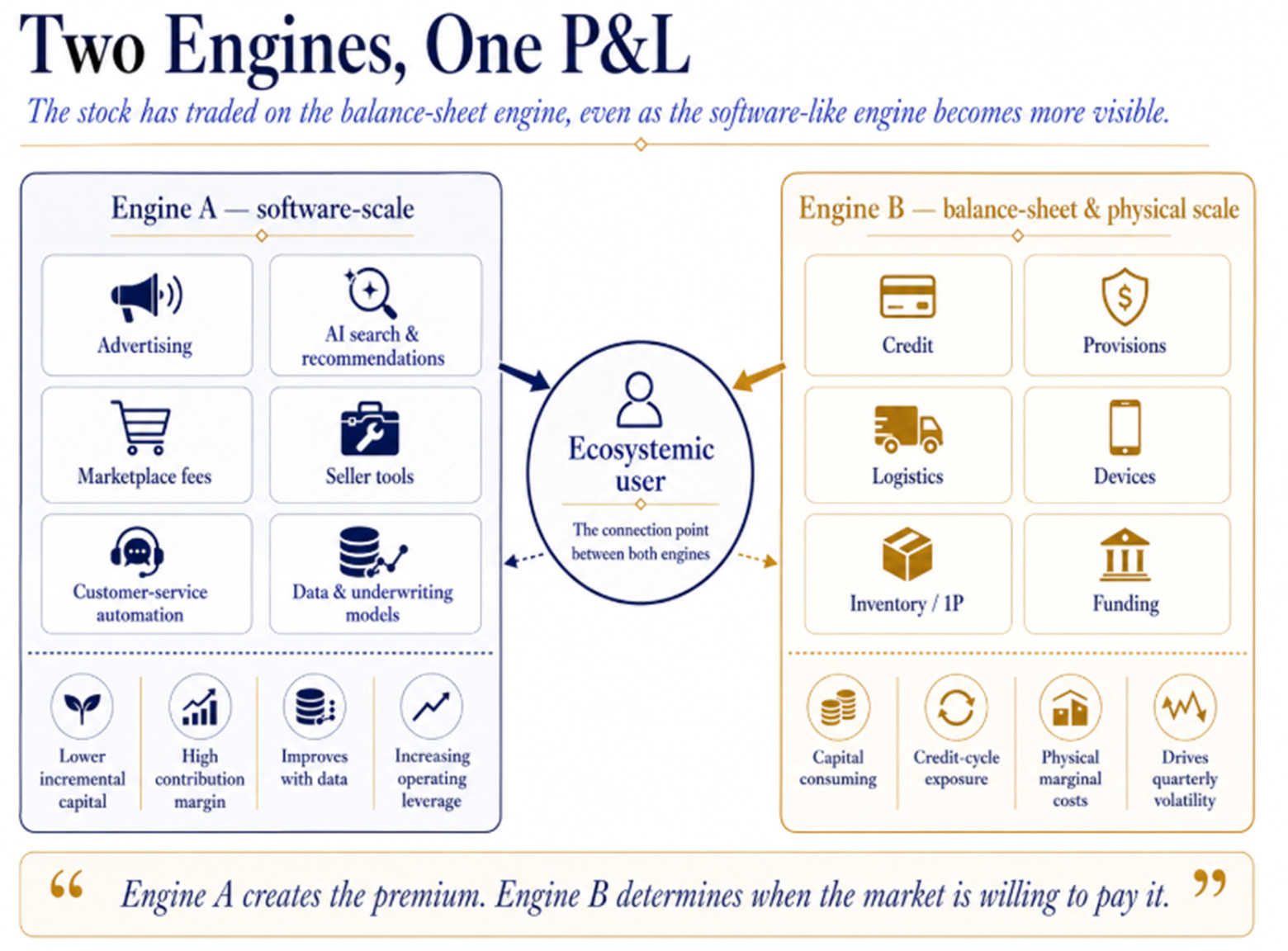
We were right that logistics density could be used offensively. We were right that integrated commerce, payments, credit, and data create a system competitors cannot easily replicate. We were right that Engine A, advertising growing 62% FX-neutral and now above 10% of Latin American digital ad share, AI productivity compounding in every operating line, would eventually become visible.
We underestimated how quickly credit would change the company’s financial identity. We underestimated how long the investment cycle could persist. Most of all, we treated value creation as if it would automatically become shareholder value. The Q1 article corrected that by asking who captures the surplus. Q2 gives the surplus question a named mechanism, the ecosystemic user, without yet proving how much of the value reaches the bottom line.
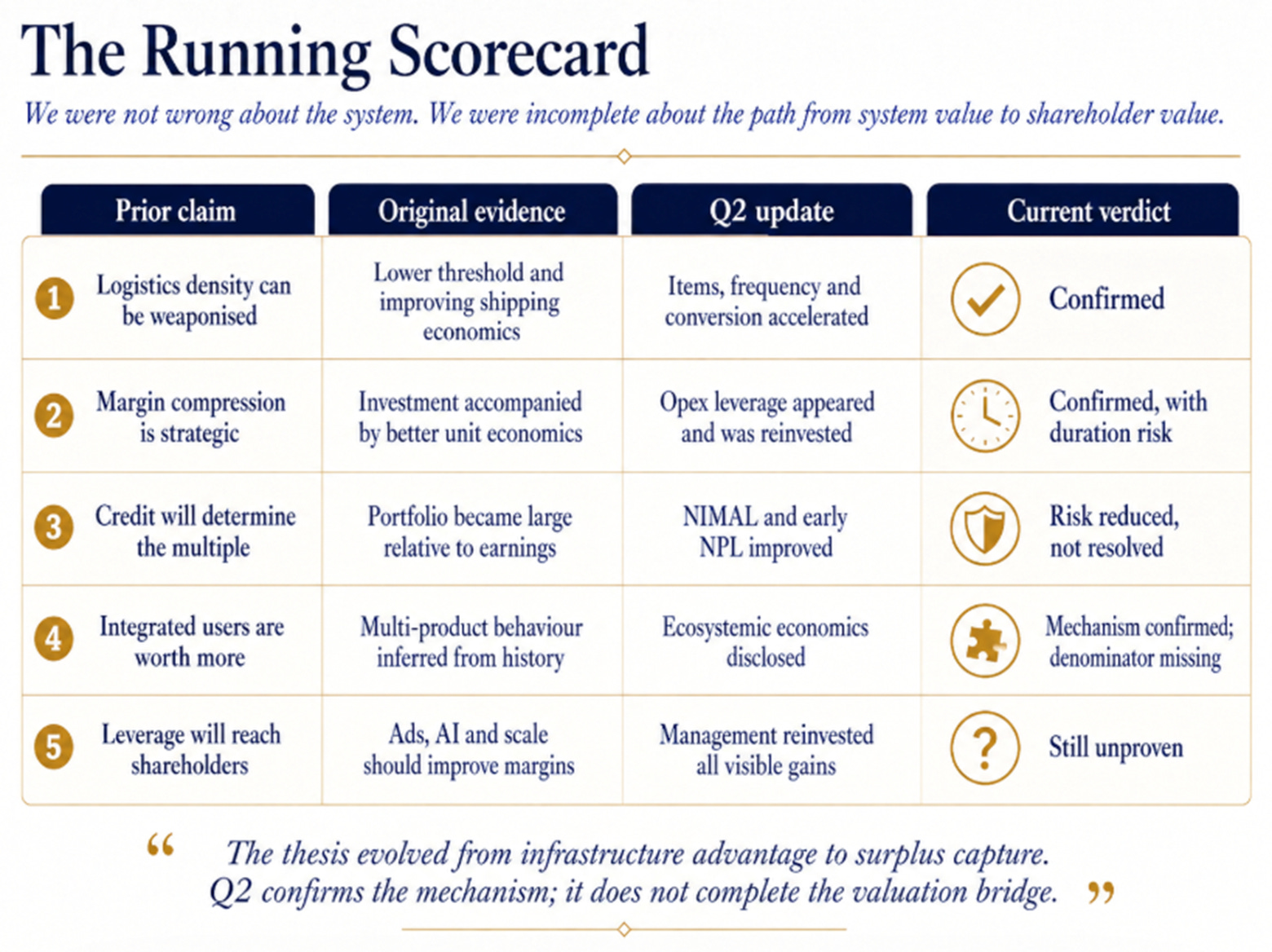
Our variant view is narrower than it was a year ago: MercadoLibre is becoming a more valuable integrated system even while reported margins remain low, and Q2 suggests the cost of building that system may be temporary rather than permanent. The missing variable is the meaning of “temporary.”
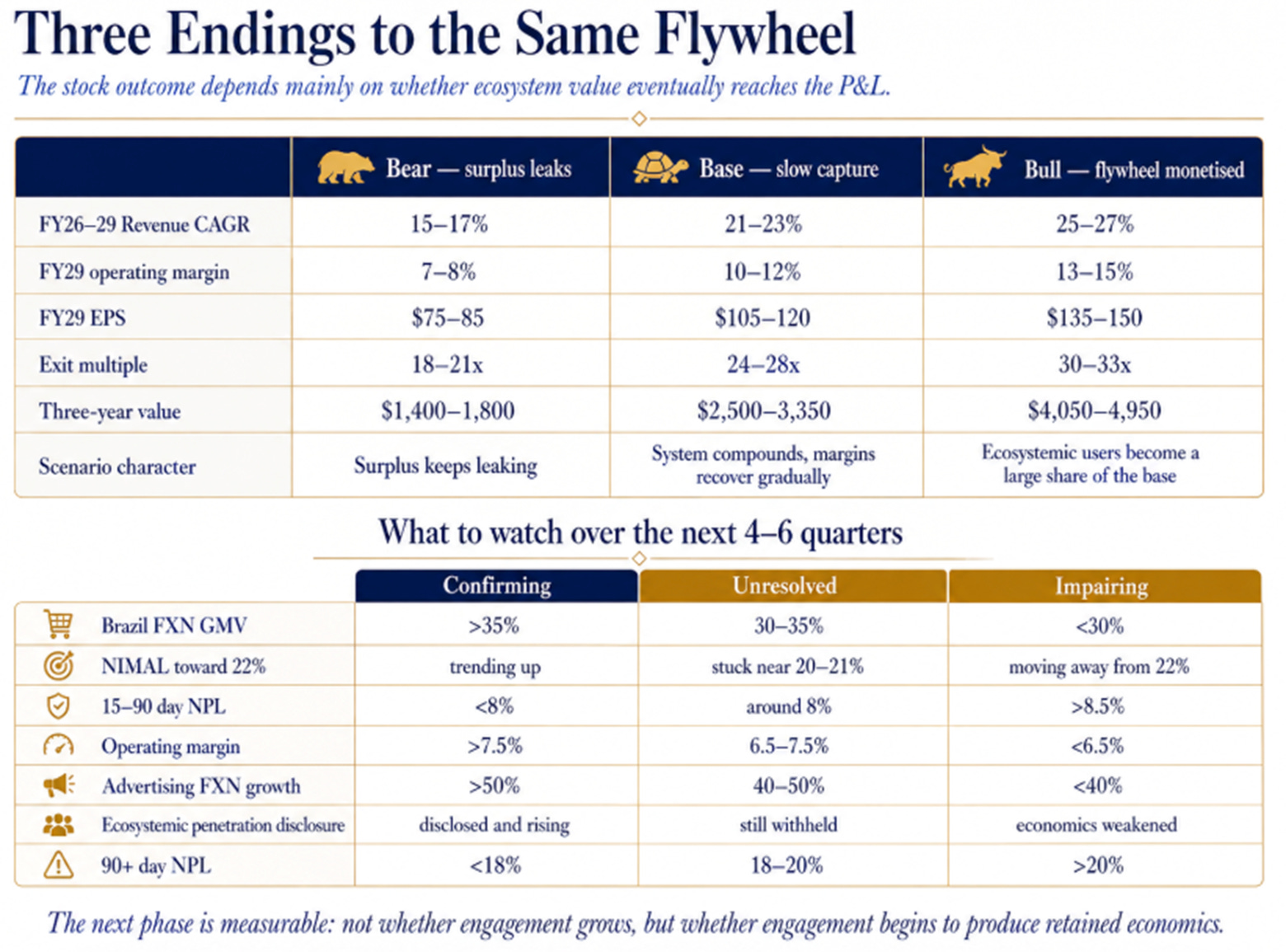
The bear case does not require MercadoLibre to lose. It requires the surplus to keep flowing to customers, sellers, and credit losses while margins stay near current levels. The base case assumes the ecosystem keeps compounding, credit seasons normally, and the cost of defending the system is higher than we once assumed but manageable. The bull case is management’s story: ecosystemic users become a large share of the base, credit cards turn profitable, advertising and AI change the margin structure, and the company gets re-categorized as integrated digital infrastructure.
Signposts graded and updated: Brazil FXN GMV above 35%, cleared at 39%, maintain. NIMAL trending toward 22%, below at 20.7%, recalibrate to “watch as issuance moderates.” 15-90 NPL below 8%, cleared at 7.0%. Operating margin above 7.5% as inflection signal, below 6.5% as stress. Advertising FXN growth above 50%, cleared at 62%, watch for quarterly revenue approaching $500 million. New: ecosystemic user penetration disclosure, when management starts reporting the number, it means they’re confident in the curve. New: 90+ day NPL below 18% confirms noise, above 20% reengages concern.
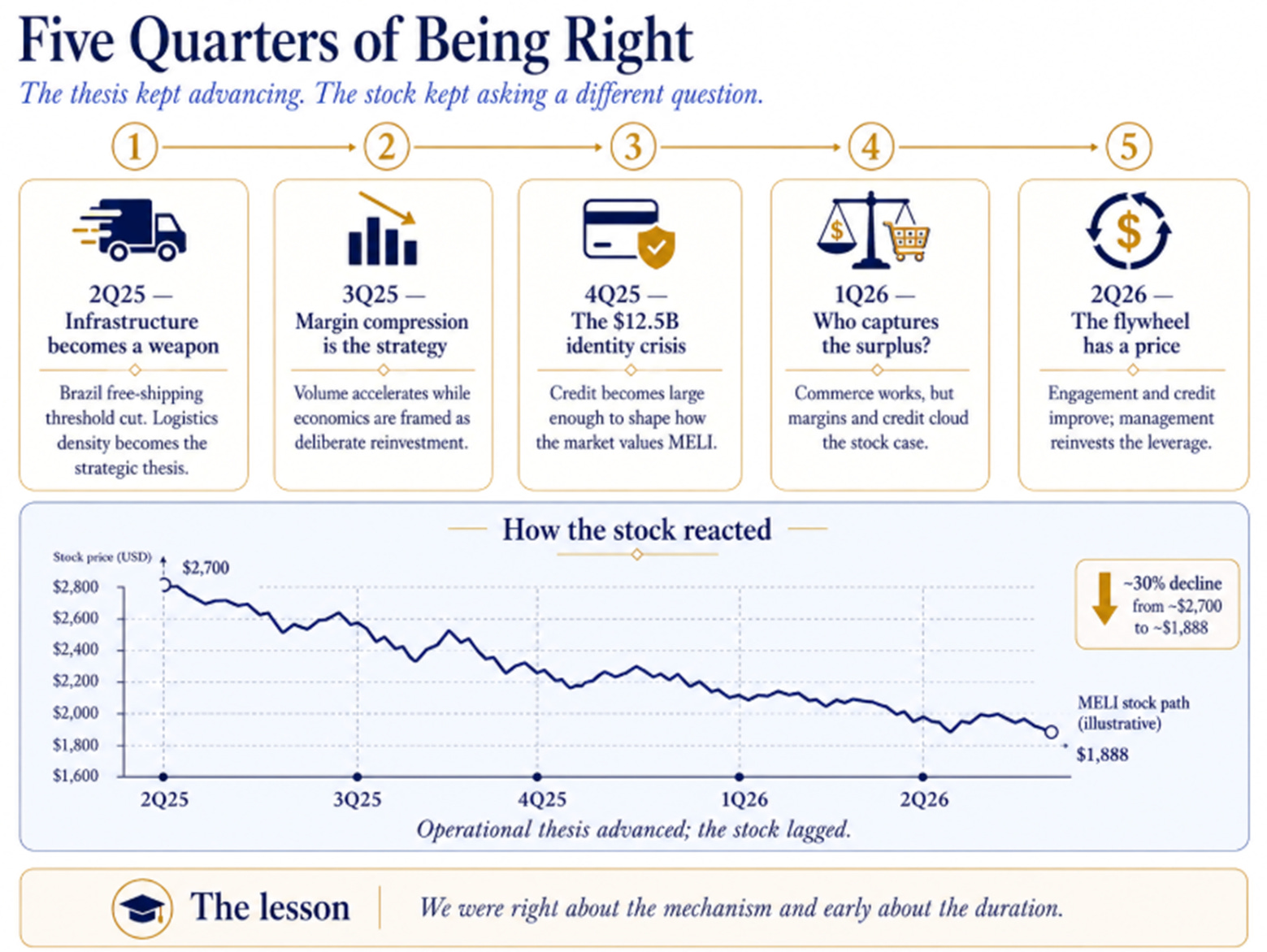
Five quarters. Five articles. The commerce thesis was right. The credit thesis scared us and recovered. The surplus question now has a named mechanism, if not yet a proven one. The moat is wider than it has ever been.
And the stock is down 30% since we started writing.
MercadoLibre is building something that does not exist anywhere else, an integrated commerce and financial services flywheel in a market where both digital shifts are happening simultaneously to 650 million people. The flywheel works. Engagement compounds. Q2 suggests the economics may follow. Management still has to let them appear.
The price of the flywheel is time. And time, for now, is what management is buying, whether the market likes it or not.
Disclaimer:
The content does not constitute any kind of investment or financial advice. Kindly reach out to your advisor for any investment-related advice. Please refer to the tab “Legal | Disclaimer” to read the complete disclaimer.