


TL; DR
The advertising thesis is working. Meta grew ad revenue 27% despite daily users rising only 3%, as better recommendation and advertising models increased both inventory and pricing.
Product return is no longer the same as shareholder return. Capital spending, depreciation, research costs and widening AI ambitions absorbed nearly all of Meta’s operating cash flow during the quarter.
The key question is whether the lab remains subordinate to the advertiser. Meta does not need to win every frontier-model contest, but it must show that unproven projects face a real capital hurdle and that free cash flow eventually returns to shareholders.
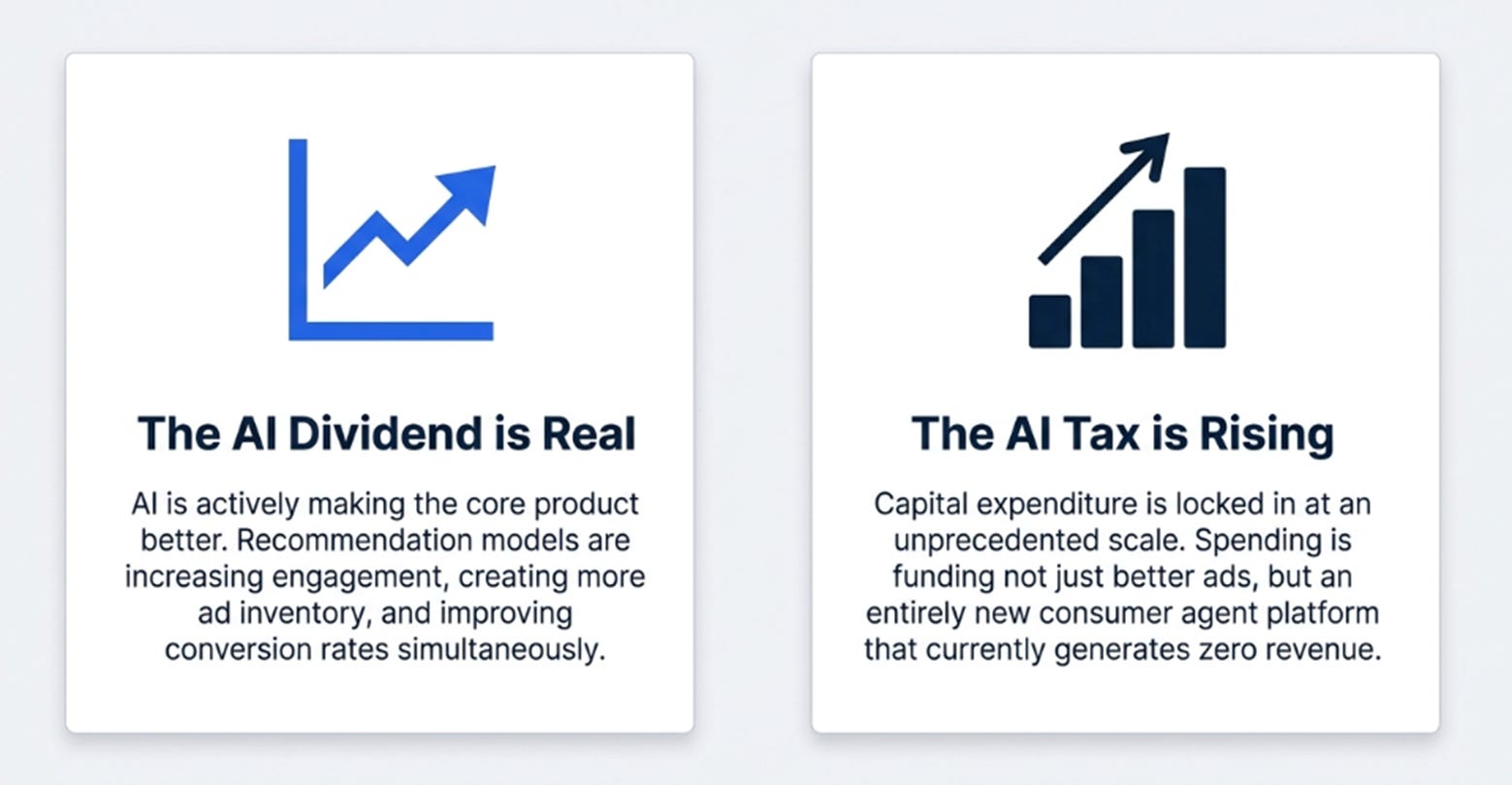
A year ago, in The Infinity Machine Boots Up, I wrote that “the ROI isn’t coming; it’s here.” Meta had shown that better recommendation models could increase engagement, create more ad inventory and improve conversion at the same time. Revenue was accelerating, margins were expanding, and the company could reinvest the resulting profit into still more compute. I called it an infinity machine.
I still believe the core idea.
What I no longer believe is that the return from Meta’s advertising systems and the return from Meta’s entire AI budget can be treated as the same thing.
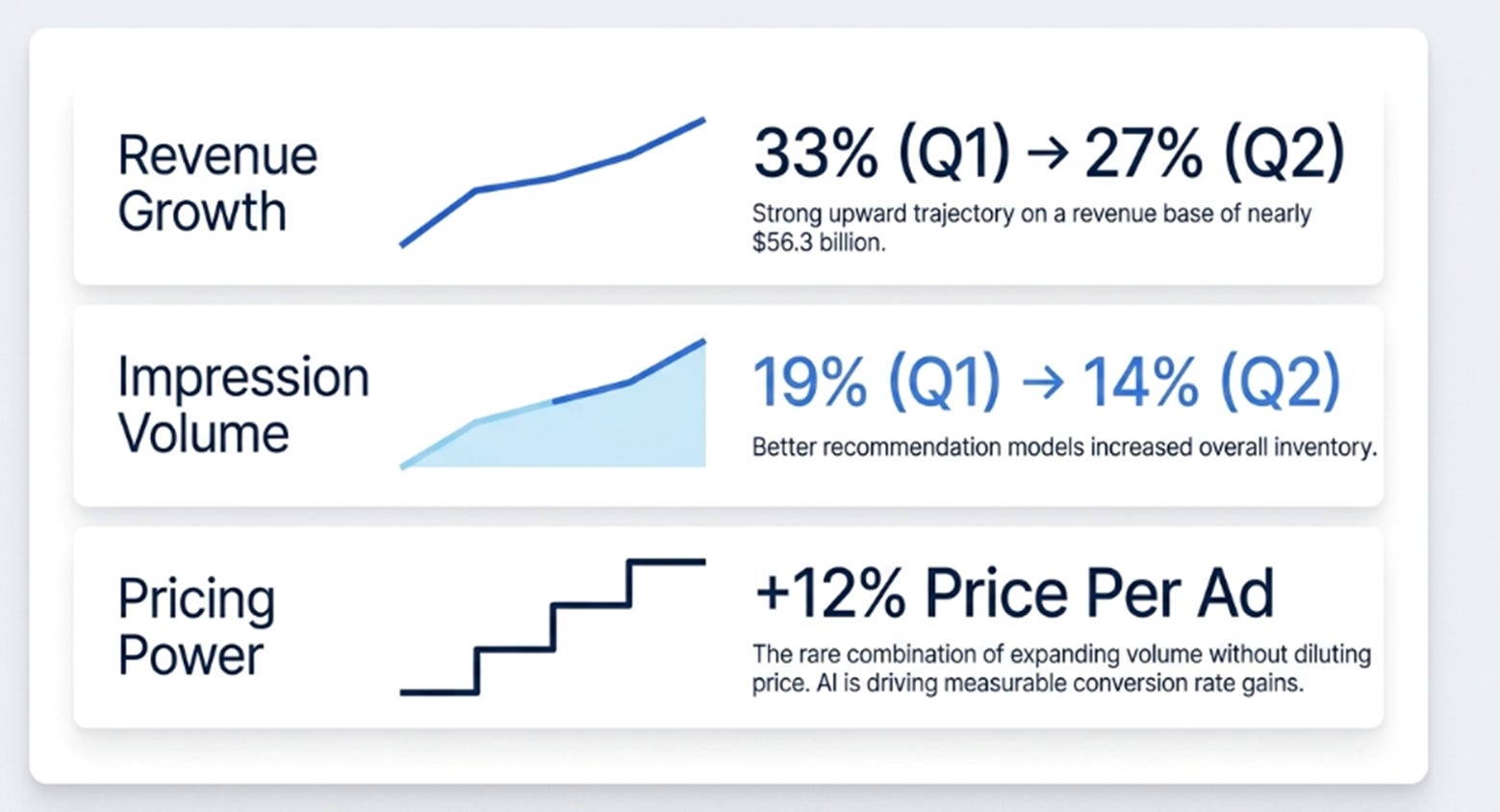
That distinction did not matter much in 2Q25. It matters now. Meta grew advertising revenue 27% while daily users increased only 3%. Family revenue per person rose about 24%; ad impressions increased 14%, and the average price per ad rose 12%. Yet reported operating margin fell from 43% to 31%, clean margin was closer to 37% after removing legal and severance charges, and $31.1 billion of quarterly capital spending left only $784 million of free cash flow. The product return is real. The shareholder return is no longer automatic.
I now think there are three separate questions. Does AI improve the product? Does that improvement exceed the operating cost of producing it? Does the cash left over accrue per share? In 2Q25, all three answers appeared to be yes. In 2Q26, the first remained emphatic, the second became more conditional, and the third was no—at least for the quarter.
I was right about Meta’s return on intelligence. I had not separated that return from Zuckerberg’s appetite to reinvest it.
The Closed Loop
The fundamental question for Meta is no longer whether AI helps the business. It plainly does.
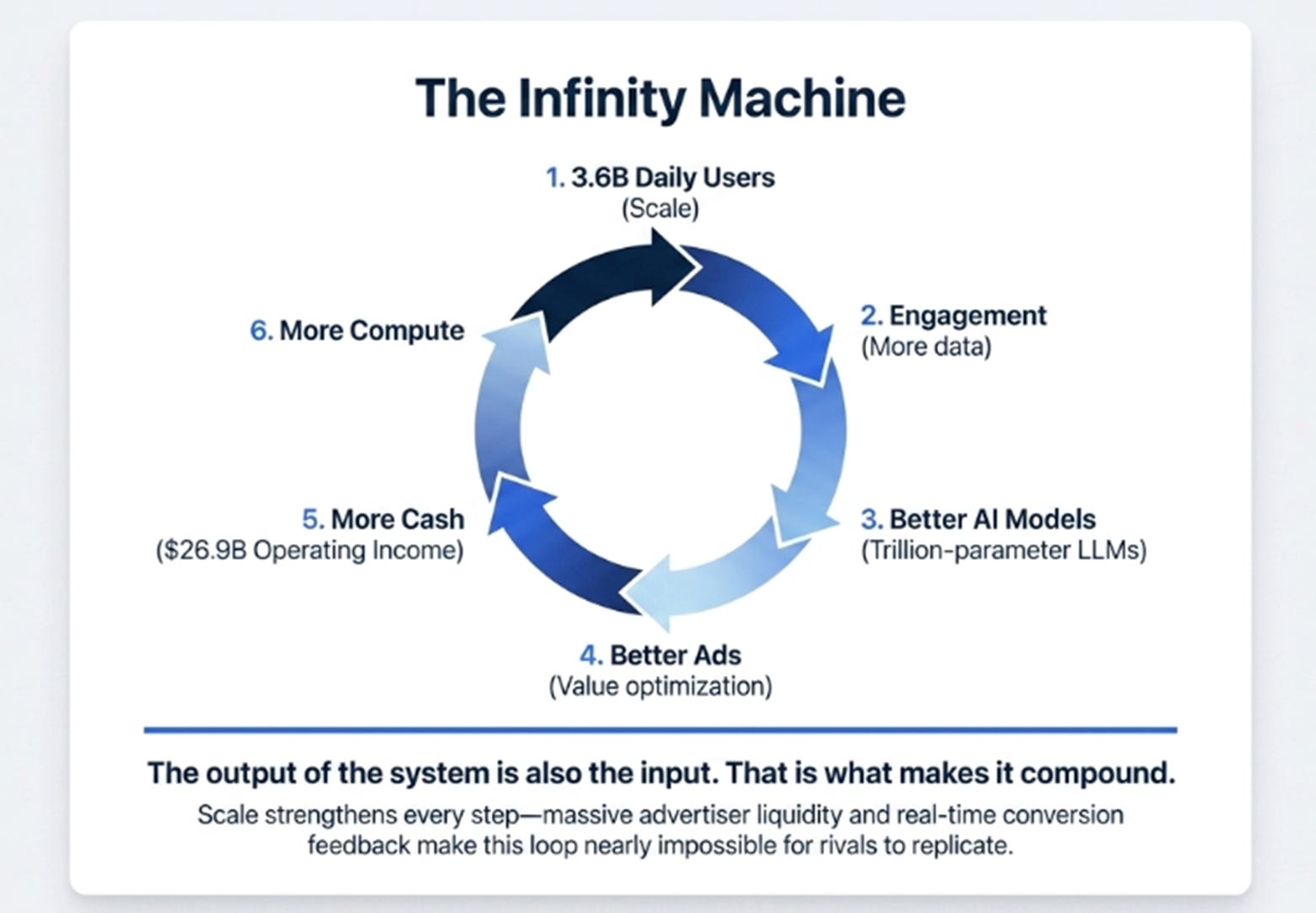
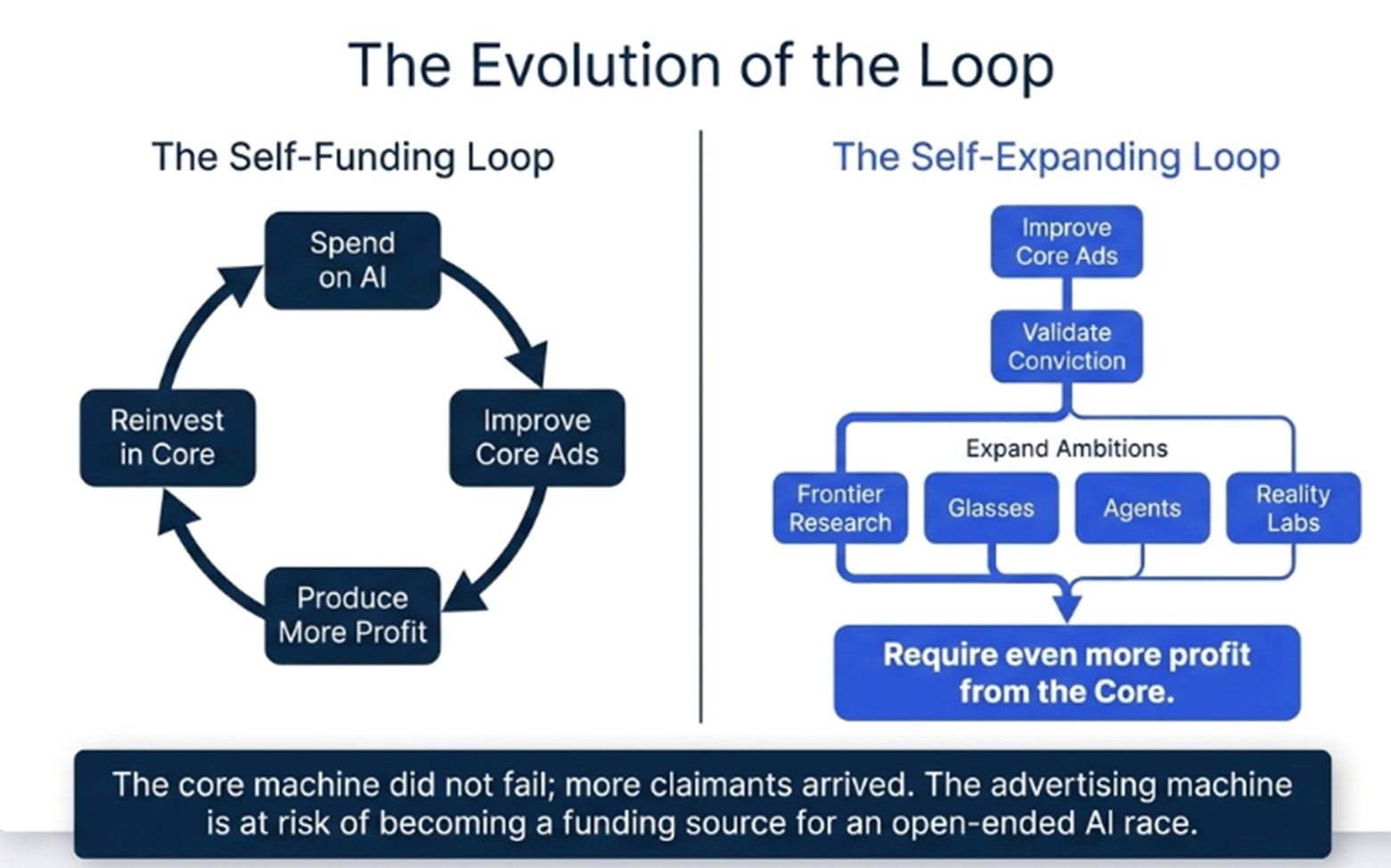
The question is whether Meta can keep the loop closed: can more intelligence create more relevant content, more attention, better advertising and more profit, which then funds still better intelligence, or will each proof of return simply widen the company’s ambitions until the advertising machine becomes the funding source for an open-ended AI race?
The productive loop is unusually powerful. Better models decide what someone wants to see before that person knows to ask. Better content keeps the person engaged for longer. More engagement creates more commercial moments. Better ad models match those moments with businesses willing to pay, and the resulting conversion data improves the next decision.
Scale strengthens every step. Meta has 3.6 billion daily users, a vast supply of content, millions of businesses and an auction learning from countless interactions. A rival can build a capable model. Recreating all four sides of that system is much harder.
The quarter confirmed the mechanism. Meta’s audience barely grew, but the economic value of that audience jumped. The mix was healthy too: impressions supplied more inventory while higher pricing showed that the new inventory retained value. Worldwide impression growth did slow from 19% in the first quarter to 14%, so I would not extrapolate 27% ad growth forever. Still, this was not a company squeezing a mature user base. It was a system becoming more productive.
The Advertising Company
Last year I wrote that Meta was no longer an advertising company. That was too clever.
Meta is an advertising company. That is the bull case.
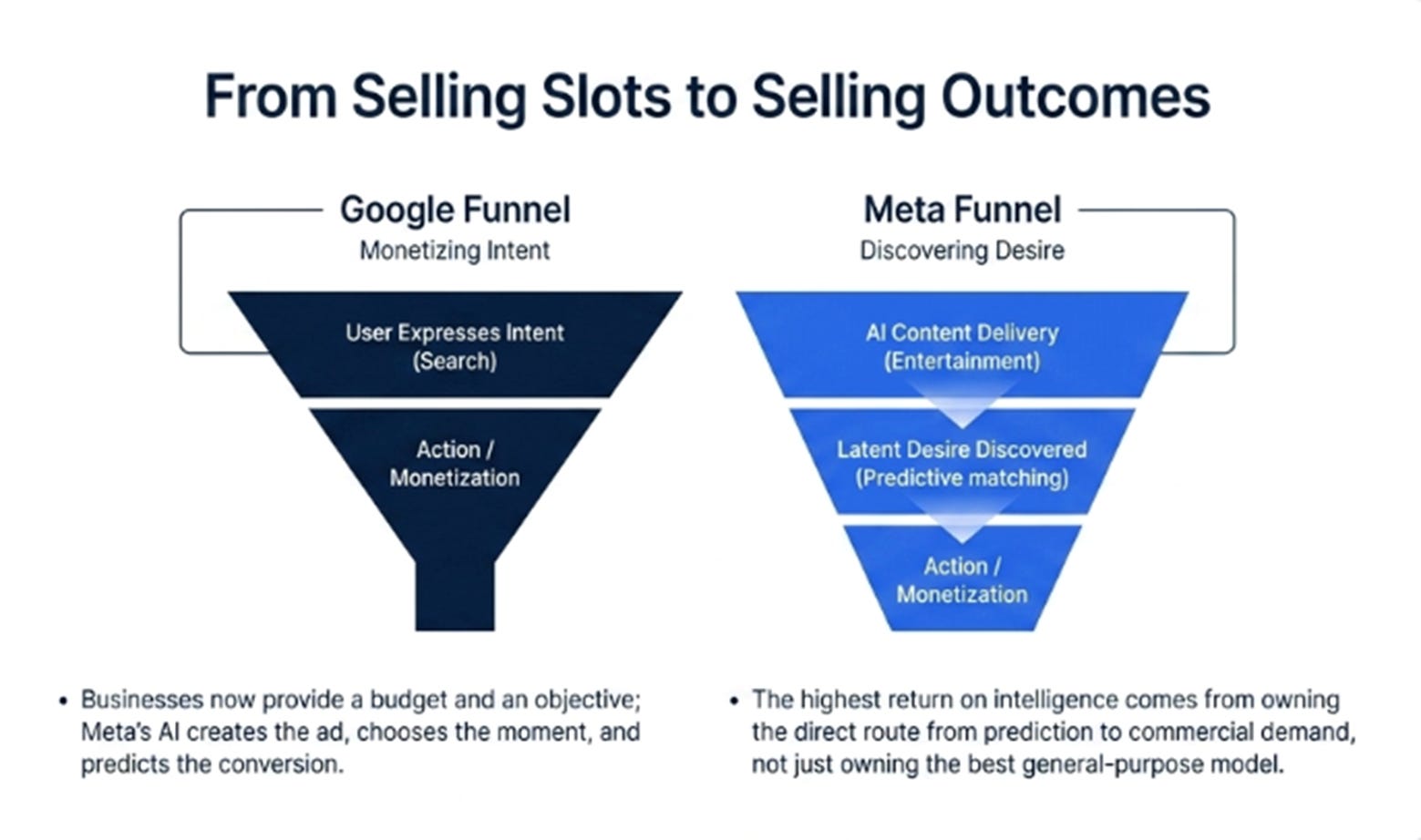
What changed is the meaning of advertising. Twenty years ago, a business bought space beside content. Today it gives Meta a budget and an objective; Meta can create the ad, identify the customer, choose the moment, predict the conversion and adjust the campaign. The business is buying an outcome rather than a slot.
Google monetises intent after a user expresses it. Amazon monetises intent near the point of purchase. Meta is strongest one step earlier: it discovers desire. Someone opens Instagram to be entertained and encounters a product they did not know existed. AI improves the content, detects the latent interest, generates the commercial message and finds the seller.
This is why I do not think Meta needs to own the best general-purpose model in every category. Anthropic may lead coding, OpenAI may own more consumer productivity, and Google may have the broadest model-and-distribution bundle. Meta can still earn the highest return from intelligence because it owns a direct route from prediction to commercial demand.
That is my variant view. The AI winner will not necessarily be the lab with the best benchmark. It may be the company with the most profitable use for a model that is good enough.
When Success Widens the Bet
The old thesis assumed a closed financial loop. There is now a second possibility. A self-funding loop can become a self-expanding one.
That does not make the spending foolish. Meta’s aggressive GPU purchases in 2022 looked excessive before they helped repair recommendations after Apple’s privacy changes and TikTok’s rise. The willingness to commit before the payoff is obvious is part of the company’s strength.
But “AI spending” now covers several different claims on capital. Recommendation, ranking and ad automation have earned their spending because the return is visible. Enough model and compute ownership to avoid dependency may be necessary even when the direct return is harder to measure. Frontier research, enterprise agents, external compute, smart glasses and the continuing Reality Labs effort remain less proven.
Meta does not tell us how the budget is divided. That is the gap.
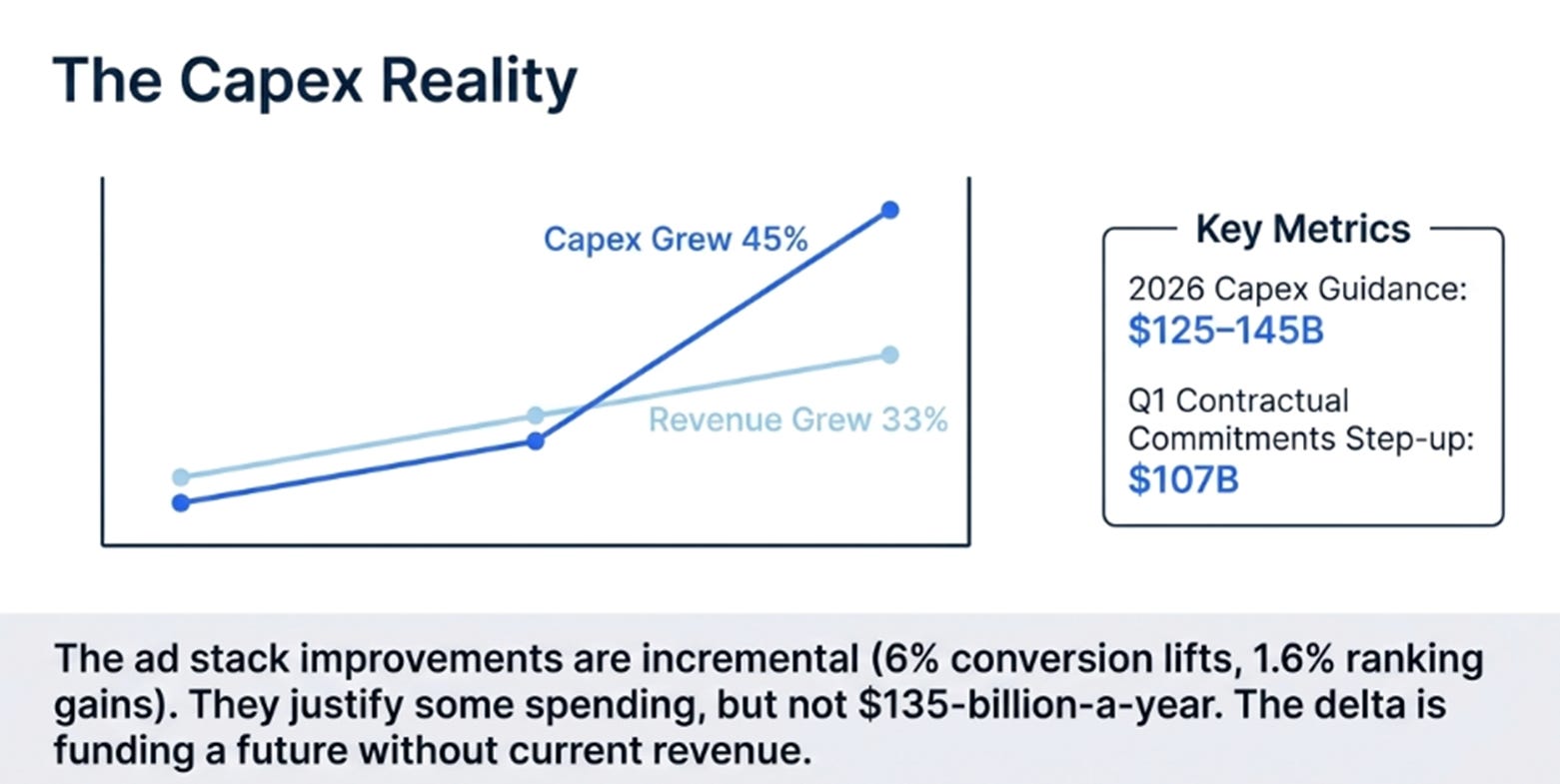
The reported quarter looked worse than the underlying business: $2.4 billion of legal charges and $1.18 billion of severance reduced operating income, and excluding them produces a clean margin near 37%. The legal cost cannot be dismissed—youth-related litigation may recur—but it tells us little about the return on AI. Even on the cleaner number, margin was down roughly six points from a year earlier. Research expense rose 67%, stock compensation rose 58%, depreciation rose 46%, and Reality Labs lost another $4.6 billion. Operating cash flow increased 25%, yet Meta made no share repurchases and issued almost $25 billion of debt as capital spending absorbed nearly all of the cash generated by operations. One quarter of construction payments should not be annualised, but the direction is clear.
The core machine did not fail.
More claimants arrived.
A Price for Ambition
Zuckerberg said Meta has received a “large number of offers” for its compute at a “meaningful premium” to what the company paid. Most people heard the outline of a new cloud business. I heard something more useful: an observable opportunity cost.
An outside rental price tells Meta what an internal workload must beat. If a recommendation model can generate more advertising profit than the same capacity would earn from a customer, Meta should take the compute back. If an internal project cannot clear that bar, it should explain the strategic value of doing so or let someone else use the machines.
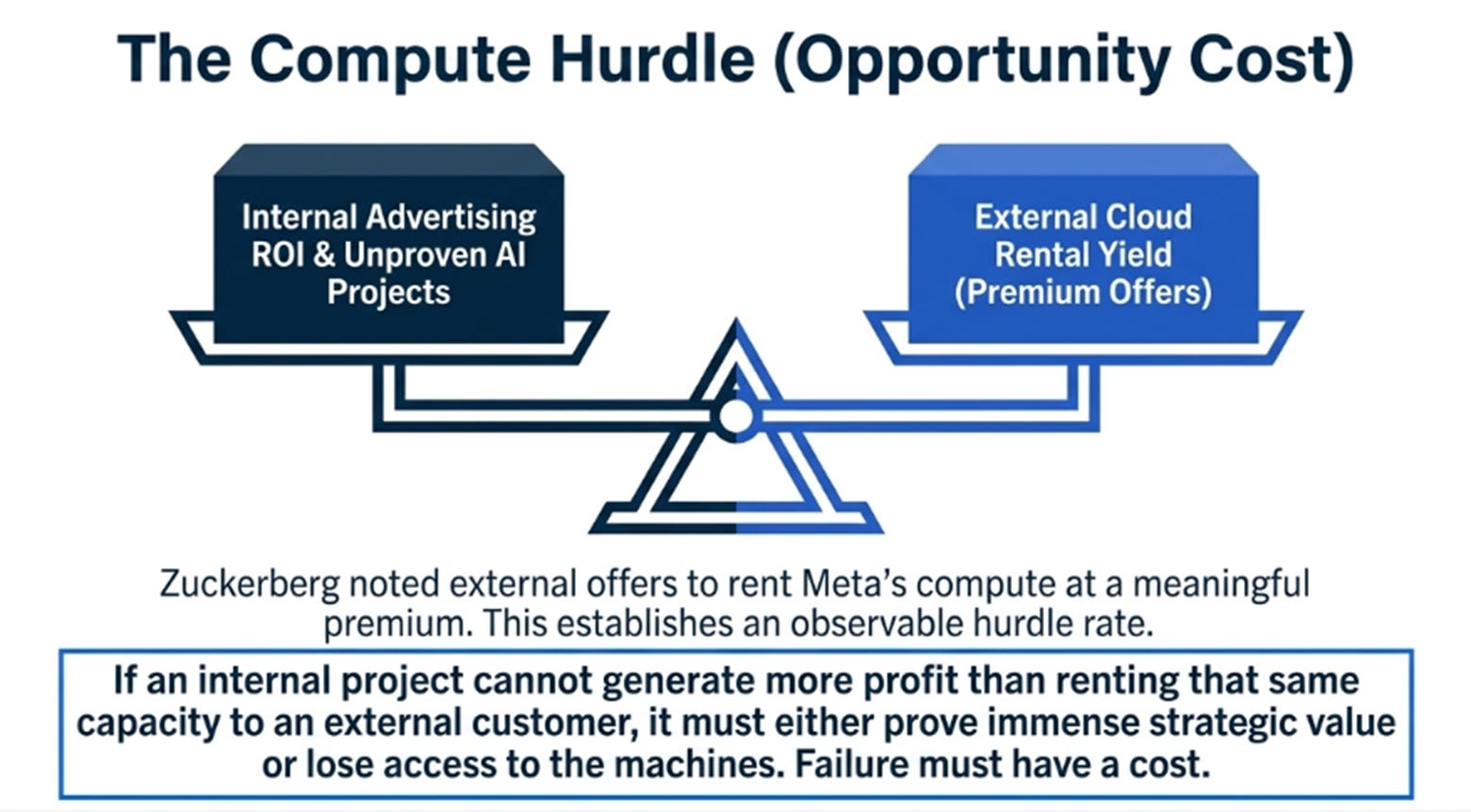
Ben Thompson made this point before the quarter, and it is the part of his argument worth keeping: compute rental can be a hurdle rather than a destination. Meta does not need another reason to build. It needs a price for deciding which ambition deserves what it has built.
This is not an argument for replacing founder conviction with a committee. Zuckerberg’s willingness to invest early has created enormous value. The better answer is a rule that lets successful bets win more capital and forces unsuccessful ones to lose access to it.
Meta need not prove that every AI project will work.
It needs to show that failure has a cost.
What I Believe Now
I am more confident that Meta owns one of the best commercial applications of AI in the world. I am also more confident that the company does not need to win every frontier contest to benefit from the technology.
I am less willing to award the wider AI programme the returns already visible in advertising. Compute rental can protect the downside, but returns on rented hardware—however attractive during scarcity—should not receive the same valuation as a self-reinforcing ad system. Agents, glasses and enterprise products may become large businesses; for now, they are claims, not evidence.
This is why the stock’s decline was both understandable and incomplete. The quarter was slightly below the buy-side revenue bar and third-quarter guidance implied slower growth. Yet clean operating income was better than the headline, and the capex midpoint barely moved. Meta managed to spend too much for shareholders focused on free cash flow and too little for semiconductor bulls seeking another upward capex surprise.
The deeper conclusion is simpler:
The quarter raised my estimate of Meta’s underlying earning power and lowered my confidence that shareholders will capture all of it.
Three Years From Now
The valuation turns on whether product return, company return and shareholder return reconnect by 2029.
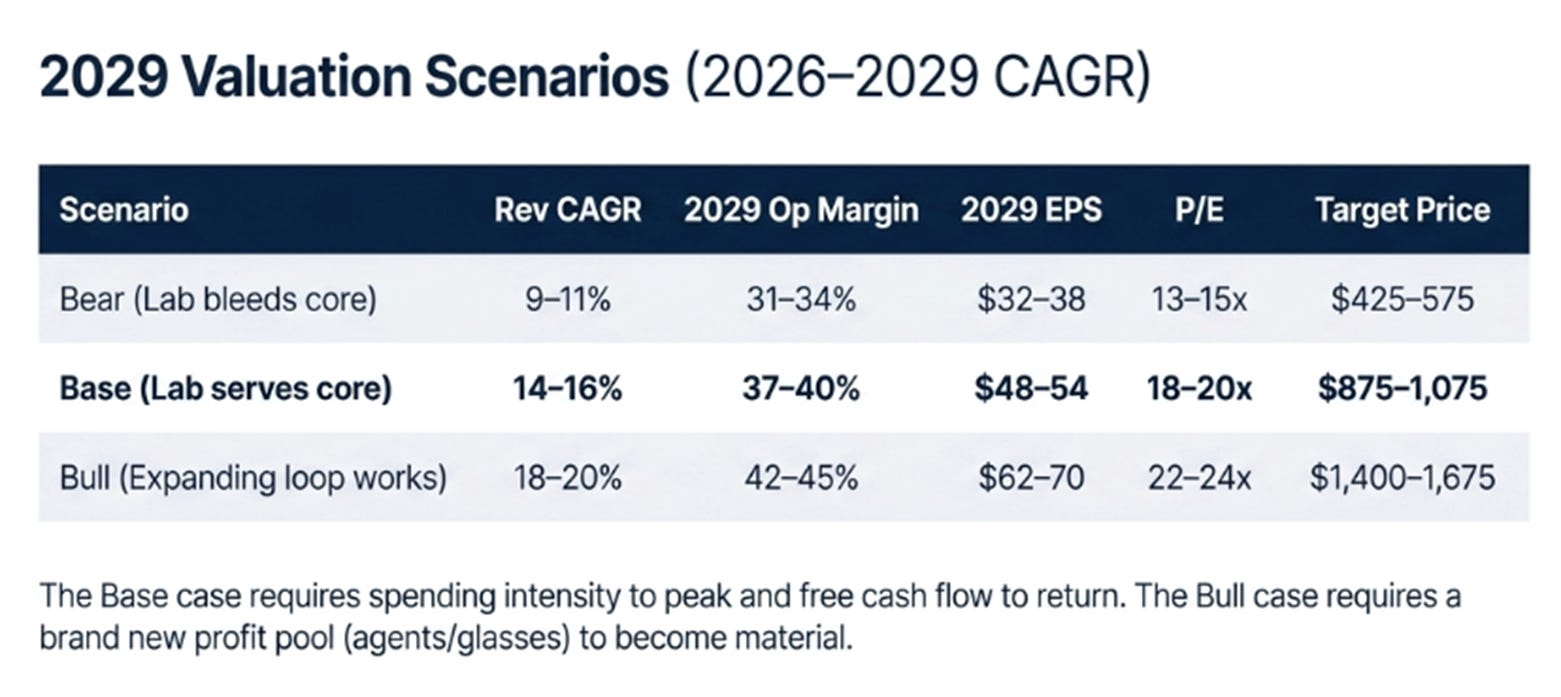
In the bear case, advertising remains a good business but slows before spending does. New products do not become material, annual capital spending remains near $200 billion, and Meta is valued as a capital-heavy advertiser.
In the base case, advertising compounds in the mid-teens, clean margins recover toward 40%, spending intensity peaks and free cash flow returns. Meta does not need another business of comparable size; it needs the lab to remain subordinate to the economics of the core.
The bull case requires a larger expansion of content and commercial inventory, plus one new profit pool—agents, messaging or glasses—becoming material. Internal uses of compute must earn far more than external rental, and capital spending must stop growing faster than revenue.
At roughly $538 after the print, the base case implies an annualised return of about 18–26% over three years. The bear case is roughly flat to down; the bull case requires evidence I am not yet willing to capitalise.
What Would Change My Mind
I will track five things. Advertising growth above 20% through early 2027 would confirm that the productive loop remains strong; below 15% while spending stays elevated would weaken it. Clean operating margin needs to stabilise above 37–38%, rather than settling below 35%. Quarterly free cash flow should recover above $10 billion before 2028. Meta needs to disclose enough about compute sales or internal returns to show that capacity has a real hurdle. And buybacks should eventually resume at a level that offsets stock compensation.
A year ago, I said the ROI had arrived.
It had.
What I missed was that the arrival of a return does not settle who gets to use it. Meta has proved that it knows how to turn intelligence into revenue. It now has to prove that it knows which ambitions deserve that revenue.
That is the cost of being right.
Disclaimer:
The content does not constitute any kind of investment or financial advice. Kindly reach out to your advisor for any investment-related advice. Please refer to the tab “Legal | Disclaimer” to read the complete disclaimer.