


TL; DR
The product thesis strengthened: more than 10 million people in the US and Canada had set up Muse within six weeks, roughly a quarter were using it daily, and shopping was the most popular use case. That is meaningful evidence that consumers want agents to act, not just answer.
But the economics are getting heavier: Meta’s advertising engine is still strong, with price per ad up 14%, yet gross margin fell to 79.3%, operating margin compressed, capex reached $34.9 billion in Q3, and free cash flow turned negative. The AI dividend is real; the broader AI tax is rising faster than we previously modeled.
Class C changes the investment question: Meta is preparing for a financing cycle that management’s own long-term forecasts suggest could require hundreds of billions of dollars. Non-voting equity preserves Zuckerberg’s control while giving Meta another funding source, but it also makes dilution and capital returns central to shareholder outcomes.
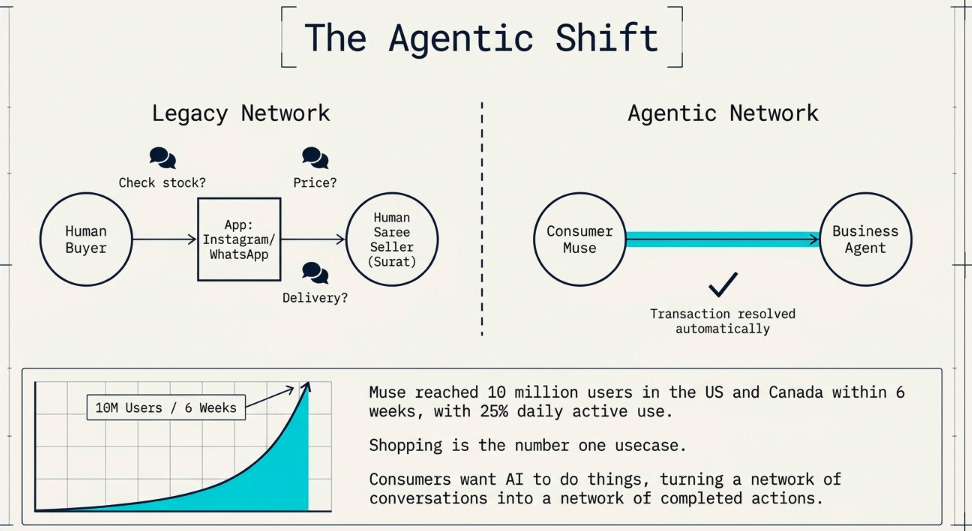
In September, we followed a woman selling sarees from her home in Surat. Her customers discovered her products on Instagram, then messaged her through WhatsApp about stock, prices and delivery. Meta connected the buyer and seller, but the work of completing the transaction remained with them. We argued that agents on both sides could take that work out of the conversation, turning Meta’s network of people and businesses into a network for getting things done.
Six weeks after launching Muse, Meta reported that more than 10 million people in the United States and Canada had set up its personal agent, with roughly a quarter using it daily. Shopping was its most popular use case. That is encouraging evidence that people want AI to accomplish things, not merely answer questions.
But the most consequential development of the quarter was not Muse’s adoption. It was Meta’s creation of a non-voting Class C share.
Asked about financing, CFO Susan Li offered a reassuring answer:
“We do not have any specific financing plans to announce at this time, but we thought it was prudent to establish the appropriate capital structure framework to ensure that we have access to a diverse pool of funding sources.”
The accompanying filing told a bigger story. Meta’s board began reviewing its capital structure in late 2025. By May 2026, management had presented three long-term financial forecasts, all contemplating the need to raise hundreds of billions of dollars over several years, potentially beginning as early as autumn 2026.
The statements are not contradictory. A company can anticipate needing capital without approving a particular financing. But the distinction matters. The call presented flexibility; the filing described the scale of the anticipated funding requirement.
In April, we argued that Meta’s increasingly profitable advertising business could finance its AI ambitions. In September, we explained how agents might create an entirely new commercial network. Q3 brought evidence that the product thesis could work. It also revealed that the cost of establishing that network, and who bears it, may matter more than we previously appreciated.
The Dividend Is Real. The Tax Is Growing.
Our April article, The AI Tax, proposed a straightforward test. If the average price per advertisement continued growing more than 10% through the second half of 2026 while capex stayed within the $145 billion guidance ceiling, the advertising dividend was outgrowing the AI tax.
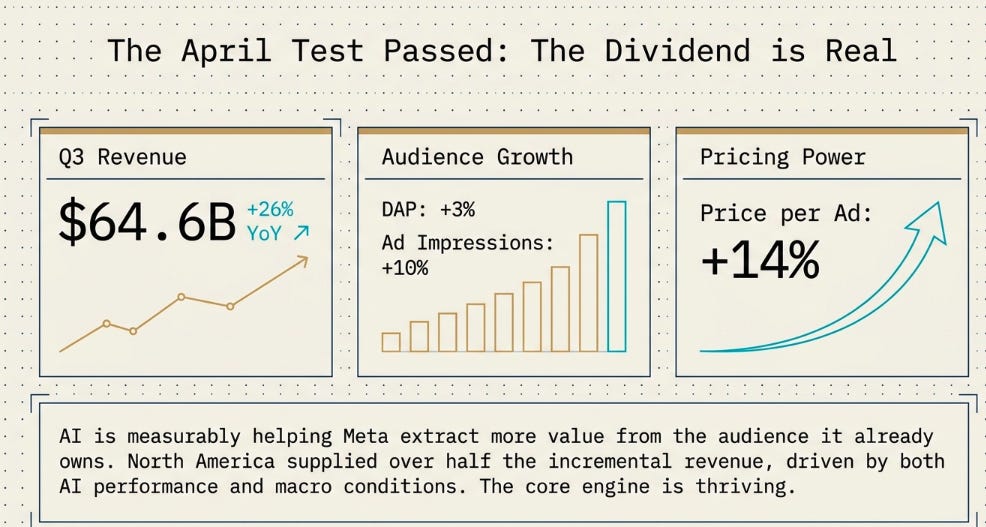
Q3 passed the first half of that test. Price per ad increased 14%, and management maintained its capex ceiling. Revenue grew 26% to $64.6 billion despite daily active people increasing only 3%. AI is helping Meta extract more value from the audience and advertising relationships it already owns.
But the composition of growth is changing. Ad impressions increased 10%, down from 19% in Q1, while price growth accelerated. North America supplied more than half of the incremental advertising revenue. Management attributed higher pricing to both better advertising performance and macroeconomic conditions, so the entire gain should not be credited to AI.
A business growing increasingly through price can remain exceptionally profitable. It simply has less room for error when its costs are accelerating.
And they are.
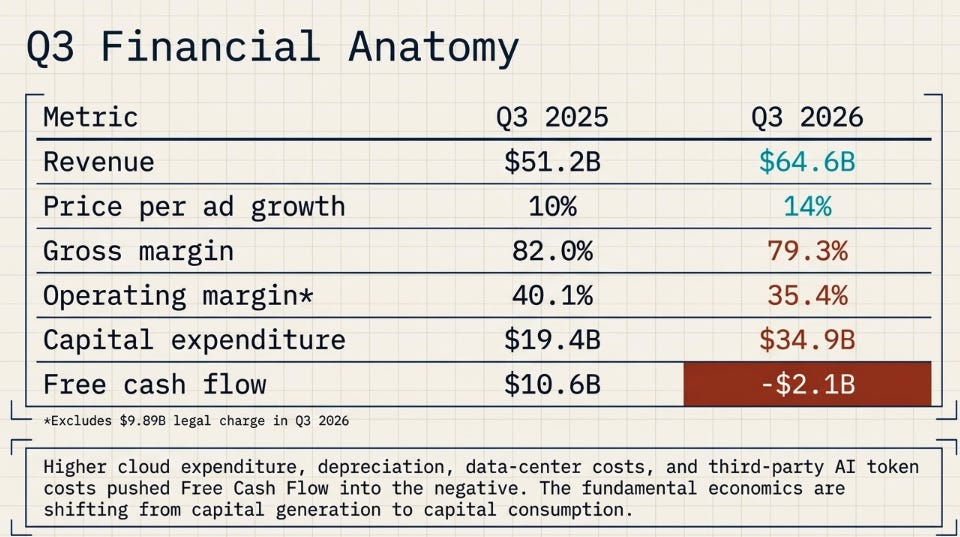
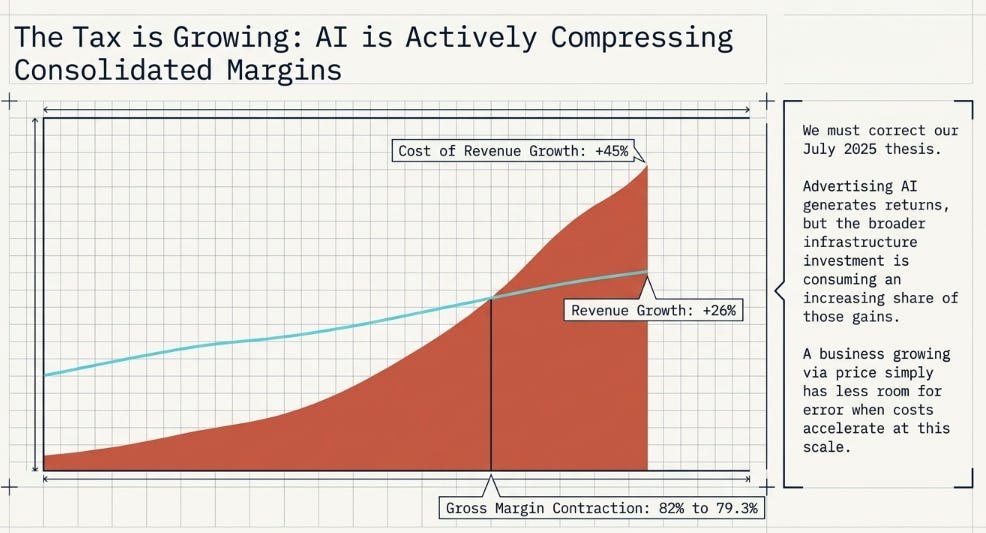
For two years, Meta’s gross margin hovered around 82%. In Q3 it fell to 79.3%, as cost of revenue grew 45%, almost twice as fast as sales. Even excluding the legal charge, operating income increased only about 11% against revenue growth of 26%.
Meta identified higher cloud expenditure, depreciation, data-center costs and third-party AI token costs. These expenses support multiple businesses, so the deterioration cannot be attributed entirely to Muse. But the underlying economics are changing.
We also need to correct something we wrote in July 2025. In The Infinity Machine Boots Up, we argued that AI spending was expanding margins rather than compressing them. That is no longer true at the consolidated level. Advertising AI continues to generate measurable returns, but Meta’s broader investment program is consuming an increasing share of those gains.
Our April test measured the dividend more carefully than the tax. Price per ad told us whether advertising AI was working. Capex guidance told us how much Meta intended to invest. Neither established what the new AI businesses would cost to operate, how much cash they would consume, or how the investment would ultimately be financed.
Those are now the more important questions.
A Network Has to Do More Than Attract Users
September’s argument was that the business agent, not just the consumer agent, could make Meta’s opportunity unusually valuable.
A personal agent can search for a saree and compare prices. But only the merchant can confirm inventory, accept payment and promise delivery. Better models cannot solve that problem without dependable access to the business.
On the Q3 call, Li described how Meta expects agentic commerce to evolve:
“Over the long run, this will move towards more permissioned, structured interactions, and that will include authenticated APIs, approved agent partnerships, or direct communications between a consumer’s personal agent and a business’s own agent.”
Meta has previewed an open Personal Agent Protocol with partners including Walmart, Stripe, Shopify and Sierra. This supports our September thesis. Rather than forcing agents to navigate websites as humans do, businesses could expose trusted capabilities that agents can use directly.
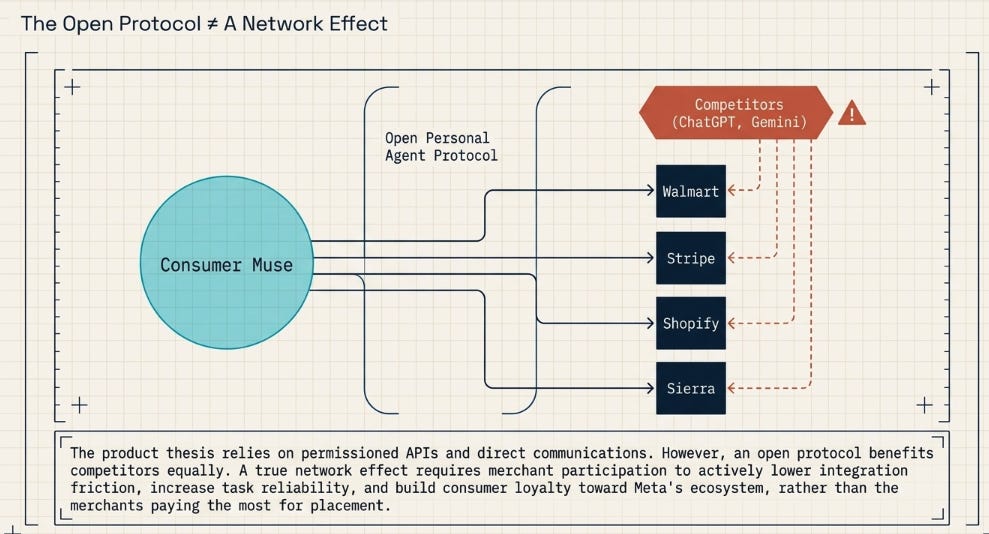
But an agent protocol is not a network effect.
That emerges only when another participating business makes the service more useful for existing consumers. More merchants should mean more tasks completed reliably. Better completion should attract more users, encouraging further merchant participation. Ideally, integrations also become cheaper as new merchants reuse capabilities developed for earlier participants.
The alternative is less attractive: Meta repeatedly negotiates, customizes and supports each integration, building a useful service without the self-reinforcing economics of its advertising franchise.
The counterparty evidence remains mixed. Amazon has blocked Muse from shopping on its site, while other businesses have restricted agent access. And an open protocol could benefit competitors equally. If merchants communicate with Muse, ChatGPT and Gemini through the same interface, the protocol makes agentic commerce more useful without guaranteeing that Meta captures the resulting value.
There is also a question of loyalty. Zuckerberg now describes an optional connection allowing Muse to improve personalization across Meta’s content and advertising systems. That changes the tension we identified in September. An agent shopping on a consumer’s behalf must earn the consumer’s trust that its recommendations reflect the consumer’s interests, rather than whichever merchant pays Meta the most.
Yet the most immediate uncertainty is cost.
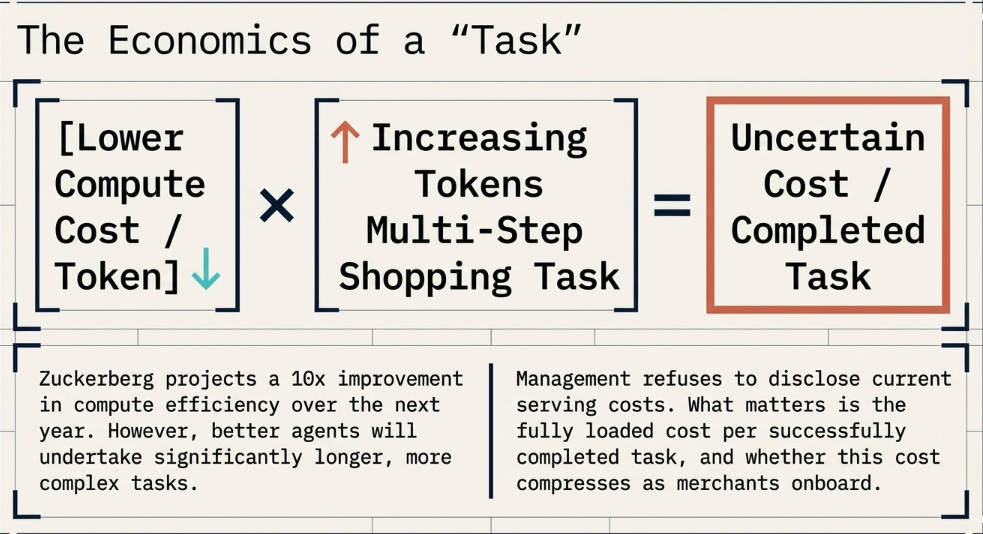
Zuckerberg expects Muse’s compute efficiency to improve more than tenfold over the next year. But better agents will also undertake longer, more complicated tasks. Lower cost per unit of intelligence does not necessarily mean lower cost per completed task if each task consumes more intelligence.
Management declined to disclose Muse’s current serving cost. What matters is the fully loaded cost per successfully completed task, and whether that cost declines as more businesses participate.
Ten million registrations demonstrate consumer interest. They do not prove that Meta is establishing another profitable network. We need evidence that merchant participation improves task reliability, reduces the cost of execution and creates value Meta can monetize.
Who Pays for the Network?
The Class C filing makes that uncertainty much more consequential.
Management was planning a massive financing program before Muse launched. The latest financial statements help explain why. Meta spent $34.9 billion on capex in Q3 and expects $135–145 billion for 2026. Long-term debt rose from $58.7 billion at the end of 2025 to $80.9 billion in September, while share repurchases fell to zero during the first nine months.
Meta still held $82.4 billion in cash and marketable securities. This is not a liquidity crisis. It is a strategic decision about financing an investment program that could exceed the internally generated cash available to support it.
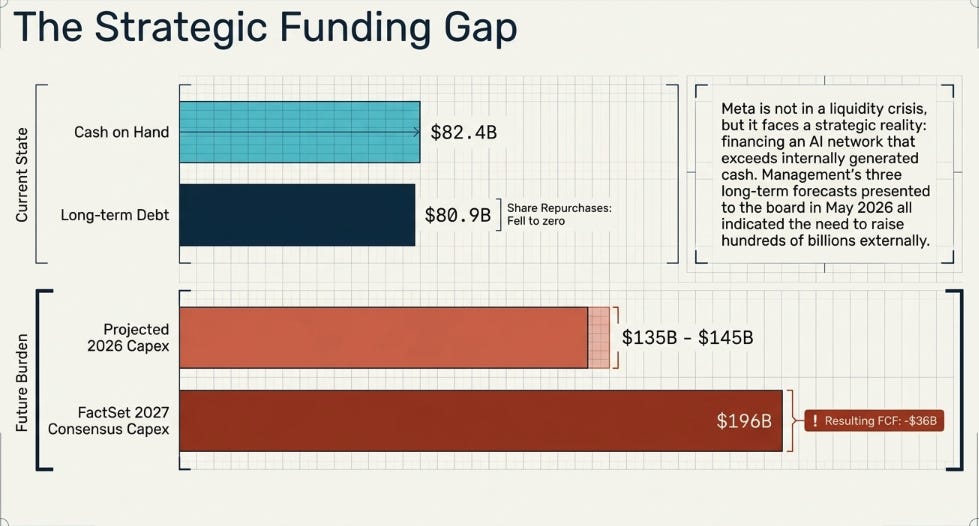
FactSet’s pre-results consensus anticipated approximately $196 billion in capex and negative free cash flow of $36 billion in 2027. That suggests substantial future funding requirements, although it does not establish how much equity Meta will need. The company can use existing cash, issue debt, bring in partners or finance individual projects separately.
The filing reveals why management wanted another option.
The board considered issuing more voting Class A shares, but Zuckerberg opposed significant financing that reduced his voting control. He owned about 13.4% of Meta’s economic interest but controlled approximately 61% of the votes. Advisers estimated that Meta could theoretically issue around $700 billion of voting equity before his voting power fell below half, under their illustrative assumptions.
He was not close to losing control. He wanted to preserve it.
Borrowing at the contemplated scale risked weakening Meta’s credit ratings. Non-voting Class C shares offered a way to raise capital without diluting Zuckerberg’s voting power.
There was also a personal dimension. The structure gives Zuckerberg greater flexibility to sell economic interests while retaining control. The independent committee negotiated meaningful restrictions on those sales but did not obtain an expiration date for his high-vote shares.
The historical comparison is revealing. Facebook proposed non-voting shares in 2016, primarily to allow Zuckerberg to sell shares without surrendering control, before abandoning the proposal in 2017 after litigation.
In 2016, Class C was principally about allowing the founder to sell while retaining control. In 2026, it is also about allowing the company to issue while retaining that control.
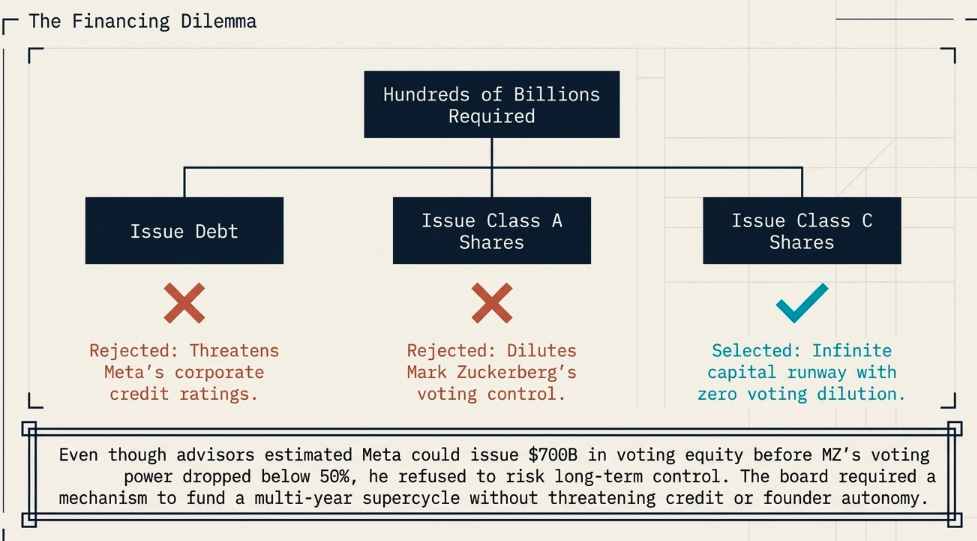
That connects directly to our January 2025 argument that founder control was one of Meta’s organizational advantages. It allowed Zuckerberg to make large, long-term investments without repeatedly seeking shareholder approval. The new structure extends that freedom to a potentially enormous financing cycle.
This does not automatically make the structure bad for shareholders. The initial one-for-one Class C distribution is economically similar to a stock split and does not dilute proportional ownership. Future primary issuance can dilute ownership, but may still create value if Meta earns attractive returns on the capital raised.
What matters is the price of the new securities and the returns produced by the investments they finance.
Class C makes the AI build more financeable. It also makes the cost of that financing a central variable in shareholder returns.
What Is Left for Shareholders?
At $697.52, the final regular-session close before Q3 results, Meta traded at roughly 21 times pre-results consensus 2027 earnings. That is not an obviously demanding valuation for its advertising franchise.
But reported earnings may become less useful if sustaining growth requires increasingly large capital commitments and additional equity issuance. We now need to model not just how much Meta earns, but how many shares those earnings are divided among.
Our revised scenarios incorporate future equity financing:
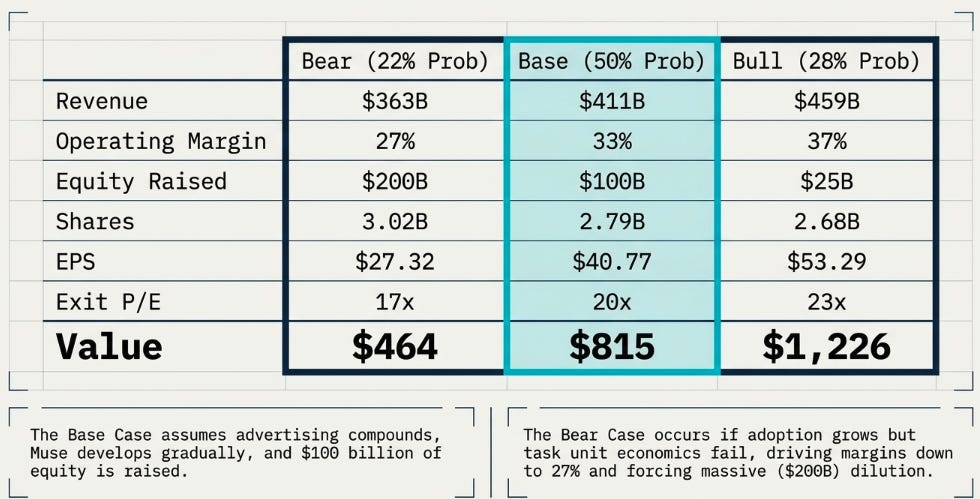
The bear case is not necessarily one where Muse fails to attract users. It is one where adoption grows without sufficiently attractive task economics, margins fall toward 27%, and a prolonged investment cycle requires substantial equity issuance.
The bull case needs more than successful adoption. Merchant participation must improve task completion and unit economics, while operating cash generation finances an increasing share of the investment. The base case lies between them: advertising continues compounding, Muse develops gradually, and Meta raises $100 billion of equity through 2029.
These assumptions remain provisional. Management’s forecasts contemplate hundreds of billions in external financing over several years, but we have not yet reconciled the full funding requirement across operating cash flow, debt, partnerships and equity. That financing bridge is now an essential part of the underwriting.
There is another problem. Our base case produces only about $12 billion of free cash flow in 2029, a yield of roughly 0.5% on the implied $2.3 trillion valuation. Paying 20 times earnings makes sense only if capex subsequently falls relative to revenue and more earnings convert into cash. If elevated spending persists, a multiple of 17–18 times is more defensible, bringing the base-case value close to today’s reference price.
Probability-weighted, our scenarios produce approximately $853 at the end of 2028, roughly 22% above $697.52, or about 10% annualized. That falls short of our 15% required return. At the same assumptions, an entry price around $625–630 would offer the expected return we require.
We would hold rather than add at the reference price. Meta may be building an extraordinarily valuable business, but the present valuation does not adequately compensate us for the uncertainty about capital requirements and shareholder returns.
January’s 2027 capex guidance will be the next major test. Spending above $235 billion would increase our concern, while a figure below $210 billion would ease it if the product rollout remains on course. We will also track advertising impressions, gross margins, Muse’s cost per completed task, merchant participation and the terms of any external financing.
The tests must remain separate. Better advertising proves the existing business is improving. More Muse users prove demand. More spending demonstrates commitment. Only improving task economics and attractive returns on the capital invested would establish that Meta is creating another valuable business for shareholders.
The Price of Making the Network Work
Return to the woman selling sarees in Surat.
Meta already owns the relationships connecting her with potential customers. If agents can reliably turn those conversations into completed transactions, Meta could create a network that becomes more useful as more consumers and businesses participate.
The opportunity is enormous. Q3 provides encouraging evidence that consumers want it, and management is building the business relationships needed to support it.
But the economics remain unproven, even as the financing commitments become more substantial. Zuckerberg’s willingness to invest ahead of visible returns has created extraordinary value before. The advertising franchise is evidence of that.
This time, however, the scale of investment may require outside shareholders to fund a meaningful part of the journey before the new business demonstrates its returns.
Meta may build the most valuable agent network in the world. The investment question is whether the value created for each existing shareholder will grow faster than the capital required to make that network work.
Disclaimer:
The content does not constitute any kind of investment or financial advice. Kindly reach out to your advisor for any investment-related advice. Please refer to the tab “Legal | Disclaimer” to read the complete disclaimer.