


Micron’s opportunity is to turn customer commitments into cash that shareholders keep before supply catches up.
TL; DR
Micron has converted scarcity into unusually strong forward visibility: strategic agreements now cover an estimated 35%+ of revenue through 2030, financial commitments reached $32 billion, and more than 75% of FY27 output is already committed. That improves planning without guaranteeing equivalent profit protection. Pasted markdown
Differentiation and near-term economics are not the same thing: HBM deepens customer dependence and brings Micron into co-design with NVIDIA, but conventional memory is currently enjoying even stronger scarcity margins. The key test is whether technical differentiation ultimately earns superior returns. Pasted markdown
The investment case now shifts from peak earnings to cash retention: Micron says it intends over time to return 100% of excess cash to shareholders. The cycle does not need to disappear for value creation to persist if exceptional cash generation is converted into sensible repurchases before supply catches up.

A customer signing a five-year memory agreement is making a judgment about more than memory prices. It is deciding that the cost of missing supply could exceed the savings from waiting for a better deal. For an AI infrastructure operator, that calculation includes processors, networking and power infrastructure whose productivity depends on having enough memory. Micron’s opportunity begins with that customer calculation; its investment case depends on what the company does with the resulting bargaining power.
In January, I argued that AI was making memory more strategically important and its most advanced forms harder to replace. In June, The Cycle Gets a Contract described Micron’s attempt to turn that importance into customer commitments before competition and new capacity caught up. Q4 advances both arguments but introduces a third: exceptional profits need not persist indefinitely if enough cash reaches shareholders while they last.
That is the position I would take after this quarter. Micron has bought greater visibility into future demand, and customers have accepted more obligations to secure supply. The task now is to convert that visibility into disciplined investment and capital returns. A longer shortage helps, but shareholder value ultimately depends on how much of its proceeds the company retains and how intelligently it uses them.
The Calendar and the Contract

Micron reported $54.23 billion of revenue, an 87% adjusted gross margin and $33.2 billion of adjusted free cash flow. The next-quarter revenue guide is $61.5 billion. On the surface, sequential growth falls from 31% to 13%; however, Q4 contained fourteen weeks and Q1 contains thirteen.
Revenue per week rose approximately 21.5% in Q4, and the Q1 guide implies another 22.1% increase. That is a materially stronger operating trajectory than the headline comparison suggests. It gives us evidence of continuing momentum, although one actual quarter and one forecast cannot establish a lasting growth rate. The more consequential evidence concerns what customers are committing to beyond the next report.
Strategic customer agreements increased from sixteen to twenty-six, covering an estimated over 35% of revenue through 2030. Financial commitments rose from $22 billion to $32 billion, predominantly deposit commitments; approximately $12.7 billion of customer deposits had been received by fiscal year-end. Management also disclosed approximately $150 billion of remaining performance obligations, calculated using committed volumes and minimum pricing for agreements with determined pricing frameworks.
The company describes why these agreements matter:
These multi-year take-or-pay agreements sharpen our long-term supply planning and enhance the durability and predictability of our strong financial performance. Further, they provide our customers supply assurance and deepen technology roadmap collaboration.
The final phrase connects the commercial change to January’s technical argument. Co-design can produce a qualified product that a customer is reluctant to replace; commitments make investment in that product easier to justify; successful manufacturing adds experience and improves delivery. If each generation strengthens the relationship, Micron acquires something more durable than an attractive spot price.
The boundaries matter because June’s language sometimes ran ahead of the disclosures. Financial commitments are not all collected cash, and a target for greater coverage is not existing protection. Today, three-quarters of agreement-covered revenue has a defined pricing framework, most such frameworks have floors and ceilings, and the remainder is periodically repriced. Separately, more than 75% of fiscal-2027 output is committed across agreement and non-agreement customers. That establishes substantial volume visibility without establishing equivalent profit protection.
The Price of Differentiation
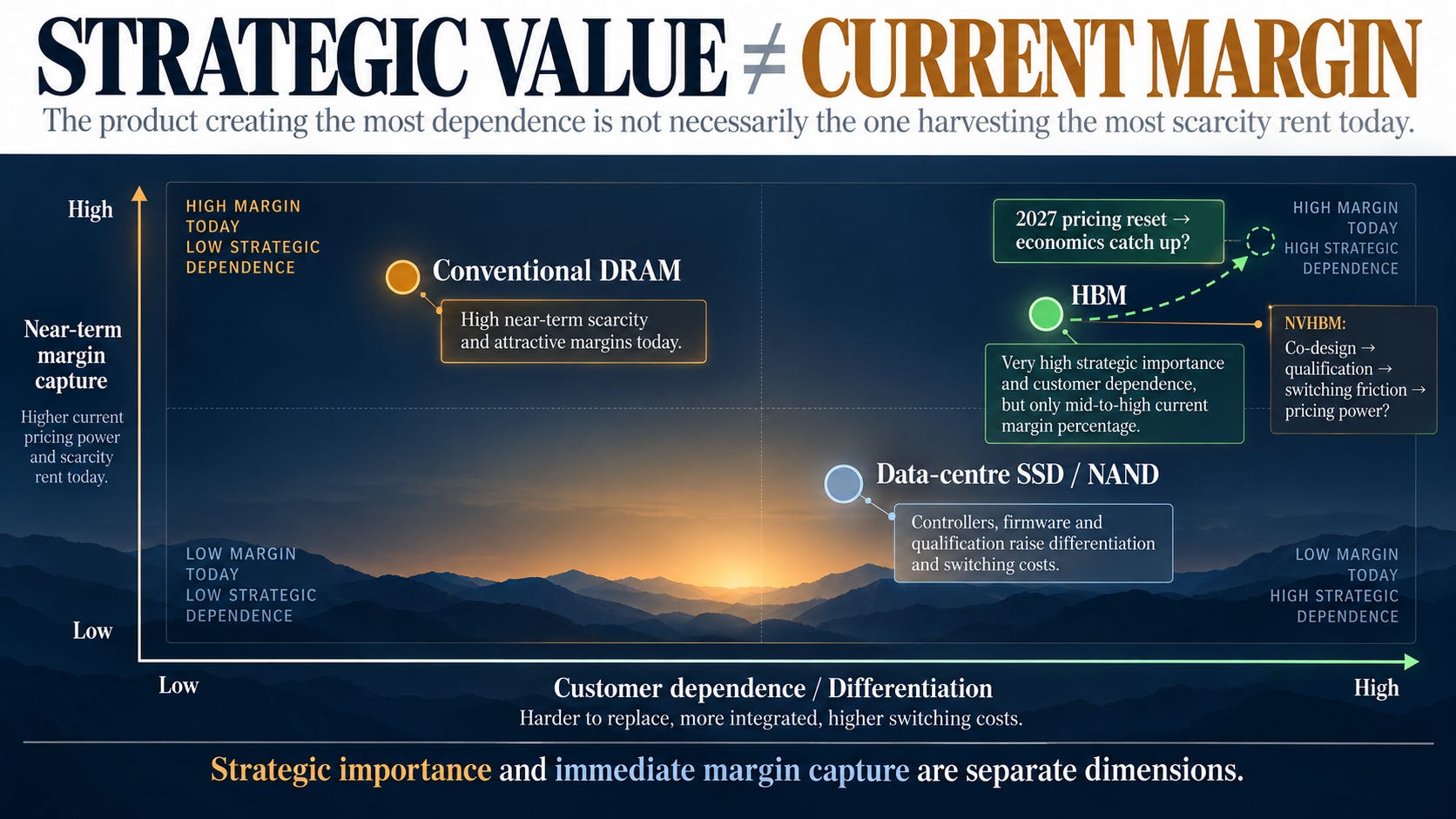
The strongest challenge to an uncomplicated AI story appears in the Cloud Memory business:
CMBU gross margins were 83%, flat sequentially, driven by higher pricing, offset by higher HBM mix.
More HBM diluted the segment’s gross-margin percentage relative to the alternative mix. Conventional memory was earning such exceptional scarcity margins that the more specialized product was less profitable on this measure. That distinction matters: the products that deepen customer dependence need not be the products extracting the greatest immediate benefit from a shortage.
Calendar-2027 HBM agreements include significant price increases intended to narrow that gap. Beyond repricing, Micron’s NVHBM work with NVIDIA places it inside the design of future computing platforms. Technology chief Scott DeBoer described that work on the analyst call:
We’ve been working with NVIDIA for over a year on HBM4E, what’s called NVHBM. We see substantial opportunity there for us in the co-design of that product with obviously a key customer to have this be a product that delivers substantial value beyond standard HBM4E.
The opportunity is real, but its economics must be negotiated. HBM4E’s base die uses a foundry process, unlike Micron’s in-house HBM4 approach, adding another participant with a claim on the product’s value. BNP Paribas analyst Karl Ackerman asked who captures the economics of customization; management expressed confidence in attractive returns without quantifying the division. The relevant test is whether pricing and manufacturing execution turn technical participation into profitable differentiation.
NAND complicates the commodity-versus-franchise distinction further. NAND accounted for most of the revenue surprise against our frozen expectations, but data-center SSDs represented more than two-thirds of NAND revenue. Controllers, firmware and qualification matter there too. Contract coverage and differentiation are separate dimensions of the business: conventional products can carry long commitments, while sophisticated products can retain pricing risk.
The Factory Is an Option
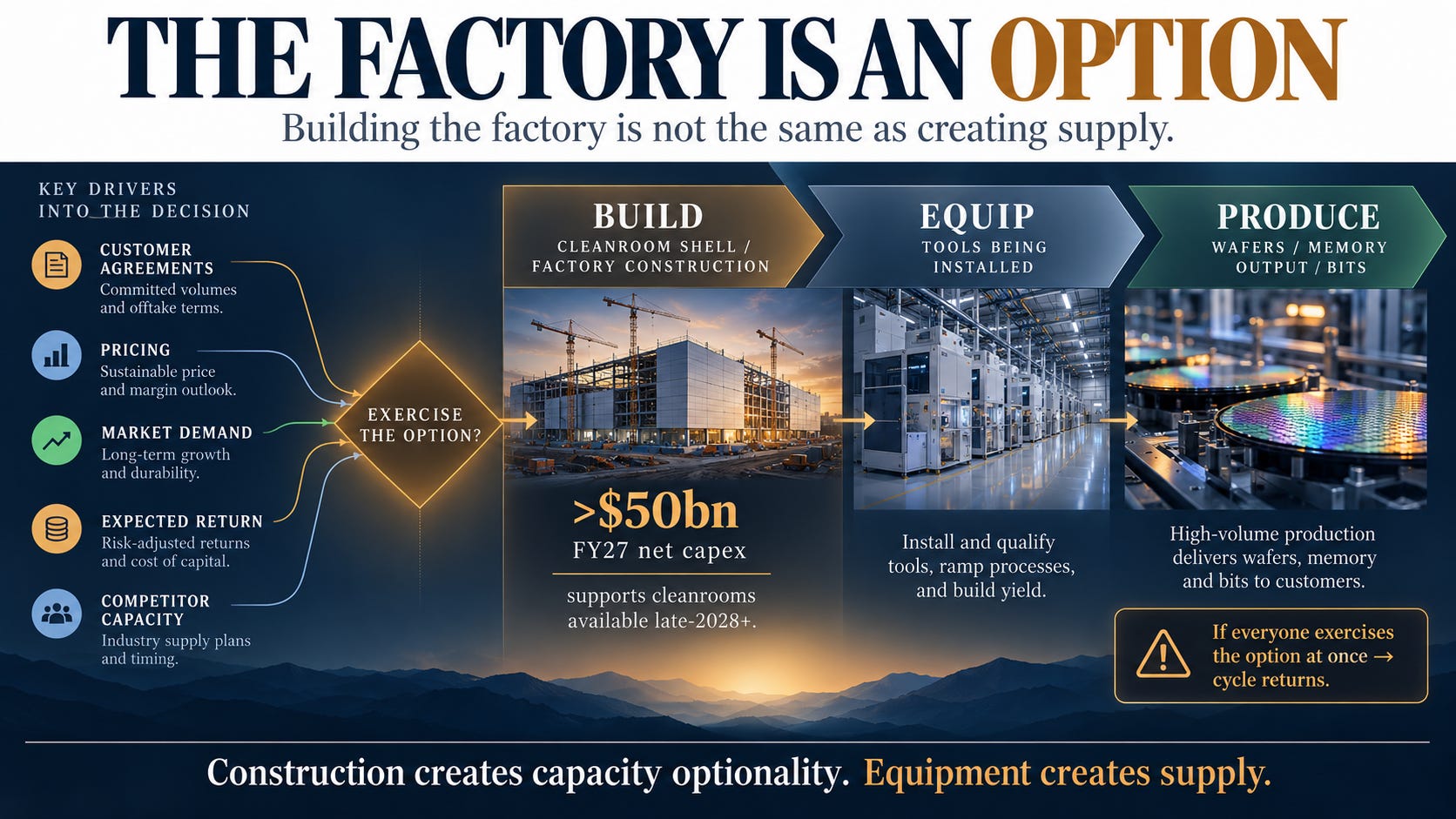
Customer commitments also make new capacity easier to finance. Micron’s spending outlook implies more than $50 billion of net capex in fiscal 2027, with much of the incremental construction supporting cleanrooms available in late 2028 and beyond. This extends June’s supply clock, but does not assign an expiration date to scarcity. Demand and the pace of equipment installation still determine what those buildings produce.
CFO Mark Murphy made that distinction when Wolfe Research’s Chris Caso asked about construction spending:
I think you made a very important point that the spend there doesn’t translate into bits, and that these fabs will be made. We put the equipment in the fabs and produce wafers when needed based on our view of the market. These SCAs are a good way for us to keep a pulse on the market and make sure that we get a return on that CapEx.
Construction creates an option to add supply; installing equipment exercises it. This gives Micron discretion, although buildings commit capital before production begins. Contracts could improve that discretion by connecting investment to customer obligations. They could also encourage several suppliers to expand simultaneously, which is why equipment decisions will eventually matter more than descriptions of construction as disciplined.
Meanwhile, capacity is not the only claimant on the profits. Management identified roughly $1 billion of additional Q1 costs from incentive compensation, startup and other items. Taiwan union representatives are separately seeking a permanent arrangement allocating 15% of operating profit to employee bonuses. The demand is not a settlement, and the company’s global compensation changes cannot simply be attributed to it; nevertheless, the dispute illustrates how exceptional profitability attracts competing claims from within the production system.
What Shareholders Keep

This brings us to the disclosure that changes the investment argument. Management intends to increase capital returns from December 9, and Murphy stated:
Over time, we expect to return 100% of our excess cash to shareholders.
The word “excess” carries the investment decision. Customer deposits have repayment conditions, factories require funding, and an authorization is not a completed repurchase. But if Micron produces substantial cash after those obligations, buying shares at prices that discount a severe earnings decline can improve the remaining shareholders’ economics even when profits subsequently normalize.
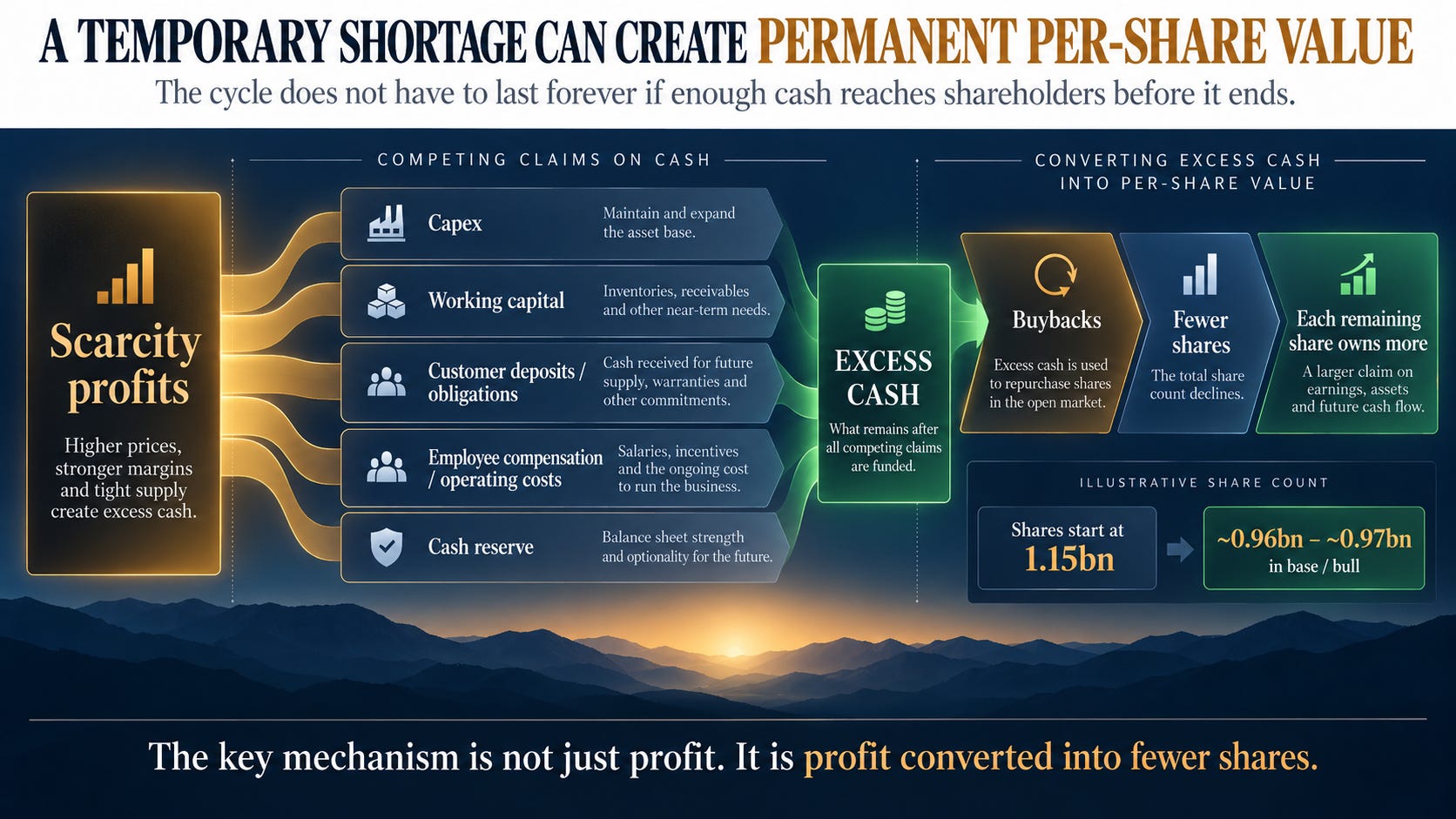
That is our investment argument: the shortage does not have to become permanent for some of its benefits to become permanent per share. It requires cash conversion and sensible repurchase prices. A valuation that ignores interim cash misses’ part of this opportunity; one that adds cash already spent on buybacks counts the same benefit twice.
The following fiscal-2029 scenarios therefore track cash and shares together. They are our assumptions, with returns measured from the September 30 pre-release close of $1,065.11 and revenue CAGR from fiscal-2026 actual revenue of $133.19 billion.
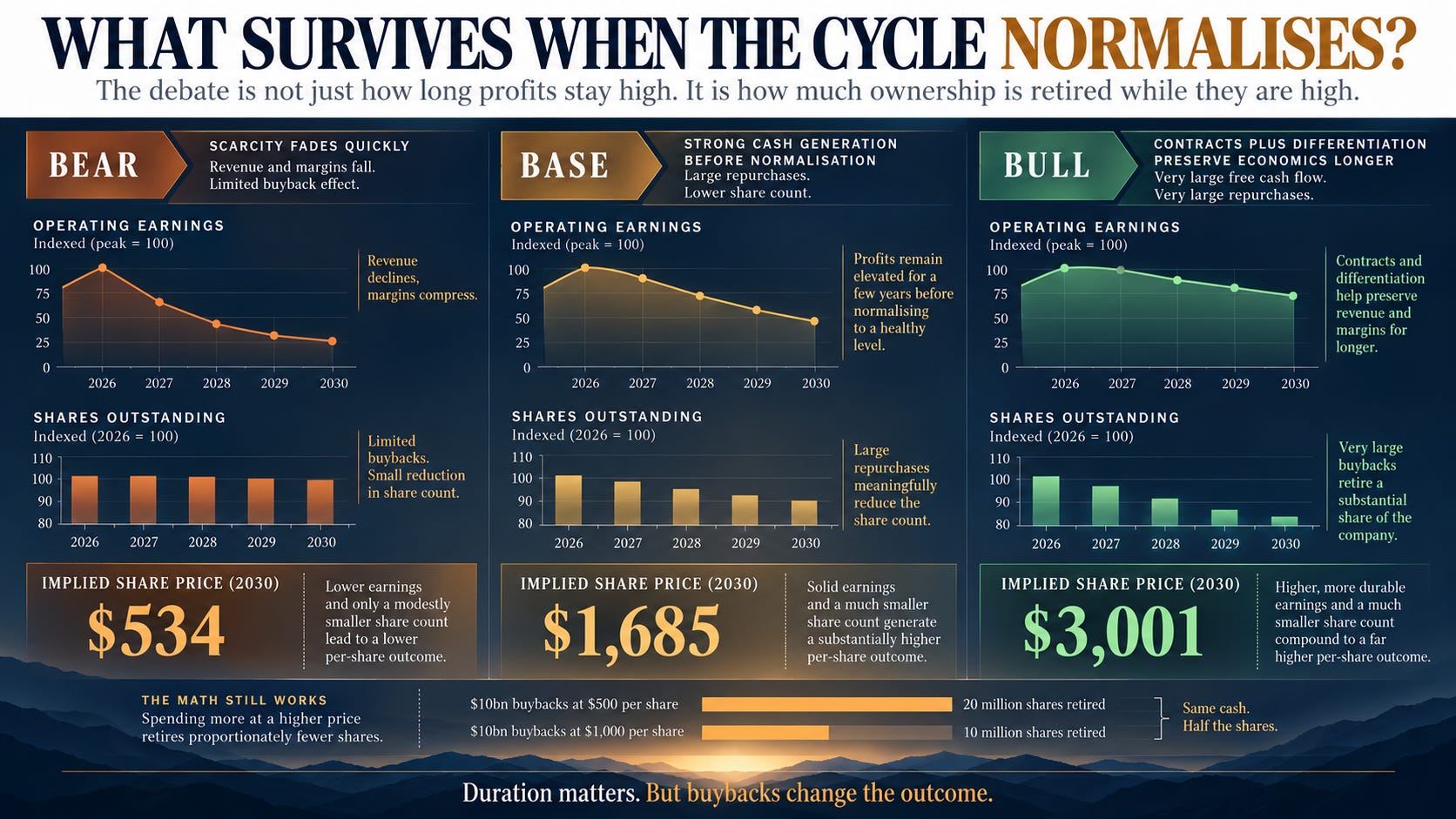
The bear assumes earnings settle at a substantially lower level; its multiple does not presume a rapid recovery from a temporary trough. The base assumes strong growth followed by margin normalization, while the bull requires differentiation and contracts to preserve unusually high profitability. A 65% operating margin makes even the base case demanding. The higher bull repurchase price also means that spending more retires proportionately fewer shares.
The cash bridge starts with $55.5 billion of net cash after reserving received customer deposits. Shares start at 1.15 billion; we assume a 17% tax rate, zero net interest, 30 million shares of cumulative dilution and $3 billion of dividends. Across bear/base/bull, three-year gross capex is $150/$185/$220 billion, depreciation is $63/$69/$72 billion, and net working-capital cash use is $0/$9/$21 billion. Repurchases reduce both cash and shares. Terminal cash reserves of $35/$50/$65 billion are excluded from value, and only remaining excess cash is added to capitalized operating earnings. Deposits and grants do not fund the modeled shareholder returns; dividends are excluded from displayed returns.
The Window

Our view has strengthened because the commitments are broader and the route from earnings to shareholder value is clearer. At the $1,065 reference price, I favor a measured position, with additions below $1,000 if the operating evidence remains intact. That stance depends on cash actually being generated and allocated well; it does not require us to declare the memory cycle abolished.
There are specific tests. Q2 gross-margin guidance above 86.25% would support management’s expected recovery after Q1. First-half free cash flow after gross capex reaching at least 70% of adjusted net income would support conversion through the investment increase. By the first-half results, I would want evidence of executed repurchases and a quantified capital-return framework, rather than another statement of intention. These are our underwriting hurdles, not additional company promises.
Contract concessions or repeated realized-price declines alongside rising supply would weaken the case more fundamentally. A modest quarterly margin miss would prompt investigation; persistent failure to translate commitments into post-investment cash would change the thesis. June showed that customers would sign for future supply. September makes the shareholder opportunity more concrete: Micron can use the interval of scarcity to strengthen both its customer relationships and each remaining share’s claim on the business. The contracts create the opportunity. Capital allocation will determine how much of it shareholders keep.
Disclaimer:
The content does not constitute any kind of investment or financial advice. Kindly reach out to your advisor for any investment-related advice. Please refer to the tab “Legal | Disclaimer” to read the complete disclaimer.