


TL; DR
Azure’s economics are improving at the operating level: Microsoft grew Azure 48% while extracting more output from installed GPUs and CPUs, showing that software engineering and workload allocation can raise revenue without proportionate new capacity.
The more interesting strategic position may sit above the infrastructure: Microsoft is increasingly routing tasks across different models and separating intelligence from identity, permissions and governance. If that works, it can benefit from competition among model providers rather than needing to own the best model itself.
But the capital burden is still rising faster than cash generation: free cash flow fell despite strong operating growth, capex is surging, and large future lease commitments remain. The thesis now depends on Microsoft turning routing, governance and consumption into durable earnings not simply carrying more AI traffic.
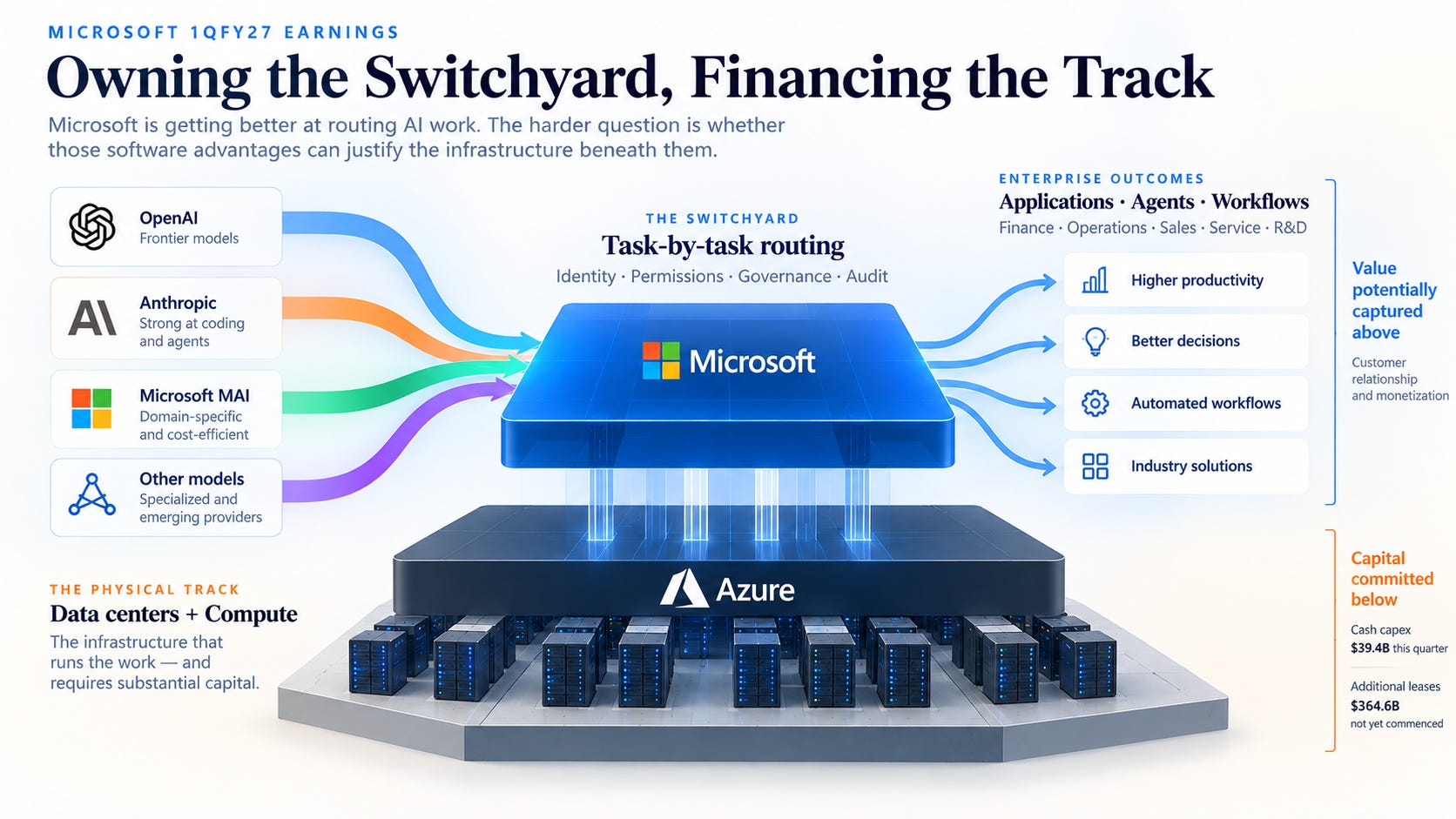
In July, after Satya Nadella told analysts to read 1873, I described Azure as the track, frontier-model companies as the cargo, and Microsoft’s identity and governance services as the right-of-way. At $386, roughly 19 times forward earnings, the attraction was that Microsoft did not need to own the AI operating system to earn an attractive return. It could carry the traffic while retaining the enterprise relationships that made the traffic valuable.
Three months later, Microsoft has demonstrated something more interesting than another increase in demand. It is extracting more revenue from infrastructure already installed, while increasingly choosing which model performs each task inside its products. But the shares closed at $531 before results, and the infrastructure business is consuming substantially more cash. The investment has therefore changed: the discount has largely disappeared, leaving a question about whether Microsoft’s emerging software advantages can justify the capital required underneath them.
A more productive railroad
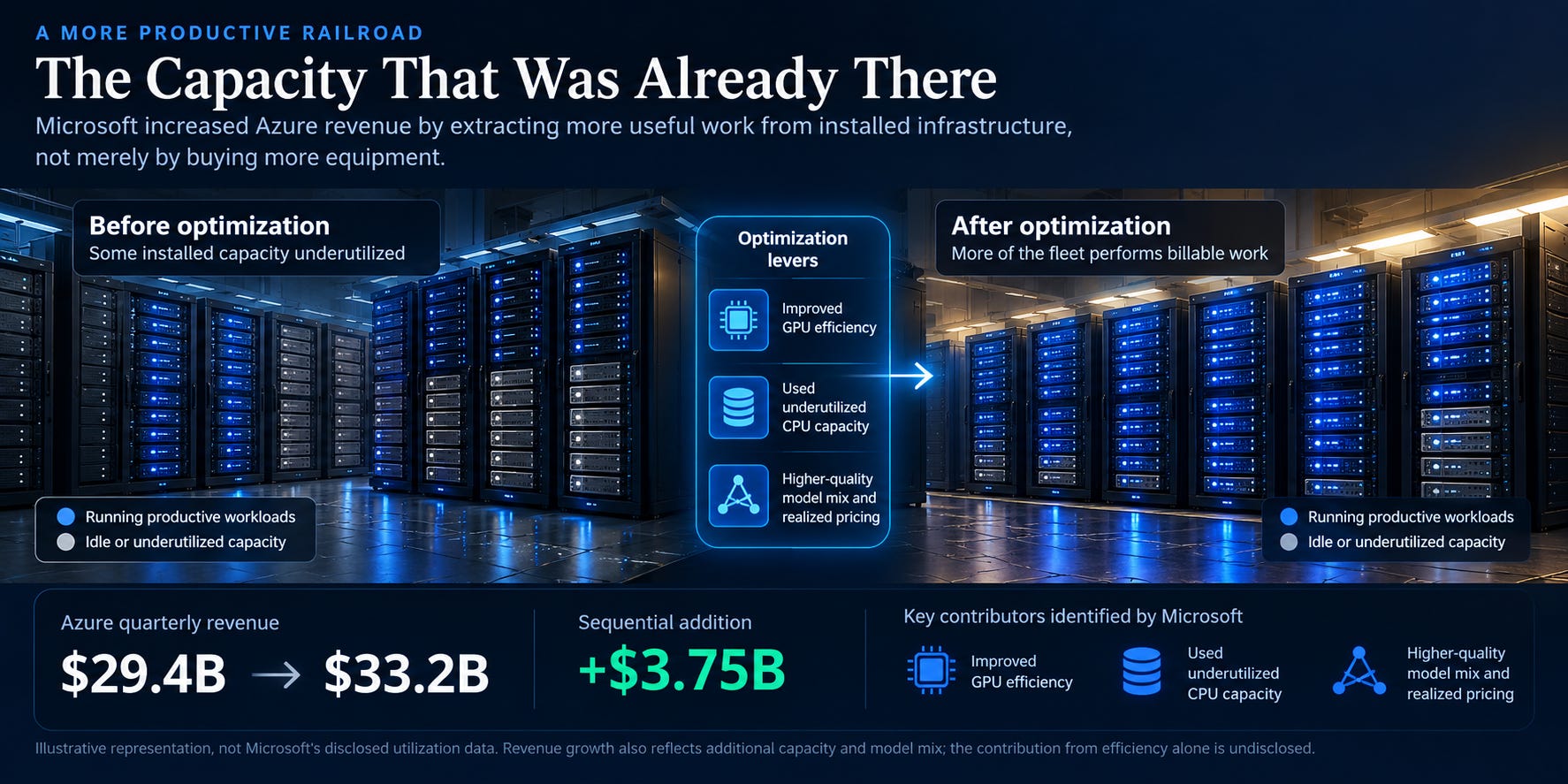
The headline results were excellent. Revenue rose 19% to $92.3 billion, operating income increased 21% to $45.9 billion, and Azure grew 48%, beating guidance of 44–45%. More revealingly, Azure’s $33.2 billion of revenue represented a record $3.75 billion sequential increase despite delays to third-party capacity deliveries. Its $10.8 billion year-over-year increase accounted for approximately three-quarters of Microsoft’s incremental revenue.
Amy Hood identified three contributors beyond simply installing more equipment. Engineers improved GPU efficiency, discovered and sold underutilized CPU capacity, and benefited from a mix of higher-quality models that generated better realized token pricing. Foundry revenue more than tripled, while Copilot workload throughput increased more than 50% sequentially. Microsoft did not merely buy additional capacity; it made the capacity it already owned more productive.
This matters because the weakest version of the Azure thesis resembles an equipment-financing business: buy expensive machines, rent them out, and repeat when they become obsolete. Engineering improvements offer a better mechanism. More useful work from installed infrastructure can increase revenue without a proportionate increase in investment, while allocating workloads across a large platform creates opportunities unavailable to a provider selling undifferentiated capacity.
That does not establish a permanent improvement in capital returns. Favorable model mix is not the same as repeatable engineering progress, and delayed hardware still needs to arrive. December’s 49–50% Azure growth guidance implies roughly $2.8–3.0 billion of sequential additions, less than September’s, and management is counting on further efficiencies to reach it. Nevertheless, July’s description of Azure as “stable, not gaining” was too pessimistic: the quarter supplied concrete evidence that operating the infrastructure well matters alongside owning it.
The switchyard
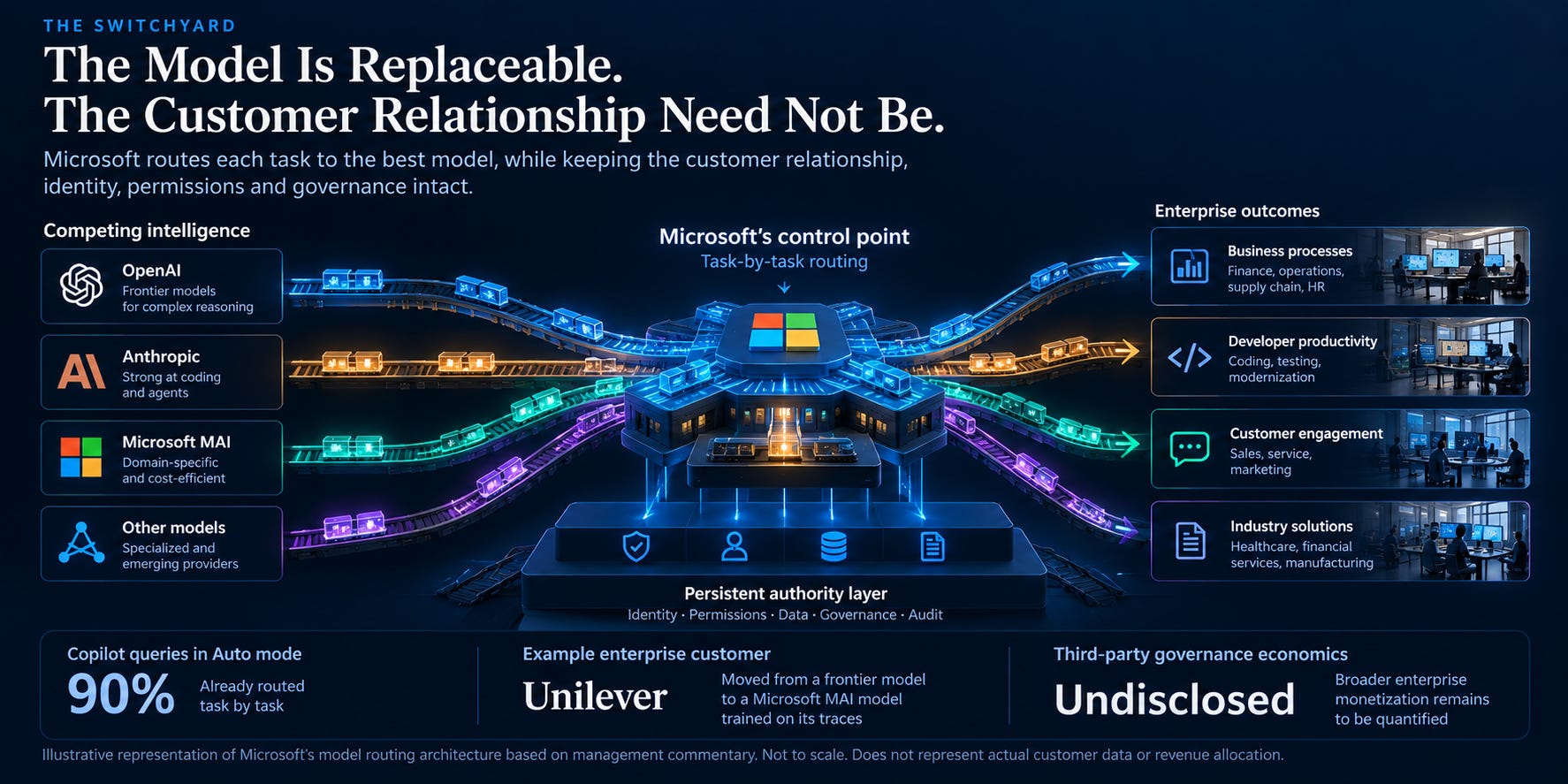
The more consequential development sits above the machines. Asked about the division of token value between frontier models and Microsoft’s own, Nadella described competition happening not between annual software contracts, but between individual tasks:
Which is you can now get frontier performance 45% faster, 75% cheaper. Who would want to not take that? If you are a coding agent user, you want, in fact, Anthropic and OpenAI, by the way, to compete for your workload, not like once a quarter, but for every task. That to me is what the value of these routers and Auto, Fusion stuff routing does, and we are very excited about it.
Microsoft says 90% of Copilot queries already run in auto mode, selecting the model task by task. It also described Unilever moving from a frontier model to a Microsoft MAI model trained on its traces. The strategic implication is straightforward: Microsoft can sell a useful outcome while changing the intelligence used to produce it. Competition among suppliers potentially improves the product, lowers its delivery cost and reduces dependence on any single model company.
This is the switchyard: the layer that determines which model performs the work. The evidence today is strongest inside Microsoft’s own products, not across every enterprise AI workload. Even there, however, the distinction matters. A model provider must repeatedly justify its place in the workflow; the company controlling the customer relationship and the routing decision can benefit when several suppliers compete successfully.
There is a useful tension here. Azure benefited this quarter from higher realized token prices, while model routing promises cheaper intelligence. Those need not be contradictory strategies for a company selling both infrastructure and finished products. Microsoft can potentially benefit from scarce capacity today and lower delivery costs inside its applications tomorrow. Its long-term interest is not necessarily an expensive token, but a valuable customer relationship through which it can sell useful work.
Governance is the second control point. Nadella described Microsoft’s approach as separating “intelligence from authority,” with identity, permissions, monitoring and containment enforced outside the model. A company might welcome a better model tomorrow without wanting to rebuild who can access its records, approve a payment or act on its behalf. Microsoft’s established identity, security and workplace services give it a plausible route to providing that continuity.
The activity is substantial: Agent 365’s registry passed 50 million agents, and Purview audited 7.6 billion agent actions. But activity is not yet an independently demonstrated governance business. Microsoft Execution Containers are free and open source; Codex supports them, while further integrations have been announced. Adoption does not oblige customers to buy Agent 365, and Microsoft has not disclosed paid third-party governance economics. The opportunity is to monetize the surrounding management system, not to collect a proprietary toll on an open format.
From seats to work
The reason these control points matter becomes clearer when considering who currently buys the capacity. Microsoft disclosed $10 billion of quarterly revenue from commercial arrangements with OpenAI, including revenue sharing, equivalent to 10.8% of company revenue. That is not all Azure hosting revenue, but it establishes meaningful concentration. Nadella’s answer to a question about enterprise demand explained why he wants a different balance:
But like everything else, the enterprise stuff is not like a quarter-over-quarter. It is a decade-long thing, and that is what I have been waiting for, as opposed to four customers who buy a lot of capacity from you, and you can show a few quarters of growth, and that is not a business as far as I am concerned. So I want the breadth.
Breadth is not simply a preference for smaller customers. A frontier-model company principally needs enormous quantities of compute; an ordinary enterprise also needs applications, organizational context, permissions, security and integration. Microsoft can potentially earn across several layers of that workload, while becoming more embedded in how the customer operates. Routing and governance are therefore not distractions from Azure: they could help turn capacity demand into a more durable enterprise relationship. Nadella outlined the accompanying business-model change in his prepared remarks:
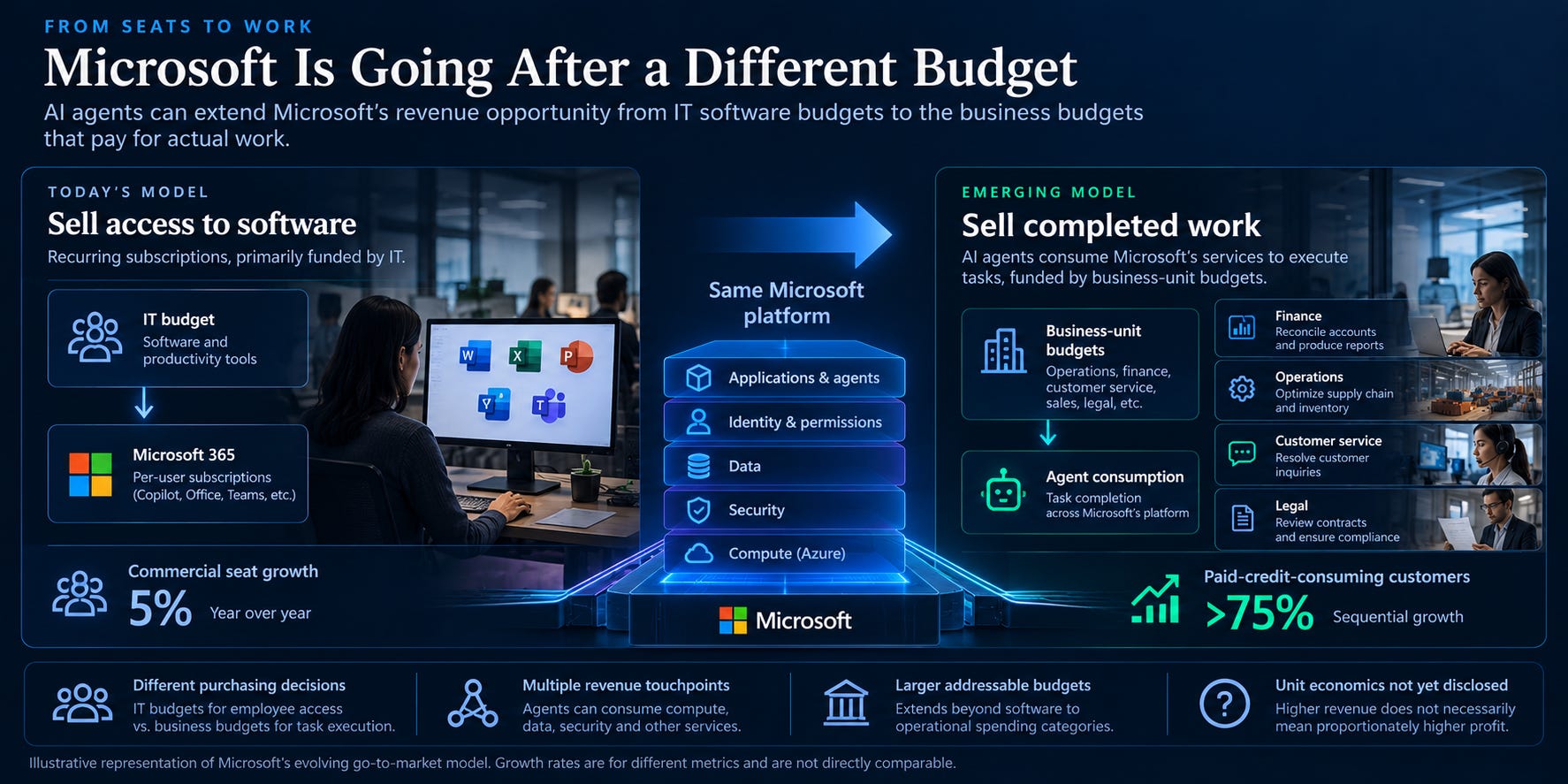
Our business model is expanding from per-seat subscriptions to include consumption, expanding our TAM and ARPU. The subscription brings increasingly capable everyday intelligence to every user. Typically, IT funds this, consolidating frontier advances for everyone across the organization. As agents take on higher-value work, consumption opens up business-funded demand, with spending tied directly to the value these agents deliver.
The important shift is the budget being addressed. Selling another subscription competes for an IT allocation; completing valuable work potentially competes against the cost of doing that work. Subscriptions provide the installed base and everyday access, while consumption allows spending to expand with useful activity rather than employee count alone. As deployment grows, common permissions and organizational context could make the platform more useful, supporting further deployment.
The quarter showed progress, not completion. Copilot daily users increased nearly 50% sequentially, and customers consuming paid credits grew more than 75%, while normalized Microsoft 365 Commercial Cloud revenue rose 19% in constant currency. However, Microsoft 365 commercial seat growth slowed to 5%, Hood acknowledged weaker execution in E3 and standalone products, and Microsoft did not update the paid Copilot seat count. Consumption monetization in core Microsoft 365 will also develop more slowly than in GitHub. These disclosures support growing usage and revenue per seat; they do not yet establish that Copilot has become the operating system for work.
Nor has enterprise diversification been demonstrated conclusively. Commercial remaining performance obligations were $677 billion, almost unchanged from June’s $678 billion, and Microsoft did not update comparable growth excluding OpenAI. That missing measure cannot be scored as a failed threshold, but it leaves July’s breadth test unresolved. The distinction is important: the switchyard thesis has become more credible without yet becoming a separately measurable profit stream.
Financing the track
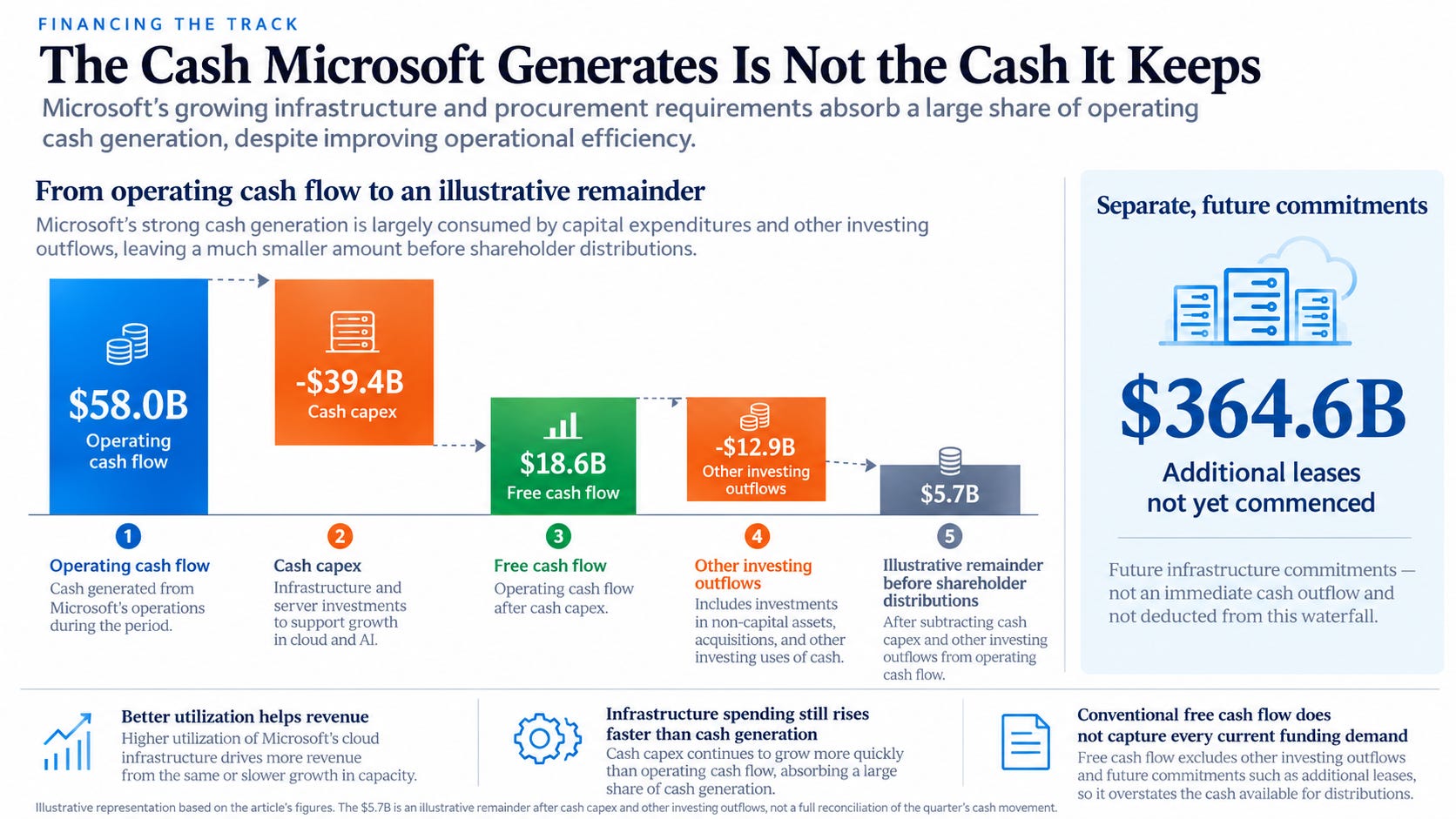
The income statement makes this transition look easier than the cash-flow statement does. Operating margin reached 49.8%, and operating cash flow increased 29% to $58 billion. Yet cash additions to property and equipment more than doubled to $39.4 billion, taking free cash flow down from $25.7 billion to $18.6 billion. Better utilization is helping the business grow; it has not stopped the infrastructure bill from growing faster than cash generation.
leases went into shorter-lived assets, principally CPUs and GPUs. Next quarter’s capex is expected to exceed $50 billion, while $364.6 billion of additional leases have yet to commence. This is not solely a one-time construction programme followed by decades of inexpensive operation. A substantial portion of the equipment must eventually be refreshed.
Procurement arrangements add another funding requirement. Server-component-related receivables reached $35.7 billion, and Microsoft disclosed $12.6 billion of restricted investments under a supplier agreement. After $12.9 billion of other investing outflows, partly associated with procurement, reported free cash flow left $5.7 billion before $10.2 billion of shareholder distributions. Those figures are not a complete cash reconciliation, and supplier advances are not necessarily permanent costs. They do show why conventional free cash flow does not capture every current demand on Microsoft’s funding. Asked about financing, Hood said:
We are lucky. We have a lot of flexibility in terms of our capacity to raise financing. I have talked about this before. There is a form of financing called leasing, and we have been using that one as a vehicle. We are fortunate to have access in the debt markets, given where our ratings are, and we have not yet, I would say, tapped that.
Access to debt is an option, not evidence of financial distress or a commitment to borrow. Nevertheless, the economic burden is real: Microsoft generally retains the assets, their utilization risk and their replacement requirements. That is the tension running through the quarter. Software can make each machine more productive and each enterprise relationship more valuable, but it must generate enough additional earnings to justify a much larger physical capital base.
What the price buys
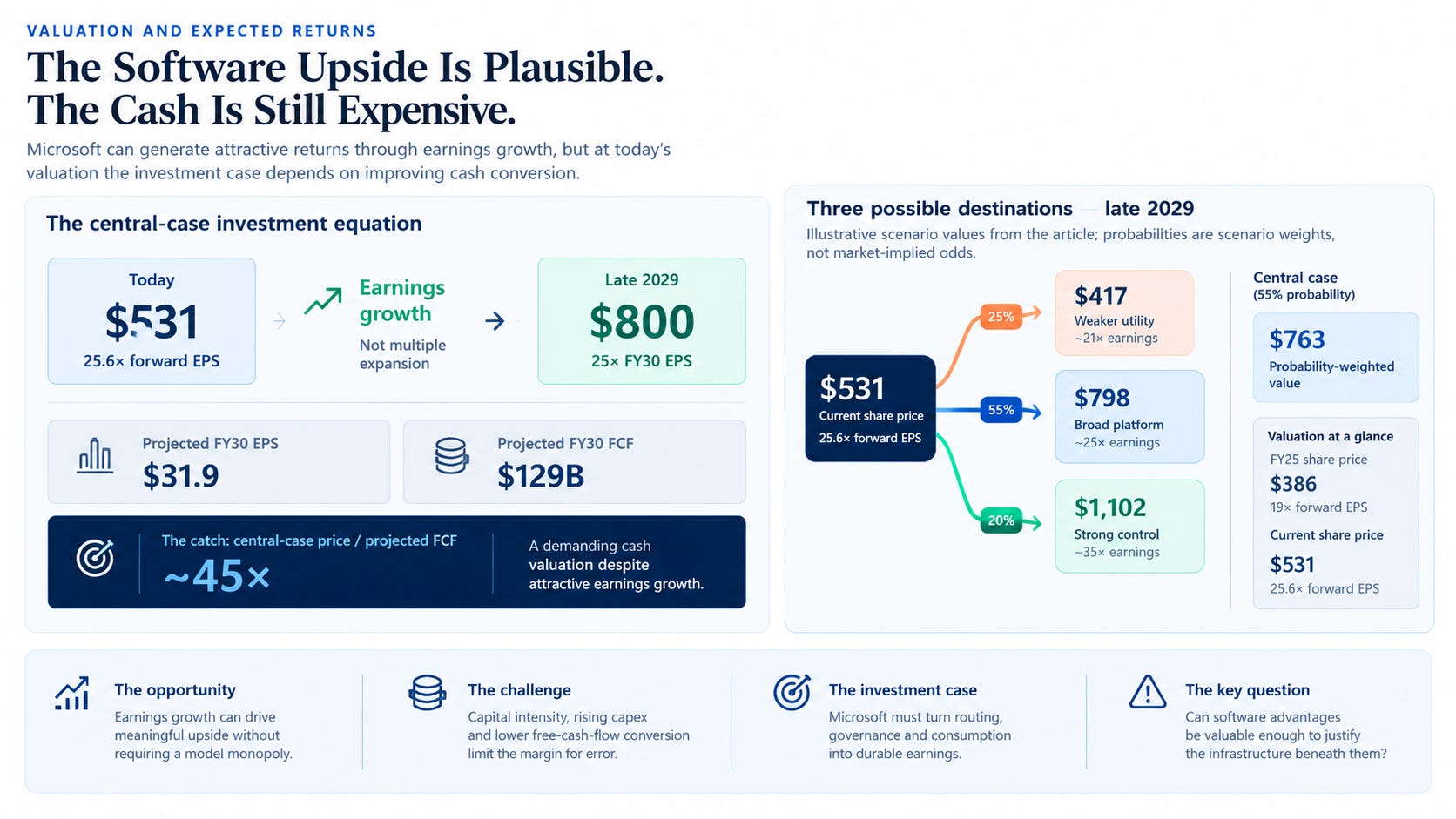
At $531, Microsoft traded at approximately 25.6 times next-twelve-month earnings, versus roughly 19 times in July. The easy re-rating argument has therefore largely played out. The remaining opportunity depends principally on earnings growth, supported by the installed enterprise franchise and improving infrastructure economics, rather than requiring a newly proven monopoly over agents.
My central scenario starts with approximately $396 billion of fiscal 2027 revenue. Azure growth moderates to 36%, 28% and 22% over the following three years, while Microsoft 365 Cloud grows 17%, 16% and 15%. That produces roughly $630 billion of fiscal 2030 revenue and, at a 46.5% operating margin, approximately $31.9 of earnings per share. Its fiscal 2029 revenue of about $548 billion remains below consensus of approximately $575 billion.
Applying 25 times fiscal 2030 earnings gives a late-2029 value near $800, roughly 50% above $531, or about 14.5% annualized over three years before dividends. A capacity-led outcome, with approximately $23 of earnings at 20 times, yields about $460; a stronger enterprise-platform outcome, with $38 at 29 times, supports about $1,100. Weighting the capacity, central and stronger-platform outcomes at 20%, 60% and 20% gives approximately $790; these are investment judgments, not measured probabilities.
Cash conversion is the qualification that matters most. Assuming operating cash flow reaches 55.5% of revenue and cash capex falls to 35%, the central case produces approximately $129 billion of fiscal 2030 free cash flow. The $800 valuation represents roughly 45 times that cash flow, not 38 times. There is attractive prospective earnings growth here, but not a cheap cash-generating utility.
The next evidence should determine which business Microsoft is building: repeatable Azure efficiency, broader demand beyond OpenAI, consumption revenue that contributes profit, and enterprises paying to govern rival agents. A slower Azure growth rate alone would not invalidate the thesis, just as more registered agents alone would not validate it. The central question is whether Microsoft retains more economic value as the amount of work passing through its system grows.
The quarter strengthened the case for that outcome. Microsoft is demonstrating that it can operate the railroad better, and its routing capabilities suggest it can influence which intelligence delivers the work. The investment no longer rests on buying overlooked infrastructure cheaply. It rests on earnings compounding through a broad enterprise platform, with a valuable governance business providing additional upside rather than an indispensable assumption.
Disclaimer:
The content does not constitute any kind of investment or financial advice. Kindly reach out to your advisor for any investment-related advice. Please refer to the tab “Legal | Disclaimer” to read the complete disclaimer.