


TL; DR
Microsoft’s AI distribution is working, but product leadership remains unresolved. Copilot seats, Agent 365 registrations and GitHub revenue are rising rapidly, even as the most important agentic products continue to emerge outside Microsoft.
The investment thesis has shifted from owning the AI operating system to controlling the right-of-way. Azure provides the track; model companies provide the cargo; Agent 365, Entra and Purview could become the governance layer every enterprise agent must pass through.
At 19× forward earnings, the stock appears priced for the utility outcome. The upside depends on whether Microsoft can govern third-party agents at scale and turn enterprise distribution into an exclusive ecosystem chokepoint.
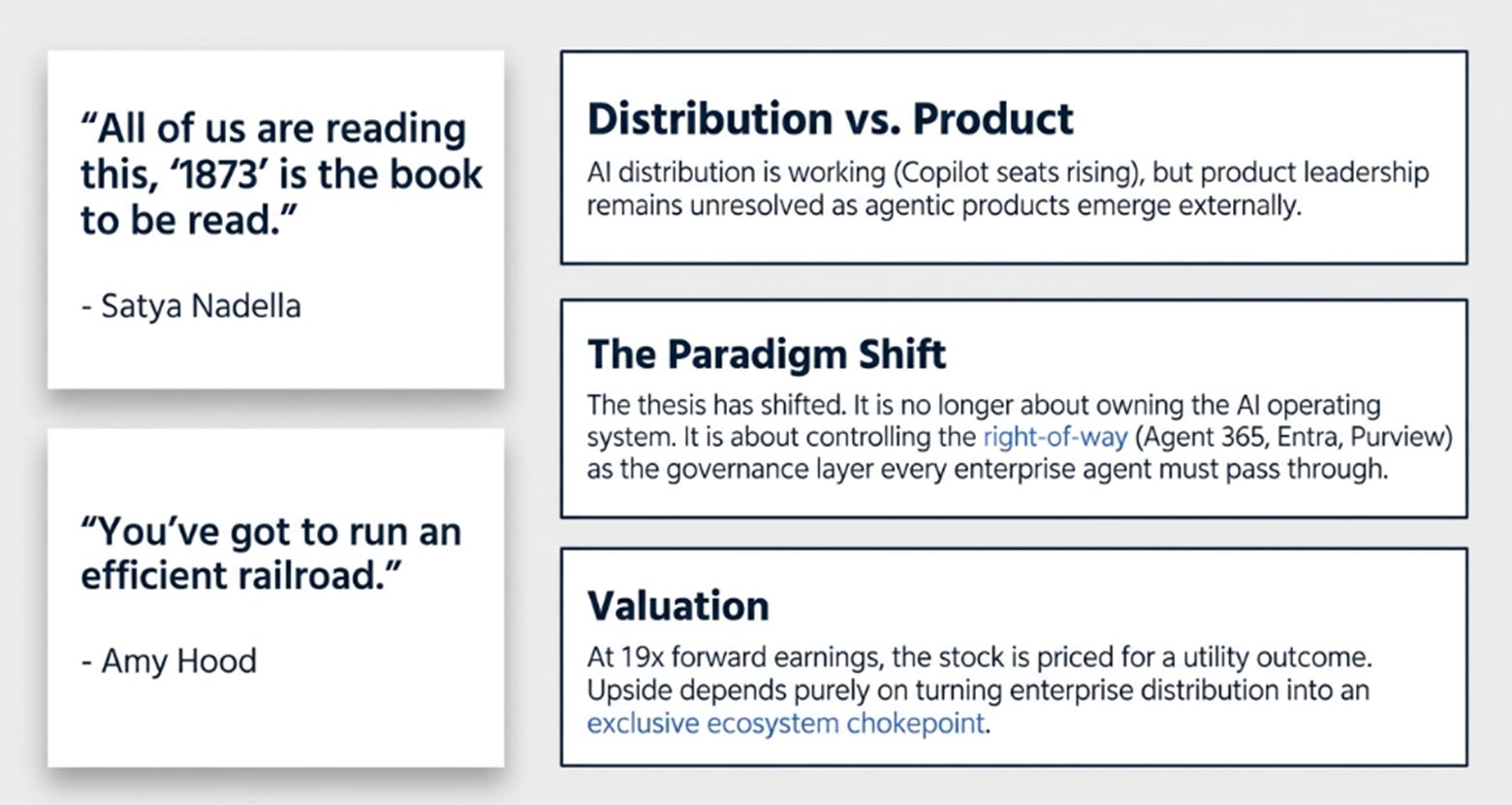
Satya Nadella, on the Q4 earnings call, responding to a question about competitive dynamics:
All of us are reading this, “1873” is the book to be read.
Amy Hood, moments later:
You’ve got to run an efficient railroad.
Three months ago, I ended the Q3 essay with a line I meant as a commitment: “The next four quarters will tell us which one it is”, whether Microsoft owns the AI operating system or operates as middleware beneath it. This is quarter one. I owe the reader a score.
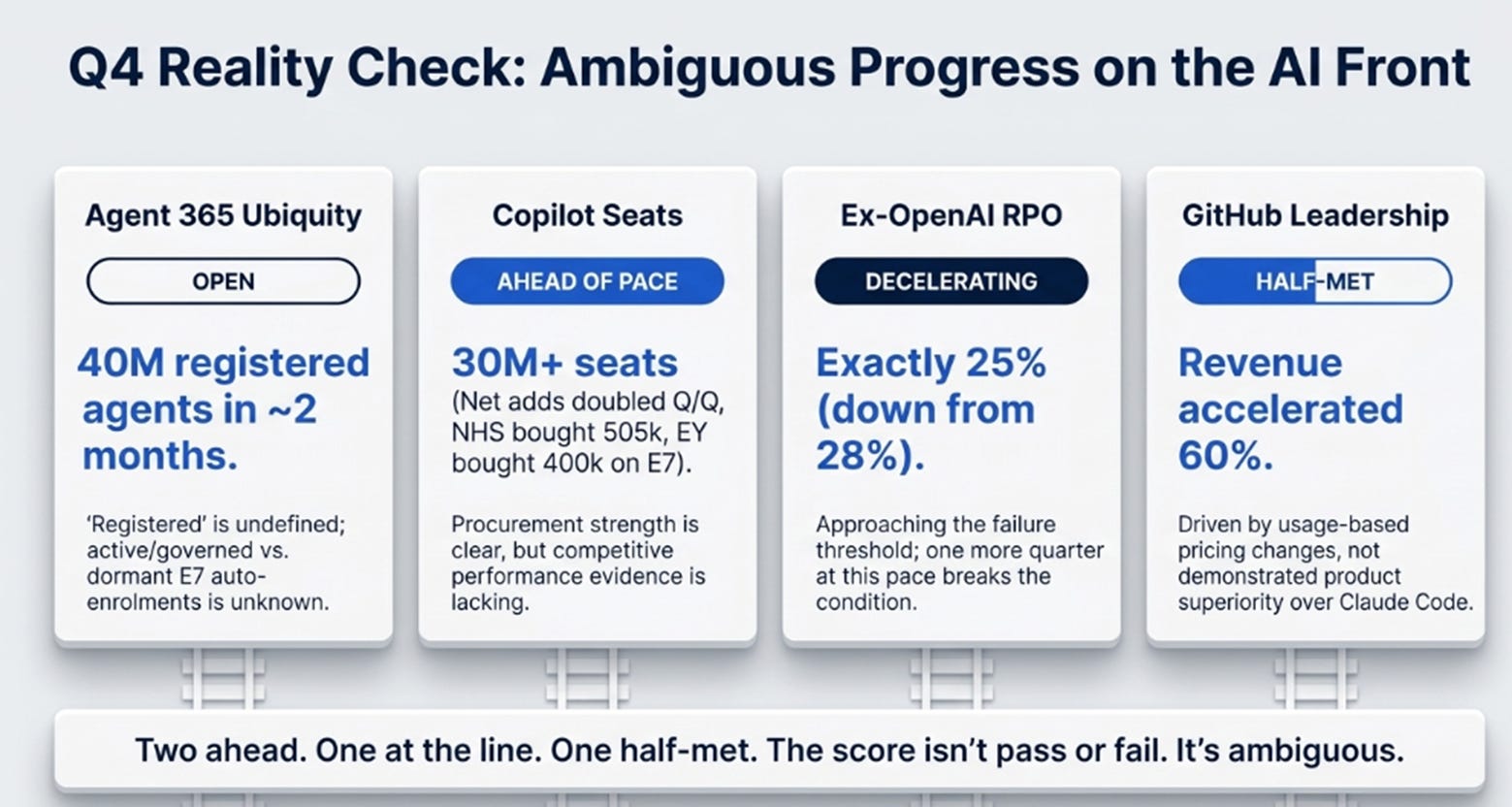
Agent 365 ubiquity. Forty million agents registered across tens of thousands of companies in roughly two months. Fast. But “registered” is undefined, a registered agent could be active and governed, or auto enrolled through an E7 bundle and sitting dormant. We don’t know how many enterprise agents run outside the control plane. This is adoption. Ubiquity is a different test. Open.
Copilot to 50 million seats. Went from 15 million to 20 million to 30 million-plus, with net adds more than doubling quarter over quarter. NHS England bought 505,000 seats. EY bought 400,000 on the new E7 SKU. Ahead of pace. But a seat procured by a CIO is not a seat chosen by a user when Claude, ChatGPT and Copilot are all available. And a seat chosen by a user is not a company that competes better because it deployed the product. We have evidence at the procurement level. We lack evidence at the competitive-performance level.
Ex-OpenAI RPO above 25%. Printed at exactly 25%. Down from 28%. Decelerating toward the threshold I set in January. One more quarter and this condition fails.
GitHub product leadership. Revenue accelerated 60%, on a billing-model change to usage-based pricing, not demonstrated product superiority over Claude Code. The franchise monetises better while the product contest remains unresolved. Half-met.
Two conditions ahead of pace. One at the line. One half-met. The score isn’t pass or fail. It’s ambiguous. And the ambiguity is the honest finding.
What Microsoft Saw and What It Missed
This is the hardest paragraph I’ve had to write in this series.
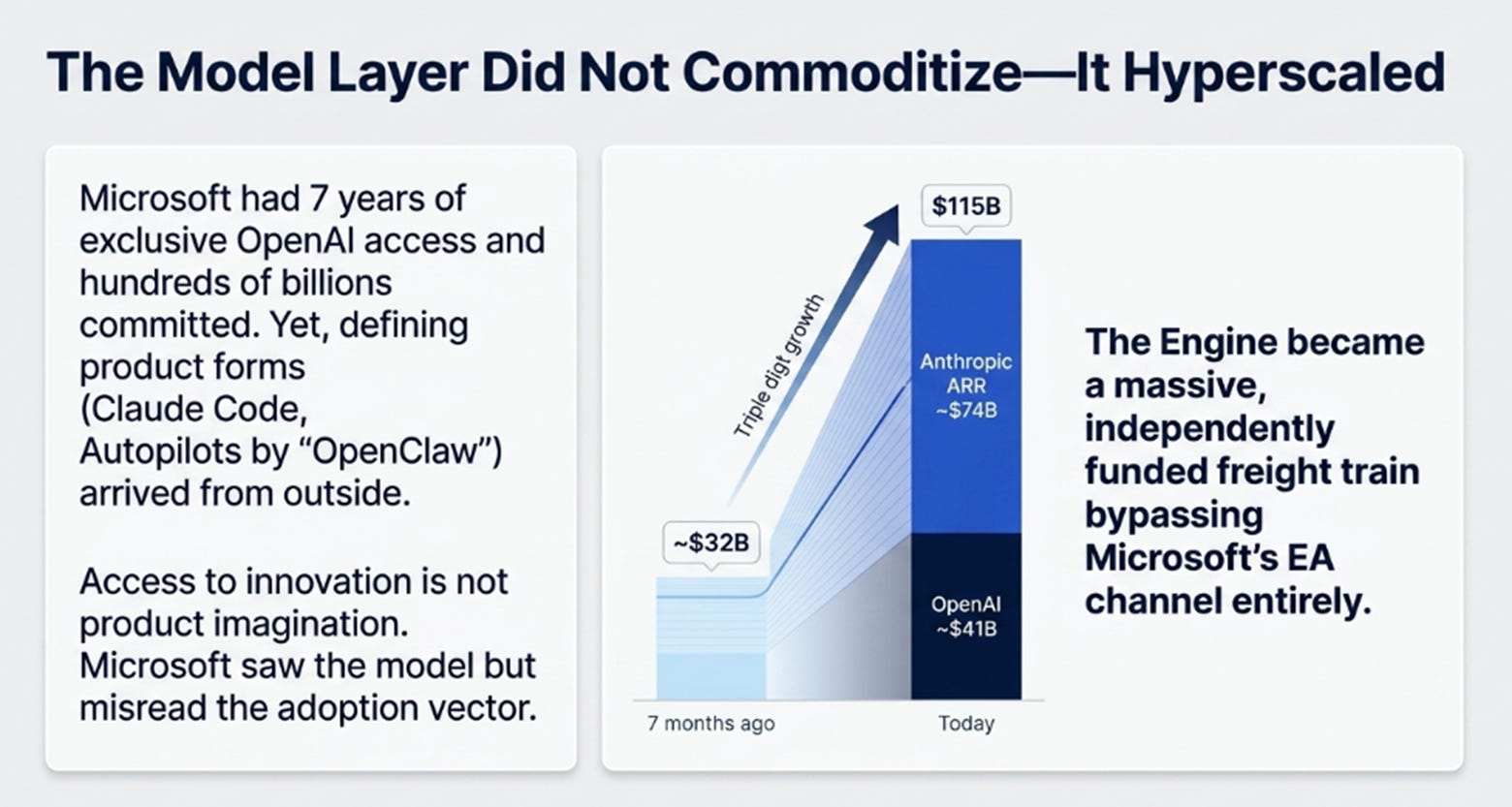
Microsoft had exclusive access to OpenAI from 2019. Seven years of the closest possible seat to the frontier. Hundreds of billions committed. And the defining product forms of the AI era appeared somewhere else. ChatGPT established the conversational interface. Cursor and Claude Code pushed coding from autocomplete to autonomous work. Anthropic built Cowork, the agentic tool for knowledge workers. Microsoft’s answer was to import Anthropic’s technology into Microsoft 365 and call it Copilot Cowork.
This quarter added a second data point. The flagship autopilots, autonomous, long-running agents with full enterprise compliance, ship “powered by OpenClaw.” That’s consecutive quarters where the defining agentic capability arrives from outside. Nadella’s own language has migrated from “chat” to “Copilot” to “autopilots” to “super app,” each rename conceding that the previous assumption about how AI would meet users was wrong.
Access to innovation is not product imagination. Microsoft saw the model. It misread the adoption vector.
Meanwhile, the model layer I had expected to commoditise did the opposite. Anthropic’s ARR is tracking at roughly $74 billion. OpenAI at $41 billion. Combined: $115 billion, growing at triple-digit rates. Seven months ago the combined figure was around $32 billion. In my October essay I described the Engine layer, AI models, as “rapidly commoditizing” and positioned it as a shrinking input to the Cockpit’s governance premium. That was wrong. The Engine didn’t compress into irrelevance. It became a massive, independently funded freight train, consuming hyperscaler infrastructure at unprecedented rates and building its own enterprise distribution that bypasses Microsoft’s EA channel entirely. Developers adopted Claude Code and ChatGPT, enterprises followed, and procurement caught up afterward.
That is the user-cycle pattern the Q3 essay warned about. It’s running faster than I expected.
The Enterprise Anesthetic
Copilot at 30 million seats is extraordinary distribution. The engagement data, satisfaction scores doubling over three quarters, weekly usage on par with Outlook and Teams, deployment-to-high-usage falling from months to days, is genuinely strong. I am not dismissing it.
But enterprise distribution can protect revenue while concealing product decay. And there is a meaningful gap between deployment and competitive advantage.
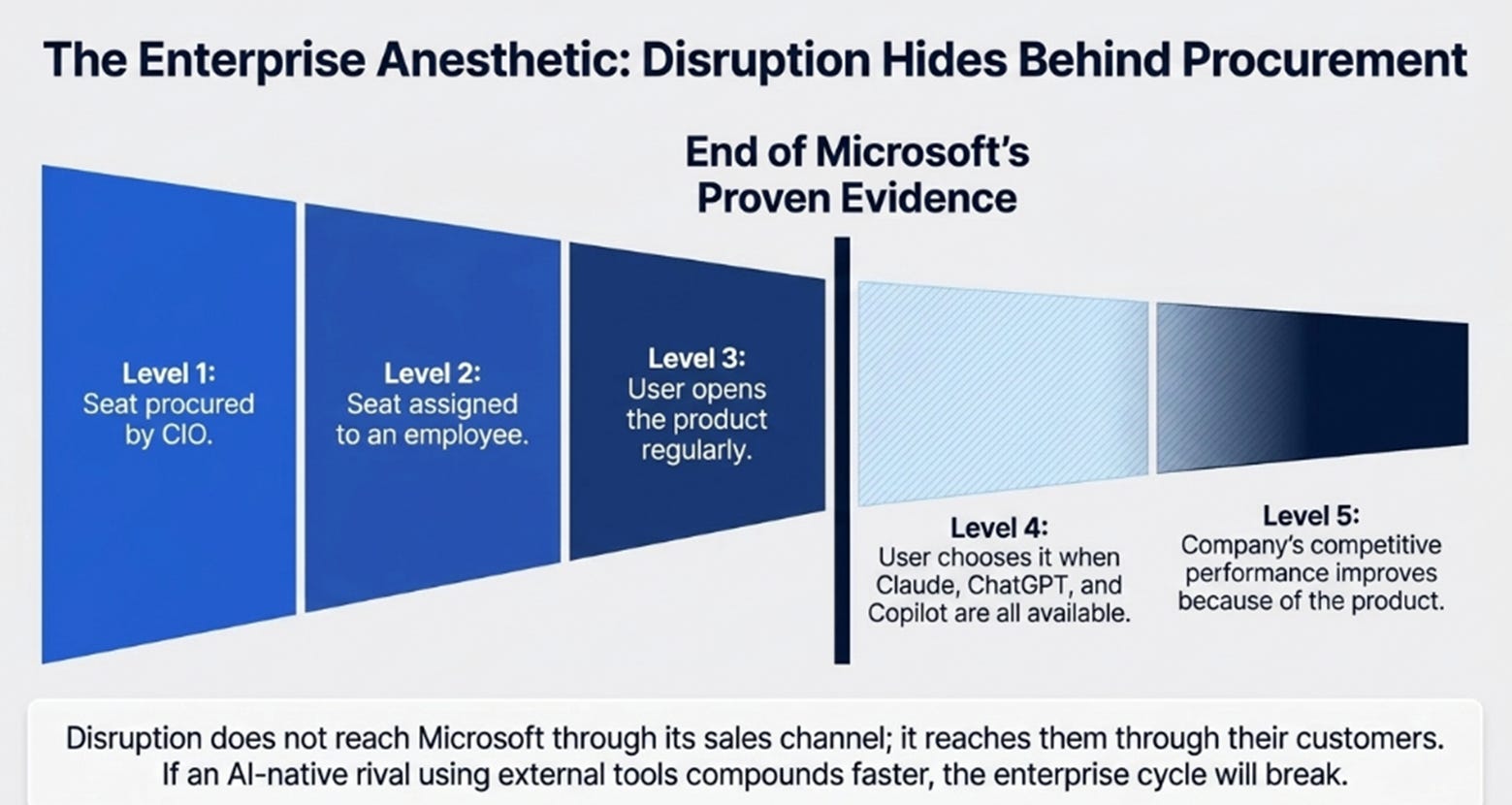
There are five levels of AI adoption:
A seat procured by a CIO. A seat assigned to an employee. A user who opens the product regularly. A user who chooses it when Claude, ChatGPT and Copilot are all available. A company whose competitive performance improves because it deployed the product.
Microsoft has strong evidence at levels one through three. What we still lack, from Microsoft, from the sell side, from anyone, is evidence at level five. Did the customer actually compete better?
That matters because disruption doesn’t reach Microsoft through its sales channel. It reaches Microsoft through its customers.
AWS didn’t defeat Microsoft by persuading CIOs that EC2 was architecturally superior to Windows Server. Developers and startups adopted AWS, moved faster, and changed competitive expectations. Then enterprise CIOs adopted cloud because the companies built on cloud were beating the ones that weren’t. The sequence was: better developer tool, faster product cycles, stronger customer outcomes, competitive pressure on incumbents, CIO adoption.
AI could follow the same path. A bank doesn’t switch from Copilot to Claude because a developer survey says Claude is better. It switches when another bank approves loans faster, ships software with fewer engineers, resolves complaints more cheaply. Unilever doesn’t abandon the Microsoft bundle because a power user mocks Copilot on Twitter. It reconsiders when a rival using AI-native tools compounds faster across every function.
The AI-native firms don’t need to defeat Microsoft’s salesforce directly. They need to help Microsoft’s customers’ competitors win.
Distribution buys time. Customer competition sets the deadline.
1873
In 1873, the railroad boom collapsed. The Northern Pacific Railway’s failure triggered a six-year depression. The industry had overbuilt, too many parallel routes, too much leverage, too many operators competing for the same freight. The railroads that survived were not the ones with the most track. They were the ones with the best routes, the most efficient operations, and the least debt. Vanderbilt. Hill. Huntington. They bought the wreckage at pennies and earned toll-road returns for a century.
The CEO of the company running the largest infrastructure build in technology history told investors to read this book. The CFO told them to run an efficient railroad.
This is not casual commentary.
Management is privately modelling a shakeout scenario and positioning Microsoft as the survivor. The evidence is specific: self-funded capex with no equity issuance (Alphabet raised $49.6 billion in stock in June; Microsoft did not); margin stability with FY2027 operating margins guided down less than a point; capex flexibility, with Hood, for the first time, explicitly telling analysts that two-thirds of spend is short-lived GPUs and CPUs that can be slowed if demand softens. And right-of-way: if your agent needs to access enterprise data, it authenticates through Microsoft.
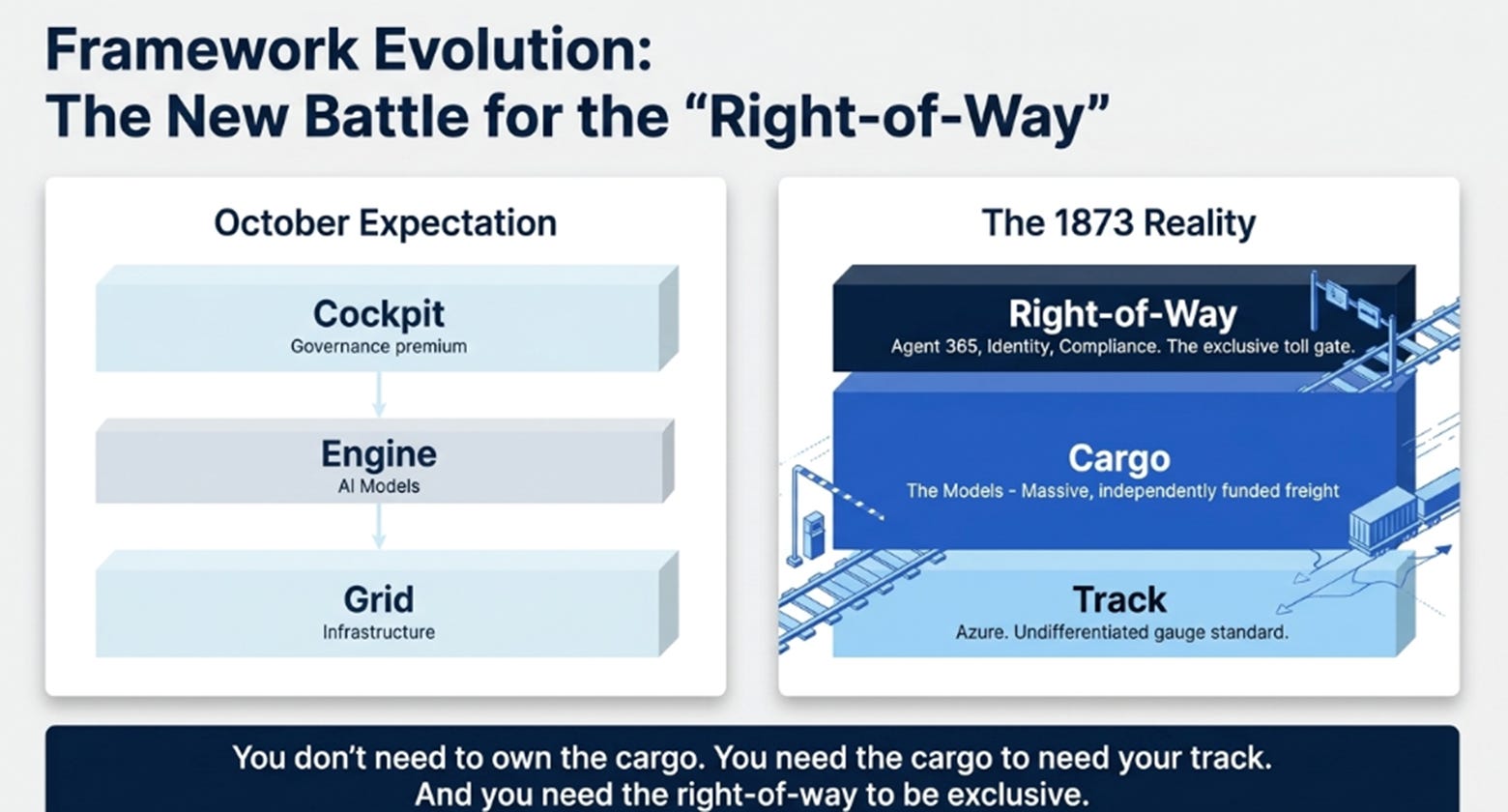
The 1873 reference also clarifies the product-layer question. Railroads didn’t own the cargo. They didn’t need to. They owned the track, the gauge standard, and the toll schedule. The efficient ones didn’t need the best locomotives, they needed the best routes and the lowest operating costs.
My October essay called the three layers Grid, Engine, Cockpit. By Q3, the Engine was supposed to be commoditising. Instead it hyperscaled to $115 billion of ARR from two companies. The Engine isn’t a commodity input. It’s a massive, independently funded freight train running on hyperscaler track.
The framework that fits now: Track, Cargo, Right-of-Way. Azure is the track. The model companies are the cargo. Agent 365, identity, compliance, governance, is the right-of-way. You don’t need to own the cargo. You need the cargo to need your track. And you need the right-of-way to be exclusive rather than an open road.
What Makes the Right-of-Way Exclusive
All three hyperscaler clouds are accelerating simultaneously. The question is the shape of the acceleration.
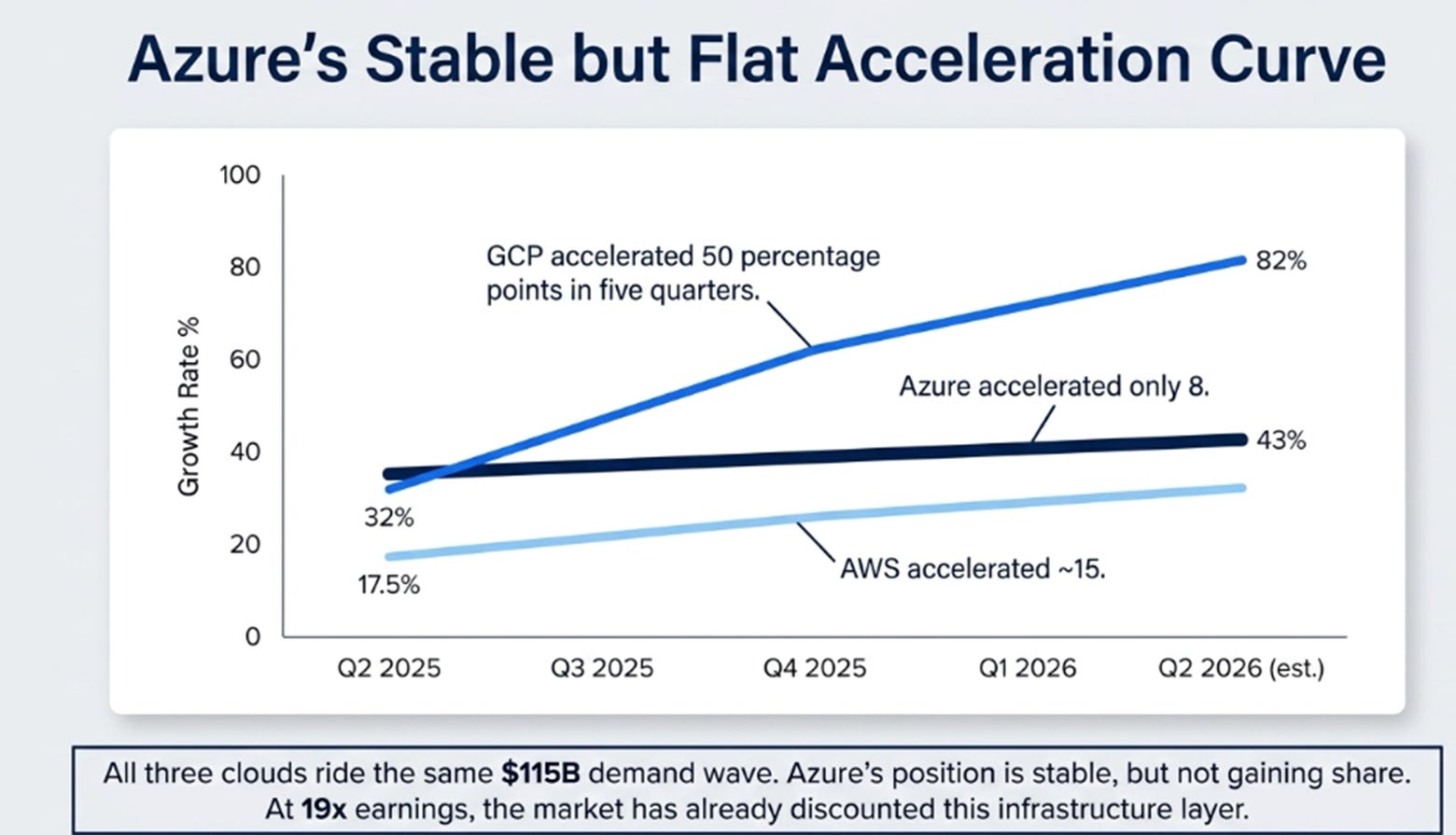
Source: Alphabet and Amazon earnings releases; Azure constant-currency growth from Microsoft filings. AWS Q2 2026 is consensus.
Azure’s growth rate is strong. It is also the flattest line on this table. GCP accelerated 50 percentage points in five quarters. AWS accelerated roughly 15. Azure accelerated eight. All three are riding the same demand wave, the $115 billion in frontier-model ARR flows through their infrastructure, but the growth curves suggest Azure’s share of incremental cloud AI demand is not expanding. The tide is real. Azure’s position within the tide is stable, not gaining.
That’s fine for the stock if the stock were an infrastructure story. It isn’t. At 19x, the market has already discounted the infrastructure layer. What the stock needs to re-rate is evidence that the other layers, the right-of-way, are exclusive. Agent 365. Entra. Purview. Work IQ. The governance plane.
And this is where the answer to the Q3 question lives.
If the right-of-way is exclusive, if every agent, regardless of model provider, must authenticate through Agent 365 before touching enterprise data, then governance is the operating system and the CIO cycle wins, because compliance centralises whether or not users prefer Claude.
If the right-of-way is replicable, if enterprises can govern agents through open protocols, competing identity systems, or the model providers’ own enterprise offerings, then governance is a feature, not a chokepoint, and user preference determines which agent wins.
The answer depends on a single variable: Agent 365 adoption depth. Not whether enterprises register agents, 40 million says yes. Whether enterprises govern non-Microsoft agents through Agent 365. If Claude Code agents inside a bank authenticate through Agent 365 before accessing enterprise data, the right-of-way is exclusive. If they run through their own API harness with a separate compliance stack, Agent 365 is a Microsoft 365 governance tool, not an ecosystem control point.
That distinction is the difference between a $700 stock and a $430 stock. Both above today’s price.
What I Own and What Would Change My Mind
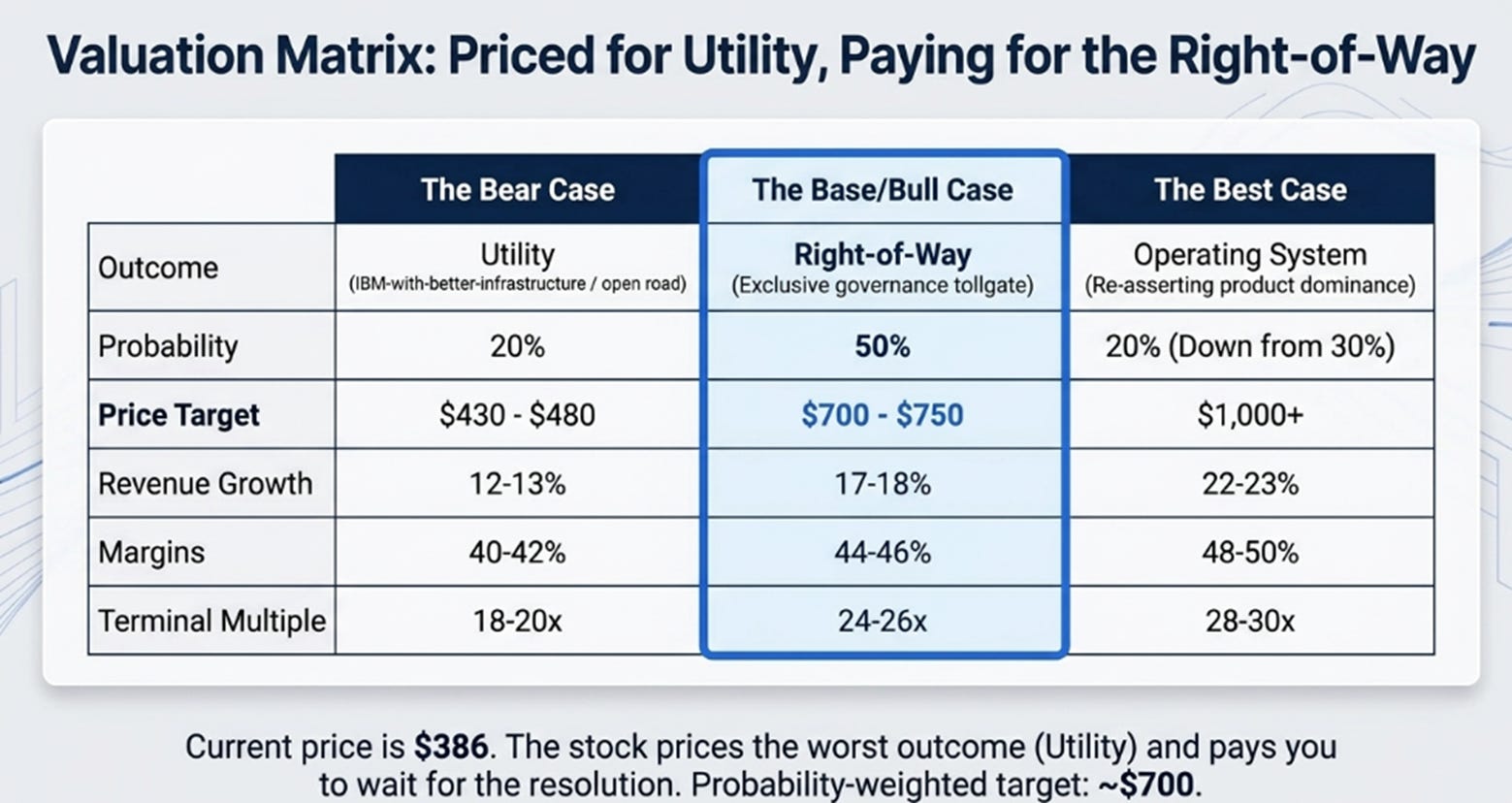
At $386, the stock is priced for the worst outcome, utility, IBM-with-better-infrastructure, 18-19x forward earnings. The right-of-way outcome, which I weight at 50%, implies $700-750 in three years on 17-18% revenue growth, 44-46% operating margins, and a 24-26x terminal multiple. The operating-system outcome, now 20% in my framework, down from 30% after two consecutive quarters of product-layer imports, implies $1,000-plus on 22-23% growth, 48-50% margins, and 28-30x. Even the bear case at 20% probability generates $430-480 on 12-13% growth, 40-42% margins, and 18-20x. Probability-weighted: roughly $700. The stock here prices the worst outcome and pays you to wait for the resolution.
Three things I’m watching:
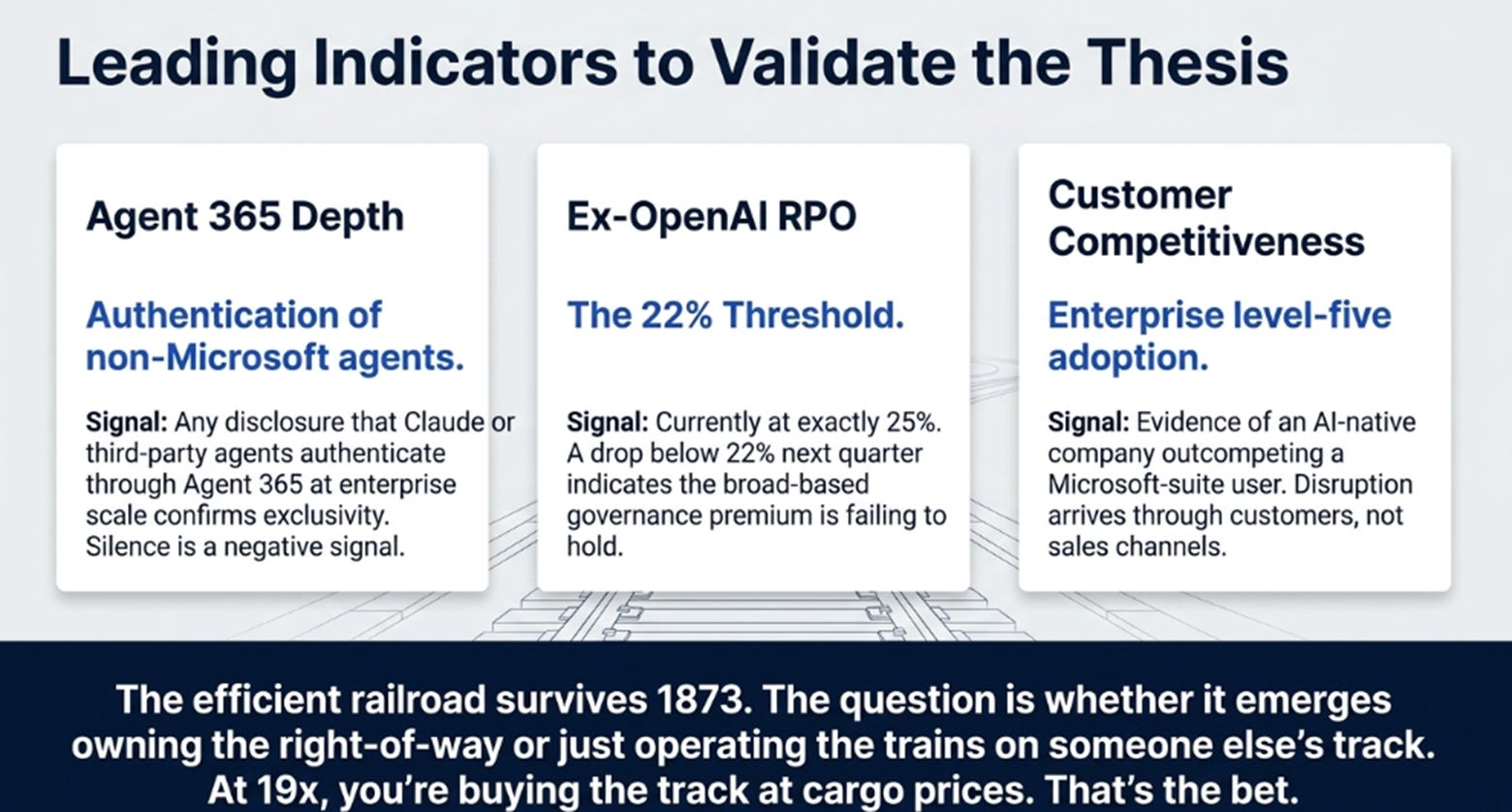
Agent 365 depth. Not registrations, governing non-Microsoft agents. Any disclosure that Claude, ChatGPT, or third-party agents authenticate through Agent 365 at enterprise scale is confirmation the right-of-way is exclusive. Silence on this metric, or the disclosure quietly dropped, is the opposite signal.
Ex-OpenAI RPO. At exactly 25%, my own threshold. Below 22% next quarter means the broad-based governance premium isn’t holding.
Customer competitiveness. The hardest to measure, the most important to track. Any evidence that a company using AI-native tools outperformed a competitor using the Microsoft suite is the leading indicator that disruption has arrived through customers, not through Microsoft’s sales channel.
The Q3 essay asked whether AI is a CIO cycle or a user cycle. After quarter one of four, the honest answer: it’s both, simultaneously, and the outcome depends on which cycle compounds faster. Microsoft’s CIO machine is converting at record pace. The user cycle, Anthropic at $74 billion, Claude Code leading developers, ChatGPT Work growing, is also converting, and it’s not flowing through Microsoft.
The efficient railroad survives 1873. The question this series will answer is whether it emerges owning the right-of-way or just operating the trains on someone else’s track. At 19x, you’re buying the track at cargo prices.
That’s the bet.
Disclaimer:
The content does not constitute any kind of investment or financial advice. Kindly reach out to your advisor for any investment-related advice. Please refer to the tab “Legal | Disclaimer” to read the complete disclaimer.