


TL; DR
MongoDB may be in the wrong valuation category. Atlas is not primarily paid per seat; it gets paid for reads, writes, storage and compute. If agents create more machine work, MongoDB can benefit from the very force hurting traditional seat-based software. Pasted markdown
AI is upside, not the underwriting. At today’s compressed multiple, roughly 20% growth, continued margin expansion and controlled dilution produce a base case of about $640 in three years. AI-native customers, Agent Engine and hyperscaler distribution are what could force the re-rating, not what the base case requires. Pasted markdown
The real risk is not the CEO vacancy. It is whether MongoDB becomes the default persistence layer for agents. AI-native customers are only 3–5% of Atlas today; Postgres, AWS and Microsoft remain credible threats. By June 2027, we should know whether the reclassification thesis is becoming real.
Snowflake Lost Its Closer. The Price Followed Something Else.
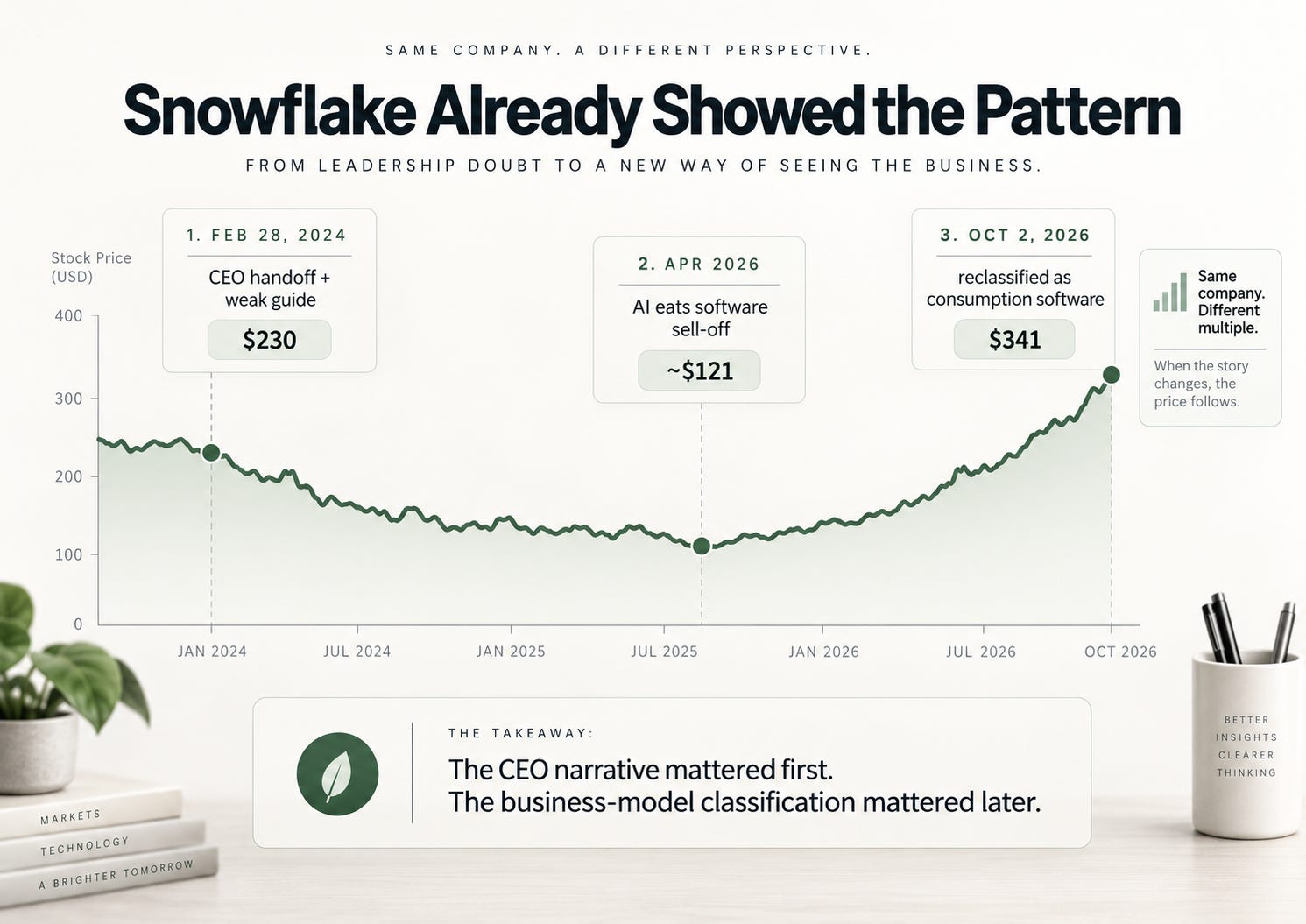
On the afternoon of February 28, 2024, Frank Slootman did something celebrated CEOs rarely do on an earnings call: he announced he was leaving, explained why, and handed the microphone to his successor in the same breath. Slootman had taken Snowflake public in the largest software IPO ever, and investors treated him as the company’s closer. His explanation was blunt:
With the onslaught of Generative AI, Snowflake needs a hard-driving technologist to navigate the challenges the new role represents. Sridhar’s vision for the future and his proven ability to execute at scale made it clear to us as a board that he is the right executive at the right time to lead Snowflake. This marks my retirement from an operating role. I will remain on duty as Chairman of the Board and look forward to working with Sridhar and the team going forward.
The successor was Sridhar Ramaswamy, who had arrived nine months earlier when Snowflake bought Neeva, his AI search start-up. The same release guided product revenue growth to 22% against a Street wanting about 31%. Snowflake closed at $230.00 that day, $188.28 the next, and $167.75 within a week, down 27%. The market priced one story: Snowflake without its closer.
Here is the part that matters. The CEO change did not set Snowflake’s price over the next two years. The stock kept sliding and hit about $121 in April 2026, in the middle of the “AI eats software” sell-off, with Ramaswamy two years into the job. Then it rose 182% to $341.04 by October 2, 2026. Nothing about him changed in either stretch.
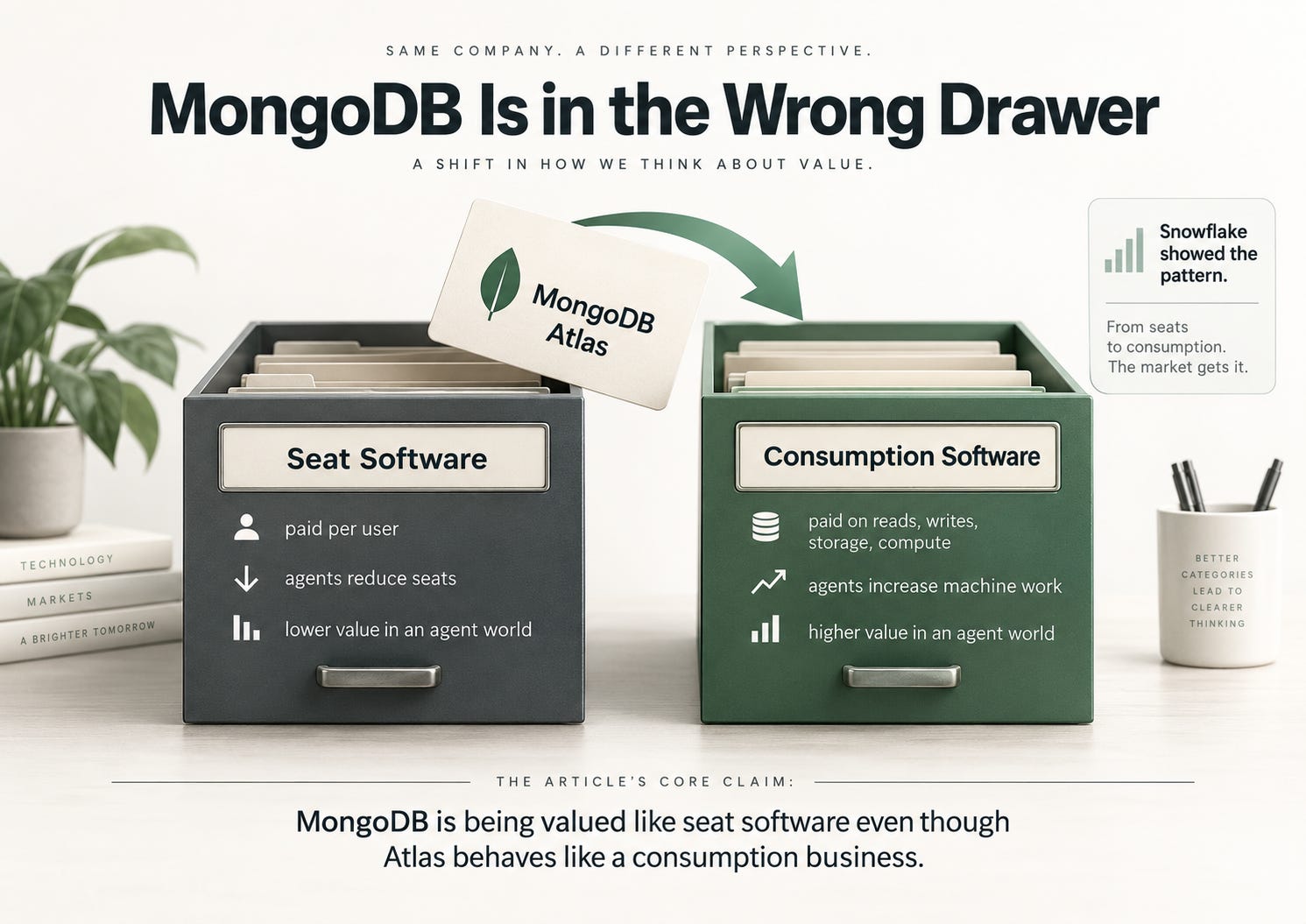
What changed was the drawer the market filed Snowflake in. In early 2026 it sat with every other software company: businesses whose customers pay per person, and whose customers need fewer people once agents do the work. By autumn it had been moved: a business that gets paid for the work a computer does and so gets paid more when agents do more work. The CEO discount was the sideshow. The classification set the price.
Thirty-one months later, the same script opened at MongoDB, with one difference: the market has not yet decided which drawer MongoDB belongs in. So here is the question this piece answers: not whether MongoDB has an AI product, but whether MongoDB gets paid when AI does more work.
MongoDB Lost 29% Without Losing the Business
From its August 13 high of $472.29 to its September 28 close of $334.68, MongoDB lost 29% of its value in six weeks, concentrated in two bad days. Neither was about the business getting worse.
On September 1 it reported a quarter most companies would frame: revenue of $771.8 million, up 30.5%; Atlas, the managed cloud service that is about three-quarters of revenue, up 29% for the sixth quarter running; operating margin of 24% against a 21% consensus; the full-year Atlas guide raised by 300 basis points. The stock fell 13.5%, because buyers positioned for acceleration wanted Atlas growth starting with a three.
On September 28, CJ Desai, CEO for less than eleven months, resigned with immediate effect to run Meta’s new enterprise business, reporting directly to Mark Zuckerberg, the day before MongoDB’s own Investor Day. The stock fell 18.5% on 7.8 times normal volume.
Then look at what followed. Guidance was reaffirmed the same day. Dev Ittycheria, CEO from 2014 to 2025, returned as interim. At Investor Day the next morning, management raised its three-year targets: revenue growth of 20% or more, Atlas in the mid-20s, margins expanding 100 to 200 basis points a year. The board added $1 billion to the buyback. FY28 EPS revisions stand at 36 up, 1 down. None of that is a company whose CEO saw trouble coming. It is a company whose CEO got an offer from Mark Zuckerberg.
The Street reads it as a holding pattern. Stifel says shares won’t re-rate “pending signs of durable acceleration for Atlas and a permanent CEO.” Capital, One calls it “a crowded long” that lost the man responsible for its alpha. That story, a good business with a leadership hole, is true. It is also the less important half.
Billed Like Snowflake, Filed Like Salesforce
MongoDB started in 2007 as a database developers chose because it matched how they wrote code: flexible documents instead of rigid tables. In 2016 it launched Atlas, the managed cloud service that runs on all three hyperscalers. In 2018 it changed its license to stop those clouds reselling its software; by then it was already selling the service itself.
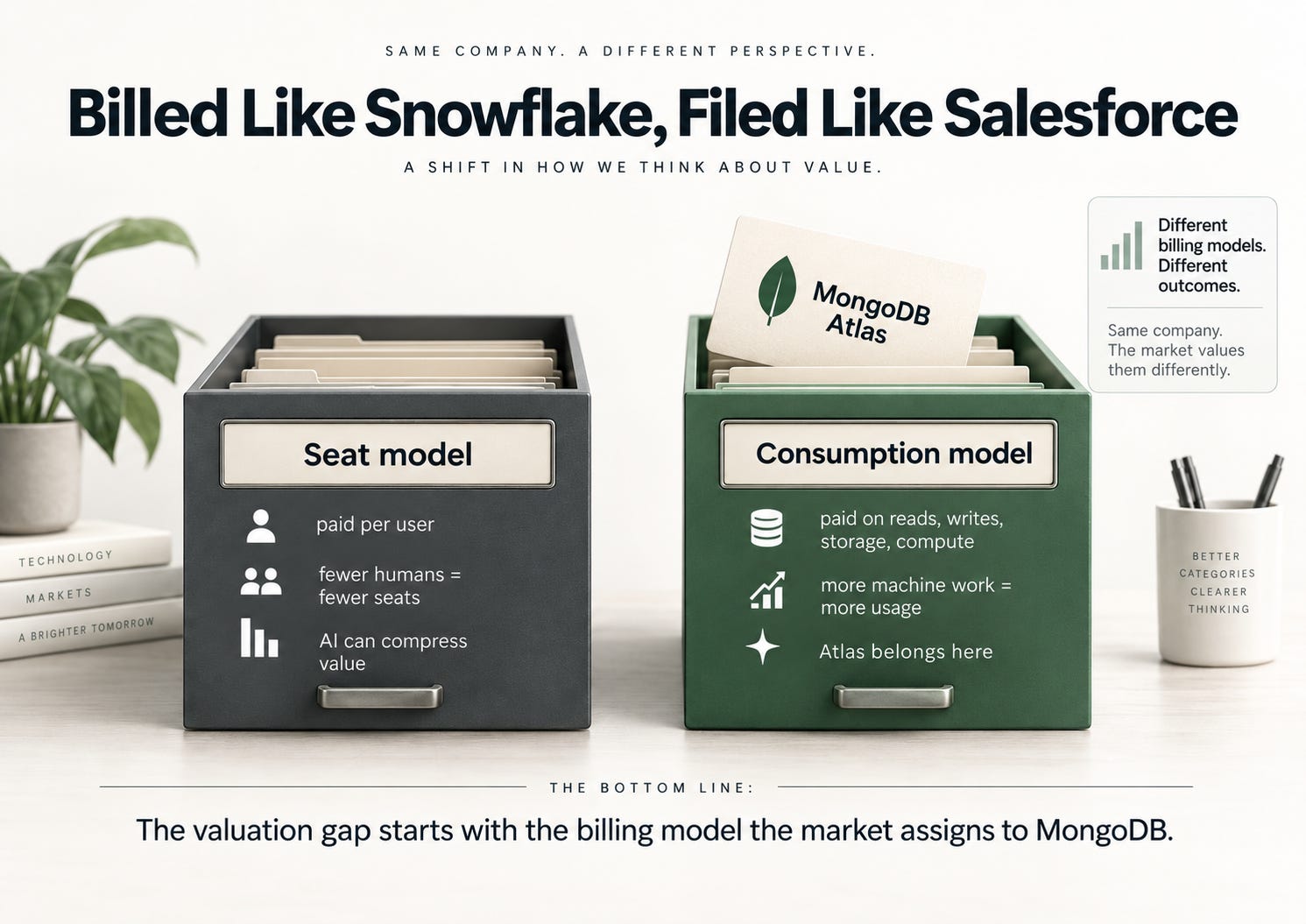
The thing that matters about Atlas is how it bills. Not per person who logs in, but for the work the database does: reads, writes, storage, compute. A company that charges per seat loses when software replaces the people in the seats. A company that charges for work done earns more when software does more work. As a chain: more agents means more applications, more applications mean more database calls, more calls mean larger clusters, and larger clusters mean more Atlas revenue, with a lag of a quarter or two at the cluster step, because most Atlas spending runs through provisioned capacity rather than per-operation metering. Nearly every software company calls AI a tailwind. Very few can name the metered unit that increases when an agent acts. MongoDB can.
The market ignored the distinction in early 2026. When Anthropic’s Claude Cowork plugins landed, the IGV software ETF’s holdings lost nearly $1 trillion of value in a week, and MongoDB fell with everything else, to an intraday low of $215.68 on April 10. The recovery then sorted the sector: from the April lows to October 2, Snowflake rose 182% and Datadog 163%. MongoDB rose 66%. You can see the misfiling in the Street’s own words; KeyBanc, staying sidelined after a strong quarter, was
cautious about competition from Postgres and how MongoDB’s subscription model compares to consumption-based peers.
Atlas is the consumption model. It is billed like Snowflake’s and filed like Salesforce’s. That gap is the opportunity.
Agents Are Better Customers Than People
The case for reclassification starts with management’s own framing. Ittycheria at Investor Day:
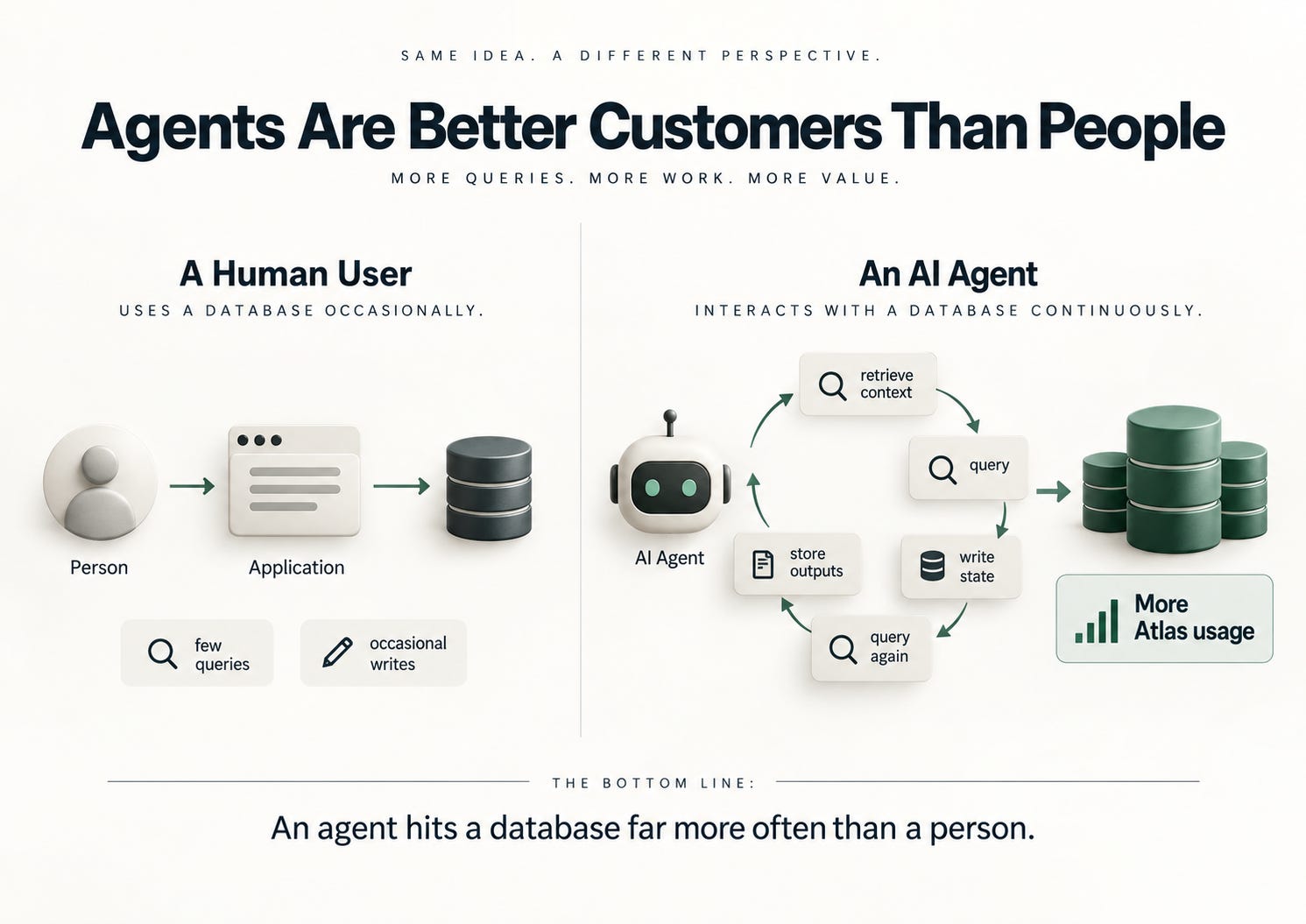
So, when it comes to AI, I think it’s very important for all of you to understand why AI is a tailwind for three basic reasons. One, more workloads. With AI, you can produce far more software far more quickly. So by definition, more software applications require more databases and more data persistence stores. So that’s point number one and you’re going to hear a lot more about this. Two, new workloads. We’re going to address a broader set of workloads around agents, memory, knowledge work. The breadth of use cases expands not just from software but taking over knowledge work that people were doing manually. And the third is a brand-new set of customers. We’ve already expanded into the frontier labs. We’ve seen a lot of AI native companies start to use MongoDB.
The evidence, in order of how much it proves. Customers with at least one AI use case now account for about 40% of Atlas annual recurring revenue, up from 30% a year ago; that means AI has reached the customers who generate 40% of the revenue, not that AI generates it. Among Atlas customers above $100,000 a year, multi-feature use, mostly full-text and vector search, has climbed from 34% to 42% to 48% over two years. Vector search customers have grown fourfold. And the company disclosed a cohort of about 2,200 AI-native customers: 3% to 5% of Atlas revenue, with growth of 67%, then 129%, then 165% over the last three periods.
The arithmetic on that last number is the core of my view. Let the cohort grow 100% a year, well below its current pace, while Atlas grows 25%: it reaches about 6.4% of Atlas in one year and about 10% in two. Hold the current 165% and it passes 8% within a year. At 10%, AI stops being an argument on an earnings call and becomes a revenue line, and the market has to reclassify the company that owns it. One caution: the cohort is defined by who the customer is, not what the workload is. It measures the pull of AI companies toward MongoDB, not agent traffic itself.
Now the bear case that actually matters, and it is not the CEO. Agents are good for databases. That does not make them good for MongoDB. The real contest is the question my earlier piece was built around: who owns the default persistence layer for agentic applications? Today, coding agents often reach for Postgres first, and the biggest data companies paid to own that reflex, Databricks about $1 billion for Neon and Snowflake about $250 million for Crunchy Data. Second, AWS and Microsoft could keep agent memory inside their own stacks; MongoDB says it is in discussions with both about building its Agent Engine memory layer directly into their AI services, and discussions are not contracts. Third, MongoDB’s own pricing: every Atlas customer is already entitled to Agent Engine, “no new contract, no new sales motion,” so MongoDB earns nothing unless agents actually burn more usage, and management’s own slide puts meaningful Agent Engine revenue in FY29. The company has lived the gap between winning workloads and earning from them: in May 2024 Ittycheria admitted “we really indexed on volume,” and the workloads won were “growing a little slower than we expected.”
My position: agents will use databases far more intensively than people do; the open question is whose. The evidence for MongoDB is real and small, 3% to 5% of Atlas, and I think it becomes undeniable within two years. The end of this piece says exactly how to know if I am wrong.
The Street’s Math Doesn’t Add Up
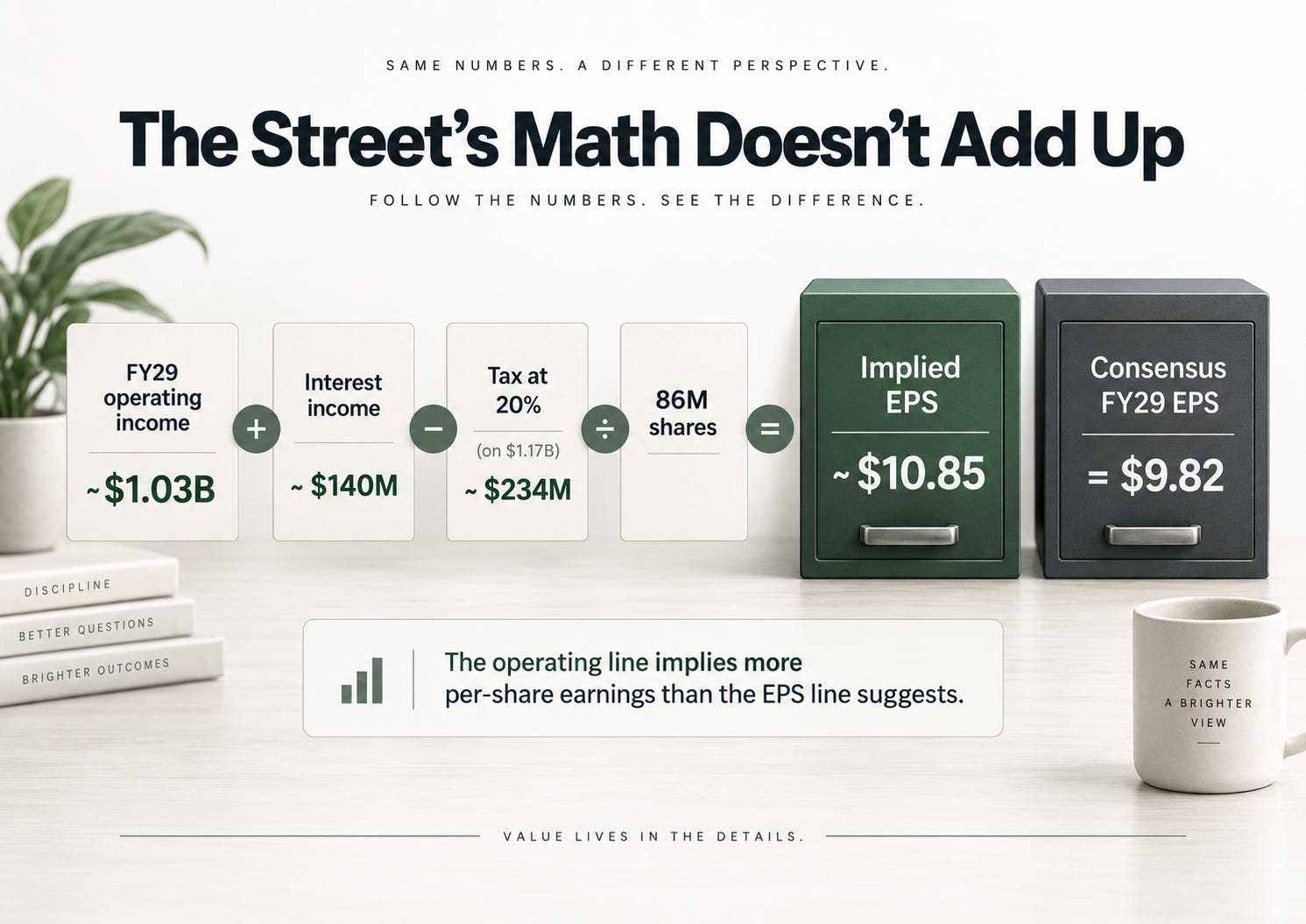
The Street’s own model offers a cross-check. I want to size it honestly, because it is not a pillar.
Consensus is not blind on margins. FactSet has revenue of $3.02, $3.61 and $4.34 billion for FY27 through FY29, with operating income of $635 million, $797 million and $1.03 billion: margins of 21.0%, 22.1% and 23.8%, expanding about 110 and then 170 basis points a year, inside management’s guided range. The margin story is in the price.
The anomaly is one floor down: the Street’s operating line and its EPS line disagree. Take its own FY29 operating income of $1.03 billion, add roughly $140 million of interest income on $3 billion-plus of cash, tax at the 20% non-GAAP rate, divide by 86 million shares: about $10.85. Consensus EPS for the same year is $9.82. Making both true requires a 27% tax rate or a share count near 95 million while a $1.35 billion buyback runs. Even before any reclassification, the Street is slightly understating the earnings conversion. Caveat: 13 analysts’ model FY29 operating income against 37 for EPS.
On top of that sits a habit. Berry at Investor Day:
So our commitment was on average 100 basis points to 200 basis points a year. We went from 14.9% in 2025 to 18.5% in 2026 and we’re guiding to approximately 21%. That was 360 basis points growth from 2025 to 2026 and 250 basis points for this year. We were super clear last year, the 100 basis points to 200 basis points was not a ceiling.
Delivered 360 and 250 against a promise of 100 to 200, and the initial revenue guide beaten by 5% to 13% every year. Earnings quality is turning too: trailing free cash flow of $659 million now exceeds stock compensation of $564 million for the first time, stock comp has fallen from about 30% of revenue to 19%, and the trailing year is GAAP-profitable. Expensive on owner earnings, no longer imaginary.
MongoDB Needs a Seller, Not Another Visionary
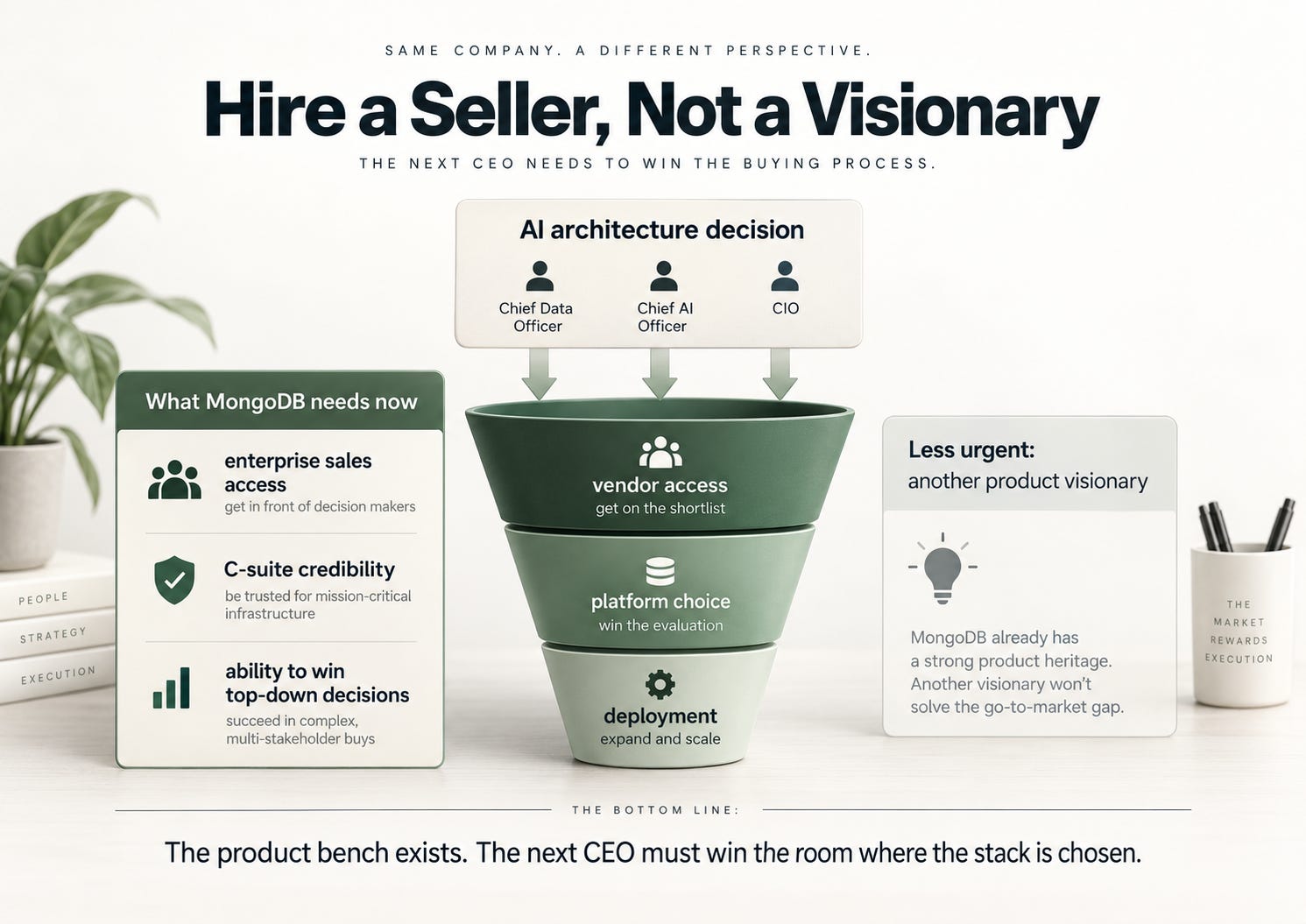
The next six to twelve months of revenue do not need a CEO. They run on existing customers expanding (net revenue retention is 122%) and self-serve sign-ups (about 2,900 net new customers a quarter). And the interim is not a caretaker: Ittycheria took the company from about $35 million to $2.3 billion-plus in annualized revenue and built Atlas.
What left with Desai was access, not product. Three weeks before resigning he told a Goldman conference that C-suite awareness of MongoDB was low, and that AI architecture decisions are made top-down by chief data and AI officers. Analysts credited his relationships for the record $90 million and $100 million-plus deals, which sit mostly in Enterprise Advanced, a quarter of revenue. His departure revealed the one thing MongoDB now lacks, and it is not vision but executive distribution: the ability to be in the room where the database behind a company’s agents is chosen. The product bench, two new Chief Product Officers, is in place. The board should hire for the room.
There is one signal I cannot explain away. Insiders filed 102 stock transactions in the last six months, all sales, none open-market buys, including after the 18.5% drop. If the people closest to the business thought $335 was absurd, one of them could have said so with their own money. None did.
You Don’t Need the AI Bull Case to Own It
MongoDB trades at about 8.4 times next-twelve-months sales and 48 times earnings. Across sixteen software names, its 19% expected growth should fetch about 10.2 times sales; 8.4 prices it as a 17% to 18% grower. The consumption cohort trades far higher: Snowflake 15.9 times, Datadog 19.0.
Read the table below as two lists. What you are paying for at today’s price: roughly 20% growth, margins expanding as guided, a buyback that holds the share count, at the multiple the CEO exit already compressed. What you are not paying for: the AI-native cohort scaling, Agent Engine shipping inside AWS or Microsoft, and the market refiling the company. The first list is the base case. The second list comes free, and it is the bull case.
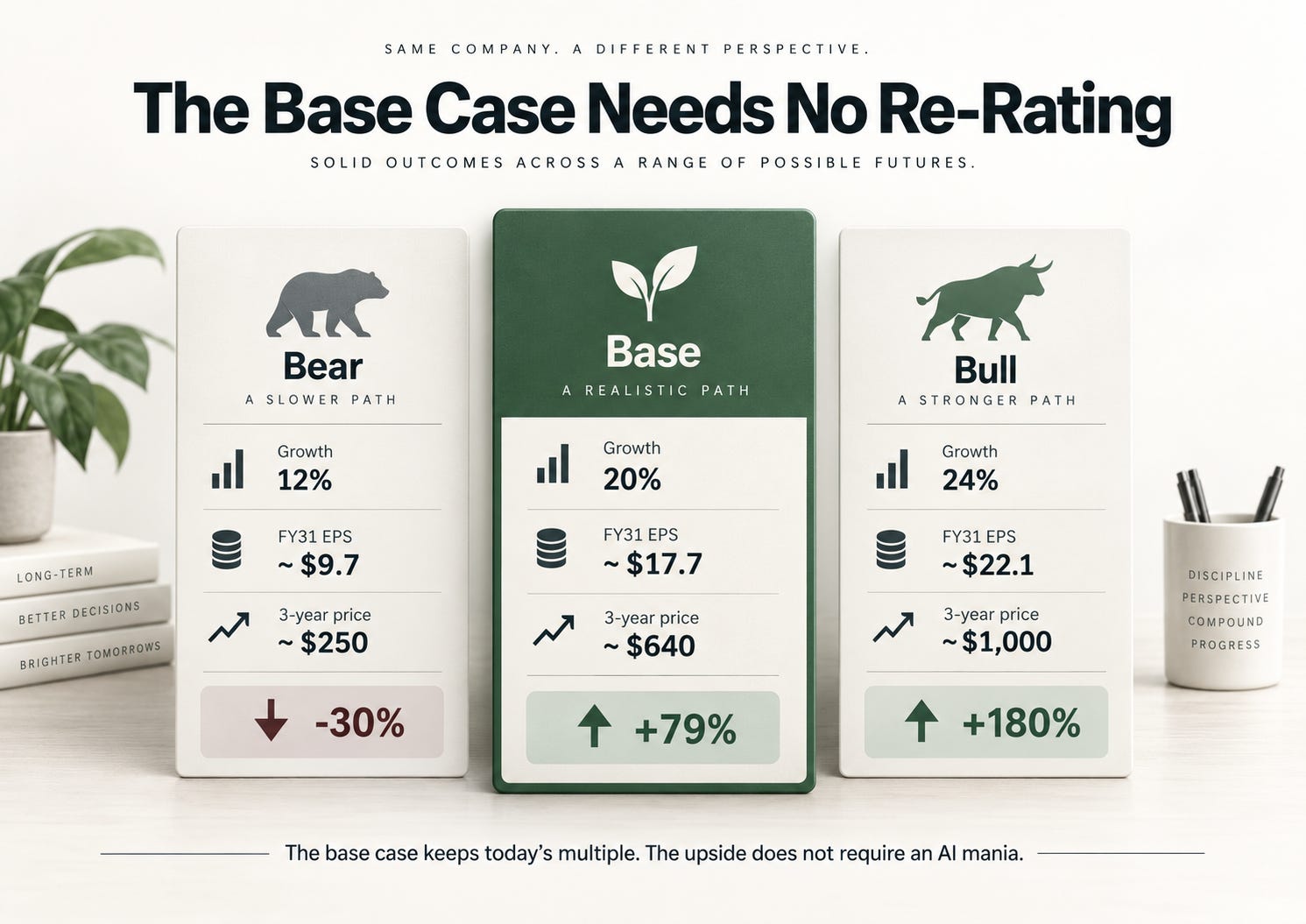
Methods: exit multiples apply to the next twelve months at October 2029 (¼ FY30 + ¾ FY31); the sales multiple is enterprise value to NTM revenue, net cash added back; EPS is operating income plus interest income, taxed at 20%, over the shares shown. Shares fall to 84M where the buyback offsets dilution, rise to 92M in the bear where it cannot.
The bear is the Teradata path, replacement rather than supplement, and its falsifiers are named below. The bull needs the reclassification, at a multiple still below where Snowflake and Datadog trade today. Probability-weighted: about $630 in three years, about $445 in twelve months.
March Will Look Worse Than the Business Is

In March 2027, the fourth quarter laps last year’s $90 million and $100 million-plus multi-year deals, booked upfront under the accounting rules, so headline growth prints near 14%. The FY28 revenue guide will start at or below consensus, because the guide always starts low. Likely still no permanent CEO. It will read like the bottom of the story while the underlying ARR has not changed, which means the worst headline of the next twelve months may coincide with the best price of the next three years. The number to read that day is the margin guide: consensus embeds about 110 basis points for FY28; 150 or more means management intends to beat the Street again on the day the narrative looks worst; below 100 means the earnings cross-check fails, and I will say so.
The Next Re-Rating Is About the Business Model, Not the CEO
Two and a half years after Slootman handed over the microphone, nobody prices Snowflake on who replaced him. They price it on what the business became. MongoDB’s answer arrives the same way, on dates already known:
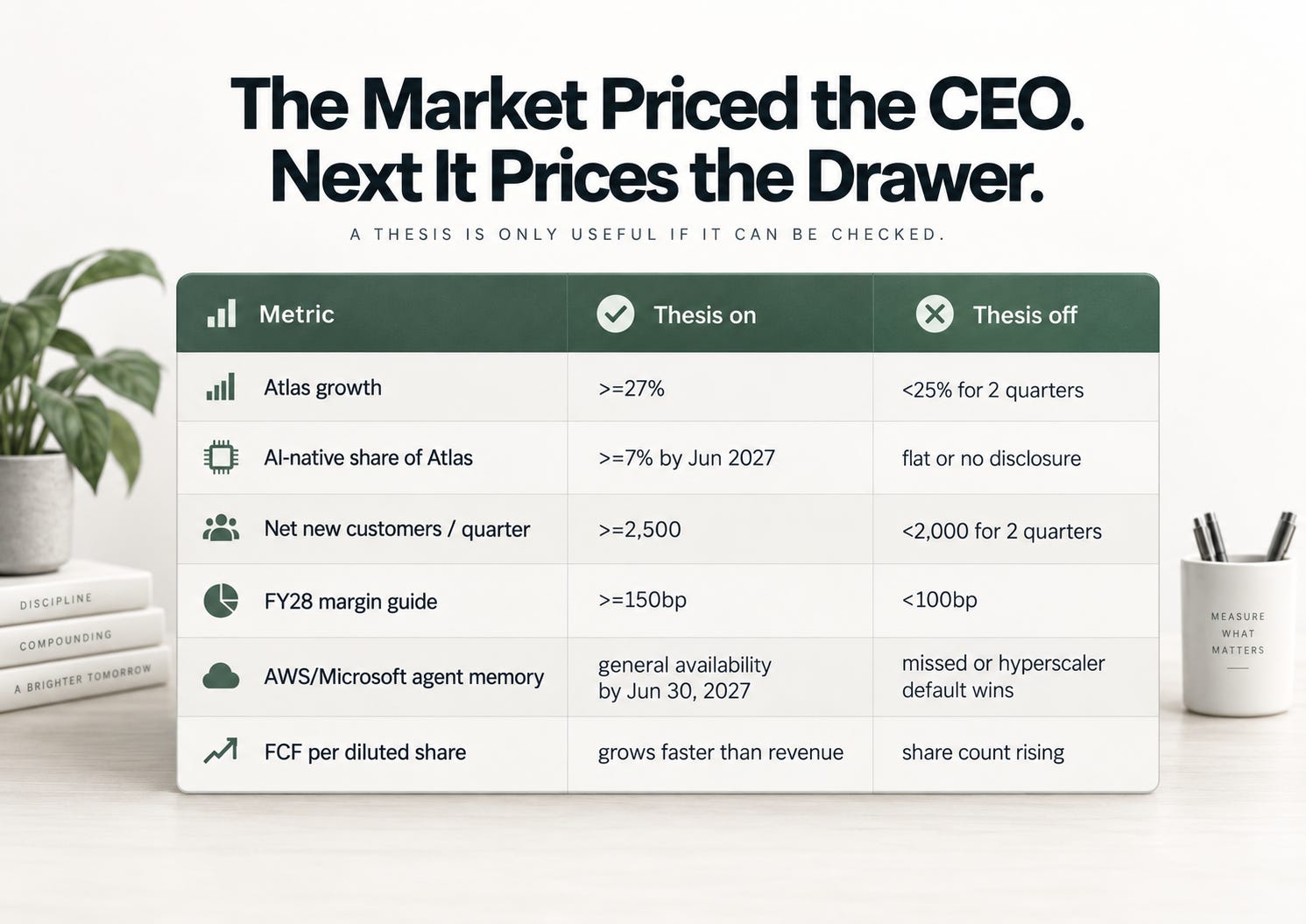
My call, in a form you can check: by June 30, 2027, AI natives are at least 7% of Atlas revenue, which requires the cohort to keep compounding above roughly 115% a year, and MongoDB’s agent memory is generally available inside AWS or Microsoft, within the window Berry gave. Both happen, and the stock trades above $500. Neither happens, and the base case still holds, because it never needed them; the bull case, though, is dead.
That is the asymmetry. MongoDB does not need agents to work for the stock to work. It needs agents to work for the market to realize it has been valuing the company incorrectly.
The market priced MongoDB’s CEO in September. Over the next two years it will price the drawer.
Disclaimer:
The content does not constitute any kind of investment or financial advice. Kindly reach out to your advisor for any investment-related advice. Please refer to the tab “Legal | Disclaimer” to read the complete disclaimer.