


TL; DR
The reported margin story is better than the underlying investment story. Revenue grew 13.7% in the first nine months and content amortization just 9.5%, but additions to content assets rose 24%. Netflix is recognizing content costs more slowly than revenue while investing much more aggressively in what comes next. Pasted markdown
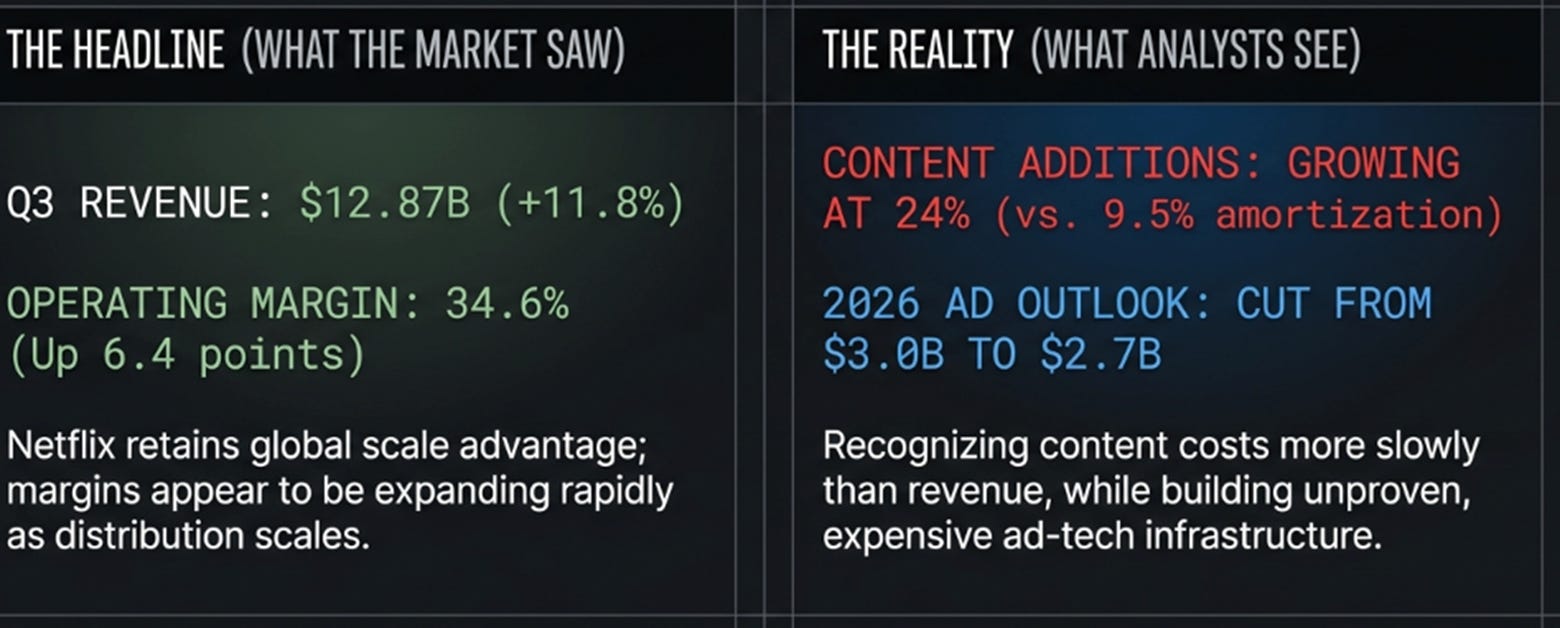
Advertising expands the revenue opportunity but also changes the economics. Netflix now needs ad technology, targeting, measurement and integrations in addition to premium content. Its 2026 advertising outlook was cut from $3.0 billion to $2.7 billion, and ad-supported members still generate less combined revenue than standard-plan members. Pasted markdown
Our variant is durability, not faster near-term growth. Netflix can still compound if global hits, pricing and advertising generate attractive incremental returns after subscriber markets mature. Our weighted 2029 value falls to roughly $98 from $110 previously because the cost of sustaining that compounding is becoming less certain.
In its 2018 fourth-quarter shareholder letter, published in January 2019, Netflix said it competed with Fortnite more than HBO. When YouTube briefly went down, Netflix viewing and sign-ups increased. The point was not about games; Netflix recognized that its market was finite consumer attention, not merely television subscription fees.
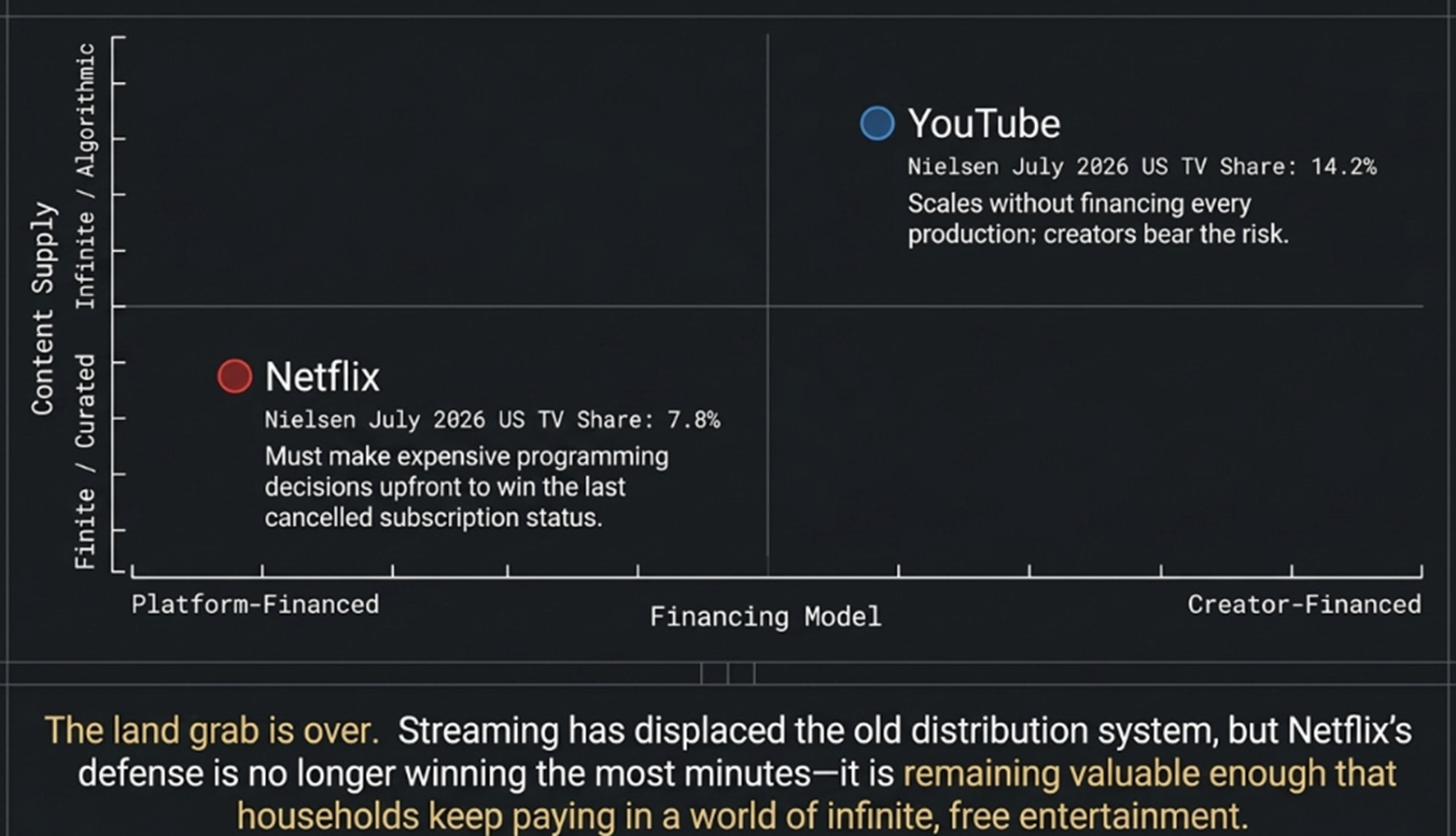
Seven years later, streaming has displaced much of the old distribution system, but Netflix’s largest markets are increasingly penetrated, and competing entertainment is effectively infinite. YouTube creators finance much of their programming, while Netflix generally must produce or license the shows that make its service worth paying for. The land grab has become a contest to be the subscription a household cancels last.
Netflix nevertheless reported $12.87 billion in Q3 revenue, up 11.8%, and a 34.6% operating margin. The stock fell roughly 6% after hours following a $13.44 billion Q4 revenue guide below $13.52 billion consensus and a 2026 advertising outlook cut from $3 billion to $2.7 billion. Behind those disappointments is a contradiction: recognized content expenses are growing much more slowly than revenue even as new content investment is growing faster. At the same time, Netflix is building systems to monetize attention that subscriptions never required.
The question is not whether Netflix has lost its scale advantage. It is whether Netflix can earn progressively more lifetime revenue from each dollar invested in premium entertainment and the systems needed to distribute and monetize it—or whether saturation and competition absorb the gains.
When Distribution Stops Being the Scarcity
Netflix’s original model was an extraordinary act of aggregation. It replaced schedules, cable bundles and national licensing silos with one interface and direct customer relationships. Once financed, a program could reach another member in another country at relatively low distribution cost. More members justified more programming; a richer catalog improved discovery and retention, attracting still more members.
That loop still operates, but mature markets change its inputs. A household cannot subscribe twice. In the US, UK and Australia, incremental revenue increasingly depends on pricing, tier mix and advertising, while membership growth remains important in less penetrated markets. Management made precisely that distinction on the Q3 call.
Revenue growth has stepped down from 17.6% in Q4 2025 to 16.2%, 13.4% and now 11.8%. FX-neutral growth decelerated sequentially in EMEA from 11% to 9%, Latin America from 16% to 12%, and Asia-Pacific from 18% to 15%; UCAN improved from 10% to 11%. Netflix is growing, but each additional point is harder to earn.
Attention has different supply economics. Nielsen measured YouTube at 14.2% of US television viewing in July 2026 and Netflix near 7.8%. These are TV-screen shares, not global engagement measures. A creator marketplace can continuously add programs without financing every production, whereas Netflix must make expensive programming decisions. Its defense is not to win the most minutes, but to remain valuable enough that households keep paying.
The Cost of the Next Hit
Netflix’s scale advantage seems evident in Q3: content amortization rose only 5.8%, from $4.00 billion to $4.24 billion, against 11.8% revenue growth. Recognized content expense fell from 34.8% to 32.9% of revenue. That is exactly what shared premium programming should produce as distribution scales.
The reported 6.4-point jump in operating margin exaggerates the underlying improvement. Q3 2025 included a $619 million Brazilian non-income tax assessment; excluding it yields a 33.6% comparison, versus 34.6% this quarter. Normalized operating profit grew about 15%, not 37%. Costs outside content amortization increased 14.8%, absorbing almost half the amortization benefit, and management attributed some quarterly margin upside to expense timing.
Yet the cost bridge cannot establish that Netflix’s economic content costs are falling. Amortization reflects past investments, whereas production and licensing commitments made today support viewing in future years. The nine-month statement shows the divergence:
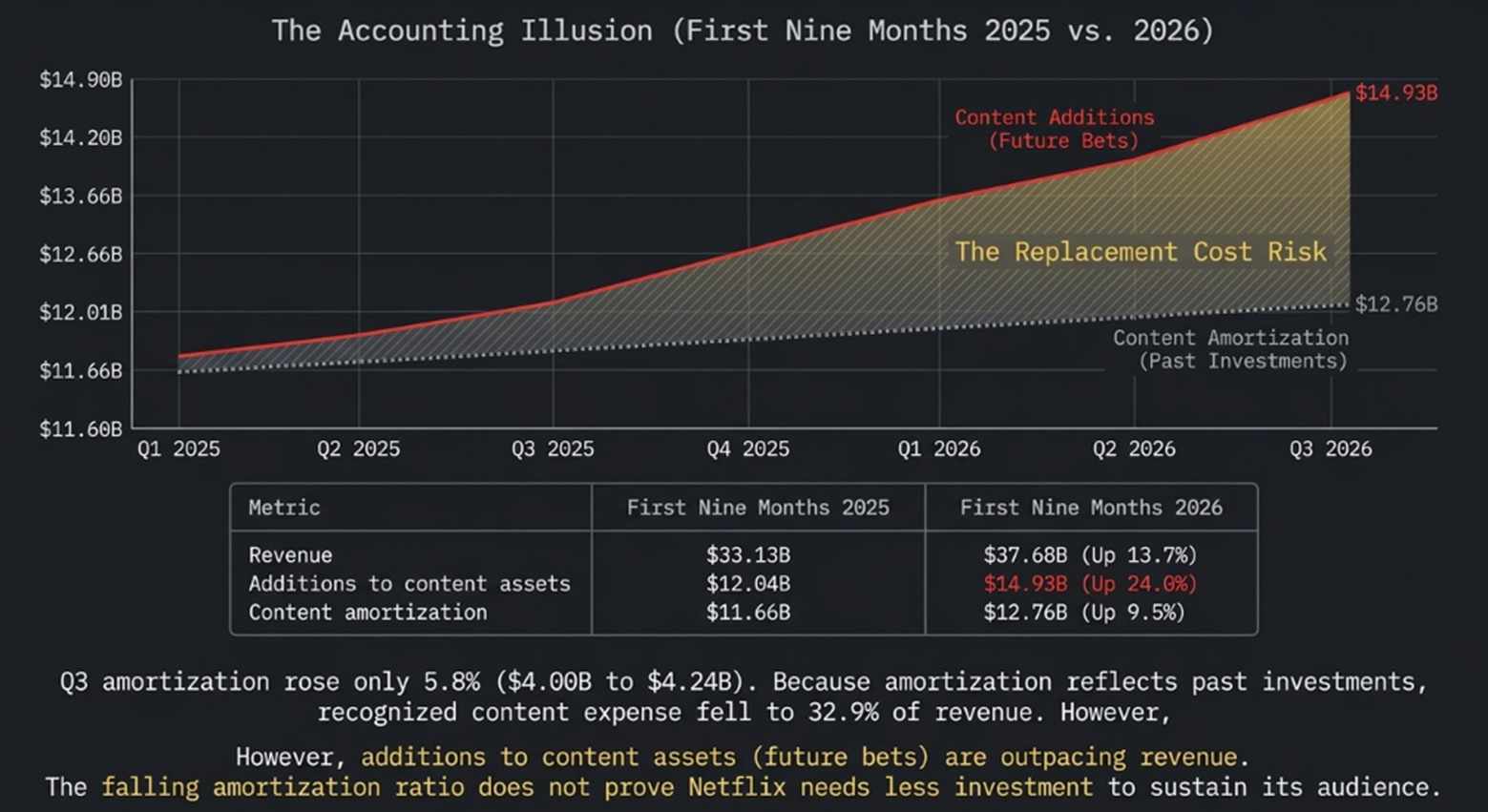
Nine-month revenue grew 13.7%, amortization 9.5%, and additions to content assets 24%. Additions are not cash payments: changes in content liabilities and payment timing matter. Nor must faster spending mean weaker returns; it may fund valuable future programming. But today’s falling amortization ratio does not prove that Netflix needs less investment to sustain its audience.
Netflix expects annual cash content spending to be around 1.1 times amortization, but that guidance is a different measure from additions to content assets. The test is not whether management can suppress accounting amortization for another quarter. It is whether the next $1 billion committed to shows creates sufficient future subscription retention, incremental customers, advertising inventory and pricing power to repay that investment. Netflix discloses useful examples of successful content, but not the cohort-level economics that would let outsiders calculate that lifetime return directly.
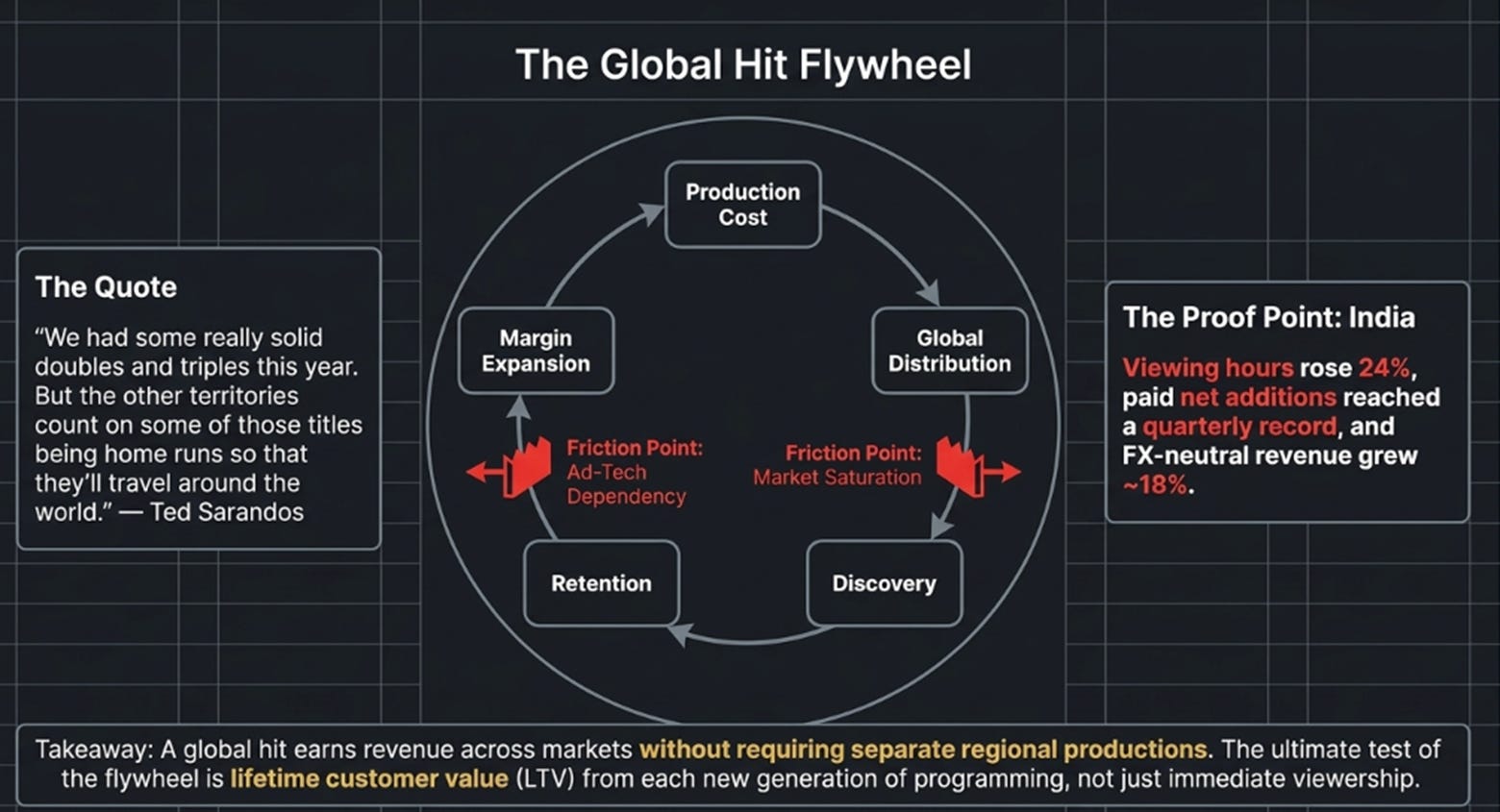
This makes Ted Sarandos’s explanation of the content leadership change particularly revealing. Discussing Peter Rice’s appointment, he said:
Our business and our business flywheel are working. There’s no need for a fundamental shift in the strategy. We do need better execution in the U.S. ... We had some really solid doubles and triples this year. But the other territories count on some of those titles being home runs so that they’ll travel around the world.
A global hit earns revenue across markets without requiring separate productions. India illustrates the mechanism: viewing hours rose 24%, hours per member improved, paid net additions reached an Indian quarterly record, and FX-neutral revenue grew around 18%. Sarandos has not proved missing US hits caused every regional slowdown, but he identified the kind of success that makes global content unusually productive. The real test is lifetime customer value from each new generation of programming.
Selling Access Is Different from Selling Attention
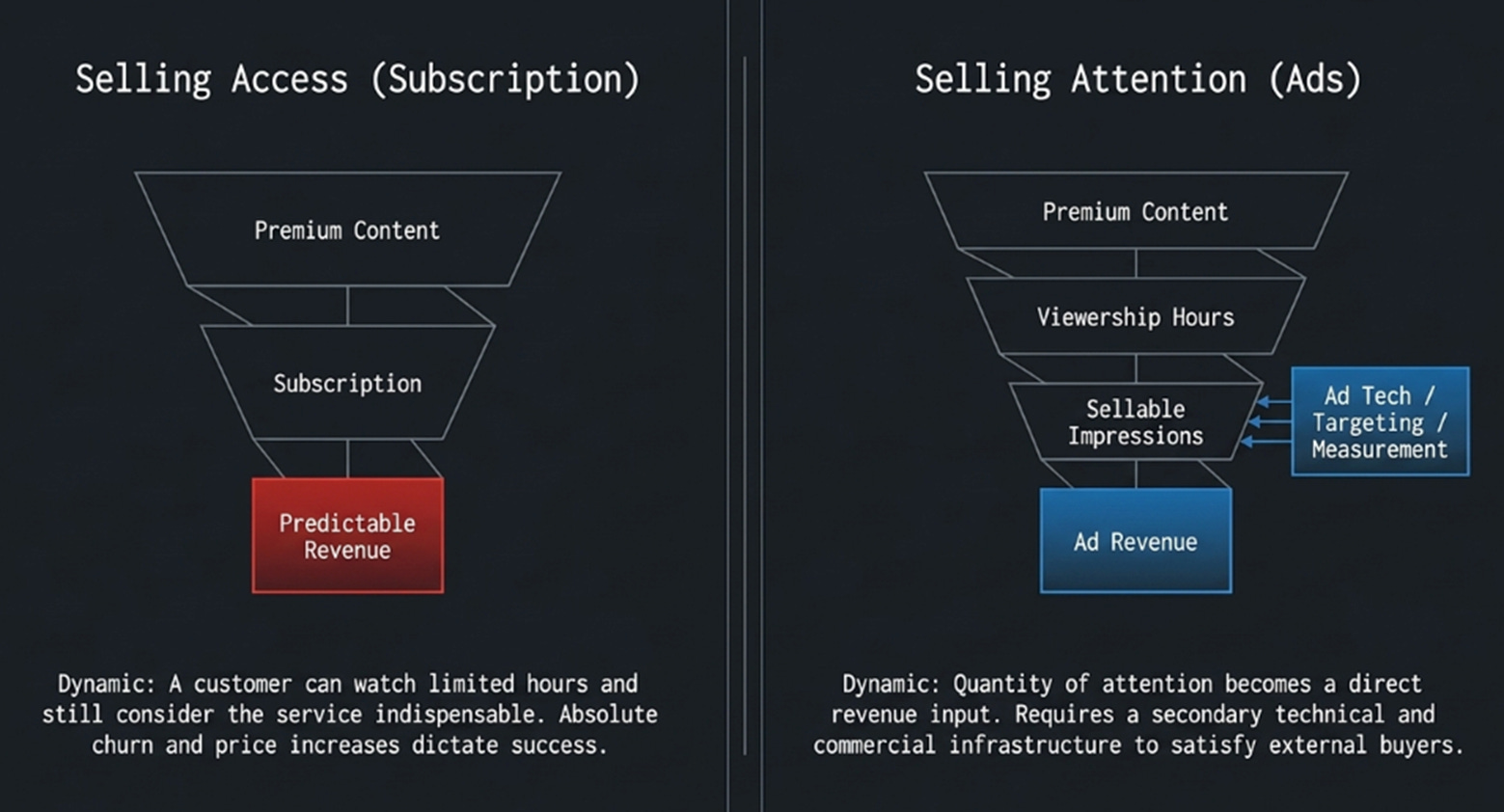
Our earlier article, The Compounding Nobody Wants, argued that monetization, margins, advertising and buybacks could keep per-share earnings compounding after the subscriber land grab. We already recognized YouTube’s threat and Netflix’s potential as a third-party entertainment interface. Q3 tests that thesis’s timing, rather than revealing a new strategic problem.
We were too optimistic. Q3 revenue of $12.874 billion missed our $12.95 billion stabilization threshold; management did not raise the 31.5% FY26 operating-margin guide we called highly conservative; and advertising guidance fell. We also set a YouTube TV-share warning threshold that had already been breached. Those are reasons to revise confidence, not history.
Subscriptions can work without maximizing hours: a limited series that convinces a household to renew may be more valuable than long stretches of catalog viewing. That makes management’s argument that not all hours are equally valuable sensible. Netflix says US and global churn improved and price increases held, although it discloses no absolute churn rate. A customer can watch less and still consider the service indispensable.
Advertising changes that equation. It requires sellable impressions, targeting, measurement, buyers and sufficient demand to deliver attractive yield. Attention quality matters, but quantity becomes a more direct revenue input. Netflix can raise yield without more viewing only if advertisers value its inventory more highly. As ads grow, Netflix becomes more dependent on engagement trends outsiders can barely measure. Netflix has stopped reporting quarterly subscribers and regional ARM and is moving its engagement report to an annual cadence.
That makes the latest advertising admission strategically important. Greg Peters explained the reduced 2026 forecast in terms of delays in product launches and partner integrations:
We have seen some delays in the rollout and partner integrations for some of those new ads products. Getting to the integration model that we want sometimes takes a bit more work with our partners, but we strongly believe that a modest short-term hit for a better long-term strategic position is a good ultimate trade-off.
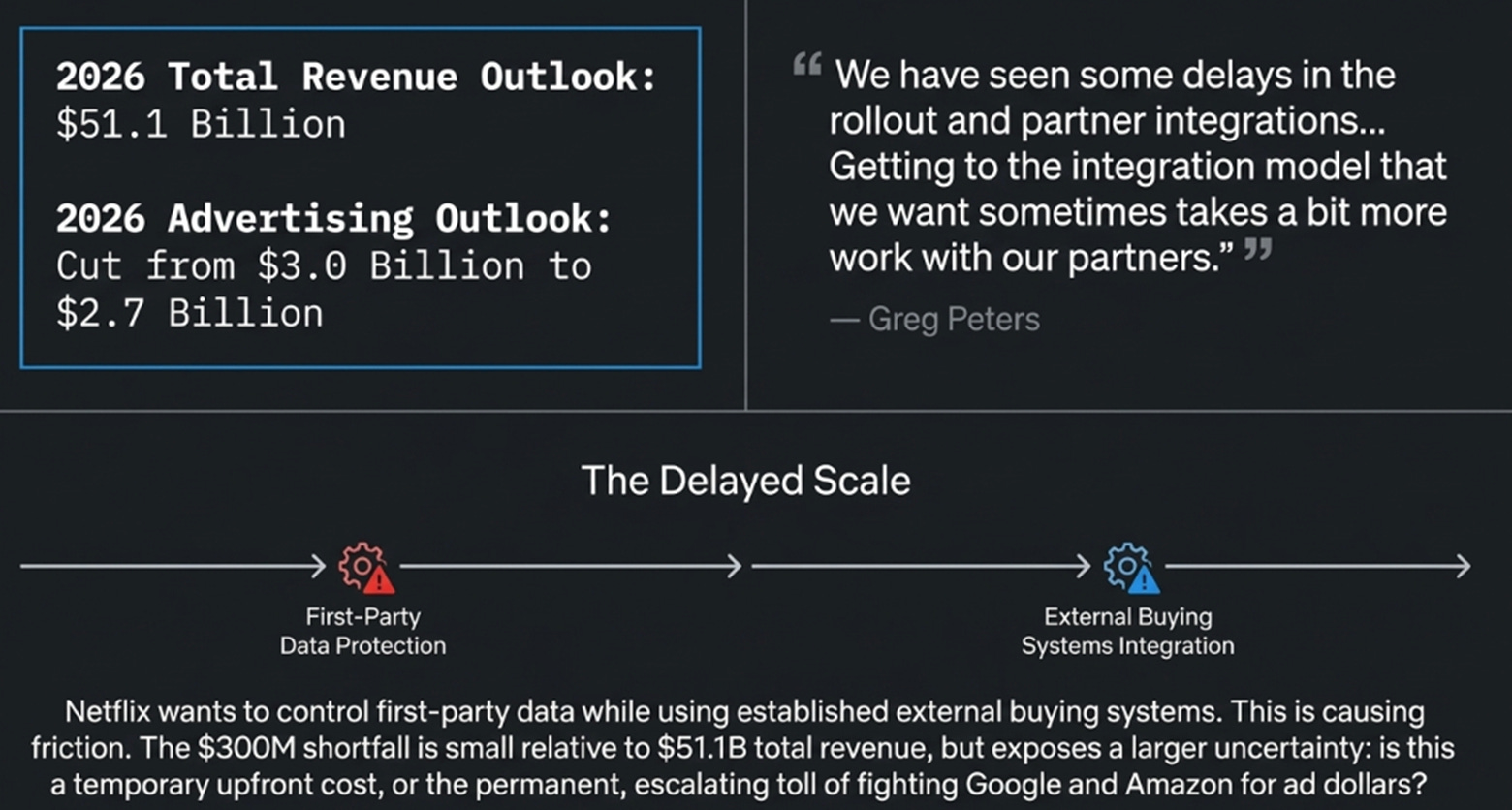
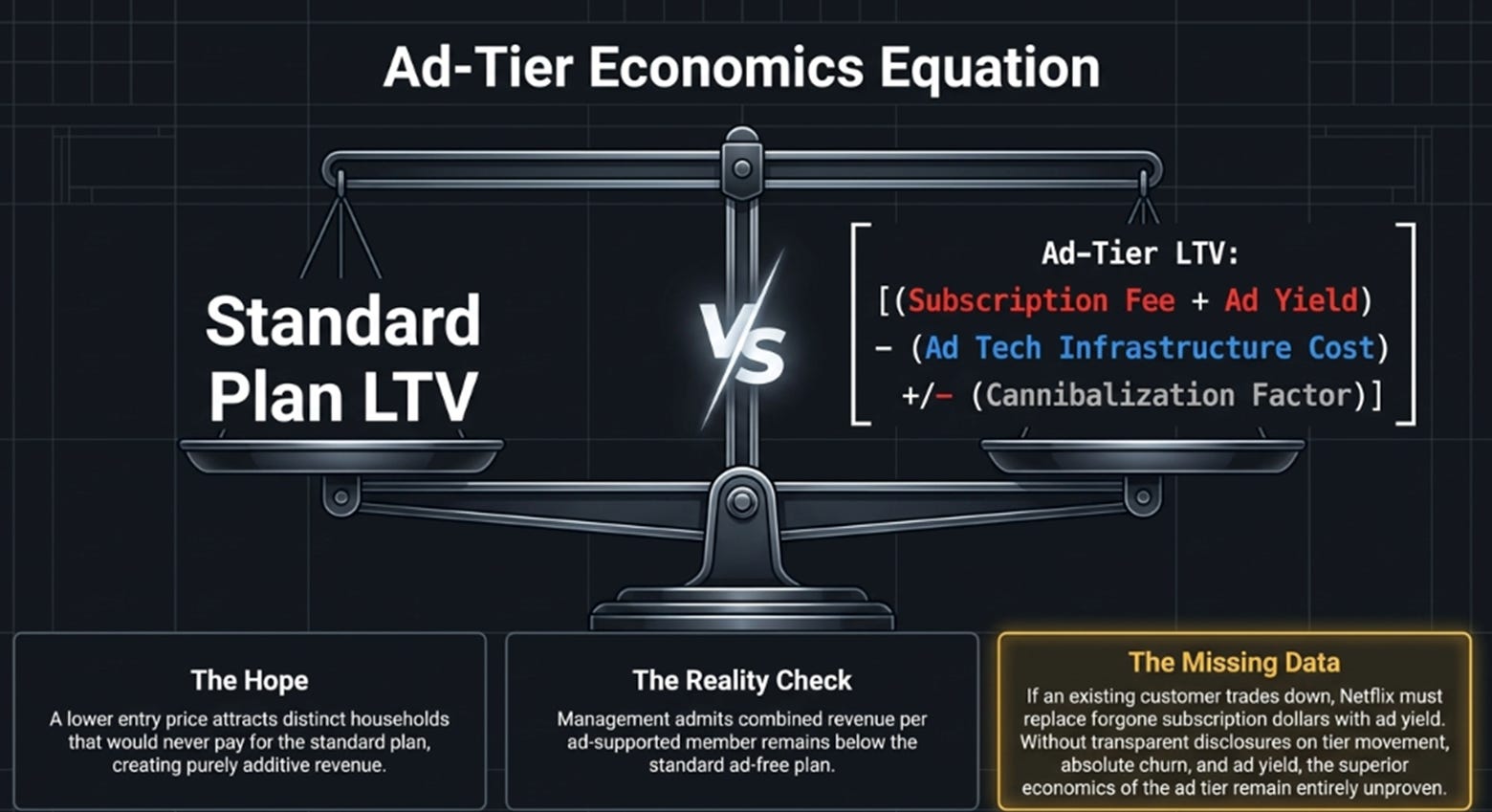
Netflix wants to control its first-party data while letting advertisers buy and measure inventory through established systems. That requires a second technical and commercial infrastructure. Management also says combined revenue per ad-supported member remains below the standard ad-free plan, although the gap is narrowing. The opportunity is real; superior member economics remain unproven. Management says advertiser demand remains strong, but actual advertising yields remain undisclosed.
A lower-revenue ad-tier member may still be a good customer if a lower entry price attracts households that would never pay for the standard plan. But the opposite is possible: an existing customer might trade down, leaving Netflix to replace forgone subscription dollars with ads. The relevant number is incremental lifetime value after cannibalization and the cost of serving advertisements, not simply the percentage of new subscribers choosing the ad tier. Netflix currently reports too little detail on tier movement, revenue yield and churn to resolve that question.
The $300 million advertising shortfall is small relative to Netflix’s $51.1 billion 2026 revenue outlook, but reveals a larger uncertainty: is the platform spending mostly upfront, spreading over future advertiser revenue, or is it the permanent cost of selling attention against Google and Amazon? The launch of the ad tier in 15 additional countries in 2027 will help test the scalability of the platform, though broader distribution alone cannot establish attractive yields.
Two Cost Curves Are Really One Investment Decision
Two cost curves make a compelling accounting story: content amortization grows slowly, while other expenses grow quickly. They are not clean business categories. Some expenses outside amortization relate to content, including live delivery, and Netflix does not allocate incremental costs by games, discovery, advertising or distribution. Its 95%-core-spending comment describes priorities, not the source of cost growth.
The curves also interact. Live content can create advertising inventory; discovery can turn an expensive film into higher retention; and TF1 programming can deepen Netflix’s value without its financing every hour. Management says TF1 viewing is growing and appears incremental, but discloses no associated profit or lifetime-value uplift. These are possible returns to integration, not evidence of a new platform moat.
This is where Netflix differs most from a creator-financed platform. YouTube can gain more supply as creators react to a larger audience and better monetization; creators bear production risk and Google shares advertising proceeds. Netflix can improve the value of a title through worldwide distribution and discovery, but it usually has to make the next investment decision itself. If TF1-style relationships allow content owners to contribute more programming in return for Netflix’s distribution, some risk could migrate to partners. Whether those partners leave enough economic value with Netflix is still unproven.
Peters acknowledged that parts of Netflix had become over-invested, explaining the layoffs. But savings create value only after weighing reinvestment. The right test is marginal return, not cost-cutting alone: a dollar of technology spending that creates several dollars of lifetime customer value is productive; spending a dollar merely to stand still is not.
The Value of Staying Essential
Our variant is not that Netflix will outwatch YouTube or suddenly beat consensus growth. It is that premium-content distribution, discovery and two revenue streams may generate durable per-share growth after subscriber markets mature—if content and advertising investments earn sufficient incremental returns. The alternative is that amortization lags rising replenishment costs while advertising makes the business permanently more complex.
The stock is a separate question. Consensus estimates on October 21 snapshot had FY2027 revenue of roughly $56.8 billion and operating margin of 33.3%; limited FY2029 coverage implied $67.7 billion in revenue and $5.37 EPS. Our base case is below those 2029 figures. The possible variant is durability of returns, not undisclosed bullish earnings forecast.
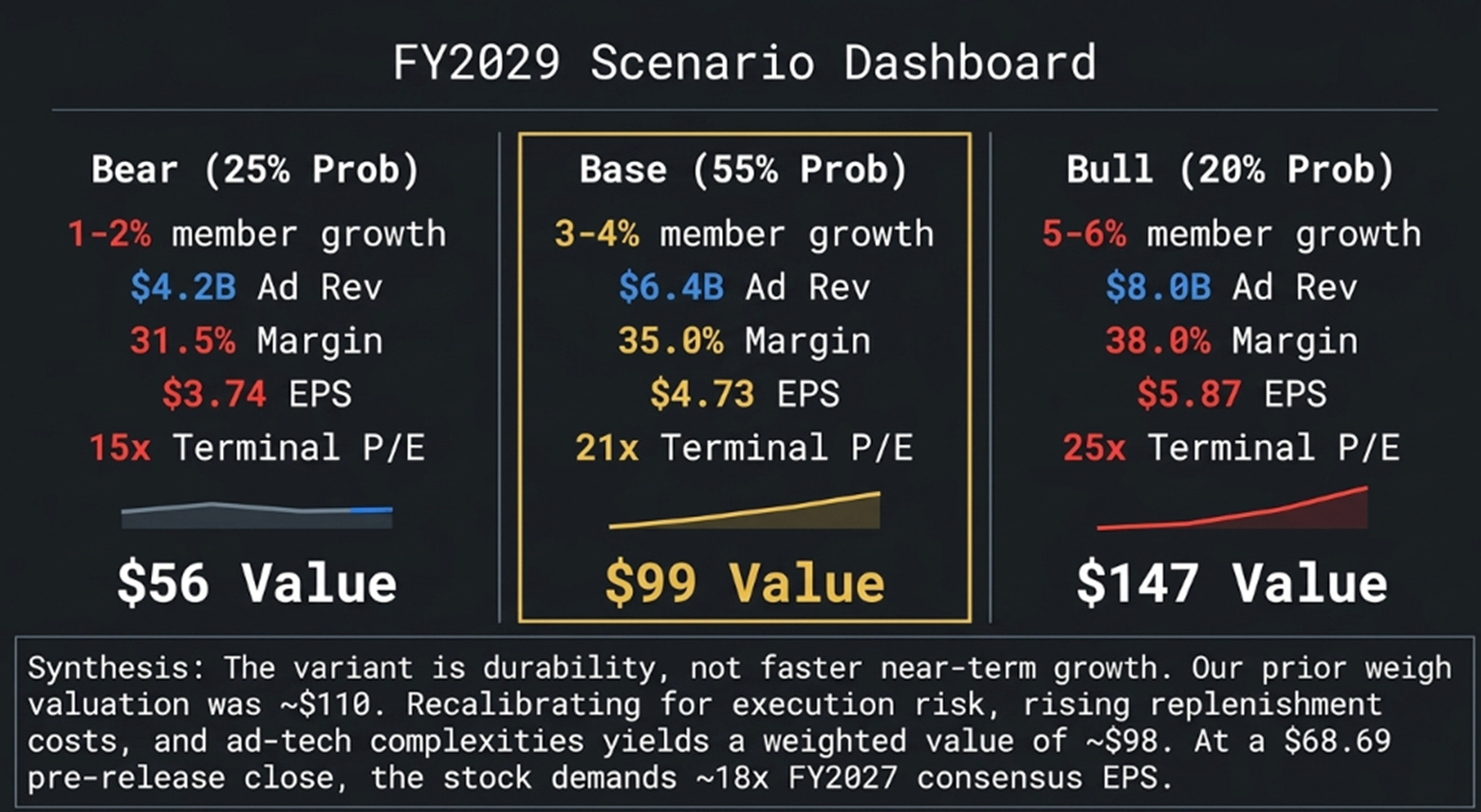
The bear assumes 1–2% membership growth, 3–4% price/mix growth and stalled ad yield; the base assumes 3–4% for each, with advertising at $6.4 billion; the bull requires stronger global hits, 5–6% membership growth, 4–5% price/mix and faster ad monetization. These are inferred components, not Netflix disclosures. EPS reflects modeled operating profit, finance expense, tax and diluted shares; FCF conversion and sustainable buybacks constrain the model.
Our prior weighted valuation was roughly $110; these probabilities and assumptions produce about $98, reflecting execution risk. At the verified $68.69 pre-release close, Netflix was near 18× FY2027 EPS consensus. The $4.73 base FY2029 EPS is worth about $86 at that multiple; $99 requires 21×. Earnings growth and re-rating are separate, and $68.69 is not a confirmed post-results entry price. The October 2029 exit values then-expected full-year FY2029 earnings.
What January Can Actually Tell Us
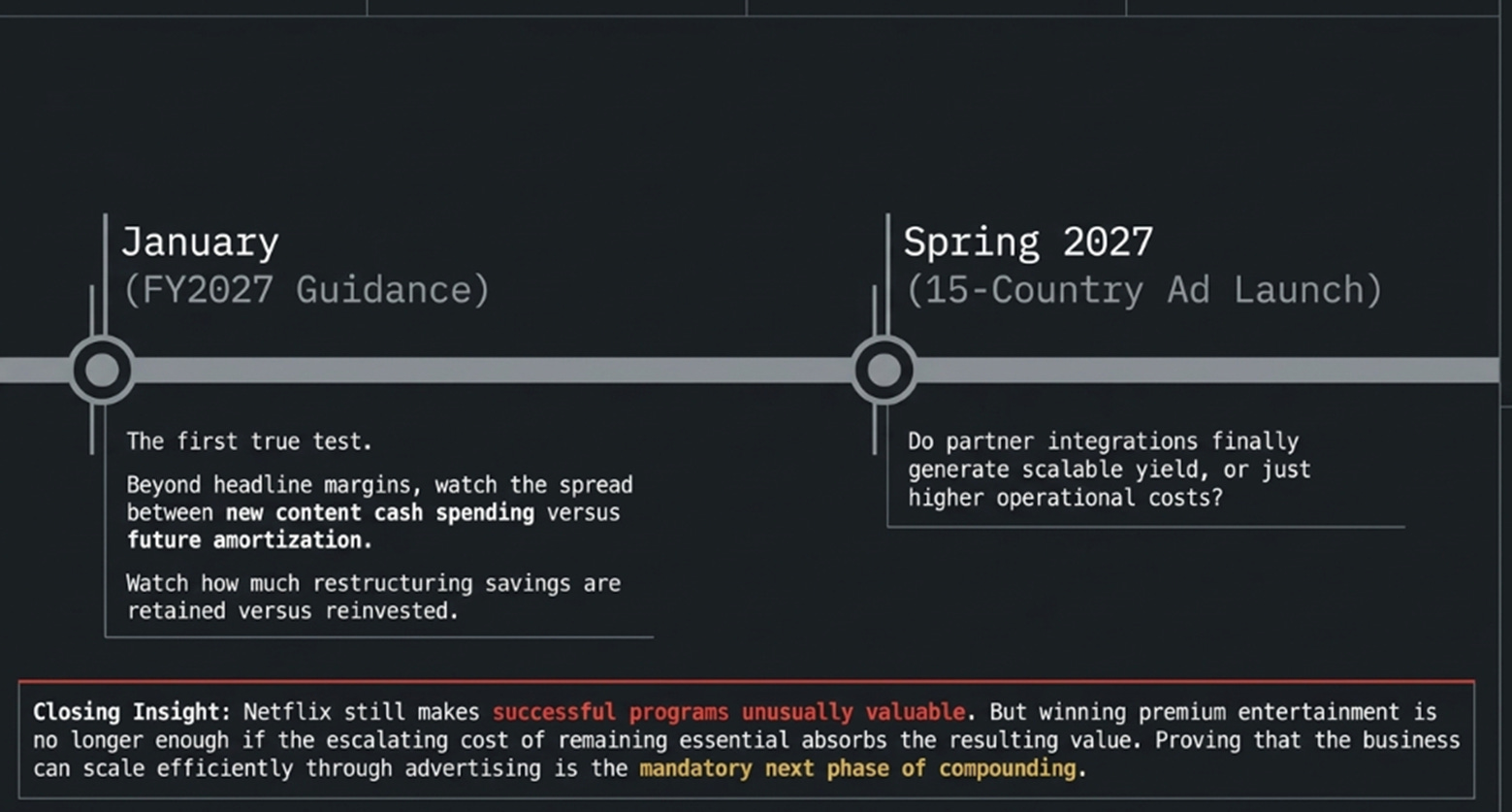
January’s FY2027 guidance is the first test. More than its margin headline, we need evidence on new content spending versus future amortization, normalized non-content costs and how much restructuring savings Netflix retains. A 33% margin guide might show improvement yet miss today’s 33.3% published consensus; the real stock bar must be updated then.
Spring 2027 brings advertising-market launches and partner integrations: do they generate better yield, or simply costs? Strong US titles should also travel internationally, supporting FX-neutral growth. The next annual engagement report may help, but absolute churn, membership and ad-tier yield could remain undisclosed.
Netflix still makes successful programs unusually valuable through global distribution. What remains uncertain is the cost of producing the next hits and whether monetizing their audiences creates another layer of scale or a permanently larger expense base. Winning premium entertainment is not sufficient if the cost of remaining essential absorbs the resulting value. That is what the next phase of compounding must prove.
Disclaimer:
The content does not constitute any kind of investment or financial advice. Kindly reach out to your advisor for any investment-related advice. Please refer to the tab “Legal | Disclaimer” to read the complete disclaimer.