


TL; DR
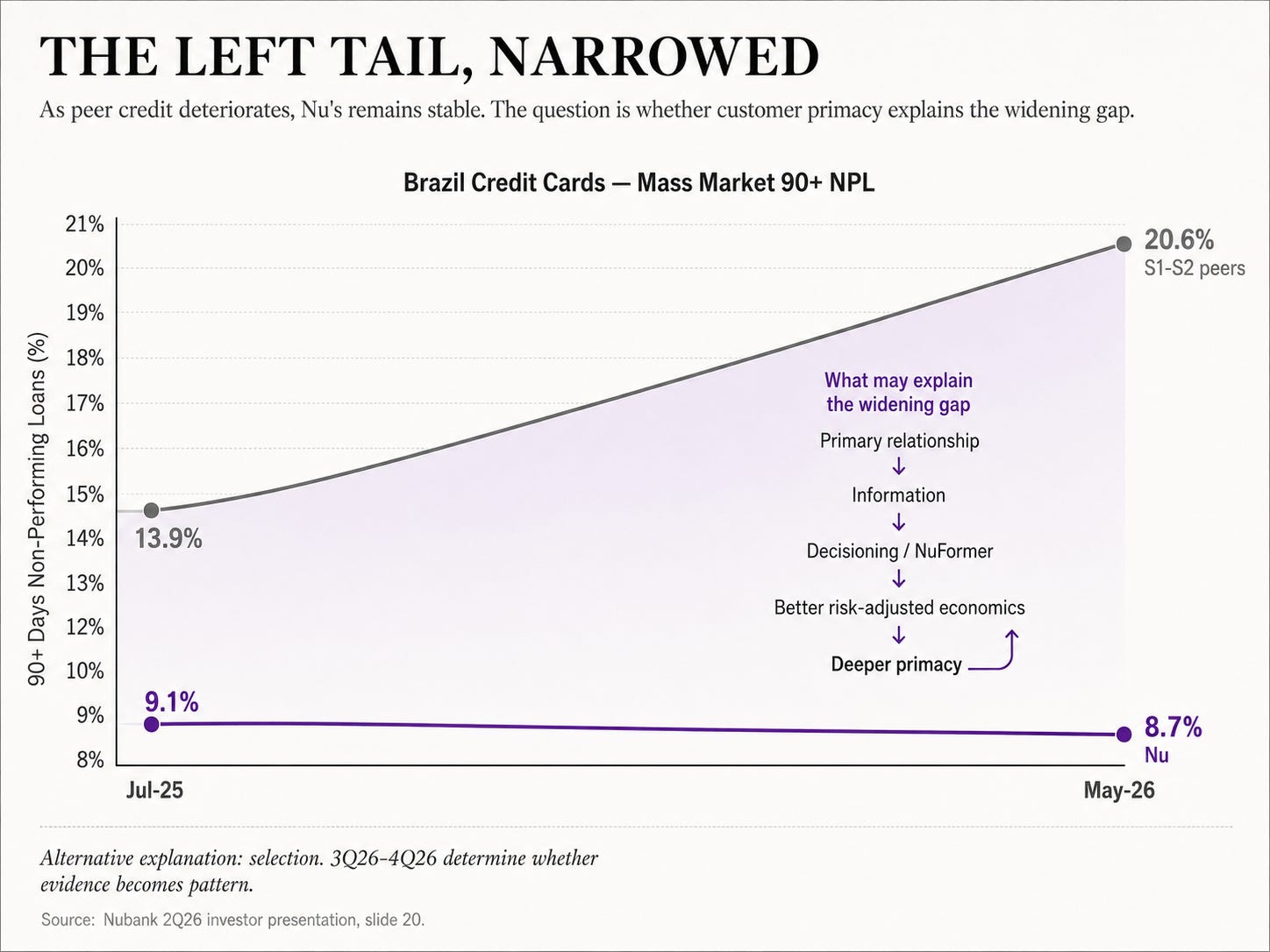
The strongest evidence was comparative: Nu’s Brazilian 90+ delinquency rates stayed flat to slightly better while peer cohorts deteriorated sharply, widening the gap across income bands.
Primacy looks increasingly like the real moat: the primary-account relationship generates richer information and payment priority; Nu’s decisioning layer then converts that into better risk-adjusted economics.
One quarter is still only evidence: RA-NIM reached 12.4% and credit economics improved materially, but the next two quarters need to show that Q2 was the start of a pattern rather than a favorable print.
Nu Holdings crossed an obvious milestone in 2Q26: quarterly net income exceeded $1 billion for the first time. The company now serves 139 million customers, ARPAC reached roughly $17, activity rose to 83.5%, and Brazil crossed 86% activity. Risk-adjusted NIM, the number that mattered most after 1Q26’s credit scare, jumped from 9.5% to 12.4%, while ROE returned to 33%.
Those numbers are excellent. They are also not the most important part of the quarter.
In our 1Q26 piece, the fundamental question was deliberately simple: “Is Nubank’s scale making its underwriting engine smarter, or merely making its credit book larger?” If more customers created more data, and more data created better decisions, then scale should improve the economics of the system. If scale merely enabled Nu to push more unsecured credit, the company could still be a very good bank, but it would remain a bank in the conventional sense: cyclical, capital-intensive, and ultimately constrained by credit losses.
2Q26 did not settle that debate. It did, however, produce the first evidence that lets us ask a better version of the question: does owning the primary customer relationship make Nubank’s economic advantage larger as the system scales, rather than gradually diluting it?
The Gap That Shouldn’t Be Widening
The key disclosure sits on slide 20. Nubank showed Brazilian credit-card 90+ delinquencies by income cohort alongside comparable Brazilian financial institutions. In the Mass Market cohort, Nu’s NPL rate moved from roughly 9.1% in July 2025 to 8.7% in May 2026. The S1-S2 peer group excluding Nu moved from 13.9% to 20.6%. The absolute gap therefore widened from 4.8 percentage points to 11.9 points. The same directional pattern appears in Super Core and High Income: Nu remained stable to improving while peers deteriorated.
The level is striking; the widening is more interesting. A persistent gap could simply mean Nu selected better borrowers in the first place. A widening gap suggests that explanation may be incomplete, although it does not eliminate selection: credit losses are nonlinear, and superior borrower selection can itself become more valuable as weaker customers cross default thresholds.
There are at least three overlapping mechanisms. The first is information. A primary institution sees salary, balances, spending and cash-flow deterioration as they happen rather than through a delayed bureau snapshot. The second is decisioning. Nu must convert those signals into better limits, pricing, collections and product decisions; having better information without using it well creates little value. The third is payment priority. A primary relationship may sit higher in a stressed customer’s hierarchy of obligations.
Management increasingly describes the advantage in exactly these terms. It says customers for whom Nu is the primary relationship have delinquency around half the portfolio average, and connects primacy to richer behavioral data, stronger underwriting and a higher position in the customer’s payment hierarchy. Vélez was even more explicit in Q&A:
“Over 60% of our mass market customers use us as their primary bank account… [that] positions us effectively as being senior in the credit stack of a customer.”
That does not prove which mechanism causes the gap. But slide 20 is the first strong comparative evidence that Nu’s primary-account system is producing different credit outcomes, not simply different growth rates.
Primacy Is the Asset; Intelligence Is the Multiplier
This changes how I think about the architecture we introduced in 3Q25. At the time, we described Nubank as three reinforcing layers: Trust & Distribution, Data, and Intelligence. NuFormer was the new “brain,” converting a proprietary dataset into better decisions.
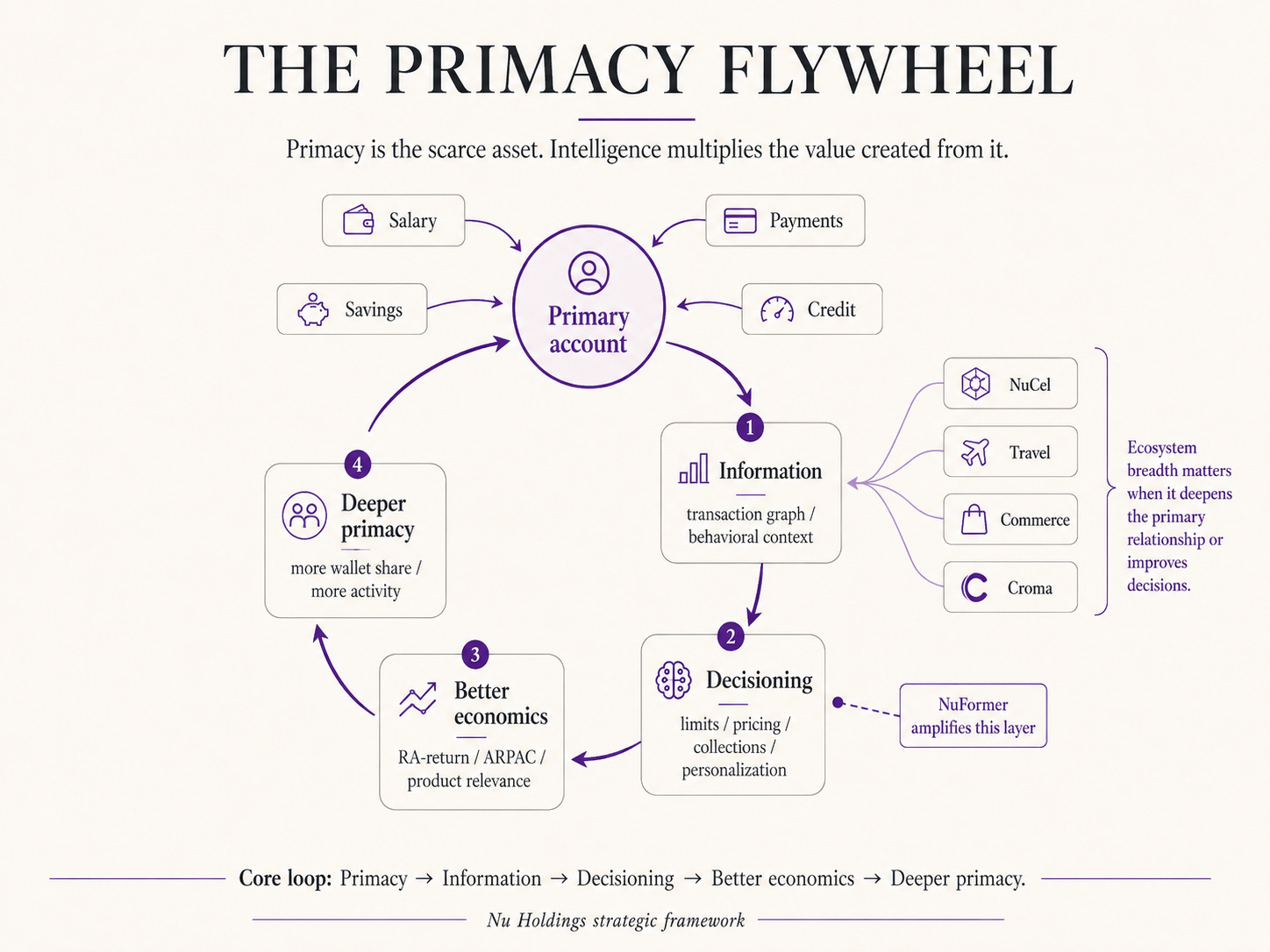
That framework still works, but 2Q26 suggests a clearer hierarchy. Primacy is the scarce customer position. Information is what primacy generates. Decisioning is the capability that converts information into economic action. NuFormer is therefore an amplifier of the moat, not the moat by itself.
AI architectures will diffuse. Compute can be purchased. Competitors can hire engineers. What is much harder to purchase quickly is the position inside a customer’s financial life that generates years of proprietary behavioral context.
The flywheel is better expressed as:
Primacy → Information → Decisioning → Better Economics → Deeper Primacy.
Ecosystem breadth still matters, but as a complement rather than a separate thesis. In 4Q25 we argued that Nu’s architecture resembles proprietary aggregation: additional services such as NuCel, travel and commerce can create more interactions and feed information back into the financial decision engine. That remains plausible. The test for every adjacency, however, should now be stricter: does it deepen the primary relationship or materially improve the decisions made from it?
NuFormer makes this loop more powerful. Management says improvements to its common backbone can propagate across downstream applications; the latest generation quadrupled context length, training and inference speed, and can reach comparable predictive performance with 20 million fine-tuning rows where older approaches required more than 400 million. It now supports credit in Brazil and Mexico, unsecured lending, customer service and more than 100 marketing campaigns.
What management still does not disclose is equally important: we do not know the incremental approval rate, loss rate or risk-adjusted return of a NuFormer cohort versus an equivalent previous-model cohort. 2Q26 shows differentiated system outcomes. It does not yet isolate AI attribution.
Taking More Risk, Making More Money
That distinction matters because the most impressive economic result this quarter was not lower risk. Nu intentionally added risk.
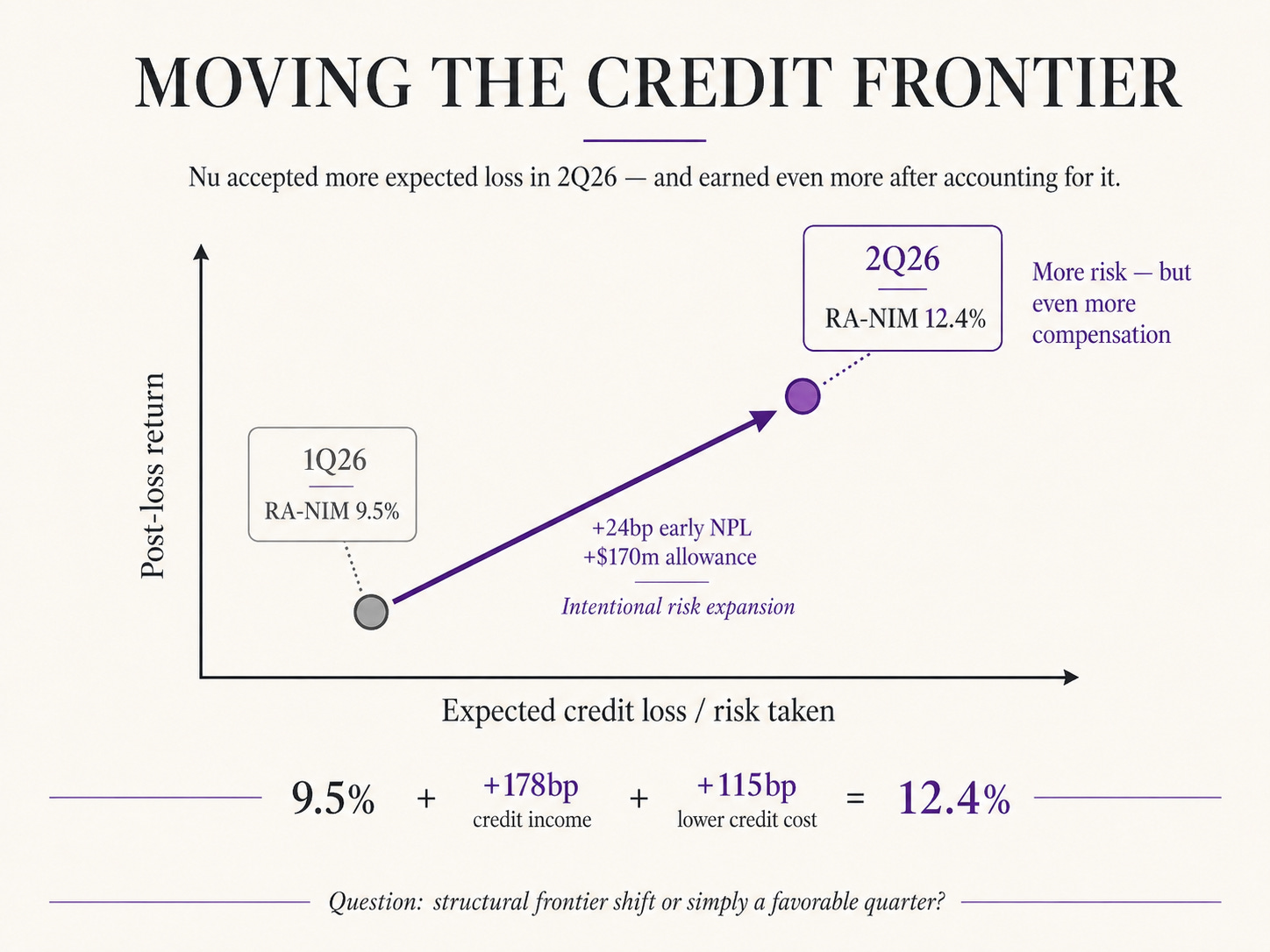
Seasonality reduced the 15–90 day delinquency ratio by 37 basis points; deliberate expansion into higher-risk, higher-return cohorts added 24 basis points back. Those same decisions added approximately $170 million to the credit-loss allowance. Yet early delinquencies still improved to 4.8%, and risk-adjusted NIM reached 12.4%.
This is the progression we wanted to see after 4Q25. Then, Nu expanded credit availability and IFRS 9 forced expected losses to be recognized before the associated balances had generated their full revenue. 1Q26 absorbed much of the cost. 2Q26 began to show the other side: credit income contributed 178 basis points to sequential RA-NIM expansion and lower credit cost another 115 basis points.
The relevant objective of a lender is not to minimize defaults. It is to identify which expected defaults are worth accepting because the yield more than compensates for them. 2Q26 is the strongest evidence yet that Nu may be moving the efficient frontier outward.
The caveat is important. Desenrola helped cost of credit; seasonality helped; and Livingston explicitly refused to call 12% RA-NIM a floor. Management is effectively giving investors permission to contemplate a higher normalized regime while warning them not to annualize 12.4%. The next two quarters will tell us whether the durable number begins with 11 or falls back toward the old 9–10% range.
Mexico Becomes the Second Experiment
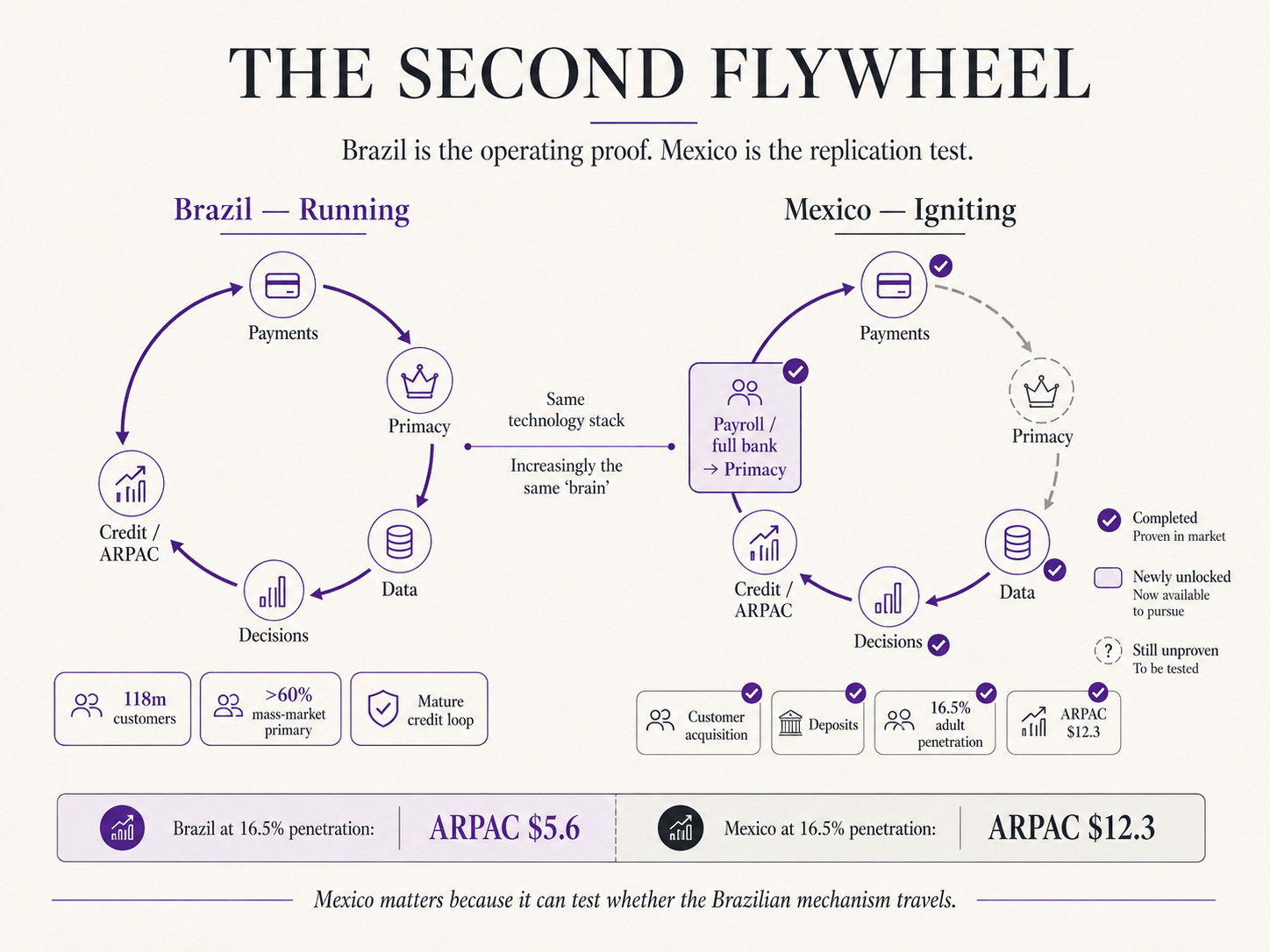
Mexico is now useful for a different reason. In 2Q25, the critical experiment was funding: Nu cut deposit yields and customers largely stayed. Trust had become an economic asset; Nu did not have to permanently buy deposits with the highest rate.
The full banking license now unlocks the next experiment: can trust become primacy?
Mexico already reaches 16.5% of adults, approximately the penetration Brazil had in 2020, but generates $12.3 of ARPAC versus Brazil’s $5.6 at the comparable stage. Management attributes that to higher income, stronger credit-card unit economics and larger earning balances. Mexico also has only a 35% loan-to-deposit ratio, leaving substantial room to convert funding into earning assets.
The banking license matters because payroll direct deposits and a fuller product set make it possible for Nu to become the account around which everyday financial activity organizes. Meanwhile, Mexico is standardizing payment interfaces in a way management explicitly compares with the regulatory conditions that helped Pix accelerate Brazilian digital banking.
But the bar has not moved. In 1Q26, we said Mexico becomes valuation-relevant when it moves from evidence of transferability to a material second earnings engine. 2Q26 does not clear that bar. What changed is that the mechanisms required to clear it are increasingly in place.
A Better Bank, or a Different Kind of Bank?
This is now the variant perception. The market does not need to be wrong about Nubank’s credit exposure for the stock to work. The base case only requires the market eventually to conclude that Nu is a premium financial compounder whose high ROE and superior post-loss economics are durable. A full platform classification is additional upside, not a prerequisite.
Using 2029 as the three-year earnings horizon, I would frame the outcomes as follows:
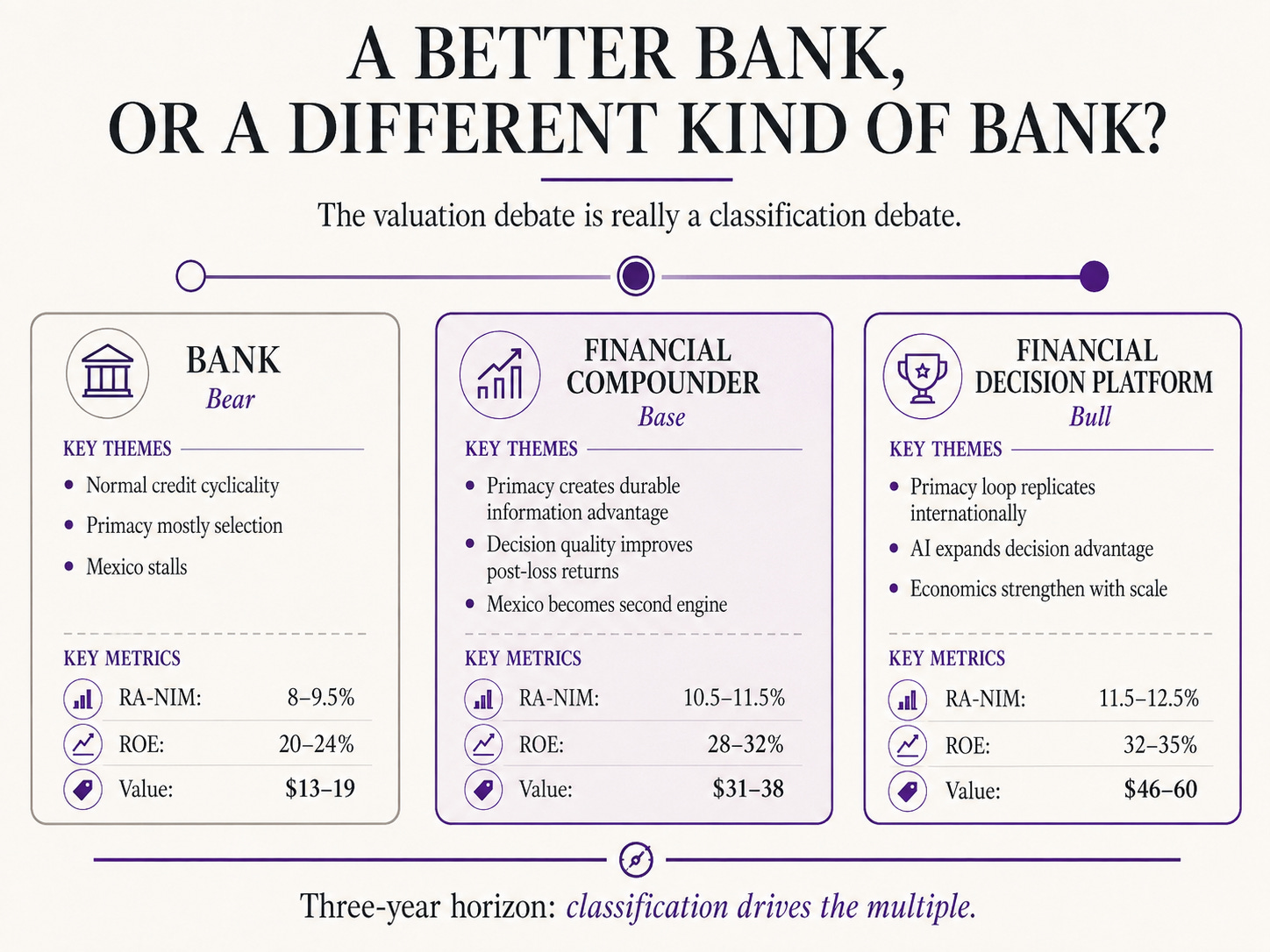
The bear case is not that Nubank fails. It is that higher-risk growth eventually behaves like higher-risk growth, RA-NIM compresses, Mexico fails to become material and Nu remains valued as a cyclical emerging-market bank. The base case requires no software multiple: roughly 20% revenue compounding, around 30% ROE and post-loss margins above 10% are enough. The bull case requires something structurally different, Mexico reproduces the Brazilian loop, primary-account density continues widening credit economics, and the decision engine scales those advantages across markets.
Evidence, Then Pattern
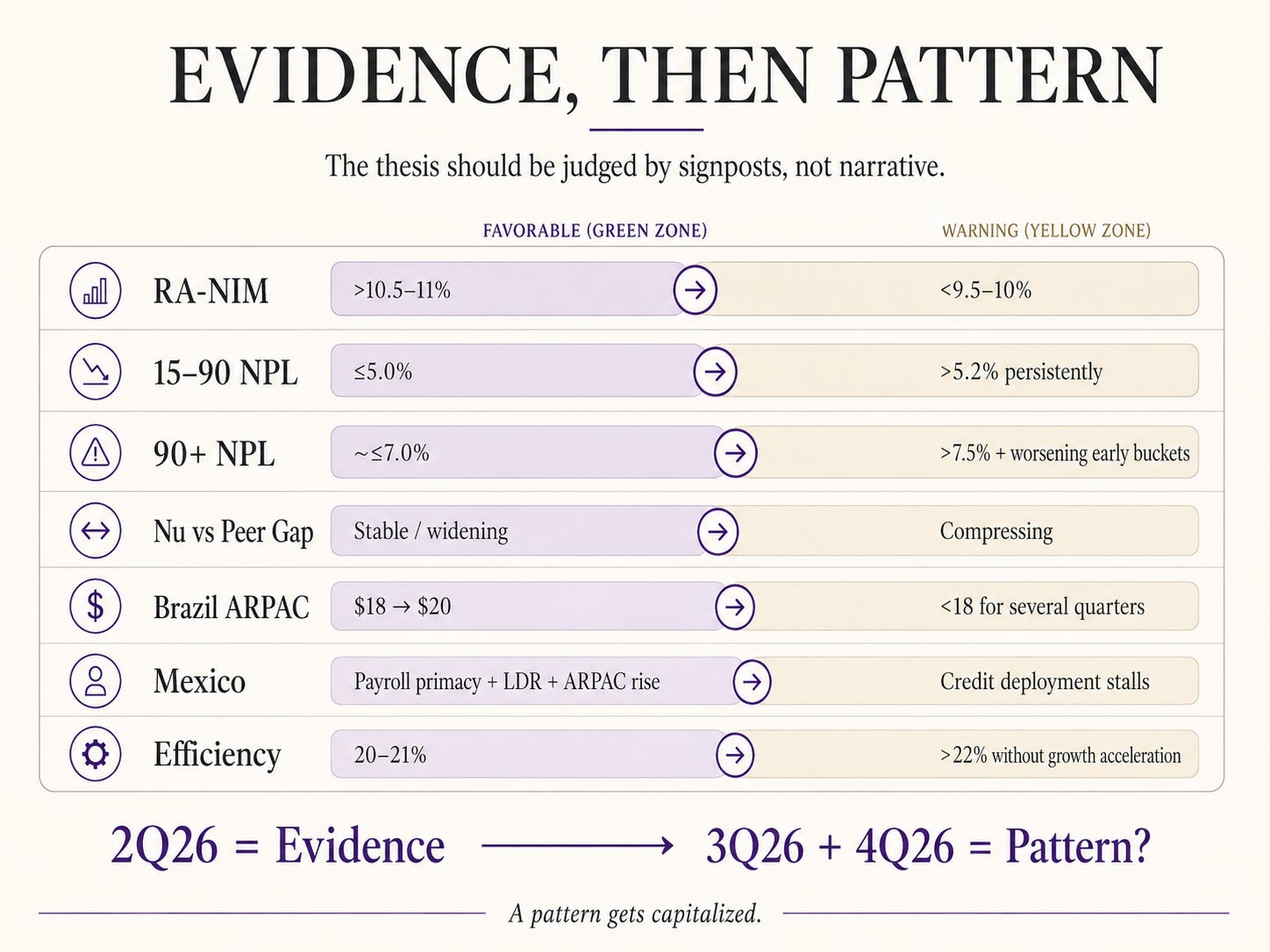
The next four quarters should be judged against hard signposts, not narrative. RA-NIM averaging above roughly 10.5–11% would strengthen the higher-regime argument; a fall below 9.5–10% without a strategic explanation would challenge it. Early NPL should remain around or below 5% outside normal 1Q seasonality, while 90+ NPL moving beyond roughly 7.5% alongside worsening early buckets would be a serious warning. Most importantly, the Nu-versus-peer cohort gap should hold or widen; compression because Nu deteriorates would attack the primacy thesis directly. Brazil ARPAC should move beyond $18 toward $19–20, while Mexico should show rising payroll/primary-account adoption, LDR and ARPAC without sacrificing funding discipline. Efficiency around 20–21% would demonstrate that these investments are still occurring inside a structurally low-cost model.
1Q26 ended with a useful discipline: one quarter can be explained; a pattern gets capitalized. 2Q26 supplies the first evidence that Nubank’s left tail may genuinely be narrower than that of the institutions from which it is taking share. More importantly, it offers a mechanism: primary relationships generate richer information and potentially greater payment priority; Nu’s decisioning infrastructure converts those advantages into profitable risk-taking; better economics allow Nu to deepen the relationship further.
That is a more demanding thesis than “Nubank has better AI,” and a more valuable one if it is true. 3Q26 and 4Q26 now have a simple job: show that 2Q26 was not merely a very good quarter, but the first visible consequence of a compounding primacy advantage.
Disclaimer:
The content does not constitute any kind of investment or financial advice. Kindly reach out to your advisor for any investment-related advice. Please refer to the tab “Legal | Disclaimer” to read the complete disclaimer.