


TL; DR
Our earlier credit thesis was too broad: Nubank’s delinquency advantage is strongest in the mass market, where it leads large banks by about 5.5 percentage points, but that advantage narrows in middle-income customers and reverses at higher incomes. The evidence points less to universally superior algorithms and more to customer selection, primacy and repayment behavior.
Payroll reform changes the source of advantage: Nubank can now reach borrowers previously tied to incumbent employer-payroll relationships, but competitors can also secure payroll deductions from customers who still use Nubank as their primary account. The address of the paycheck matters less when another lender can claim repayment before the money arrives.
The right scoreboard is risk-adjusted return, not delinquency: recurring risk-adjusted margin improved, but delinquencies are also rising as Nu deliberately expands into higher-risk credit. The next proof is whether those newer cohorts generate durable returns after funding costs, realized losses and capital consumption.
In August’s The Left Tail, Narrowed, I argued that Nubank’s primary-account relationships were beginning to produce something more valuable than customer growth: demonstrably better credit outcomes. The logic was compelling. A bank receiving a customer’s salary knows more about that customer’s finances, has a better opportunity to underwrite their borrowing, and may be the first institution they choose to repay when money becomes scarce.
Third-quarter results strengthened parts of that argument. Nu’s credit portfolio grew 33%, recurring risk-adjusted interest margin improved, and the company earned $1.09 billion in net income with a 32% return on equity. Yet the quarter also exposed a consequential error in our evidence and a change in Brazilian banking regulation that could alter the source of Nubank’s advantage.
The question is no longer simply whether Nubank has better credit models. It is whether the information and repayment priority associated with being a customer’s primary bank remain advantages that competitors cannot easily reproduce.
The Advantage We Overstated
Our August argument relied heavily on a chart comparing credit-card delinquency across Brazilian income groups. We wrote:
The key disclosure sits on slide 20. Nubank showed Brazilian credit-card 90+ delinquencies by income cohort alongside comparable Brazilian financial institutions. In the Mass Market cohort, Nu’s NPL rate moved from roughly 9.1% in July 2025 to 8.7% in May 2026. The S1-S2 peer group excluding Nu moved from 13.9% to 20.6%. The absolute gap therefore widened from 4.8 percentage points to 11.9 points.
That comparison was wrong. The 13.9% starting point belonged to the smaller S3–S5 institutions, not the large S1–S2 banks. Nubank’s new presentation allows us to reconstruct the correct comparison.
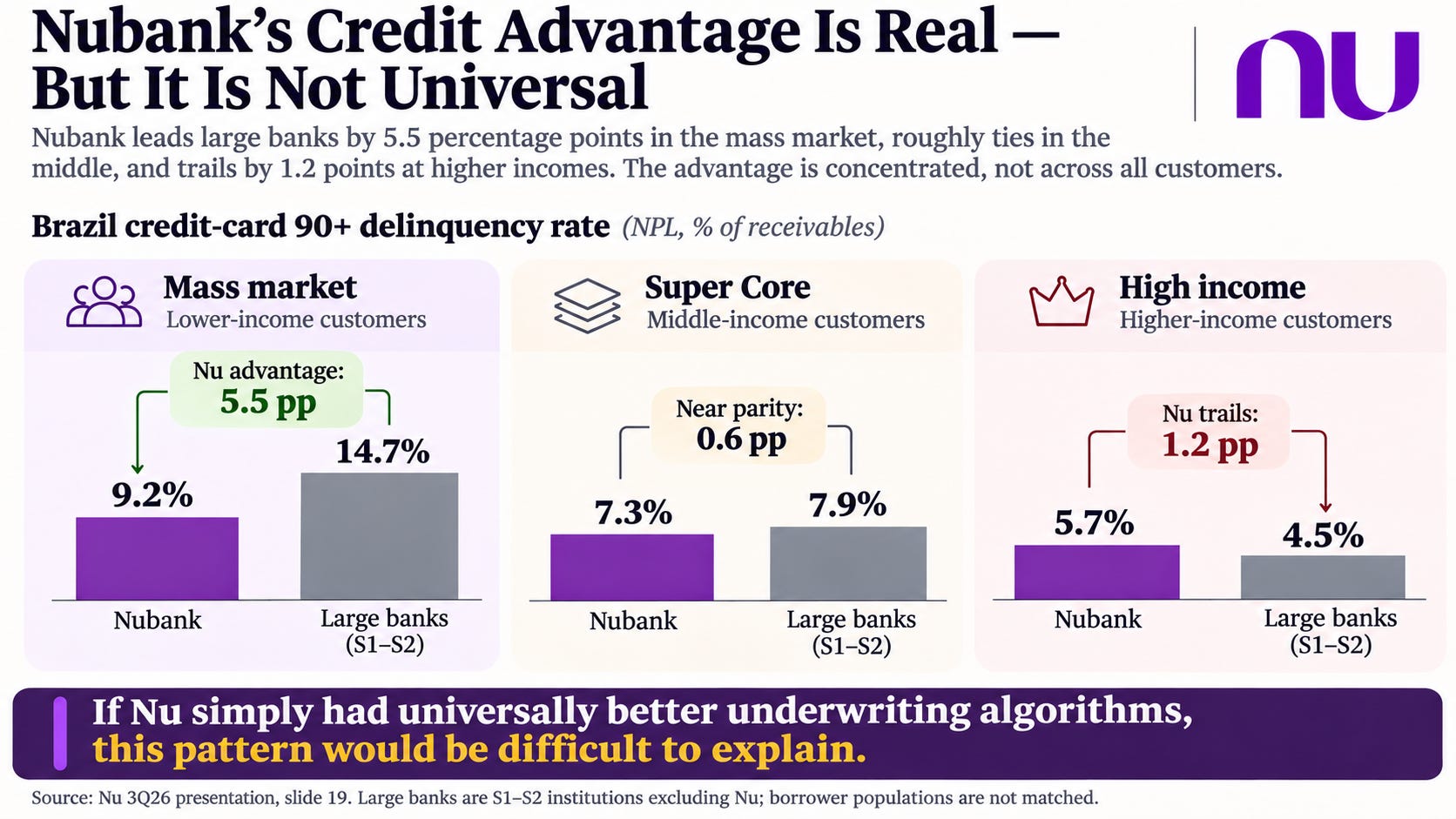
Source: Nu 3Q26 presentation, slide 19. Large banks are S1–S2 institutions excluding Nu; borrower populations are not matched.
The correction changes more than the magnitude of the advantage. Nubank leads large banks by 5.5 percentage points in the mass market, roughly ties them in the middle and trails them by 1.2 points among higher-income customers.
If Nubank’s superior performance came simply from universally better algorithms, that pattern would be surprising. It suggests that where banks acquire their customers, which customers choose them as their primary institution and which borrowers they elect to serve may matter as much as the sophistication of their models.
The chart does not establish which explanation is correct. It does, however, narrow the thesis considerably. Nu has a meaningful advantage in its strongest customer segment, not a demonstrated underwriting advantage across Brazilian banking.
Where the Paycheck Lands
David Vélez provided the most revealing explanation during the earnings call:
Being the primary bank account means effectively you get positive selection, not negative selection. You get positive selection, and you are, in a way, senior in the credit stack of the customer. You are the card that consumers will pay first. That gives us a huge advantage in underwriting credit and managing delinquency in a tougher scenario. We’re not the marginal lender. We’re not the one that’s given the fifth card or the sixth card or the sixth loan.
Vélez is describing two related but distinct mechanisms. The first is selection: customers who make Nubank their primary institution may have characteristics that make them better borrowers. The second is repayment priority: a customer who relies on Nubank for daily financial activity may choose to repay it before a peripheral lender.
Both can produce superior credit outcomes without requiring a uniquely powerful algorithm. Information from salary deposits and everyday transactions can reinforce the advantage, but the reported delinquency comparison cannot separate selection, information and repayment behavior.
There is also an important distinction between being paid first by customer preference and having a legally senior claim on income.
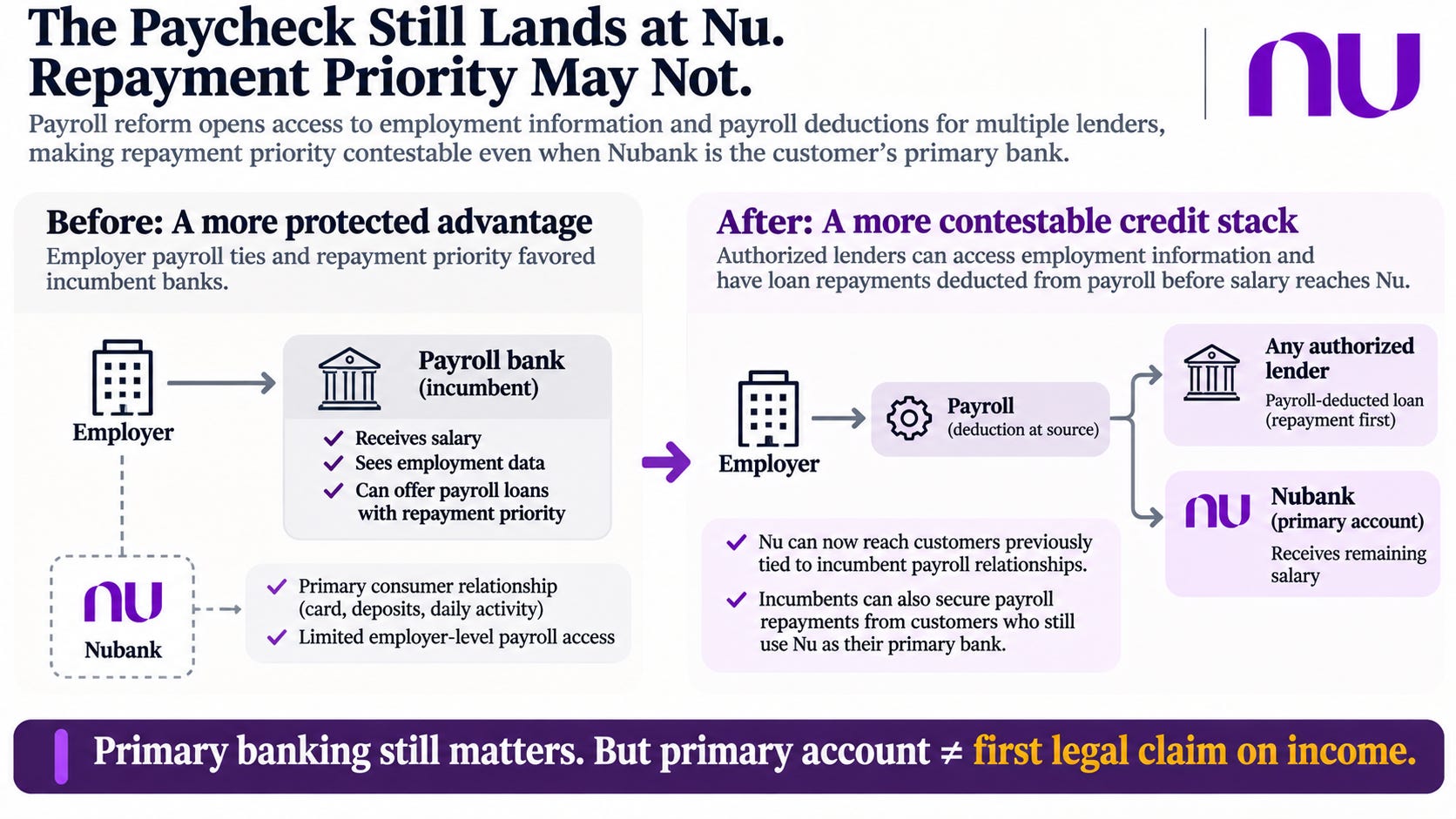
Brazil’s Crédito do Trabalhador reform, introduced in March 2025 and subsequently enacted into law, makes that distinction economically important. Authorized lenders can offer payroll-deducted loans to eligible formal-sector employees without first negotiating an exclusive arrangement with their employers. With the required permissions, lenders can obtain employment information, and repayments are deducted through the payroll system before the remaining salary reaches the employee’s bank account.
The reform changes who can obtain information and repayment priority, not merely how conveniently consumers can borrow.
Former CFO Guilherme Lago explained the opportunity in May:
...it will allow us to have access to customers and data that we have been unable to do as we don’t have a corporate business. So if you are today an employee of a large corporate in Brazil, most likely that corporate has a payroll agreement with one of the top five incumbent banks of the country. And we historically have had some limitations on the amount of data that we could get from those customers by virtue of not being able to offer that payroll services.
Historically, the bank serving a large employer possessed privileged access to employees and their income information. Nubank could win a consumer’s card and deposit account without controlling the employer relationship. The reform reduces that disadvantage by allowing Nu to compete for payroll lending without first displacing the corporate payroll bank.
But the same mechanism works against Nubank.
A customer may receive their salary into Nubank and consider it their primary bank, while another lender collects a payroll-loan installment before the money arrives. The external lender has contractual repayment priority over that portion of income, even if Nubank remains the customer’s preferred account.
This does not destroy primacy. Payroll deductions are limited, and the primary account still provides valuable transactional information, deposits and customer engagement. The reform also does not extend the same mechanism to informal-sector workers without eligible payroll arrangements.
Nevertheless, for formal workers, part of the historical advantage associated with controlling the salary relationship has become contestable.
The address of the paycheck matters less when another lender can reach it before it arrives.
The Incumbent Is Running the Same Race
Itaú’s third-quarter call provides an unusually useful comparison because it describes the same Brazilian credit environment from the opposite position.
CEO Milton Maluhy explained why Itaú had deliberately surrendered credit-card market share:
Probably we lost the market on some lines. We were aware. This is by design. Our market share in credit cards dropped by design. We took the decision to reprofile our entire portfolio. We had to renounce market share, and thank God we did because otherwise the results were not as strong as we got them.
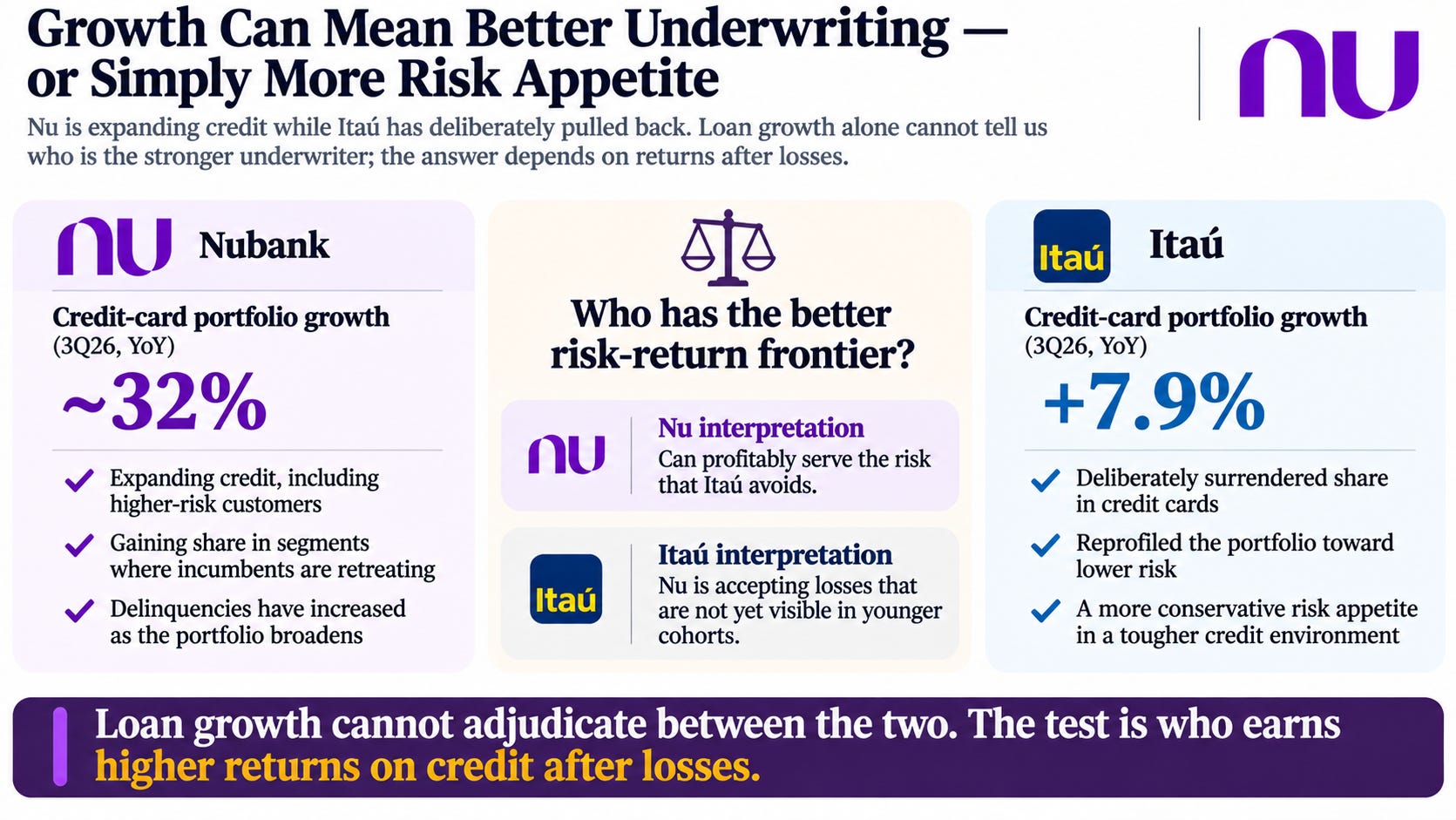
Itaú’s card portfolio grew 7.9% over the year, compared with roughly 32% currency-neutral growth at Nubank. But Itaú’s growth was considerably stronger among middle- and higher-income customers, where it has longstanding relationships and a more favorable delinquency profile.
Maluhy’s comments raise the question our previous articles did not adequately address. When an incumbent deliberately withdraws from certain lending segments and a challenger expands into them, should we interpret the challenger’s growth as evidence of superior underwriting or simply greater willingness to accept risk?
The answer depends on the returns earned after losses.
Nu could have a genuinely superior risk-return frontier, allowing it to profit from borrowers Itaú cannot serve economically. Equally, Itaú could be sacrificing present growth to avoid losses that will become evident only after newer loans mature.
The payroll reform intensifies this competition. Itaú is defending established income and employer relationships while Nubank is trying to enter them. Both banks are increasingly competing over repayment priority, not simply card issuance or app engagement.
The economic winner will not necessarily be the institution that books the most loans. It will be the one that consistently earns the better return on the credit risk and capital it assumes.
The Right Scoreboard
Vélez made this distinction explicit:
We don’t make decision based on a specific NPL or delinquency number we have to hit. We make a decision based on, is this decision, this credit loan, is this credit limit NPV positive, assuming a worsening scenario, yes or no?
That is the correct objective. A bank should not minimize delinquencies at all costs. It should accept additional risk when the expected interest income, after funding, credit losses, servicing and capital costs, produces attractive returns.
Nu’s latest figures support the argument, although not without qualifications.
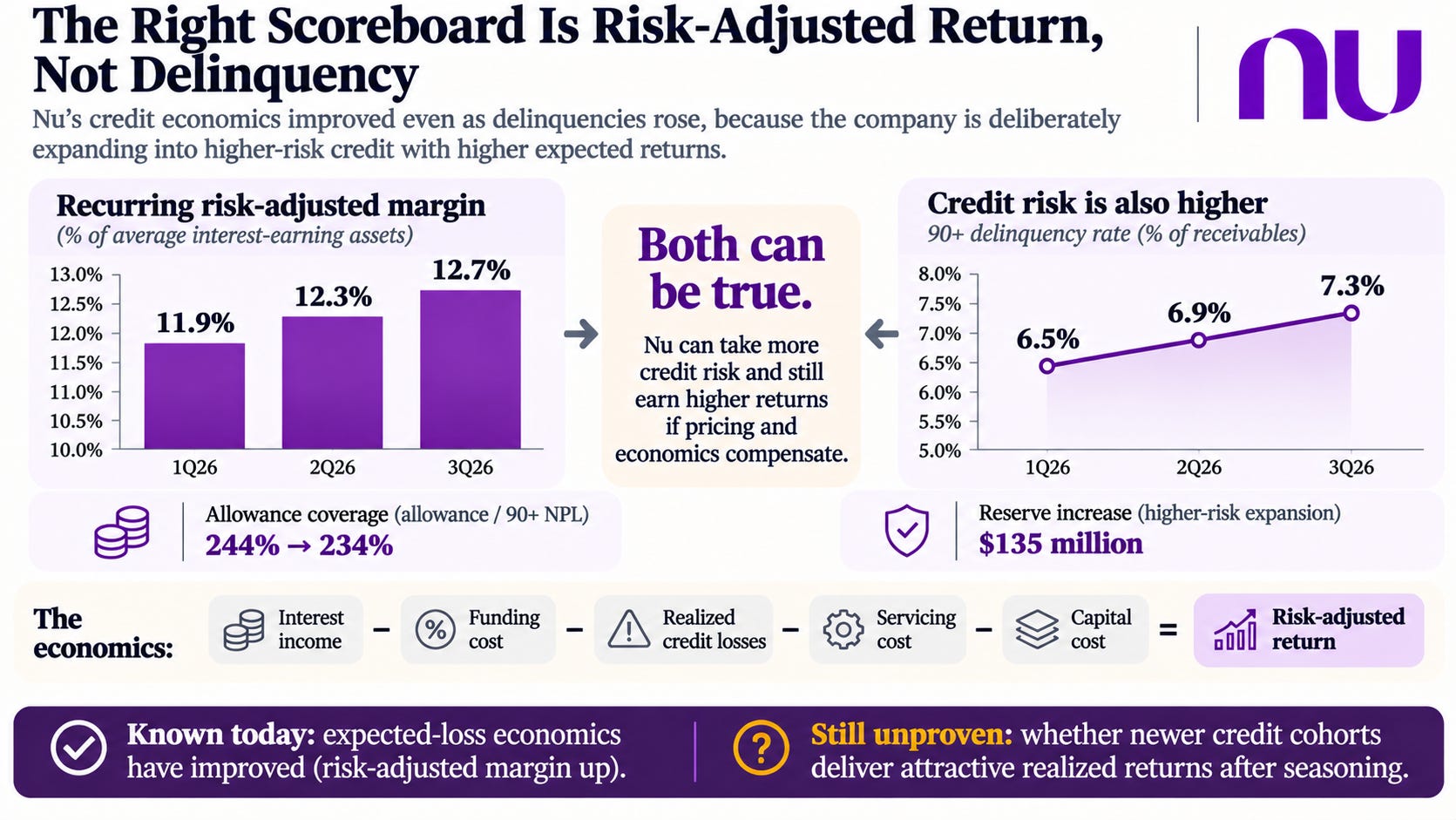
Reported risk-adjusted net interest margin declined from 12.4% in Q2 to 12.1% in Q3. But Q2 benefited from a nonrecurring Desenrola item, while Q3 included a charge associated with failed payment institutions unrelated to ordinary consumer lending. Excluding those identified effects, recurring risk-adjusted margin improved from 11.9% to 12.7%.
That is meaningful evidence that Nu is improving the economics it earns after its current expected-loss charges.
At the same time, 90-day delinquency increased from 6.5% in Q1 to 6.9% in Q2 and 7.3% in Q3. Even measured against the interest-earning portfolio, delinquency rose from 11.6% to 12.1%. Management attributed $135 million of the quarterly reserve increase to intentional expansion into higher-risk lending, while allowance coverage of 90-day delinquencies declined from 244% to 234%.
These trends are not contradictory. Nubank may rationally be lending to riskier borrowers at sufficiently attractive prices. But the risk-adjusted margin depends on expected future losses, while the newer loans have not yet demonstrated their realized credit performance through a full cycle.
We also owe readers another correction. In Q1, we established 6.8% NPL as a warning threshold. That was breached in Q2, and our August article shifted the warning toward 7.5% without adequately explaining why. A changing loan mix may justify changing the threshold, but not without revisiting the economics behind it.
The better test is whether Nubank earns durable incremental profit from the additional risk it assumes. Seasoned credit cohorts, realized losses, funding expenses and capital consumption matter more than one quarter’s delinquency or adjusted margin.
Mexico provides a related test of whether the franchise can travel. Nu now operates there as a fully licensed bank, with greater deposit protection and the ability to offer payroll accounts. It has 16.6 million customers, but customer acquisition alone does not establish primary banking. Its deposit balance declined from $5.7 billion to $5.3 billion as management optimized funding costs. The relevant question is whether more customers move their everyday financial lives to Nu, allowing the Brazilian relationship advantage to emerge with similarly attractive credit economics.
What Is the Advantage Worth?
Nu’s valuation has compressed alongside Brazilian financial stocks. At the November 12 pre-earnings close of $11.83, the shares traded around 11 times FY2027 consensus earnings of approximately $1.09. I think that understates the quality of Nubank’s mass-market franchise, but consensus may still be optimistic about near-term profits.
Management expects Brazil’s tax rate to rise toward the low-to-mid-20s in 2027. A weaker real would also reduce dollar earnings. My estimate is closer to $0.97 for FY2027 EPS, making the stock roughly 12 times next year’s earnings rather than the approximately 11 times implied by consensus.
The three-year outcomes have changed substantially since August.
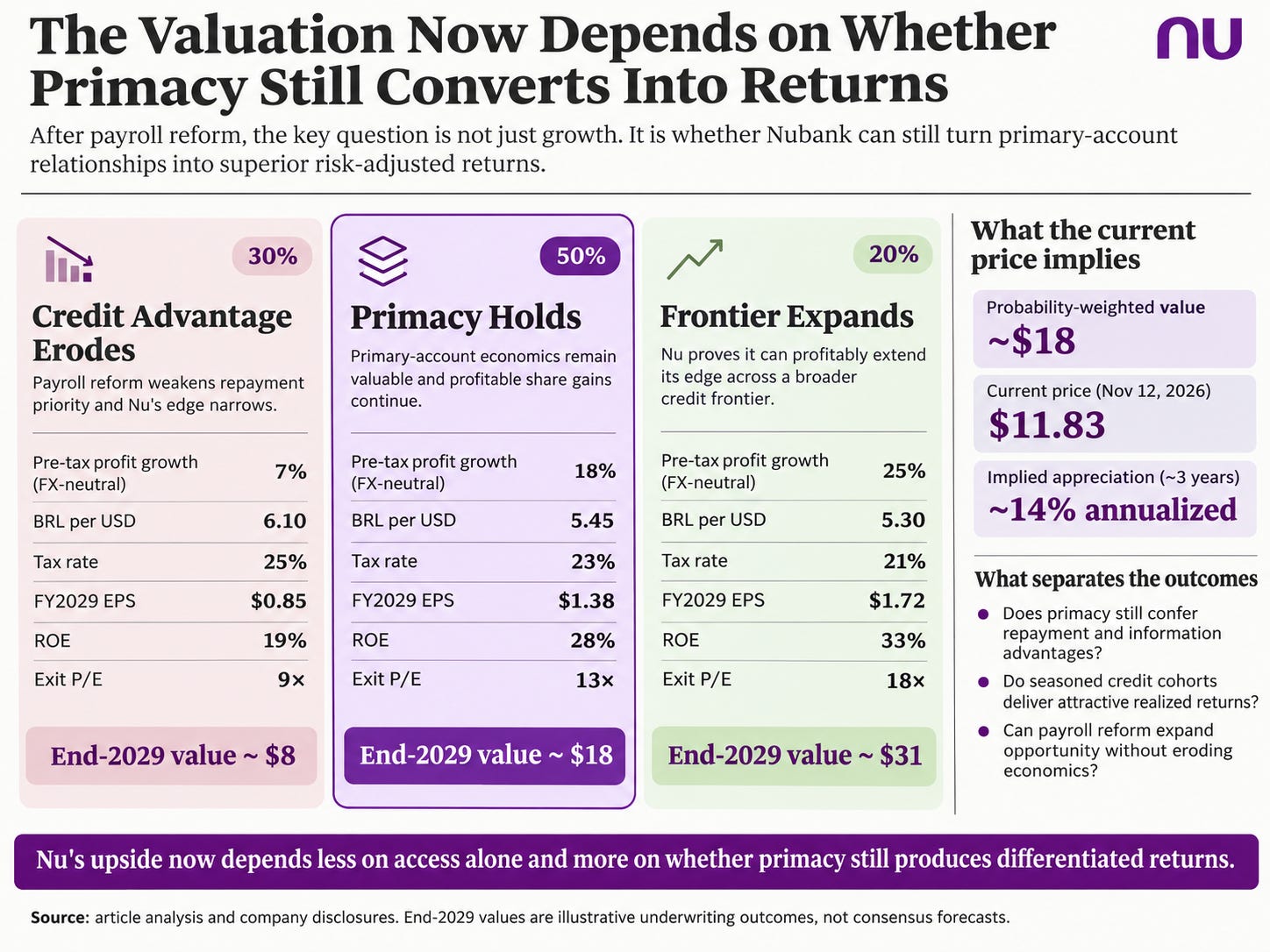
The earlier central valuation of $31–38 assumed both faster earnings growth and a higher multiple. I no longer think that combination is justified before Nubank demonstrates superior returns across seasoned credit portfolios and the competitive consequences of payroll reform become clearer.
Our revised central outcome assumes that primacy remains valuable, that Nu continues gaining profitable credit share and that Mexico gradually contributes. It does not assume a software-like multiple for a bank whose earnings remain exposed to Brazilian credit conditions, currency and regulatory capital requirements.
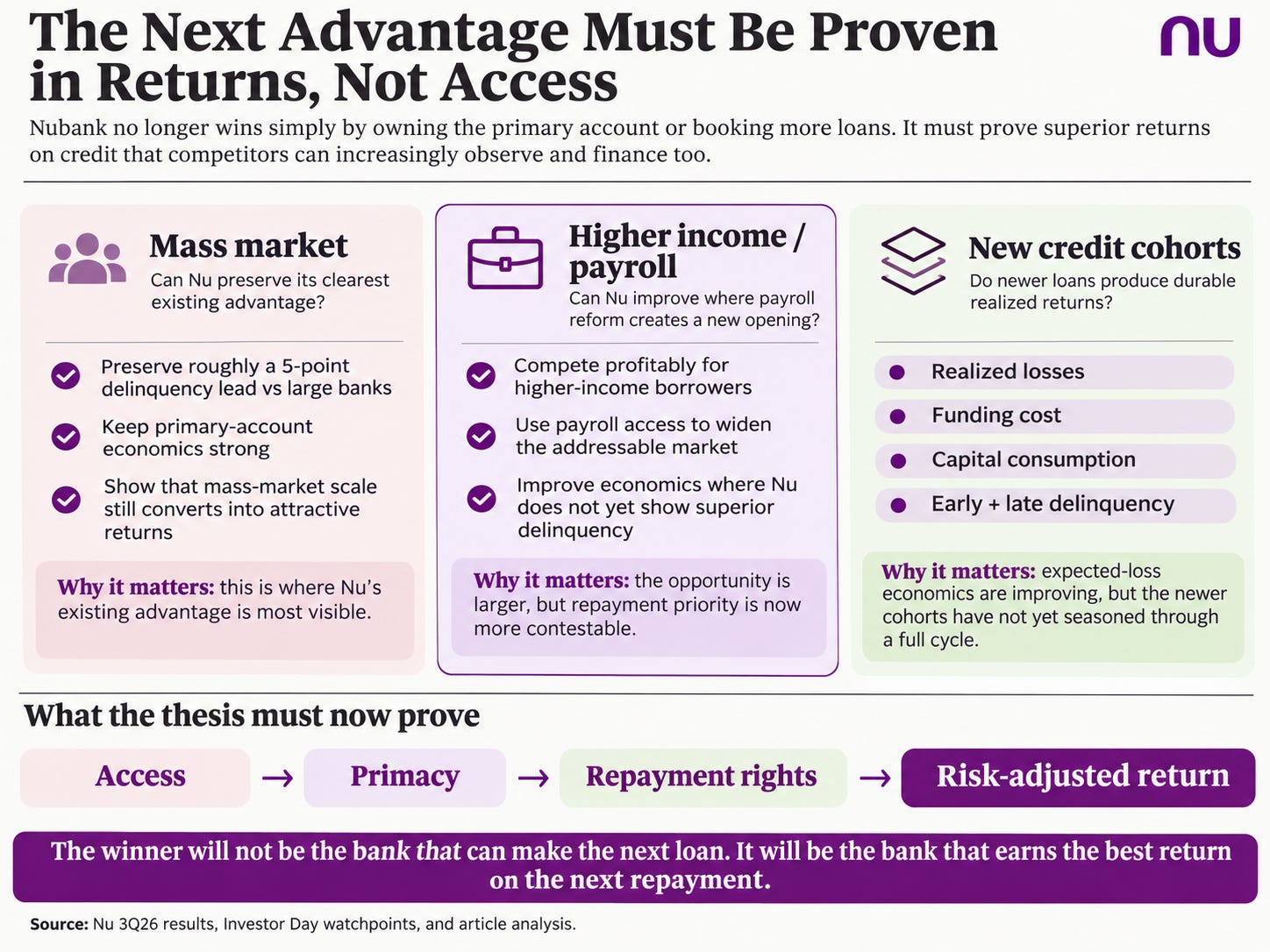
The evidence required is unusually concrete. December’s Investor Day should clarify private-payroll growth and the economics of new lending cohorts. Subsequent results need to show recurring risk-adjusted margin remaining healthy without a persistent deterioration in early and late delinquencies. The most important competitive test is whether Nubank preserves its five-point mass-market delinquency lead while improving its position in higher-income lending, where payroll reform creates a new opportunity.
In August, we argued that primacy was the asset and intelligence its multiplier. That remains a useful description, but it needs one qualification: the value of primacy depends on which information and repayment rights the relationship actually provides.
Brazil has changed the rules under which some of those rights can be obtained. Nubank can now reach borrowers historically protected by incumbent payroll relationships, while those same incumbents can secure repayment from customers who bank primarily with Nu.
The bank’s next advantage will not be demonstrated by having the most sophisticated algorithm or the lowest delinquency ratio. It will be demonstrated by earning superior returns on risks its competitors can increasingly observe and finance as well.
The competition is moving from the account that receives the paycheck to the lender that can profitably claim the next repayment. Nubank’s opportunity is larger, but its advantage must now prove itself on that new terrain.
Disclaimer:
The content does not constitute any kind of investment or financial advice. Kindly reach out to your advisor for any investment-related advice. Please refer to the tab “Legal | Disclaimer” to read the complete disclaimer.
Where the paycheck lands is basically SoFi's pitch too. Their CEO said checking can't be judged on cost of funds alone, because it shows them a member's mortgage payment, other loans and card debt. SoFi Money products are at 8.5M, up 34%