


TL; DR
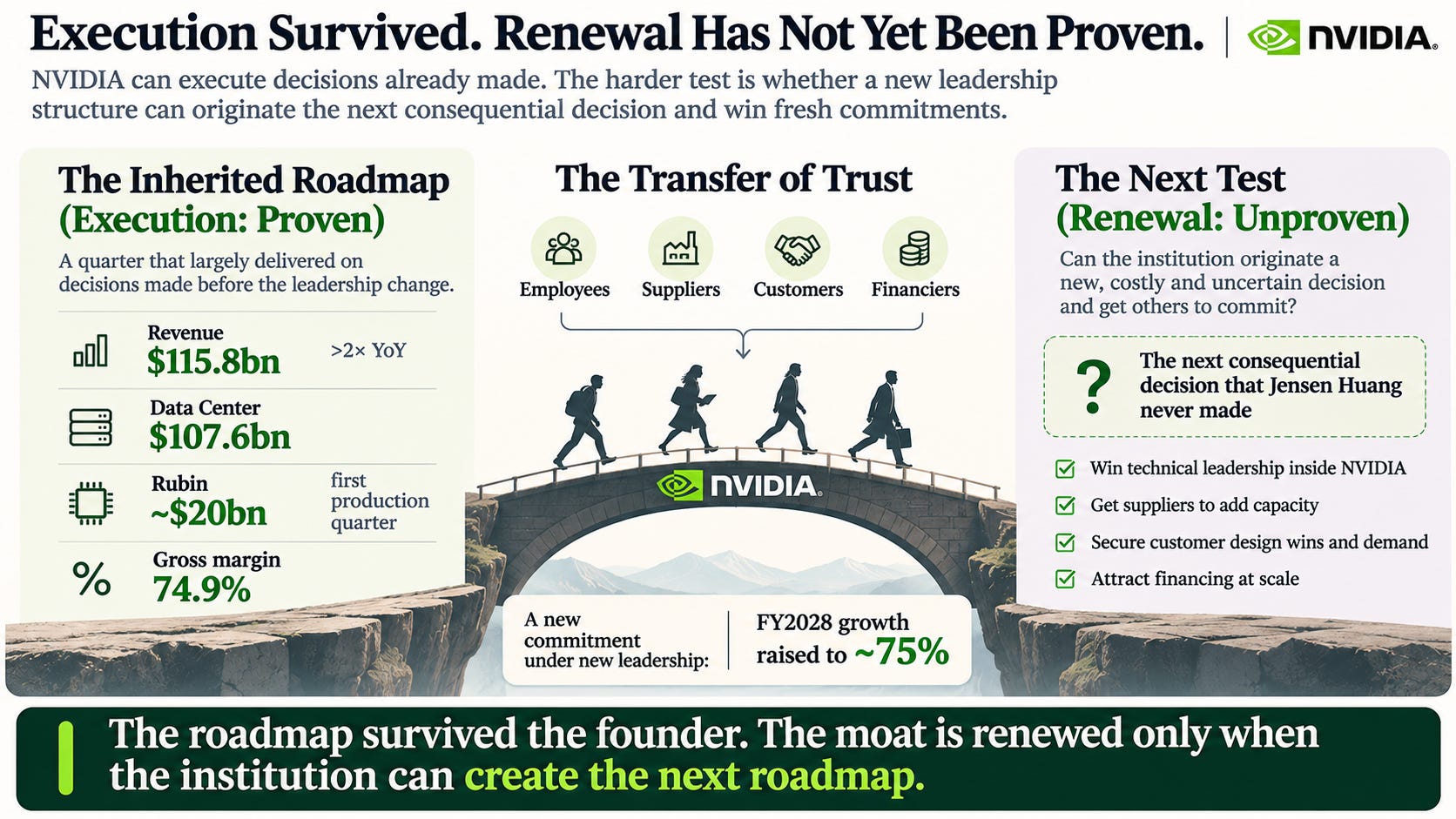
The immediate continuity test was passed: revenue reached $115.8 billion, Rubin shipped nearly $20 billion in its first production quarter, Data Center hit $107.6 billion, and management raised FY2028 growth guidance to roughly 75%. The organization can clearly execute an inherited roadmap without Jensen Huang in the CEO chair.
But execution is not the same as institutional renewal: much of NVIDIA’s advantage came from repeatedly expanding the scope of competition before rivals could close the previous gap. We treated that capacity too readily as a corporate characteristic when many of the consequential decisions: CUDA, systems, networking, customer financing were closely associated with Huang’s judgment and authority.
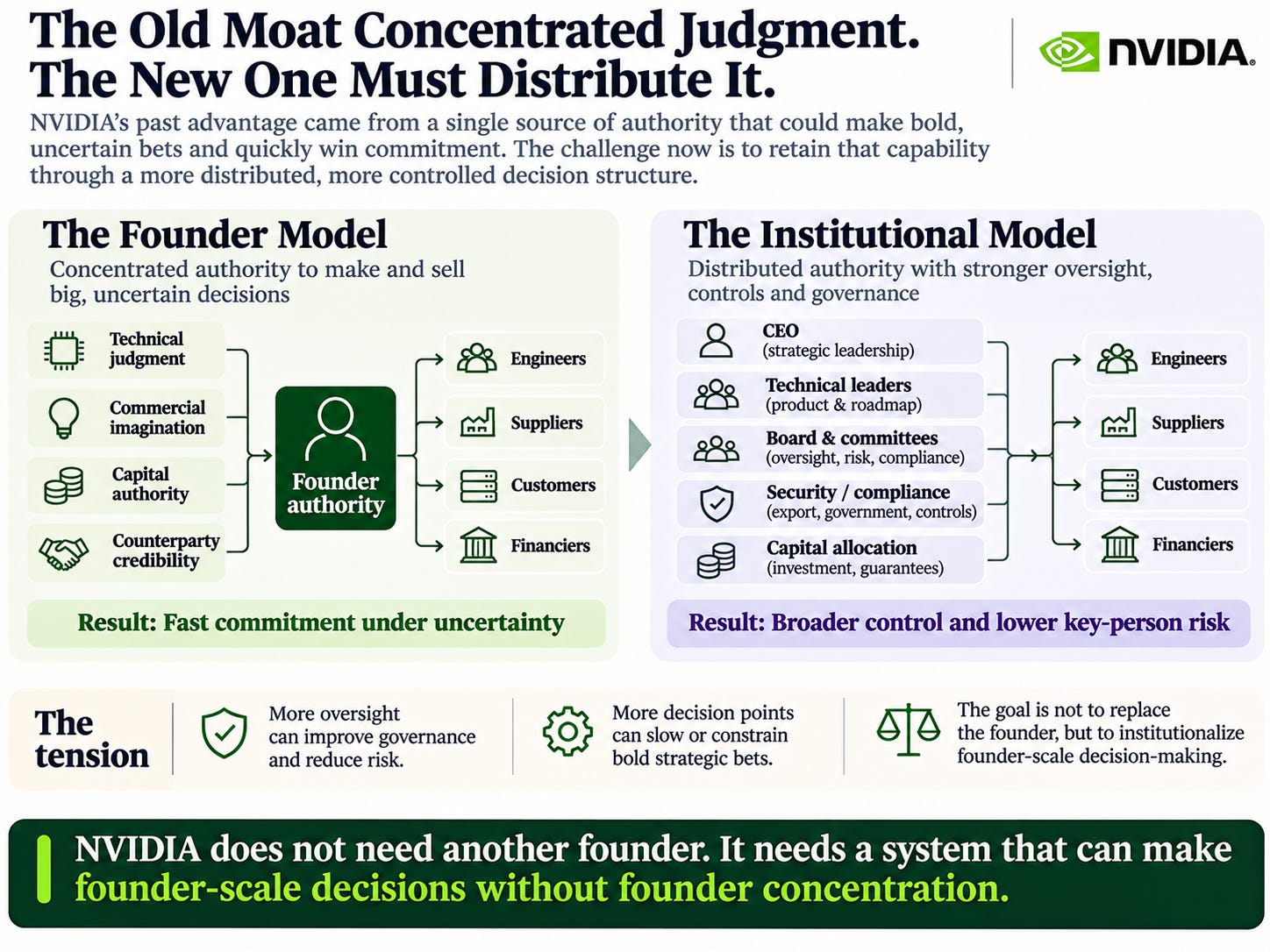
The next moat is the institution’s ability to recreate commitment: stronger oversight, export controls and tighter capital discipline may reduce strategic freedom even as they improve governance. NVIDIA does not need another founder figure; it needs to prove that a different leadership structure can originate a costly, uncertain strategic decision and persuade engineers, suppliers, customers and financiers to back it.
Hours before NVIDIA reported its third-quarter results, Jensen Huang offered to return. In his first public statement since resigning, he acknowledged his mistakes, described the calls from employees, investors and business partners, and said he would be “honored to answer these calls and return as CEO.” The founder remained available and capable of commanding allegiance. Colette Kress was about to ask those same people to believe in a company under different leadership. Before she could make that case, chairman Harvey Jones had to establish whose decisions would govern it. He did so before Kress presented a single number:
On November 12th, our Board of Directors announced that after disclosure of personal behavior inconsistent with the company’s code of conduct, standards, and cultural norms, Jensen Huang voluntarily resigned his positions as President, CEO, and board member. The NVIDIA Board unanimously accepted his resignation and does not intend to reinstate Jensen as CEO. The Board appointed Colette Kress, NVIDIA’s longtime and well-respected CFO, as interim CEO. In addition, the Board announced it was initiating a search for a permanent chief executive, and we have since retained Heidrick & Struggles to lead the search. While this was an unexpected transition, the Board acted deliberately and in the best interest of the company’s employees, customers, partners, and shareholders.
The numbers that followed were exceptional: $115.8 billion of revenue, more than twice the previous year’s, and a higher growth forecast for fiscal 2028. But this series has increasingly described a business whose advantage depends on commitments made before their outcome is known. Suppliers expand capacity, customers build facilities, lenders advance money and engineers commit years of work. Huang helped persuade them to move together. The question on Tuesday was whether NVIDIA could preserve the judgment and authority that made those commitments worth making after the man who exercised them had gone.
The Chairman
I think the board was right to close the door. An interim chief executive cannot establish durable authority while counterparties expect the founder to reclaim it. More fundamentally, questions about conduct and controls during Huang’s tenure require an institution capable of investigating its former leader independently. His commercial achievements do not remove that responsibility, just as the investigation does not erase those achievements.
The public record is more complicated than either vindication or condemnation. Reporting about Huang’s relationship with a former executive of Megaspeed, a Singapore-based customer, has brought NVIDIA’s commercial controls into the controversy. The November 17 Justice–Commerce statement says Commerce began investigating Megaspeed in 2024, requested NVIDIA records in May 2025, and that NVIDIA placed the company on its no-sell list that June. DOJ subsequently took the lead in the criminal investigation of Megaspeed. This chronology establishes neither NVIDIA’s culpability nor the adequacy of its controls. An earnings beat cannot resolve either question. Jones described the board’s response:
This morning, the company announced that our Board has established a National Security and Export Control Oversight Committee that will include a select group of our independent Board directors, senior external advisors, and legal counsel. This committee will enhance our engagement with the U.S. government, including all relevant agencies. We will not be addressing or taking questions on today’s call regarding the circumstances of Jensen’s resignation and the ongoing investigation. Our Board will communicate further when appropriate.
The new committee gives the security and trade-compliance teams a direct reporting route to directors as well as to Kress. That could improve decisions by ensuring uncomfortable information reaches people able to act. It does not answer how effectively the board exercised oversight before the crisis. Directors are now managing the consequences of a concentration of authority they accepted while it produced extraordinary results.
That is the difficulty with NVIDIA’s inheritance. The authority that enabled unusual commercial bets also made succession unusually consequential. Stronger oversight must now preserve the ability to make decisions that cannot be justified by an existing customer’s order. A company can reduce its dependence on one person’s judgment and still become less capable of exercising judgment at all.
The Interim CEO
Kress had been chief financial officer for thirteen years and interim chief executive for five days. With an investigation open, she had limited freedom to explain the past. What she could establish was that the operating organization remained capable of delivering, and the quarter provided substantial evidence.
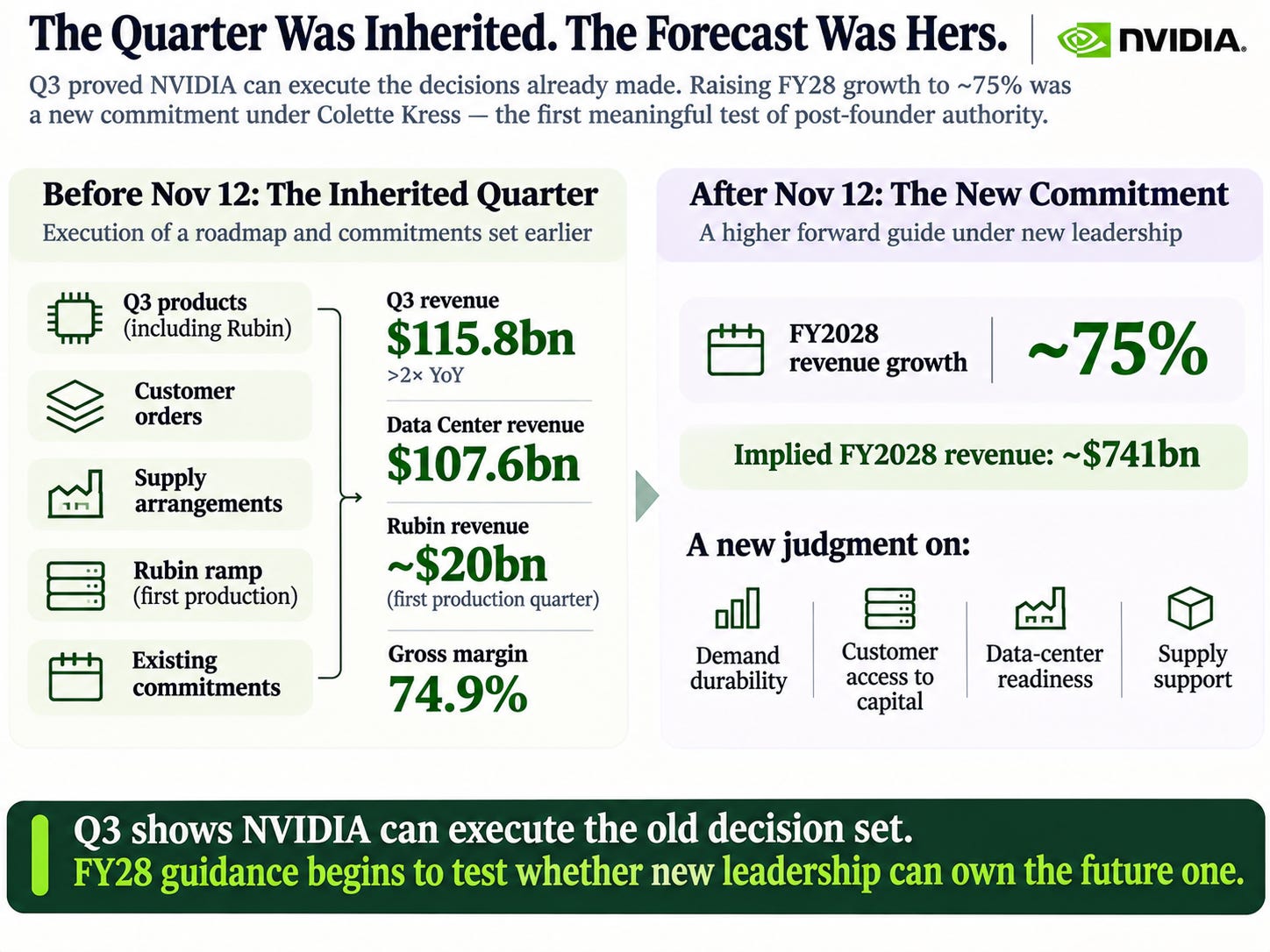
Revenue exceeded the $108 billion guidance midpoint by 7.3%. Data Center reached $107.6 billion; adjusted EPS was $2.68 and adjusted gross margin 74.9%. Rubin generated nearly $20 billion in its first quarter of production shipments. Management said hyperscale partners brought it into production in about a month, half the time required for Grace Blackwell. Networking exceeded $21 billion, and co-packaged optics for scale-out networking entered volume production. These achievements require coordinated engineering across NVIDIA and its partners; they cannot be attributed to one executive alone.
The quarter ended on October 25, before the leadership change. Its products, supply arrangements and orders were inherited. The forecast was a fresh commitment:
We are addressing strong demand for compute across a diverse and expansive set of end customers, including hyperscalers, frontier labs, AI natives, enterprises, and governments. This combined with increased support from our supply base, we are raising our fiscal year 2028 outlook. We expect revenue to grow approximately 75% year over year, up from 70% and off what is now a higher fiscal 2027 base. Our outlook considers data center readiness, the strength and durability of end customer demand, and our customers’ access to capital.
An interim chief in these circumstances had every reason to retain the existing outlook. Kress raised it. Applying 75% growth to FY27 revenue implied by the Q4 guidance midpoint gives approximately $741 billion for FY28. That is a calculation from management’s outlook, not a separately issued dollar forecast, but it shows the scale of the judgment she endorsed.
Q4 itself needs a calendar adjustment. The $130 billion midpoint includes fourteen weeks; a simple thirteen-week equivalent is $120.7 billion, approximately 4.2% above Q3. Shipment timing makes that an imperfect comparison. The much larger commitment is the following year’s growth, accompanied by expected gross margins of 72–73% after a Q4 trough of 71–72%.
Asked what would endure through the transition, Kress described the relationships behind that confidence:
From a business perspective, it’s business as usual. We’ve engaged with our customers, we’ve engaged with our suppliers, our partners. They’re all 100% behind us. Customers have expressed their support to the business outlook and helping us through that. They’ve been working closely with our suppliers to narrow the supply and demand gaps as well. And I see right now the leadership even from TSMC that was in our offices just this week, also fully engaged in helping us. We’ve secured memory, we’ve secured advanced packaging, but I think the most important thing is where we are internally as a company and the strength that we have to continue.
These are management’s assurances, but they concern precisely the relationships that must endure. The reported TSMC visit and higher forecast support immediate continuity. The quarter’s increase in supply commitments, by contrast, predates Huang’s departure. Existing obligations give the successor time; they cannot establish how partners will respond when a new decision requires them to take additional risk.
The Technologist Who Did Not Speak
Ian Buck, who led the creation of CUDA, was introduced as joining Kress for questions, but did not speak. A tightly controlled call offers ordinary explanations for that silence, and it would be wrong to infer an absence of technical leadership from it. What investors did not receive was much visibility into how technical authority will work from here, including who resolves disagreements over the next architectural or commercial bet.
That question exposes a weakness in this series. In August’s The Netting Question, I wrote:
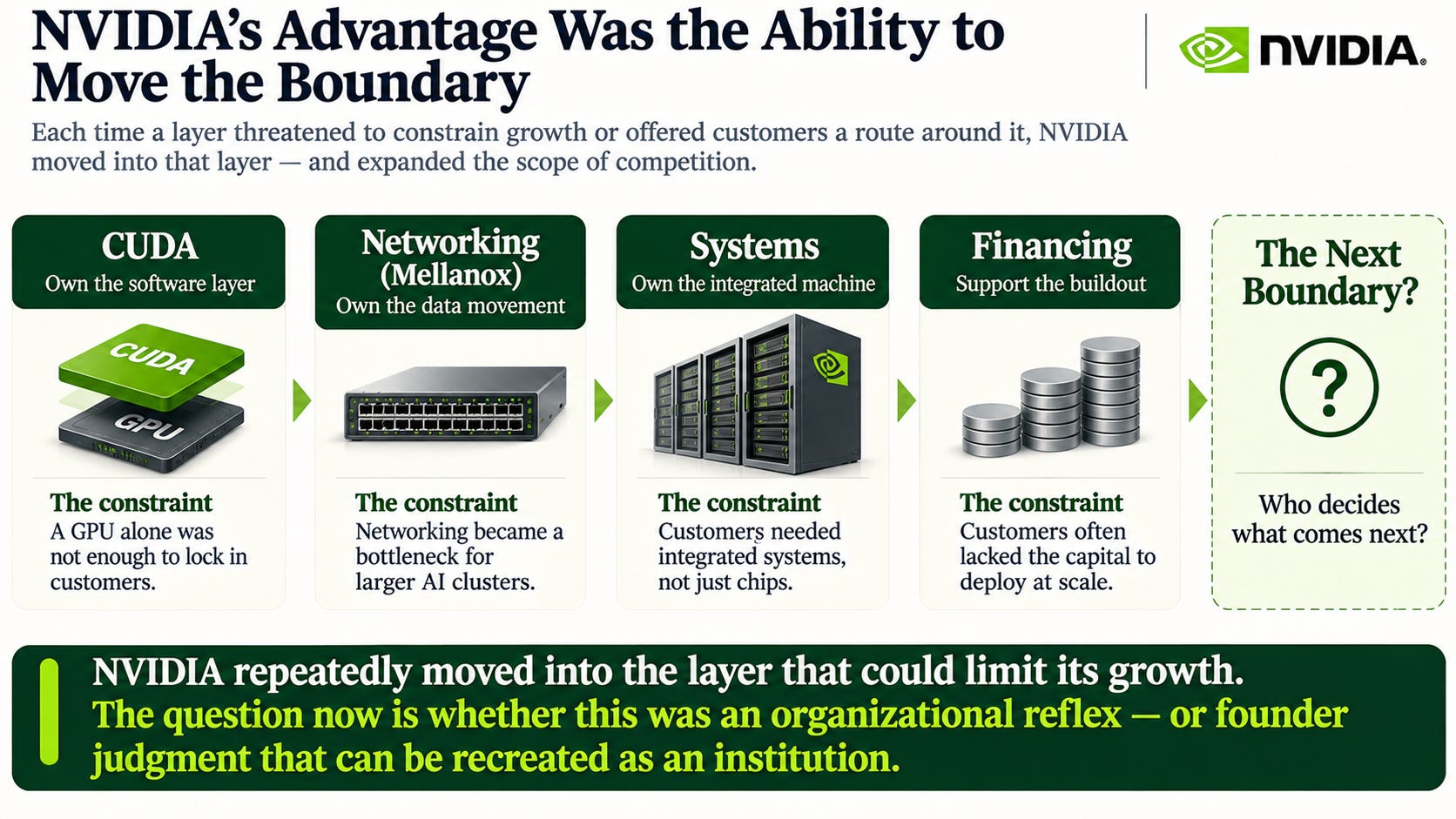
Each move looks adjacent on its own. Together they reveal the strategy: whenever a layer either constrains NVIDIA’s growth or offers customers a route around NVIDIA, the company moves sufficiently far into that layer to keep the larger system centered on NVIDIA.
The network became a constraint and NVIDIA acquired Mellanox. Customers needed complete systems and NVIDIA expanded the unit of sale. Their ambitions outgrew their finances, and NVIDIA made its own balance sheet part of the solution. The moat described here is partly something NVIDIA does: repeatedly changing the scope of competition before competitors can close the previous gap. I treated that capacity as a corporate characteristic while explaining it largely through one person’s decisions.
Huang deserves the credit implicit in that description. His commitment to CUDA preceded a clear market for it. His systems strategy required suppliers and customers to believe in a market larger than the one they could already see. Such decisions combined technical judgment, commercial imagination and the authority to commit the company before agreement was universal. Reproducing that combination is harder than continuing an established roadmap.
Yet much of the capability is demonstrably institutional. Engineers have shipped successive generations, developers have invested in software, and customers have organized their operations around NVIDIA systems. Rubin Ultra and Feynman remain on the roadmap. The question is how effectively those accumulated capabilities can inform and execute decisions under a different distribution of authority.
Kress addressed the people who must make that possible in the most human passage of the call:
Probably the most important thing that we think through right now is our employees. Our employees are absolutely important, instrumental to everything in this company. We are always thinking about our employees. Like every community that there’s out there, there are diverse opinions. Our employees, though, we believe are committed. They are committed to doing their life’s work at NVIDIA, and that has been true about our company from the very beginning. We will take care of our employees during this transition to make sure that they are safe and making sure the work can be done in the current environment.
Acknowledging disagreement made the reassurance more credible. Employees can admire Huang, disagree about his departure and remain committed to their work. Keeping that organization capable of acting is itself a substantive leadership task. The next test is whether its technical leaders can originate a consequential decision, win internal support and persuade suppliers and customers to commit. Successful execution of the existing roadmap gives them the opportunity; it does not complete the test.
The Terms of Trust
There is a second correction to make. In Industrialization of Reasoning, published a year ago, I wrote:
Third, the China risk that dominated investor conversations for two years has essentially evaporated... What was once a 25% revenue dependency has been completely replaced by U.S. hyperscaler and sovereign demand. The geopolitical overhang is gone.
That was wrong. I confused a measurable revenue exposure with the political consequences of NVIDIA’s importance. Direct dependence on China could fall while Washington’s interest in controlling access to NVIDIA technology increased. Removing Chinese revenue from a forecast never removed the government’s interest in customers, intermediaries and overseas computing access. The company became more strategically consequential as it became less dependent on direct Chinese sales.
Jones made that change explicit when asked about competitive advantages and talent retention:
From the board’s point of view, we take the search very seriously. We’re going to look into internal candidates as well as external candidates. The board appreciates that we’re living in a world where the advanced silicon technologies and national security dynamics are making major changes in our marketplace. Our new CEO will have to navigate those waters very carefully. So the search will be thorough and we want to install the CEO, the permanent CEO, as quickly as possible, but we won’t expedite the CEO before finding exactly the right person.
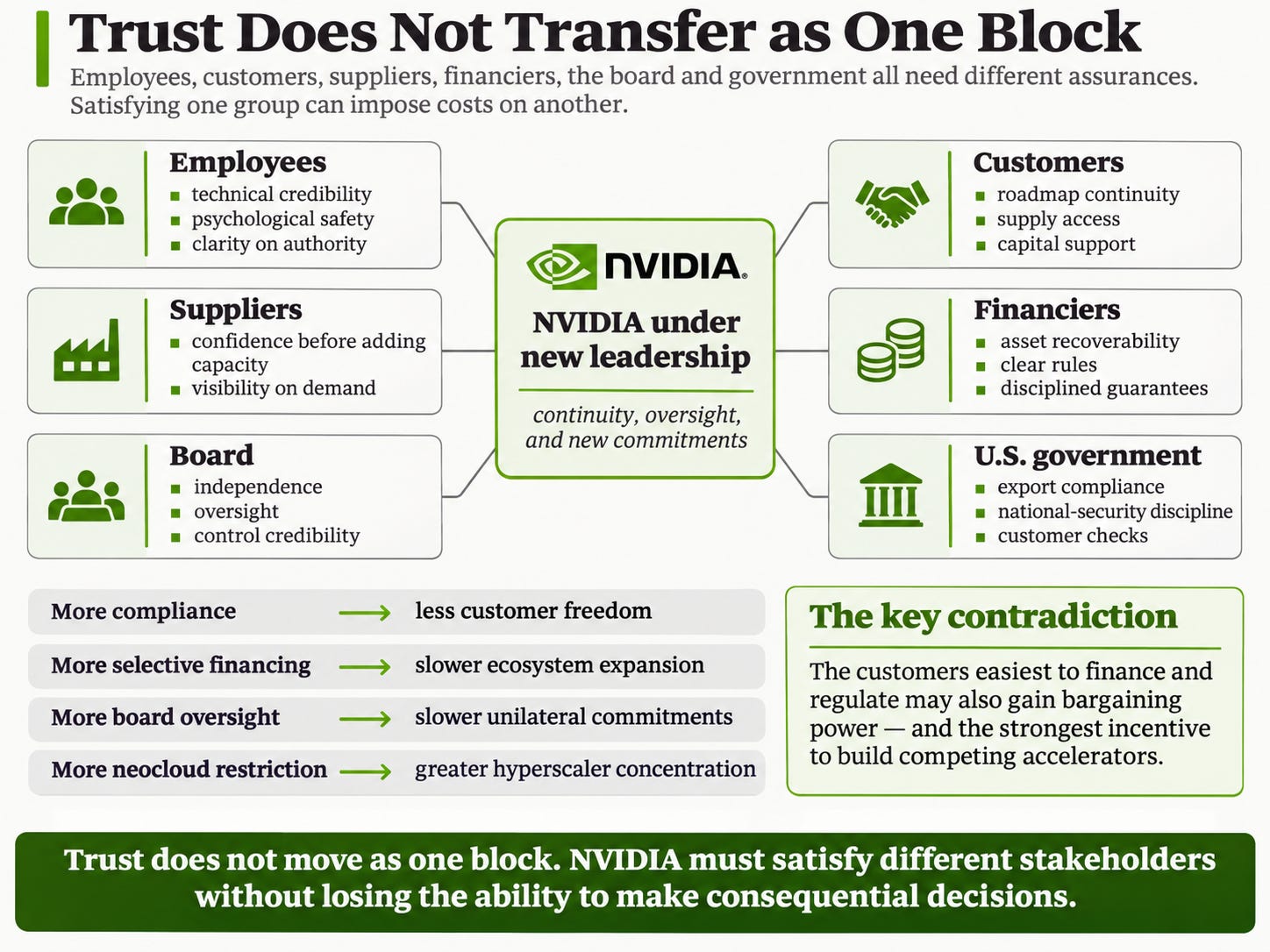
The difficulty is that trust does not transfer as one block. Investors, suppliers, engineers, customers and government require different assurances, and satisfying one can impose costs on another. A chief executive effective in Washington must also command technical credibility. More restrictive customer checks can improve compliance while limiting the independent clouds that diversify NVIDIA’s demand. Clearer rules may reassure lenders while narrowing the projects they can finance.
That last consequence reaches directly into August’s investment argument. I suggested that NVIDIA systems could become better financing assets because their usefulness across models and operators made them easier to re-lease. Kress offered encouraging evidence about their continuing economic life:
All of this is creating a powerful flywheel. Token prices have fallen nearly 60% since May, accelerating token usage and demand for compute. As a result, GPU rental prices are rising across generations. Hopper GPUs have re-contracted at up to twice their original price under the multi-year agreements, while the B300 rates have risen more than 60% since their introduction. NVIDIA compute remains fully utilized across every hyperscaler and neo-cloud we serve, underscoring the productivity, durability, and fungibility of our infrastructure.
Those are NVIDIA’s reported figures. They support the proposition that older equipment remains commercially valuable; they do not yet demonstrate cheaper financing than competing architectures. That requires comparable lending terms, collateral requirements and evidence of how much NVIDIA support each project needs.
The new Commerce rule adds another qualification by addressing overseas remote access to controlled computing technology. Depending on the applicable provisions, exemptions and licensing decisions, an affected lender could face fewer eligible replacement users or a longer recovery process. Technical versatility expands what a machine can do; legal permission determines who can pay to use it. The financing advantage remains a hypothesis to test under both conditions.
The strategic consequence could be larger than a temporary interruption to sales. If financing and licensing increasingly favor the largest cloud companies, those buyers gain bargaining power. They are also best placed to develop their own accelerators. NVIDIA could sell every system it can produce while becoming more dependent on customers with the strongest incentive to reduce its share of their spending. Kress nevertheless made clear that independent clouds would continue to receive support:
NeoClouds remain an increasingly important part of the global AI infrastructure ecosystem, providing additional customers with access to NVIDIA compute, and expanding the reach of our platform. We have supported the development of this ecosystem, and we will continue to be disciplined and selective in our support.
When asked whether newly explicit activation conditions represented a change, she said they did not. Supplier support remained a capital priority, alongside existing investments and selected customer guarantees. Tuesday therefore offered evidence against an immediate financing withdrawal. It left open how future decisions would change when suppliers, shareholders, customers and regulators wanted different outcomes.
What Confidence Is Worth
The financial inheritance makes that question concrete. In its supplemental disclosures, NVIDIA disclosed $390 billion of supply commitments, $118 billion of maximum guarantee exposure and $32 billion of conditional neocloud agreements. They have different purposes, maturities and activation conditions. The $105 billion PORTS-Pike guarantee is included in the $118 billion total, with the first phase expected to become effective in FY29. These figures should not be treated as an immediate cash bill.
Nor should the separate $102 billion of cloud-service and uncommenced data-center lease commitments all be classified as customer financing: NVIDIA describes them as supporting its own research and development, with some leases potentially assignable later. The $1.8 billion impairment of non-marketable investments demonstrates that invested capital can lose value, but does not identify a particular neocloud arrangement as the source. These distinctions make the exposure intelligible without making it disappear.
Our existing financial tests still apply. An exceptional leadership transition is no reason to replace the standards the series previously set:
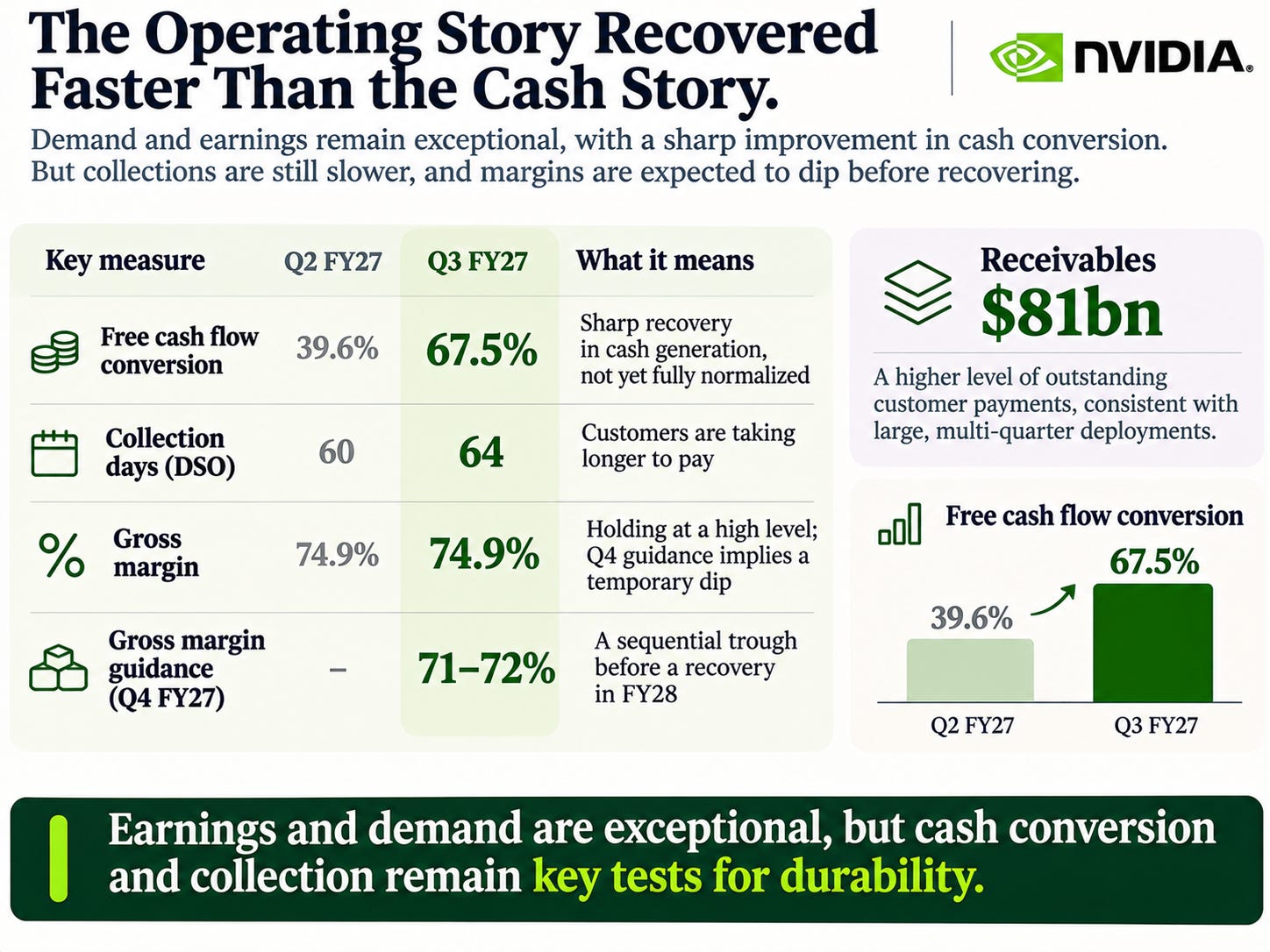
Free cash flow recovered to $43.8 billion, partly because of tax-payment timing. Receivables nevertheless rose to $81 billion; management cited Rubin shipment timing and extended terms for investment-grade customers. There is another admission to make: in May I treated margins below 72–73% as a serious concern; by August I had accepted 71–72% as the expected trough. The investment case had shifted toward greater dollar profit per installation: August’s $40 billion revenue opportunity per gigawatt for Rubin implied $29 billion of gross profit at a 72.5% margin, against $18.8 billion for Blackwell at 75%. That was a revised judgment based on management’s estimates, and both the economics and margin recovery need to be demonstrated.
Disclosure is the immediate test. NVIDIA plans to file its 10-Q “in the coming weeks” and explicitly included expectations about the filing and investigations in its forward-looking statements. The ordinary 40-day deadline is December 4. The filing should provide further information on contingencies and controls; its absence on earnings day does not establish misstated accounts. A subsequent delay would require an explanation of its cause and materiality. Congressional questioning in early December will add scrutiny, without necessarily settling every issue.
At $162.94 in late after-hours trading on November 17, the stock was about ten times the $15.74 FY28 EPS consensus estimates, before a full round of post-call revisions. That makes durability the central valuation question. The price alone cannot tell us whether investors doubt the forecast, margins, cash collection or future leadership, and those uncertainties can reinforce one another.
My base view is that NVIDIA has enough distributed technical and commercial capability for continuity to prevail. I expect it to sustain the product roadmap and selective customer support while accepting tighter oversight of where it sells and how it commits capital. That should preserve substantial earning power, but it warrants less confidence in strategic freedom than the series previously assumed. The following scenarios value NVIDIA around November 2029 using FY30 earnings. They are my assumptions, not company guidance or consensus:
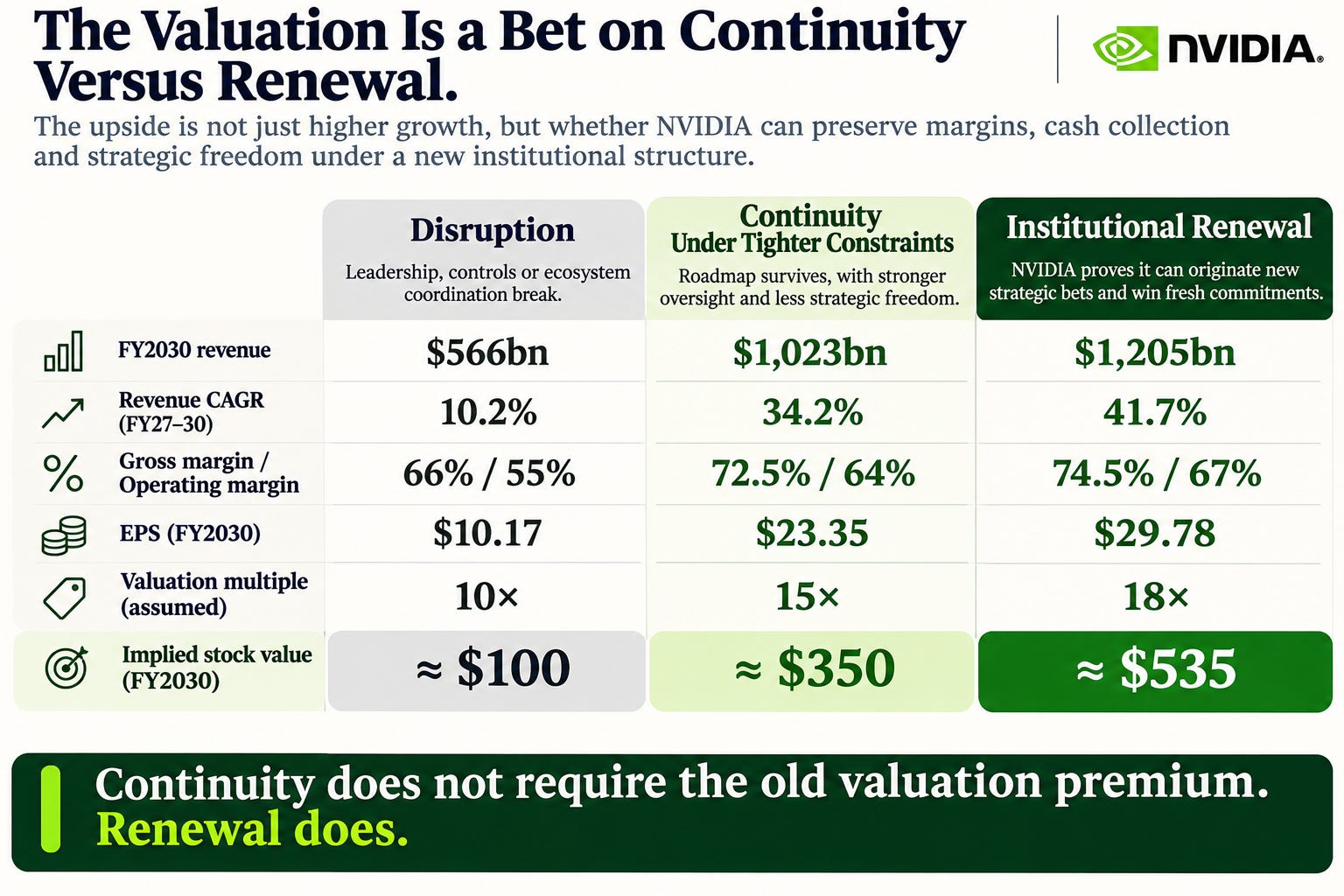
The adverse case cuts growth and margins as well as the multiple. Exceptional guarantee calls or legal liabilities could produce worse outcomes than this recurring-earnings calculation. The base case requires delivery of the FY28 outlook and revenue exceeding $1 trillion by FY30; it is a demanding operating case at a restrained multiple. Renewal requires independent customer financing and continued product advances to support both growth and profitability. A satisfactory filing or credible CEO appointment alone would not establish it.
August’s approximate values were $130, $400 and $550. The revisions reflect changed operating and valuation judgments. My conclusion is that successful continuity can produce substantial value without a return to the old valuation premium. It depends on the earnings being collectible and repeatable, and on the institution retaining the ability to make its next consequential commitment.
The Next Decision
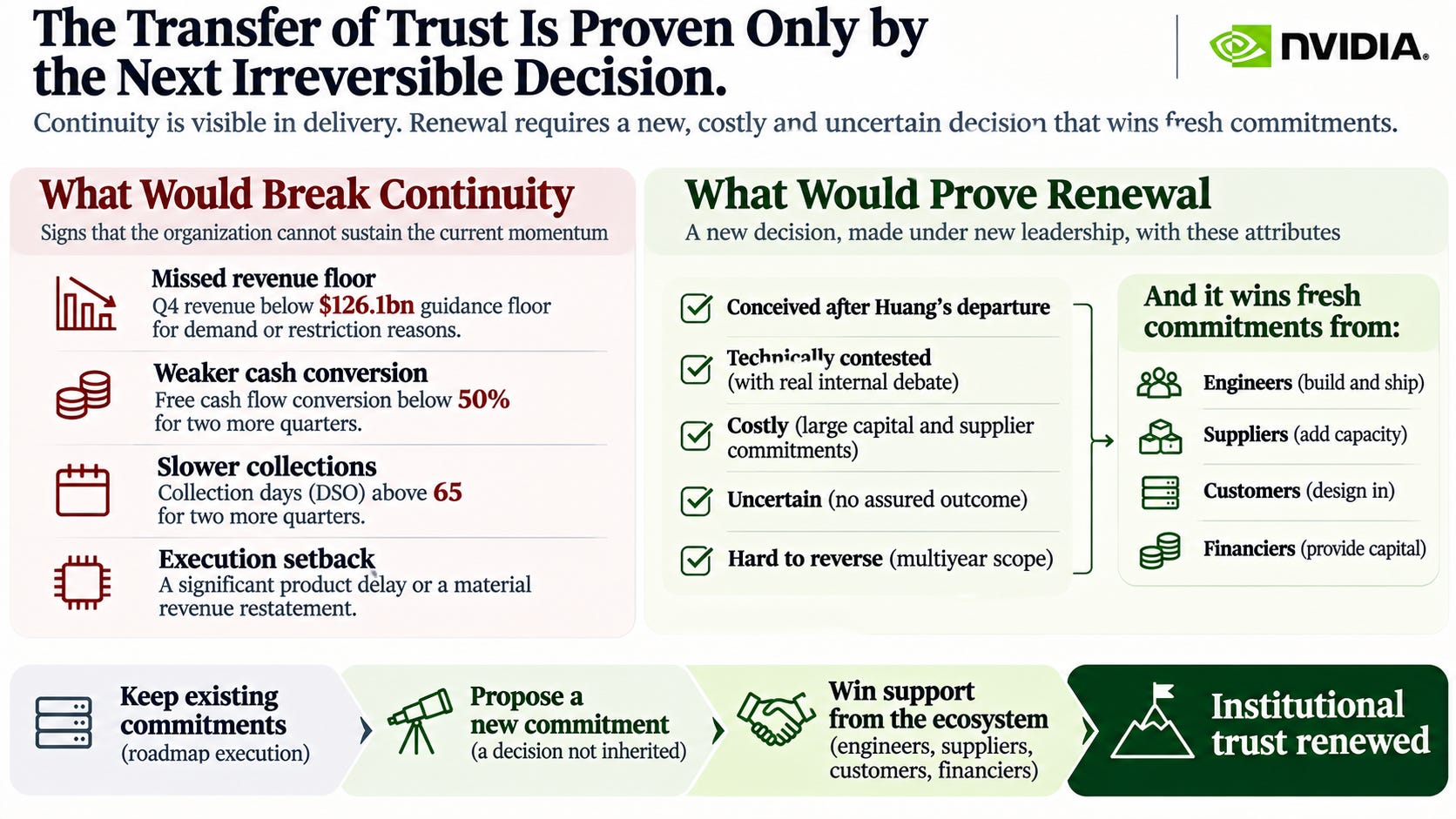
I would abandon uncomplicated continuity if a material revenue restatement undermined confidence in reported sales or a significant product delay revealed a breakdown in coordination. Q4 revenue below the $126.1 billion guidance floor because customers withdrew or restrictions prevented deliveries would also break that operating expectation. Two further quarters with cash conversion below 50% and collection days above 65 would overturn the expectation of financial normalization. These tests connect observable evidence to the mechanism that would have failed.
The stronger outcome requires evidence of a different kind: a consequential initiative conceived and authorized under the new leadership, supported by technical leaders and counterparties willing to commit resources. The most revealing decision will involve disagreement, uncertainty and something costly to reverse. That is where the distinction between a company executing an inheritance and one renewing its advantage becomes visible. Kress closed the call with these words:
Thank you all for joining us today. Our momentum is real. Our demand is accelerating. Our supply is growing. Our customers and our partners are with us. And employees are committed. We’ve got this.
She had earned the right to make the claim about continued delivery. On an exceptionally difficult evening, NVIDIA presented a coherent account of its operations and accepted responsibility for a more ambitious future. The transfer of trust began with giving people reasons to keep their existing commitments. It will be proven when NVIDIA can persuade them to commit to something its founder never decided.
Disclaimer:
The content does not constitute any kind of investment or financial advice. Kindly reach out to your advisor for any investment-related advice. Please refer to the tab “Legal | Disclaimer” to read the complete disclaimer.