


TL; DR
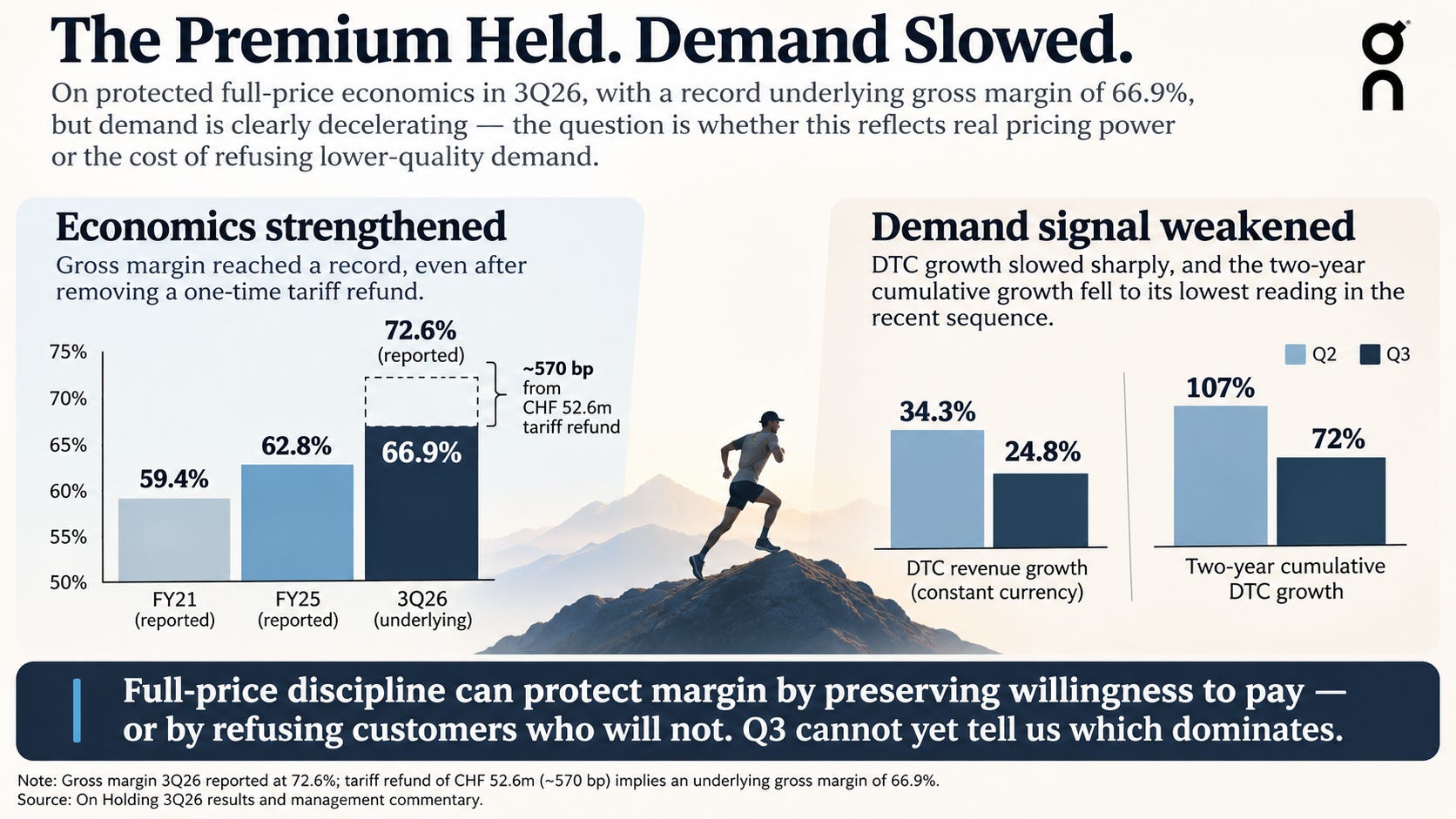
The premium remains intact, but demand is slowing underlying gross margin reached a record 66.9% even as DTC growth decelerated sharply. That distinction matters: On may be protecting price because customers still value the product or because it is simply refusing lower-quality demand.
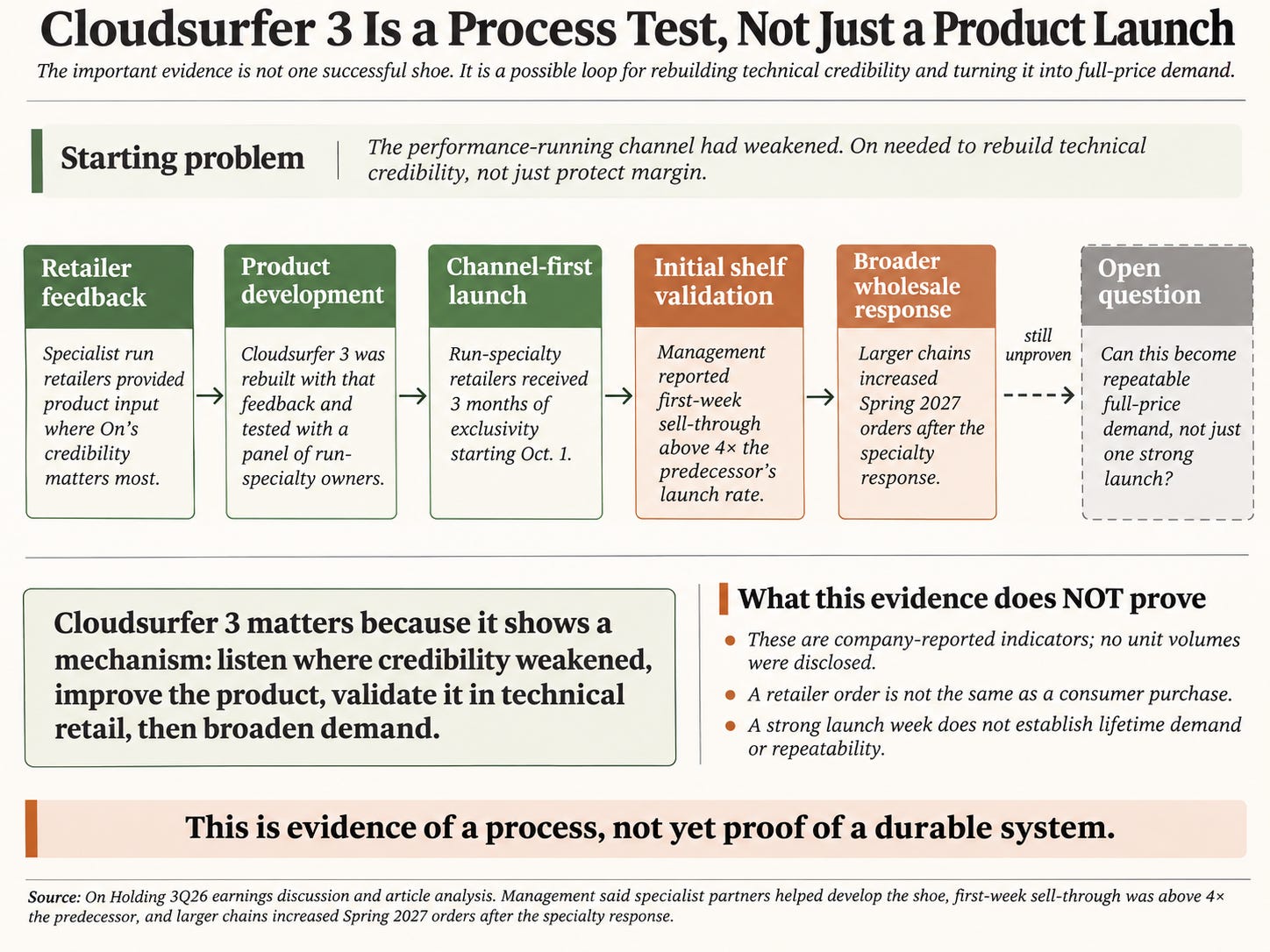
Cloudsurfer 3 is the first real evidence that the product engine can restore demand: On rebuilt the shoe with specialist retailers, gave them exclusivity, and reported much stronger initial sell-through and subsequent wholesale orders. If repeatable, this is a more durable mechanism than discounting.
The margin is now funding the next growth bet: On is reinvesting part of its gross-margin upside into new sports and product launches. The question is no longer whether the current business has premium economics; it is whether those economics can finance enough innovation to keep full-price growth compounding.
In 2014, Coach faced a problem that looked like distribution success. Its handbags had become ubiquitous across department stores and outlets, but promotions had taught customers to wait for the sale. The company began withdrawing discounts and eventually exited hundreds of department-store locations. Sales suffered before the brand recovered. The lesson was not that refusing to discount creates value; it was that a brand cannot keep teaching customers that its stated price is fictional.
On Holding faces almost the reverse problem. Its premium remains intact, and management is determined not to damage it while the footwear industry becomes more promotional. But the economic trade-off is the same: customers who will not pay full price may not buy at all. In September’s The Missing Discount, we argued that On had avoided footwear’s familiar growth trap—pushing inventory into wholesale channels until excess stock forces markdowns. We also wrote about management’s decision to restrict shipments after a weak US running season:
Holding back shipments is not avoiding the error, because shipping fewer shoes you have already made is not the same as making fewer shoes... That is the cheaper currency only if the shoes eventually sell at full price.
Q3 answers half that challenge. On held the price. The question is what it gave up to do so, and whether the product engine can win that demand back.
The Cost of Keeping the Discount Missing
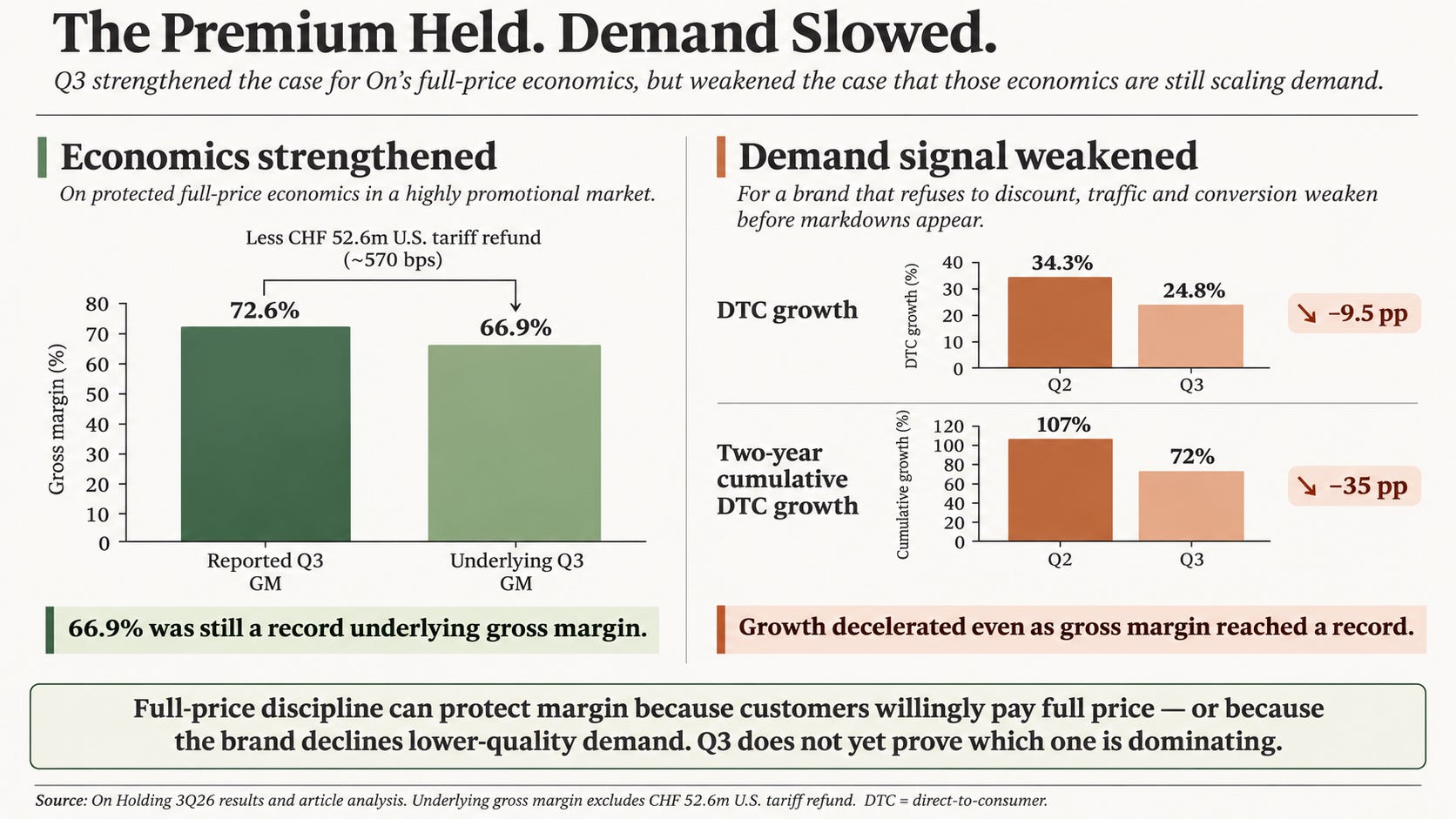
Revenue reached CHF 931.4 million, up 17.8% in constant currency and broadly in line with consensus. Reported gross margin was an extraordinary 72.6%, but a one-time US tariff refund accounted for CHF 52.6 million, or about 570 basis points. Excluding it, gross margin was still a record 66.9%. Adjusted EPS of CHF 0.54 also flattered the underlying quarter: removing the refund and favorable currency effects brings it to approximately CHF 0.39 on our normalized estimates, much closer to consensus than the headline beat suggests.
The more revealing figure was direct-to-consumer growth. It slowed from 34.3% in Q2 to 24.8%, despite an easier comparison. Two-year cumulative DTC growth dropped from 107% to 72%, the weakest reading in the available recent sequence. On was not losing sales in absolute terms; it was growing more slowly, just as gross margin reached a record.
Co-CEO Caspar Coppetti defended that choice:
That is the On Premium Playbook doing exactly what it was built to do: growth and margin together, and not or. We delivered these results in what remains a highly promotional environment by staying true to who we are. That means leading with innovation, design, and resonant storytelling, giving our fans a unique offering that they do not find elsewhere. In a high-discount environment, there will always be some consumer choices based on price. It has never been our strategy to go for these.
The last two sentences acknowledge the cost. CFO Frank Sluis said online traffic was softer in a promotional environment, while two delayed store openings also weighed on DTC. The timing explains some missing revenue; two stores cannot plausibly explain the entire deceleration. Nor can the slowdown be assigned wholly to pricing: product mix, conversion and consumer demand are not disclosed in enough detail. Still, the economic distinction is unavoidable. A company can protect margins because customers eagerly pay full price, or because it declines transactions with those who will not. The first is scalable pricing power. The second can become a ceiling on growth.
That distinction exposes the flaw in September’s dashboard. We called markdowns the gauge on the machine and watched gross margin and inventory for early deterioration. Those are sensible indicators for brands that discount when demand weakens. For a brand that refuses, they are lagging measures. Full-price traffic and conversion move first; markdowns may never arrive. DTC growth, particularly across two years, must now sit alongside margin rather than behind it.
The Shelf’s First Answer
The September thesis was not that On had lost its appeal. It was that the performance-running channel, where technical credibility is earned, had weakened while lifestyle sales continued monetizing that credibility. Losing specialist runners is more consequential than their immediate revenue share suggests. A premium athletic brand must repeatedly demonstrate that its shoes deserve to exist beyond fashion.
Q3’s most encouraging evidence arrived after the quarter ended. Cloudsurfer 3 launched October 1 with specialist retailers receiving three months of exclusivity. Coppetti explained why the company chose that route:
The Run Specialty channel for us is something that is very close to our heart because that is where we started, and we still believe that is where technology is validated. So, what we have done now with Cloudsurfer 3, this shoe was heavily, basically was developed with a lot of input from our Run Specialty partners, a lot of insights. We also have a panel of Run Specialty owners that then test the product. So, we said, to honor that commitment that the channel has to On, the channel has access to it for the first three months exclusively, right?
Management reports first-week sell-through above four times the predecessor’s launch rate, top-model status at several partners, and increased spring 2027 orders from larger chains following the specialty response. These are company-reported indications without unit volumes or independent cohort data; a retailer’s order is not the same as a consumer purchase, and a launch week does not establish lifetime demand. But they are evidence of a mechanism, not merely another optimistic product announcement.
On listened where its credibility had weakened, rebuilt the product with those retailers, and let the technically demanding channel validate it before broadening distribution. The sequence matters. A brand depending on constant promotion buys demand anew each season. One that can convert runner feedback into better products may generate demand at full price, with wholesale partners following rather than leading the consumer. LightSpray could eventually deepen that manufacturing and design advantage, though its economics at scale remain unproven.
This is why Cloudsurfer 3 matters more to our thesis than one quarter’s gross margin. If the process is repeatable, protecting pricing through a weak season can be an investment in the next one. If it produces only a successful launch, the brand still depends on finding another hit before consumers lose patience.
What the Margin Is Funding
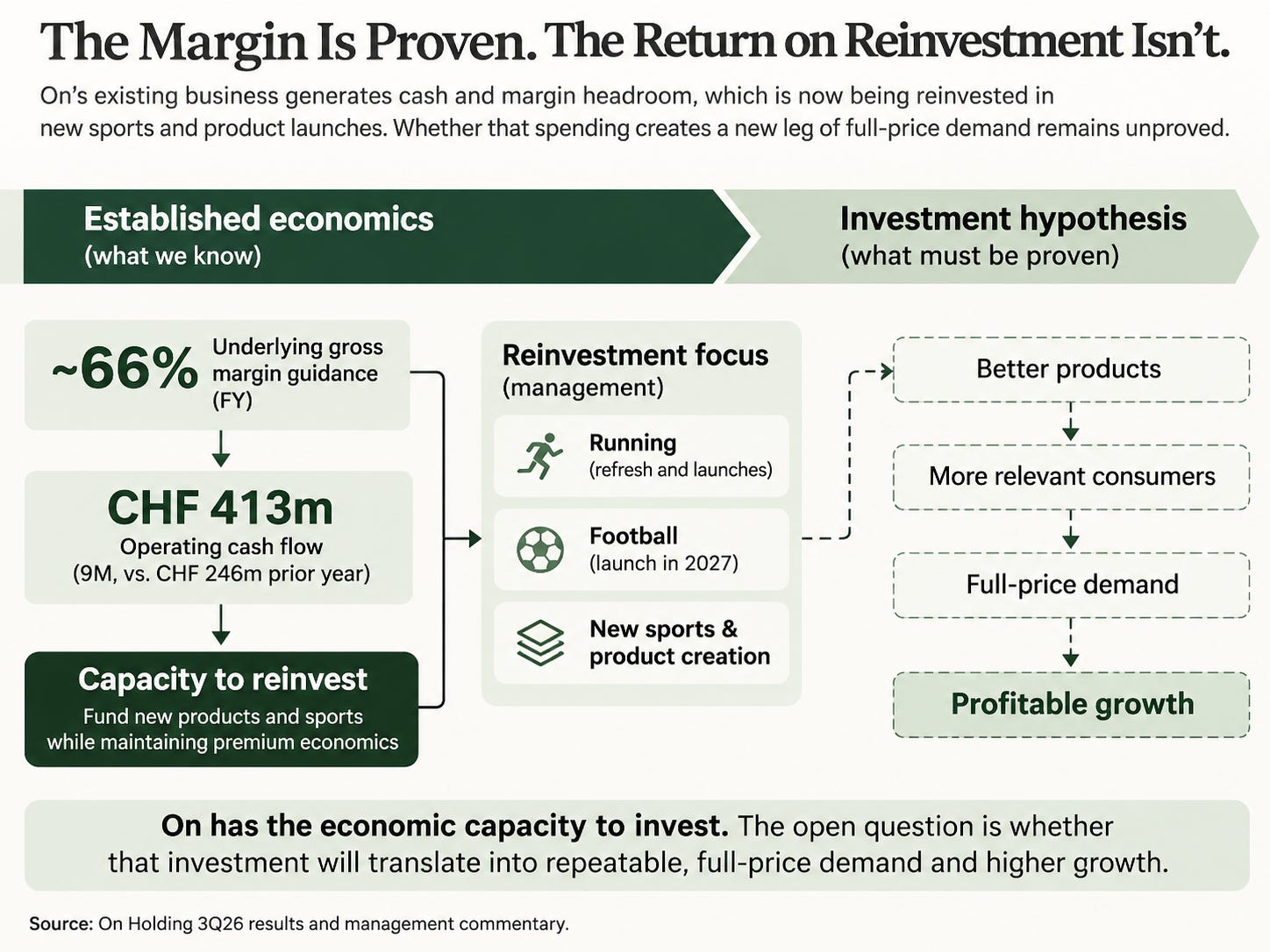
The financial model gives On room to make that bet. Management raised underlying full-year gross-margin guidance to roughly 66% while keeping adjusted EBITDA-margin guidance at 19.5–20%. Asked where the additional gross profit would go, Sluis explained:
We have indeed decided recently to invest some of it into the business, because of course, the new sports are coming in new. We did not know that at the beginning of the year, we will have a bit of production costs, for example, for the football launch in 2027.
The decision is consistent with a premium brand investing in product creation rather than relying on discounts to defend volume. But there are two separate claims: the existing business generates an attractive margin, and the spending it finances will create attractive new demand. The first is established. The second remains an investment hypothesis. A football launch or broader running refresh can improve the brand’s relevance, but an expanding innovation budget is not proof of innovation returns.
Cash generation helps. Nine-month operating cash flow reached CHF 413 million versus CHF 246 million a year earlier, before capital expenditure and lease payments. Inventory complicates the picture: its reported value rose 30.2%, but units increased only 16%. Currency and product mix matter, and the company has not supplied a full bridge. The economically relevant test is whether those units clear at full price as new products arrive, not whether their translated value happens to rise faster than sales.
We also need to correct our historical comparison. In September we wrote that On’s gross margin had risen from 52% in 2021 to 65% in 2025. The reported figures were 59.4% and 62.8%. The expansion was meaningful, but much smaller than claimed. Today’s premium economics should stand on their actual record, not an embellished one.
The Price of the Machine
The stock’s 7.5% post-results decline reflects a business that is financially impressive but less certain about its growth. At approximately $34.70, the question is whether full-price demand returns quickly enough to justify the earnings power embedded in our September valuation. I would retain the long-term operating outcomes while modestly reducing the weight on sustained acceleration.
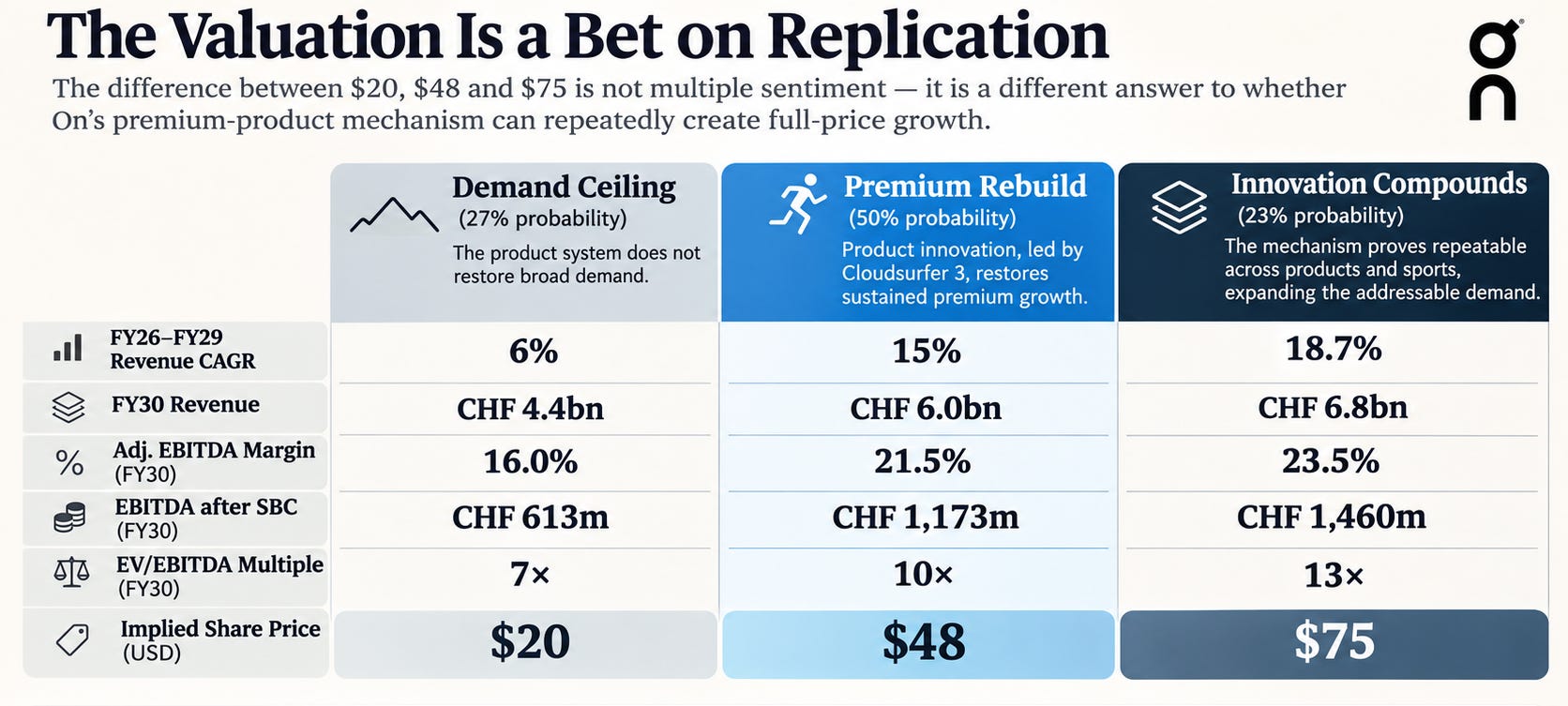
These outcomes retain September’s FY2030 earnings framework, with lease liabilities and anticipated buybacks reflected in the equity bridge. The central case does not require multiple expansion; it requires On to make its premium product system produce roughly 1 5% annual revenue growth with improving operating leverage.
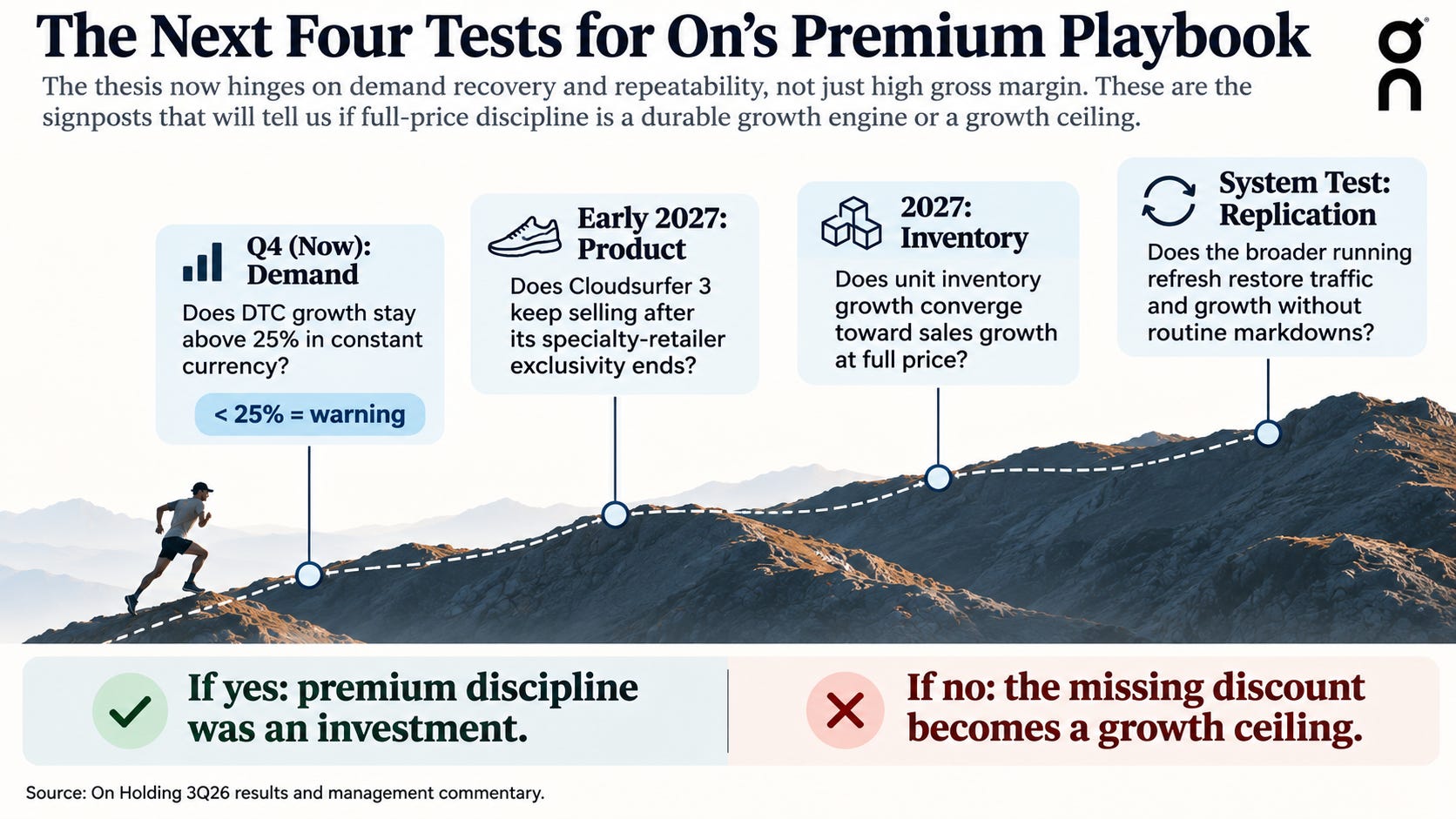
I would hold and add on evidence rather than simply on a lower share price. Fourth-quarter DTC growth below 25% in constant currency would make the cost of full-price discipline look persistent. The more decisive 2027 evidence is whether Cloudsurfer 3 keeps selling after its specialty exclusivity ends, inventory-unit growth converges toward sales, and the broader running refresh restores traffic without routine markdowns. Those are tests of whether the margin is funding better products or merely underwriting slower growth.
Coach had to spend years persuading customers that full price meant something again. On has preserved that belief, but preserving it is not the same as expanding the number of people willing to pay. The shelf is beginning to offer an answer: product feedback has become a better shoe, and a better shoe is beginning to generate orders. If that process repeats, the foregone volume was an investment. If it does not, the discount may remain missing while the bill keeps growing.
Disclaimer:
The content does not constitute any kind of investment or financial advice. Kindly reach out to your advisor for any investment-related advice. Please refer to the tab “Legal | Disclaimer” to read the complete disclaimer.