


TL; DR
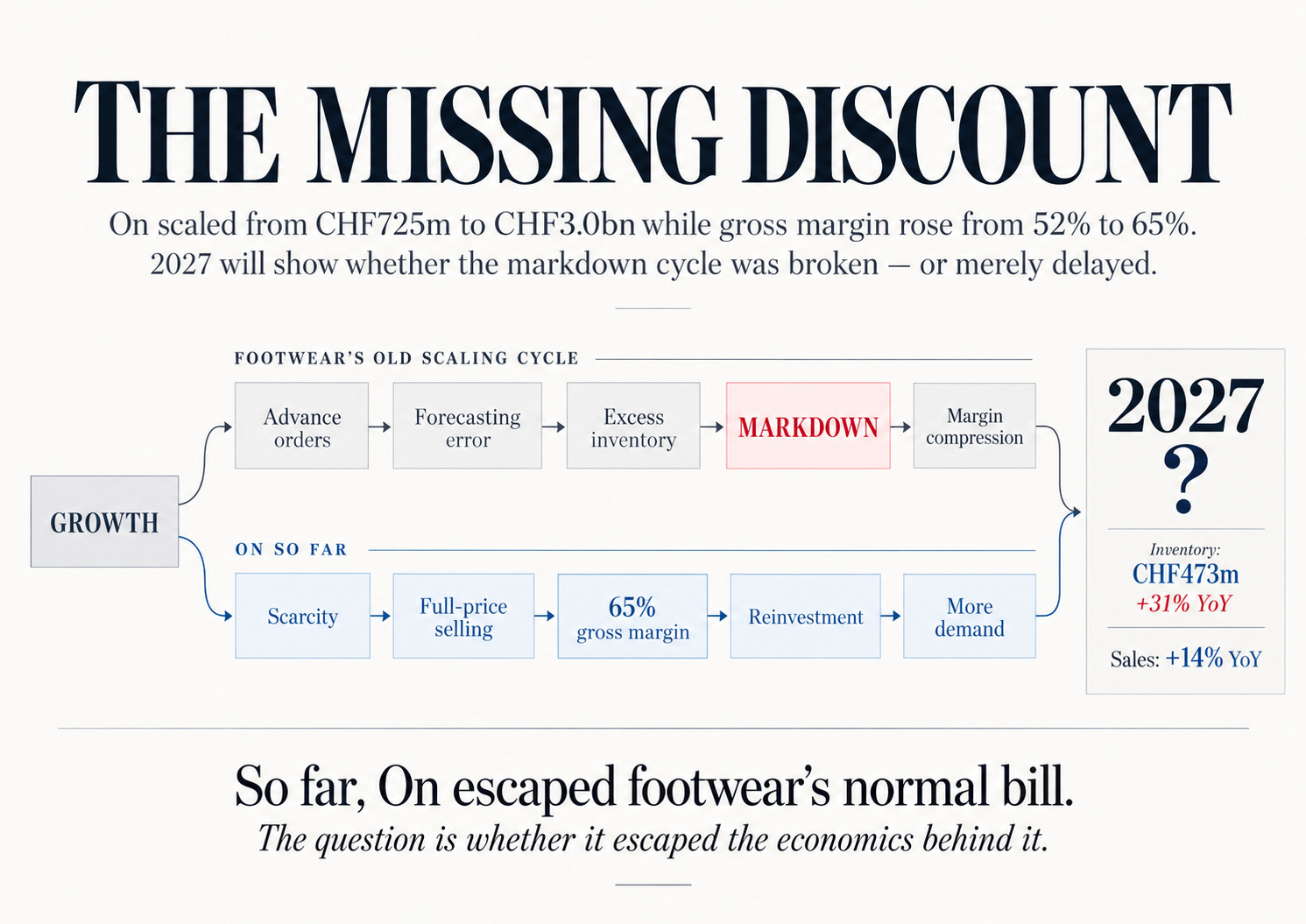
On has done something unusual in footwear: it scaled from CHF725 million to CHF3.0 billion while raising gross margin from 52% to 65% and largely avoiding the markdown cycle that has historically destroyed challengers. Pasted text
The mechanism is more than product innovation: athlete credibility supports premium pricing, full-price discipline protects desirability, and high margins fund the next round of product, stores and marketing. The crucial gauge is whether discounts stay absent as the company scales. Pasted text
2027 is the real test: Nike has returned, US run-specialty weakened, inventory is running ahead of sales, and On has already sacrificed shipments to protect full-price integrity. If the refreshed running range restores sell-through without markdowns, the engine is real; if not, the missing discount was merely delayed.
The bill from 1972
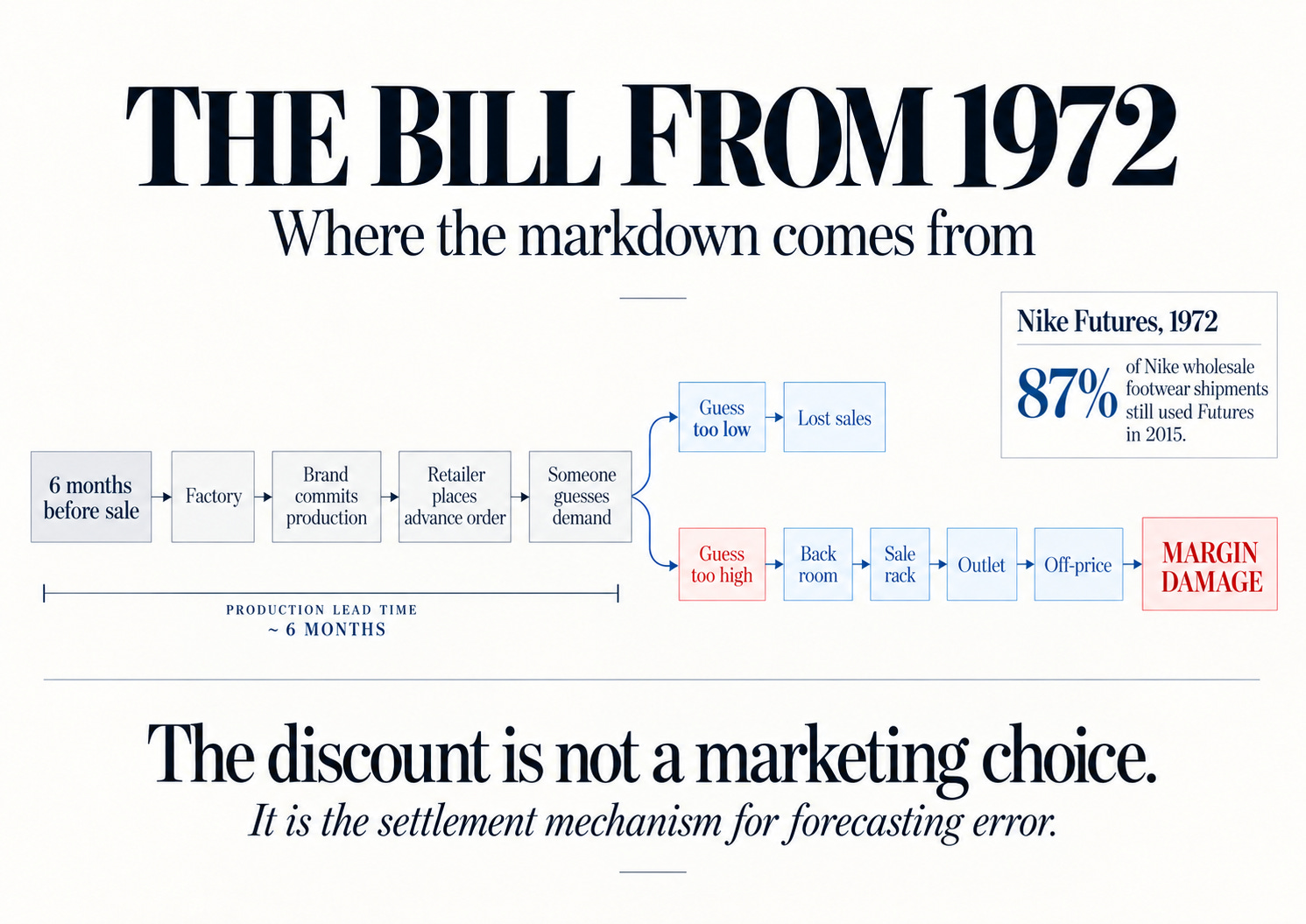
Phil Knight had a problem that every fast-growing shoe company eventually meets: he was selling shoes faster than he could pay for them. Nike in the early 1970s had to pay its Japanese factories months before American retailers paid Nike, the banks had stopped extending credit, and growth itself was pushing the company toward insolvency. His solution, described in Shoe Dog, was to change who carried the risk:
Why not go to all of our biggest retailers and tell them that if they’d sign ironclad commitments, if they’d give us large and nonrefundable orders, six months in advance, we’d give them hefty discounts, up to 7 percent?
Nike called the program Futures, and it worked so well that it stopped being a program and became the industry. As late as 2015, 87 percent of Nike’s wholesale footwear shipments still flowed through Futures orders, four decades after the cash crunch that invented them.
But Futures carried a clause nobody wrote down. When a retailer commits to shoes six months before they arrive, somebody is guessing what people will want to wear half a year in the future, and the guess is always wrong by something. When it is wrong in the expensive direction, the extra pairs do not disappear; they go to the back room, then the sale rack, then the outlet, then the off-price chains. The discount was never really a marketing decision. It is how footwear pays for its forecasting errors, and the bill lands hardest on challengers, who must buy shelf space with volume before they know what sells. That is a large part of why the list of new footwear brands that reached even $4 billion in the last fifty years is so short, and why the ones that did mostly died on the way up. Under Armour got there in 2016, hit a wall in US wholesale, pushed the excess through off-price chains, and taught its customers to wait; a decade later its sales are below where they started. Allbirds, worth $4 billion at its 2021 IPO, marked its inventory down until gross margin fell from 53 to 41 percent, and agreed this March to sell its footwear business for $39 million.
Which is what making the company this article is about so strange. Between 2021 and 2025 a Swiss firm grew from CHF 725 million of revenue to CHF 3.0 billion, roughly 43 percent a year, much of it through the same wholesale doors, under the same advance-order system, against the same incumbents. And the bill never showed up: no sale rack, no off-price channel, a gross margin that rose from 52 to 65 percent while the average shoe climbed from $145 to $170. Either On Holding built a machine the industry has never seen, or it caught the best weather the industry has ever offered. The halved stock price says weather. Working out which it happens to be worth about thirty dollars a share.
What On was actually selling
Start with the founding insight, because it is more precise than the garden-hose legend suggests. In 2010 Olivier Bernhard, a retired Swiss Ironman champion, did glue sections of garden hose to a running sole in pursuit of a soft landing and a firm push-off in the same stride. But his co-founder Caspar Coppetti brought something else to that kitchen table, and he described it at last week’s Investor Day:
I had also brought a spreadsheet to that kitchen. We had studied the market, and we had found something very surprising. Passionate runners were investing more into their gear, into their sport every year. They were basically willing to pay for progress. The most valuable customers in the category. However, there was no brand that catered to them exclusively. I think that was the moment where it all made sense to us. We would disrupt running with innovation, and we would only sell at the premium end.
Everyone believed running shoes were a saturated market because Nike and Adidas served everybody. That was exactly the opening: brands that serve everybody cannot cater to the customer who wants to pay more, because their whole apparatus, from factory volumes to wholesale terms to $60 price points, is built for the middle. The premium runner was underserved in plain sight, and a company with no factories and no middle to defend could serve her exclusively.
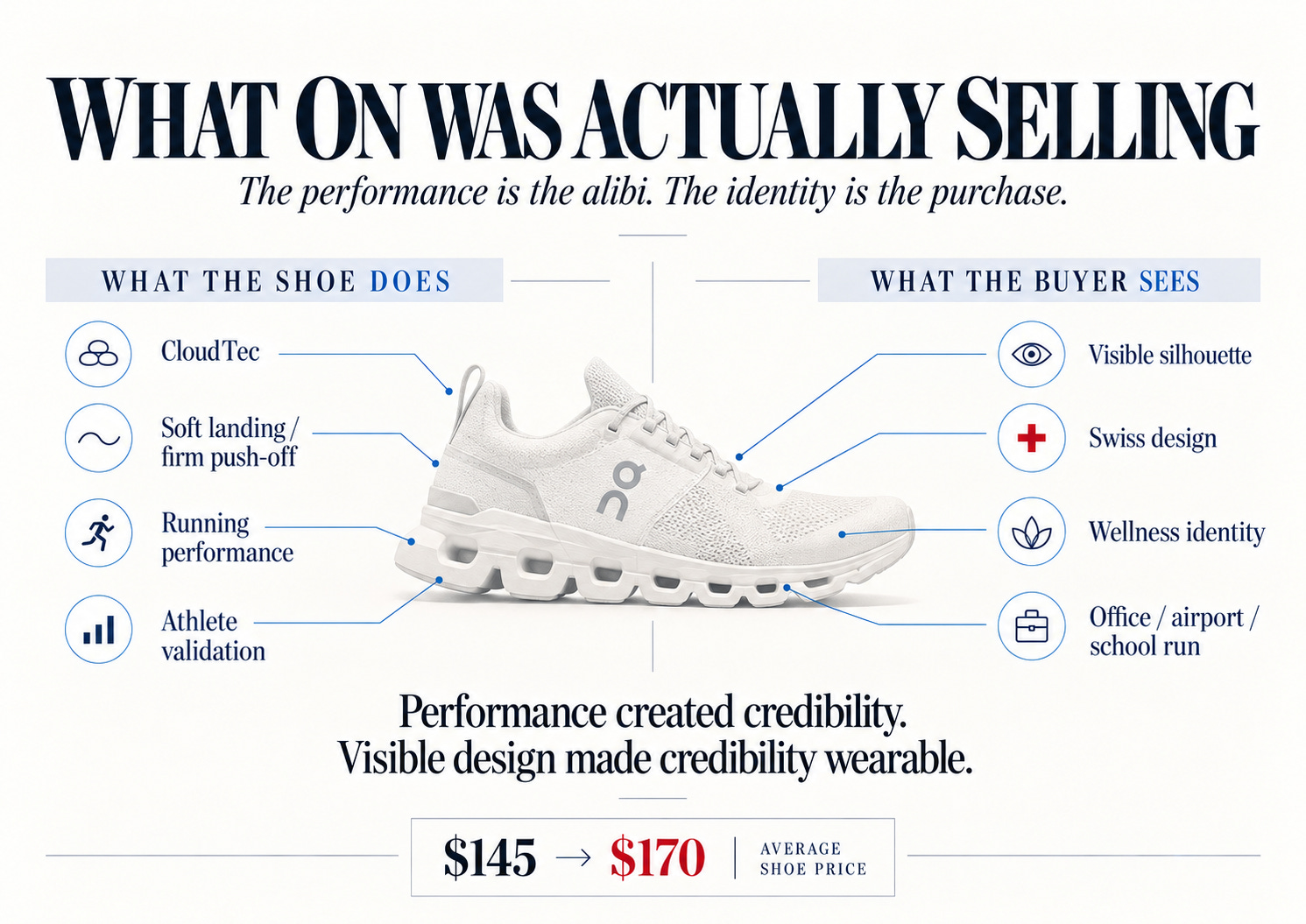
But the insight that made On a niche winner is not the one that made it a CHF 3 billion company. The hollow pods that Bernhard engineered for cushioning turned out to have a second property that mattered more: you can see them from across a room. Most performance technology is invisible, a foam formula buried in a midsole, which is why shoe marketing historically needed athletes and airtime to explain it. CloudTec explained itself. The shoe was its own advertisement on the shelf, on the train, on a colleague’s feet, and its design chief later compressed the whole approach into a sentence: engineering solves a functional requirement, and design makes the solution desirable. What that combination produced was a product most of its buyers never use as intended. The people in Clouds and Cloudtilts at the office, the airport and the school run are not runners; they are buying quiet, affluent, health-adjacent identity with a Swiss engineering story attached, a signal of self-care that a logo sneaker cannot send. The performance is the alibi; the identity is the purchase. That is why the price could rise without volumes falling, and it is the first reason the discount went missing: the person buying identity does not comparison-shop the way the person buying cushioning does.
Today that product is a $10 billion company by market value, selling in more than 90 countries, still 92 percent footwear, with the Americas slightly over half of revenue, Europe about a quarter, and Asia-Pacific, the fastest-growing fifth, compounding at over 50 percent last quarter. Apparel, with accessories, is about 7 percent and targeted to triple. The mix matters later; hold onto it.
The engine
At the Investor Day, Allemann posed the question every investor asks and gave an answer worth quoting in full, because the rest of this article is essentially a test of whether it is true:
People ask us all the time, what makes On On? What is the secret behind the success? Here is the honest answer. A single piece of On can be copied. A foam can be reverse engineered. An athlete can sign with somebody else, right? A beautiful store can be built. What cannot be copied is how the pieces reinforce each other.
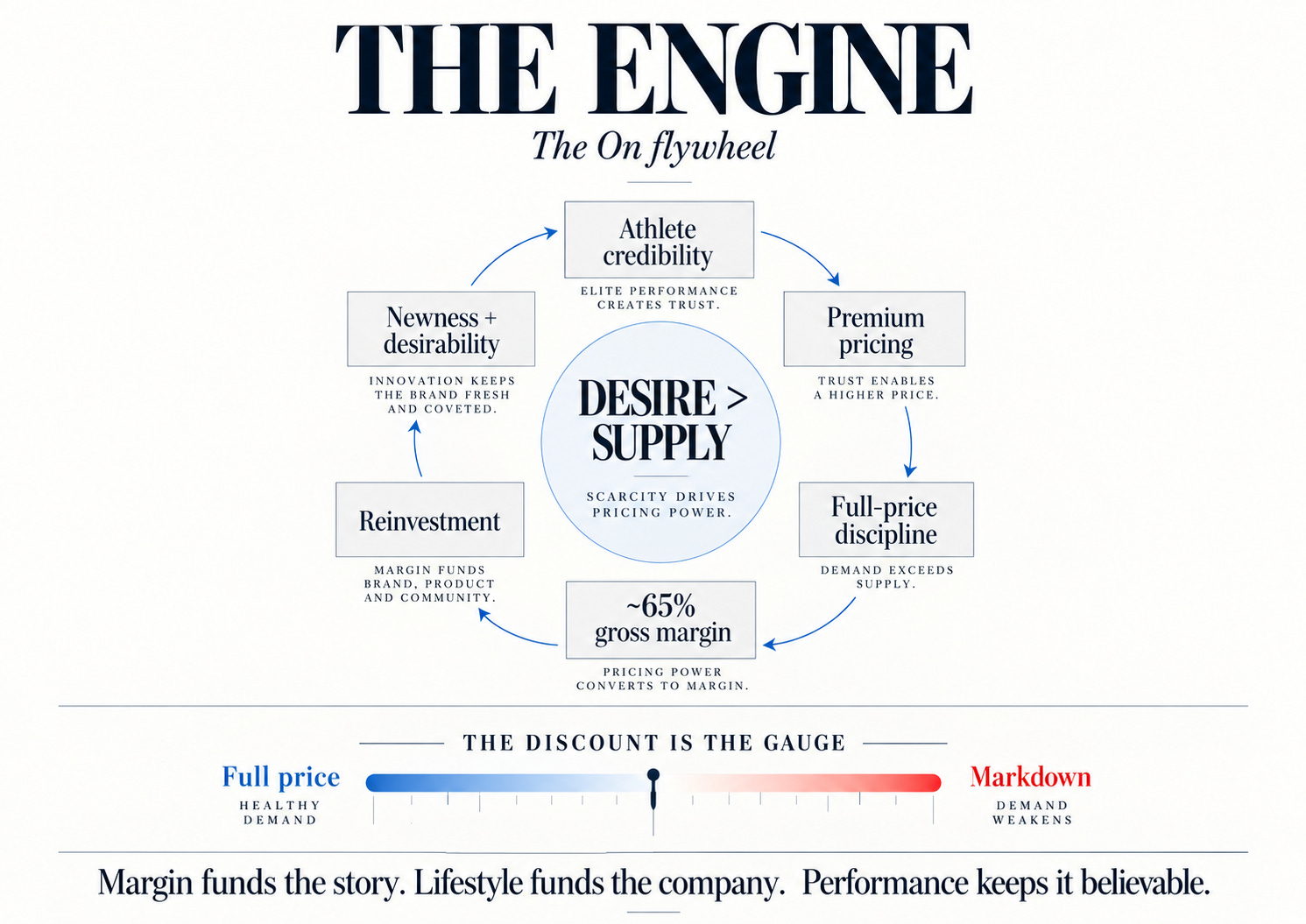
Strip the mission language and the pieces do form a loop you can trace through five years of results. Athletes validate the product at the highest level: Hellen Obiri won Boston and an Olympic medal in On prototypes she helped build, Iga Świątek won Wimbledon in On tennis gear, and Federer, who joined in 2019 as an owner and co-engineer rather than an endorser, gave a nine-year-old brand the single most credible name in premium sport. Validation permits the premium price. The full-price rule protects the desirability the price depends on, because nothing corrodes a status good like a sale rack. The 65 percent gross margin that results funds the athletes, the labs, roughly 100 stores in the right cities, and marketing at 14 percent of sales, which produce the next visible product, which earns the next validation. Performance funds the story, lifestyle funds the company, and margin funds both.
Two details show the loop was engineered rather than lucky. The first is sequencing: On earned its stripes in run specialty, the small stores where staff fit serious runners and a brand’s credibility is minted, and only from 2023 scaled into DICK’S, Foot Locker and JD, by which time it arrived as the hot brand rather than the supplicant. The second is that the loop has now run twice. Tennis, entered through Federer in 2019, has compounded at 61 percent a year since 2021 and carries On’s highest customer lifetime value by management’s account; the same playbook, athlete first, premium only, lifestyle crossover after credibility, is now being loaded for football, with Mbappé signed away from Nike, and golf. A flywheel that works once may be circumstance. One that repeats in a second sport is a machine.
And the discount is the gauge on the machine. As long as the loop generates slightly more desire than On supplies, the discount stays missing; the moment supply runs ahead of desire, the discount reappears, first at the edges, then everywhere, and the margin that funds the whole loop unwinds. Watch the gauge and you are watching the engine. Which is why, before August, the reading had been so remarkable: On repeated “full price” on every one of twenty earnings calls, and by 2022 Allemann was saying the quiet part aloud, that “having a certain amount of product scarcity helps us remaining premium and also helps our margin situation.”
The weather
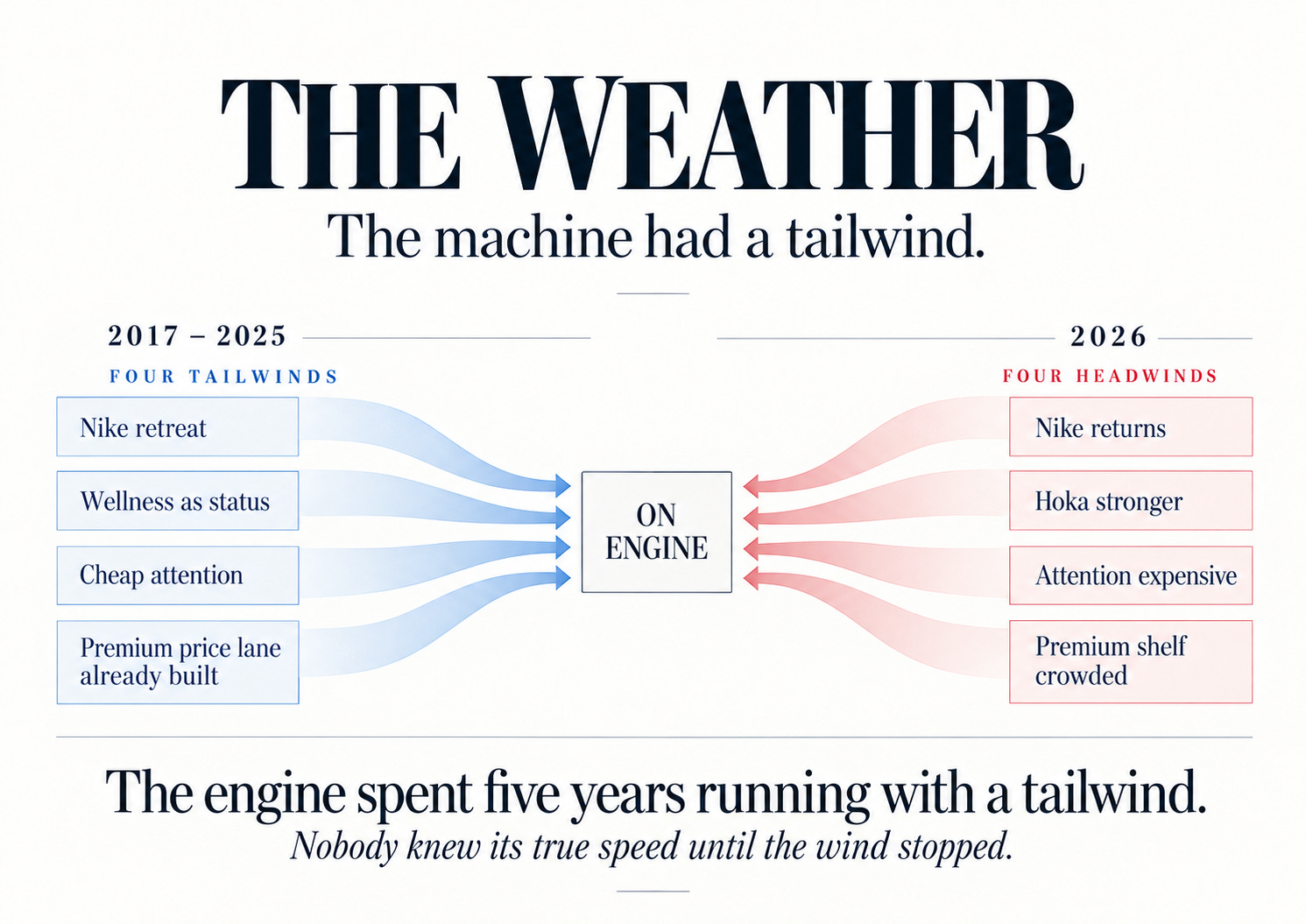
Here is the uncomfortable part for the bulls, and the reason this article exists rather than a victory lap: the decade that machine spun up in was the most favourable stretch of weather a footwear challenger has ever been handed, and every element of it is now expiring.
The first and largest was that Nike left. In June 2017 it announced the Consumer Direct Offense, and that October said it would concentrate on roughly 40 of its more than 30,000 retail partners. The company that invented the wholesale system walked away from most of it to sell directly, emptying exactly the shelves where runners shop, and then spent the following years recycling legacy silhouettes while its running innovation went quiet. A challenger did not have to beat Nike for space and newness; Nike surrendered both. On’s CMO was disarmingly honest at the Investor Day about what that meant:
We do not have an archive. We cannot go down into the dustbins in the basement and pick out something from decades before. But what we know from consumers is that other brands can do that. They want newness. They want innovation. They want freshness. They are actually pretty hungry for a brand like us to come along with something very, very different.
Newness was On’s only inventory, and it happened to be the one thing the incumbent had stopped supplying. Second, the culture moved toward the product: wellness became a status symbol in the pandemic years, applicants to the London Marathon went from 120,000 to 1.3 million, and, as Coppetti argued last week, luxury houses priced out some 80 million aspirational customers whose spending went looking for a new signal. Third, social media collapsed the cost of building a brand; a Swiss startup could reach American buyers through athletes, a Zendaya contract and a Loewe collaboration instead of two decades of television, which is the only reason a challenger could afford the awareness game at all. Fourth, the price lane was pre-cleared: Lululemon had trained the affluent to pay premium prices for activewear and Hoka had normalised the $150 everyday running shoe, so On’s $170 asked customers to step up a rung, not build the ladder.
Count what has expired. Nike has a new chief executive, rebuilt wholesale relationships and, by its own account, gained five points of running share in North America and Western Europe in fiscal 2026, more than any top-five brand; Hoka claims share gains above $120 in the same months. The wellness boom continues but now lifts every boat on the shelf. Attention is no longer cheap: awareness of 30 percent, up from 12 in 2023, must now be defended with that 14 percent of sales against competitors spending multiples in dollars. And the price lane is crowded with the brands that cleared it. The machine, in other words, spent five years running with a tailwind, and nobody, including management, knew its true speed. Then, this spring, the wind stopped.
11 August 2026: the first quarter without weather
The American market turned promotional in the spring of 2026 as competitors cleared aging stock, and the big chains matched prices to keep customers. Ed Stack, executive chairman of DICK’S, described the mechanics from the retailer’s chair:
The margin pressure is real as these legacy silhouettes have slowed down, and then some of the brands started discounting, and the discounting got pretty aggressive. And we felt it was really important for us to stay with the market from a price standpoint... they say: We can buy this shoe for $25 less expensive on such and such a site. We didn’t want them to go someplace else to buy that product.
On’s everyday running shoes, late in their product lives, sat next to rivals that had just gotten $25 cheaper, and the rule forbade a response. Worse, the trouble in the channel that mints credibility had started earlier. At US run-specialty stores, On’s dollar sales fell 19.7 percent in the first nine months of 2025, the worst of any top-ten brand, while Nike’s rose 35 percent, and On’s president Scott Maguire had discovered why in the most analog way possible, spending a day watching shoppers in one of those stores:
We watched as people came in. They picked up our shoes and then put them down. Some chose On, and some chose others. We went super deep on why. Some of the answers were in the product, some were in the storytelling, some were in the channel, even some was the information on the side of the shoebox. The store staff couldn’t quickly work out what product they were pulling. We were losing out exactly when it mattered.
Read that twice, because it locates the problem precisely. On was not losing on price, and the brand was not fading; the company was losing on product, presentation and even the box label, in the store where the performance job is won, while an ageing range met a rejuvenated Nike. The engine’s most important cylinder was misfiring even as the group grew 30 percent.
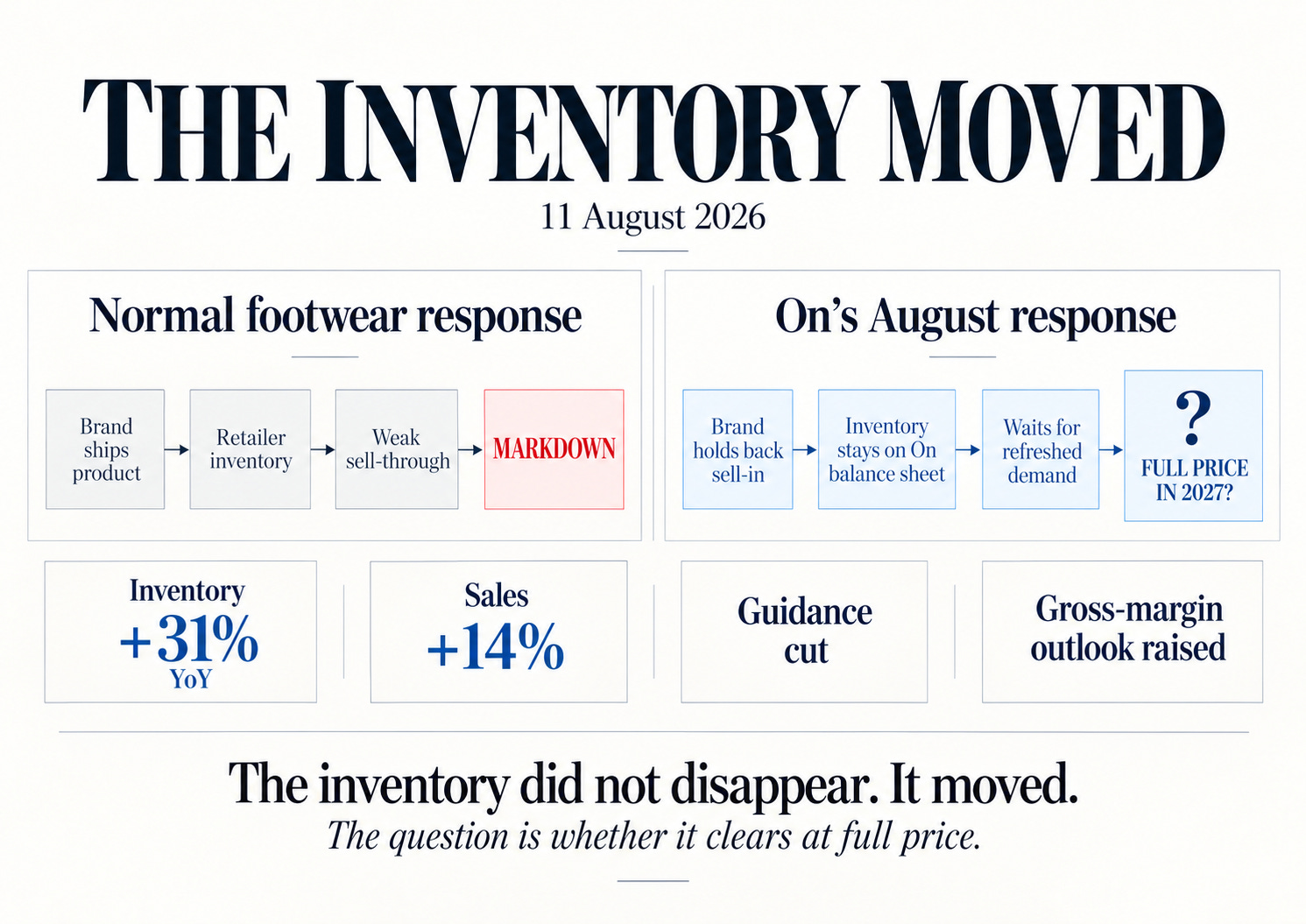
So, when the promotional storm hit, On faced the exact choice its system was built for, and on 11 August it chose. The company cut its full-year outlook from at least 23 percent constant-currency growth to the low twenties, its first guidance cut as a public company, raised its gross margin outlook in the same release, and explained: “We held back sell-in rather than build inventory in the channel that could potentially compromise On’s full price integrity down the line.” The stock fell 20 percent that day and reached $26.76 by mid-September, 47 percent below its January high. The market looked at a decelerating challenger with a US problem and priced the Under Armour script.
Here is where precision matters more than conviction. Holding back shipments is not avoiding the error, because shipping fewer shoes you have already made is not the same as making fewer shoes. On’s inventory ended the quarter at CHF 473 million, up 31 percent year over year against sales growth of 14 percent, which tells you the shoes largely exist; the company moved the mistake from the retailer’s shelf, where it would have been settled in markdowns, onto its own balance sheet, where On controls the clock. That is the cheaper currency only if the shoes eventually sell at full price. Clearance so far looks normal, the outgoing Cloudsurfer 2 at $95 in a single colourway, but if that 31 percent becomes markdowns in 2027, the discount was never missing, just late. August proved that management will sacrifice growth, its stock price and a five-year beat-and-raise reputation to protect the gauge. It did not prove the protection was free. For what it is worth, the people who can see the inventory voted: all three founders bought stock in the open market in May, and two bought again on 14 August, three days after the cut.
The 2029 wager
Six weeks later, standing in Zurich in front of the investors who had halved its stock, management, run since May by Allemann and Coppetti as co-chief executives with a new finance chief beside them, raised the stakes: at least CHF 5.6 billion of revenue by 2029, gross margin of 65 percent or better throughout, an EBITDA margin of at least 22 percent built from named cost lines rather than price rises, and a first buyback of up to $1 billion. The plan is less heroic than it sounds. It needs the Americas to grow only in the low teens, distribution costs have already fallen from 13.4 percent of sales to 10, and the biggest product refresh in the company’s history, every running franchise renewed around the lessons of Maguire’s store visit, lands in full by mid-2027. This is not a plan that requires new weather. It requires the engine to work at twice the size, and two of its assumptions deserve a harder look than the sell-side has given them.
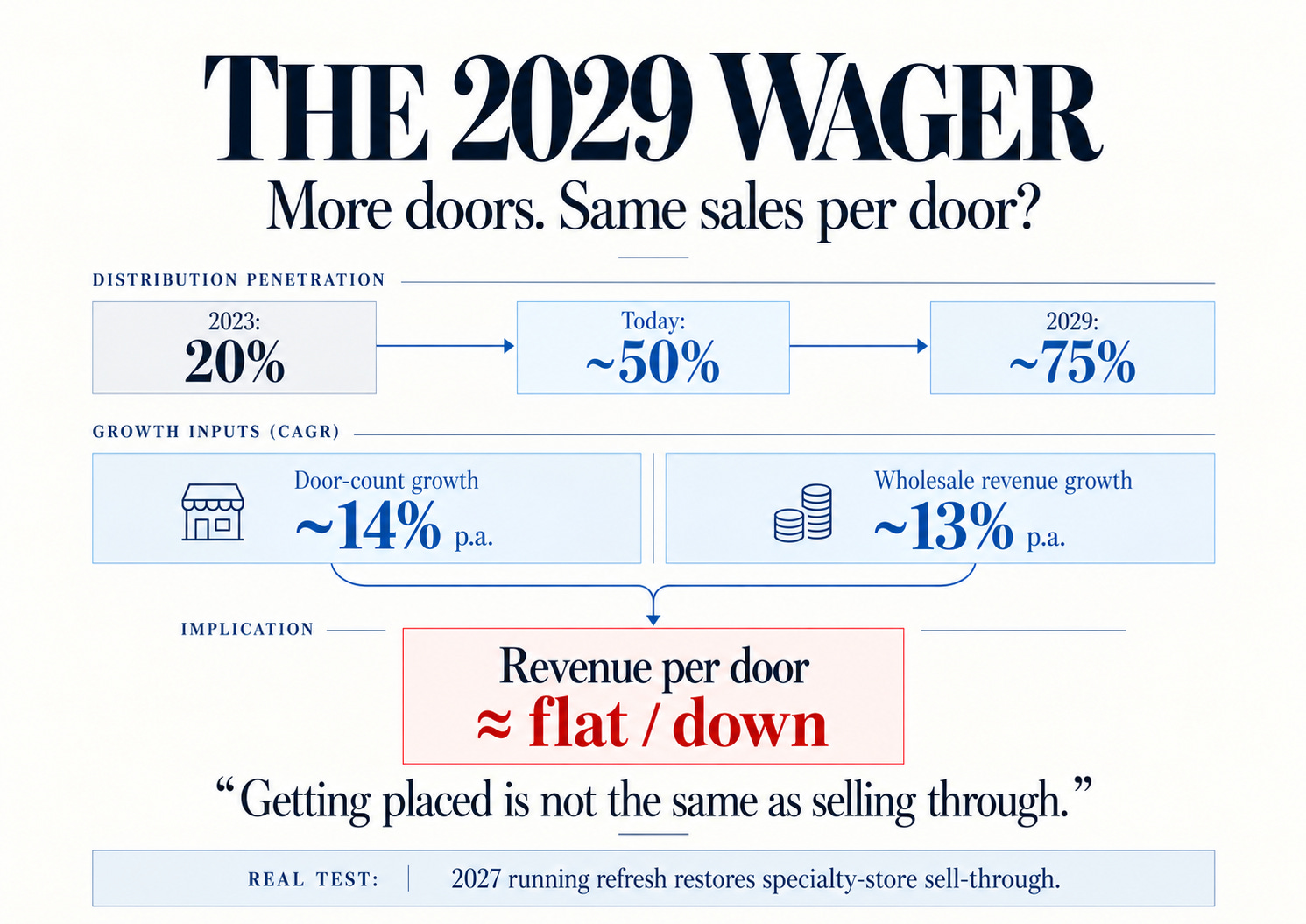
The first is hiding in the plan’s own arithmetic. On sits in about half its key partners’ doors, up from 20 percent in 2023, and intends roughly 75 percent by 2029, which means growing the door count around 14 percent a year, while the planned channel mix implies wholesale revenue growing about 13 percent. Side by side, those numbers mean the plan assumes revenue per door flat or slipping for three years, across a widening and necessarily weaker set of stores, each new door another advance-order guess of precisely the kind this company is supposed to be taming. Sam Poser of Williams Trading put the objection to management directly, “Getting items placed is different than having good sell-through,” and he is right: flat-per-door expansion is the exact shape the error took at every brand that ended up on the rack. Management’s reply is that the ceiling is deliberate, in Rebecca Cai’s words that “while we could easily be in all doors tomorrow, 75 percent is the premium distribution that we believe fits our brand,” and that weekly colour-level sell-through data lets it see trouble early. Perhaps. The engine has instruments no challenger ever had; the question is whether anyone throttles back when the instruments say so, because the last time the choice arose, in August, they did, and it cost them a third of the company’s value. They will be asked again.
The second assumption is that the credibility engine restarts. Recall the division of labour: performance running is small in units but supplies the belief that lets a $170 lifestyle shoe outsell a $90 one. The run-specialty numbers say that source was shrinking for a year while the lifestyle business boomed, and strong lifestyle demand with a decaying credibility base is not a stable state; it is the first act of Under Armour, whose lifestyle pivot outlived its performance reputation by about two years. On’s answer, the 2027 range led by the rebuilt Cloudsurfer 3, gets its referendum in the same specialty stores in the second half of 2027, and the early signals, demand at six times initial supply for the newest racing shoe, 40 to 50 percent of Cloudmonster sales in higher-priced versions, all come from the seller. Until independent sell-through confirms them, the honest status of the US running problem is: diagnosed, plausibly product-specific, not yet fixed.
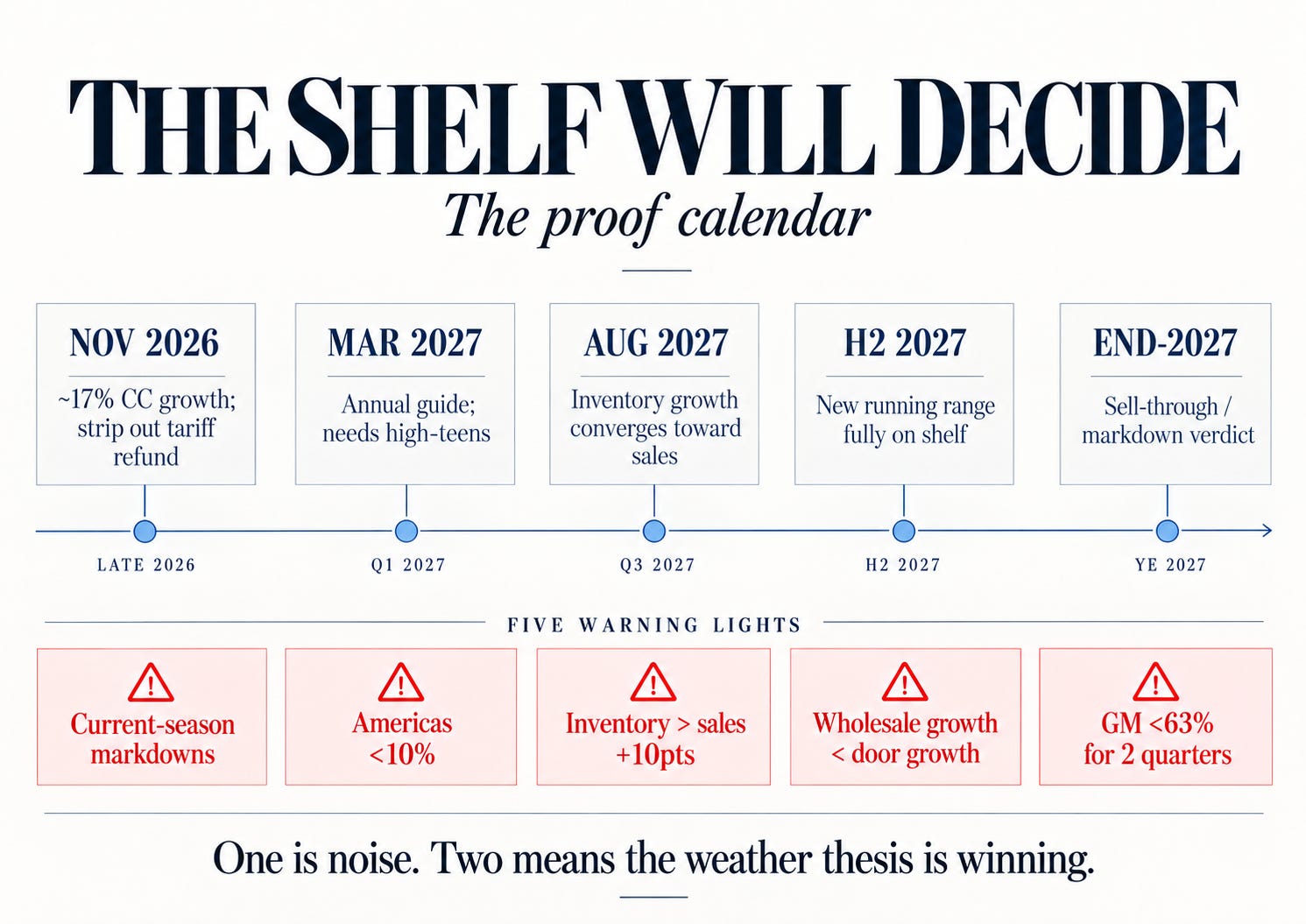
I would abandon the thesis if two of the following five occur: markdowns on current-season styles at two or more major US retailers lasting a month or more; Americas growth below 10 percent in the second half of 2027, after the refresh; inventory still growing ten points faster than sales next summer; wholesale revenue growth running persistently below door growth; or gross margin, excluding tariff refunds, below 63 percent for two straight quarters. Any one is noise. Two is the weather thesis winning.
What the price assumes
The strange thing about On’s valuation is that the sceptic is not the analyst community, which rates the stock overwhelmingly a buy, carries a $43.53 average target, and models 2027 revenue almost exactly where the CFO hinted, “we may exceed” $5 billion “somewhere next year.” The sceptic is the price. At $30.16, On trades at 15x times 2027 consensus earnings, in the same neighbourhood as Deckers and Amer Sports on roughly double their growth, and a reverse DCF at a 10 percent discount rate implies growth of about 10 percent a year, a figure that moves between 6 and 14 percent as the rate shifts, so treat it as a range. However you cut it, the market is pricing a company whose rise was mostly weather. My variant view is the one this whole article has been building: the engine is real, it has repeated in a second sport, its gauge never moved even in the storm, and the disagreement with the market is about duration, not next quarter, which management has effectively pre-announced.
The scenarios below are the spine translated into prices, one method throughout: a multiple on fiscal 2030 EBITDA net of stock-based pay, plus accumulated net cash after the buyback, on a flat 335 million shares, at $1.2138 per franc.
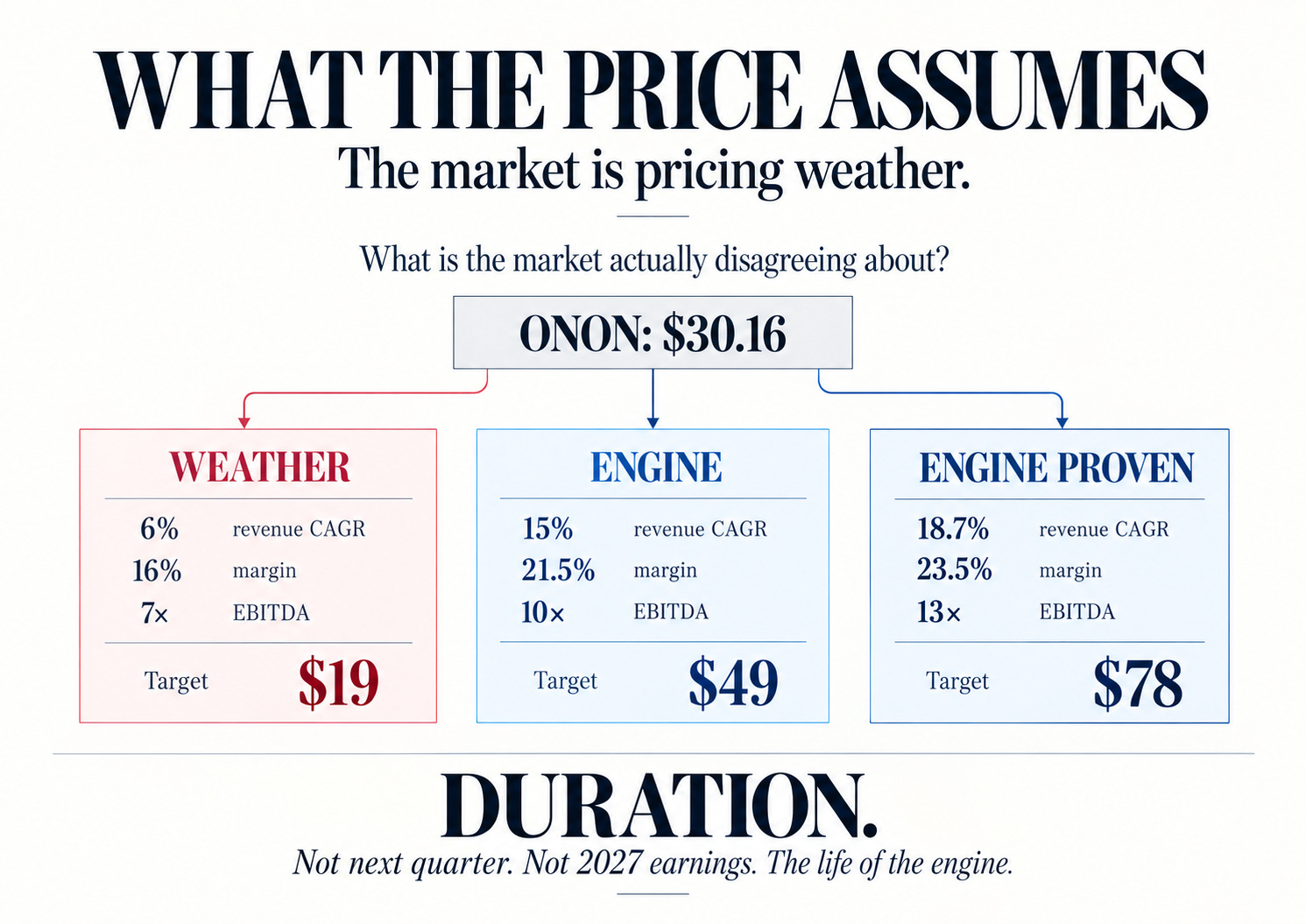
The weighted value is about $49, roughly 17 percent a year from here, and the shape of the bear case matters as much as its number: it is not a collapse but an ordinary footwear company, single-digit growth, drifting margins, a multiple to match, which is the outcome the market is already closest to pricing. The calendar of proof is short and specific. November’s third-quarter report should show about 17 percent constant-currency growth, largely pre-announced, with a tariff refund of up to CHF 53 million flattering gross margin that you should strip out. March brings the first annual guide under the new plan, which needs to say high teens. By next August, inventory growth must be converging on sales growth. And through 2027, watch wholesale revenue against door count, and above all watch the specialty-store wall when the new range is fully on it.
Phil Knight solved his cash problem by selling retailers more of the future than anyone could see, and the industry has paid for the wrong guesses ever since, in price, on the rack, every season, a bill that crushed nearly every challenger who tried to scale beneath it. On grew up in a rare decade when the bill collector was distracted, and it used that decade to build something the industry has not seen: a loop of validation, price, margin and reinvestment with a working gauge on the front. August was the first payment demand, and On paid in volume, exactly as designed, at a price the market mistook for failure. If the inventory clears, the new range takes back the running wall, and the doors sell what they stock, then the engine was real all along, and the discount that never appeared will compound longer than any shoe the company ever launches. If not, the weather made the brand, and the bill from 1972 is still out there, accruing interest on 473 million francs of shoes. By the end of 2027, the shelf will tell us which company On has been all along.
Disclaimer:
The content does not constitute any kind of investment or financial advice. Kindly reach out to your advisor for any investment-related advice. Please refer to the tab “Legal | Disclaimer” to read the complete disclaimer.